


SEO for IT Companies in GCC: Rank & Convert
SEO for IT Companies in GCC: Rank & Convert
SEO for IT Companies in GCC: Rank & Convert
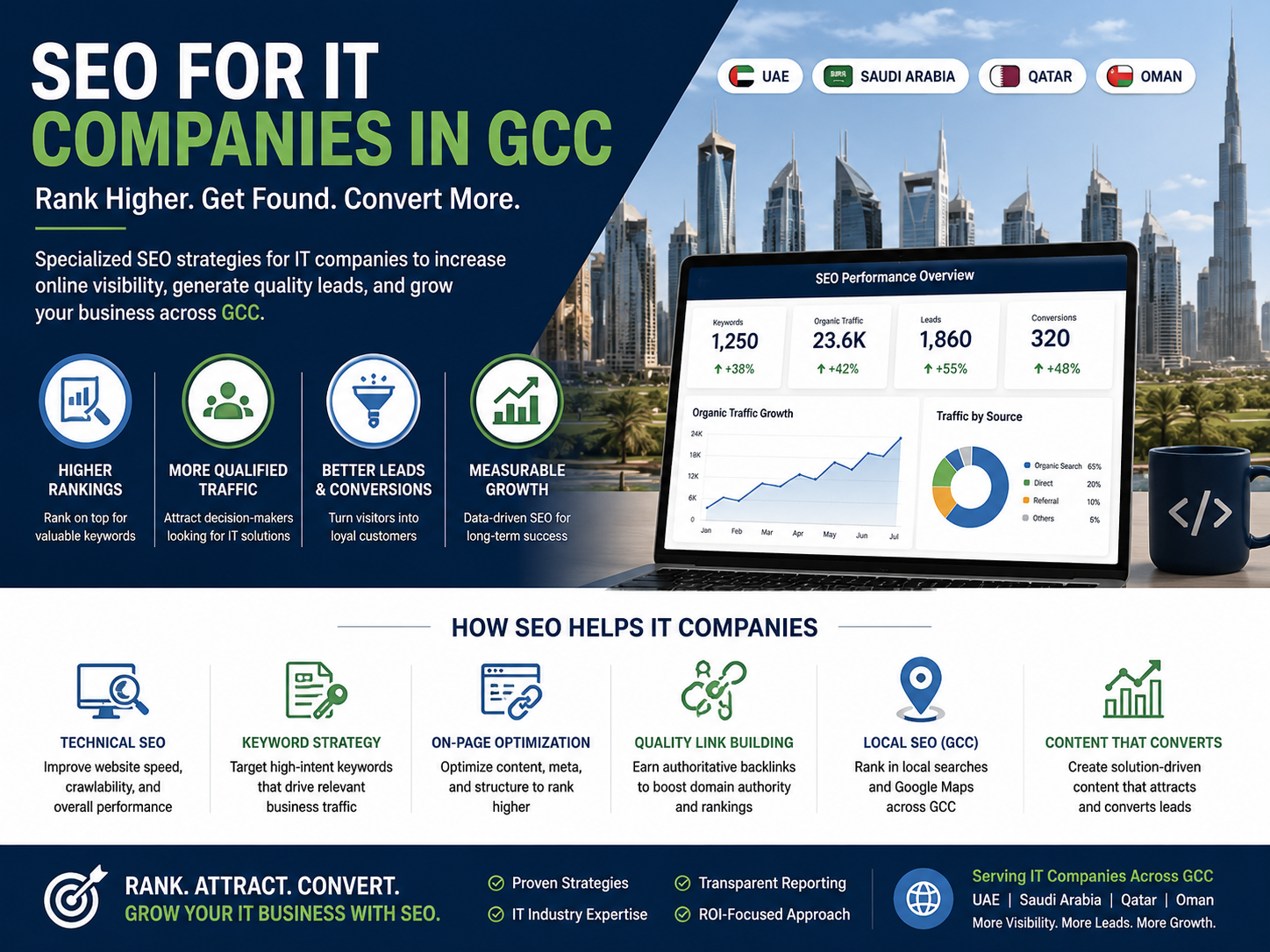
SEO for IT companies in the GCC works best when service pages match commercial search intent, demonstrate genuine local expertise, answer buyer questions clearly, and provide credible regional proof. For Saudi Arabia, the UAE, and Qatar, effective IT SEO combines localized content, technical authority, trust signals, internal linking, and a straightforward conversion path.
Why GCC IT Service Pages Need to Rank and Convert
Ranking for “cloud services” is useful. Ranking when a buyer in Riyadh, Dubai, or Doha is actively looking for a provider is far more valuable.
Effective SEO for IT companies connects search visibility with commercial intent. A strong service page should quickly tell a potential buyer what you offer, where you operate, why your expertise is relevant, and what they should do next.
That means combining professional SEO services with regional relevance, bilingual user experience where appropriate, credible proof, and a conversion path that feels natural rather than forced.
How SEO for IT Companies Works in GCC Markets
Match IT Services With Commercial Search Intent
Not every keyword represents the same level of buying intent.
A broad query such as “IT services” may signal early research. Searches such as “managed IT services Riyadh,” “Microsoft 365 company Dubai,” or “cybersecurity services Qatar” are much closer to a commercial decision.
For most GCC service pages, a practical keyword structure is:
Service + solution + location
The page should then satisfy the intent behind that combination instead of simply repeating the phrase throughout the copy.
Build a Logical Country, City, and Service Architecture
A scalable site structure can follow:
Country → City → Service → Supporting Content
That does not mean every city automatically deserves its own landing page.
A Riyadh managed-services page makes sense when the offer, proof, buyer requirements, delivery coverage, or market context is genuinely different. Creating near-identical pages for multiple GCC cities can produce thin content and make the site harder for both buyers and search engines to understand.
Start with a clear service architecture, then expand into location pages only where the business case supports them.
Plan for English, Arabic, and Local UX
English remains important across GCC B2B technology searches, but Arabic should not be treated as an afterthought when the target audience uses it.
Depending on the market, a strong user experience may include.
Accurate Arabic terminology rather than literal keyword translation
Proper RTL layouts
Region-specific contact details
Mobile-friendly forms and CTAs
Clear language switching
Local service and delivery information
Arabic and English pages should each feel as though they were created for real users—not generated by replacing keywords in translated copy.
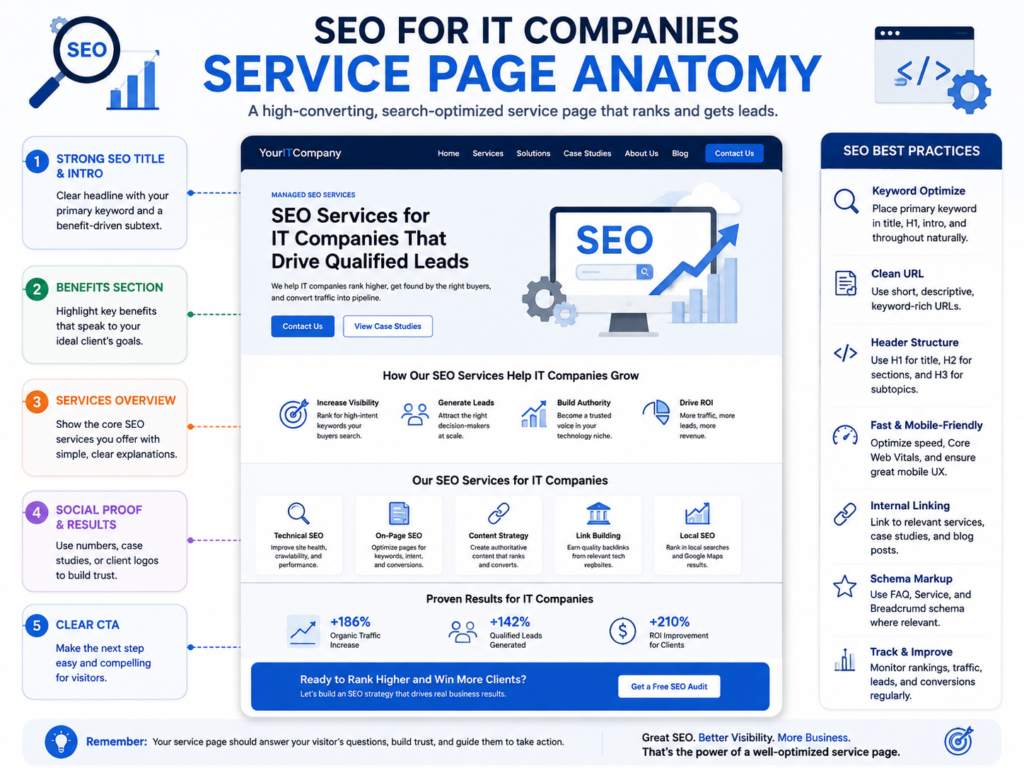
SEO for IT Companies: Anatomy of a High-Converting GCC Service Page
Lead With Service, Market, Outcome, and CTA
The first screen should answer four questions quickly.
What service do you provide?
Which market do you serve?
What business outcome does it support?
What should the visitor do next?
For example.
Managed Cloud Services for Riyadh Businesses secure, scalable infrastructure with implementation and ongoing support.
That is more useful than a generic headline such as “Leading IT Solutions Company.”
The surrounding page experience matters too. Fast performance, clear navigation, mobile usability, and strong web development foundations support both SEO and conversion.
Give Buyers Enough Service Depth
A B2B technology buyer usually needs more than a short benefits list.
A useful IT service page can explain.
Core deliverables
Problems the service solves
Ideal customer profiles
Platforms and technologies supported
Implementation or onboarding
Support model
Relevant industries
Related services
Common procurement questions
The emphasis should change by industry. FinTech buyers may care heavily about security and governance. Government teams may focus on controls and procurement. Logistics companies may prioritize integrations and continuity, while retailers may care more about availability, speed, and customer-facing performance.
Add GCC Proof Before Asking for the Lead
Local credibility is especially important when an IT company is targeting buyers in Saudi Arabia, the UAE, or Qatar.
Proof can include relevant case studies, delivery coverage, customer examples, certifications you genuinely hold, local partnerships, regional experience, or industry-specific expertise.
What should an IT service page include to rank in Saudi Arabia?
A Saudi IT service page should target one clear commercial intent, demonstrate genuine Saudi relevance, explain the service in depth, answer buyer questions, use sensible internal links, provide credible proof, and end with an appropriate consultation CTA.
Claims such as “best IT company in Saudi Arabia” add little value unless there is objective evidence behind them. Specific proof is more persuasive than promotional language.
Step-by-Step IT Service Page SEO Workflow
Map One Primary Intent to Each Page
Before writing, define.
Primary service
Main keyword
Related semantic terms
Country or city
Target buyer
Search intent
Conversion goal
Example.
Managed IT Services Riyadh → commercial intent → IT support and outsourcing → book a consultation
This gives the page one clear job.
Optimize Content, Metadata, and Internal Links
Once the intent is clear, align the important on-page elements.
SEO title
URL
H1
Opening copy
H2 and H3 headings
Image ALT text
Internal links
Descriptive anchor text
CTA language
Internal links should help the buyer continue their journey rather than exist purely for SEO.
For example, an IT service page can naturally connect to relevant WordPress development services, cybersecurity content, cloud solutions, or supporting guides when those topics genuinely overlap.
Add Trust, Conversion, Schema, and QA
Before publishing, review the page as both a search result and a sales asset.
Check:
GCC market relevance
Accuracy of claims
Customer or industry proof
Mobile usability
English and Arabic journeys
FAQ quality
Structured data
CTA placement
Internal links
Page speed and technical quality
Rankings matter, but rankings without a clear buyer journey rarely create meaningful B2B results.
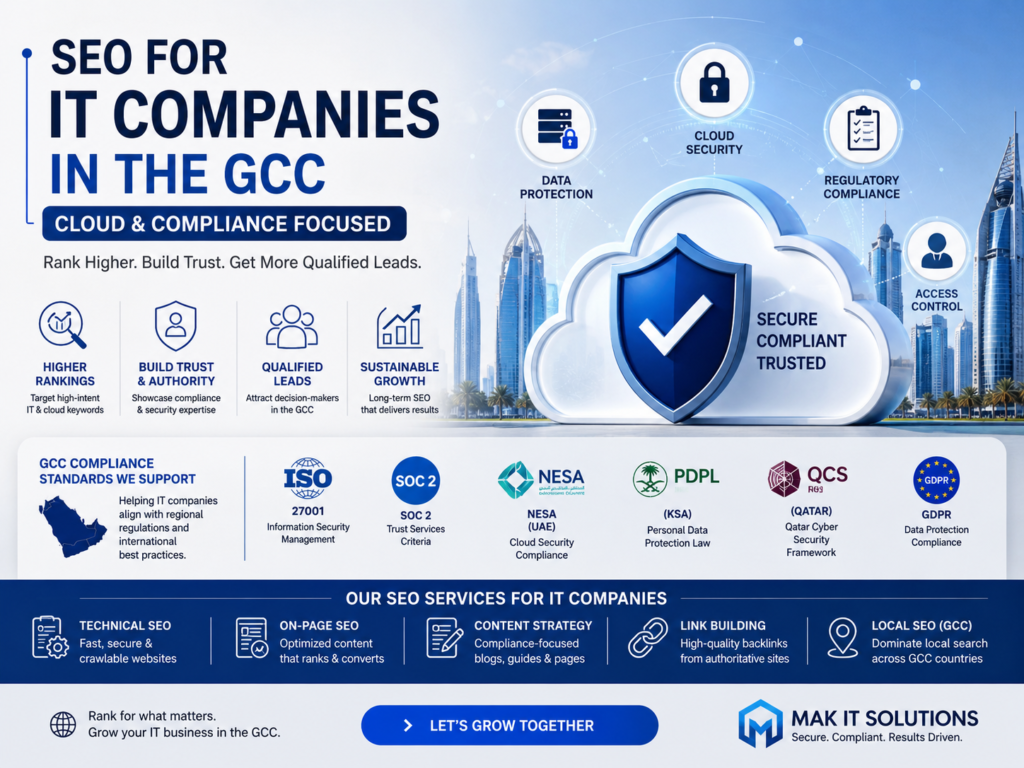
Localizing SEO for IT Companies in Saudi Arabia, UAE, and Qatar
Saudi Arabia.
Saudi-focused pages should make their Riyadh, Jeddah, or broader Kingdom relevance clear where it genuinely applies.
For enterprise buyers, useful signals can include bilingual UX, procurement readiness, security practices, local support coverage, and evidence of Saudi market experience.
Regulatory references need to be specific rather than decorative. For example, a technology provider serving supervised financial organizations may need to understand relevant Saudi Central Bank expectations. The SAMA Cyber Security Framework can be relevant in that context.
A standard website or IT-support page does not become more trustworthy simply because it mentions SAMA.
UAE.
Competition for IT services in Dubai and Abu Dhabi is strong, which makes generic “IT company UAE” content difficult to differentiate.
A Dubai service page should explain exactly what the company delivers, who it serves, and why its offer is relevant to that market.
For example, an e-commerce business may need technology services alongside digital marketing support, mobile optimization, analytics, and conversion improvements.
References to the UAE’s TDRA should appear only when telecommunications, digital-government services, or another genuinely related area makes the authority relevant.
Qatar.
Qatar may offer fewer broad search opportunities than larger markets, but specific commercial queries can still attract highly relevant buyers.
How can Qatar IT companies turn SEO traffic into qualified B2B leads?
Focus on direct service-and-location searches, explain the buyer’s problem clearly, demonstrate Doha or Qatar experience where available, address procurement questions, and guide visitors toward a consultation rather than a generic contact form.
For regulated financial technology, Qatar Central Bank context may be relevant. For an unrelated IT service, it probably is not.
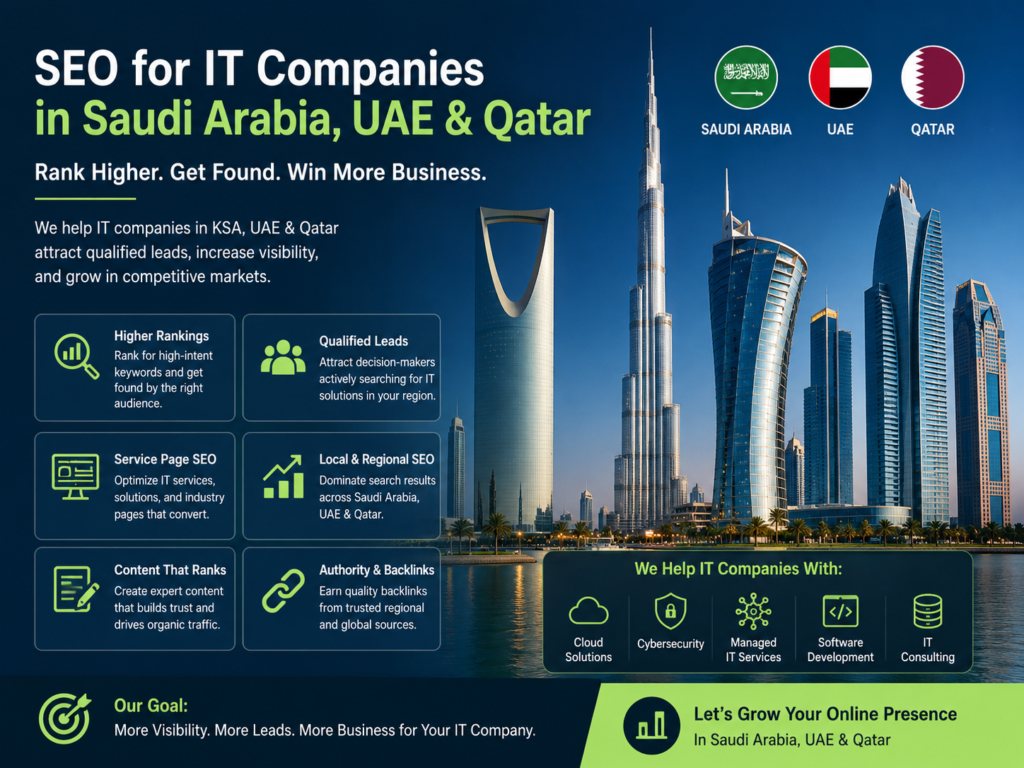
GCC Compliance, Cloud, and Trust Signals for IT Pages
Mention Regulators Only When There Is a Genuine Connection
Regulatory names can strengthen a page when they help buyers understand how a service relates to their obligations.
Relevant examples may include.
SAMA for certain Saudi financial-sector technology services
TDRA for appropriate UAE telecommunications or digital-government contexts
QCB for relevant Qatar banking and FinTech services
ADGM or DIFC where the company’s regulated-sector work genuinely connects to them
Unrelated regulator lists can have the opposite effect. They may make the copy look artificial or suggest expertise the company has not demonstrated.
Explain Data Governance and Hosting Clearly
Cloud and infrastructure pages may need to discuss.
Data residency
Access management
Cybersecurity controls
Backup strategy
Disaster recovery
Governance
Business continuity
Infrastructure options in the region include AWS Middle East in Bahrain, Azure UAE Central in Abu Dhabi, and Google Cloud in Doha.
However, selecting a nearby cloud region does not automatically make a workload compliant with every local or industry requirement. Infrastructure location is only one part of a broader governance and security model.
AWS maintains current region information in its official infrastructure documentation.
Match Proof to the Buyer’s Industry
Different sectors evaluate IT providers differently.
FinTech teams may prioritize security, resilience, and uptime. Government buyers may focus on governance and controls. Retailers may care about multi-channel availability and performance. Logistics businesses often need reliable integrations and operational continuity.
Providers working with reporting and decision systems can support these outcomes through relevant business intelligence capabilities.
GCC Service Page Template for SEO, AEO, and AI Visibility
A practical rank-and-convert service page can follow this structure.
H1: Service + primary market
Outcome-led value proposition
Primary CTA
Trust proof
Problems solved
Capabilities
Local use cases
Delivery process
Industry applications
GCC case study or relevant proof
Related services
FAQs
Final CTA
The exact order can change, but the page should move naturally from relevance to understanding, trust, and action.
How Should GCC IT Companies Structure Pages for Google and AI Overviews?
Use descriptive headings and answer important buyer questions directly.
A strong format is:
Direct answer → supporting explanation → proof or example → next step
Clear service and location entities, useful FAQs, logical internal links, visible expertise, semantic depth, and standard technical SEO make the page easier for both search engines and AI-powered search experiences to interpret.
There is no special markup that guarantees inclusion in an AI Overview. Useful, crawlable, well-structured content remains the foundation.
Measure Qualified Leads, Not Traffic Alone
Organic sessions are useful, but traffic by itself does not tell you whether SEO is creating business value.
Useful performance indicators can include.
Non-brand rankings
Local search impressions
Consultation bookings
Qualified leads
Form completions
Phone or WhatsApp enquiries
Landing-page conversion
Assisted conversions
Country-level performance
The commercial model is simple:
Rank → establish GCC trust → answer the buyer → convert
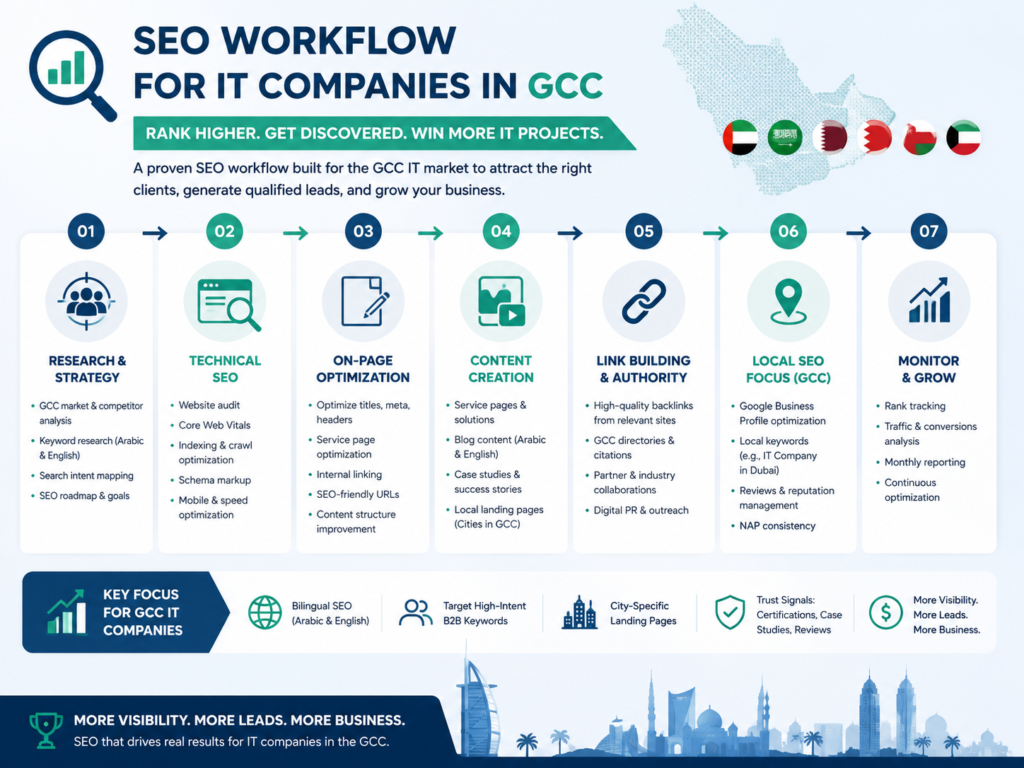
Concluding Remarks
Successful SEO for IT companies is not a keyword-placement exercise.
The strongest GCC service pages connect search intent with useful content, regional relevance, genuine expertise, credible proof, and a clear next step. That applies whether you are targeting Riyadh, Jeddah, Dubai, Abu Dhabi, Doha, or a broader GCC audience. Mak It Solutions
Start by auditing one priority service page against the Rank + Convert framework. Fix the intent, strengthen the proof, answer the questions buyers actually ask, and improve the path to consultation before multiplying location pages.
For a tailored Saudi Arabia, UAE, or Qatar strategy, you can also contact Mak It Solutions to discuss SEO requirements for your priority IT services.
FAQs
Q : How can Saudi IT companies target Riyadh and Jeddah without duplicate pages?
A : Create separate Riyadh and Jeddah pages only when the services, buyer needs, proof, delivery coverage, or search demand are meaningfully different. Otherwise, one strong Saudi service page can mention supported cities naturally without creating thin location variations.
Q : Should UAE IT companies create separate Dubai pages for cloud, cybersecurity, and Microsoft 365?
A : Usually, yes if each service targets distinct commercial intent and has enough unique material to justify its own page. Each page should have different use cases, buyer questions, expertise, supporting proof, and conversion messaging rather than swapping service keywords into the same template.
Q : Do Qatar IT companies need Arabic service pages to rank in Doha?
A : Not necessarily. The decision should depend on the target audience, Arabic search demand, procurement journey, and whether the company can maintain genuinely localized content. If Arabic pages are created, accurate terminology, RTL usability, and a complete language journey matter more than literal translation.
Q : When should an IT service page mention SAMA, TDRA, or QCB?
A : Mention a regulator when it helps buyers understand a real relationship between the service and their regulatory environment. SAMA can be relevant to certain Saudi financial organizations, TDRA to appropriate UAE telecom or digital-government topics, and QCB to Qatar financial-services and FinTech contexts.
Q : What internal links should GCC IT service pages receive?
A : Prioritize contextual links from service hubs, closely related services, case studies, industry pages, location content, and educational resources. Use descriptive anchor text naturally instead of repeating exact-match commercial keywords across the site.