


AEO vs SEO vs GEO: Win AI Search in 2026
AEO vs SEO vs GEO: Win AI Search in 2026
AEO vs SEO vs GEO: Win AI Search in 2026
Search visibility no longer ends with ten blue links. AEO vs SEO vs GEO now describes a wider discovery landscape that includes traditional search, Google AI Overviews and AI Mode, Chat GPT, Gemini, Perplexity, Copilot, and other generative experiences.
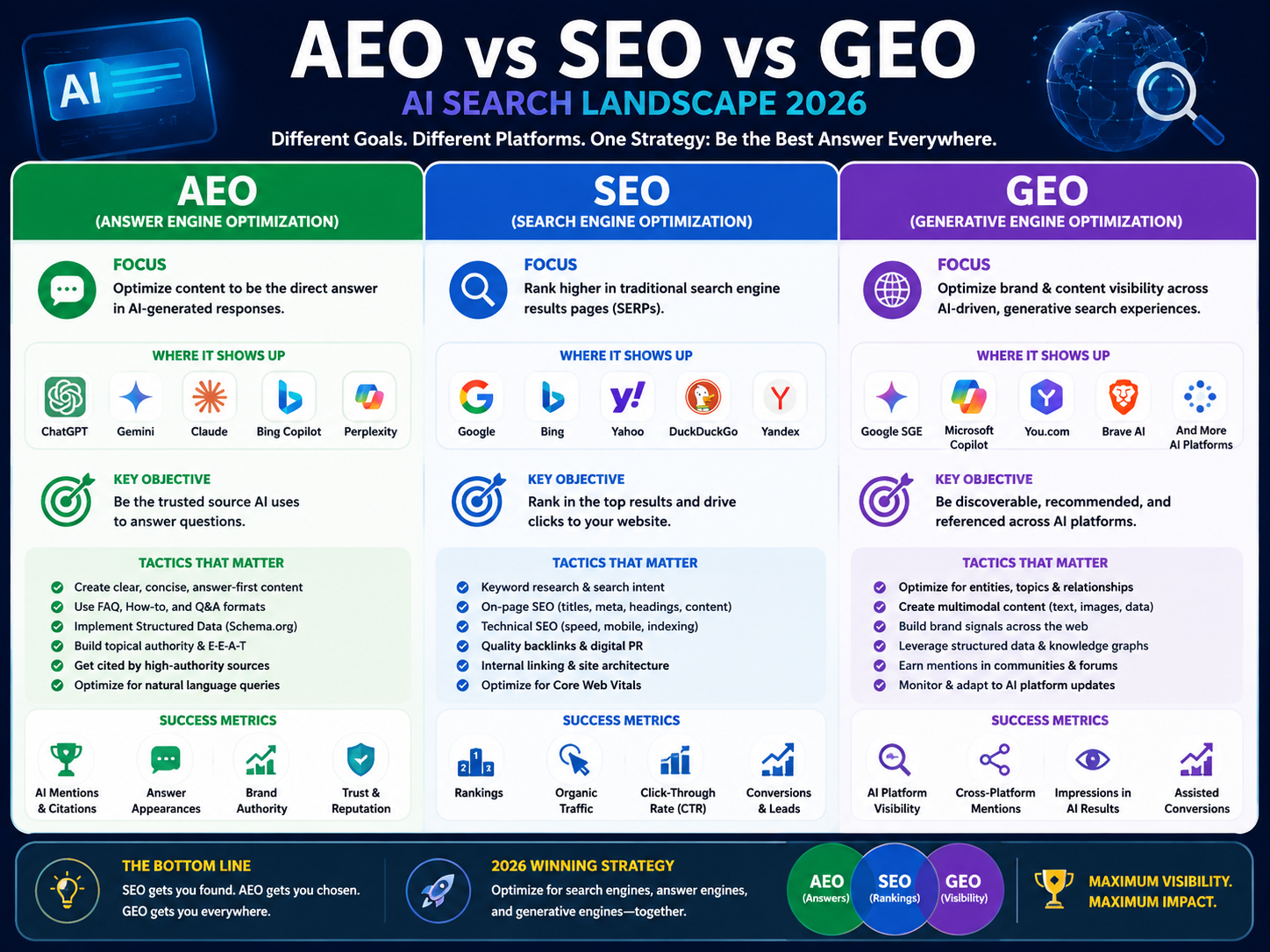
The short answer is simple: SEO helps your content get discovered and ranked, AEO makes it easier to extract as a direct answer, and GEO improves its chances of being selected, cited, or mentioned by generative AI systems. Businesses do not need to choose only one. The strongest approach uses SEO as the foundation, then adds AEO and GEO capabilities on top.
This shift is already significant. Google said AI Overviews had scaled to more than 1.5 billion monthly users across 200 countries and territories by May 2025.
AEO vs SEO vs GEO: What Is the Difference?
Although the three disciplines overlap, they optimize for different parts of the discovery journey.
SEO.
Search Engine Optimization: improves rankings, crawlability, relevance, authority, and organic search performance.
AEO.
Answer Engine Optimization: helps engines identify and extract a clear answer from your content.
GEO.
Generative Engine Optimization: improves the likelihood that your content or brand is referenced, summarized, cited, or recommended within generative AI experiences.
In practice, these are better treated as connected layers rather than competing marketing strategies.
What Is SEO and What Does It Optimize For?
SEO helps search engines discover, understand, index, and rank useful pages. Its foundation includes technical accessibility, search intent, internal linking, content quality, entities, authority, backlinks, and user experience.
SEO has not become irrelevant because AI-generated search experiences exist. Google continues to recommend established SEO fundamentals, people-first content, accessible pages, and useful original information for its AI search features.
Businesses that need to strengthen those fundamentals can connect content improvements with [search engine optimization services] and broader website performance work.
What Is AEO and How Is It Different From SEO?
Answer engine optimization focuses on making important information easy to identify and extract.
That usually means writing clear question-based headings, answering the question early, using concise definitions, and keeping individual passages understandable without requiring the reader to scan an entire page.
AEO is especially useful for searches such as.
What is GEO?
Which solution is better?
How much does a service cost?
Is a platform compliant?
What is the difference between two products?
The goal is not to make every paragraph unnaturally short. It is to make the answer obvious before adding supporting detail.
What Is GEO and How Does It Differ From AEO?
Generative engine optimization goes beyond direct-answer formatting. It focuses on making a source useful and trustworthy enough to be selected within an AI-generated response.
That makes AI citations, source inclusion, entity clarity, evidence, and brand mentions more important.
GEO overlaps with AEO because clear passages are easier for machines to interpret. But GEO also considers whether your brand and content are consistently represented across the wider information ecosystem.
Should Businesses Prioritize SEO, AEO, or GEO First?
For most businesses, SEO should still come first. AI systems need accessible, understandable, authoritative source material before answer formatting or generative visibility tactics can deliver much value.
A practical order is.
Build or repair the SEO foundation.
Improve important pages for AEO.
Add GEO monitoring, citation-focused content, and platform testing.
Google’s current guidance similarly emphasizes foundational SEO rather than a separate technical shortcut for appearing in generative Search experiences.
When AEO Becomes the Next Priority
AEO becomes particularly useful when customers regularly ask questions before making a decision.
Instead of burying an answer under several introductory paragraphs, give readers the useful response first. Add explanation, examples, evidence, limitations, and next steps underneath.
This structure improves usability for humans while making key passages easier for answer systems to interpret.
When GEO Creates Additional Business Value
GEO deserves more attention when buyers use AI assistants alongside search engines for research, comparison, and vendor discovery.
The scale of that behavior is substantial. Open AI reported roughly 700 million weekly Chat GPT users in 2025; later company material reported the platform had grown beyond that level.
That means marketing teams increasingly need visibility metrics beyond traditional Google rankings.
How to Build an Integrated SEO, AEO, and GEO Strategy in 2026
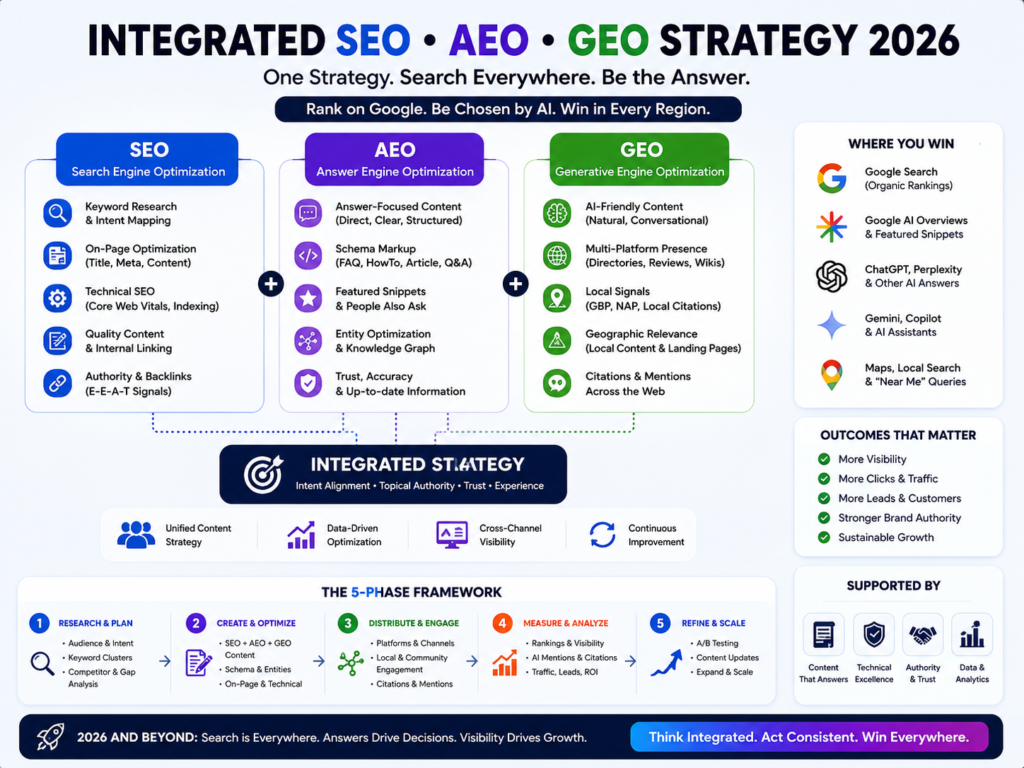
A useful AEO vs SEO vs GEO strategy should operate through one publishing workflow rather than three disconnected programs.
Start with genuine search intent. Answer important questions clearly. Build recognizable entities. Support important claims. Publish material worth referencing. Then measure both traditional organic performance and AI-driven visibility.
Build Topical Authority Around Entities and Search Intent
Avoid publishing isolated articles simply because a keyword has search volume.
Instead, build connected topic clusters around questions customers genuinely research. Service pages, educational content, supporting resources, authors or company entities, and internal links should form a logical information structure.
For organizations working with proprietary datasets, business intelligence services can also support original analysis, benchmarks, and insights that give other sources a stronger reason to reference the brand.
Structure Content for Humans and Answer Engines
Put useful answers close to the questions they address.
Descriptive headings, concise opening explanations, comparison tables, bullet points, definitions, and self-contained passages can make complex pages easier to navigate.
Avoid mechanically repeating terms such as “LLM optimization” or “generative search optimization.” Clear meaning matters more than forcing every keyword variation into the copy.
Create Original, Citable Content
Generic summaries are easy to reproduce. Original material gives your page a stronger reason to exist.
Useful assets may include.
Proprietary research.
Expert commentary.
Original benchmarks..
Case examples.
Screenshots.
Diagrams.
Unique frameworks; and
First-party data.
A strong web design and development experiences should also make these assets fast, accessible, readable, and easy to navigate.
How to Optimize for Google AI Overviews, Chat GPT, and Perplexity
Different AI experiences may select and present information differently, but several fundamentals remain useful across platforms.
Optimize for Google AI Overviews and AI Mode
For Google, begin with useful original content, crawlable pages, clear site structure, strong internal navigation, and conventional SEO fundamentals.
Google specifically says site owners do not need special AI-only files or unusual schema to appear in AI features beyond normal Search requirements and best practices.
Google also reported in 2025 that AI Overviews were driving more than a 10% increase in usage for the types of queries that showed them in major markets including the United States and India.
Optimize for Chat GPT, Gemini, Perplexity, and Copilot
Keep your company name, services, products, authorship information, and major claims consistent across accessible pages.
When possible, support commercially important claims with original evidence or authoritative primary sources. A page that clearly establishes what a company does, who it serves, and why a claim is credible is easier for both people and machines to interpret.
Organizations building AI-enabled products or data applications can also align their content strategy with relevant technical capabilities such as Python development services.
Use Structured Data Without Treating Schema as a GEO Shortcut
Structured data provides explicit machine-readable information about a page and can help supported search systems understand its content. It does not guarantee rankings, rich results, or generative AI citations.
Use schema only when it accurately represents visible page content.
One important 2026 change is worth noting: Google says FAQ rich results are no longer shown in Google Search, following their removal in May 2026. FAQ content can still be useful to readers and answer-oriented experiences, but publishers should not add it simply because they expect the old FAQ rich-result treatment.
How to Measure AI Search Visibility and GEO Performance
Traditional SEO metrics still matter, but they no longer tell the whole story.
Track AI Citations, Mentions, and Source Inclusion
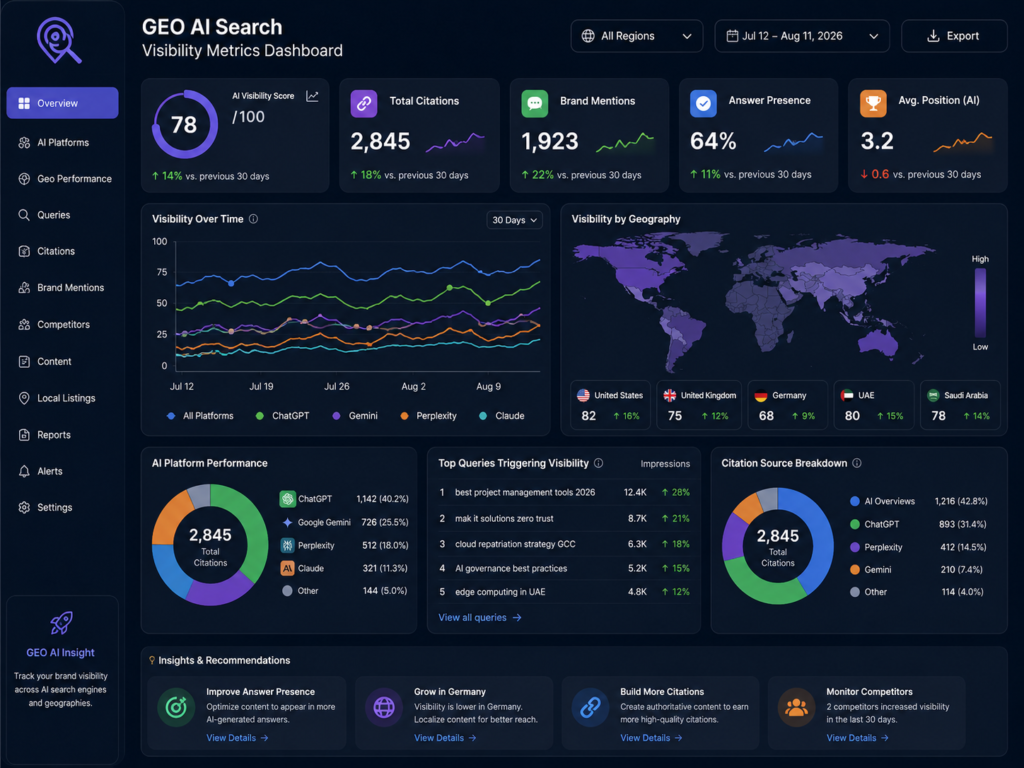
For commercially important prompts, monitor whether your brand, domain, or content appears in generated responses.
Useful GEO indicators may include.
Cited URLs.
Brand mentions.
Source inclusion.
Recommendation frequency.
Generative share of voice; and
Visibility differences across AI platforms.
These measurements should be interpreted as directional indicators rather than guaranteed attribution.
Combine GEO Metrics With Traditional SEO KPIs
A unified reporting view can combine.
organic impressions.
Clicks.
rankings.
Conversions.
Branded searches.
AI citations.
AI visibility; and
Assisted business outcomes.
Google added dedicated Generative AI performance reporting to Search Console in June 2026, providing site owners with separate visibility views for generative AI features such as AI Overviews and AI Mode.
Business intelligence services can help teams consolidate those signals into reporting that executives can actually use.
Measure Business Impact Beyond Referral Clicks
A buyer may encounter a brand in an AI-generated answer and later return through branded search, direct traffic, or another marketing channel.
For that reason, GEO should not be evaluated using referral clicks alone. Look at branded demand, lead quality, assisted conversions, sales conversations, and changes in overall discovery patterns alongside direct AI referrals.
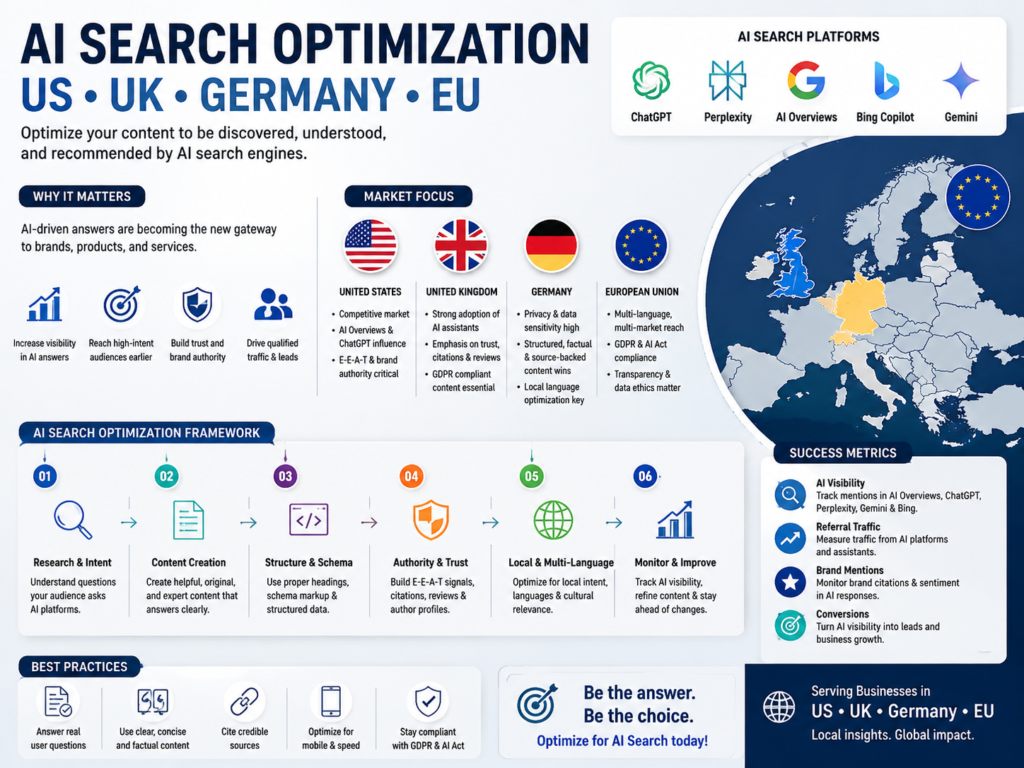
How AI Search Optimization Changes Across the USA, UK, Germany, and EU
The core strategy can remain consistent across markets, but localization needs to go deeper than changing city names.
USA.
A SaaS business in San Francisco may need stronger technical authority and enterprise trust signals, while a healthcare company in New York may need to consider HIPAA obligations when its services involve regulated health information.
The HIPAA Security Rule requires covered entities and business associates to use appropriate administrative, physical, and technical safeguards for electronic protected health information.
Ecommerce businesses handling payment account data may also need to account for PCI DSS, which defines baseline technical and operational requirements designed to protect payment account data.
UK.
Businesses targeting London, Manchester, or the wider UK market should localize terminology, buyer expectations, spelling, proof points, and commercial language rather than copying US content word for word.
Where personal data processing is relevant, ICO guidance on the UK GDPR provides an authoritative reference for areas including transparency, security, individual rights, and accountability.
Germany and the EU.
A Berlin technology company or Munich financial-services business may need German-language terminology, consistent brand entities across translations, accurate hreflang implementation, and market-specific authority signals.
Regulatory context matters as well. Regulation (EU) 2024/1689, commonly known as the EU AI Act, created the EU’s harmonized legal framework for artificial intelligence and entered into force on 1 August 2024, with provisions becoming applicable on a staggered timetable.
The 2026 Decision Framework.
Keep the SEO Foundation That Already Works
Protect the basics: technical accessibility, useful content, internal linking, topical authority, clear information architecture, and conversion measurement.
These assets remain valuable whether a customer discovers your company through a conventional search result or an AI-generated experience. Google’s guidance for AI Search continues to point site owners back to established SEO best practices.
Businesses that need technical delivery and visibility improvements to work together can also review the broader [Mak It Solutions service portfolio].
Add AEO and GEO to the Existing Workflow
Once the foundation is sound, add answer-first passages, better evidence, strong entity signals, AI visibility monitoring, and generative-platform testing.
The objective is not to run three separate marketing programs. It is to build one discovery system that works across multiple search and AI surfaces.
Audit Your Current Search and AI Visibility
Review priority pages against four practical questions.
Do they rank or receive meaningful organic visibility?
Do they directly answer the questions buyers are asking?
Are important claims credible, specific, and easy to verify?
Does the brand appear in relevant generative answers?
The answers will show whether your immediate gap is primarily SEO, AEO, GEO, or a combination of all three.
Final Recommendation
The AEO vs SEO vs GEO debate is most useful when it leads to integration rather than choosing sides.
Keep SEO strong enough to make your content discoverable and trustworthy. Use AEO to make important answers clear. Then use GEO principles to strengthen entities, evidence, citations, and visibility across generative experiences.
Not sure where your strongest pages stand across Google and AI platforms? Contact Mak It Solutions for a focused visibility review covering SEO foundations, answer readiness, AI visibility, and priority opportunities across your target markets. Mak It Solution
Key Takeaways
SEO remains the technical, content, and authority foundation.
AEO improves answer clarity and extractability.
GEO extends visibility into AI citations, mentions, and generated recommendations.
Original evidence gives other systems a stronger reason to reference your content.
Rankings, AI visibility, branded demand, and conversions should be measured together.
US, UK, German, and wider EU content should reflect real market and regulatory differences rather than cosmetic localization.
FAQs
Q : Will GEO replace traditional SEO?
A : No. GEO is better viewed as an additional visibility layer rather than a replacement for SEO. Generative discovery still benefits from accessible, useful, authoritative source material, while Google continues to recommend established SEO fundamentals for its AI Search experiences.
Q : Can a page appear in AI answers without ranking number one on Google?
A : Yes. Generative systems can synthesize information from multiple sources rather than simply reproducing the first organic result. However, no SEO, AEO, or GEO technique can guarantee that a specific page will be selected or cited.
Q : Which AI search visibility metrics should marketing teams report?
A : Useful metrics include AI citations, brand mentions, source inclusion, generative share of voice, organic impressions, rankings, branded-search activity, conversions, and lead quality. The goal is to connect visibility with commercial outcomes rather than reporting citation counts as a standalone vanity metric.
Q : Does schema markup guarantee citations from Chat GPT or Google AI?
A : No. Structured data can help supported systems understand page content, but Google explicitly does not guarantee a particular search appearance even when markup is implemented correctly.
Q : Do companies need different AI search strategies for the US, UK, and Germany?
A : They need a shared core strategy with meaningful localization. Regulatory context, terminology, buyer expectations, language, entities, and trust signals can differ significantly between the US, UK, Germany, and the wider EU.
[…] Citation SEO vs. GEO, AEO, and Traditional […]