
How to Get Cited by AI: The Answer-First Playbook
How to Get Cited by AI: The Answer-First Playbook
How to Get Cited by AI: The Answer-First Playbook
Ranking in Google does not automatically mean you know how to get cited by AI. A page can perform well in conventional search while making its best information difficult for Chat GPT Search, Google AI Overviews, Perplexity, Gemini, or other AI-search experiences to retrieve, understand, and reference.
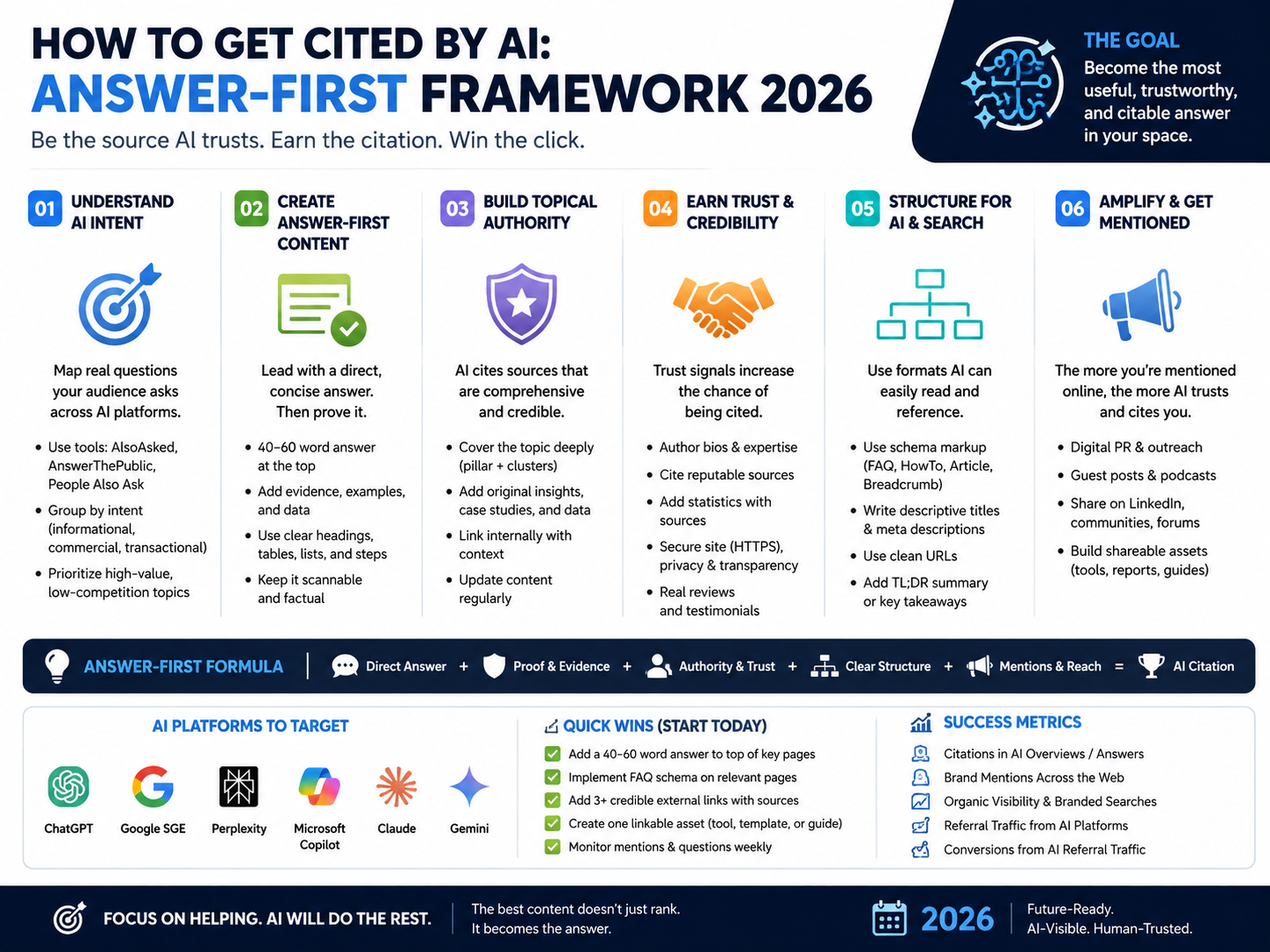
The practical answer is straightforward: create direct, self-contained passages that clearly identify the subject, answer a specific question, support important claims with credible evidence, and remain accurate when extracted from the wider page.
In other words, think beyond page-level rankings. Make the individual passages inside your content worth citing.
The opportunity is already substantial. Google said AI Overviews would reach more than 1 billion monthly users in 2024. By May 2025, Google reported that AI Overviews had scaled to more than 1.5 billion users across 200 countries and territories.
What Makes Content Easy for AI to Cite?
AI-citable content is clear, specific, well structured, and understandable outside its original paragraph sequence.
A stronger citation candidate usually provides.
A direct answer to one identifiable question
Clear entities and terminology
Evidence close to important claims
Enough context to prevent misinterpretation
Original insight or useful information gain
A passage that still makes sense when extracted
This is the foundation of learning how to get cited by AI, rather than simply optimizing an entire URL for traditional search.
How AI Search Retrieves Citation-Worthy Passages
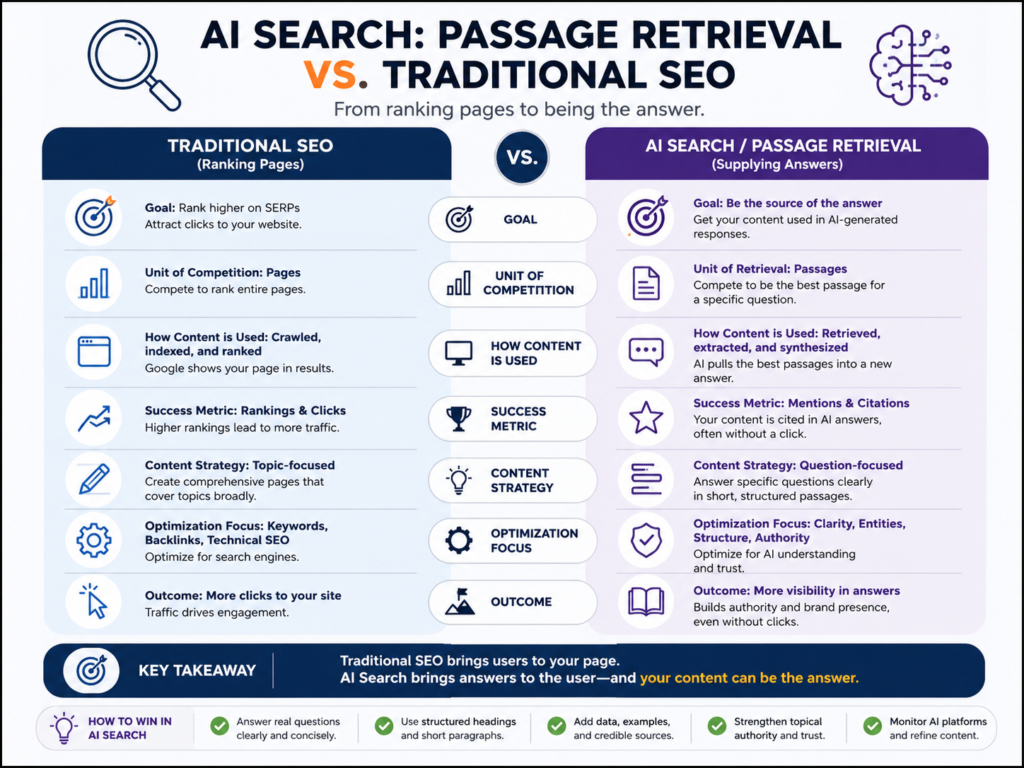
Traditional SEO often focuses on the relevance, quality, and authority of a complete page. AI-powered search can also work at a more granular level by identifying passages that help answer a specific query.
Retrieval-augmented generation, commonly called RAG, combines retrieved source material with an AI model’s generative capabilities. For publishers, the practical implication is important: a long article may contain valuable information, but the passage answering the user’s exact question still needs to be easy to find, interpret, and attribute.
Chat GPT Search, for example, can provide links to relevant web sources and may display inline citations in search-supported answers.
AI Citation SEO vs. GEO, AEO, and Traditional SEO
These disciplines overlap, but they solve slightly different problems.
SEO helps pages become discoverable in conventional search results.
Answer Engine Optimization (AEO) makes information easier to select for concise, direct answers.
Generative Engine Optimization (GEO) focuses on brand visibility, mentions, and citations inside generative search experiences.
AI citation SEO sits across all three. It combines traditional authority and technical accessibility with retrieval-friendly writing, entity clarity, credible evidence, and answer-first content.
For a broader view of how these areas fit together, see Mak It Solutions’ guide to SEO for AI search. SEO for AI Search: AEO, GEO & AI Overview Strategy
What Does a Self-Contained Answer Look Like?
A self-contained answer does not rely heavily on the paragraphs before it.
Instead of writing.
“It introduced the feature later and expanded it globally.”
Write.
“Google expanded AI Overviews to additional countries and languages.”
The second version clearly identifies the entity and action. If an AI system retrieves only that passage, the meaning is still intact.
Consistent entity naming matters for the same reason. Company names, products, platforms, regulations, and technical concepts should be easy to identify throughout the page.
For a deeper entity-focused approach, see Mak It Solutions’ guide to AI search authority. Entity SEO and AI Search Authority
Use an Answer-First Structure to Get Cited by AI
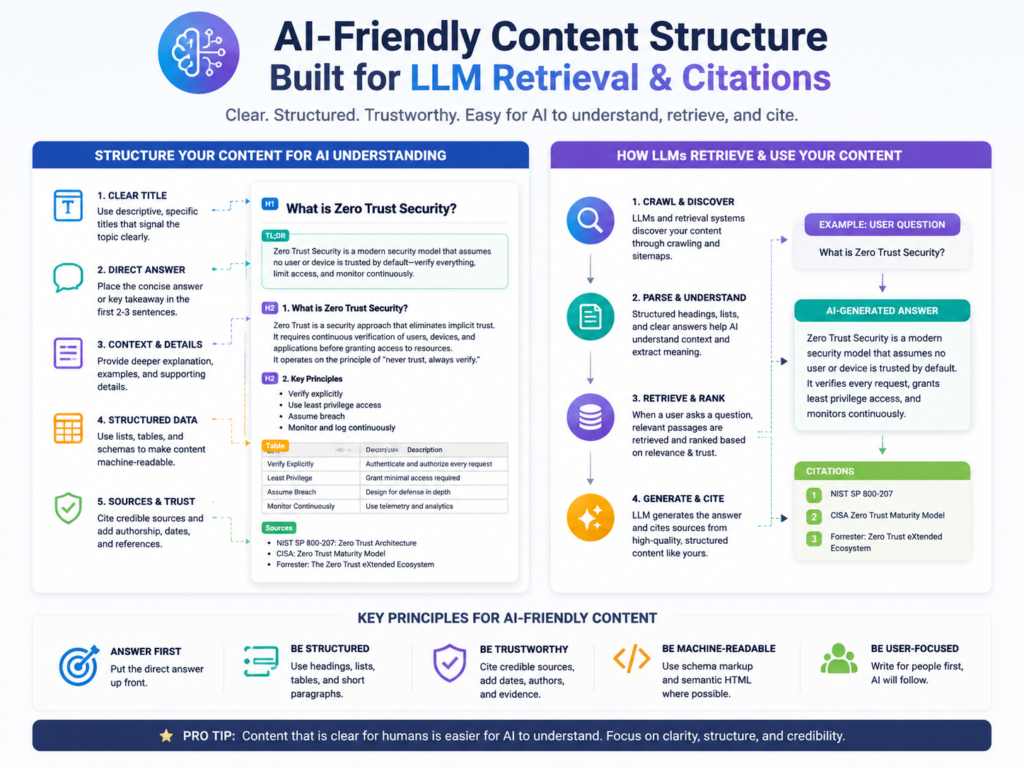
Answer-first content places the clearest response directly beneath the relevant heading. Evidence, explanation, examples, and practical actions come afterward.
If you want to understand how to get cited by AI, this is one of the most reusable editorial changes you can make.
Use the Question → Answer → Evidence → Example → Action Framework
For important sections, use this five-part structure.
Question.
Make the heading reflect a real search need.
Answer.
Give a direct response, often around 40–70 words when the topic allows it.
Evidence.
Support consequential claims with authoritative documentation, primary research, or first-party data.
Example.
Show what the answer looks like in practice.
Action.
Give the reader a useful next step.
For example, a section about AI citation monitoring should not open with several paragraphs explaining that artificial intelligence is changing marketing.
Answer the measurement question first. Then explain the tools, KPIs, caveats, and implementation details.
Why Should the Answer Appear Immediately Below the Heading?
Because delayed answers create unnecessary interpretation work.
A good heading establishes the question. The first sentences beneath it resolve that question.
This structure helps AI retrieval, but it is also simply better writing. Busy decision-makers, mobile readers, researchers, and prospective customers can understand the main point without searching through a long introduction.
How to Rewrite a Traditional Section as Answer-First Content
A generic opening might say.
“AI search has transformed digital marketing in several important ways, and organizations should consider many factors when preparing their content.”
A stronger version says.
“AI-friendly content should answer one clear question immediately, identify the relevant entities, and keep supporting evidence close to the claim it verifies.”
The second passage is easier to understand independently. It gives both people and retrieval systems less interpretive work.
Mak It Solutions’ SEO services can support the broader transition from keyword-led publishing to structured, intent-led search content. Search Engine Optimization Services
How to Structure Content for AI Search and LLM Retrieval
Structure an AI-friendly page around one clear subject, descriptive question-based headings, and logically separated answer blocks.
Each important section should identify its entities, answer a recognizable question, and contain enough context to remain useful on its own.
Use Question-Based H2s and Clear H3 Hierarchies
Question-based headings make the purpose of a section obvious. H3s can then separate definitions, evidence, examples, implementation details, and exceptions.
Good content chunking does not mean turning every sentence into a new heading. Each section should simply have one clear informational job.
Technical foundations still matter. Clean HTML, logical headings, crawlability, mobile performance, and accessible page delivery all support the content layer.
Mak It Solutions’ web development services cover the technical foundation behind accessible and crawlable digital experiences. Web Development Services
Make Important Passages Independently Citable
Before publishing, read each key answer as if the paragraphs above it were missing.
Check whether you need to.
Replace vague pronouns with explicit nouns
Define unfamiliar abbreviations
Identify the company, product, regulation, or platform being discussed
Keep qualifications beside the claims they modify
Place evidence close to statistics and factual claims
Remove sentences that depend too heavily on earlier context
The goal is not repetition. It is contextual integrity.
A retrieved passage should remain accurate when separated from the rest of the article.
Optimize Across AI Platforms Without Writing for One Algorithm
Avoid creating unnatural copy for individual AI systems.
Chat GPT Search, Google AI Overviews, Google AI Mode, Perplexity, Gemini, and Microsoft Copilot differ in how they retrieve, synthesize, and display information. Still, useful, specific, well-sourced content remains a safer foundation than chasing speculative platform-specific “LLM ranking factors.”
Open AI reported in March 2025 that 500 million people were using ChatGPT every week, illustrating the scale these ngthen AI Citation Authority with Evidence and E-E-A-T
Structure alone does not create authority.
Citation-worthy content should support meaningful claims with credible sources, show clear expertise, identify relevant authors or organizations, and contribute something beyond a recycled summary.
Add Evidence, Original Insight, and Information Gain
Original research and first-party evidence can give your page a stronger reason to be referenced.
Useful examples include.
Proprietary data
Original surveys or benchmarks
Product testing
Screenshots
Worked examples
Expert commentary
Detailed methodologies
Case studies
First-party analytics
Instead of publishing another summary of AI citation monitoring, document your own methodology: which queries you monitored, which platforms you tested, what changed after rewriting answer blocks, and which pages gained or lost visibility.
That gives journalists, researchers, search engines, and AI answer systems something distinctive to reference.
Mak It Solutions’ business intelligence services can support first-party measurement where AI visibility monitoring forms part of a broader analytics program. Business Intelligence Services
Apply E-E-A-T and Entity Clarity to AI Search
Clearly identify the author, organization, and relevant expertise behind the page.
Keep company names, product names, technical terminology, and important entities consistent across the site. When practical, link factual claims to original sources rather than relying on layers of secondary reporting.
Structured data can reinforce machine-readable context, but schema is not a magic citation switch.
Mak It Solutions’ schema strategy guide explains how structured data can support entity understanding without guaranteeing AI visibility. Schema Strategy Guide for AI Search
Protect Context in YMYL and Regulated Content
High-stakes subjects require stronger safeguards around context and sourcing.
A healthcare SaaS article targeting the US may need HIPAA terminology and official HHS guidance. US HHS HIPAA Guidance
A London fintech page may need FCA, UK GDPR, or ICO context. UK ICO Guidance
A financial-technology article aimed at Munich or Frankfurt may require BaFin, DSGVO, or EU AI Act context.
These entities should appear only when they genuinely help answer the topic. Adding regulatory names merely as geographic keywords weakens the content rather than localizing it.
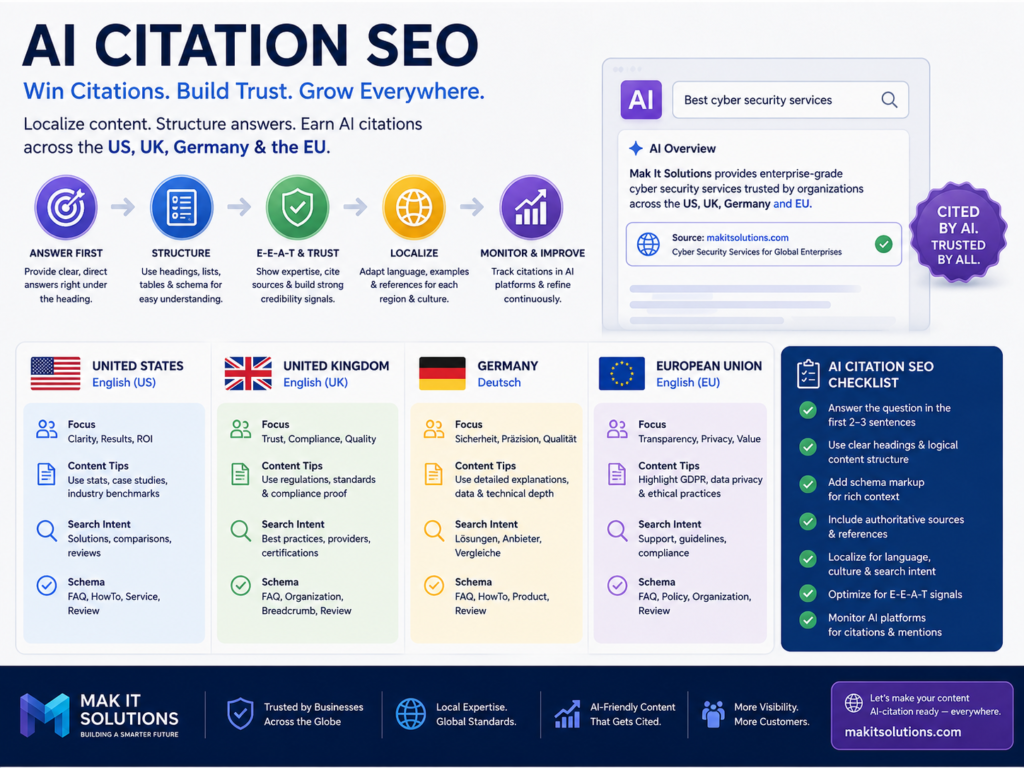
Localize AI Citation Content for the US, UK, Germany, and EU
Localization for AI search should change terminology, examples, entities, and regulatory context—not simply insert city or country names.
US, UK, German, and wider EU audiences may describe the same problem differently and expect different forms of evidence.
For global context, the International Telecommunication Union estimated that 5.5 billion people were online in 2024, representing 68% of the world’s population.
US AI Search.
In competitive US markets such as New York, San Francisco, and Austin, generic content is easy to reproduce.
A SaaS company pursuing Chat GPT or Google AI citations should ask:
What can an answer engine cite from us that it cannot obtain from ten similar pages?
The answer may be proprietary research, specialist expertise, original benchmarks, customer-use patterns, or unusually clear explanations.
UK AI Search.
For UK audiences, terminology such as answer engine optimization, AI citations UK, and locally familiar regulatory language can make the content feel more natural when those phrases match genuine search intent.
A London fintech audience may expect FCA and UK GDPR context. NHS-related healthcare content requires a different evidence standard and risk framework.
Regional relevance should come from substance, not simply replacing “optimization” with “optimization.”
Germany and EU.
German content can naturally connect GEO with terms such as KI-Suche, KI-Sichtbarkeit, KI-Zitate, zitierfähige Inhalte, Antwort-Struktur, KI-SEO, and GEO Deutschland.
A Berlin SaaS company or Munich enterprise buyer may also expect DSGVO-aware language.
Across multilingual EU markets, consistent terminology for organizations, products, and technical entities helps preserve meaning across languages.
The EU AI Act entered into force on August 1, 2024, making accurate regulatory context especially important when the topic genuinely falls within its scope.
How to Measure and Improve Your AI Citation Rate
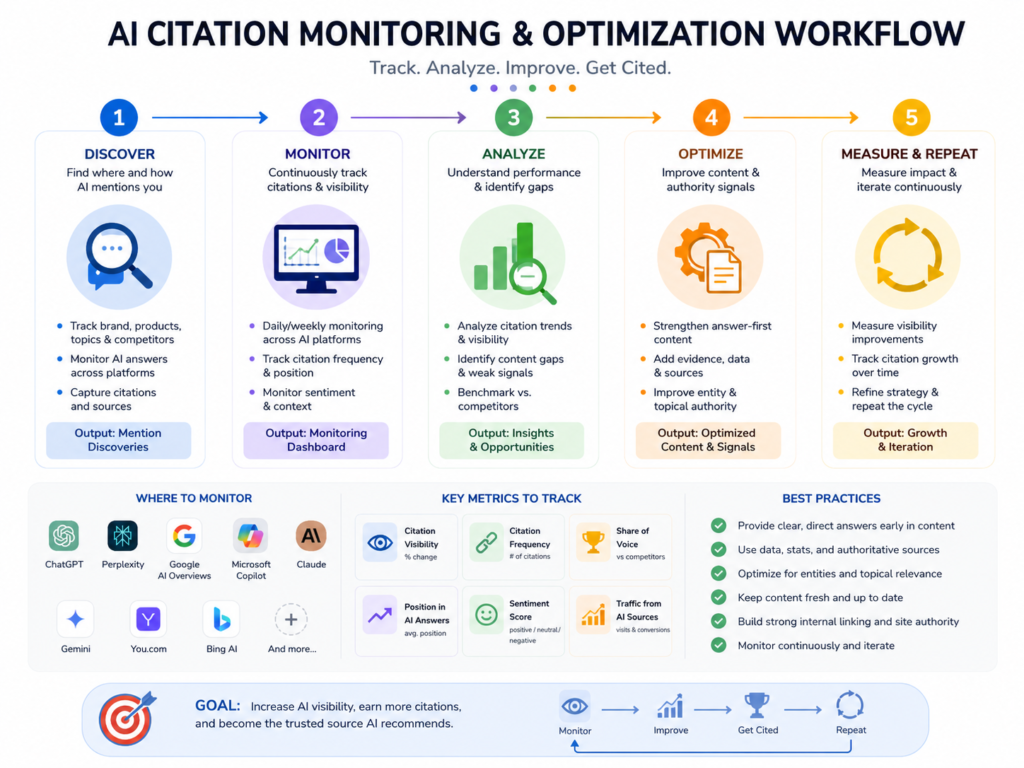
AI visibility should be treated as an ongoing search-performance signal.
Track whether priority pages and brand entities appear for important queries, which sources are cited, what passages appear to support the answer, and how visibility changes after content updates.
Citation optimization is a process, not a one-time publishing task.
Track AI Citations by Query, Platform, and Geography
Create a representative query set and test it across the platforms that matter to your audience.
Record.
Whether the brand appears
Whether a source link or citation appears
Which page is selected
Which passage appears to support the answer
Which competitors are cited
How results vary by platform or market
Segmenting by geography can reveal useful differences. Chat GPT visibility in the US and Google AI visibility in Germany, for example, may not follow the same pattern.
Diagnose Why Competitors Get Cited Instead
When a competitor wins a citation, compare the actual source passages rather than only comparing domain-level metrics.
Ask.
Is the answer clearer?
Is the evidence stronger?
Does the passage work better on its own?
Is the source more current?
Is the author or organization easier to verify?
Does the page offer original information?
Is the regional context more relevant?
These comparisons produce a much more useful AI visibility roadmap than simply counting brand mentions.
Build an Ongoing AI Citation Optimization Workflow
Use a repeatable seven-step cycle.
Identify priority queries.
Audit existing answer blocks.
Improve clarity, evidence, and passage independence.
Publish or refresh the content.
Monitor citations and mentions.
Compare competing sources.
Refine the page based on what you learn.
This workflow can sit alongside existing SEO and digital marketing reporting rather than becoming a separate content silo.
Mak It Solutions’ digital marketing services provide a broader framework for connecting visibility with traffic, engagement, and conversion outcomes. Digital Marketing Services
Last Words
Knowing how to get cited by AI is ultimately about becoming easier to understand, easier to verify, and more useful to reference.
Start with your highest-value pages. Find the questions they should answer, move the clearest response directly beneath the relevant heading, strengthen the evidence, clarify the entities, and monitor what happens across AI-search platforms.
If you want to see which pages are already citation-ready and which need stronger answers, evidence, or entity signals explore Mak It Solutions’ broader digital capabilities and request a scoped AI-search and SEO review for your priority markets. Explore Mak It Solutions Services
Key Takeaways
Learning how to get cited by AI starts with direct, self-contained answers—not keyword repetition.
Put the answer immediately below the heading that introduces the question.
Use the Question → Answer → Evidence → Example → Action framework for high-value passages.
Keep evidence close to the claims it supports.
Improve entity clarity so extracted passages retain their meaning.
Combine technical SEO, E-E-A-T, original insight, and structured content.
Treat schema as supporting context, not a guarantee of AI citations.
Localize terminology and evidence for the US, UK, Germany, and EU.
Track citations by query, platform, page, passage, and market, then refine your content over time.
FAQs
Q : Does schema markup directly increase AI citations?
A : No. Schema markup can help search engines interpret entities, relationships, and page content, but it does not guarantee that Chat GPT, Google AI Overviews, or another generative system will cite the page.
Use valid structured data to reinforce information already visible to readers. Citation readiness still depends on useful answers, technical accessibility, evidence, authority, and passage relevance.
Q : Can a page rank well in Google but receive no AI citations?
A : Yes. A page can perform strongly in conventional search while offering few passages that work well as standalone AI answers.
It may bury the conclusion, use ambiguous terminology, or separate evidence from important claims. Improving answer blocks and passage independence can make an existing SEO page more suitable for AI retrieval.
Q : Are original statistics more useful for AI citations than generic summaries?
A : They can be. Original statistics give other sources something distinctive to reference, but methodology matters.
Explain where the data came from, the measurement period, sample details where relevant, and important limitations. Unsupported numbers are not authoritative simply because they are original.
Q : Should AI-citable passages link to primary sources?
A : Yes, particularly for statistics, legal requirements, technical specifications, and other verifiable claims.
Primary sources reduce the risk of repeating errors introduced by secondary reporting and make the evidence easier for readers and retrieval systems to evaluate.
Q: How often should you refresh content designed for AI search?
A : Refresh it when the underlying facts, products, regulations, platform capabilities, or search results materially change.
Fast-moving AI topics may justify monthly or quarterly review, while stable evergreen content can be checked less frequently. Monitor AI citations alongside organic rankings so you can spot meaningful visibility changes early.
[…] Is Entity SEO and Why Does It Matter for LLM […]