
Entity SEO: Build Authority for AI Search
Entity SEO: Build Authority for AI Search
Entity SEO: Build Authority for AI Search
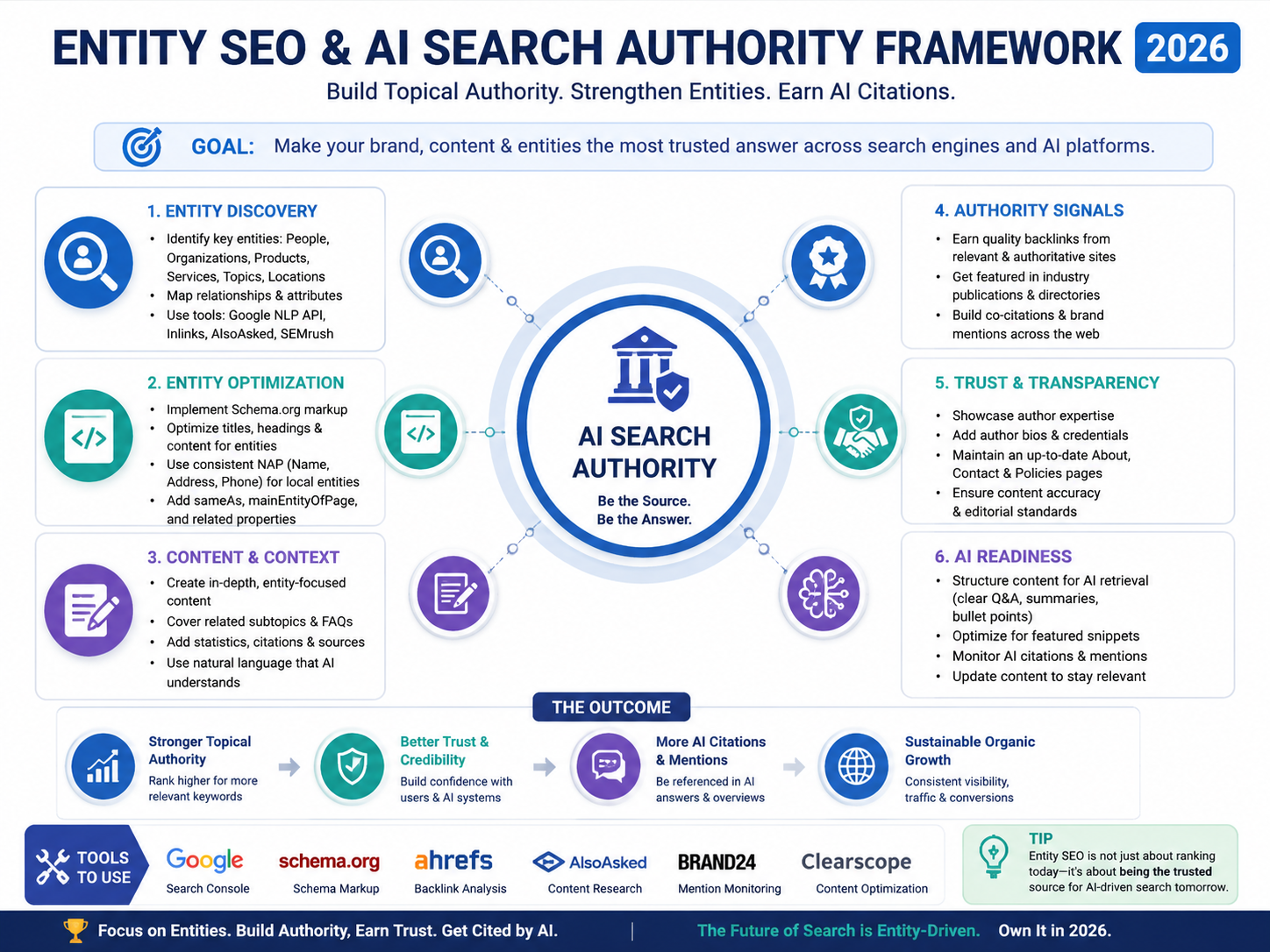
Entity SEO is becoming a core part of brand discoverability because search systems no longer evaluate pages only as bundles of keywords. They also try to understand entities companies, people, products, places and the relationships around them.
For brands, the goal is straightforward: make it easy for search engines and AI systems to identify who you are, what you do, and which topics you can credibly speak about. In practice, entity SEO combines a clear Entity Home, consistent brand facts, structured data, authoritative content, and independent corroboration. Those signals can improve retrievability and increase the chance that systems such as Google AI Overviews, AI Mode, Chat GPT, Gemini, Claude, and Perplexity recognize, mention, or cite a brand. It does not guarantee inclusion in AI-generated answers.
A useful way to think about the process is:
Entity clarity → corroborated authority → retrievability → LLM recognition → citations or mentions → brand discovery
The scale of AI-powered search makes this increasingly relevant. At Google I/O 2026, Google reported that AI Overviews had surpassed 2.5 billion monthly active users, while AI Mode had exceeded 1 billion monthly active users. Google has also reported more than 5 trillion searches annually.
What Is Entity SEO and Why Does It Matter for LLM Visibility?
Entity SEO is the practice of helping search engines and AI systems identify a brand, person, product, or organization as a distinct entity and understand how it relates to relevant topics, people, services, locations, and trusted sources.
It goes beyond optimizing an individual page for a keyword. The bigger objective is to create a consistent digital footprint that machines can interpret with less ambiguity.
Entity-Based SEO vs. Keyword-First SEO
Traditional keyword SEO often starts with a question such as.
“Which search query should this page rank for?”
Entity-based SEO adds another layer:
“What does this organization represent, and how is it connected to recognized topics, products, people, and sources?”
Keywords still matter. The difference is that semantic SEO, entity recognition, and knowledge graph optimization provide context around those keywords.
For a broader view of how these disciplines fit together, see Mak It Solutions’ AEO vs SEO vs GEO guide and SEO for AI Search strategy guide.
Entity Disambiguation, the Entity Home, and Knowledge Graph SEO
An Entity Home is the clearest canonical page describing a brand. For many organizations, that will be the homepage or a strong About page.
It should make important facts easy to confirm, including the preferred or legal brand name, services, locations, contact information, leadership, and relevant relationships.
Google recommends placing organization structured data on the homepage or a single page describing the organization rather than mechanically repeating it across every page.
Consistency matters. Conflicting company names, outdated addresses, mismatched descriptions, and abandoned profiles can make entity disambiguation harder for both search engines and AI retrieval systems.
How Entity SEO Supports AI Search Visibility
Clear entity signals give retrieval systems better context for interpreting a brand and its content.
When that clarity is reinforced by authoritative pages, relevant expertise, and independent sources, a company becomes easier to associate with the topics it genuinely covers.
That can support LLM visibility, AI citations, brand mentions, and discovery across Google AI experiences and generative platforms. It is better treated as long-term authority building than as a shortcut to “rank in Chat GPT.”
Mak It Solutions’ How to Get Cited by AI playbook explains the complementary role of answer-first content.
How to Build a Brand Entity Search Engines and AI Can Recognize
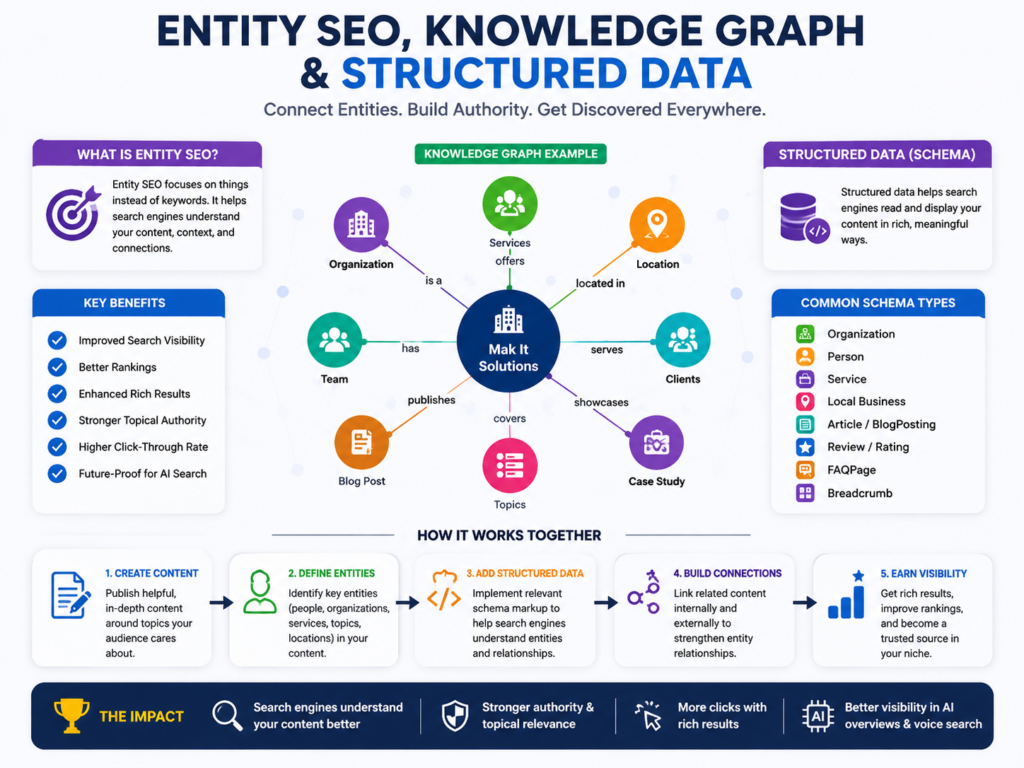
Strong entity signals begin with one dependable source of truth. From there, structured data, expert content, official profiles, and third-party references should reinforce the same identity.
Create an Entity Home and Standardize Core Brand Facts
Document the facts that should remain consistent across your digital presence.
Canonical brand name and legal name
Clear company description
Primary business categories
Products and core services
Locations and markets served
Founders, leadership, or genuine subject-matter experts
Official social profiles
Relevant registration or regulatory information
These details should align across your website and important external profiles.
In practice, correcting contradictory information is often more valuable than creating another page of generic content.
Use Organization, Person, and Product Schema Correctly
Schema.org markup gives machines explicit information about entities and their relationships.
Use Organization schema for the company, Person schema for genuine people or authors, and Product schema when a specific product is actually being described.
Google says organization markup can help it understand and disambiguate an organization, and its documentation supports properties such as name , legal name url contact details, addresses, and sameAs URLs.
Schema is descriptive evidence. It does not manufacture expertise or authority.
For broader technical and content optimization, Mak It Solutions’ SEO services provide a natural next step.
Strengthen sameAs Relationships and External Corroboration
Use sameAs for URLs that genuinely represent the same organization elsewhere, such as official social profiles or appropriate authoritative profiles.
Avoid adding every directory listing you can find simply to make the markup look larger.
External corroboration may come from:
Official business registries
Professional associations
Respected industry publications
Relevant review platforms
Credible directories
Wikidata, when appropriate
Earned media and expert references
The strongest entity footprint is one that remains recognizable even when the brand is described by independent sources.
Why Brand Authority and Third-Party Mentions Matter for AI Discovery
Entity clarity helps systems understand who a company is. External authority provides evidence for why that company may be relevant or trustworthy in a particular context.
This is where digital PR, expert citations, reviews, topical backlinks, and category associations become especially useful.
Digital PR, Earned Media, and Off-Site Brand Mentions
Digital PR for AI search should prioritize credible, context-rich mentions, not raw backlink volume.
For example, a cybersecurity company repeatedly referenced in respected security publications develops a clearer topical association than one collecting large numbers of unrelated directory links.
The same principle applies to SaaS, cloud services, healthcare IT, analytics, AI consulting, and mobile development.
Mak It Solutions’ digital marketing services connect naturally with this broader work around distribution, brand visibility, and off-site authority.
Co-Citation, Co-Occurrence, and Category Associations
Brands also gain semantic context from the entities and topics that regularly appear around them.
If a company is genuinely discussed alongside enterprise RAG, AWS, Azure, GDPR, data analytics, or AI governance, those relationships can help clarify its topical environment.
The aim is not manufactured repetition. It is consistent participation in the publications, categories, partnerships, and conversations that define the market.
E-E-A-T, Expert Authors, and Topical Authority
Experience, expertise, authoritativeness, and trust are strongest when readers and machines can see supporting evidence.
Useful signals can include named subject-matter experts, detailed first-hand explanations, transparent references, original analysis, customer evidence, credible reviews, and independent mentions.
Self-declared expertise in schema cannot replace those signals.
For organizations producing data-heavy content, Mak It Solutions’ Business Intelligence Services provide a relevant route into analytics and evidence-driven reporting.
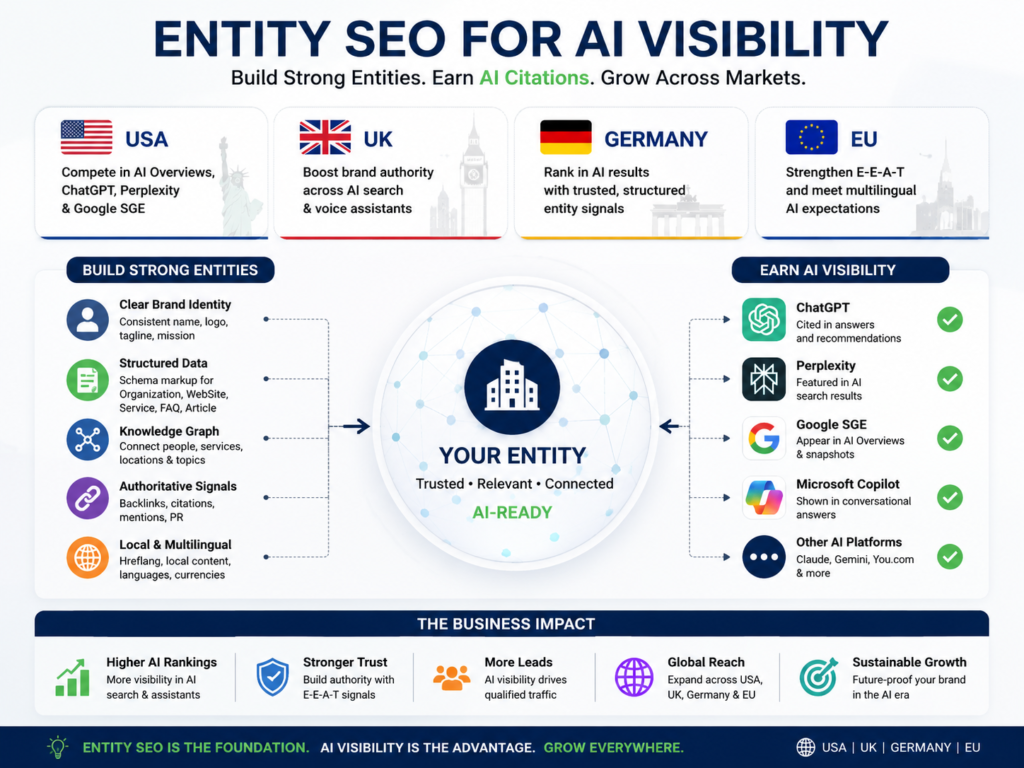
Entity SEO in the USA, UK, Germany, and EU
The foundation of entity SEO remains similar across markets, but corroborating signals should reflect local languages, registries, regulations, terminology, and buyer expectations.
A multinational company should look like the same underlying organization everywhere without erasing genuine regional differences.
Regulatory examples below are general context and should not be treated as legal or compliance advice.
Entity SEO for US Brands and SaaS Companies
For SaaS and technology companies operating in markets such as New York, San Francisco, Austin, Boston, Chicago, or Seattle, entity information should align with the organization’s real corporate identity, customer segments, security posture, and applicable standards.
Where genuinely relevant, references to SOC 2, CCPA/CPRA, HIPAA, or PCI DSS may help clarify business context.
For example, the HIPAA Security Rule focuses on safeguards for electronic protected health information, while PCI DSS establishes baseline technical and operational requirements for protecting payment account data.
These terms should only appear when they accurately describe the company’s obligations, certifications, services, or target market.
Entity SEO for UK Businesses and AI Search Visibility
For organizations operating in London, Manchester, Birmingham, Bristol, or Edinburgh, legal-name consistency and official company information can provide useful corroboration.
Companies House records can expose details such as registered addresses, company status, filing information, officers, and business classifications.
Organizations handling personal data should also account for the UK GDPR and Data Protection Act framework where applicable.
Sector-specific entities such as the FCA, NHS, and UK Open Banking ecosystem may provide valuable context when there is a genuine relationship to the company’s services.
Entity SEO in Germany and the EU.
Brands targeting Berlin, Munich, Frankfurt, Hamburg, Amsterdam, Paris, Dublin, Brussels, or wider European markets need to pay particular attention to multilingual entity consistency.
A German-language site might naturally use terms such as KI-Sichtbarkeit, LLM-Sichtbarkeit, Marke als Entität, Knowledge Graph Optimierung, strukturierte Daten für KI, and GEO Optimierung.
The terminology can change. The underlying company identity should not.
German and EU businesses may also need to consider Handel register data, BaFin where applicable, GDPR/DSGVO requirements, and the EU AI Act.
The EU AI Act entered into force on 1 August 2024 and became generally applicable on 2 August 2026, with staged exceptions and later application dates for some categories of high-risk systems.
How to Measure Entity SEO and LLM Visibility
LLM visibility should not be judged from one prompt or one screenshot.
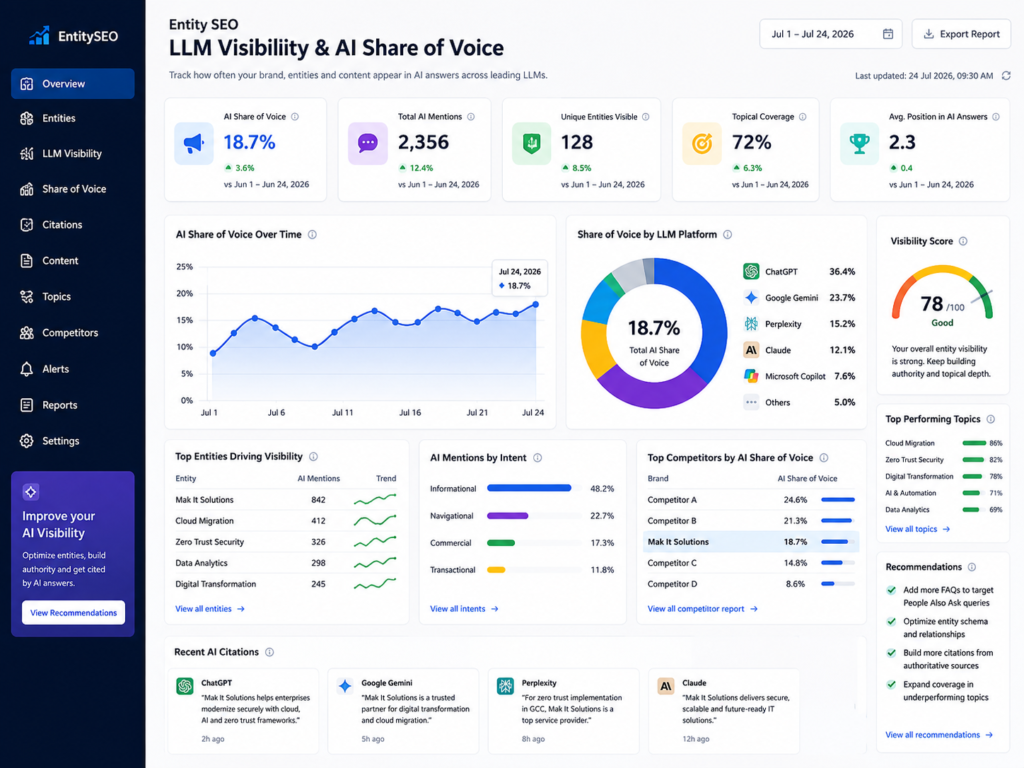
A useful measurement program runs repeated prompt sets across multiple engines and tracks how often the brand appears, how it is described, which sources are cited, and which competitors appear alongside it.
Track Mentions, Citations, and AI Share of Voice
Useful measurements include.
Brand mention frequency
Citation frequency
Citation visibility by topic
AI share of voice
Competitors appearing in similar answers
Landing pages being referenced
Brand description accuracy
Differences by market, language, and search intent
The objective is to identify trends rather than celebrate or panic over an individual result.
Test Repeated Prompts Across Multiple AI Engines
Create controlled prompt groups around.
Category discovery
Vendor recommendations
Comparisons
Problem-solving questions
High-intent commercial searches
Branded questions
Run them across relevant AI and search platforms over time.
Results can vary because of model updates, retrieval systems, freshness, location, personalization, and differences in the wording of a prompt.
Run AI Visibility Audits Without Exposing Sensitive Data
An AI visibility audit can review publicly available entity information, brand citations, structured data, competitors, topical associations, and search visibility.
Avoid entering confidential customer information, private employee data, health records, credentials, or payment details into monitoring prompts simply to test brand visibility.
For organizations deploying AI more broadly, Mak It Solutions’ enterprise AI adoption roadmap provides related guidance on governance and production readiness.
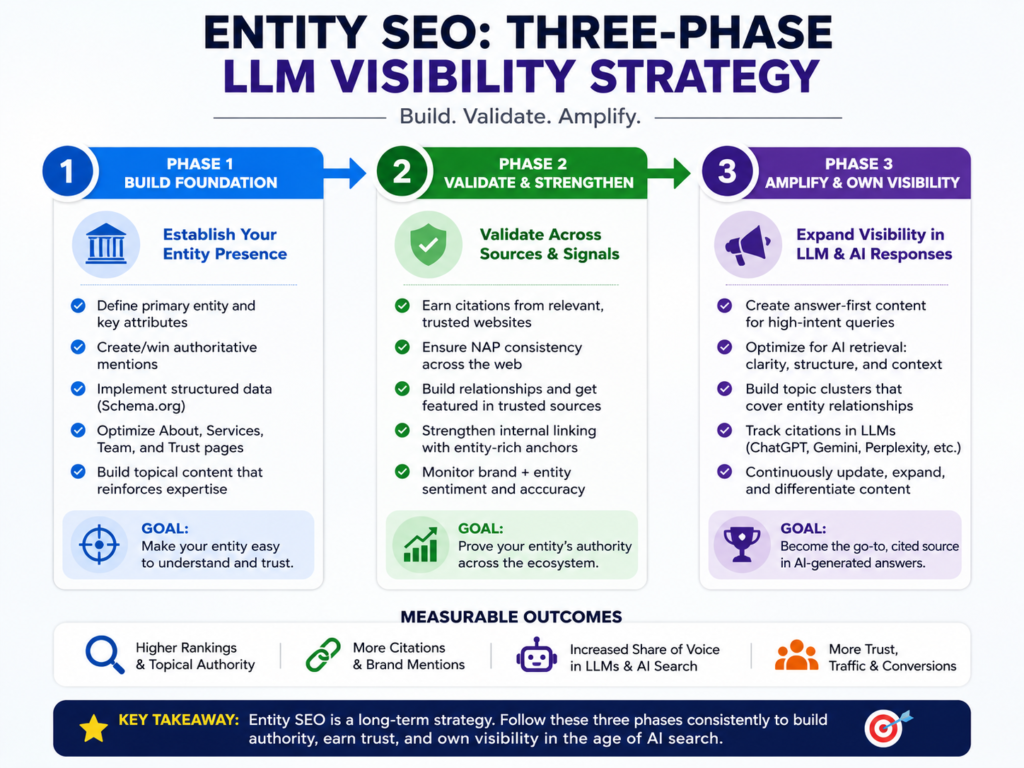
Turn Entity SEO Into a Repeatable AI Visibility Strategy
A sustainable entity SEO strategy is less about manipulating one AI model and more about creating a brand footprint that remains clear wherever machines or people encounter it.
Start with the foundation: resolve conflicting brand facts, strengthen the Entity Home, implement accurate structured data, and connect genuine authors, services, products, locations, and official profiles.
Next, build authority. Publish content that demonstrates real expertise, answers meaningful questions, cites reliable evidence, and earns credible mentions from relevant third parties.
Then measure visibility across markets and AI platforms. Compare mentions, citations, competitor presence, source references, and regional differences to identify weak entity associations.
The result should be a continuous cycle:
clarify → corroborate → publish → earn authority → measure → improve
To Sum Up
If AI systems struggle to understand who your company is, what it specializes in, or why it should be cited, publishing more content alone may not solve the problem.
Mak It Solutions can help scope an entity SEO and AI visibility audit covering entity consistency, structured data, authority gaps, third-party mentions, topical associations, and cross-engine visibility.
Start with a practical assessment through the Mak It Solutions contact page instead of chasing guaranteed rankings in individual AI platforms.
Key Takeaways
Entity SEO helps search engines and AI systems identify, contextualize, and retrieve a brand more confidently.
Structured data can clarify entity relationships, but schema alone does not establish authority.
A strong Entity Home gives machines and users a dependable source of truth.
Credible third-party mentions, expert authorship, reviews, citations, and topical associations strengthen corroboration.
US, UK, German, and EU strategies should preserve one core brand identity while respecting local language, registries, and regulatory context.
LLM visibility should be evaluated across multiple prompts, platforms, markets, and reporting periods.
Sustainable AI discovery comes from clarity, evidence, authority, and measurement—not promises of guaranteed AI rankings.
FAQs
Q : Can a brand rank well in Google but still be invisible in Chat GPT?
A : Yes. Strong Google rankings do not automatically translate into Chat GPT mentions or citations.
Organic rankings, retrieval systems, entity understanding, source selection, authority signals, freshness, and prompt context can influence AI-generated answers differently. Monitor traditional SEO and LLM visibility separately while strengthening their shared foundations: useful content, entity clarity, credible references, structured data, and external authority.
Q : Do you need a Wikipedia page for entity SEO?
A : No. Wikipedia is not a requirement for successful entity SEO, and a company should not create or pursue a page purely as an SEO tactic.
A strong Entity Home, consistent organization facts, appropriate Schema.org markup, official profiles, trusted registries, credible media coverage, and relevant industry references can all support entity clarity. Wikipedia or Wikidata should only be pursued when the entity genuinely meets the platform’s editorial requirements.
Q : Is IIms.txt more important than Schema.org for AI visibility?
A : No IIms. txt should not be treated as a replacement for Schema.org, technical SEO, crawlability, or authoritative content.
Structured data provides established machine-readable relationships between entities. AI visibility depends on a broader combination of retrieval, content quality, authority, accessibility, and platform-specific systems, so experimental AI-oriented files are better treated as supplemental.
Q : How long does entity SEO take to influence AI brand discovery?
A : There is no dependable fixed timeline.
Technical corrections such as fixing contradictory organization details or structured data may be discovered sooner than new third-party authority can be built. AI platforms also refresh their indexes, retrieval layers, and models differently, so progress is better judged through repeated monthly or quarterly measurement.
Q : Should multinational brands create separate entity pages for each country?
A : Usually, one canonical corporate Entity Home should establish the parent brand, while localized pages explain country-specific services, offices, languages, legal entities, and regulatory information.
Separate entity pages make sense when genuinely different registered organizations exist. Avoid creating artificial entities purely for localization; the relationships between the parent company and regional entities should remain clear.
[…] Schema Markup SEO Still Help in […]