


Schema Markup SEO 2026: What Still Works
Schema Markup SEO 2026: What Still Works
Schema Markup SEO 2026: What Still Works
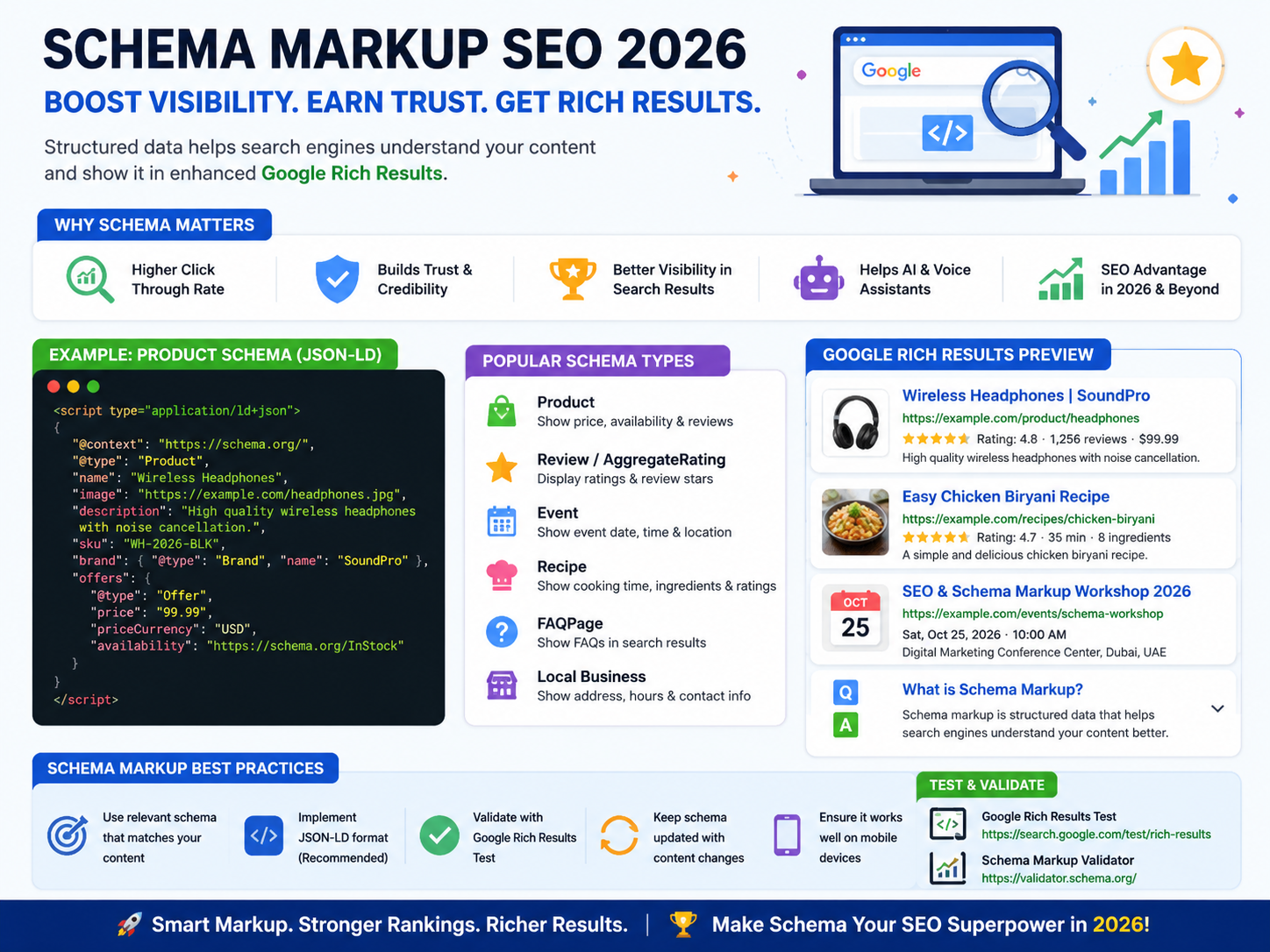
Schema markup SEO still matters in 2026, but not because structured data magically pushes a page higher in Google. Its real value is simpler: schema gives search engines clearer information about a page and can make eligible content available for supported rich-result experiences.
That distinction is even more important as search becomes more AI-driven. In May 2025, Google said AI Overviews had grown to more than 1.5 billion monthly users. Structured data remains useful technical infrastructure, but it is not a shortcut to rankings, AI Overview citations, or mentions in Chat GPT.
Does Schema Markup SEO Still Help in 2026?
Yes. Schema markup can still help SEO by giving search engines explicit information about content, entities, and important page attributes.
Google describes structured data as a way to classify page content and potentially enable richer appearances in Search. The important word is potentially: correct markup creates eligibility, not guaranteed visibility.
Schema Markup Is Not a Ranking Guarantee
Adding technically valid JSON-LD does not mean a page will jump from a lower search position to the top results.
Google explicitly says that even correctly implemented structured data is not guaranteed to appear as a rich result. Search presentation can vary according to the query, device, location, and Google’s own systems.
That is why schema works best as part of a broader technical SEO strategy. Mak It Solutions’ SEO services combine structured data with crawling, indexing, on-page optimization, and content improvements.
Where Structured Data Still Creates Value
In practice, structured data is most useful when it helps machines understand information that already exists clearly on the page.
It can describe.
Products and offers
Businesses and organizations
Events
Videos
Authors and profile pages
Reviews and ratings
Forum and community content
Google’s current Search documentation continues to support structured-data features including Product, Event, Local Business, Organization, Profile Page, Discussion Forum, Review Snippet, and Video.
For new web development projects, building schema into templates from the beginning is usually cleaner than adding fragmented markup later.
Schema.org vs. Google Search Central
Schema.org provides the structured-data vocabulary. Google Search Central tells you which parts of that vocabulary Google currently supports for specific Search features.
That difference matters.
A property can be valid according to Schema.org without producing a special Google search appearance. Properties such as sameAs, for example, can describe relationships and canonical entity references, but markup should never be added simply because a property exists.
The rule is straightforward: your structured data should accurately represent the visible page.
Which Schema Types Matter Most for SEO in 2026?
There is no universal list every website should install. The best schema type depends on what the page actually contains and whether Google currently supports a relevant experience.
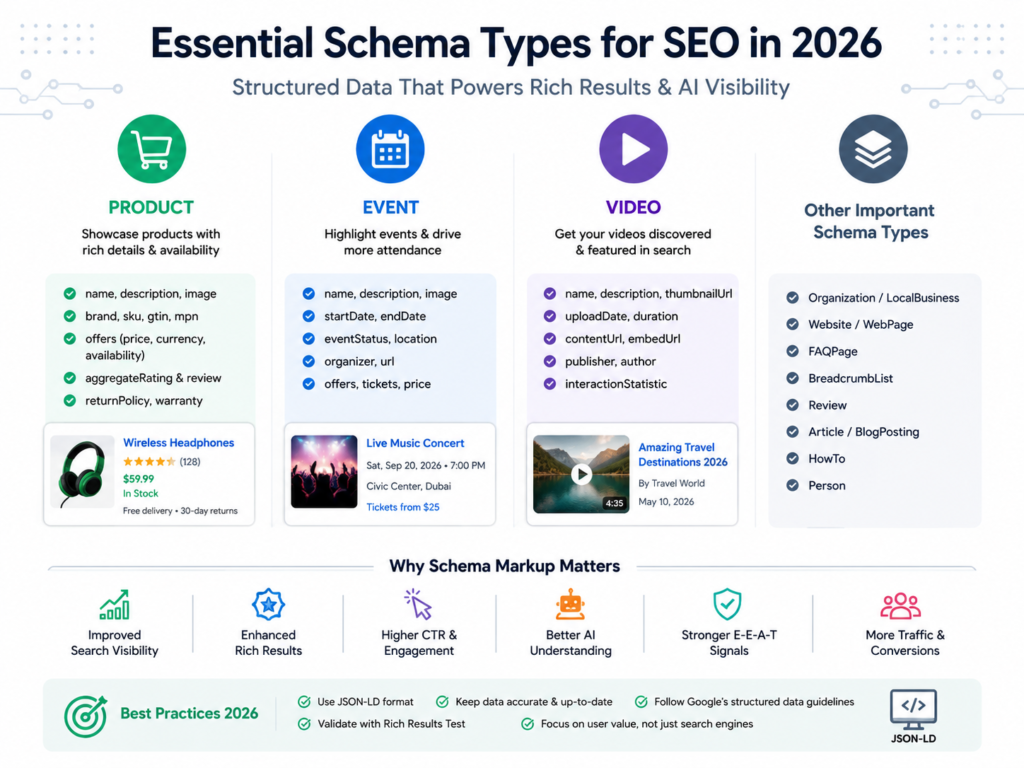
Product, Offer, and Review Structured Data
For ecommerce websites, Product remains one of the most practical structured-data types.
Depending on the page and eligibility requirements, product markup can communicate details such as.
Price
Availability
Offers
Ratings and reviews
Shipping information
Return policies
Google also recommends coordinating product structured data with Merchant Center information where appropriate.
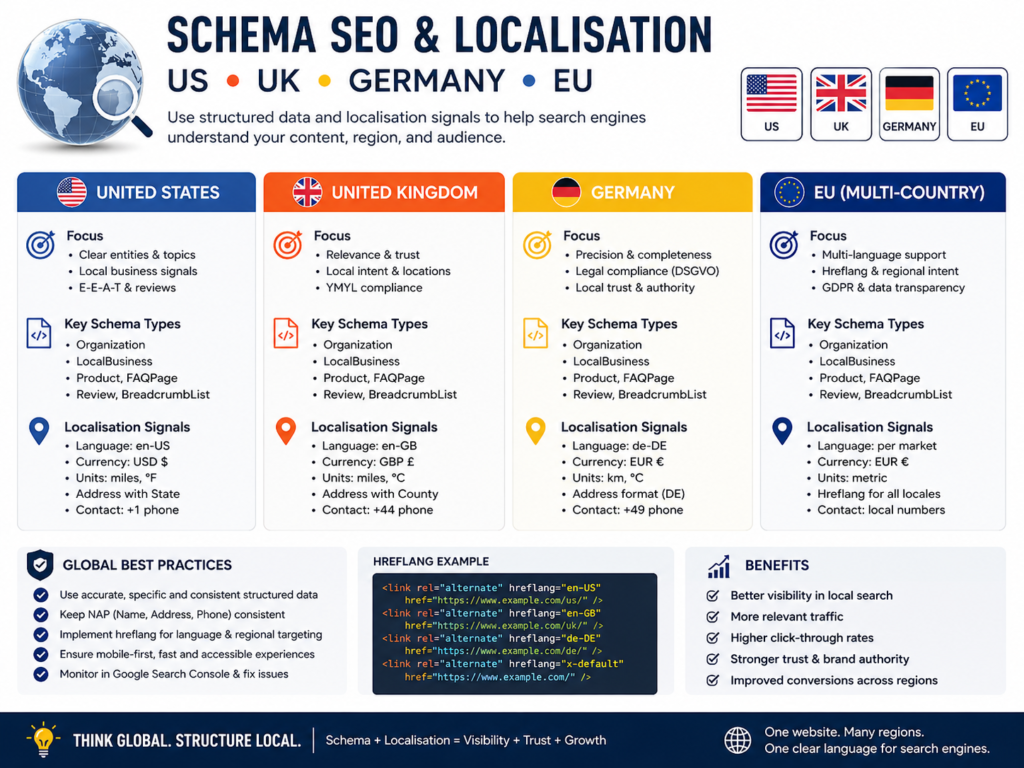
For businesses selling internationally, the markup must match the visible offer. A US page showing USD, a UK page showing GBP, and a German page showing EUR should not send conflicting pricing or availability information to search engines.
Businesses building or upgrading stores can connect structured-data work with Mak It Solutions’ e-commerce development services.
Event and Video Object Schema
Event and video object remain relevant when the underlying content genuinely matches those types. Google’s current structured-data gallery still lists both Event and Video as supported Search features.
For events, structured information can clarify dates, venues, locations, and event details. Video markup can help describe video content and related metadata.
A conference publisher in New York, a training company in London, or an event platform in Berlin should localize the visible page and its markup together.
The goal is accurate discovery not filling JSON-LD with every available Schema.org property.
Organization, Local Business, and Community Schema
Organization and local business can help define official business information, while profile page and discussion-related structured data can provide context for genuine community or profile content.
Google’s 2026 documentation also continues to list Organization, Local Business, Profile Page, and Discussion Forum among its supported structured-data features.
For local organizations, structured data should complement accurate Google Business Profile information and consistent details across the website.
That entity consistency also fits naturally into a broader digital marketing strategy.
What No Longer Delivers the Same Schema SEO Value?
Structured data evolves. A schema type can remain technically valid even after Google stops displaying the Search feature marketers once associated with it.
That is why a 2026 schema markup SEO strategy should be based on current documentation—not an old plugin checklist or a screenshot from several years ago.
FAQ Rich Results Ended in May 2026
One of the clearest recent examples is FAQ markup.
Google stopped showing the FAQ rich result in Search starting May 7, 2026 and removed its FAQ rich-result documentation in June 2026.
FAQ Page still exists as a Schema.org type, so using it to describe genuine FAQ content can remain semantically valid. What marketers should no longer do is forecast extra Google FAQ visibility or CTR gains as though the old rich-result feature still exists.
Valid Schema Does Not Guarantee Rich Results
Passing a validation tool means your markup meets the technical checks that tool performs. It does not mean Google must display an enhanced result.
Google specifically states that correctly marked-up pages may still not receive rich-result treatment.
Validation is therefore a quality-control step not a business KPI.
Avoid Hidden Content and Entity Stuffing
Adding more schema is not automatically better.
Do not fill JSON-LD with unrelated businesses, people, keywords, or entities simply to create a larger knowledge graph. And do not use markup to describe information users cannot actually see on the page.
Google’s structured-data guidelines warn against hidden, irrelevant, misleading, or inaccurately represented content.
A smaller, accurate schema graph is usually more useful than an impressive-looking block of markup that does not match the page.
Does Schema Markup Help AI Overviews and Chat GPT?
Schema can improve machine-readable clarity, but there is no credible basis for promising that adding structured data will earn a citation in Google AI Overviews or Chat GPT.
The safest way to think about schema is as supporting infrastructure.
What Google Says About Schema for AI Search
Google’s current guidance says websites do not need special schema.org markup or other additional technical requirements to appear in AI Overviews or AI Mode. Established SEO fundamentals still apply.
Google also says structured data should continue to match the visible text on the page.
In May 2025, Google reported more than 5 trillion searches annually, which shows the scale at which Search is evolving. But that scale does not turn speculative “AI schema hacks” into proven optimization techniques.
Why Schema Cannot Guarantee AI Citations
Structured data can make product attributes, organizations, relationships, and other facts easier for machines to interpret.
That does not prove that schema caused an AI system to select a particular source.
AI search systems can rely on retrieval, ranking, authority, relevance, content quality, entity relationships, and many other signals. Claims such as “add this schema property and Chat GPT will cite your website” should therefore be treated cautiously.
How Schema Supports AEO and GEO Indirectly
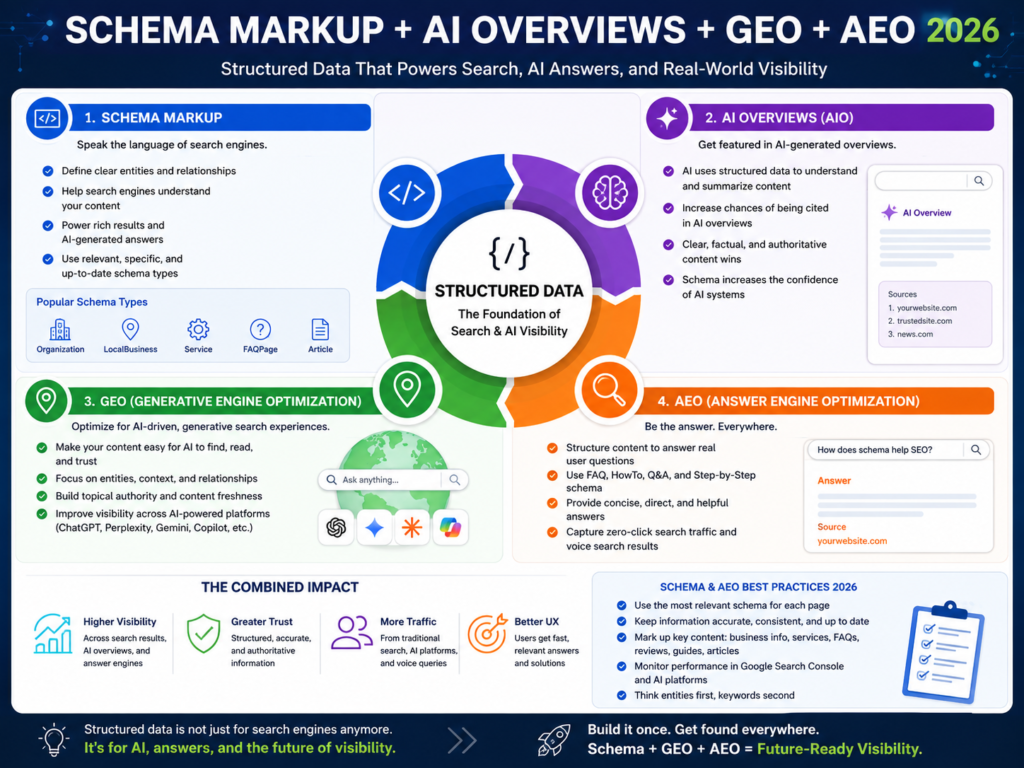
A stronger AEO and GEO approach combines structured data with content that is already easy to understand.
That includes.
Clear answers near the top of relevant pages
Consistent entity information
Descriptive headings
Accurate product and business attributes
Original, useful information
Strong internal linking
Content that answers the query directly
For organizations working across multiple markets, structured data can reinforce facts already presented in content, feeds, and analytics. Mak It Solutions’ business intelligence services can help connect search visibility with measurable business outcomes.
How to Implement Schema Markup SEO Correctly
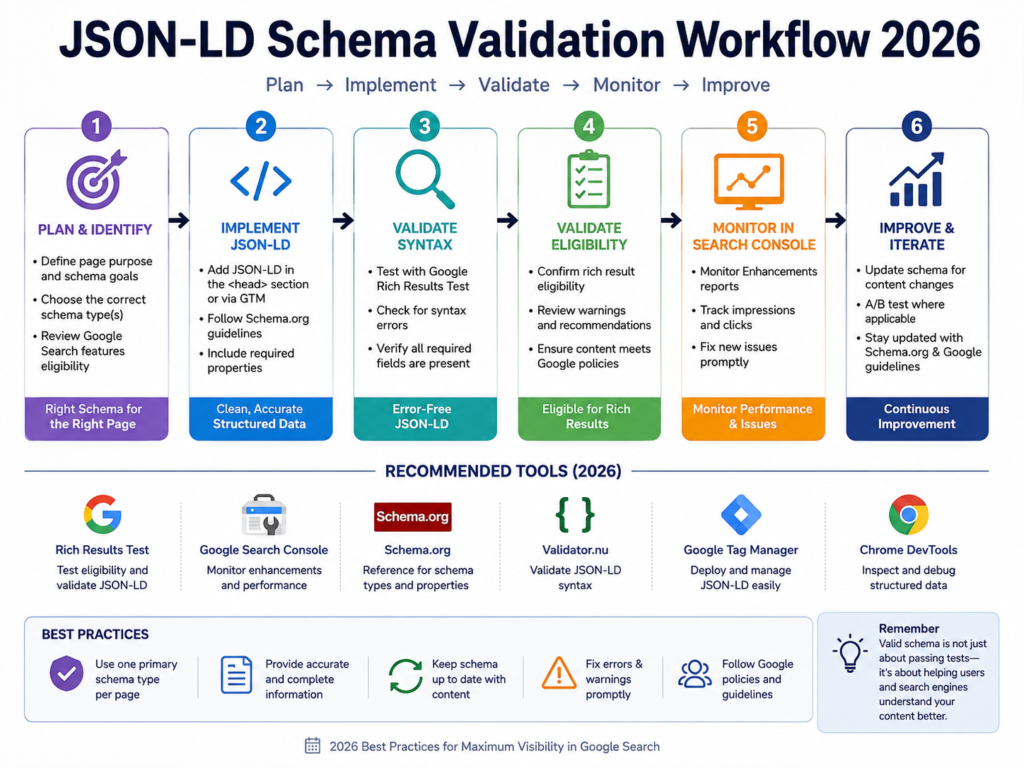
A reliable implementation process is simple: mark up what users can actually see, validate the code, check Google’s current documentation, and measure the effect before scaling changes across the site.
Use JSON-LD When It Fits Your Setup
Google supports JSON-LD, Microdata, and RDFa. Its documentation recommends JSON-LD in most situations because it is generally easier to implement and maintain at scale.
Choose schema types based on the page itself.
An article may need Article-related markup. A product page may need Product markup. A genuine business location may qualify for Local Business.
Do not add every schema type your plugin offers.
For WordPress websites, structured-data implementation can also be included in WordPress development and maintenance.
Test With the Right Validation Tools
Use Google’s Rich Results Test when you are checking markup associated with Google-supported Search features.
For broader Schema.org vocabulary validation, use a Schema.org validator as well.
Then confirm three things.
The required properties are present.
The structured data matches visible content.
Google can crawl and process the page.
Fix critical errors first. Warnings may still deserve attention, but an error-free validator screen should never become the goal by itself.
Audit Before Scaling Across Templates
Schema problems often become expensive when an incorrect template automatically publishes them across thousands of pages.
Before scaling, review.
Duplicate schema objects
Outdated properties
Unsupported Search features
Conflicting business information
Incorrect prices or availability
Template-generated validation errors
Markup that does not match visible content
A schema audit becomes more useful when it connects technical implementation with search visibility, conversions, and the wider Mak It Solutions service portfolio.
How to Measure Schema Markup SEO Performance
Do not measure success by counting schema objects or celebrating a green validator result.
Instead, look at what changes after implementation.
Google itself recommends before-and-after testing on suitable pages and reviewing performance in Search Console.
Track Search Console and SERP Impact
Depending on the feature, useful metrics can include.
Impressions
Clicks
Click-through rate
Search appearance
Average position
Leads or sales from affected pages
Try to compare similar periods and account for other changes such as rankings, seasonality, redesigns, and content updates.
Schema should support measurable search performance not become an isolated technical vanity project.
US and UK Schema Considerations
A New York SaaS company and a London ecommerce retailer may use the same Schema.org type names even when their visible copy uses different spelling conventions.
The structured data should still match localized information such as.
USD or GBP pricing
Business addresses
Product availability
Local URLs
Visible company information
Relevant privacy disclosures
Schema should reflect localization, not replace it.
Germany and EU Structured Data Localization
For German and wider EU websites, structured data should stay aligned with translated visible content.
A Berlin or Munich business should keep core entity identity consistent while making sure localized pages accurately reflect EUR pricing, availability, URLs, business details, and relevant VAT or privacy information.
For multilingual sites, schema should also work alongside the site’s language targeting and hreflang implementation rather than contradicting it.
Final Thoughts
A strong schema markup SEO strategy is not about adding more code. It is about giving search engines accurate, useful information while focusing development effort on pages that can actually support visibility and business results.
Not sure whether your current structured data is useful, outdated, duplicated, or based on Search features Google no longer supports?
Request a scoped schema and SEO review from Mak It Solutions and start with the pages that matter most to revenue and search visibility. ( Click Here’s )
Key Takeaways
Schema markup SEO still helps search engines understand page content and can create eligibility for supported Search features.
Correct structured data does not guarantee rankings or rich results.
Product, Event, Video, Organization, Local Business, Profile Page, and discussion-related markup remain relevant where the page genuinely qualifies.
Google stopped displaying FAQ rich results on May 7, 2026.
Google says no special schema is required for AI Overviews or AI Mode.
JSON-LD remains the practical default for many websites.
Structured data should always match visible content.
Measure Search Console performance and conversions rather than validator scores alone.
Localize schema together with language, currency, offers, and business information.
FAQs
Q : Can too much schema markup hurt SEO?
A : Having a large amount of valid markup does not automatically create a ranking penalty. The problem starts when structured data becomes irrelevant, misleading, hidden, or inconsistent with the visible page. Use schema for information the page genuinely represents.
Q : Should every page on a website have structured data?
A : No. Prioritize pages where structured data provides meaningful machine-readable context, such as products, events, articles, videos, organizations, or local businesses. Adding markup simply to achieve full-site “schema coverage” is not a useful SEO goal.
Q : Is JSON-LD better than Microdata for SEO in 2026?
A : Google supports JSON-LD, Microdata, and RDFa, but generally recommends JSON-LD because it is easier to implement and maintain. The format itself does not create a ranking advantage; accuracy and eligibility matter more.
Q : How often should structured data be audited?
A : Review structured data after major template changes, redesigns, ecommerce migrations, or significant updates to Google’s documentation. Dynamic information such as prices, availability, shipping details, and event dates should be monitored more closely because it can become outdated quickly.
Q : Should multilingual websites use different schema for each country?
A : Structured data should match each localized page. Keep the core identity of the organization or product consistent, while localizing language, URLs, currencies, offers, availability, and relevant business information for each market.