
Content Refresh Strategy to Recover GCC Rankings
Content Refresh Strategy to Recover GCC Rankings
Content Refresh Strategy to Recover GCC Rankings
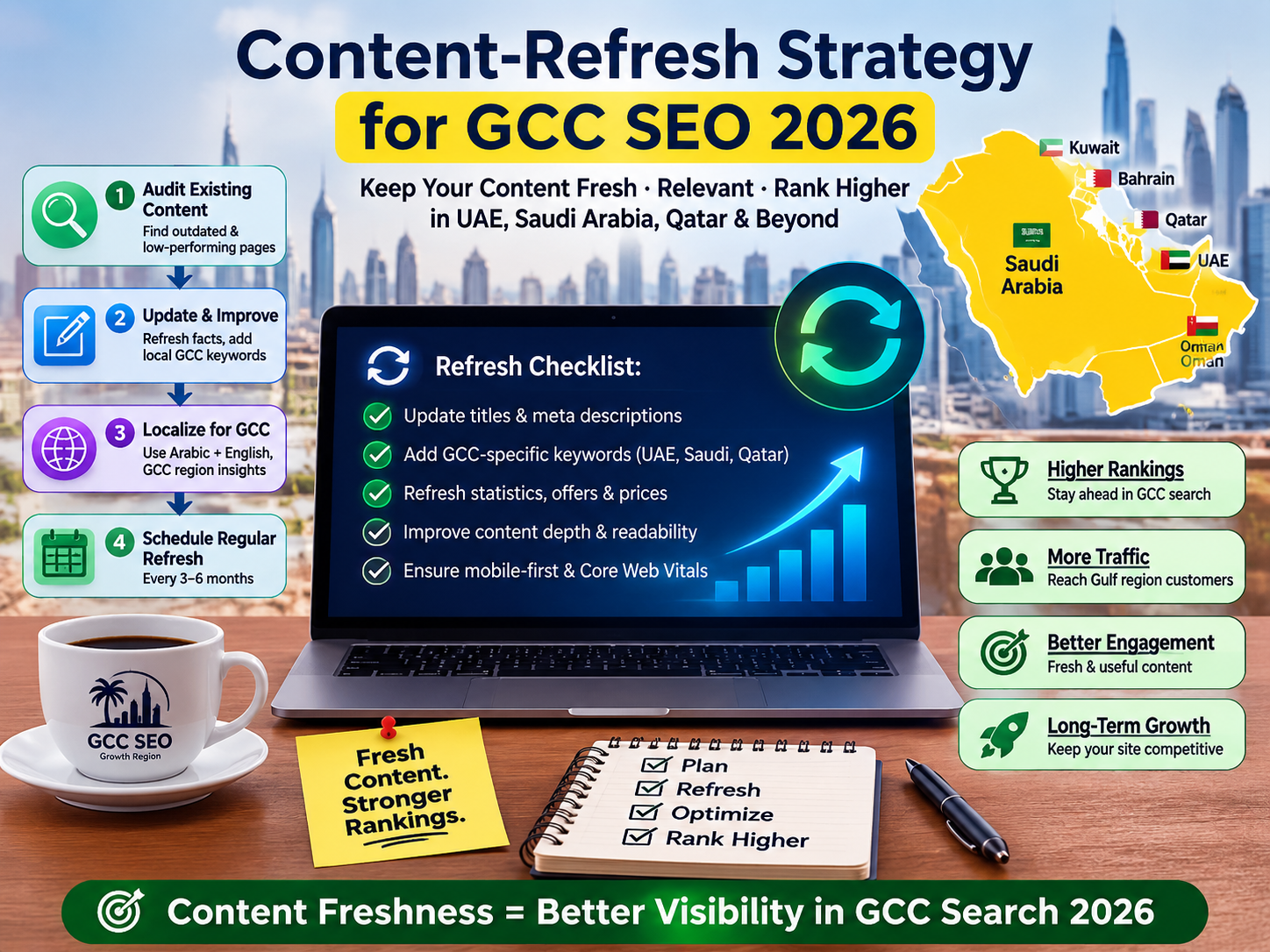
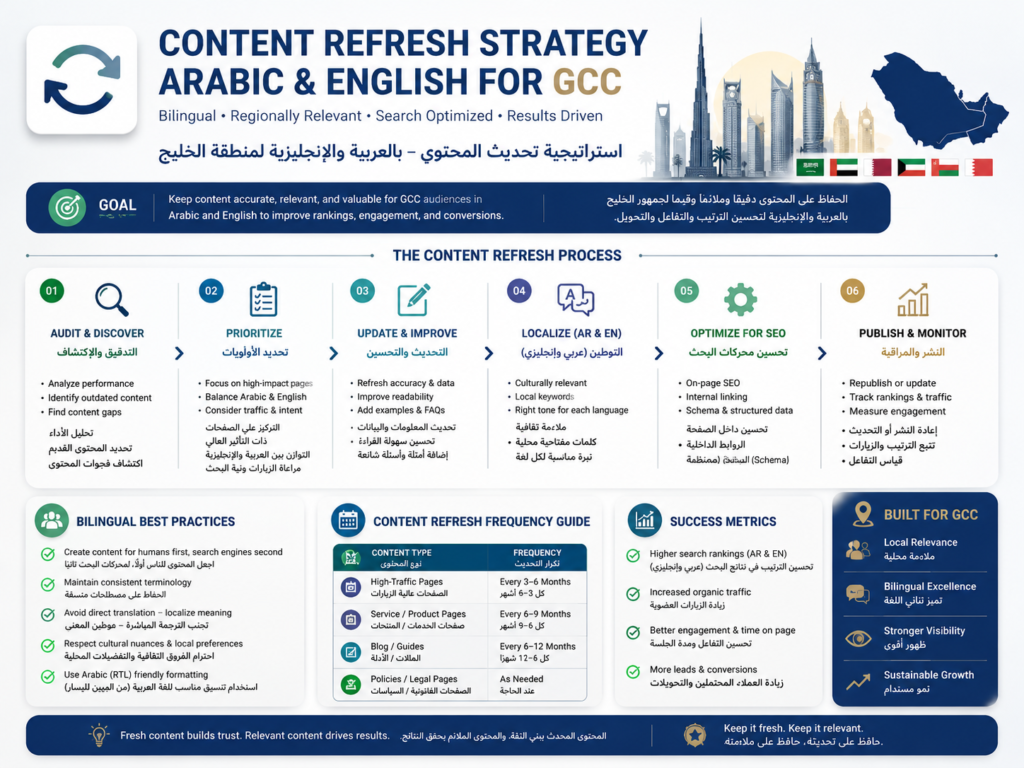
A strong content refresh strategy can help GCC businesses recover declining organic visibility without relying on a constant stream of new articles. Instead of abandoning pages that already have authority, backlinks, rankings, or conversion history, the goal is to improve the assets that still have commercial potential.
For businesses in Saudi Arabia, the UAE, and Qatar, the process is straightforward: audit, prioritize, refresh, localize, strengthen answers, consolidate, and measure. The most effective refreshes improve usefulness for readers while making content easier for search engines and AI answer systems to understand.
Why GCC Businesses Need a Content Refresh Strategy in 2026
Publishing more content is not always the fastest route to organic growth.
Across Riyadh, Dubai, Abu Dhabi, and Doha, many websites already have pages with valuable search history. Those pages may once have attracted consistent clicks or enquiries but gradually lost visibility because the information became outdated, competitors improved their coverage, internal links weakened, or search intent shifted.
A practical content refresh strategy gives those pages another opportunity to perform.
This matters even more for bilingual GCC websites. English and Arabic versions can drift apart over time, especially when service details, market terminology, regulations, pricing models, or customer expectations change.
Refreshing content therefore involves more than rewriting paragraphs. It means checking whether the page still answers the right questions for the right audience.
What Is a Content Refresh Strategy?
A content refresh strategy is a structured process for identifying existing pages with unrealized or declining potential and improving them for current users, search engines, and AI-driven discovery systems.
The goal is not to make every old page look new. It is to strengthen pages where an update can improve relevance, trust, rankings, conversions, or user experience.
Content Refresh SEO vs. Publishing New Content
Content refresh SEO improves an existing URL rather than starting from zero.
A meaningful refresh might include.
Rewriting outdated sections
Expanding weak answers
Updating examples or references
Improving page structure
Strengthening internal links
Removing irrelevant sections
Consolidating overlapping content
Improving calls to action
Localizing information for a specific GCC market
For businesses that need broader technical or strategic support, professional SEO services can help connect editorial updates with site-level optimization.
Simply replacing “2025” with “2026” does not make a page genuinely fresh.
Why Old Pages Lose Rankings and Organic Traffic
Content decay rarely has a single cause.
A page may lose visibility because.
Competitors published more complete resources.
Search intent changed.
Facts or examples became outdated.
Internal linking weakened.
The page no longer matches current user questions.
Several pages began competing for the same search intent.
Technical issues affected indexing or crawlability.
Before rewriting anything, teams should understand what actually changed.
Why Content Refresh Matters for GCC Websites
Saudi Arabia, the UAE, and Qatar are fast-moving digital markets, but regional relevance cannot be achieved by inserting city names into generic content.
Localization has to make the page more useful.
For bilingual websites, that also means checking terminology, Arabic-English consistency, RTL usability, and market-specific user expectations. Mak It Solutions’ Arabic UX guidance shows why Arabic localization should extend beyond literal translation.
Which Old Content Should GCC Businesses Refresh First?
Not every outdated page deserves the same level of investment.
The best place to start is with URLs that previously generated meaningful visibility, enquiries, conversions, backlinks, or revenue.
Find Pages With Declining Clicks, Rankings, and Impressions
Use Google Search Console, GA4, historical organic traffic, and conversion data to identify pages that have lost momentum.
A page that performed strongly six months ago but is steadily losing qualified clicks may be a better refresh candidate than an old article that never attracted meaningful demand.
Look for patterns such as.
Falling organic clicks
Declining impressions
Lower average rankings
Reduced click-through rate
Fewer leads or assisted conversions
Strong impressions but weak engagement
Pages losing visibility for commercially valuable queries
The key is to prioritize business impact rather than traffic volume alone.
Separate Refresh, Consolidate, Rewrite, and Retire Candidates
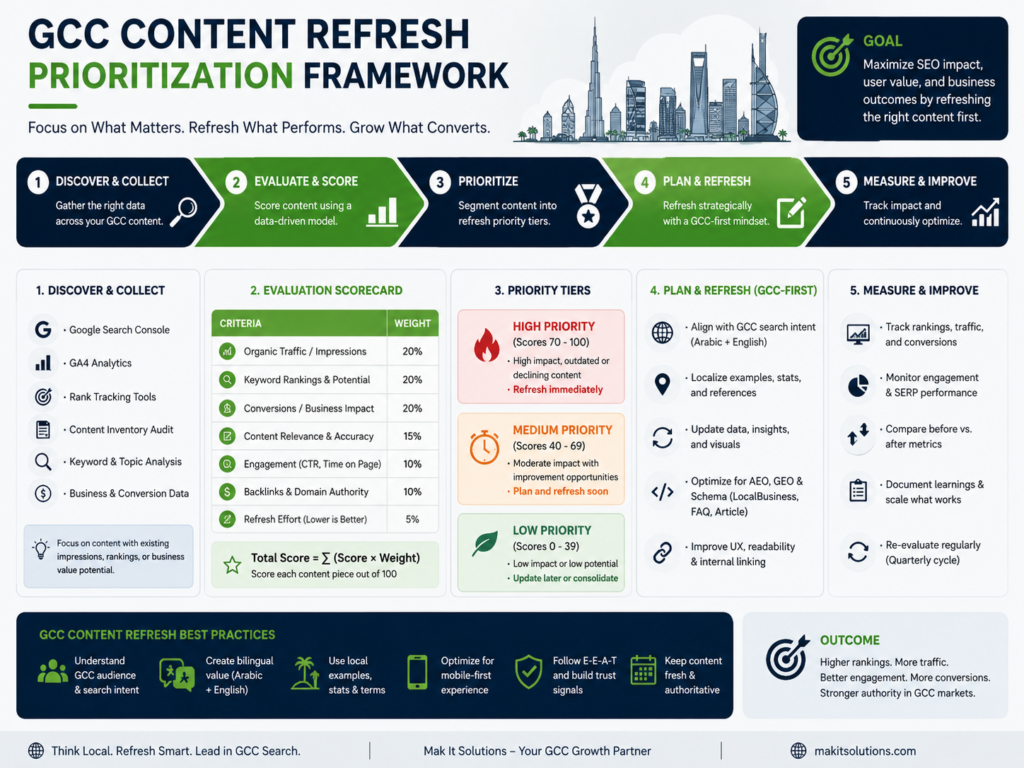
A useful content audit normally leads to four possible actions.
Refresh: The URL is still valuable, but parts of the page are outdated or underdeveloped.
Consolidate: Multiple pages overlap and compete for substantially the same search intent.
Rewrite: The topic still matters, but the current page no longer serves the intent effectively.
Retire or redirect: The content is obsolete and has little strategic value on its own.
Before assuming the problem is editorial, check technical foundations as well. This technical SEO checklist for Arabic GCC websites can help identify canonical, indexing, crawl, and implementation issues.
Prioritize Saudi, UAE, and Qatar Pages by Business Value
Think commercially.
A Riyadh fintech page losing qualified leads deserves attention. So does a Dubai B2B guide built around outdated market information or a Doha service page that depends entirely on international examples.
These pages are valuable refresh candidates because improved visibility could influence real business outcomes rather than simply increase pageviews.
How to Refresh Old Content Without Losing Rankings
The safest approach is to protect what already works while improving what has become weak.
Avoid rewriting a successful page simply because it looks old.
Revalidate Search Intent Before Editing
Before making major changes, review.
Current search results
Competitor coverage
User questions
Related queries
Informational versus commercial intent
The page’s existing ranking terms
Sections already attracting backlinks or engagement
The purpose is to understand why the page deserves to rank now, not why it ranked in the past.
Update Facts, Structure, Examples, and Internal Links
Replace outdated statistics, broken references, screenshots, product details, service information, and examples.
Then look at the reading experience.
Can the introduction answer the core question faster? Are headings specific enough? Do important questions receive direct answers? Are internal links still relevant? Does the CTA match the reader’s likely stage of consideration?
For commercial pages, Mak It Solutions’ Qatar service-page SEO guide provides a useful model for connecting organic visibility with conversion-focused content.
Protect Existing SEO Signals
During a refresh:
Keep strong URLs unless a change is genuinely necessary.
Preserve valuable sections that still satisfy search intent.
Avoid removing useful topical coverage without evidence.
Review canonical tags.
Maintain relevant internal links.
Protect backlink value.
Update date Modified only after meaningful changes.
If the problem extends beyond copy and page structure, web development services may be needed for broader implementation work.
Content Refresh Strategy for Saudi, UAE, and Qatar Localization
Localization should reflect how customers in each market actually search, compare, evaluate, and buy.
It should never be reduced to inserting Riyadh, Dubai, Abu Dhabi, or Doha into otherwise generic content.
Refresh Arabic and English Pages Without Version Drift
English and Arabic pages should share consistent core facts, but they do not always need identical wording or structure.
Search behavior can differ by language.
During a bilingual refresh, check.
Product and service terminology
Company facts
Regulatory references
Calls to action
Search intent
Frequently asked questions
Internal links
Arabic RTL presentation
Local phrasing
Arabic content should feel written for Arabic-speaking users rather than translated line by line from English.
Add Local Market Signals Where They Improve Meaning
Local context works best when it adds useful detail.
For example, a Dubai e-commerce business could update examples around mobile shopping or regional customer journeys. A Doha logistics company could replace generic overseas scenarios with examples that better match Qatar’s operating environment.
Likewise, Riyadh fintech content may need Saudi-specific terminology, while an Abu Dhabi consultancy may need examples that reflect local B2B decision-making.
The city name itself is not the SEO strategy. The surrounding relevance is what matters.
Recheck Regulatory and Data Claims
Regulatory references should appear only when they are genuinely relevant to the page.
A Riyadh fintech company, for example, should verify applicable Saudi Central Bank information through the official SAMA website before republishing sensitive claims.
UAE financial content may require relevant ADGM or DIFC context, while Qatar banking content may require QCB references.
In practice, a GCC refresh might involve.
A Riyadh fintech updating SAMA-related wording and onboarding terminology.
A Dubai e-commerce brand improving mobile UX examples and internal linking.
An Abu Dhabi consultancy replacing obsolete service information.
A Doha SME reviewing cloud or data-residency references where they affect the topic.
Regulators and market names should support accuracy, not act as decorative SEO keywords.
How a Content Refresh Strategy Can Improve Google and AI Visibility
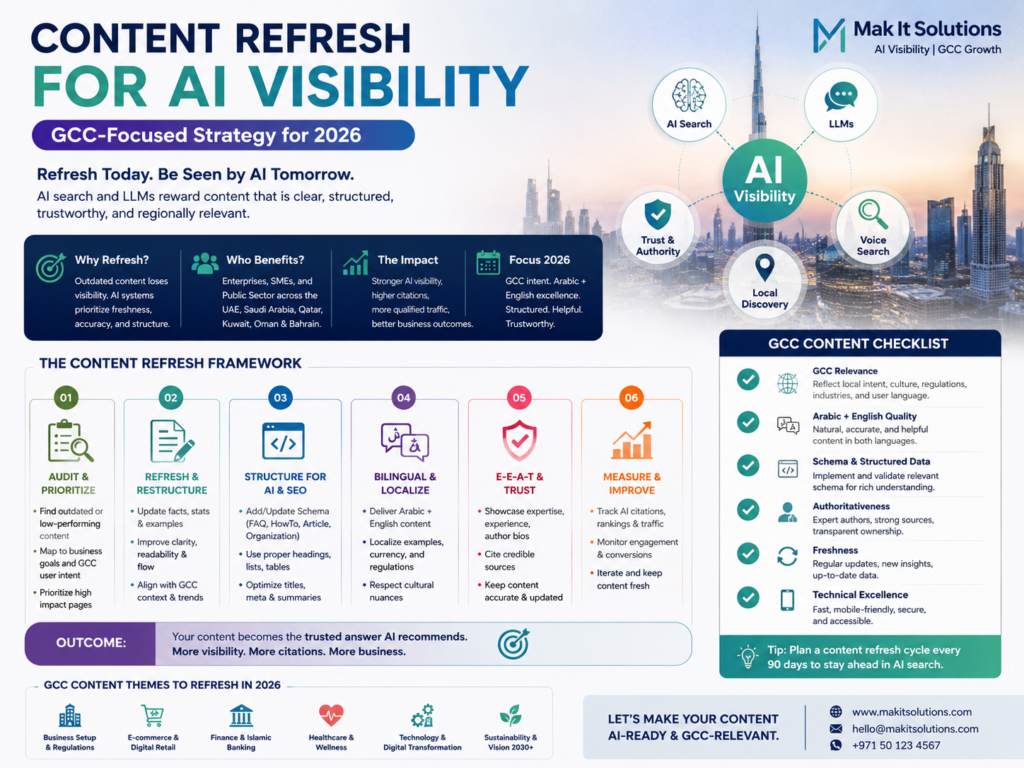
Refreshed content should be easy for both people and machines to interpret.
That does not mean writing mechanically for algorithms. It means making important information clear, specific, and easy to extract.
Strengthen Direct Answers for AI Overviews and Answer Engines
Question-led headings can make complex pages easier to navigate.
Where appropriate, answer an important question immediately before adding deeper context.
For example:
What is a content refresh strategy?
It is a structured process for improving existing pages that have lost relevance, visibility, or commercial performance rather than replacing them with entirely new content.
This answer-first approach can improve usability while giving search and answer systems clearer passages to interpret.
Mak It Solutions’ guide to AI SEO for MENA tech companies explores the connection between conventional SEO, entities, and AI-driven discovery.
Improve Entity and Context Signals
Useful context is stronger than repetitive geography.
“Riyadh fintech,” “Dubai e-commerce,” “Abu Dhabi professional services,” and “Doha logistics” provide clearer relationships between market, industry, and intent than repeating a city name throughout a page.
The goal is to make the subject unambiguous.
Keep Conventional SEO Foundations Strong
AI visibility does not replace SEO fundamentals.
Refreshed pages still need.
Indexability
Helpful original content
Clear authorship
Accurate structured data
Strong internal linking
Reliable factual claims
Logical heading structure
Good user experience
For implementation guidance, see the GCC schema markup blueprint.
How Should GCC Teams Measure Content Refresh Results?
A refresh should be measured against the page’s pre-update performance rather than judged by impressions alone.
Track Rankings, Clicks, Leads, and Recovery
Monitor metrics such as.
Organic clicks
Impressions
Click-through rate
Ranking changes
Leads
Conversion rate
Assisted conversions
The right success metric depends on the page.
A commercial service page should not be judged by traffic alone if its real job is generating qualified enquiries.
Measure English and Arabic Performance Separately
Bilingual websites need language-level reporting.
Track Arabic and English landing pages, query sets, conversion behavior, and regional traffic independently.
Improvement on the English version does not prove that the Arabic version is also performing better.
Monitor Search and AI Visibility After Republishing
Where practical, monitor.
Featured snippets
People Also Ask visibility
Long-tail query growth
Branded searches
Query expansion
Observable AI citations or mentions
These signals should complement traditional SEO and conversion metrics rather than replace them.
Build a Repeatable GCC Content Refresh Workflow
Content refreshing works best as an operating process, not an emergency response to falling rankings.
Audit and Prioritize Content Quarterly
A quarterly review can help teams identify high-value pages before performance declines become severe.
Pay particular attention to.
High-value commercial URLs
Pages with sustained traffic decline
Regulatory-sensitive content
Evergreen resources
Bilingual pages showing factual or terminology drift
Pages competing for overlapping intent
Use a Refresh Checklist Before Republishing
Before publishing the updated version, check.
Search intent
Factual accuracy
GCC localization
Arabic-English consistency
Internal links
Direct answers
Metadata
Structured data
Conversion elements
Technical implementation
The aim is to make the page materially better, not simply newer.
Know When Specialist SEO Support Is Needed
Editorial teams can usually handle straightforward content updates internally.
Specialist support becomes more useful when the decline involves.
Keyword cannibalization
Technical SEO
Multilingual site architecture
Indexation problems
Large-scale content consolidation
Regulated subject matter
Conversion and lead-generation issues
A broader digital marketing strategy can also help connect ranking recovery with lead generation and commercial goals.
Concluding Remarks
A successful content refresh strategy does not start with rewriting everything.
It starts with finding pages that already have search history and business value, understanding why they declined, and making targeted improvements. ( Click Here’s )
For GCC businesses, the framework is simple.
Audit → Prioritize → Refresh → Localize → Strengthen answers → Consolidate → Measure
Before investing entirely in new content, review the Saudi, UAE, and Qatar pages that already have authority, visibility, or conversion potential.
Mak It Solutions can help businesses assess declining pages, strengthen bilingual content, and build a custom GCC content refresh strategy focused on sustainable organic visibility and commercial performance.
FAQs
Q : How often should Saudi businesses refresh old SEO content?
A : There is no universal deadline. Commercially important pages should be reviewed regularly, with quarterly audits providing a practical starting point.
Regulatory-sensitive pages may require more frequent checks, especially when accuracy depends on changing official guidance.
Q : Should Dubai companies change the publication date after refreshing a blog post?
A : Only after a substantive update.
Correcting a typo or replacing “2025” with “2026” is not enough. A meaningful refresh may include updated information, rewritten sections, new UAE examples, stronger answers, and improved internal links.
Q : Can a content refresh recover rankings after a Google update in the UAE?
A : It can support recovery when the refresh addresses the real reason a page lost competitiveness, but recovery is never guaranteed.
Teams should investigate search intent, content quality, technical issues, cannibalization, and competitor improvements before making major changes.
Q : Should Qatar businesses refresh English and Arabic pages at the same time?
A : Coordinated refreshing is usually helpful because it reduces factual drift.
However, Arabic and English search intent should still be evaluated separately. Core facts can remain consistent while wording, questions, examples, and optimization differ by language.
Q : When should GCC companies consolidate old pages instead of updating them?
A : Consolidation is usually the better option when multiple pages compete for substantially the same search intent without a clear reason to remain separate.
Before consolidating, compare rankings, backlinks, conversions, and topical coverage, then preserve the strongest information and authority in the preferred destination page.
[…] Managed IT Services GCC Businesses […]