


Internal Linking Best Practices for Smarter SEO
Internal Linking Best Practices for Smarter SEO
Internal Linking Best Practices for Smarter SEO
Internal linking best practices help users find relevant content while giving search engines clearer signals about your site structure, priority pages, and topical relationships. The goal is not to add links everywhere. It is to connect the right pages with useful, descriptive anchors and keep important content easy to discover.
A strong internal linking system combines contextual relevance, logical site architecture, sensible crawl depth, descriptive anchor text, and regular maintenance. Done well, it can improve navigation, support crawlability, prevent orphan pages, and strengthen the relationship between pillar pages, supporting content, and commercial URLs.
What Are the Most Important Internal Linking Best Practices?
The most effective internal linking best practices are simple: connect contextually related pages, use descriptive anchor text, give important URLs stronger internal support, prevent orphan pages, and maintain a clear site hierarchy.
There is no universal “perfect” number of internal links. Relevance and usefulness matter more than arbitrary limits.
Use Contextual Internal Links Where They Help the Reader
A contextual internal link should feel like a natural next step.
For example, a technical SEO article can point readers toward Mak It Solutions’ SEO services or its detailed internal linking strategy guide when those pages genuinely expand on the topic.
Avoid inserting links simply because a matching keyword appears in a sentence. The destination should help the reader answer a question, understand a concept, or continue a useful journey.
Navigation links have their place, but editorial links inside relevant copy provide stronger context about how two pages relate.
Prioritize Important Pages Without Linking Everything to Everything
Internal links can help distribute authority across a website, so they should support pages that matter most.
Depending on the site, those may include.
Core service pages
Important product or category pages
High-value evergreen guides
Topic hubs
Pages with strong commercial or conversion intent
Strategic content that deserves greater visibility
PageRank is more nuanced than simply counting links. Instead of linking every page to every other page, create a hierarchy based on topical relevance, user value, and business importance.
Prevent Orphan Pages and Broken Internal Links
An important page should not sit alone with no crawlable internal path pointing toward it.
Orphan pages can be difficult for users and crawlers to discover, while broken internal links interrupt navigation and waste opportunities to guide visitors toward useful content.
Whenever pages are removed, redirected, merged, or substantially updated, review the internal links pointing to them.
Mak It Solutions’ guide to indexing controls also covers related decisions involving canonical tags, noindex directives, and retired URLs.
How Should You Structure an Internal Linking Strategy?
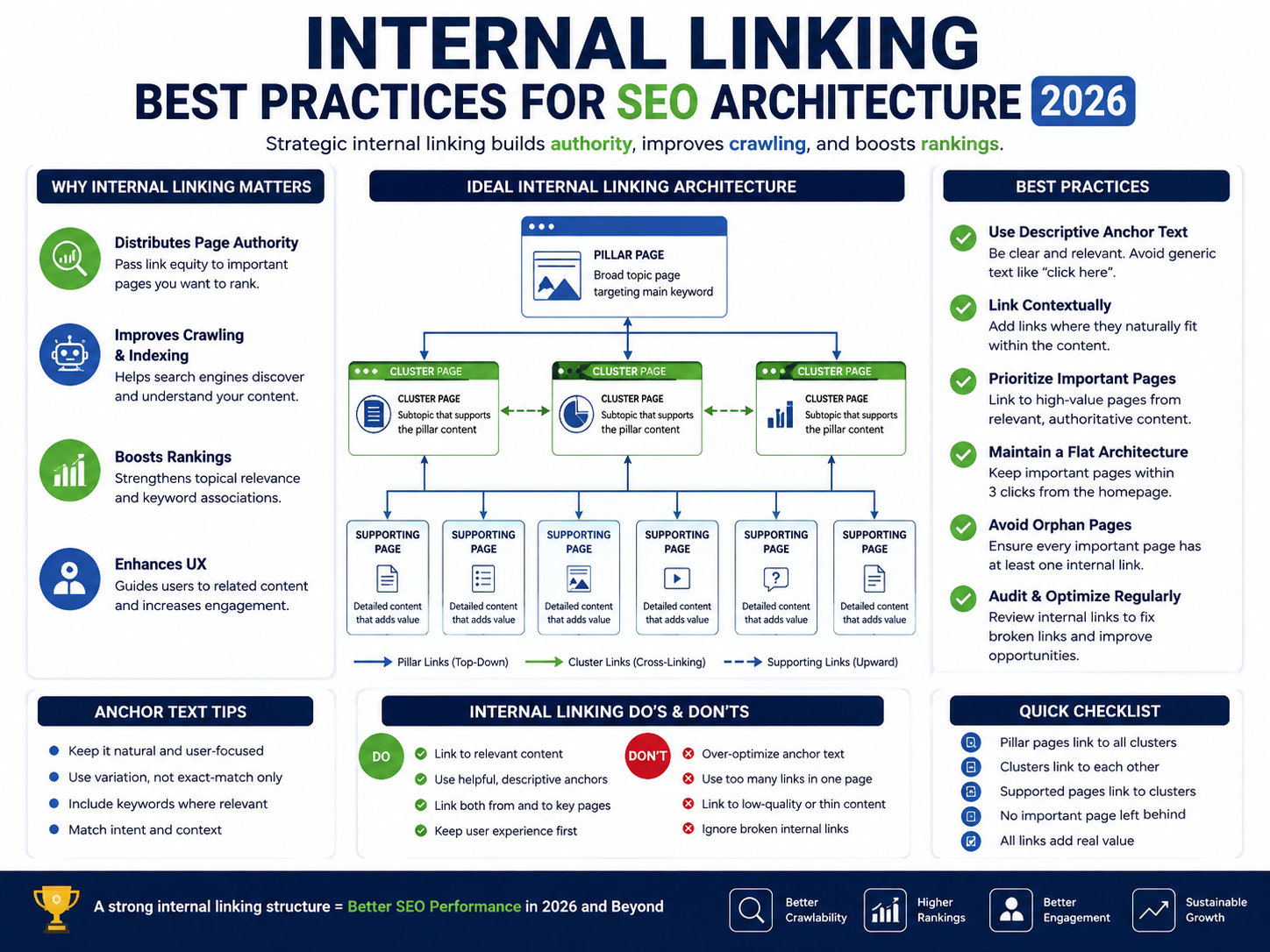
A strong internal linking strategy usually starts with hierarchy. Broad pillar pages should connect to narrower supporting content, while those supporting pages link back to relevant parent topics.
Useful lateral links can also connect related resources that serve the same search journey.
Build a Pillar → Cluster → Supporting Page Architecture
Start with a primary pillar page covering a broad topic.
Then create supporting content around narrower subtopics and questions. Those pages should link back to the main pillar where relevant, while the pillar links down to strong supporting resources.
This creates a connected topic cluster rather than a collection of isolated articles.
Mak It Solutions’ topic cluster strategy guide explores this model in more detail.
Keep the Internal Link Structure Shallow and Logical
Important pages should be reasonably easy to reach through navigation, hub pages, breadcrumbs, or contextual links.
There is no universal “three-click” SEO rule. Still, deeply buried pages can be harder for both users and crawlers to discover.
The practical goal is simple: do not hide valuable pages behind unnecessary layers.
Google Search Console’s Links report can also help identify which pages receive the most internal links and which pages link to specific URLs.
Map Links Around Search Intent and Page Value
Not every URL deserves the same level of internal support.
Give stronger internal visibility to pages with.
High business value
Strong conversion potential
Important ranking opportunities
Strategic topical importance
Clear usefulness within the user journey
For example, a SaaS company in San Francisco may use educational articles to support a product or solution page. A London consultancy might connect informational guides to high-intent service pages.
Mak It Solutions’ service page SEO guide explains how search intent, technical SEO, and conversion goals can work together.
What Anchor Text Should You Use for Internal Links?
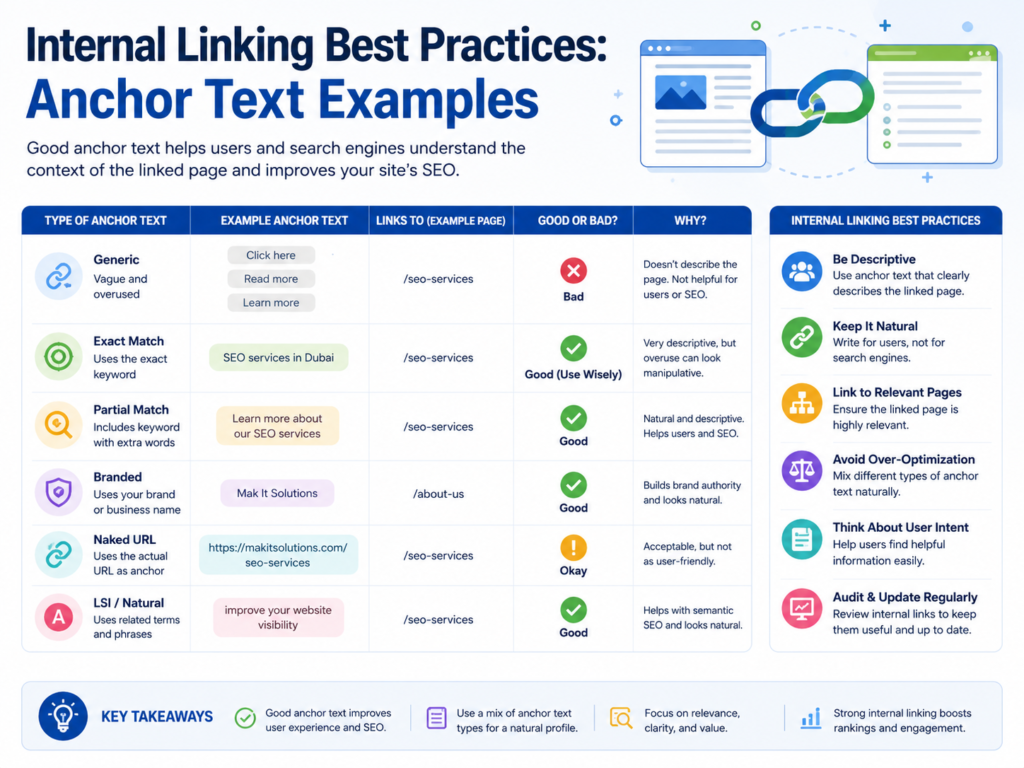
Use concise, descriptive anchor text that makes the destination clear before a visitor clicks.
Exact-match anchor text can be completely natural in the right context. The problem begins when the same optimized wording is repeated mechanically across a site.
Match Anchor Text to the Destination Page
Good anchor text sets an accurate expectation.
Compare these examples.
Weak: click here
Better: technical SEO audit process
Better: AI search optimization strategy
Better: internal linking strategy guide
The stronger versions tell users what they are about to open.
Descriptive anchors can also help search engines understand the relationship between the source page and the destination.
Use Exact-Match and Partial-Match Anchors Naturally
Exact-match anchors are not automatically harmful.
If the wording fits the sentence naturally and accurately describes the destination, it can work well. You can also use.
Partial-match anchors
Synonyms
Branded wording
Long-tail descriptive anchors
Natural variations of the topic
The goal is clarity, not mechanical keyword repetition.
Avoid Common Anchor Text Mistakes
Internal anchor text becomes less useful when it is vague, misleading, repetitive, or unrelated to the destination.
Common mistakes include.
Repeating the same optimized phrase across many pages
Linking unrelated keywords to a target URL
Using vague wording such as “read more” without context
Forcing keywords into unnatural sentences
Linking to a destination that does not satisfy the expectation created by the anchor
Treat anchor text as navigation first and optimization second.
How Many Internal Links Should a Page Have?
There is no universal Google-approved number of internal links a page should contain.
A long, detailed guide may need many useful internal links. A short landing page may need far fewer. The correct number depends on the page’s purpose, length, structure, and user journey.
Do Not Optimize Around a Fixed Link Limit
Trying to hit an arbitrary target such as 10, 20, or 50 internal links can lead to clutter.
Instead, ask whether each link earns its place.
A useful internal link should usually meet most of these conditions.
The destination helps the reader
The destination is topically relevant
The target page is current and useful
The link supports an important journey
The anchor text accurately describes the destination
If a link adds little value, remove it.
When Do Too Many Internal Links Become a Problem?
Too many links become a problem when they make a page harder to use.
Warning signs include.
Distracting link clutter
Repetitive navigation
Too many competing calls to action
Multiple links to low-value pages
Important destinations becoming visually indistinguishable from minor ones
More links are not automatically better. Strong internal linking creates hierarchy instead of flattening it.
How Do Internal Links Affect SEO, PageRank and AI Search?
Internal links can help search engines discover URLs, understand relationships between pages, identify important content, and distribute authority across a site.
They can also reinforce topic structures that make a site’s information architecture easier for machine systems to interpret.
Internal Links, PageRank and Link Equity
Authority can flow through links from stronger pages toward deeper destinations, but internal PageRank should not be treated as a perfectly measurable score.
Third-party authority metrics can be useful for analysis, but they are not direct measurements of Google’s PageRank.
Focus on sensible link equity distribution rather than attempting to engineer precise mathematical sculpting.
Internal Linking for Crawlability and Indexation
Crawlable HTML links help search engines discover pages.
In practice, important destinations should be connected through standard, accessible links rather than hidden behind unnecessarily complex implementations.
WordPress, Shopify, Webflow, Wix, and custom websites can all support strong internal linking, but menus, related-post widgets, templates, and JavaScript components still require oversight.
For additional platform context, see Mak It Solutions’ WordPress, Webflow and Wix comparison.
Internal Linking for Topic Authority and AI Understanding
Clear pillars, descriptive anchors, and connected supporting pages create stronger relationships between topics.
That does not guarantee visibility in AI-generated answers or search summaries. It does, however, make the structure of your content easier to interpret.
For a broader approach, see Mak It Solutions’ SEO for AI search guide.
How to Audit and Optimize Internal Links
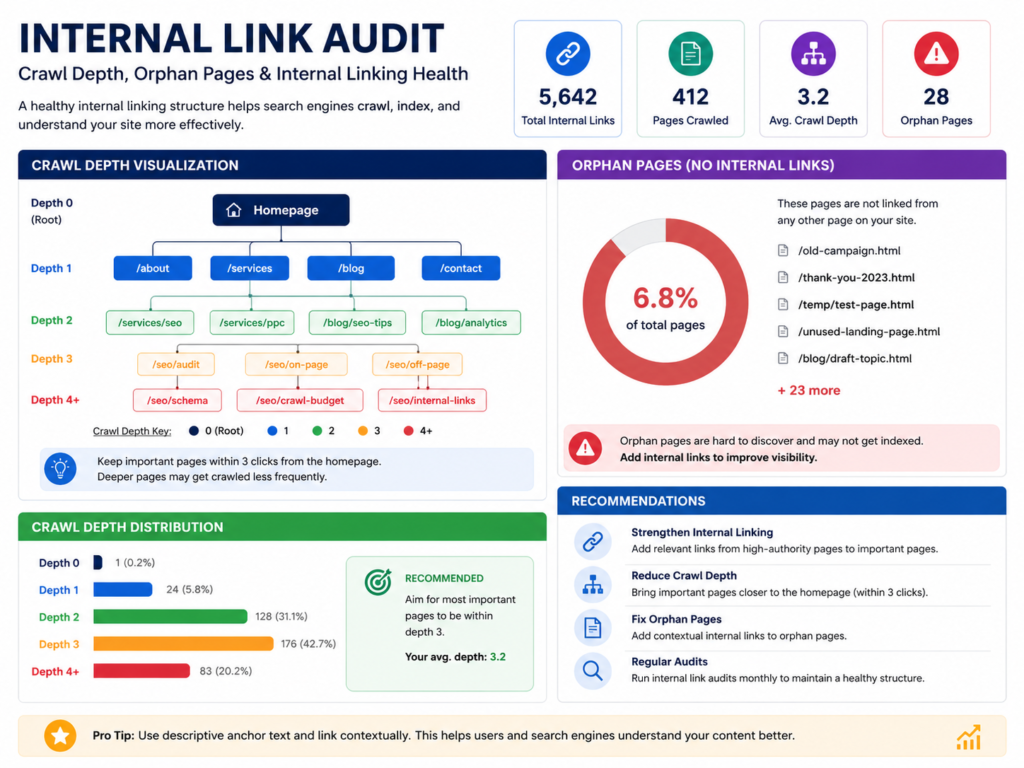
A useful internal linking audit looks for broken URLs, orphan pages, unnecessary redirects, weak anchors, excessive crawl depth, under linked priority pages, and isolated content.
The objective is not to maximize the number of links. It is to improve relevance, discoverability, and hierarchy.
Find Broken Links, Orphan Pages and Excessive Crawl Depth
Google Search Console can be combined with crawlers such as Screaming Frog, Ahrefs, Semrush, Sitebulb, SISTRIX, or Suability.
During an audit, look for.
Internal links pointing to 404 pages
Links that unnecessarily pass through redirects
Pages with very few meaningful internal links
Important URLs buried deep in the architecture
Sitemap URLs that are poorly connected internally
Old anchors that no longer match the destination
Comparing crawl data with your sitemap and analytics can reveal pages that technically exist but are poorly integrated into the site.
Strengthen Pages That Need More Internal Authority
Prioritize pages that matter to both users and the business.
These may include.
Revenue-generating service pages
Important category pages
High-value informational resources
Pages close to stronger search visibility
New resources that have not yet accumulated many internal links
A well-planned web architecture makes these relationships easier to maintain over time. Mak It Solutions’ modern web development guide covers crawl paths and SEO-ready site structure in more detail.
Create a Recurring Internal Linking Maintenance Process
Internal linking should not be treated as a one-time cleanup task.
Review your links whenever you.
Publish new content
Refresh an existing article
Merge overlapping pages
Redirect URLs
Remove outdated content
Launch a new service, category, or resource hub
Periodic deeper audits can then identify broken destinations, isolated pages, weak topic clusters, and underlinked commercial URLs.
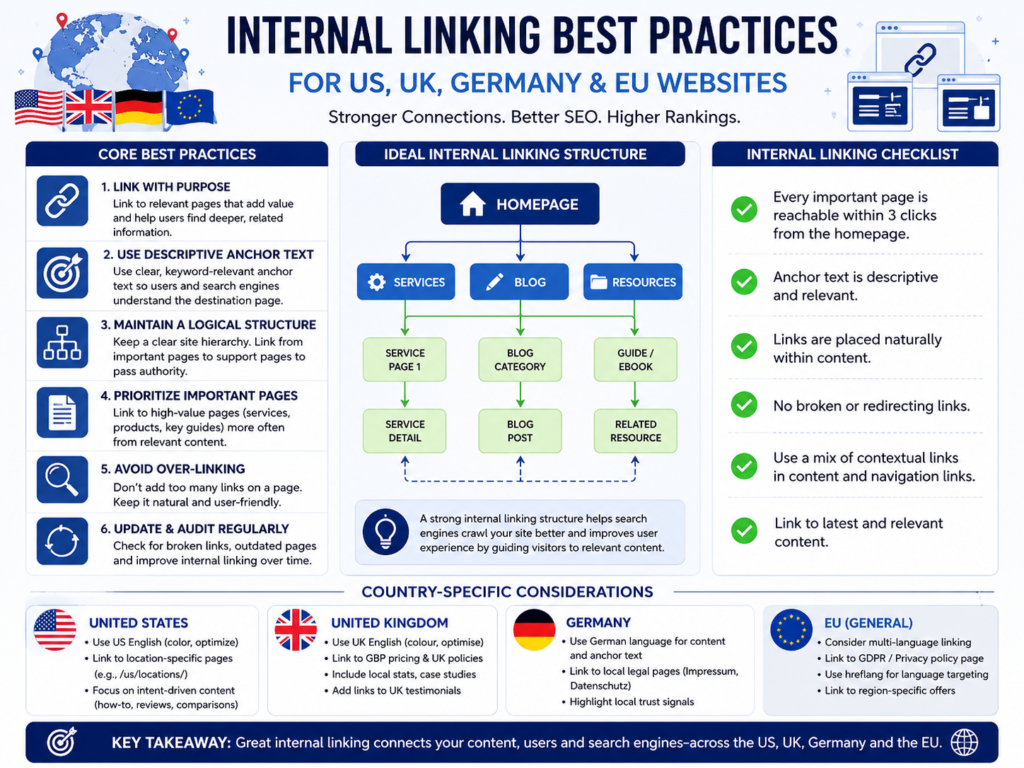
Internal Linking Best Practices for USA, UK, Germany and EU Websites
The core principles stay broadly consistent across markets, but international sites should make sure localized sections are equally well connected.
A strong multilingual architecture should not leave one country or language section structurally isolated.
US vs UK.
A page aimed at New York readers may naturally use optimization, while a London or Manchester page may use optimization.
Regional wording should match the audience, but the site architecture should remain consistent.
Do not create disconnected US and UK content silos simply because spelling or terminology differs.
German SEO.
For German-speaking users in markets such as Germany, Austria, or Switzerland, natural SEO terminology can include interne Verlinkung, Ankertext, Linktiefe/Klicktiefe, and Linkjuice.
Anchor text should still be written for the user. Avoid mechanically translating English keyword phrases when a more natural German expression would make the destination clearer.
Multilingual Linking, Hreflang and Regional Architecture
For international websites serving the United States, United Kingdom, Germany, France, the Netherlands, Ireland, Austria, and Switzerland, localized versions should have comparable crawl paths where practical.
If localized or language-specific versions of the same page exist, hreflang may also be appropriate to help search engines understand regional and language relationships.
Whether your international architecture uses country domains, subdomains, or subfolders, avoid turning regional sections into orphaned mini-sites.
If analytics or personalization tools are used across European or UK markets, privacy and consent requirements should also be considered separately from SEO architecture.
Final Thoughts
Internal linking best practices work best when they are built around relevance, hierarchy, and user intent.
You do not need a magic number of links or aggressive anchor-text formulas. You need a structure that helps people find the next useful page while making important content easy for search engines to discover and understand. ( Click Here’s )
If you want to uncover orphan pages, weak anchor patterns, buried commercial URLs, and missed authority opportunities, explore Mak It Solutions’ professional SEO services and request a scoped SEO review.
Key Takeaways
Add contextual internal links where they genuinely help the reader.
Build pillar, cluster, and supporting-page relationships around search intent.
Use concise, descriptive anchor text instead of vague or repetitive wording.
Give priority pages stronger internal support without linking everything to everything.
Keep important content reasonably easy to discover.
Fix orphan pages, broken links, unnecessary redirects, and weak crawl paths.
Maintain consistent architecture across US, UK, German, and wider European site sections.
Treat internal linking as an ongoing SEO system rather than an occasional cleanup task.
FAQs
Q : Should internal links open in the same tab or a new tab?
A : In most cases, internal links should open in the same tab because that matches normal website navigation. Opening every internal link in a new tab can create browser clutter and accessibility friction.
A new tab may make sense in a specific workflow where users genuinely need to keep the original page open, but that is a usability decision rather than an SEO tactic.
Q : Can too many internal links dilute PageRank?
A : Adding more internal links distributes attention and link equity across more destinations, but there is no fixed numerical limit you should optimize around.
The bigger risk is losing hierarchy. If every page links prominently to everything else, users and search engines receive fewer clues about which destinations matter most.
Q : Should you link to the same internal page more than once?
A : Yes, when more than one link genuinely helps navigation or context.
A page may link to the same destination through navigation and again inside the body. Repeating the same link many times solely for SEO value is unnecessary.
Q : Do breadcrumb links count as internal links for SEO?
A : Yes. Breadcrumbs are internal links that help communicate hierarchy and make it easier for visitors to move back through categories or sections.
They are especially useful on ecommerce stores, large publishing sites, SaaS documentation, and deeply structured service websites. Breadcrumbs should complement contextual links rather than replace them.
Q : Should no index pages receive internal links?
A : They can when users still need access to them.
Login pages, utility pages, filtered views, or campaign pages may reasonably receive internal links while remaining outside search results. However, important indexable pages should still have strong crawlable paths from relevant indexable content.
[…] Zero-Click SEO Builds Visibility in AI […]