


Topic Clusters for SEO: Win More Tech Rankings
Topic Clusters for SEO: Win More Tech Rankings
Topic Clusters for SEO: Win More Tech Rankings
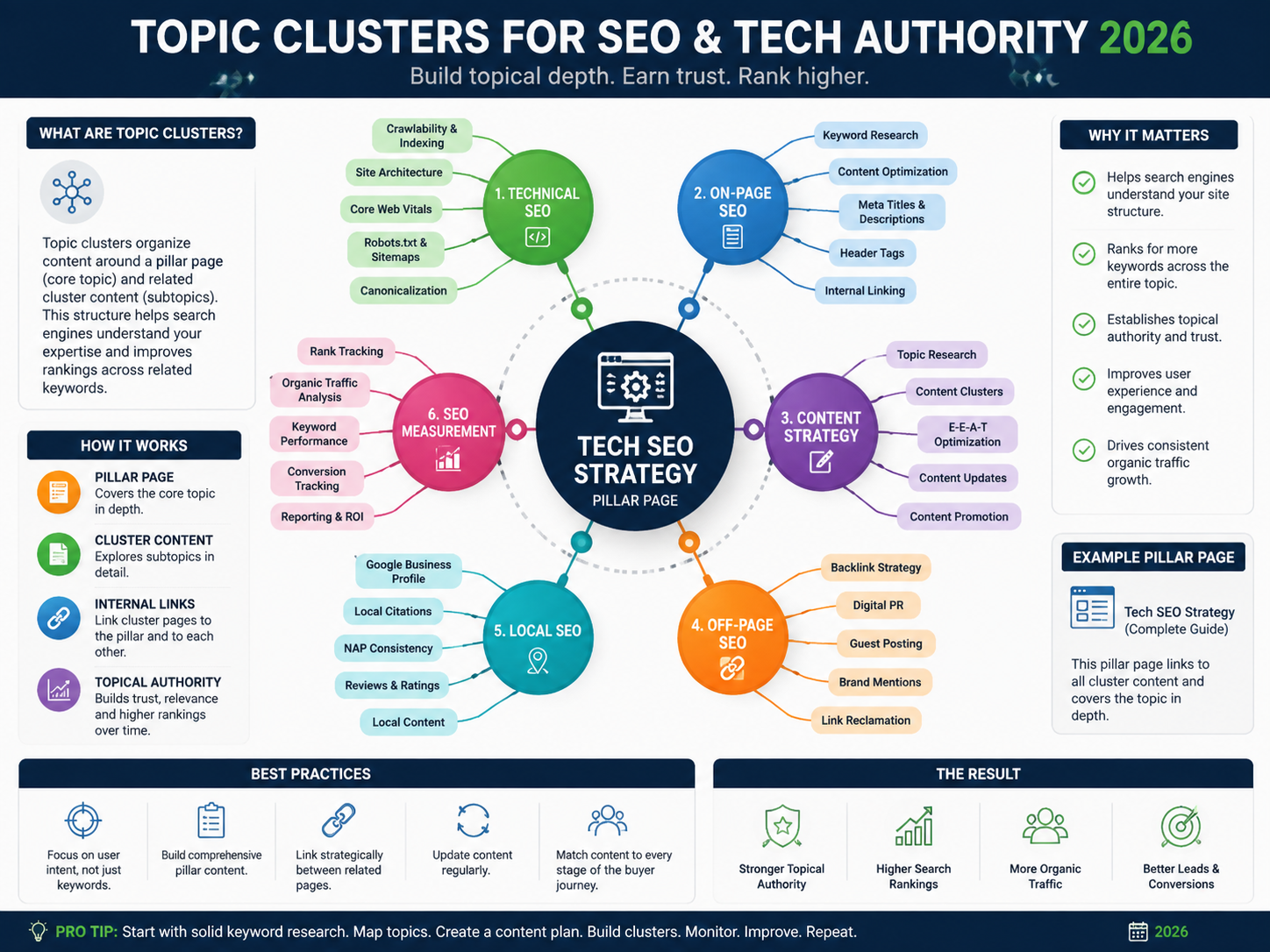
Topic clusters for SEO turn disconnected articles into a structured content system built around one central subject. Instead of publishing separate posts for every keyword variation, you organize related pages around a pillar, cover distinct search intents with supporting content, and connect everything through useful internal links.
For technology companies, that structure is especially valuable. Subjects such as AI, SaaS, cybersecurity and cloud infrastructure are too broad to explain well on a single page. A well-planned cluster gives readers a clear path from high-level education to technical detail, comparison and commercial research.
What Are Topic Clusters for SEO?
A topic cluster is a group of closely related pages organized around a central subject.
The pillar page covers the broad topic, supporting articles answer narrower questions, and contextual internal links connect the pages into one clear information architecture.
In simple terms:
Pillar page → supporting cluster content → contextual internal links → broader topical coverage
This structure helps users move naturally through a subject while making relationships between pages easier for search engines and AI-assisted answer systems to interpret.
Pillar Pages vs. Cluster Pages
A pillar page gives broad, authoritative coverage of a subject such as cloud infrastructure or cybersecurity compliance.
Cluster pages go deeper into individual questions or use cases, such as.
AWS migration
SOC 2 readiness
Cloud cost optimization
Security audits
SaaS integrations
Together, these pages create an information hierarchy rather than a collection of isolated blog posts.
How the Hub-and-Spoke Content Model Works
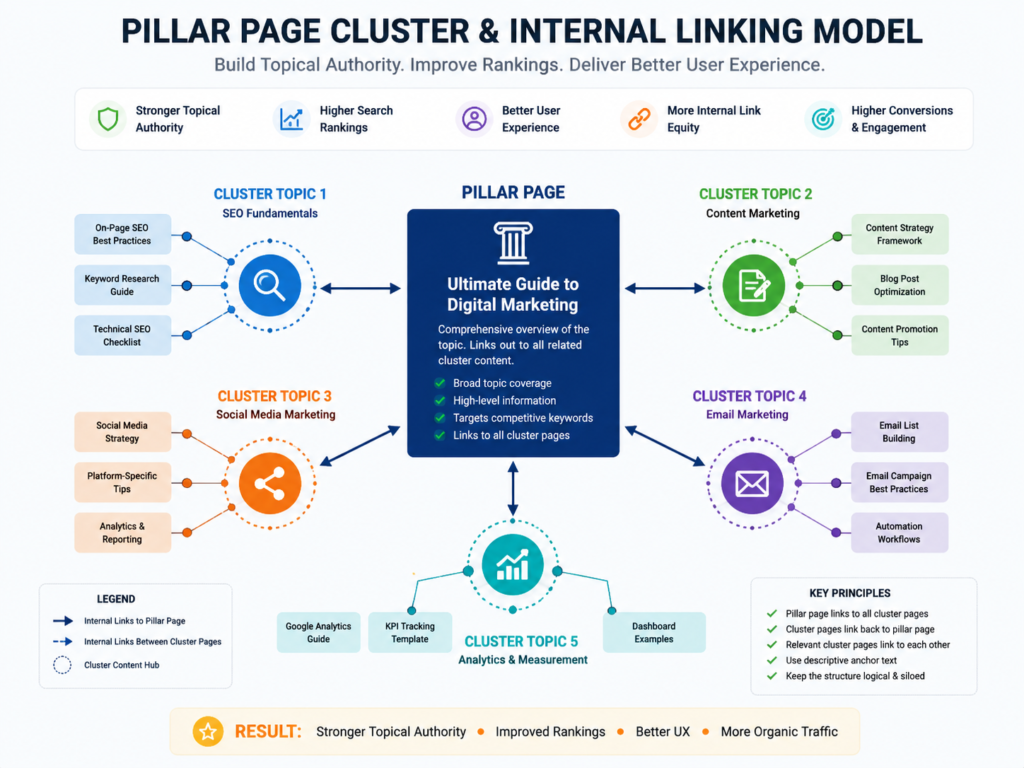
The hub-and-spoke model places the pillar at the center and supporting pages around it.
Each cluster article should connect back to the pillar where useful. The pillar, in turn, should guide readers toward more detailed supporting resources. Related cluster pages can also link to one another when the connection genuinely helps the reader.
Google recommends contextual internal links and descriptive anchor text because links help it discover pages and understand their relevance.
Mak It Solutions’ guide to internal linking strategy explains how a deliberate linking structure can also reduce orphan pages and strengthen site hierarchy.
Topic Clusters vs. Content Clusters
“Topic clusters” and “content clusters” usually refer to the same basic model, although topic clusters is the more common English SEO term.
German-language strategies may use terms such as Themencluster, Content Cluster and Pillar Content.
The terminology matters less than the architecture. Each page should address a distinct intent without creating unnecessary overlap.
How Topic Clusters Build Topical Authority
Topic clusters can strengthen topical authority by covering a subject comprehensively across connected pages.
Instead of expecting one article to answer every possible question, the site builds depth across multiple URLs while keeping the relationships between those URLs clear.
From Isolated Keywords to Topical Coverage
A keyword-by-keyword publishing strategy can quickly become fragmented.
For example, a SaaS company could create separate articles for dozens of CRM-related phrases with no clear relationship between them. A stronger approach is to build one CRM pillar supported by focused content covering areas such as.
Implementation
Integrations
Pricing
Migration
Security
Analytics
This is closer to how people actually research complex technology products.
Mak It Solutions’ guide to entity SEO and AI-search authority provides a related framework for clarifying entities and their relationships.
Search Intent, Content Gaps and Keyword Cannibalization
Before creating a new cluster page, ask what problem the URL will solve.
Two keywords that look different may represent the same intent. If two articles answer essentially the same question, publishing both can create unnecessary competition between URLs.
A cluster inventory helps reveal.
Missing search intents
Duplicate or overlapping articles
Weakly connected pages
Commercial gaps
Content that should be refreshed or consolidated
In practice, improving an existing cluster is often more valuable than simply adding more posts.
Topic Clusters, E-E-A-T and AI Search Visibility
Topic clusters do not create authority automatically.
Strong architecture still needs.
Accurate technical explanations
Credible sources
Clear authorship
Useful examples
First-hand or expert input where available
Regular updates for fast-changing subjects
Clusters can also make content easier to navigate as AI-assisted search expands. Google reported in 2024 that AI Overviews were expected to reach more than 1 billion monthly users globally.
That does not mean “topical authority” is a confirmed standalone Google ranking factor. The practical value comes from building useful, connected coverage that gives readers and machines clearer context.
How to Build Topic Clusters for a Tech Blog
To build topic clusters for SEO on a technology site, start with one commercially relevant subject, map the important intents around it, assign each distinct intent to an appropriate URL and connect those pages with descriptive internal links.
Expand the cluster only when an additional page solves a genuinely different user need.
Choose a Pillar Topic Around Product, Audience and Demand
Strong pillar topics usually sit at the intersection of four signals.
Product or service relevance
Audience pain points
Organic search demand
Internal expertise
For a technology company, possible pillar subjects include.
AI software
Cybersecurity
Cloud infrastructure
Developer tools
Fintech
B2B SaaS
Educational clusters should also have a natural route toward relevant commercial pages. For example, Mak It Solutions’ SEO services can serve as a conversion destination from content focused on organic growth and search strategy.
Map Keywords and Search Intent Into Cluster Pages
Group queries by intent rather than by wording alone.
For example:
| Query | Likely Intent | Possible Content Type |
|---|---|---|
| Best cloud platform for SaaS | Commercial investigation | Comparison guide |
| AWS vs Azure | Comparison | Versus article |
| How to migrate SaaS infrastructure | Implementation | Step-by-step guide |
These searches share entities, but the user needs are different.
Commercial resources can also connect naturally with a strong service-page SEO framework.
Decide How Many Articles Belong in Each Cluster
There is no universal number of pages required for a successful cluster.
Five strong articles may cover a narrow technical topic better than 25 thin posts.
The goal is not publishing volume. It is sufficient depth to answer meaningful sub-intents without creating duplication, keyword cannibalization or low-value pages written simply to make the cluster look larger.
Internal Linking Strategy for Topic Clusters and Pillar Pages
Internal linking is what turns a set of related articles into a functioning topic cluster.
Supporting pages should point readers toward the pillar when that resource adds context. The pillar should guide users into deeper articles, and closely related cluster pages can link laterally where useful.
Link Supporting Pages Back to the Pillar
Use anchor text that clearly describes the destination.
For example, “cloud cost optimization guide” tells the reader far more than “click here.”
Google’s guidance similarly recommends concise, relevant anchor text that helps both users and Google understand the linked page.
Build Lateral Links Between Related Articles
Cross-link cluster pages when there is a genuine relationship.
An article about AI governance could link to EU AI Act implementation guidance. A structured-data article could connect naturally to Mak It Solutions’ schema strategy for AI search.
The goal is to improve the user journey not to insert links simply because two pages belong to the same category.
Audit Orphan Pages, Link Depth and Cannibalization
Use a crawler, Search Console data and a content inventory to identify.
Orphan pages
Important URLs buried too deeply
Weak internal-link paths
Several pages targeting the same intent
Older articles that should be consolidated
Audit the architecture before commissioning more content. Sometimes the fastest SEO improvement comes from reconnecting or merging pages that already exist.
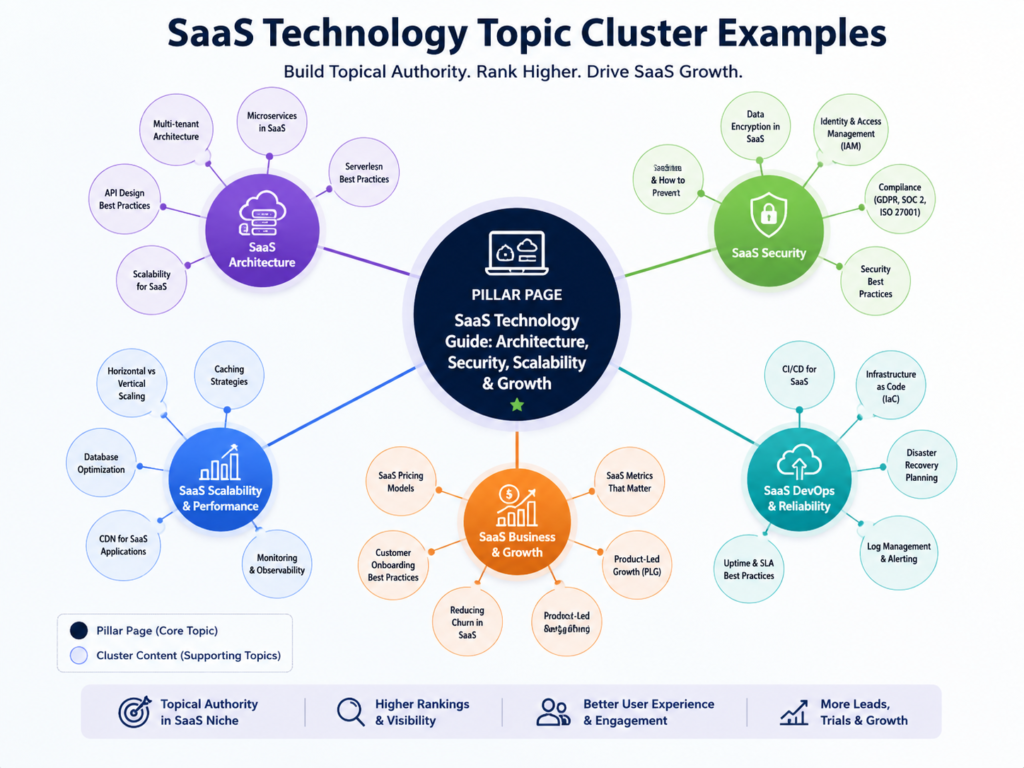
Topic Cluster Examples for SaaS and Technology Companies
The right cluster structure depends on the product, buyer journey and level of technical depth your audience expects.
Cybersecurity SaaS Cluster Example
A pillar titled Cybersecurity Compliance for SaaS could connect supporting pages covering.
SOC 2
ISO 27001
HIPAA
NIS2
GDPR
Security-audit readiness
This allows one broad compliance theme to support multiple industries and regions without forcing every regulation into one oversized article.
Cloud and Developer Tools Cluster Example
A Cloud Infrastructure Guide could branch into content about.
AWS
Microsoft Azure
Google Cloud
Containers
Observability
APIs
DevOps workflows
Public-cloud end-user spending was forecast at roughly $675 billion in 2024.
Related analytical content can also lead naturally to services such as business intelligence and analytics when a reader moves from research toward implementation.
AI Software and Fintech Cluster Example
An AI cluster might cover:
Governance
Model deployment
Evaluation
Security
Compliance
EU AI Act requirements
A fintech cluster may include Open Banking, PCI DSS, DORA and BaFin requirements where those topics genuinely match the target market.
Worldwide enterprise application SaaS revenue was approximately $218.5 billion in 2024.
For B2B software publishers operating in competitive categories, that scale makes clear content differentiation increasingly important.
Localizing Topic Clusters for the USA, UK, Germany and EU
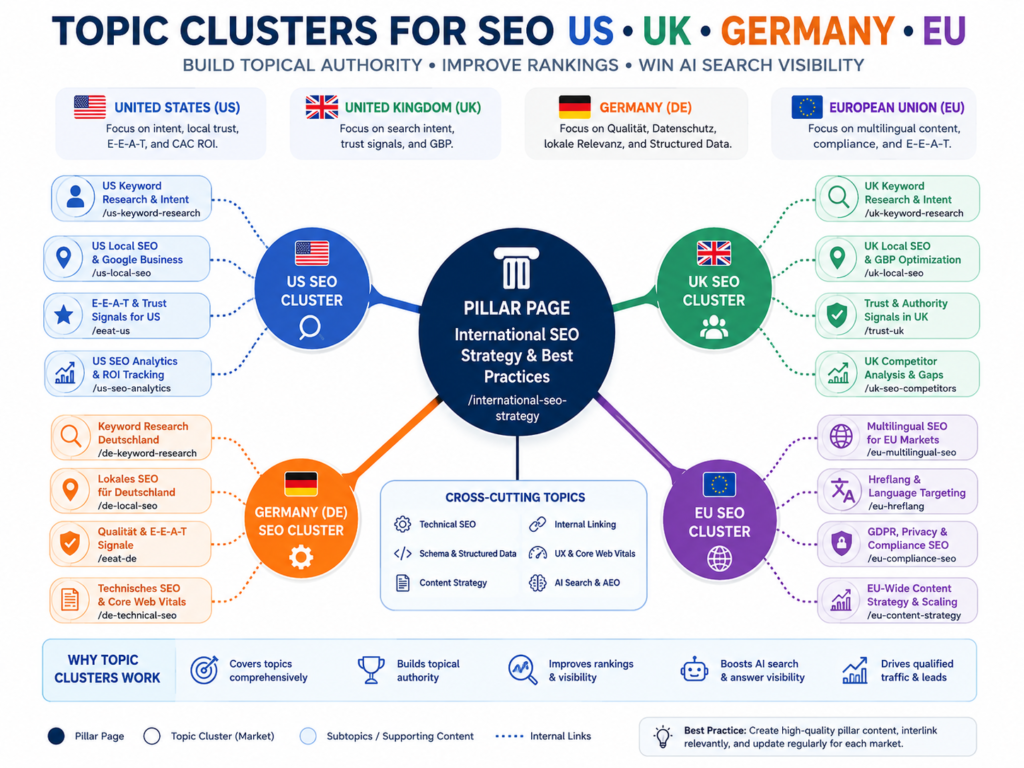
International topic clusters should maintain a shared conceptual structure while adapting language, regulation, terminology, examples and buyer expectations to each market.
A cybersecurity cluster, for example, might emphasize SOC 2 or HIPAA in the US, UK-GDPR in Britain, DSGVO in Germany and NIS2 for relevant EU audiences.
USA.
A San Francisco SaaS company may focus heavily on cloud infrastructure and SOC 2.
A Boston health-tech business may need HIPAA-related resources. Technology companies in New York, Austin or Seattle can similarly adapt examples around relevant local industries without creating thin city pages simply for geographic targeting.
Localization should reflect real user needs, not just location names.
UK.
For UK audiences, fintech and SaaS content may reference.
FCA expectations
Open Banking
UK-GDPR
ICO guidance
The ICO confirms that UK GDPR operates alongside the Data Protection Act 2018, so jurisdiction-specific wording matters rather than simply duplicating EU-focused content. (ICO)
London-focused fintech content may differ from technology content aimed at Manchester or Cambridge, where SaaS, research and healthcare contexts can create different search needs.
Germany and EU.
For German audiences, adapt terminology to natural search behavior.
Relevant terms may include:
Themencluster
Thematische Autorität
Interne Verlinkung
DSGVO
Berlin SaaS, Munich enterprise-tech and Frankfurt fintech audiences may also encounter BaFin, BSI, DORA or NIS2 considerations.
EU-focused AI content should reference the actual EU AI Act rather than generic “European AI rules.” Regulation (EU) 2024/1689 establishes the EU’s harmonized framework for artificial intelligence. (EUR-Lex)
Use hre flang where appropriate for language or regional variants, but do not treat localization as literal translation. Search demand, terminology, compliance context and buyer expectations may all change between markets.
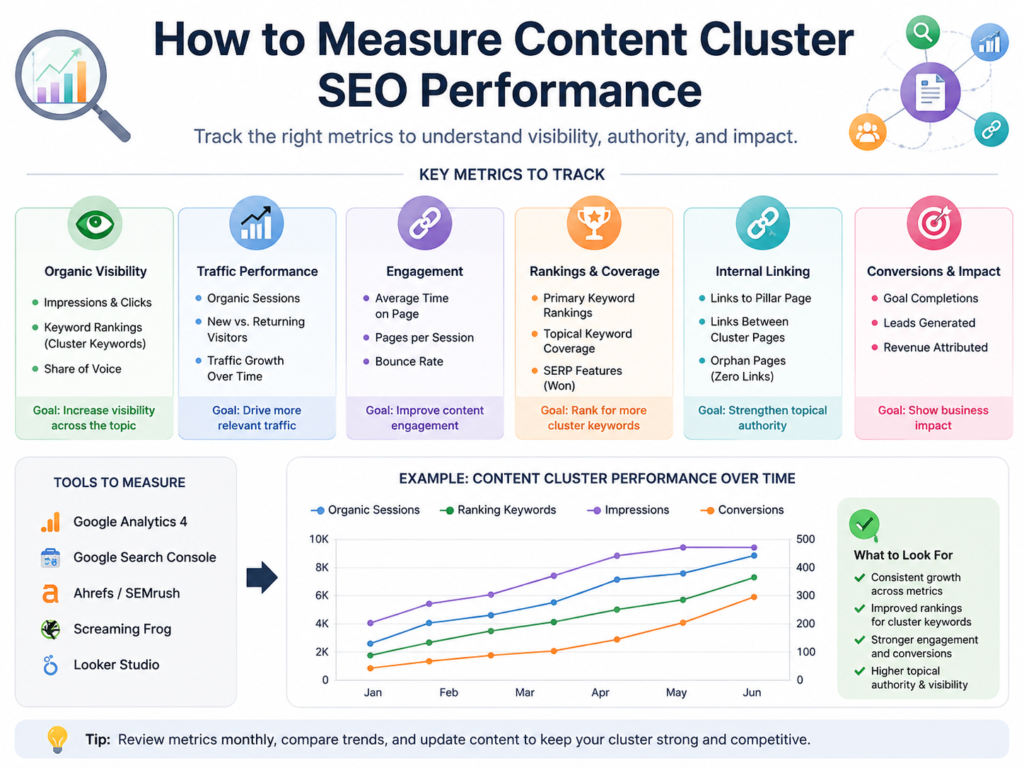
How to Measure and Improve a Content Cluster Strategy
Topic clusters for SEO should be measured as connected portfolios rather than as isolated URLs.
Track Rankings Across the Whole Topic
Monitor performance across both the pillar and supporting pages.
Useful metrics include.
Organic impressions
Organic clicks
Ranking distribution
Conversions
Visibility across supporting queries
Commercial landing-page visits
A cluster may begin gaining dozens of relevant mid-tail searches before its highest-volume keyword shows significant movement.
Measure Internal-Link and Engagement Signals
Review how users and crawlers move through the cluster.
Useful signals include.
Crawl depth
Internal clicks
Movement between pillar and supporting pages
Assisted conversions
Engagement with relevant service pages
For broader acquisition analysis, SEO performance can connect with the company’s digital marketing services and analytics approach rather than being judged by rankings alone.
Expand, Consolidate or Refresh Content
Add a page when a genuine intent gap appears.
Consolidate content when several URLs compete to solve essentially the same problem. Refresh pages when technical facts, regulations, platform capabilities or buyer expectations change.
This matters particularly for.
AI
Cybersecurity
Cloud platforms
Compliance
Software pricing
Technical documentation
Outdated information can weaken trust even when the overall cluster architecture is strong.
Final Thoughts
Effective topic clusters for SEO are not about publishing as many related articles as possible. They are about organizing expertise in a way that helps people move from broad questions to specific answers without confusion.
Before publishing another isolated technology article, audit one commercially important topic already on your website. Map the existing URLs, identify missing intents, consolidate overlap and strengthen the internal links between pages that genuinely belong together. ( Click Here’s )
If you want help turning that audit into a scalable content architecture, explore Mak It Solutions’ Search Engine Optimization services and request a scoped consultation.
Key Takeaways
Topic clusters connect pillar content, supporting pages and contextual links into one coherent architecture.
Build clusters around search intent and commercial relevance—not article volume.
Use descriptive internal links and regularly audit orphan pages, crawl depth and overlapping URLs.
Localize clusters for US, UK, German and EU regulations, terminology and buyer expectations.
Treat topical authority as the outcome of useful, credible subject coverage rather than a guaranteed standalone ranking factor.
Measure visibility, engagement and conversion performance across the whole cluster.
FAQs
Q : Should old blog posts be added to a new topic cluster?
A : Yes. Existing articles are often one of the fastest ways to strengthen a new cluster. Review each post for relevance, freshness, search intent and overlap, then link useful pages to the pillar with descriptive anchors.
If several older posts answer the same question, consolidation may be better than forcing every URL into the structure.
Q : Can one article belong to more than one topic cluster?
A : Yes, when the article genuinely connects two subjects.
An AI security article, for example, could support both an AI governance cluster and a cybersecurity cluster. It should still have one clear primary purpose, with secondary links added only where they improve the reader’s journey.
Q : How often should a SaaS company update its topic clusters?
A : High-value SaaS clusters should generally be reviewed at least quarterly, with faster checks for rapidly changing topics such as AI regulation, cybersecurity, platform documentation and pricing.
Not every page needs a rewrite. Focus on whether search intent, technical facts, internal links and conversion paths have materially changed.
Q : Do multilingual websites need separate topic clusters for each country?
A : Not always.
A multilingual site can begin with one shared conceptual architecture and create localized versions where language, regulations, terminology or search intent differ significantly. UK, German and US audiences may research the same SaaS product in different ways, so localization should go beyond literal translation.
Q : What SEO tools can help identify missing pages in a topic cluster?
A : Google Search Console can reveal queries and URLs already earning impressions.
Crawlers such as Screaming Frog or Site bulb can help identify internal-link depth, orphan candidates and overlapping targeting, while keyword platforms can provide additional competitor and demand data.
The final decision should still come from human search-intent analysis rather than tool output alone.