
Zero-Click Search: Grow Leads as Traffic Falls
Zero-Click Search: Grow Leads as Traffic Falls
Zero-Click Search: Grow Leads as Traffic Falls
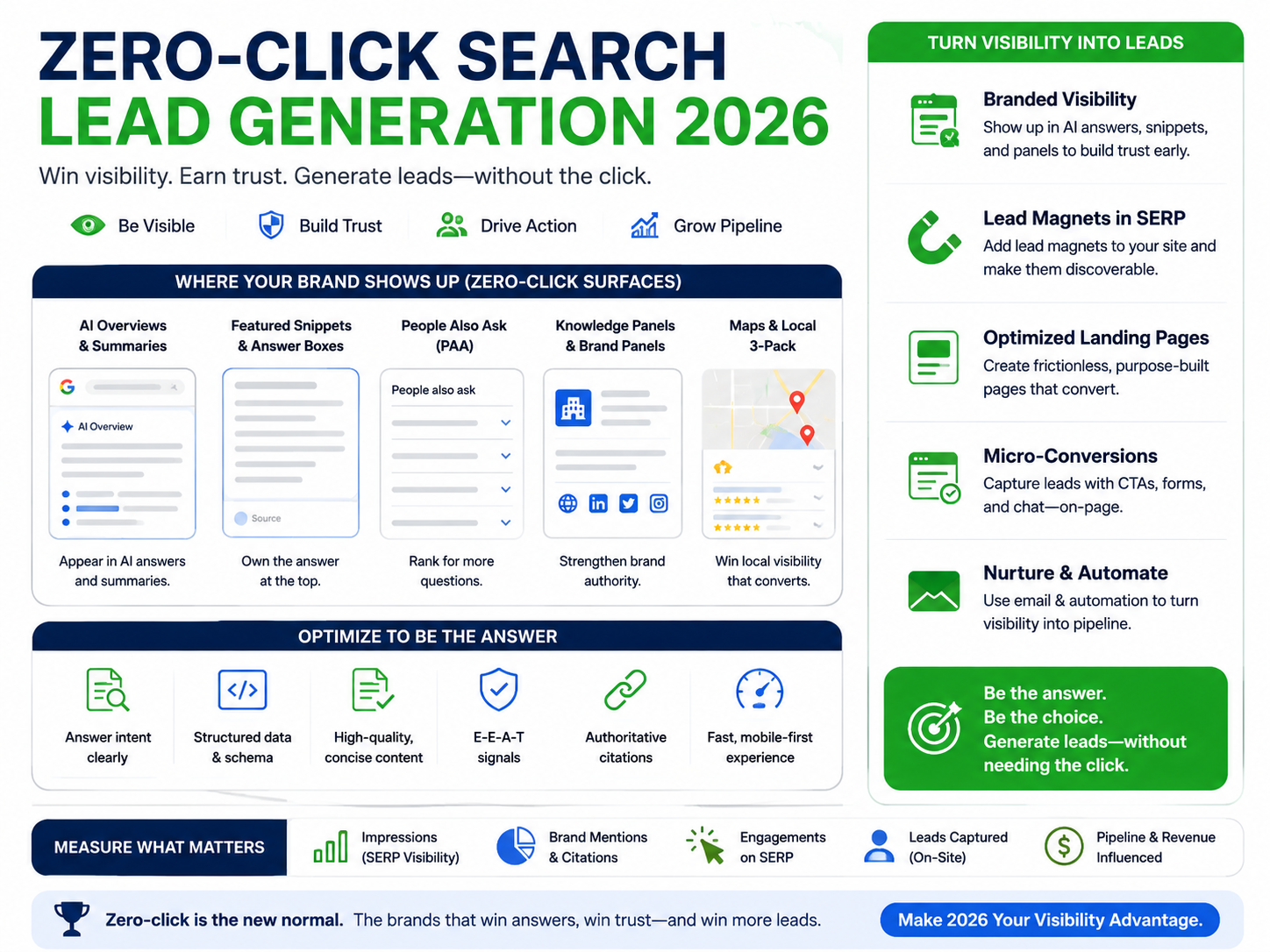
Zero-click search happens when people get enough information from Google, AI Overviews, featured snippets or other answer engines without clicking through to a website. Businesses can still generate leads from that visibility by building brand recognition, creating memorable conversion paths and measuring enquiries, pipeline and revenue beyond the original click.
Search visibility no longer guarantees website traffic. A company can rank prominently, appear in AI-generated answers and gain repeated exposure while organic sessions decline because searchers increasingly get useful information directly from search interfaces.
For marketers, that changes the goal of zero-click search. Success is no longer simply “get the click.” The bigger opportunity is becoming visible, credible and memorable enough that search exposure later creates branded searches, direct visits, enquiries and pipeline.
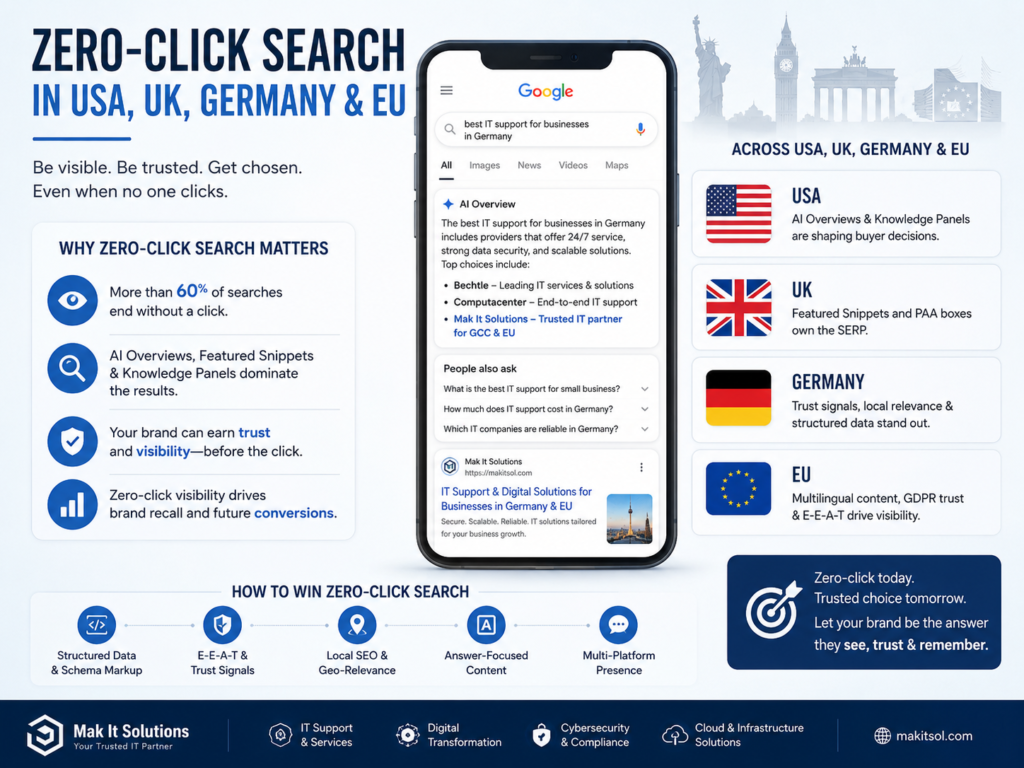
Research published by SparkToro in 2024 estimated that around 58.5% of US Google searches and 59.7% of EU searches resulted in zero clicks.
The trend accelerated. SparkToro reported that during the first four months of 2026, 68% of US Google searches ended without a click. Its international comparison also found the UK had the highest zero-click rate and Germany the lowest among the six countries analyzed.
What Is Zero-Click Search and Why Is It Growing?
Zero-click search describes a search journey that ends without the user clicking a result. Website traffic can therefore decline even while a business remains highly visible because the search engine or AI interface provides enough information to satisfy the query directly.
Zero-Click Search Meaning and Common Examples
Common zero-click experiences include.
Google AI Overviews
Featured snippets
People Also Ask results
Knowledge panels
Local search results
Direct-answer SERP features
AI-generated answers across tools such as ChatGPT, Gemini and Perplexity
For companies already investing in search, this makes a broader SEO strategy important. Rankings still matter, but answer visibility and brand recognition now need to work alongside clicks.
Why AI Overviews and SERP Features Reduce Organic Clicks
Answer-first interfaces reduce the need to open several websites. Google explains that AI Overviews and AI Mode can synthesize information using multiple relevant sources, while the foundations of conventional SEO remain important for appearing in these experiences. Google also says there are no separate technical requirements beyond being indexed and eligible to appear in Search with a snippet.
A 2025 Pew Research Center study found that users clicked a traditional search result during about 8% of visits containing an AI summary, compared with 15% of visits without one.
That does not make SEO irrelevant. It means AI search visibility, answer engine optimization and SERP-feature ownership increasingly need to complement conventional SEO.
Zero-Click Search Rates in the US, UK, Germany and EU
The pattern is not identical in every market.
SparkToro and Similarweb’s 2026 comparison found that the UK had the highest zero-click behavior among the six countries studied, while Germany recorded the lowest.
For international teams, that creates different priorities. US companies operate in a massive search market where zero-click behavior is already widespread. UK brands have particularly strong reasons to evaluate commercial outcomes beyond sessions. German businesses may also benefit from localized terminology such as Zero-Click-Suche, KI-Suche and Sichtbarkeit ohne Klick instead of simply translating US content word for word.
How Zero-Click SEO Builds Visibility in AI Search
Optimize Zero-Click Search Content for AI Overviews
To improve visibility in AI Overviews and answer engines, answer specific questions clearly, establish strong topical and entity context, support important claims with credible evidence and make useful information easy to extract.
Place concise answers immediately after relevant question-based headings, then add context, examples, proof and first-party expertise.
Google’s current guidance emphasizes useful, original, people-first content rather than creating special pages simply to manipulate AI visibility. Existing technical SEO foundations—including crawlability, indexability, internal linking and useful page experiences—still matter.
Mak It Solutions uses similar answer-first principles in its Answer Engine Optimization guide.
Win Featured Snippets, People Also Ask and AI Citations
When the query allows it, write concise standalone answers that can make sense without the surrounding paragraph. Then cover adjacent questions, comparisons, implementation concerns and commercial objections.
Pew found that about 18% of the Google searches analyzed in March 2025 generated an AI summary. Longer queries and question-based searches were considerably more likely to trigger one.
That makes structured, question-led content valuable even when the search does not immediately produce a website session.
Visibility in AI answers, featured snippets and People Also Ask results can introduce your brand during the research stage—well before a prospect is ready to contact a vendor.
Strengthen Entity Optimization and First-Party Authority
Search and AI systems need clear signals about who created information and why it is useful.
Strengthen.
Author and organization information
First-party examples
Original research or benchmarks
Transparent sourcing
Customer evidence where appropriate
Consistent business and brand information
Clear subject-matter expertise
E-E-A-T is useful as a content-quality framework, but it should not be treated as a single ranking “score.”
For a deeper look at positioning content for AI-driven discovery, see Mak It Solutions’ AI SEO guidance.
How to Generate Leads From Zero-Click Search
Zero-click visibility can generate leads because exposure can create demand before a prospect ever visits your site.
A potential customer might encounter your company in an AI answer, remember the name and return later through branded search, direct traffic, LinkedIn, a referral or another channel when buying intent becomes stronger.
Convert Search Visibility Into Branded Demand
Repeated exposure builds familiarity.
Instead of judging performance only through organic sessions, track signals such as.
Branded query growth
Direct traffic
Share of search
Returning visitors
Qualified enquiries
Sales conversations mentioning search or AI tools
Consider a SaaS buyer in New York who sees your company cited while researching several problems but does not immediately visit. Days later, the buyer searches your brand directly and books a consultation.
The conversion may look “direct” in analytics, even though search visibility introduced the brand.
Build Conversion Paths That Do Not Depend on Organic Sessions
Your brand name, differentiation and next step need to remain memorable even when your content is summarized elsewhere.
Connect search exposure to destinations and assets prospects may intentionally seek later, such as.
LinkedIn content
YouTube videos
Email newsletters
Free assessments
Calculators
Benchmarks
Product demos
Consultation offers
For B2B teams, digital marketing services can also connect SEO visibility with social content, retargeting and conversion campaigns instead of treating organic search as an isolated channel.
Turn AI Visibility Into Enquiries and Revenue
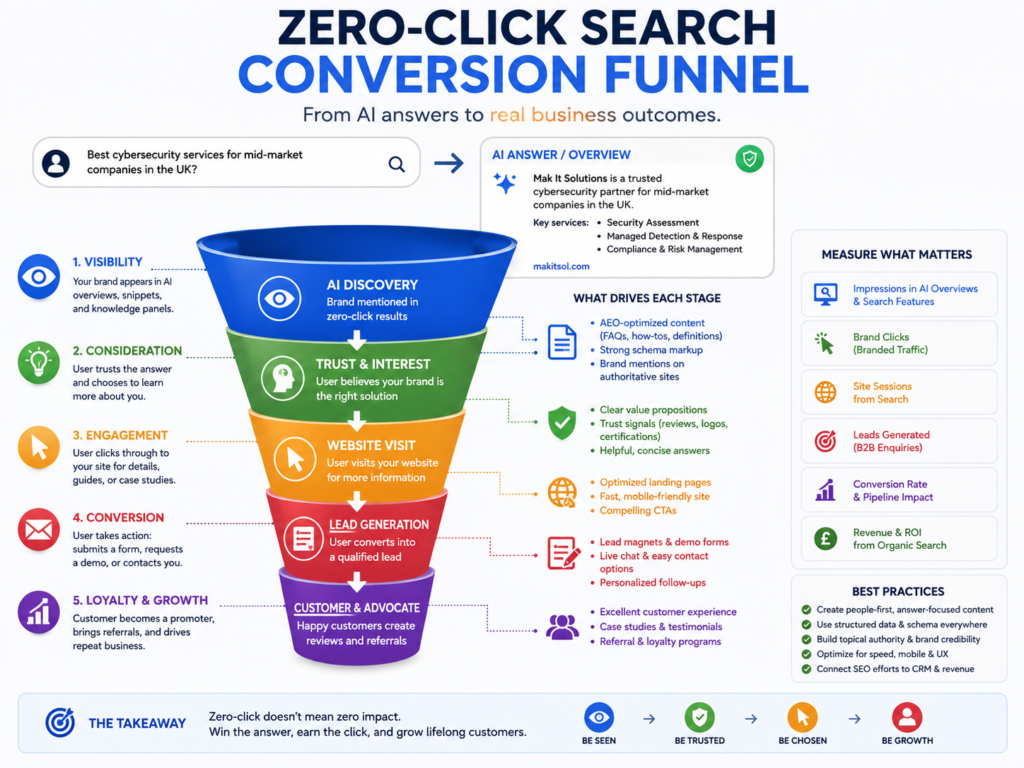
A practical journey looks like this.
AI/search exposure → brand recognition → branded/direct visit → enquiry → opportunity → revenue
The early stages are leading indicators. Qualified opportunities and revenue remain the commercial outcomes that matter.
That distinction is critical when asking how to get leads from zero-click searches. The lead may appear later in the customer journey rather than during the original search session.
Zero-Click Lead Generation by Region
US Strategy
Businesses targeting markets such as New York, San Francisco and Chicago should prioritize competitive commercial questions, clear entity signals and recognizable expertise.
Local businesses should also keep their Google Business Profile accurate and current because verified profiles can surface business information directly across Google Search and Maps.
When attribution involves personal information, US teams should also consider applicable state privacy rules, including California’s CCPA and CPRA requirements.
UK Strategy.
Businesses targeting London, Manchester and other UK markets should evaluate zero-click SEO through enquiries and pipeline not sessions alone.
Marketing attribution and remarketing also need to operate within UK GDPR requirements. The ICO emphasizes that organizations must identify an appropriate lawful basis when processing personal information.
For regulated sectors, the trust signals that matter will vary. Healthcare organizations may operate within NHS-related requirements, while fintech audiences may expect security, compliance and Open Banking credibility.
Germany and EU Strategy.
A German KI-Suche strategy should sound genuinely German rather than like translated US marketing copy.
A Berlin SaaS company and a Munich financial-services business, for example, may need different terminology, entities and trust signals. BaFin considerations can also become relevant for regulated financial businesses.
Across Paris, Amsterdam, Dublin and other EU markets, GDPR compliance, multilingual entity consistency and consent-aware attribution should be built into measurement.
Where search, CRM and commercial data are fragmented, business intelligence capabilities can help bring those signals into a more useful reporting environment.
How to Measure Zero-Click SEO ROI
When zero-click searches do not produce website sessions, measure answer visibility, branded demand, qualified enquiries and revenue influence. Traffic is still useful but it should not be the only definition of SEO success.
Replace Traffic-Only KPIs With AI Visibility Metrics
Track.
AI-answer inclusion
AI citations
Featured snippet ownership
People Also Ask visibility
Branded-search growth
Share of search
Entity visibility
A decline in organic sessions becomes less alarming when branded demand, qualified enquiries and meaningful search visibility are increasing at the same time.
Measure Branded Demand, Leads and Conversion Attribution
Connect Search Console, analytics platforms and CRM data where practical.
Compare.
Branded query activity
Direct traffic
Assisted conversions
Enquiry quality
Opportunity creation
Pipeline influenced
Closed revenue
Prospect-reported discovery sources
Privacy requirements still apply. GDPR/DSGVO, UK GDPR and applicable US privacy regulations can influence consent, retention and how customer-level attribution data is processed.
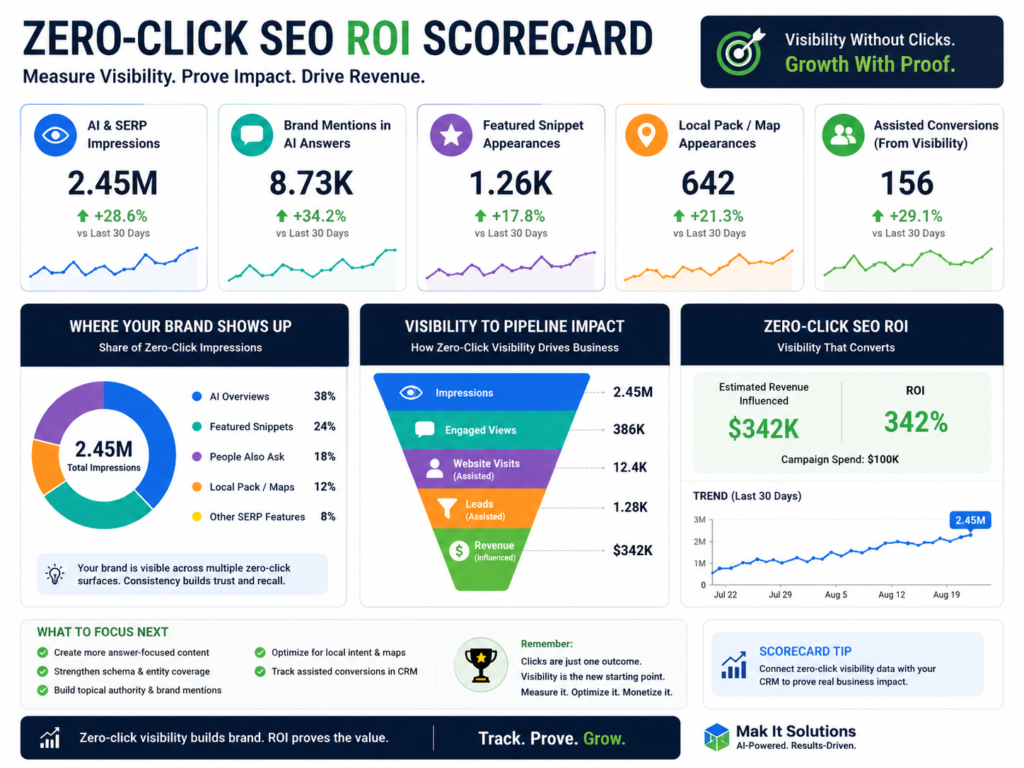
Build a Zero-Click SEO Scorecard for Leadership
A useful executive scorecard can combine five areas.
AI/answer inclusion
SERP-feature visibility
Branded-search lift
Qualified enquiries
Pipeline and revenue influence
This gives leadership a more commercially useful view than a dashboard built entirely around rankings and sessions.
Mak It Solutions’ broader services portfolio can support the SEO, technical, analytics and development layers involved in connecting those signals.
A Practical Zero-Click Search Strategy for 2026
Prioritize High-Intent Questions and Extractable Answers
Audit queries where AI Overviews, featured snippets and People Also Ask results already appear.
Give priority to buyer questions involving.
Pricing
Product or vendor comparisons
Implementation
Risks
Use cases
Integrations
Alternatives
Vendor selection
Answer the main question directly before adding supporting detail.
Build Content Around Entities, Proof and Conversion Assets
Combine expert commentary, original examples, credible statistics and clear authorship with assets worth seeking out directly.
Useful assets might include calculators, benchmarks, templates, demos and assessments.
This is where zero-click search stops being purely a traffic problem and becomes a demand-generation opportunity.
Final Thoughts
Traditional SEO, answer engine optimization, brand marketing and conversion measurement should work inside one commercial framework.
Search teams should not optimize AI visibility as a standalone vanity metric. Where possible, connect visibility signals with CRM reporting so leadership can see whether increased exposure ultimately contributes to enquiries, opportunities and revenue.
For organizations making that transition, Mak It Solutions can connect SEO, development and analytics capabilities under a broader search-growth strategy.
If your rankings still look healthy but organic traffic and attribution are becoming harder to interpret, a zero-click visibility audit can reveal where your brand appears, which questions competitors are winning and where your current measurement framework is missing demand. ( Click Here’s )
Request a scoped zero-click SEO and AI-search visibility assessment from Mak It Solutions to connect zero-click search visibility with branded demand, qualified leads and measurable business outcomes.
Key Takeaways
Zero-click search makes traffic less reliable as the only measure of SEO performance.
AI Overviews, snippets, People Also Ask results and AI citations can create meaningful brand exposure before a visit occurs.
Lead generation should connect search exposure with branded demand, direct visits, enquiries and revenue.
US, UK, German and wider EU strategies require different localization, privacy and attribution considerations.
Strong entity signals, credible expertise and extractable answers improve readiness for AI-driven search.
SEO teams should connect visibility metrics with analytics, CRM data and commercial outcomes.
FAQs
Q : Does zero-click search mean traditional SEO is becoming obsolete?
A : No. Traditional SEO remains the technical and content foundation behind search visibility. Google continues to state that established SEO practices are relevant to its generative AI search features.
The difference is that rankings and organic sessions no longer tell the full story. Businesses increasingly need to evaluate answer visibility, entity strength and branded demand as well.
Q : Can a business appear in AI answers without ranking first in Google?
A : Yes. Google’s generative search experiences can retrieve and surface information from a broader set of relevant pages rather than simply reproducing the top traditional organic result.
Strong topical relevance, useful answers, credible evidence and sound technical SEO can therefore create visibility opportunities even when a page is not ranked first.
Q : Which types of content are most likely to earn AI citations?
A : Content that answers specific questions clearly and supports its claims with useful evidence is generally better positioned for AI-driven visibility.
Original research, detailed technical explanations, comparisons, expert commentary and genuinely useful first-party information are stronger than generic content that repeats what dozens of competing pages already say.
Q : How long does it take to see commercial results from zero-click SEO?
A : There is no universal timeline. Results depend on existing authority, competition, indexing, content quality and the length of the customer buying cycle.
Track leading indicators such as answer visibility and branded-search growth first, then evaluate whether those signals contribute to qualified enquiries, opportunities and revenue over time.
Q : Should B2B companies track AI-search leads differently from organic SEO leads?
A : Yes. B2B journeys are often multi-touch, so forcing every opportunity into a last-click “organic” bucket can hide AI search’s influence.
Track first-touch and assisted channels, branded searches, direct visits, CRM source information and sales feedback. Where appropriate, ask prospects how they discovered the company. The goal is not perfect attribution; it is enough credible evidence to connect search exposure with pipeline influence.
[…] If your service pages already receive traffic but generate too few qualified enquiries, the next opportunity may be better intent alignment and conversion not simply publishing more content. Mak It Solutions […]