


Service Page SEO: Rank, Convert & Win More Leads
Service Page SEO: Rank, Convert & Win More Leads
Service Page SEO: Rank, Convert & Win More Leads
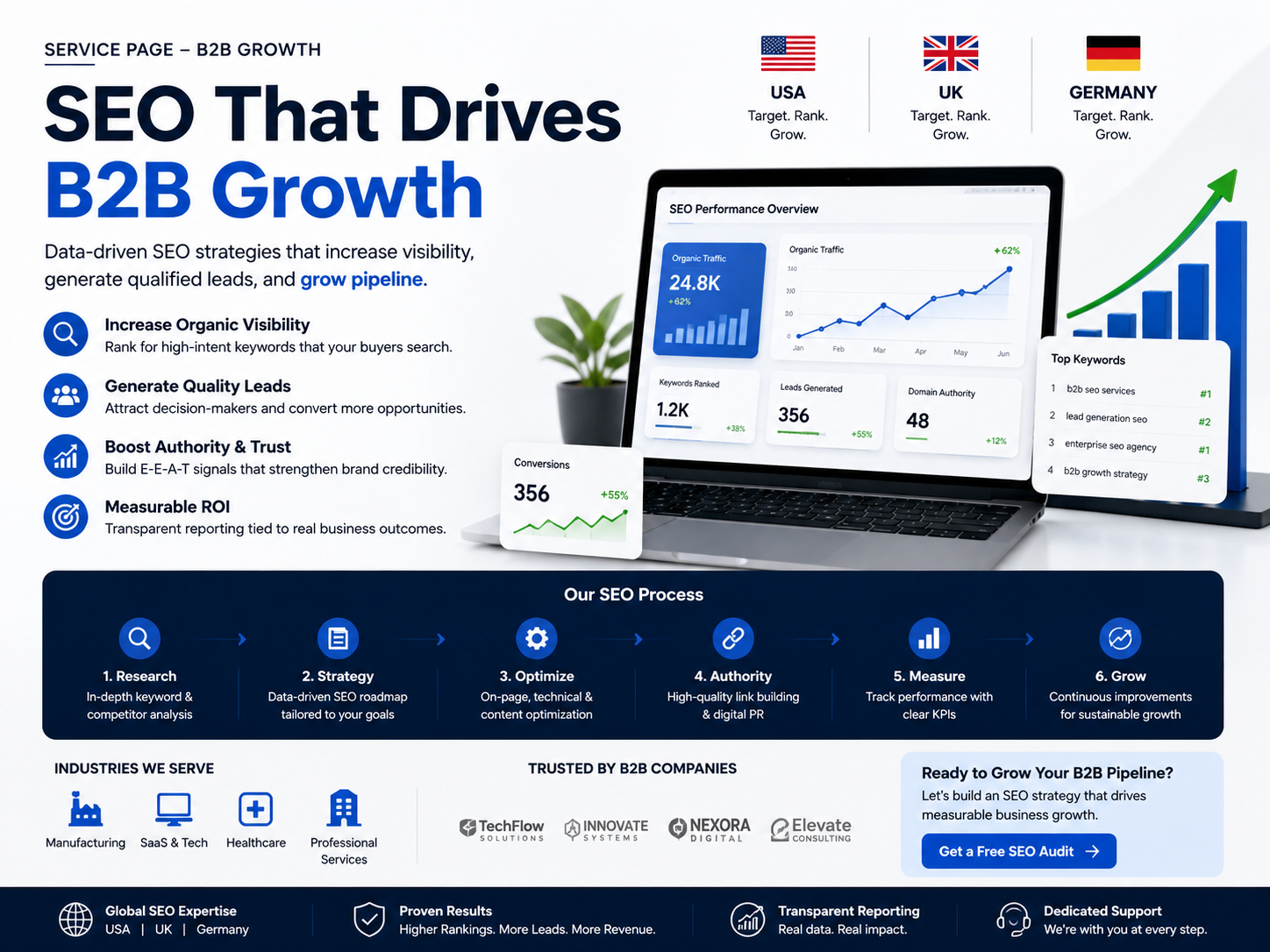
A strong B2B service page has two jobs: get found by the right buyers and give them enough confidence to take the next step. That is where service page SEO goes beyond rankings—it connects search intent, useful content, credible proof and conversion paths on one commercially focused page.
Put simply, service page SEO is the process of optimizing a dedicated service URL for buyer-intent searches while helping prospects evaluate your expertise, delivery process, outcomes and fit. Done well, it can turn organic visibility into enquiries, consultations and qualified pipeline rather than traffic that never converts.
For B2B companies targeting the USA, UK, Germany and the wider EU, that matters more as buyers increasingly research vendors independently. Gartner reported in 2024 that roughly 75% of B2B buyers preferred a sales experience without a representative, while around 40% of B2B purchases were completed without sales-rep assistance.
Your website and particularly your service pages is no longer just supporting the sales process. In many cases, it is part of the sales process.
What Is Service Page SEO and Why Does It Matter?
Service page SEO means optimizing a service-specific page so search engines can clearly understand what you offer while prospective buyers can quickly decide whether the service addresses their problem.
Each commercially important B2B service should usually have a dedicated page. This gives search engines a stronger topical signal and gives buyers a more relevant destination than a broad page trying to explain several unrelated capabilities at once.
Service Pages vs. Landing Pages vs. Solution Pages
These page types often overlap, but they serve different purposes.
A service page explains an ongoing capability and is designed for long-term organic discovery.
A landing page is usually created for a campaign and focused on one conversion action.
A solution page connects one or more capabilities to a particular problem, industry or use case.
An industry page adds vertical-specific context for audiences such as healthcare, fintech or manufacturing.
Separating these page types gives B2B companies tighter control over search intent, messaging, internal links and conversion journeys.
Why Every Major B2B Service Needs Its Own Page
A dedicated service URL gives you room to target one clear commercial intent without forcing several unrelated keywords and offers onto the same page.
For example, Mak It Solutions maintains separate pages for search engine optimization services, digital marketing services and web development services.
That makes the relationship between the search, the service and the expected outcome much clearer.
How Service Pages Support Leads, Pipeline and CRM Attribution
Traffic alone is not the goal.
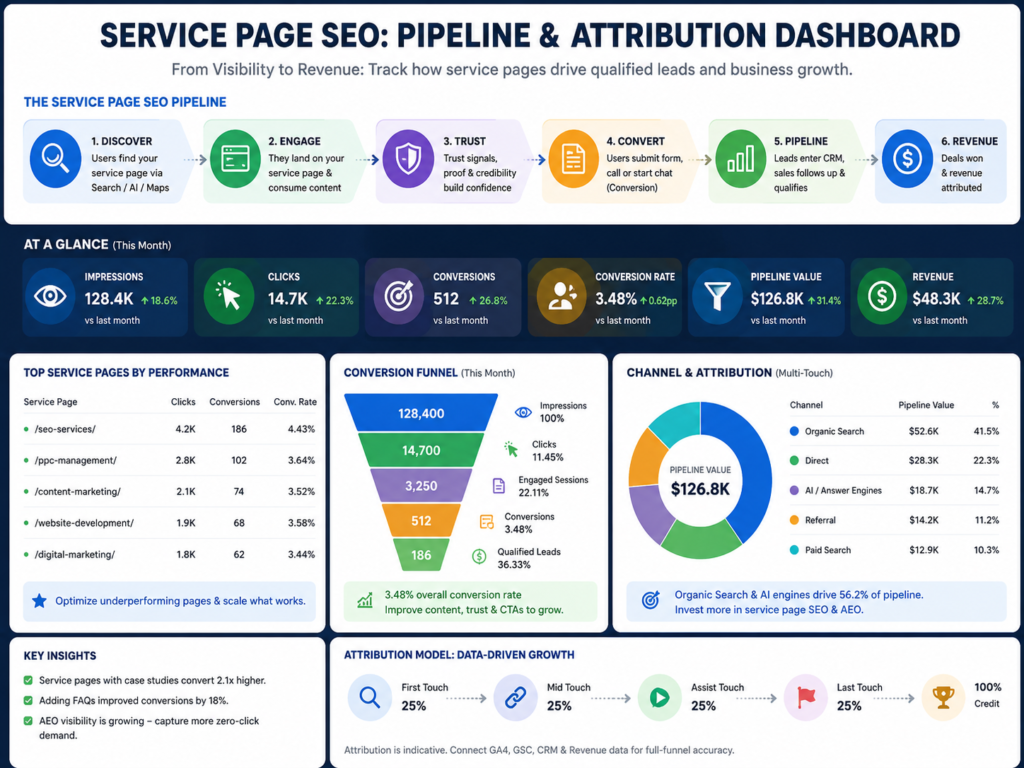
A useful service page should guide relevant visitors toward actions such as consultation requests, proposal enquiries, calls or booked meetings. With GA4 events, form tracking, consistent UTM handling and CRM attribution, marketing teams can also identify which pages contribute to qualified opportunities.
That is a much stronger measure of SEO performance than impressions alone.
How to Optimize Service Pages for SEO and Conversions
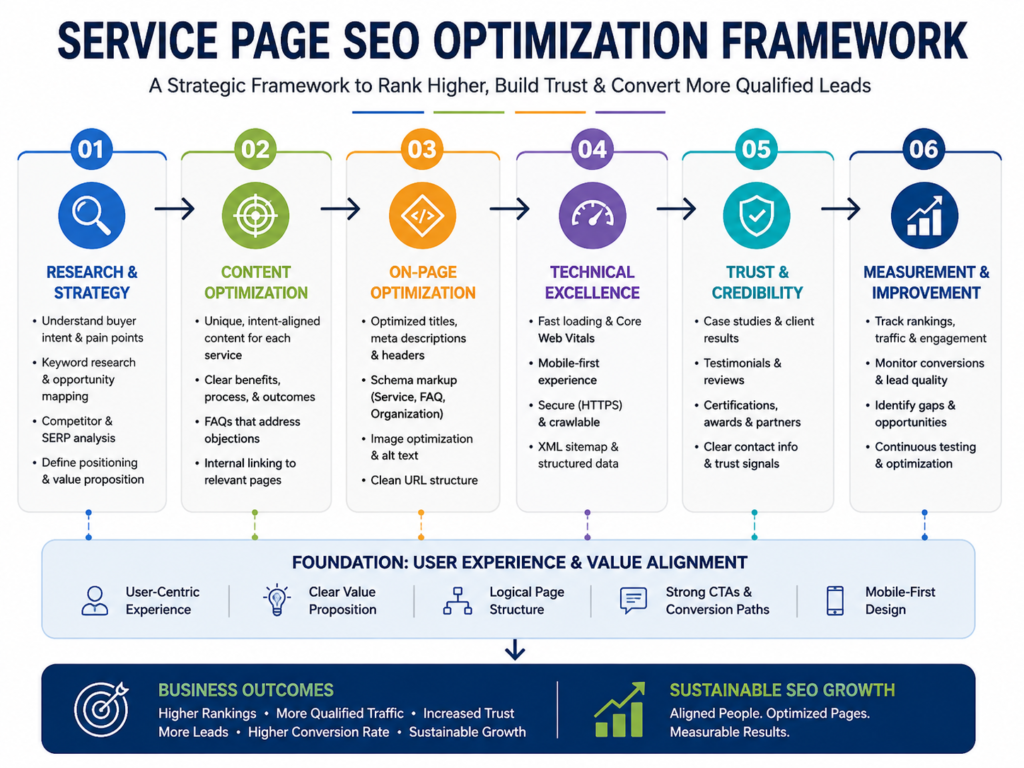
Effective service page SEO starts with one clear buyer intent. From there, build a dedicated URL around relevant metadata, useful service information, internal links, credible evidence, structured data and measurable conversion actions.
Match Buyer-Intent Keywords to Search Intent
Start with the language a real buyer would use while looking for a provider.
A primary phrase such as service page SEO can naturally sit alongside related concepts such as.
Buyer-intent keywords
Search intent optimization
Conversion-focused copy
Service schema markup
Trust signals and social proof
B2B service page optimization
For Germany, that may also include relevant terms such as kaufrelevante Keywords or Entscheider-Keywords where they reflect genuine search behaviour.
The aim is not to repeat the same keyword throughout the page. It is to align the content with the buyer’s problem, ICP, decision stage and commercial intent.
Optimize Titles, Headings, Metadata and Internal Links
Your title and H1 should immediately communicate what the page is about. H2 and H3 headings should then answer the questions buyers are likely to ask as they evaluate the service.
Keep the page crawlable and indexable, write useful metadata and add contextual internal links where they genuinely help the reader.
For example, a development-focused page may naturally connect to WordPress development, mobile app development or the broader Mak It Solutions services hub.
Add Structured Data, E-E-A-T and Service Schema Markup
Structured data helps search engines interpret page content and the entities connected to it. Google describes structured data as a standardized way of providing information about a page and classifying its content.
Markup, however, should support strong visible content not try to replace it.
Useful trust signals can include.
Relevant expertise
Case studies
Customer testimonials
Industries served
Certifications
Documented delivery processes
Clear company information
In practice, buyers need to see the evidence themselves. Schema should simply reinforce what is already visible on the page.
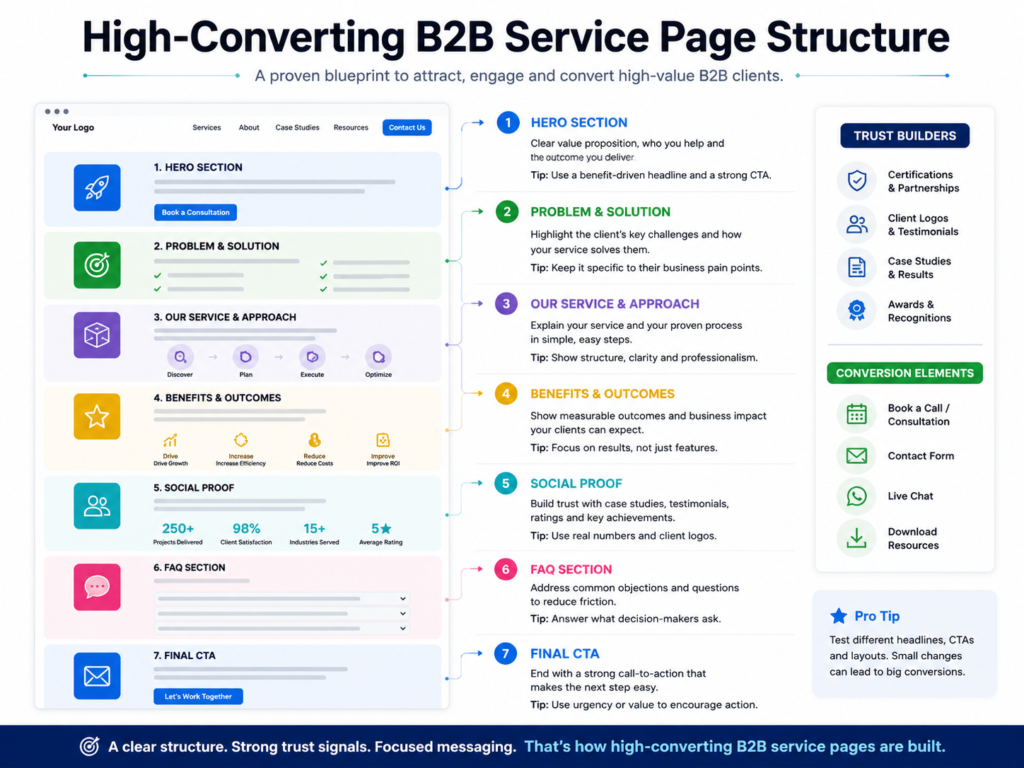
Build a High-Converting B2B Service Page Structure
A high-converting service page removes uncertainty.
Within the first screen or two, a buyer should understand who the service is for, what problem it solves, what outcome it supports and what they can do next.
Lead With a Clear Value Proposition and Outcome
Above the fold, answer four questions quickly.
Who is this service for?
What problem does it solve?
What business outcome does it support?
What should the visitor do next?
Avoid vague statements such as “innovative world-class solutions.”
A cybersecurity buyer in New York or a SaaS decision-maker in Austin is usually looking for relevance, capability and evidence not adjectives.
Include Process, Deliverables, Proof and Objection Handling
Strong service pages explain what happens after a prospect gets in touch.
Depending on the service, that may include.
Implementation steps
Expected deliverables
Integrations
Timelines
Service levels
Certifications
Case studies
security or compliance information
Enterprise buyers may also need procurement documentation, technical reviews or compliance details before they are comfortable involving sales.
Gartner reported purchase regret at roughly 43% among digital self-service buyers compared with about 26% among buyers completing traditional representative-led purchases.
Clear decision support can help reduce uncertainty before the buyer reaches the sales conversation.
Use CTAs That Match Buyer Readiness
Not every visitor arriving through organic search is ready to buy immediately.
Match the CTA to the likely stage of the journey. Options may include.
Book a Consultation
Request a Proposal
Get an Audit
Start an Enquiry
For earlier-stage visitors, a case study, checklist or service overview can provide a lower-friction next step.
Service Page SEO for AI Overviews, AEO and Answer Engines
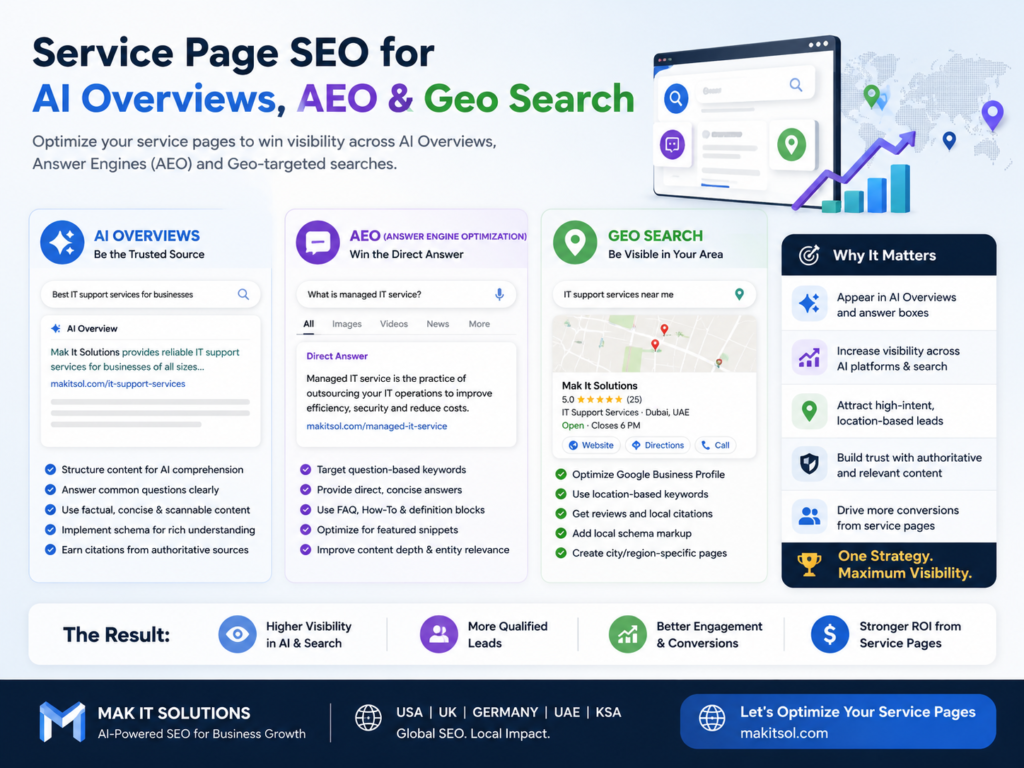
Modern service pages should be easy for both people and answer engines to interpret.
That means using concise definitions, question-led sections, clear entities, structured information and verifiable evidence rather than filling the page with generic sales language.
Google reported in 2025 that AI Overviews had expanded to more than 200 countries and territories and over 40 languages. It also reported a usage increase of more than 10% for query types displaying AI Overviews in major markets such as the US and India.
Add Self-Contained Answers to High-Intent Questions
Answer important “what,” “why,” “how” and commercial questions directly.
A concise 40–70 word answer at the beginning of a section can give readers an immediate response before the page expands into more detail. It also creates cleaner, more extractable information for search and answer systems.
Strengthen Entities, Relationships and Topical Context
Give search systems clear contextual relationships.
Depending on the service and market, that may mean connecting the page to relevant.
Industries
Buyer roles
Platforms
Locations
Regulations
Technical standards
Examples could include GDPR, NHS, FCA, BaFin, PCI DSS, SOC 2, AWS, Azure or Google Cloud where genuinely relevant to the offer.
Avoid adding well-known entities simply to make a page appear comprehensive. They should support the buyer’s actual evaluation process.
Make Claims Easy to Interpret and Trust
Specific information is easier to understand than vague superlatives.
Use clearly explained processes, named evidence, case-study outcomes and properly attributed factual claims wherever possible. Consistent terminology also makes the page easier for readers and machine systems to interpret.
Localize Service Page SEO for the USA, UK and Germany
Localization is more than swapping keywords or translating the same page word for word.
Buyers in different markets can have different expectations around terminology, compliance, vendor evaluation and calls to action.
USA.
For US buyers, service pages can place stronger emphasis on ROI, speed to implementation and measurable business outcomes.
In markets such as New York, Chicago, San Francisco, Austin and Boston, enterprise buyers may also assess SOC 2, CCPA/CPRA or sector-specific requirements.
For healthcare-related services, HIPAA becomes relevant where protected health information is involved. The U.S. Department of Health and Human Services explains that the HIPAA Security Rule establishes safeguards for electronic protected health information handled by regulated entities. HHS
UK.
British audiences will often expect locally familiar wording such as optimise, enquiries and professional services.
This can be particularly useful when targeting buyers in London, Manchester or Birmingham.
Where personal data is relevant, the page should accurately address UK GDPR and the Data Protection Act 2018. GOV.UK
Financial, healthcare and Open Banking offers may also need FCA, NHS or other sector-specific context.
Germany and the EU.
German buyers may expect more detailed technical information, process transparency and appropriate Fachsprache.
Useful terminology may include Dienstleistungsseite, Leistungsseite, qualifizierte Anfragen, Entscheider-Keywords and Buying Center when those terms match the target audience.
For prospects in Berlin, Munich, Hamburg or Frankfurt, discuss DSGVO/GDPR, data residency or BaFin considerations where relevant instead of treating compliance as a generic trust badge.
Measure Whether Your Service Page Generates Pipeline
Rankings matter, but they are only one part of the result.
The more important question is whether the page attracts relevant buyers and contributes to qualified enquiries, opportunities and revenue.
Track Rankings, Buyer-Intent Traffic and Qualified Leads
Monitor impressions and organic sessions, but connect those metrics to actions such as.
Form submissions
Booked calls
Qualified leads
Sales opportunities
Pipeline value
A page receiving 500 highly relevant visits can create more commercial value than one receiving 10,000 visits from people with no buying intent.
Connect Analytics, CRM and Revenue Attribution
Combine Google Search Console data with GA4 conversion events, form or call tracking and CRM opportunity stages.
The goal is to understand the journey from query to service-page visit, conversion and eventual sales outcome.
For organizations that need deeper reporting, services such as business intelligence and analytics can help turn fragmented performance data into clearer business insights.
Improve Pages Using SEO and CRO Feedback Loops
Service pages should evolve as buyer behaviour changes.
Review Search Console queries, CTA engagement and conversion rates alongside feedback from sales.
If prospects repeatedly ask the same pricing, implementation or security question, the page probably needs to answer it. CRM data and lost-deal feedback can reveal content gaps that keyword research may never uncover.
Service Page SEO Checklist for B2B Companies
Before considering a service page finished, check the fundamentals.
SEO and Technical Checklist
Dedicated, indexable service URL
Clear search and buyer intent
Aligned title, H1 and supporting headings
Useful metadata
Relevant internal links
Correct canonical signals
Appropriate structured data
Strong mobile performance
Content, Trust and Conversion Checklist
Specific value proposition
Clear business outcomes
Process and deliverables
Case studies or credible proof
Objection handling
Relevant FAQs
Expertise and trust signals
Primary and secondary CTAs
Conversion tracking
GEO and AEO Checklist
Region-appropriate terminology
Relevant locations and compliance entities
Self-contained answer sections
Clear relationships between services and audiences
Visible expertise
Structured information
Region-specific evidence where available.
Final Thoughts
Effective service page SEO is about more than improving rankings. A strong service page should match buyer intent, explain the service clearly, build trust with proof, and guide visitors toward a relevant next step. When SEO, conversion-focused copy, structured information, and regional context work together, service pages can attract better-fit prospects and support stronger B2B lead generation.
For companies targeting the USA, UK, Germany, and wider Europe, continuous optimization is essential. Review search performance, buyer questions, conversion data, and CRM insights regularly. The goal is simple: turn service page SEO into a reliable source of qualified enquiries, opportunities, and measurable business growth. ( Click Here’s )
If your service pages already receive traffic but generate too few qualified enquiries, the next opportunity may be better intent alignment and conversion not simply publishing more content. Mak It Solutions
Explore Mak It Solutions’ SEO services and request a Service Page SEO Audit to identify where rankings, messaging, trust signals or conversion paths may be losing potential buyers.
Key Takeaways
Effective service page SEO is a pipeline strategy, not just a ranking exercise.
Give every commercially important service a clear, intent-focused page. Combine SEO with useful copy, credible proof, objection handling and CTAs that reflect how B2B buyers actually make decisions.
For companies serving the USA, UK, Germany and wider Europe, localization also matters. Buyers should feel that the page understands their language, business environment and evaluation criteria rather than simply targeting their country name.
Finally, measure what happens after the click. Qualified enquiries, opportunities and attributed revenue tell you far more about a service page’s value than traffic alone.
FAQs
Q : How long should a B2B service page be for SEO?
A : There is no universal SEO word count. A service page should be long enough to answer important buyer questions about the service, outcomes, process, proof, implementation and next steps without adding filler. For relatively straightforward services, 800–1,200 words may be enough, while complex enterprise offers can require more detail.
Q : Should service pages include pricing information?
A : Include pricing when it helps prospects qualify themselves and your commercial model allows useful guidance. Fixed packages can show exact pricing, while complex B2B services may be better suited to ranges, starting prices or an explanation of what affects cost.
Q : How many keywords should one service page target?
A : Focus on one primary search intent rather than a fixed number of keywords. Support the main keyword with closely related variations, buyer-intent phrases and relevant entities without forcing unrelated services onto the same page.
Q : Do service pages need FAQs and schema markup?
A : FAQs are useful when they answer genuine buyer questions that do not fit naturally elsewhere on the page. Structured data can help search engines interpret page content, but markup alone does not guarantee additional visibility.
Q : How often should B2B service pages be updated?
A : Review high-value service pages at least quarterly and whenever your offer, pricing, regulations, technology, case studies or buyer questions change. Fast-moving areas such as AI, cloud, cybersecurity and regulated SaaS may require more frequent updates.
[…] Makes an SEO Case Study […]