


Sovereign AI Middle East 2026: GCC Opportunity Guide
Sovereign AI Middle East 2026: GCC Opportunity Guide
Sovereign AI Middle East 2026: GCC Opportunity Guide
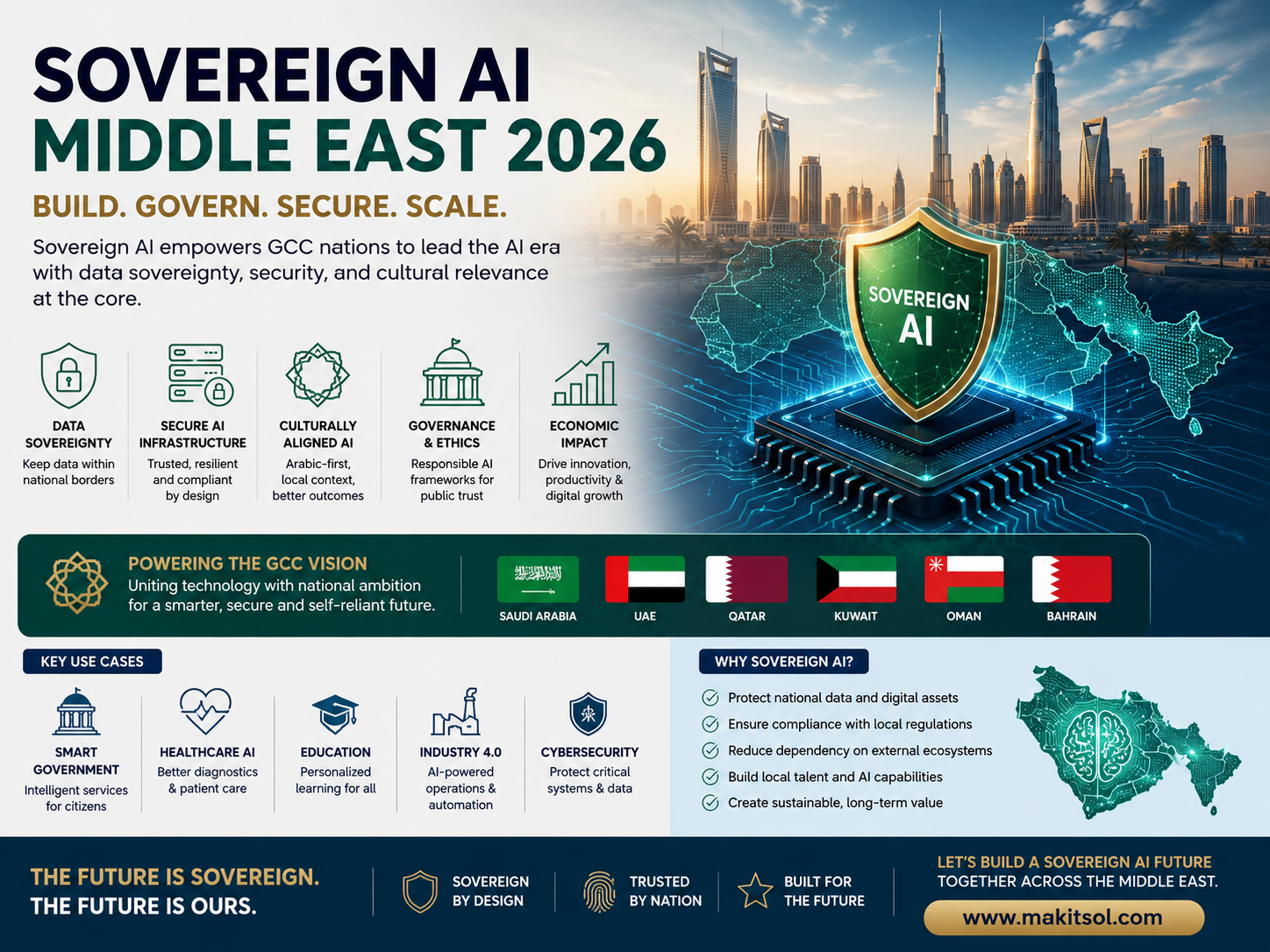
overeign AI Middle East refers to AI infrastructure, data, models and applications operated with greater national or local control over security, governance and deployment. Across Saudi Arabia, the UAE and Qatar, the opportunity is moving from policy into sovereign compute, Arabic AI and regulated enterprise applications.
Why Sovereign AI Is Becoming Strategic in the GCC
AI infrastructure is increasingly being treated as strategic national infrastructure across Riyadh, Abu Dhabi, Dubai and Doha. Governments and businesses want the benefits of generative AI without giving up control over sensitive data, regulatory obligations or Arabic-language performance.
That is why the Sovereign AI Middle East ecosystem is developing around four connected layers.
Infrastructure
Governed data
AI models
Enterprise applications
Together, these layers create a practical framework for understanding where GCC governments, technology providers and enterprises are investing.
What Is Sovereign AI in the Middle East?
Sovereign AI means maintaining defined local or national control over AI compute, data, models and deployment.
It does not necessarily mean that every workload must remain physically inside one country. The right architecture depends on the type of data involved, the industry, applicable regulations and the organization’s risk profile.
Sovereign AI vs Sovereign Cloud vs Data Sovereignty
The terms are related, but they are not interchangeable.
Sovereign AI covers the broader AI stack, including compute, data, models, governance and applications.
Sovereign cloud refers to cloud environments designed around jurisdictional, security and operational controls.
Data sovereignty focuses on how information is stored, processed and governed under applicable laws and policies.
The Four Layers of GCC Sovereign AI
A practical sovereign AI stack usually includes GPU infrastructure, governed data, foundation or Arabic large language models, and enterprise applications.
For businesses, these layers become more valuable when governed data is converted into useful operational insights. Business intelligence services can support that transition from controlled data to decision-making.
Why Saudi Arabia, UAE and Qatar Are Prioritizing Sovereign AI
Several forces are pushing sovereign AI higher on GCC technology agendas: economic diversification, government digitization, regulated-sector adoption and the need for stronger Arabic AI capability.
Regional cloud options have also expanded through infrastructure such as AWS Bahrain, Azure UAE Central and Google Cloud Doha, giving organizations more choices when designing locally governed environments.
How Saudi Arabia, UAE and Qatar Are Building Sovereign AI
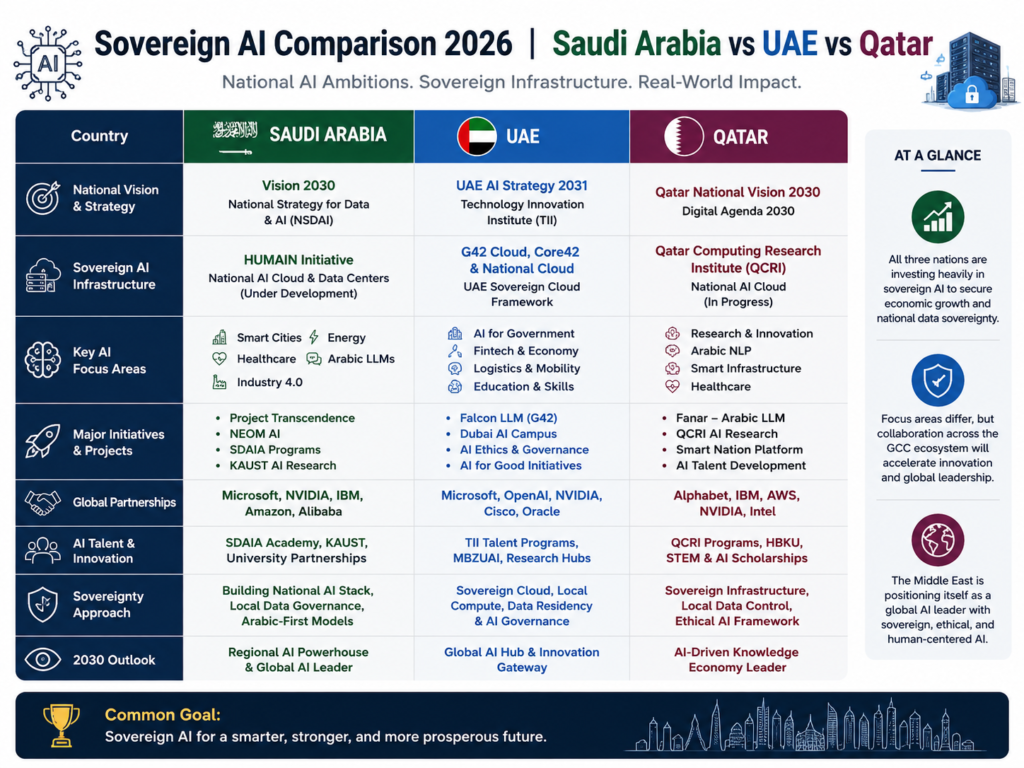
Saudi Arabia, the UAE and Qatar are not following identical strategies. Saudi Arabia is emphasizing scale, the UAE has built a strong commercialization ecosystem, while Qatar is developing an Arabic-focused national capability.
For GCC technology providers and enterprise buyers, those differences create distinct entry points.
Saudi Arabia.
Saudi Arabia launched PIF-owned HUMAIN in 2025 to operate across data centers, cloud infrastructure, AI models and applications, including ALLaM.
That broad mandate positions Riyadh as a major commercial market for sovereign compute, Arabic AI and enterprise deployment.
At the same time, SDAIA and the National Data Management Office play important roles in the country’s wider data and AI governance environment. For organizations entering the Saudi market, infrastructure decisions therefore need to be considered alongside data classification, cybersecurity and sector-specific requirements.
UAE.
The UAE has developed one of the GCC’s most visible commercial sovereign AI ecosystems.
Abu Dhabi’s G42 ecosystem, Core42 and the Falcon model family illustrate how infrastructure, models and enterprise deployment can be connected within a broader national technology strategy.
In July 2026, Core42 and e& UAE announced in-country sovereign GPU infrastructure for government and enterprise workloads. This reflects a wider shift from sovereign AI as a policy concept toward infrastructure that organizations can use in production environments.
Qatar.
Qatar is building a different but equally relevant position around Arabic AI and locally governed infrastructure.
QCRI and QCAI developed Fanar as an Arabic-centric generative AI platform with government support. Doha also benefits from local cloud infrastructure, strengthening the country’s ability to support sensitive and Arabic-first AI applications.
For businesses serving Qatar, this creates opportunities around secure AI deployment, Arabic language applications, data platforms and integration services.
Sovereign AI Infrastructure and Data Residency in the GCC
Infrastructure is only one part of sovereignty. The more difficult question is often how compute, data, identity, security controls and model access work together.
GPU Clouds, AI Factories and In-Country Compute
Sovereign AI infrastructure in the Middle East increasingly includes.
GPU clusters
High-performance computing
Local AI inference
Colocation
AI data centers
Private cloud environments
Sovereign cloud integration
Companies building customer-facing products on top of this infrastructure can connect secure back-end environments with custom web development and mobile application development.
Saudi Data Governance, NDMO and Sensitive AI Workloads
Saudi AI deployments should consider PDPL obligations, NDMO governance requirements, cybersecurity controls and rules around cross-border processing.
NDMO oversees national data-governance standards, while SAMA applies additional requirements to supervised financial organizations using cloud services.
For a Riyadh fintech, for example, choosing an AI platform is not simply a question of model accuracy. The architecture may also need to address how customer data is classified, where it is processed, who can access it and whether third-party services meet financial-sector controls.
UAE and Qatar Data Residency for Regulated AI
Organizations in the UAE may need to consider requirements associated with jurisdictions or regulators such as TDRA, ADGM and DIFC.
In Qatar, financial-sector AI deployments should similarly consider QCB requirements alongside applicable privacy obligations.
The key point is simple: sovereignty is an architecture and risk-management decision, not merely another word for localization.
Arabic Sovereign AI Models.
Arabic capability is one of the strongest reasons Sovereign AI Middle East strategies cannot simply copy deployment patterns from other regions.
Arabic AI systems may need to understand Modern Standard Arabic, Gulf dialects, bilingual workflows and highly specific cultural or industry terminology.
That matters in sectors such as government, finance, healthcare and customer service, where language accuracy directly affects usefulness and trust.
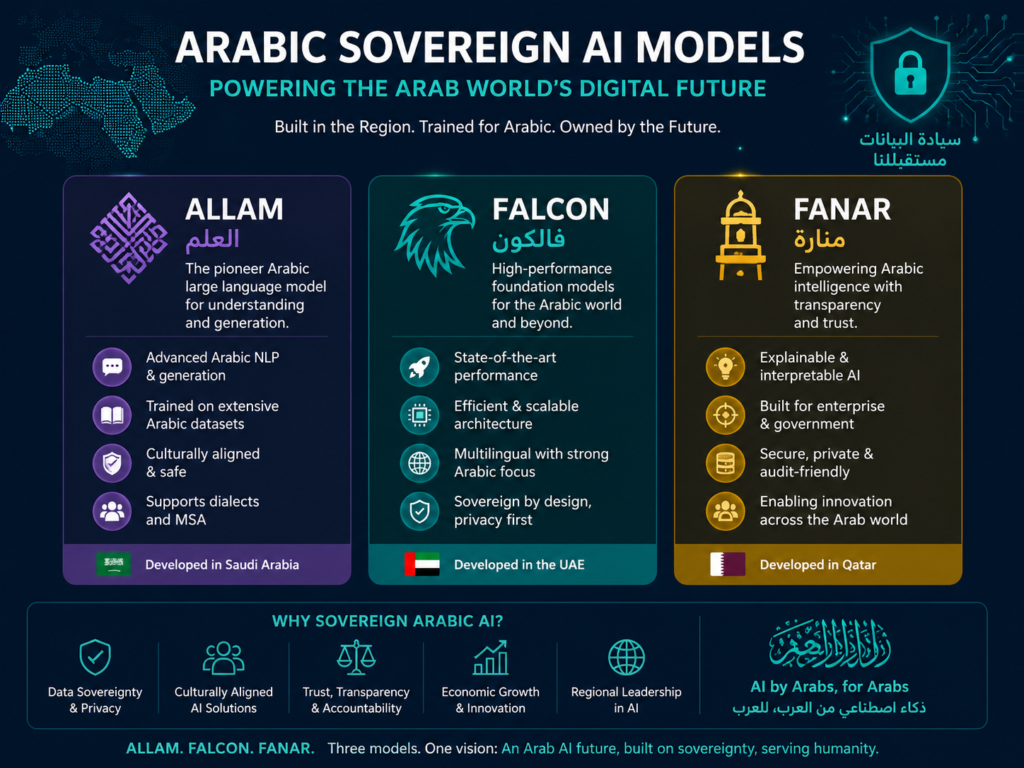
Falcon, ALLaM and Fanar Compared
| Model | Market | Ecosystem | Primary Role |
|---|---|---|---|
| ALLaM | Saudi Arabia | SDAIA / HUMAIN | Saudi Arabic AI capability |
| Falcon | UAE | TII | UAE foundation-model ecosystem |
| Fanar | Qatar | QCRI / QCAI | Qatar Arabic generative AI stack |
Local Models vs International Models
Sovereign AI does not always require a locally developed model.
Many GCC deployments are likely to remain hybrid, combining locally governed infrastructure with technologies from NVIDIA, AMD, AWS, Microsoft, Google Cloud or international foundation-model providers.
The better question is whether the chosen architecture delivers the required combination of.
Arabic accuracy
Security
Data control
Regulatory alignment
Performance
Latency
Cost efficiency
A local model may be the strongest choice for one workload, while an international model running inside a tightly governed environment may perform better for another.
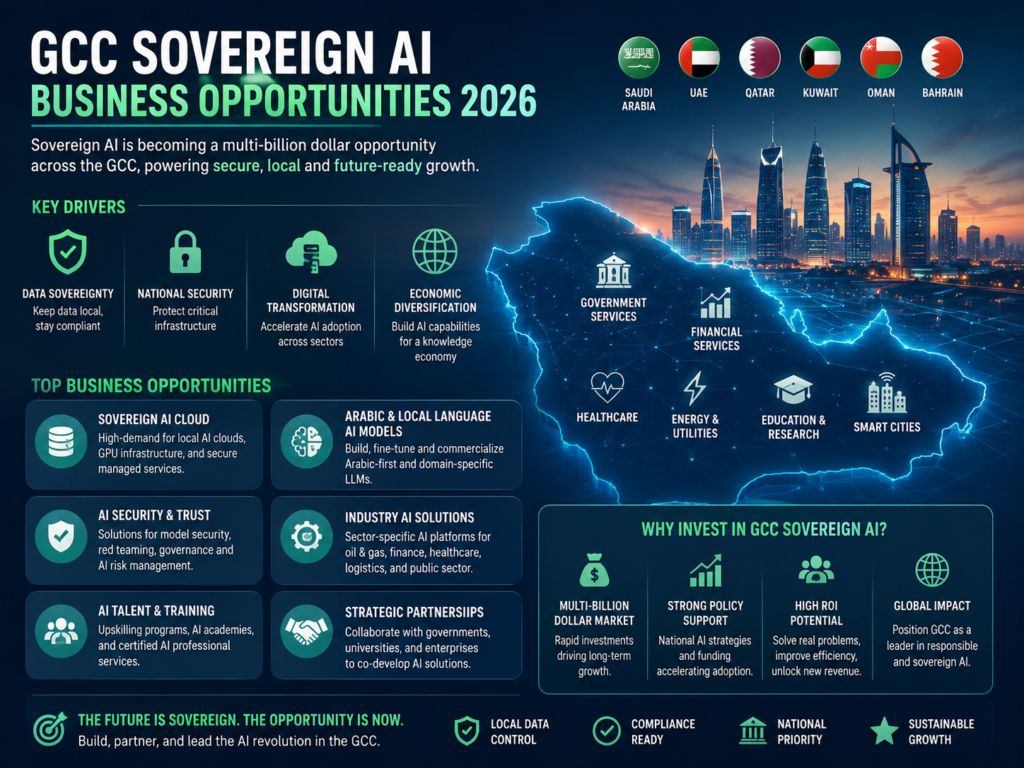
Sovereign AI Business Opportunities in the GCC
The commercial opportunity extends well beyond data centers.
The Sovereign AI Middle East value chain includes infrastructure, cloud platforms, cybersecurity, data engineering, models, enterprise applications and compliance services.
For Mak It Solutions, that can translate into opportunities across analytics, secure digital products, AI-enabled workflows and e-commerce solutions.
Infrastructure and Platform Opportunities
Growing demand can create opportunities in areas such as.
GPU cloud infrastructure
Cybersecurity
Data platforms
MLOps
Private AI
Sovereign-cloud integration
AI monitoring and governance
Organizations often need help connecting these technical layers into a usable enterprise architecture rather than purchasing isolated tools.
Enterprise AI Opportunities by Industry
A Riyadh fintech could deploy an Arabic risk or compliance copilot within an architecture designed around SAMA controls.
A Dubai e-commerce company could combine governed AI with digital commerce development, personalized customer experiences and scalable mobile applications.
A Doha SME handling sensitive information could use local cloud capacity for controlled AI workloads without building its own AI infrastructure from scratch.
Government and logistics organizations can also explore secure knowledge assistants, document automation, forecasting and internal decision-support tools.
Compliance, Consulting and Managed AI Opportunities
As enterprise adoption grows, the service layer becomes increasingly important.
Potential professional-service opportunities include.
AI governance assessments
Data-residency architecture
Cybersecurity reviews
Model evaluation
Private LLM deployment
Arabic AI testing
Cloud and infrastructure integration
Ongoing managed AI operations
In practice, many enterprises will need support deciding what should remain local, what can operate in a regional cloud and what can safely connect to international AI services.
How GCC Enterprises Should Evaluate a Sovereign AI Strategy
A sovereign AI project should begin with business and regulatory requirements rather than with a model or GPU purchase.
Classify Data, Risk and Regulatory Requirements
Start by identifying personal, financial, government and intellectual-property data.
Map where that information currently moves, which systems process it and whether cross-border processing is involved. Sector-specific obligations should be reviewed before selecting infrastructure or AI vendors.
Choose the Right Infrastructure and Model Architecture
Compare the options available for the workload.
Regional public cloud
Sovereign cloud
Dedicated GPU infrastructure
Private cloud
On-premise deployment
Then decide whether the application requires a local model, an international model, retrieval-augmented generation, fine-tuning or a hybrid approach.
Evaluate Arabic Performance, Security and Total Cost
A technically impressive model is not automatically enterprise-ready.
Before production deployment, test.
Modern Standard Arabic and dialect accuracy
Latency
Data residency
Identity and access controls
GPU utilization
Integration requirements
Migration costs
Vendor lock-in
Total operating cost
Testing against real workflows is especially important for Arabic customer support, financial services and government applications.
What Comes Next for Sovereign AI in the Middle East?
Sovereign AI across the GCC is likely to become less about isolated national projects and more about complete enterprise ecosystems.
Saudi Arabia’s Scale-Up Opportunity
Saudi Arabia has the potential to scale through AI factories, large infrastructure investments, Arabic models and demand from regulated enterprises.
Riyadh’s opportunity is particularly strong where compute capacity, data governance and enterprise implementation can be packaged together.
UAE Commercialization and Regional Export Potential
The UAE is well positioned to commercialize sovereign AI capabilities and potentially export deployment expertise across the wider GCC.
Its ecosystem can serve as a model for combining compute infrastructure, foundation models, cloud services and enterprise applications.
Qatar and the Next Wave of GCC Sovereign AI
Qatar offers another model built around Arabic capability and locally governed infrastructure.
As sovereign AI procurement matures, Kuwait, Bahrain and Oman could create additional opportunities for regional technology providers, cloud integrators and AI consultancies.
Outlook
A successful Sovereign AI Middle East strategy needs to connect infrastructure, data governance, Arabic performance, security and measurable business value.
The strongest architecture is not necessarily the one with the most local components. It is the one that gives the organization appropriate control while still delivering the performance, flexibility and economics required for the use case.
For businesses exploring GCC AI opportunities, Mak It Solutions services can support the wider technology stack, from data and analytics to secure application development.
Contact our team for a consultation to discuss a custom GCC technology and AI implementation strategy.
FAQs
Q : Does sovereign AI require all data to stay inside Saudi Arabia?
A : No. Saudi data residency requirements depend on the information involved, the processing activity and the relevant sector.
PDPL and NDMO requirements can shape data governance, while SAMA may impose additional requirements on supervised financial institutions. Businesses should classify their data before assuming that every workload must remain inside Saudi Arabia or that unrestricted overseas processing is acceptable.
Q : Can UAE banks use international AI models in sovereign deployments?
A : Potentially. Model origin is only one part of the decision.
Financial institutions also need to consider data location, access controls, privacy, cybersecurity, contractual protections and the rules of the relevant jurisdiction, including frameworks associated with ADGM or DIFC.
Q : What is the role of SAMA and NDMO in Saudi enterprise AI?
A : NDMO, operating under SDAIA, develops national policies, standards and controls related to data management and governance.
SAMA provides sector-specific requirements affecting supervised financial institutions. For Saudi financial organizations, national data-governance requirements and sector-specific financial controls may therefore need to be considered together.
Q : Is Fanar suitable for Arabic AI applications in Qatar?
A : Fanar is designed as an Arabic-centric generative AI platform, making it relevant for Qatar-based Arabic applications.
Its suitability for a specific enterprise use case still depends on testing accuracy, dialect coverage, security, latency and domain knowledge against real workflows.
Q : Which GCC industries are most likely to adopt sovereign AI first?
A : Financial services, government, healthcare, logistics and large digital-commerce businesses are strong candidates because they combine valuable data with significant governance, security and localization requirements.
These sectors can benefit from sovereign AI when compliance and business value are designed into the same architecture.
[…] Is Sovereign AI vs Sovereign […]