
Sovereign AI vs Sovereign Cloud: GCC Guide
Sovereign AI vs Sovereign Cloud: GCC Guide
Sovereign AI vs Sovereign Cloud: GCC Guide
GCC enterprises are investing heavily in cloud infrastructure and artificial intelligence, but sovereign AI vs sovereign cloud is still easy to misunderstand. Hosting a system in Riyadh, Dubai, Abu Dhabi or Doha may satisfy certain data-residency requirements without giving an organization full control over models, administrators, encryption keys or AI operations.
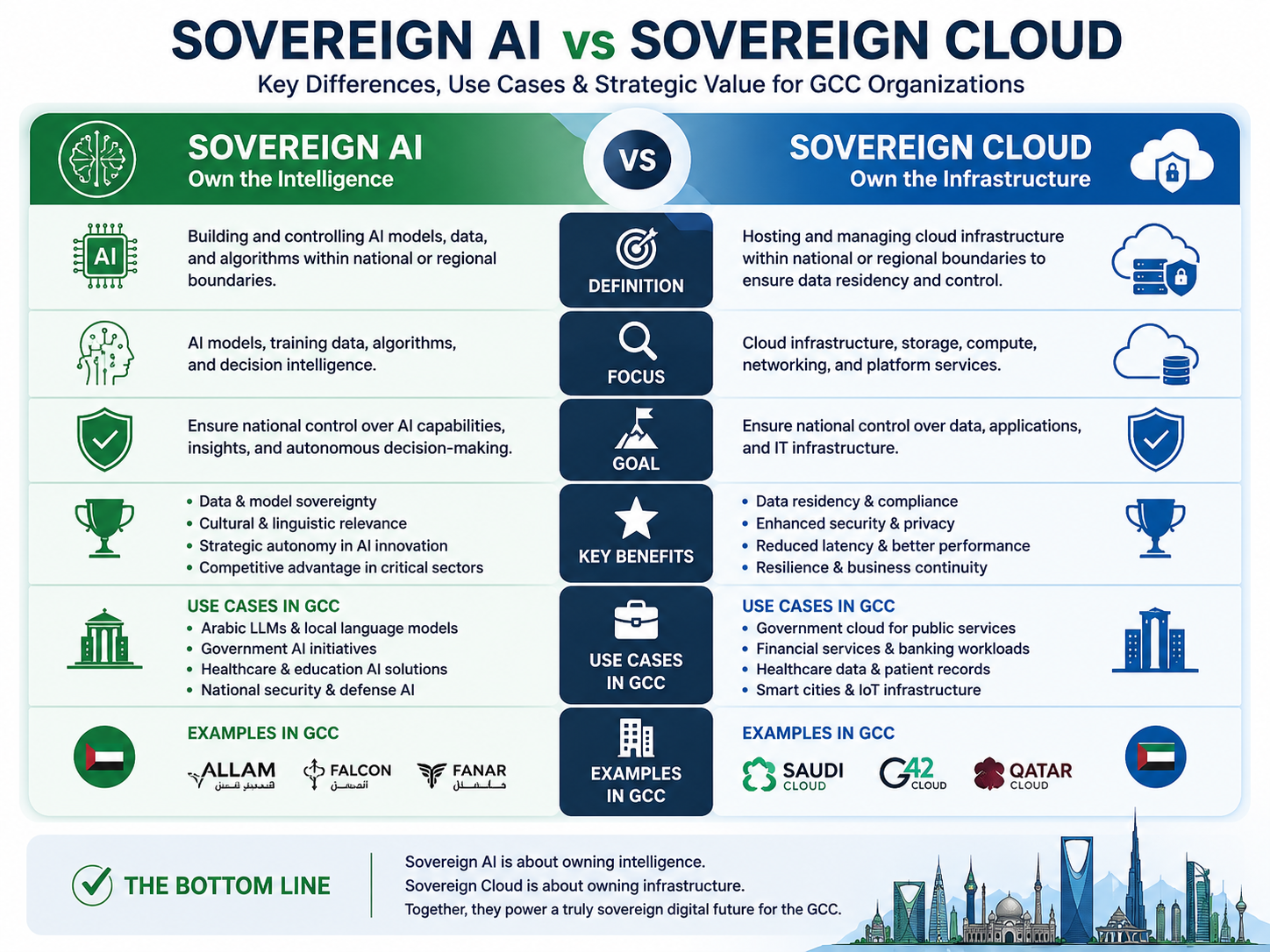
The distinction is straightforward: sovereign cloud focuses mainly on control of infrastructure, data and operations, while sovereign AI extends that control across the AI lifecycle, including models, compute, training, inference and governance. For GCC organizations, the right approach depends on workload sensitivity, sector requirements and how much control must remain local.
That matters for CIOs, CISOs and compliance teams working across government, financial services, healthcare, logistics, e-commerce and other data-sensitive sectors.
What Is Sovereign AI vs Sovereign Cloud?
Sovereign cloud and sovereign AI are related, but they solve different layers of the sovereignty problem.
A sovereign cloud creates stronger controls around the environment where applications and data operate. Sovereign AI goes further by asking who controls the AI system running inside that environment.
What Sovereign Cloud Controls
A sovereign cloud may provide controls such as.
Approved local or regional infrastructure
Data-location restrictions
Jurisdictional safeguards
Restricted administrator access
Customer-controlled encryption keys
Audit and monitoring capabilities
Defined operational responsibilities
For Saudi financial institutions, for example, SAMA’s cloud requirements address areas including risk assessment, provider due diligence, data location and audit rights. Organizations should assess the exact requirements that apply to their sector and workload through the SAMA Rulebook.
Companies building secure digital platforms can also review Mak It Solutions‘ web development services.
What Sovereign AI Adds Beyond Sovereign Cloud
Sovereign AI expands the control boundary to the AI layer itself.
That can include.
Model weights
Training and fine-tuning data
Prompts and inference data
GPU and accelerator infrastructure
LLM hosting
Model updates
AI administrators
Logging and telemetry
Model governance
Security operations
Put simply, sovereign cloud protects the environment in which AI runs; sovereign AI extends sovereignty to the AI system itself.
AI Sovereignty vs Data Sovereignty
These terms are also easy to mix up.
Data residency focuses on where information is stored or processed.
Data sovereignty considers which laws and jurisdictions govern that information.
AI sovereignty adds another layer: control over models, compute infrastructure, training, inference and AI operations.
That is why an Arabic-capable model is not automatically a sovereign model. Language localization can improve usefulness, but it does not determine who controls the technology.
Why Sovereign AI Matters for GCC Enterprises
Protecting Sensitive Enterprise and Government Data
Generative AI can interact with information that traditional applications may never expose in the same way.
Banking prompts, government documents, patient-related records, internal reports and proprietary datasets can all enter AI workflows through retrieval systems, fine-tuning pipelines or user prompts.
Sovereign AI architecture helps organizations define how that information enters the AI environment, where it is processed, who can access it and whether it can leave the approved control boundary.
Data-driven organizations may complement these controls with business intelligence services.
Reducing Foreign Jurisdiction and Access Risk
Local hosting alone does not answer every sovereignty question.
A database physically hosted in Riyadh could still depend on overseas administrators. An AI application in the UAE or Qatar could rely on foreign-controlled model services, sub processors or encryption-key infrastructure.
For GCC buyers, the important questions therefore go beyond server location.
Who can administer the platform?
Who owns or controls the encryption keys?
Can prompts or outputs leave the country?
Where are model weights stored?
Who updates the model?
Which third parties can access operational data?
Which jurisdiction governs those services?
Supporting National AI and Digital Sovereignty Strategies
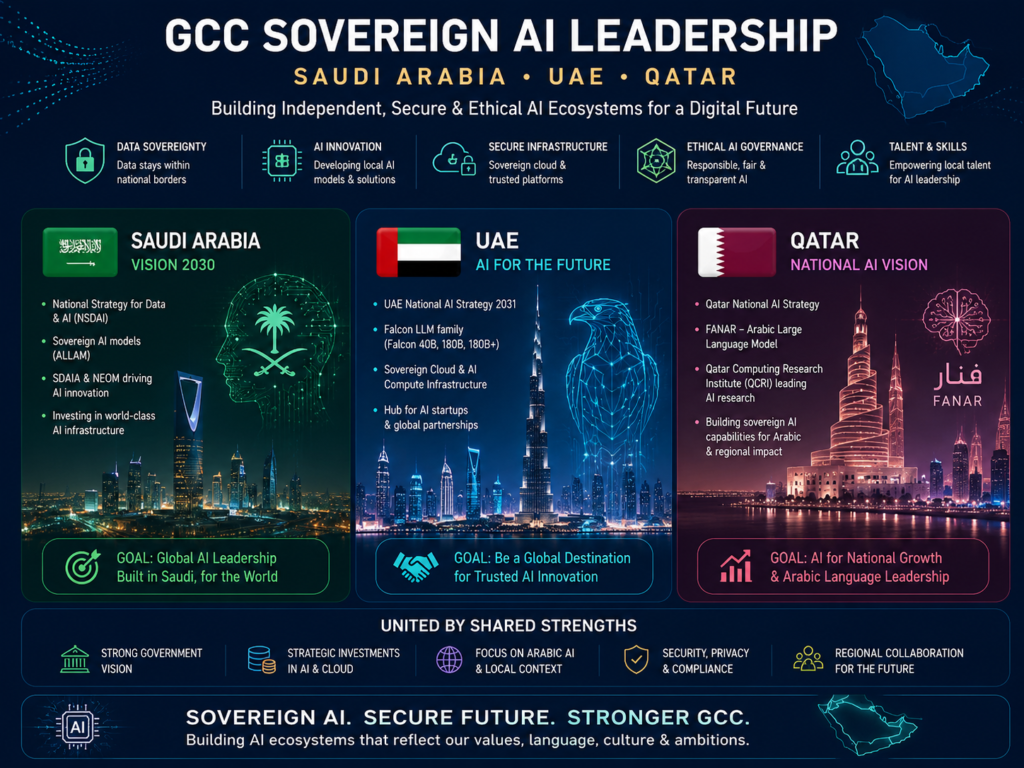
Saudi Arabia, the UAE and Qatar continue to expand their domestic cloud and AI ecosystems through local telecommunications providers, technology groups, government-backed initiatives and partnerships with global hyper scalers.
The region also benefits from established infrastructure such as AWS Middle East services. AWS maintains official documentation covering its available regions and availability zones through its global infrastructure documentation.
For enterprises, however, national or regional infrastructure is only one part of the architecture. Operational sovereignty must still be assessed at the workload level.
Sovereign AI vs Sovereign Cloud in Saudi Arabia, UAE and Qatar
The basic principles are similar across the GCC, but regulatory responsibilities, sector rules and available infrastructure differ by market.
Saudi Arabia.
Saudi organizations may need to consider requirements from bodies such as SAMA, SDAIA/NDMO, NCA and CST, depending on their sector and workload.
For SAMA-regulated organizations, cloud governance includes considerations around provider assessment and data location. That makes it important to distinguish between ordinary cloud adoption and architectures that require stronger local operational control.
A Riyadh fintech, for example, should not ask only where its AI application is hosted. It should also map model access, inference, administrators, encryption keys, logging and third-party dependencies against its regulatory obligations.
UAE.
The UAE combines a mature cloud ecosystem with major digital markets in Dubai and Abu Dhabi.
Organizations operating within regulated environments may need to consider federal requirements as well as frameworks applicable in financial centres such as ADGM or DIFC.
ADGM’s data-protection guidance covers areas such as security, processor obligations, impact assessments and international data transfers. Relevant organizations can review current guidance directly through the ADGM Office of Data Protection.
Microsoft also lists cloud regions in the UAE, including UAE Central in Abu Dhabi and UAE North in Dubai, in its Azure regions documentation.
For a Dubai e-commerce company, this creates architectural flexibility. Ordinary customer-facing workloads may run in standard cloud environments, while sensitive AI workloads can be isolated behind stronger data, model and operational controls.
Companies scaling those customer experiences can combine controlled infrastructure with mobile app development or e-commerce solutions.
Qatar.
Qatar businesses should similarly separate cloud residency from complete AI sovereignty.
Where applicable, organizations should examine QCB requirements alongside their own contractual, security and data-governance obligations. QCB technology-risk guidance for banks highlights cloud-related risks including unauthorized access, data leakage and legal exposure.
Organizations can review the relevant material through the Qatar Central Bank technology-risk guidance.
Doha also has local hyperscale infrastructure. Google Cloud announced the opening of its Doha region in 2023, while Microsoft lists Qatar Central in Doha.
That infrastructure can support residency goals, but Qatar organizations still need to evaluate model hosting, administrative access, telemetry, encryption keys and inference separately.
Public Cloud vs Sovereign Cloud vs Sovereign AI
The right model depends on the sensitivity of the workload rather than the popularity of a particular architecture.
| Approach | Best Fit | Main Control Focus |
|---|---|---|
| Public cloud | Lower-sensitivity, flexible workloads | Cost, scalability and speed |
| Sovereign cloud | Workloads requiring stronger local infrastructure and data control | Residency, jurisdiction, keys and administration |
| Sovereign AI | Sensitive AI workloads requiring control over models and operations | Data, models, compute, inference and AI governance |
Choose Public Cloud for Low-Sensitivity Workloads
Public websites, development environments, test systems and non-confidential applications often prioritize flexibility, scalability and cost efficiency.
For customer-facing platforms, React development services can support scalable front-end delivery without requiring every surrounding workload to adopt the highest sovereignty level.
Choose Sovereign Cloud When Infrastructure and Data Are the Priority
Sovereign cloud is a stronger fit when the main requirements involve.
Local or approved hosting
Jurisdictional control
Restricted administrators
Customer-controlled keys
Auditing
Data-location requirements
Choose Sovereign AI When the AI Layer Must Also Stay Controlled
Sovereign AI becomes more important when organizations need stronger control over.
Model weights
Private RAG systems
Confidential prompts
Training or fine-tuning
GPU infrastructure
Model updates
Inference operations
AI telemetry
AI administrators
Government AI systems, proprietary enterprise copilots and regulated financial applications are examples where these controls may become important.
The decisive question is simple:
Do you need to control only where the workload runs, or must you also control its models, inference, training, compute and operations?
GCC Compliance and Governance Requirements for Sovereign AI
Data Residency Is Only the Starting Point
A locally hosted workload may satisfy a residency requirement while still depending on foreign-controlled operational components.
GCC organizations evaluating sovereign AI should review.
Data residency
Applicable jurisdiction
Identity and access management
Encryption-key ownership
Logging and monitoring
Sub processors
Model governance
Model-weight location
Cross-border prompt handling
Operational access
Incident response
Audit rights
The phrase “hosted locally” should not automatically be treated as equivalent to “sovereign.”
Saudi, UAE and Qatar Regulatory Considerations
Saudi businesses may encounter SAMA, NDMO/SDAIA, NCA or other sector-specific requirements.
UAE organizations may need to consider federal requirements alongside ADGM, DIFC or industry-specific frameworks.
Qatar financial institutions may need to assess QCB requirements in addition to their internal risk and data-governance policies.
The correct architecture depends on the organization, data classification, use case and applicable regulatory framework.
AI Governance, Auditability and Arabic UX
Technical sovereignty also needs governance.
A robust AI governance program may include.
Model documentation
Prompt and output controls
Human oversight
Model versioning
Access monitoring
Security logging
Update approval processes
Incident procedures
Arabic-language testing where relevant
Arabic language support can significantly improve usability across the GCC, particularly where dialects, formal Arabic or Arabic-English workflows matter.
It should still be evaluated separately from sovereignty. A highly localized model can remain dependent on foreign infrastructure or foreign operational control.
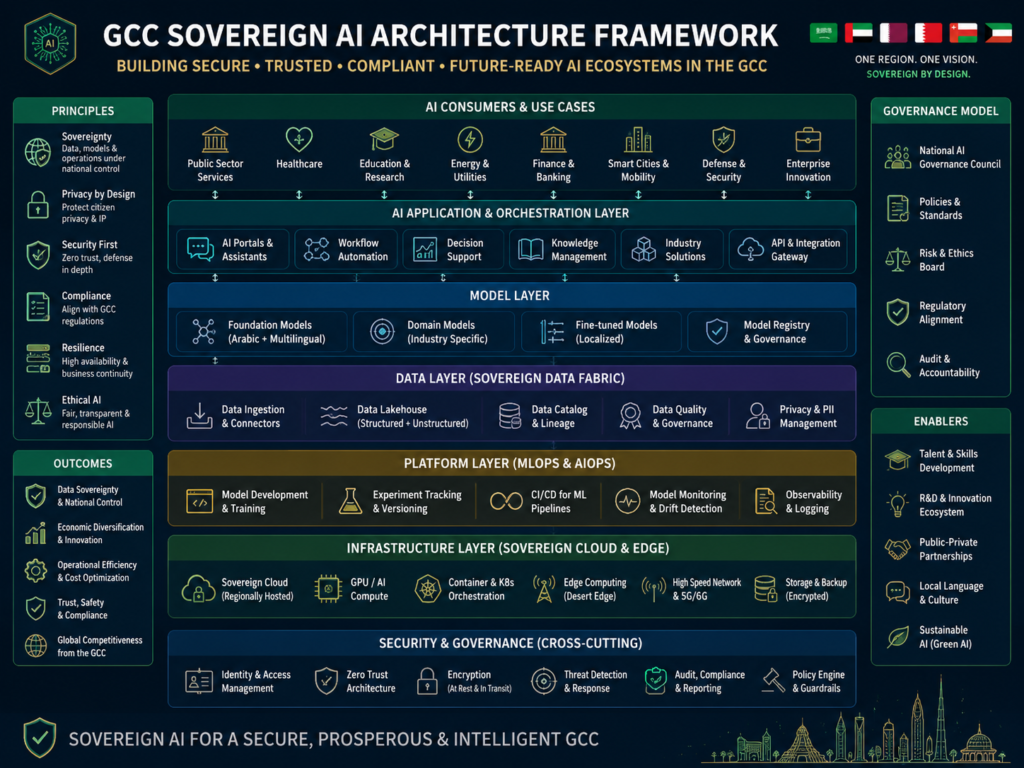
How to Build a Sovereign AI Architecture in the GCC
A practical sovereign AI strategy can be built around three stages.
Classify Data, AI Workloads and Regulatory Risk
Start by identifying what the AI system will actually process.
Classify workloads according to categories relevant to your organization, such as.
Public
Internal
Confidential
Regulated
Nationally sensitive
Do not classify only conventional database records. Include prompts, training data, model outputs, retrieved documents and proprietary knowledge sources.
SDefine Sovereignty Across Data, Models, Compute and Operations
Next, define exactly what must remain under organizational or local control.
Document responsibility for.
Data
Model weights
GPU infrastructure
Fine-tuning
Inference
Encryption keys
Administrators
Logging
Security operations
Model updates
This prevents procurement teams from accepting vague claims about sovereignty without identifying the actual control boundaries.
Choose Build, Buy or Hybrid Sovereignty
There is no single architecture that works for every GCC enterprise.
Build.
Offers greater control but can require significant infrastructure, security and AI expertise.
Buy.
Can accelerate deployment but requires careful validation of operational access, model control and third-party dependencies.
Hybrid.
Allows organizations to keep highly sensitive AI components under tighter control while using broader cloud services for lower-risk workloads.
For many businesses, hybrid architecture offers a practical balance between sovereignty, cost and implementation speed.
Organizations modernizing the surrounding application layer can also review Mak It Solutions’ complete services.
Sovereign AI Costs, Risks and Best Practices for GCC Businesses
What Drives Sovereign AI Cost?
Sovereign AI can require more dedicated infrastructure and operational controls than standard API-based AI deployment.
Major cost drivers can include.
GPU capacity
Model size
Dedicated infrastructure
Storage
Training versus inference requirements
Cybersecurity controls
Compliance processes
Disaster recovery
AI operations
Arabic model customization
The highest-control architecture is not always the best architecture. Enterprises should match sovereignty requirements to actual risk rather than applying maximum controls to every workload.
Common Sovereign AI Risks
Common risks include.
Vendor lock-in
Limited GPU availability
Skills shortages
Foreign operational dependencies
Model supply-chain exposure
Weak exit procedures
Poor auditability
Overly broad administrator privileges
Marketing claims that describe ordinary local hosting as “sovereign”
Procurement teams should therefore request evidence for sovereignty claims rather than relying on labels alone.
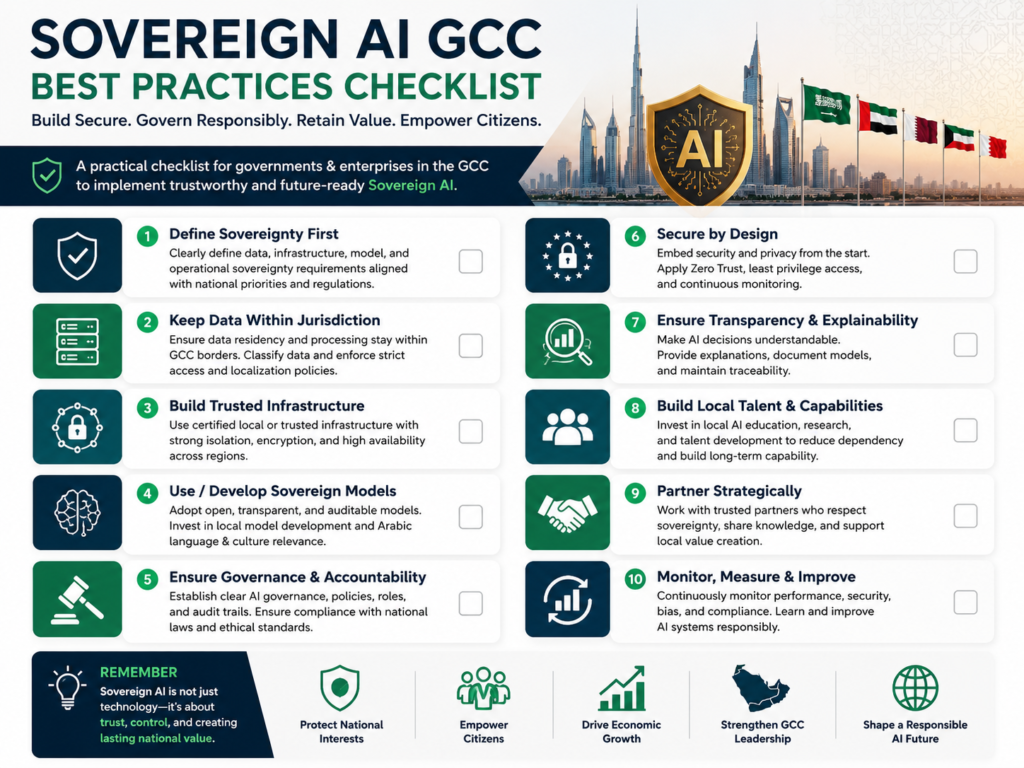
GCC Sovereign AI Best-Practice Checklist
Before selecting a provider or architecture, confirm.
Where is enterprise data stored?
Where does inference occur?
Who operates the environment?
Who controls encryption keys?
Where do model weights reside?
Can prompts or outputs leave the approved jurisdiction?
Who can update the model?
Which sub processors participate?
Can administrators outside the country access the system?
Are independent audits possible?
What happens to data and models when the contract ends?
In practice, these questions will look different for every organization.
A Riyadh fintech should map sovereignty controls to SAMA and other applicable requirements.
A Dubai e-commerce business may separate sensitive customer or AI workloads from ordinary application infrastructure.
A Doha SME may use locally available cloud infrastructure while separately checking whether its model, inference and operational layers meet its sovereignty expectations.
Final Thoughts
The sovereign AI vs sovereign cloud decision should not be reduced to a choice between two competing technology labels.
Sovereign cloud establishes stronger control over infrastructure, data and operations. Sovereign AI extends that thinking to the models, compute, prompts, inference, training and governance that make up an AI system.
For GCC organizations, the best architecture is the one that matches the sensitivity of the workload, applicable regulation and required level of operational control.
If your organization is planning a regulated digital platform, private AI system or modernization program across Saudi Arabia, the UAE or Qatar, contact Mak It Solutions to discuss an architecture aligned with your technical and business requirements.
Regulatory requirements vary by sector, data type and jurisdiction. This article provides general technology and compliance guidance and is not legal advice.
FAQs
Q : Does Saudi Arabia require all AI workloads to be hosted inside the Kingdom?
A : No single rule applies to every AI workload in Saudi Arabia. Requirements depend on the organization, sector, data classification and applicable regulatory framework.
SAMA-regulated organizations, for example, have specific cloud-governance and data-location considerations. Each AI workload should therefore be assessed against the rules that actually apply to the organization.
Q : Is a UAE-hosted AI model automatically sovereign AI?
A : No. Hosting an AI workload in Dubai or Abu Dhabi addresses location, but location alone does not establish full AI sovereignty.
Organizations should also evaluate model ownership or control, administrator access, encryption keys, model updates, sub processors and potential cross-border data flows.
Q : What should Qatar businesses check before choosing a sovereign AI provider?
A : Qatar businesses should review data location, inference location, administrator access, encryption-key control, model-weight storage, sub processors, audit rights and exit procedures.
Organizations in regulated industries should also assess the specific Qatari requirements that apply to their sector.
Q : Can GCC enterprises use hyper scalers and still maintain AI sovereignty?
A : Yes. A hybrid architecture can combine hyper scaler infrastructure with stronger local controls around sensitive data, model weights, inference and operations.
The provider’s brand alone does not determine sovereignty. The architecture, contracts, access model and operational controls do.
Q : Are Arabic-language AI models more sovereign than global AI models?
A : Not automatically.
Arabic fluency and cultural localization can make an AI system more useful in Riyadh, Jeddah, Dubai, Abu Dhabi or Doha, but sovereignty depends on who controls the data, model, compute, administrators and operations.
[…] Is Sovereign AI […]