


SEO Case Study: Win High-Intent Keywords
SEO Case Study: Win High-Intent Keywords
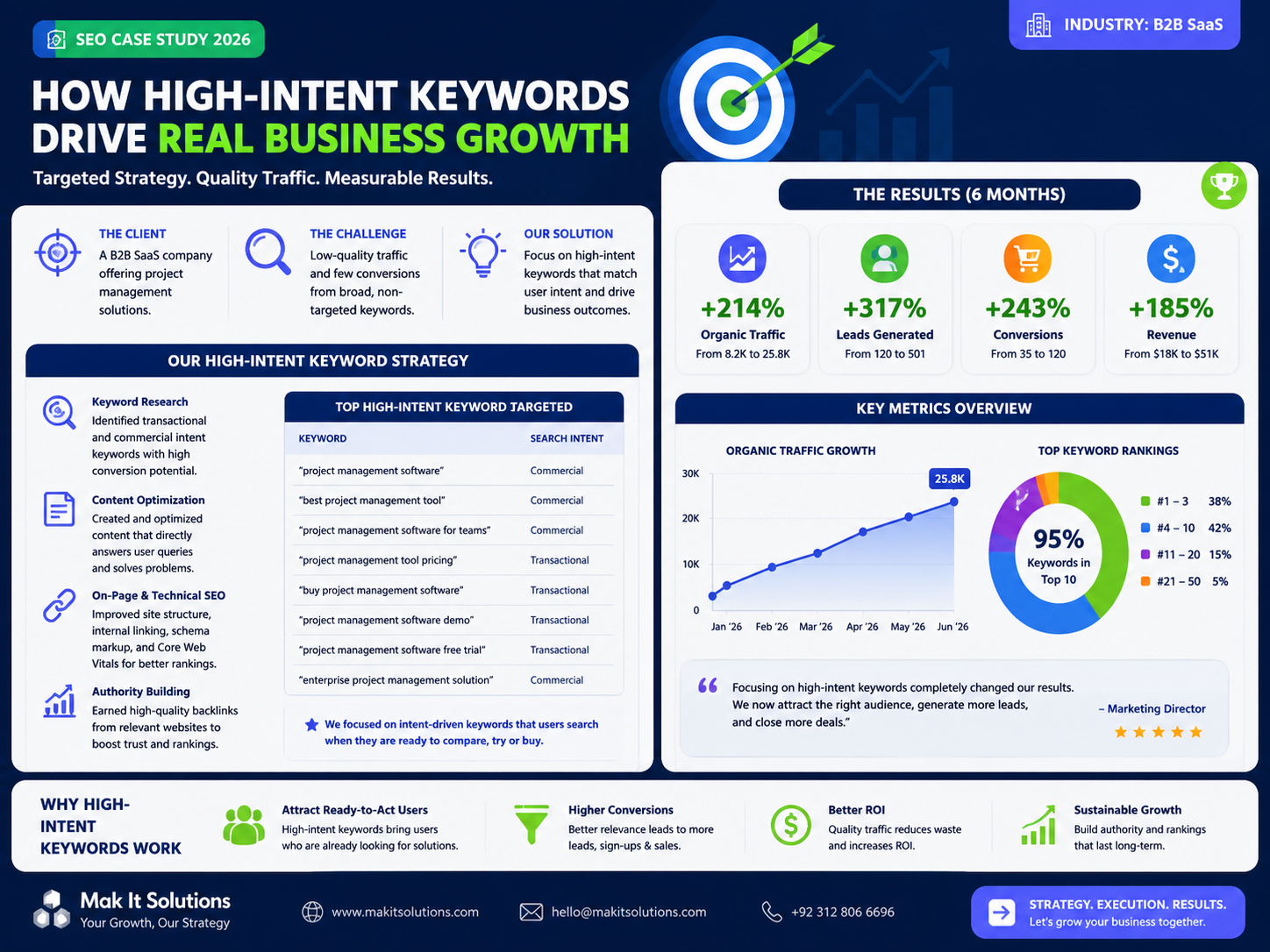
SEO Case Study: Win High-Intent Keywords
A strong SEO case study should prove more than a rising traffic graph. It should show how search visibility attracted the right audience and helped generate enquiries, conversions, pipeline, or revenue.
At its core, an SEO case study documents the problem, strategy, execution, and measurable results of a campaign. The most convincing examples connect keyword rankings and organic traffic with genuine commercial outcomes not vanity metrics.
Organic search generated roughly 33% of website traffic across seven major industries in 2024, while about 91% of surveyed marketers said SEO positively affected website performance and marketing goals.
The framework below focuses on a practical sequence: understand search intent, identify high-value commercial keywords, build the right content architecture, measure qualified visibility, and connect SEO performance to conversions.
What Makes an SEO Case Study Credible?
A credible SEO case study clearly explains the starting problem, what changed, how performance was measured, and what business impact followed.
Ranking improvements matter, but rankings alone rarely tell the whole story. The stronger question is: did those rankings attract people who were genuinely interested in buying, enquiring, booking, or taking another meaningful action?
Use a Clear Problem, Strategy, Evidence, Results Structure
Begin with business context and a measurable baseline. Then document.
The original SEO or business problem
Search-intent and keyword analysis
Content and technical changes
Before-and-after performance
Conversion or commercial impact
Lessons learned
The next growth opportunity
Supporting evidence may include Google Search Console queries, GA4 conversion data, SERP tracking, CRM records, and tools such as Ahrefs, SEMrush, SISTRIX, or Screaming Frog.
Measure Business Impact, Not Traffic Alone
A 100% increase in traffic is not automatically a commercial success.
A useful case study separates general visibility from commercially valuable activity. Metrics worth tracking can include:
Qualified organic sessions
Rankings for buyer-intent queries
Conversion rate
Enquiries or demo requests
Assisted conversions
Sales-qualified leads
Pipeline
Revenue where attribution is reliable
For B2B sites, industry reporting has placed average organic-search conversion rates at around 5%.
Strengthen E-E-A-T With Firsthand Evidence
Instead of simply claiming that a campaign succeeded, show the evidence behind the conclusion.
Anonymized dashboard screenshots, Search Console comparisons, methodology notes, measurement periods, and clearly stated limitations all make an SEO case study more trustworthy.
Google’s Search documentation also emphasizes building websites that search engines can crawl, understand, and evaluate effectively rather than depending on isolated optimization tricks. (Google Search Central)
How to Find High-Intent Keywords for an SEO Case Study
High-intent keywords are searches that indicate a user is actively evaluating a provider, service, product, or purchase.
They often contain modifiers related to services, pricing, comparisons, alternatives, products, locations, or terms such as “best.” These queries may attract less traffic than broad informational keywords, but they can be far more valuable commercially.
Separate Buyer Intent From Informational Intent
Informational searches usually indicate research.
For example.
“How does technical SEO work?”
“What is an SEO audit?”
Commercial or transactional searches move closer to a decision.
“Enterprise SEO agency”
“SEO audit pricing”
“Best SEO company in New York”
Those query types should not be judged by exactly the same success metrics.
Awareness content may be valuable for reach and topical authority. Commercial content should be evaluated more heavily on qualified visits, enquiries, conversions, and revenue potential.
Map Solution-Aware and Product-Aware Keyword Families
Organize related searches around different stages of the buyer journey.
Useful keyword families include.
Service searches
Pricing searches
Comparisons
Alternative queries
Industry-specific solutions
Location-based services
Case studies
For example, “SEO agency for SaaS” usually deserves a commercial service page. “How SaaS SEO works” is better suited to an educational guide.
Mak It Solutions follows this commercial-page approach across its SEO services and service-page SEO content.
Priorities Conversion Potential Over Search Volume
Search volume should inform a keyword decision, not control it.
Consider business relevance, buyer intent, ranking difficulty, SERP composition, CPC signals, and likely conversion potential together.
A low-volume search can still be strategically important when it reflects a highly specific buying need. Ahrefs also notes that keyword-volume estimates should not be confused with a page’s total traffic potential because one page can rank for many related long-tail searches.
SEO Case Study Framework for Winning Commercial Queries
A practical SEO framework starts by identifying the buyer stage, clustering related searches, assigning each cluster to the correct page type, and strengthening priority pages with relevant internal links and credible evidence.
Success should then be measured through commercial rankings, qualified traffic, conversions, and revenue—not visibility alone.
Diagnose Search Intent Before Creating Content
Classify each target query as informational, commercial-investigation, or transactional.
Then inspect the current SERP.
If search engines consistently rank service pages for a query, publishing another generic blog post may create the wrong asset even if the article itself is well written.
Intent should guide the page type.
Build Keyword Clusters Around the Customer Journey
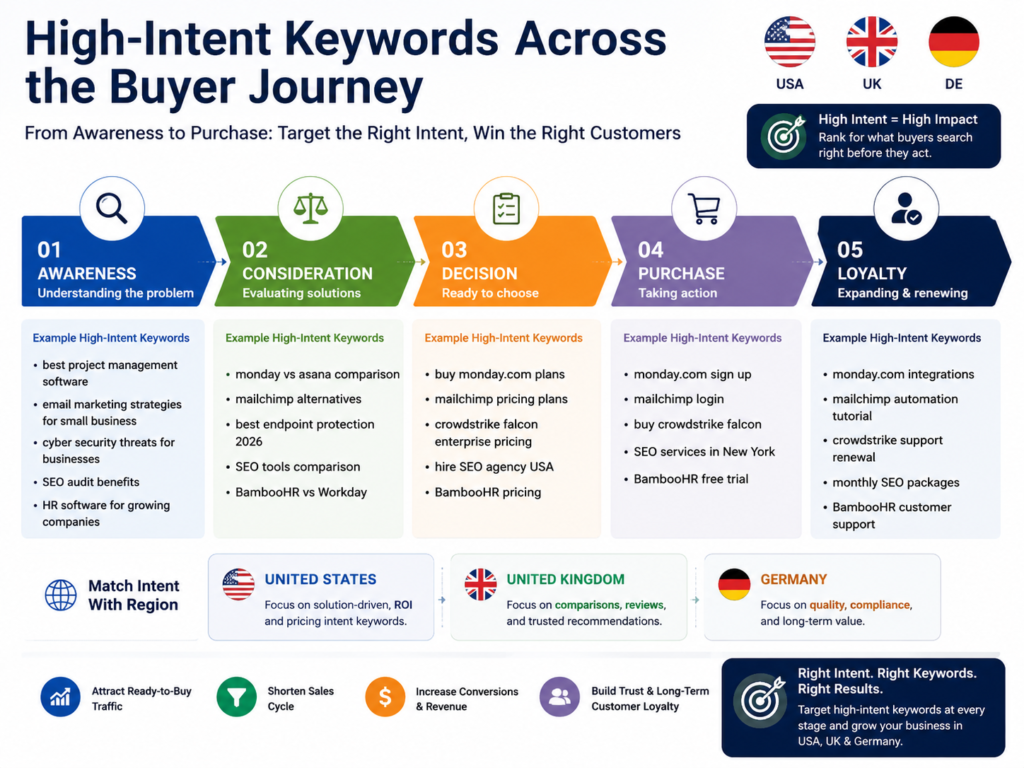
Group keywords around awareness, consideration, and bottom-of-funnel needs.
Educational content can build topical depth and answer early-stage questions, while contextual internal links can direct interested readers toward commercial pages.
For businesses connecting SEO with wider acquisition and measurement, digital marketing services and business intelligence capabilities can also support stronger attribution and decision-making.
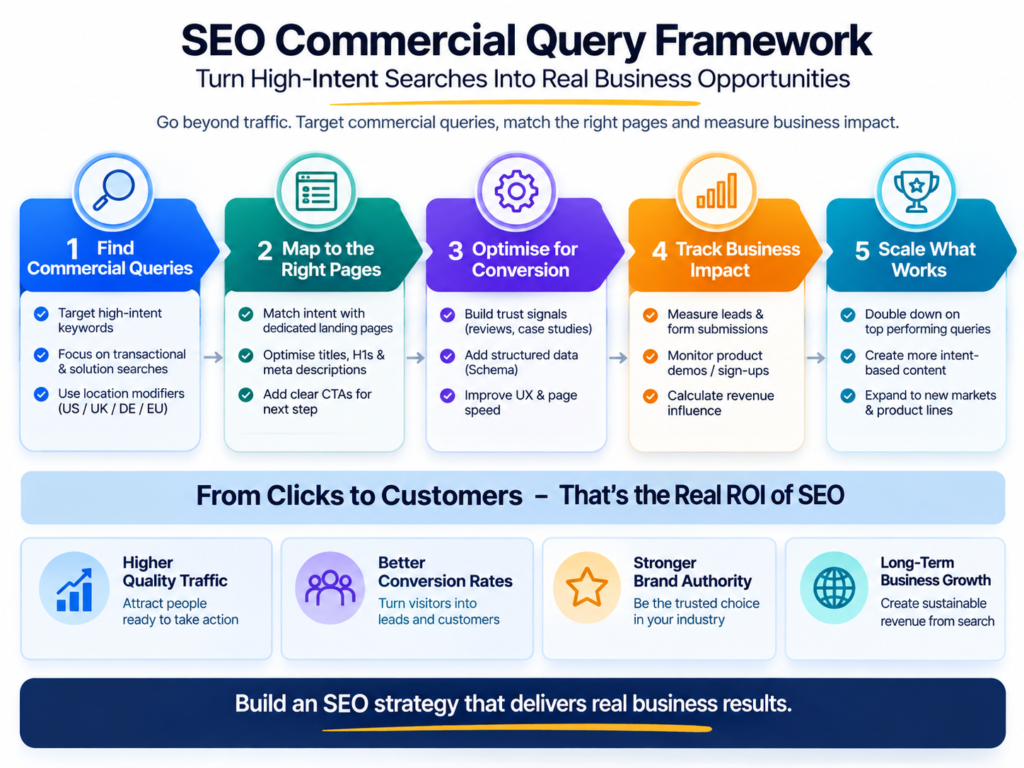
Match Each Query to the Right Page Type
Different searches deserve different assets.
Map.
Transactional searches → service or landing pages
Comparison searches → comparison pages
Alternative queries → alternatives content
Pricing searches → pricing or commercially focused pages
Educational questions → guides and supporting articles
Internal linking should then connect supporting content with the pages designed to convert.
How to Measure SEO Case Study Results Beyond Traffic
An SEO case study becomes more commercially useful when it tracks conversions rather than relying on traffic alone.
The measurement sequence should move from visibility to business impact: strategically important rankings, qualified organic traffic, conversions, and finally attributable pipeline or revenue where reliable data is available.
Establish a Comparable Baseline
Before major SEO work begins, capture a baseline using Google Search Console, GA4, and relevant business systems.
Record metrics such as.
Search rankings
Organic clicks
Qualified sessions
Conversions
Conversion rate
Leads or enquiries
Revenue where attribution is available
Avoid comparing periods distorted by seasonality, website migrations, tracking changes, or unusual campaigns.
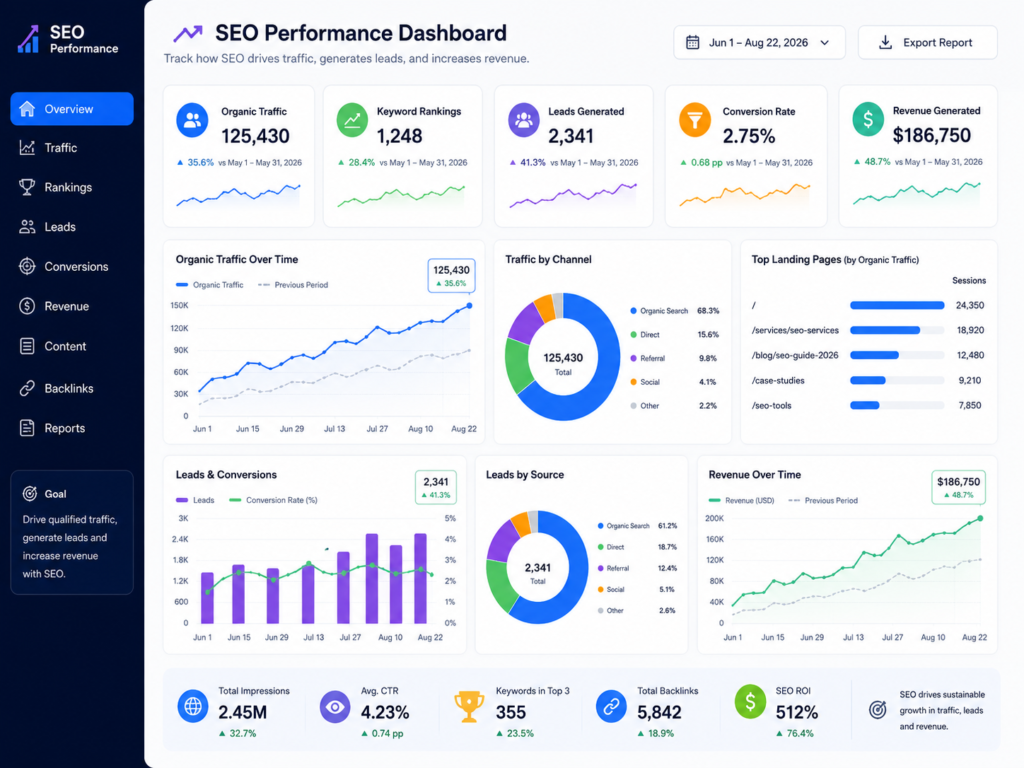
Separate Commercial Rankings From Informational Visibility
Not every ranking has equal business value.
For example, moving from position 18 to position 4 for a high-value service query may matter more commercially than generating thousands of additional impressions for broad informational topics.
Segmenting keyword performance makes that difference easier to see.
Connect Organic Search to Leads and SEO ROI
Use GA4 events, CRM information, assisted conversions, call tracking, and sales qualification data where appropriate.
A 2025 survey reported that approximately 56% of marketers had experienced increased traffic since Google introduced AI Overviews.
Traffic, however, is only part of the commercial question. The more important issue is whether that visibility influences qualified demand.
SEO Case Study Examples for the USA, UK, Germany and EU
The underlying SEO framework can remain consistent across markets, but keyword language, competitive conditions, regulatory expectations, and proof signals need localization.
USA.
Consider an IT consultancy targeting “cloud migration consulting New York.”
Rather than competing primarily for broad terms such as “cloud computing,” the business could create a commercial page around decision-stage needs, technical capabilities, proof, buyer concerns, and local relevance.
For California audiences, customer-data workflows may also need to account for CCPA and CPRA obligations.
UK.
A campaign targeting London or the wider UK should reflect British terminology, spelling, buyer expectations, and local conversion behavior instead of simply duplicating US copy.
Depending on the sector, relevant entities may include the FCA, NHS, Open Banking, and UK GDPR.
The Information Commissioner’s Office highlights principles such as lawfulness, fairness, transparency, data minimization, security, and accountability within UK data-protection guidance. (ICO)
Germany and the EU.
A campaign targeting Berlin, Munich, or other German-speaking markets should research native search behavior rather than translating US-English keywords word for word.
Relevant concepts may include.
SEO Fallstudie
Suchintention
Kaufabsicht
Sichtbarkeit
Transaktionale Keywords
In finance, SaaS, and other data-intensive sectors, GDPR/DSGVO, BaFin, data residency, and wider European regulatory expectations may also influence content and conversion design.
The same localization principle applies across France, the Netherlands, Ireland, Spain, Italy, Austria, and other European markets.
SEO Case Study Template You Can Reuse
Business Problem and SEO Baseline
Document the market, audience, business objective, starting rankings, organic traffic, conversion rate, and any available lead or revenue baseline.
Intent Mapping, Content Strategy and Execution
Record.
Target query families
Keyword clusters
Search intent
Intended page type
Content changes
Internal links
Technical dependencies
Reasoning behind each intervention
Results, Lessons and Next Opportunities
Compare equivalent periods and report rankings, qualified traffic, conversions, and commercial outcomes.
Also explain what worked, what underperformed, any attribution limitations, and what should be tested next.
Turn Your SEO Case Study Into a Repeatable Growth System
A good case study should not end with a results screenshot. It should help determine the next SEO investment.
Find the Next High-Intent Keyword Cluster
Use Search Console, conversion data, competitor gaps, and sales feedback to identify adjacent commercial searches.
A successful keyword cluster often exposes the next logical buying need worth targeting.
Avoid International SEO Cannibalization
Do not create us, uk, and de pages by simply replacing country names.
Localize the keyword mapping, language, examples, offers, regulations, search behavior, and conversion expectations for each market.
Turn Evidence Into the Next Investment Decision
Use the SEO case study to decide whether the next priority should be.
New commercial landing pages
Supporting content clusters
Technical SEO improvements
Conversion optimization
International expansion
That turns reporting into a growth system rather than a retrospective document.
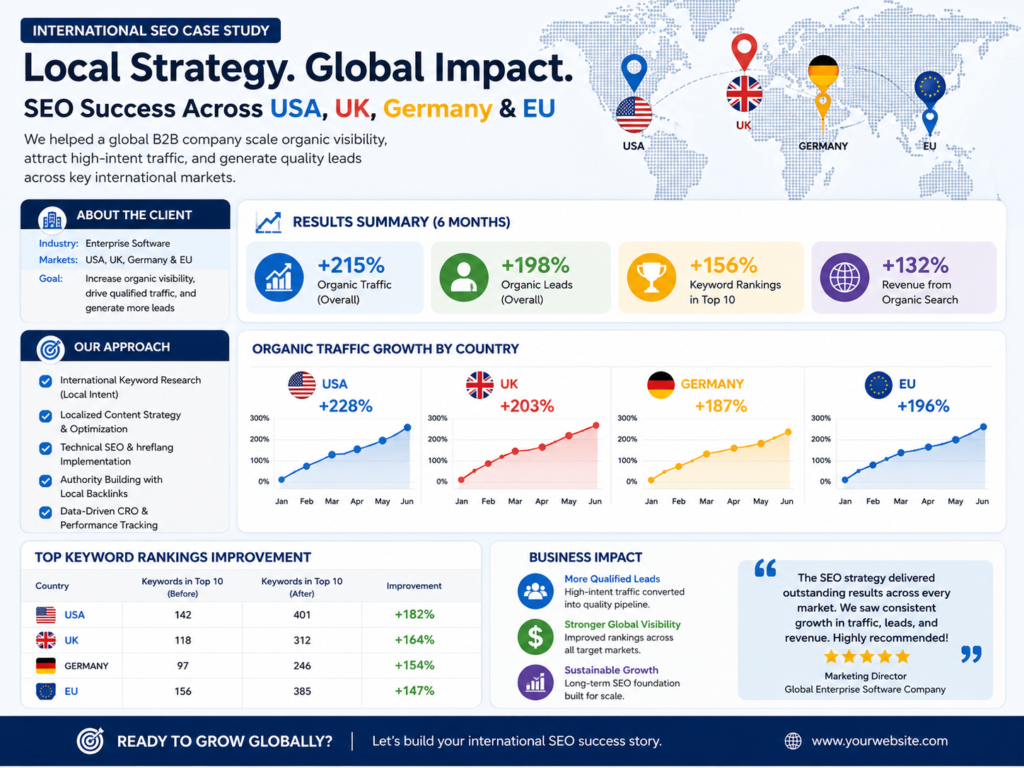
Wrap It Up
If your next SEO case study only proves that traffic increased, it leaves the most important question unanswered: did SEO create meaningful business opportunities?
Start with the high-intent keyword clusters closest to the buying decision, match them with the right pages, and measure what happens after the click. ( Click Here’s )
Explore Mak It Solutions’ SEO services and digital marketing capabilities to request a scoped estimate for an intent-led SEO audit.
The goal is not simply more traffic. It is organic visibility that supports measurable growth.
Key Takeaways
A strong SEO case study connects rankings with qualified traffic, conversions, pipeline, or revenue.
Priorities buyer intent and conversion potential instead of search volume alone.
Match high-intent keywords with the correct service, comparison, alternative, pricing, or landing page.
Track informational and commercial keyword performance separately.
Localize strategy for the USA, UK, Germany, and wider EU instead of duplicating pages.
Use first-party evidence, transparent methodology, and reliable analytics to make results credible.
FAQs
Q : How long should an SEO case study track results before publishing?
A : Most campaigns need enough time for indexing, ranking movement, user behavior, and conversions to become meaningful. Three to six months can provide an initial view, while competitive markets may require six to twelve months. Always use comparable periods and disclose factors that could distort the results.
Q : Which SEO metrics make a case study trustworthy?
A : Start with rankings for commercially relevant searches, then measure organic clicks, qualified sessions, conversion rate, enquiries, assisted conversions, and attributable pipeline or revenue. Baseline data and a clearly defined measurement period make the findings easier to evaluate.
Q : Can low-volume commercial keywords outperform high-volume keywords?
A : Yes. A low-volume query may create more commercial value when the searcher is closer to making a decision. A specific search such as “enterprise SEO audit provider” can have stronger buying intent than a much broader query such as “what is SEO.”
Q : Should SEO case studies include client revenue and conversion data?
A : Include revenue and conversion information when the client permits it and attribution is reliable. If financial information is confidential, use percentages, indexed values, qualified-lead counts, conversion-rate changes, or anonymized pipeline data instead.
Q : How should an international SEO case study localize results?
A : Report performance by market and search behavior rather than combining every country into a single average. Localize terminology, keyword mapping, competition, compliance considerations, and conversion expectations for each region.
[…] What Is a Content Refresh in SEO? […]