
Update Old Blog Posts for SEO & Win Back Traffic
Update Old Blog Posts for SEO & Win Back Traffic
Update Old Blog Posts for SEO & Win Back Traffic
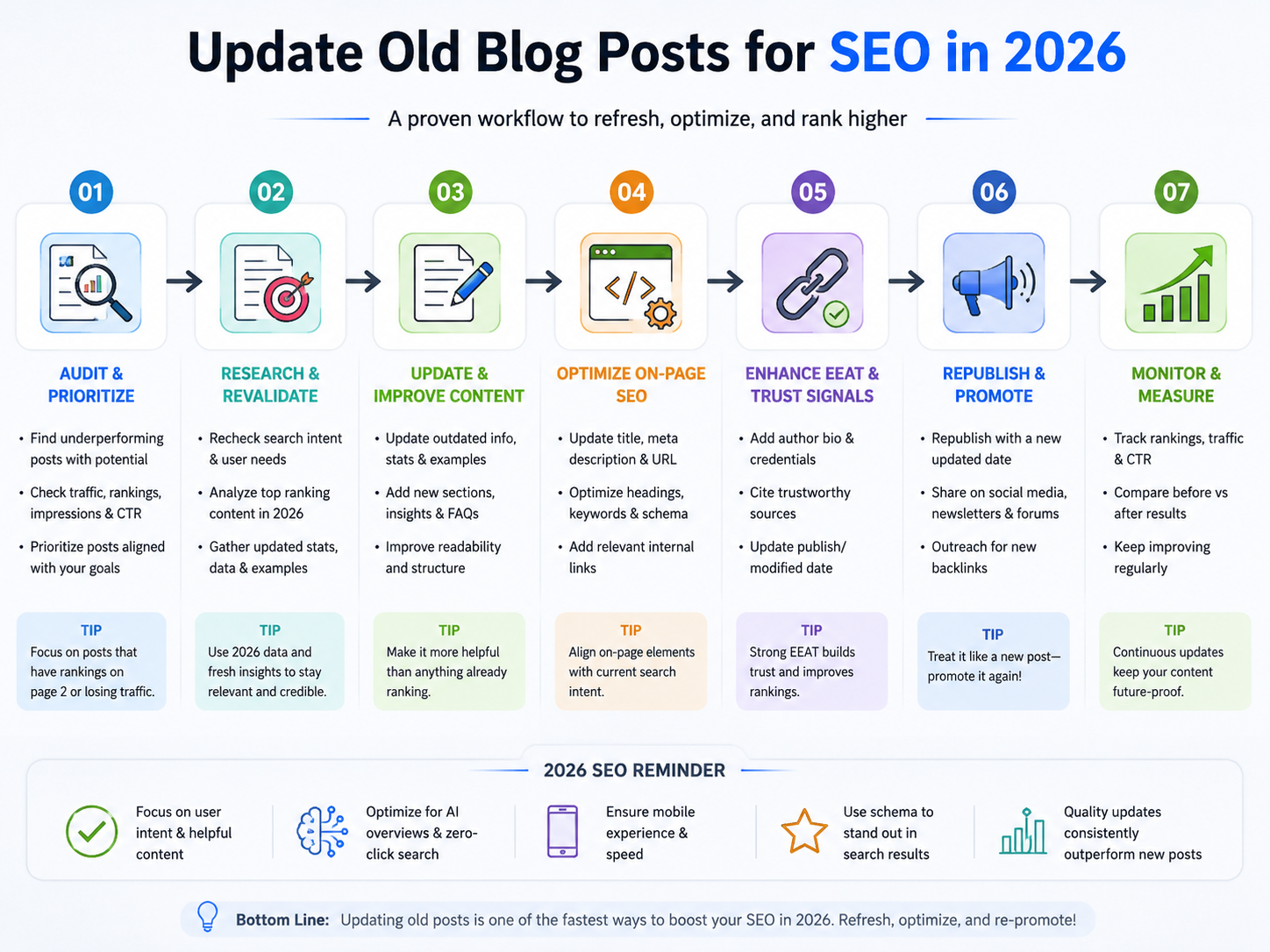
Old content does not always need replacing. In many cases, the faster route to stronger organic performance is to update old blog posts for SEO by improving pages that already have rankings, backlinks, history, and authority.
A good content refresh keeps the valuable parts of an existing URL while fixing what has become outdated, incomplete, or misaligned with search intent. That means more than changing the year in the title. It means improving accuracy, usefulness, structure, internal links, and the page’s ability to answer both traditional search queries and AI-powered search experiences.
What Is a Content Refresh in SEO?
A content refresh is the process of improving an existing page so it remains accurate, competitive, and useful in organic search.
Depending on the page, that may involve:
Replacing outdated facts, screenshots, or examples;
Adding topics users now expect to see;
Improving weak explanations;
Updating titles and meta descriptions;
Strengthening internal links;
Reorganizing sections around current search intent;
Checking schema, canonicals, and indexability.
The objective is not to make an article look newer. It is to make it genuinely better.
Content Refresh vs. Cosmetic Freshness
Substantive freshness improves the reader’s experience. Cosmetic freshness only creates the appearance of an update.
Changing “2025” to “2026,” editing a handful of sentences, or modifying the publication date without meaningful changes is not a proper refresh. Google specifically advises publishers against changing dates simply to make pages appear fresh when their content has not substantially changed.
Historical optimization should improve accuracy, relevance, completeness, or usability.
Why Old Blog Posts Lose Rankings and Traffic
Content decay can happen gradually.
A competitor may publish a stronger explanation. Search intent can change. Statistics become outdated. Product screenshots stop matching the current interface. Important subtopics emerge, while sections that once mattered become less useful.
Internal visibility can also weaken as a website grows. An article that once received links from several prominent pages may become buried deeper in the site.
CTR can decline as well. Sometimes impressions remain healthy, but competing titles and descriptions become more attractive.
When Updating Existing Content Beats Publishing Something New
Refresh an existing URL when it still satisfies the right search intent and already has useful SEO signals, such as.
Rankings.
Backlinks.
Organic traffic.
Conversions.
Topical authority.
Brand recognition.
Publishing another article targeting nearly the same query can divide relevance between two pages and create keyword cannibalization.
When the established URL still has strategic value, improving it is usually more efficient than rebuilding its authority from zero.
Which Old Blog Posts Should You Update First?
Not every old article deserves equal attention.
The best candidates usually combine declining performance with realistic recovery potential and clear business value.
Find Content Decay in Google Search Console
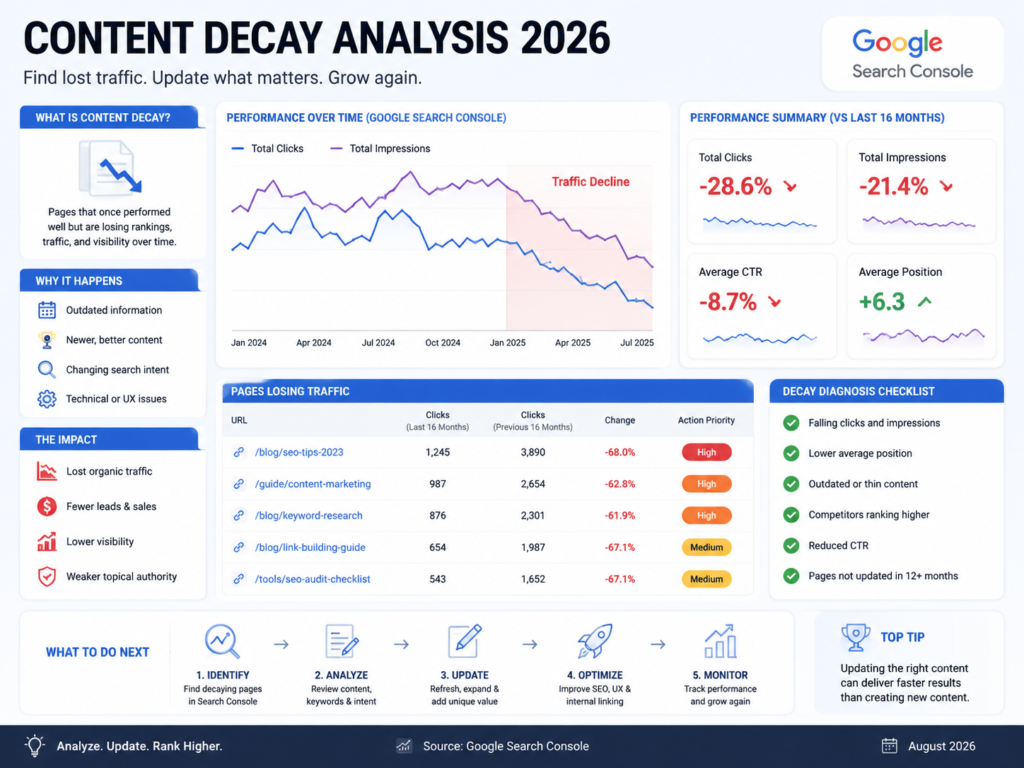
Use Google Search Console to compare an article’s performance across equivalent periods.
Look at.
Clicks.
Impressions.
CTR.
Average position.
Important queries.
Landing-page performance.
Google defines CTR as clicks divided by impressions, but no single metric tells the whole story.
For example, if a page loses 35% of its clicks while impressions remain relatively stable, the problem may be declining CTR. Falling impressions can point toward reduced demand, weaker relevance, lost query coverage, or stronger competition.
Look at the pattern rather than reacting to one number.
Prioritize Pages Ranking Around Positions 4–20
Pages ranking in positions 4–20 can be particularly attractive refresh opportunities because search engines already recognize their relevance.
Review what currently outranks the page. Ask.
Are competing pages answering questions yours misses?
Are they structured more clearly?
Do they include fresher evidence?
Has the dominant search intent changed?
Are users now expecting a different format?
The goal is not to copy competitors or chase their word count. Find genuine information gaps and improve the page where it matters.
For sites that need broader support across content and technical optimization, Mak It Solutions’ SEO services cover search visibility, optimization, analytics, and related SEO work.
Score Refresh Opportunities by Traffic, Value, and Effort
A simple scoring model can make prioritization easier.
Consider.
Organic traffic decline.
Current ranking position.
Query coverage.
Backlink profile.
Conversion potential.
Commercial relevance.
Factual risk.
Age of important information.
Estimated effort required.
A declining article that regularly generates qualified enquiries should usually take priority over an older page with no meaningful traffic, links, or business relevance.
How to Update Old Blog Posts for SEO Step by Step
To update old blog posts for SEO without unnecessarily risking rankings, keep the established URL where practical, preserve useful sections and links, reassess current intent, make meaningful content improvements, and strengthen the surrounding technical and internal-link signals.
Recheck Search Intent, Competitors, and Content Gaps
Search the main and secondary queries again.
The SERP may have changed dramatically since the article was first published. Review current terminology, page formats, entities, examples, and question patterns.
Look for information gain rather than imitation.
Your refreshed article should give readers something clearer, more complete, more specific, or easier to use than the version it replaces.
Upgrade the Content, Evidence, and On-Page SEO
Remove or replace.
Outdated statistics.
Broken references.
Obsolete screenshots.
Superseded product details.
Inaccurate regulatory statements.
examples that no longer reflect the market.
Do not keep adding paragraphs to weak sections simply to make the article longer. Sometimes a clean rewrite is more useful than another 500 words.
Also review the title tag, meta description, headings, and opening paragraphs. If rankings remain reasonable but CTR is weak, the search snippet may need as much attention as the body copy.
McKinsey reported in 2024 that about 72% of surveyed organizations were using AI in at least one business function, showing how quickly technology-focused content can become dated.
When editorial updates require technical implementation as well, Mak It Solutions offers web development services and web design services.
Strengthen Internal Links, Schema, and Technical Signals
A refreshed article should not sit in isolation.
Add relevant contextual links from strong pages elsewhere on the site. Remove broken destinations and check whether the page has effectively become orphaned.
Also confirm.
The canonical URL.
Indexability.
Structured data.
Internal-link destinations.
Redirect behavior, if a URL change is unavoidable.
Preserve the existing URL whenever practical. If migration is genuinely necessary, use an appropriate redirect and update important internal links pointing to the old address.
For larger projects where content, design, development, and optimization overlap, Mak It Solutions’ broader digital and development services provide a useful starting point.
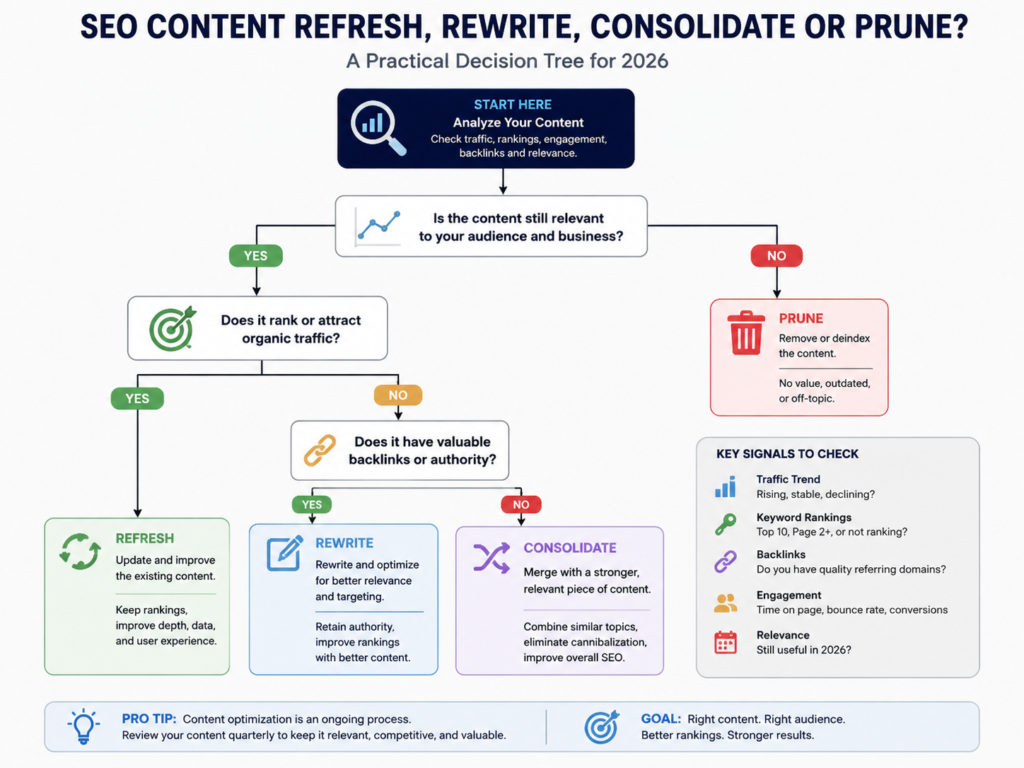
Refresh, Rewrite, Consolidate, or Prune?
A falling page does not automatically need more content.
Choose the action according to what remains valuable.
| Situation | Best Action |
|---|---|
| URL still matches intent and has rankings or links | Refresh |
| Topic matters, but the page is structurally weak | Rewrite |
| Multiple pages compete for the same intent | Consolidate |
| Page is obsolete, thin, duplicate, and has little value | Prune |
Refresh When the Topic Still Matches Search Intent
Refresh when the article still answers the right question and retains meaningful SEO or business value.
Keep strong sections. Remove obsolete material. Add the information users genuinely need now.
Rewrite or Consolidate Weak and Cannibalized Content
A full rewrite makes sense when the topic remains important but the current article is too weak or poorly organized to repair section by section.
Consolidation is often better when several URLs target almost the same query. Combine their strongest useful material into one primary resource and redirect obsolete pages where another destination truly satisfies the same intent.
Prune Only When a Page Has No Real Strategic Value
Pruning should be deliberate.
Before removing a page, check its backlinks, conversions, rankings, historical traffic, and internal-link relationships.
Delete or redirect content only when keeping it offers little value. A redirect should lead somewhere genuinely relevant, not merely to the homepage for convenience.
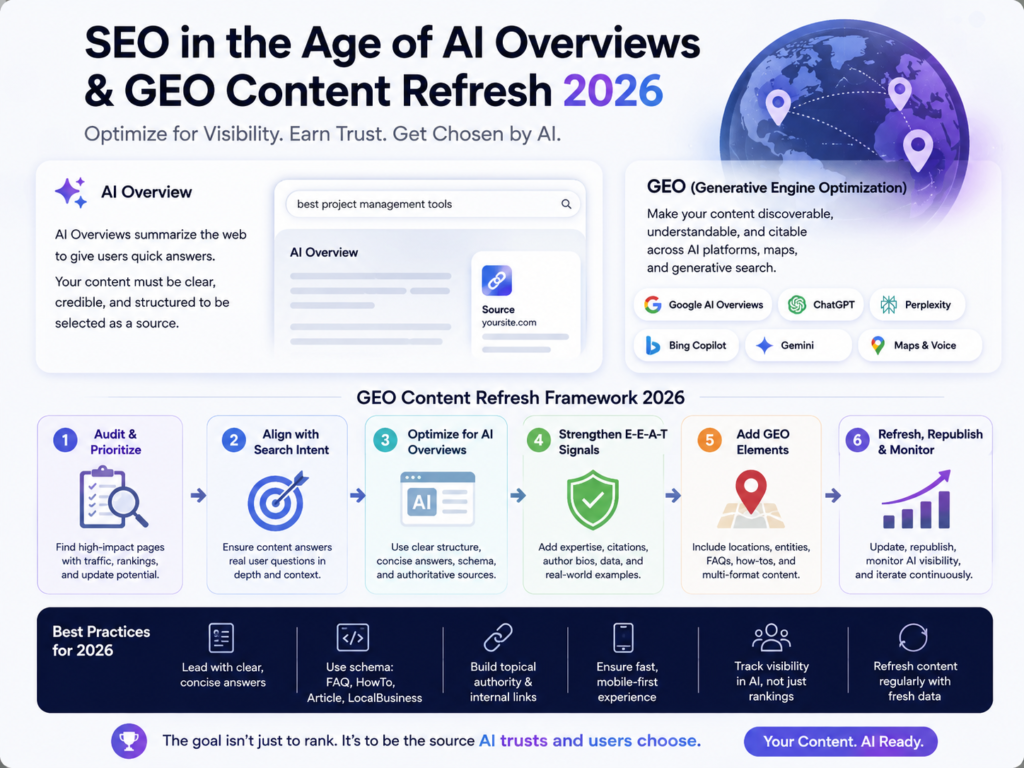
How to Refresh Content for AI Search and GEO in 2026
Updating content for AI-driven discovery is not about writing unnatural copy for machines.
It is about making useful information easier to understand, retrieve, verify, and cite.
Make Answers Easy to Extract
Place concise answers directly below important question-based headings.
Use.
Short definitions.
Direct explanations.
Logical H2 and H3 headings.
Numbered processes.
Explicit comparisons.
Descriptive entity relationships.
Google reported in 2025 that AI Overviews had reached around 1.5 billion monthly users across 200 countries and territories.
That level of adoption makes answer-friendly structure increasingly relevant alongside conventional search optimization.
Add Information Gain, Entities, and Real Evidence
Generic summaries are easy to reproduce. Original insight is harder to replace.
Where genuine evidence is available, strengthen a refresh with.
First-hand observations.
Before-and-after results.
Named tools.
Expert commentary.
Proprietary examples.
Original screenshots.
Client-approved case information.
Make relationships between entities explicit as well. For example, connect Google Search Console clearly with impressions and CTR, or explain how GDPR relates to EU data-protection obligations.
McKinsey also reported that approximately 65% of surveyed organizations were regularly using generative AI in at least one business function in early 2024.
Optimize for Google, Chat GPT, and Gemini Without Writing for Bots
Do not force keywords into every paragraph or manufacture awkward “AI-friendly” sentences.
The fundamentals remain useful across discovery systems.
Clear intent.
Credible sourcing.
Information gain.
Descriptive headings.
Direct answers.
Strong internal links.
Trustworthy backlinks.
Appropriate structured data.
For teams building measurement-heavy content programs, Mak It Solutions’ business intelligence services can support reporting and data-led decision-making.
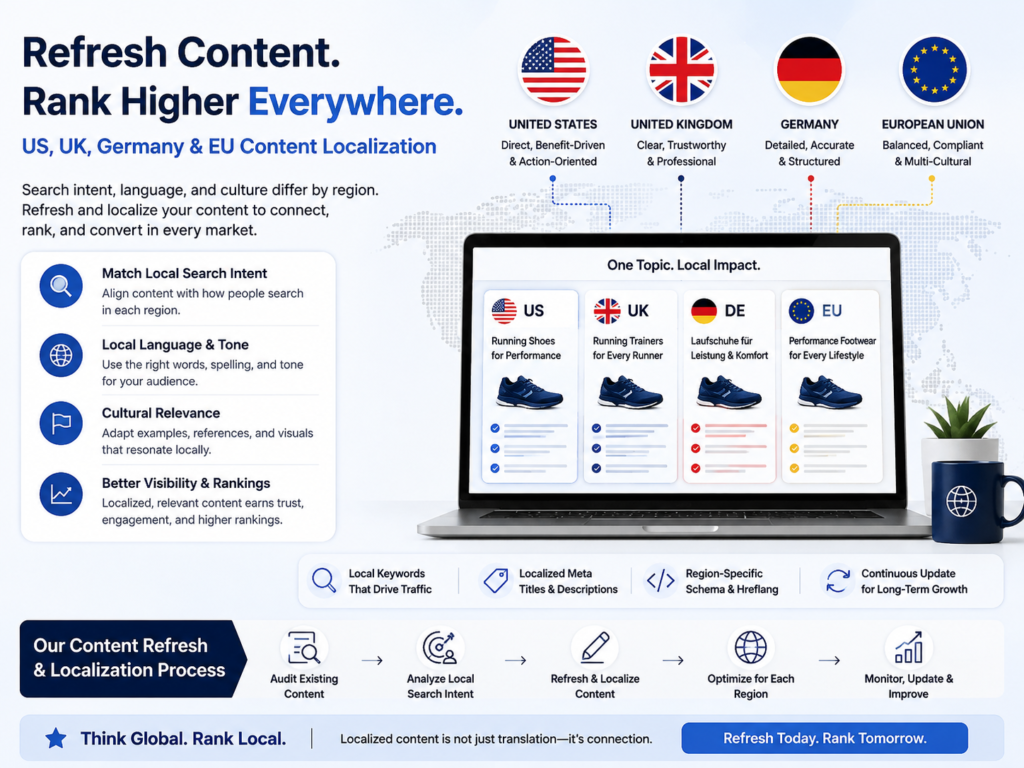
Localize Content Refreshes for the USA, UK, and Germany/EU
Localization requires more than changing spellings or adding a city name.
A global refresh should review regulatory references, terminology, currencies, market assumptions, and user expectations for each region.
USA.
For US-focused content, verify references to CCPA/CPRA, HIPAA, FTC, FDA, HHS, SOC 2, and PCI DSS whenever they are relevant.
California’s CCPA, as amended by the CPRA, includes privacy rights covering access, deletion, correction, and certain restrictions involving sensitive personal information.
A SaaS page written for a San Francisco audience may therefore need different context from an Austin startup guide or a New York healthcare article.
HIPAA-related claims should also be checked against current HHS guidance whenever protected health information is involved.
UK.
For readers in London, Manchester, and the wider UK, use natural British terminology where appropriate, such as optimise and priorities.
Review references to UK GDPR, the FCA, NHS guidance, and other UK-specific rules instead of assuming EU or US language applies unchanged.
The Information Commissioner’s Office remains a key authoritative source for UK data-protection guidance.
Germany and the EU.
German and EU pages may need updates to GDPR/DSGVO terminology, financial references involving BaFin or PSD2, and newer AI-related regulatory information.
For German-speaking users in markets such as Berlin, Munich, or Frankfurt, phrases such as Content Refresh Strategie, alte Inhalte aktualisieren, Rankings zurückgewinnen, and KI-Sichtbarkeit may make sense when they reflect real search behavior and the language of the page.
Also audit.
Hreflang.
regional canonicals.
Currencies.
Translations.
Regulatory claims.
Data-residency statements.
Measure SEO and AI Visibility After the Refresh
A content refresh is not complete when the edits go live.
You need a baseline and a clear way to judge what changed.
Track Rankings, Clicks, Impressions, and CTR
Record pre-refresh Search Console performance for the page and its important queries.
After publishing, compare equivalent periods while considering seasonality and changes in demand.
Track clicks, impressions, CTR, position, and query coverage together rather than judging the refresh by one keyword.
Monitor Conversions, Engagement, and Backlinks
Organic visibility only matters if it supports the page’s purpose.
Depending on the article, also monitor.
Leads.
Assisted conversions.
Important internal-link clicks.
Engagement with commercial pages.
Recovered backlinks.
New backlinks.
An article can become more valuable to the business even when ranking gains are modest.
Build a Repeatable Content Refresh Workflow
Maintain a simple refresh backlog containing.
URL.
Decline signal;
Business valu
Owner
Recommended action
Update date
post-refresh results.
For regulated, financial, healthcare, and other YMYL topics, factual changes should trigger reviews when necessary instead of relying only on an arbitrary publishing calendar.
Teams looking for wider implementation support can review Mak It Solutions’ web and digital services or discuss a scoped project.
To Sum Up
Before putting your entire content budget into publishing new articles, look at the opportunities already sitting in your existing content library.
Old posts can lose visibility as search intent changes, competitors publish stronger content, and information becomes outdated. A strategic refresh can improve relevance while preserving the value your existing URLs have built over time.
Mak It Solutions can help identify content decay, prioritize high-opportunity pages, and create a practical update old blog posts for SEO strategy focused on measurable recovery not unnecessary rewrites.
Ready to turn underperforming content into a stronger SEO asset?
Request a scoped SEO consultation and start with the pages offering the greatest recovery potential.
Key Takeaways
Update old pages because their performance or relevance has changed, not simply because they are old.
Preserve established URLs and useful backlinks when the original search intent still fits.
Refresh statistics, screenshots, examples, internal links, metadata, and regulatory claims meaningfully.
Prioritize pages with realistic ranking upside and measurable business value.
Structure important answers clearly for Google search, AI Overviews, Chat GPT, Gemini, and other answer engines.
Localize US, UK, German, and EU versions according to terminology, compliance requirements, and user expectations.
Measure clicks, impressions, CTR, conversions, query coverage, and backlinks after publishing.
FAQs
Q : How often should high-performing blog posts be reviewed for SEO?
A : Review important evergreen and commercial content periodically, but do not refresh pages simply because a set number of months has passed. Performance drops, outdated facts, shifting intent, or regulatory changes are stronger triggers.
Q : Should you change the publication date when refreshing old content?
A : Only when the article has been substantively updated and the displayed date accurately reflects that change. Updating a timestamp alone does not make an article more useful.
Q : How long should you wait before measuring results from a content refresh?
A : Begin tracking immediately, but evaluate the trend across several weeks rather than a few days. Crawling frequency, competition, seasonality, and search demand can all affect how quickly changes become visible.
Q : Can updating an old blog post temporarily reduce its rankings?
A : Yes. Rankings may fluctuate while search engines recrawl and reassess major edits. Preserving the URL, useful content, internal links, and established search intent can reduce unnecessary risk.
Q : Should regional versions of the same article be refreshed at the same time?
A : Reviewing related versions together can help keep core facts consistent, but the pages should not become identical. US, UK, German, and wider EU versions may need different terminology, regulations, currencies, examples, and search-intent adjustments.
[…] and external tools create costs that traditional SaaS seat pricing was never designed to represent. Mak It Solutions’ guide to enterprise RAG architectures shows why the surrounding AI stack is part of the pricing […]