


AI Infrastructure GCC: Saudi, UAE & Qatar Guide
AI Infrastructure GCC: Saudi, UAE & Qatar Guide

AI Infrastructure GCC: Saudi, UAE & Qatar Guide
The AI infrastructure GCC market is becoming a practical enterprise consideration, not just a regional technology ambition. Saudi Arabia, the UAE and Qatar are expanding access to local GPU compute, sovereign AI services and data-center capacity, giving organizations more choices for training, fine-tuning and inference.
For enterprise buyers, the key benefit is greater control over where AI workloads run and how data moves. But the right infrastructure decision still depends on performance, residency requirements, regulation, utilization and total cost—not simply which provider has the largest GPU footprint.
Why AI Infrastructure GCC Growth Matters Now
The GCC is moving beyond consuming AI services hosted elsewhere and toward building serious local compute capacity. That shift changes how regional enterprises can approach model deployment, data residency, latency and vendor strategy.
Organizations developing AI-enabled applications can connect infrastructure planning with scalable Python development services and reliable back-end development expertise.
From Traditional Cloud to GPU-Accelerated AI
Traditional cloud infrastructure is designed for broad computing requirements. AI-ready infrastructure adds specialized components such as GPUs, accelerated networking, high-density racks, advanced cooling and storage optimized for model training and inference.
That difference matters because AI workloads can create much heavier requirements for memory, networking, power and sustained compute than standard enterprise applications.
Saudi Arabia Is Pushing for Large-Scale Capacity
Saudi Arabia has become one of the region’s most visible AI infrastructure expansion markets.
On August 31, 2026, HUMAIN’s AMD- and Cisco-powered production compute infrastructure went live. HUMAIN and Data Volt have also moved forward with development of a 100MW AI-ready phase at Oxagon in NEOM, while center3 is pursuing additional AI-focused capacity aligned with Vision 2030.
Why Local GPU Compute Can Change Enterprise Economics
More local capacity can reduce dependence on distant GPU regions and give enterprises additional choices when deploying production workloads.
Potential advantages include.
Lower latency for regional users
Reduced international data movement
Faster access to specialized AI compute
More options for data-residency-sensitive workloads
Greater flexibility when negotiating infrastructure strategy
These benefits can be particularly relevant for inference workloads that run continuously rather than occasional model-training projects.
What Is GPU Infrastructure?
GPU infrastructure combines accelerators, high-speed networking, storage, power and cooling designed for demanding AI workloads.
GPU infrastructure GCC investment is growing because governments and enterprises increasingly want regional compute for Arabic-language AI, sovereign workloads, real-time applications and large-scale AI adoption without relying entirely on infrastructure located outside the region.
Saudi Arabia vs UAE vs Qatar AI Infrastructure
There is no single GCC infrastructure model. Each market is developing at a different pace and with a different mix of sovereign platforms, hyper scalers and local providers.
Saudi Arabia.
Saudi Arabia represents the region’s biggest infrastructure expansion story.
HUMAIN, NVIDIA, AMD, center3, Data Volt and other players are contributing to an ecosystem spanning Riyadh and western Saudi Arabia. Google Cloud operates its Dammam region, while AWS lists its Saudi Region as coming soon.
For Saudi enterprises, this growing ecosystem creates more options for workloads that may benefit from local processing, lower latency or tighter control over data location.
UAE.
The UAE already offers more immediately consumable sovereign AI services.
Core42 and e& launched on-demand, in-country GPU infrastructure in July 2026. Abu Dhabi also anchors Stargate UAE, while Microsoft Azure operates UAE cloud regions.
For enterprise buyers, the UAE’s appeal is not only capacity. It is the combination of local hosting, sovereign service models and a relatively mature regional cloud ecosystem.
Qatar.
Qatar’s infrastructure market is smaller, but it offers credible locally hosted choices.
Ooredoo operates sovereign NVIDIA-powered AI cloud services, while MEEZA’s MAI platform provides Qatar-hosted GPU-as-a-Service. Google Cloud’s Doha region adds another infrastructure option for organizations considering regional data residency.
The practical takeaway is simple: enterprise AI infrastructure GCC selection should be country-specific. Saudi Arabia emphasizes expansion and scale, the UAE combines mature sovereign services with hyperscale investment, and Qatar offers a focused local-hosting market.
What Growing GCC GPU Capacity Means for Enterprises
Faster Training, Fine-Tuning and Inference
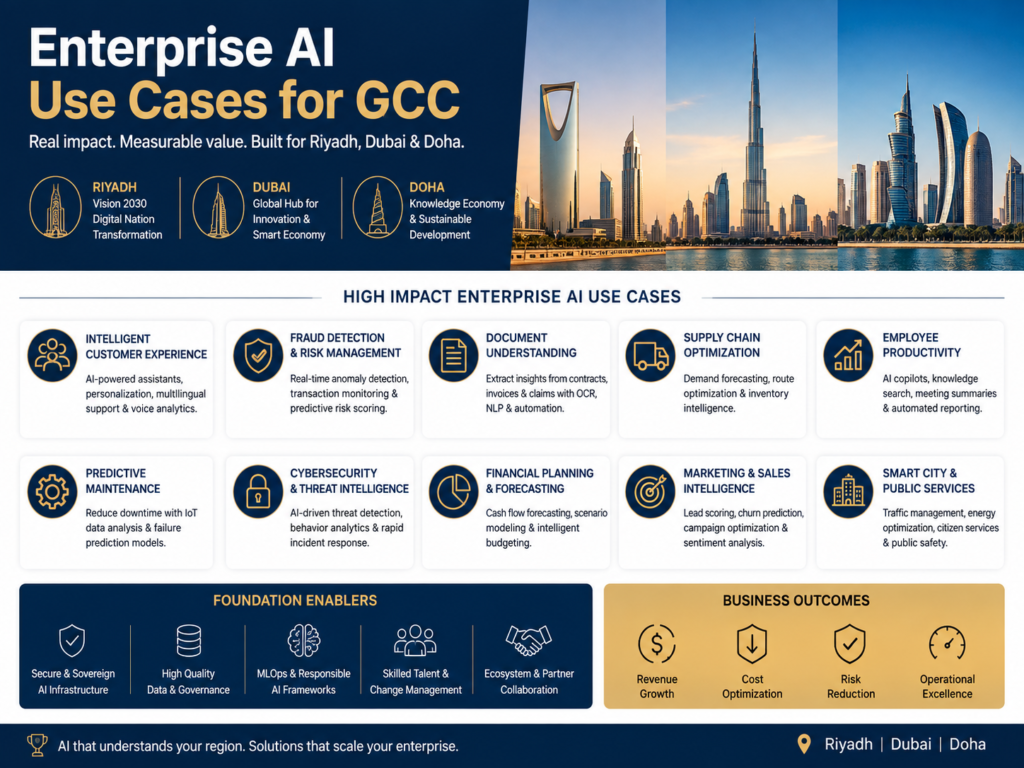
Regional AI compute can support workloads such as.
Arabic-language copilots
Computer vision
Fraud detection
Predictive analytics
Recommendation systems
Document intelligence
Real-time inference
For many enterprises, inference will matter more than frontier-scale model training. A business may train or fine-tune occasionally but run inference thousands of times as employees or customers use an AI-enabled product.
Lower Latency and More Control Over Enterprise Data
Keeping models and related data closer to regional users can improve responsiveness while making governance easier to design.
AI data architecture should consider more than traditional databases. Prompts, embeddings, logs, model outputs, training datasets and backups may also contain sensitive or regulated information.
Organizations operationalizing these workloads can connect infrastructure planning with business intelligence services where AI insights feed reporting and decision-making systems.
Opportunities Across GCC Industries
The strongest use cases will vary by sector.
A Riyadh fintech could run low-latency fraud models while accounting for SAMA expectations. A Dubai e-commerce platform could personalize Arabic customer journeys. A Doha logistics company could use predictive models for routing and operations, while an Abu Dhabi government platform could process Arabic documents closer to national datasets.
The common theme is not simply “more AI.” It is the ability to deploy AI closer to the users, systems and regulatory environment that matter.
Data Residency, Sovereignty and GCC AI Compliance
Infrastructure location can simplify some governance decisions, but local hosting does not automatically make an AI deployment compliant.
Enterprises still need to understand which data is processed, where it travels, who can access it and which legal or sector-specific requirements apply.
Saudi AI Infrastructure and Data Governance
Saudi organizations should map relevant PDPL requirements, SDAIA and NDMO controls, data classification and cross-border transfer obligations before choosing an infrastructure model.
Financial institutions may also need to consider SAMA requirements. Saudi PDPL specifically addresses transfers of personal data outside the Kingdom. (SDAIA Data Governance Platform)
UAE Sovereign AI and Data Protection
UAE deployments may involve federal PDPL requirements alongside sector-specific or free-zone frameworks, including ADGM and DIFC.
Organizations should also consider TDRA and other relevant authorities where the AI architecture intersects regulated digital or telecommunications services.
“Sovereign” should therefore be treated as a set of technical and contractual controls—not merely as a marketing label.
Qatar Data Residency and Regulated Workloads
Qatar’s NCSA National Data Classification Policy establishes requirements for classifying information, while QCB considerations may apply to financial workloads.
Locally hosted GPU services can make some architectures simpler when sensitive information needs to remain inside Qatar, but organizations should still evaluate security, access, retention and sector obligations.
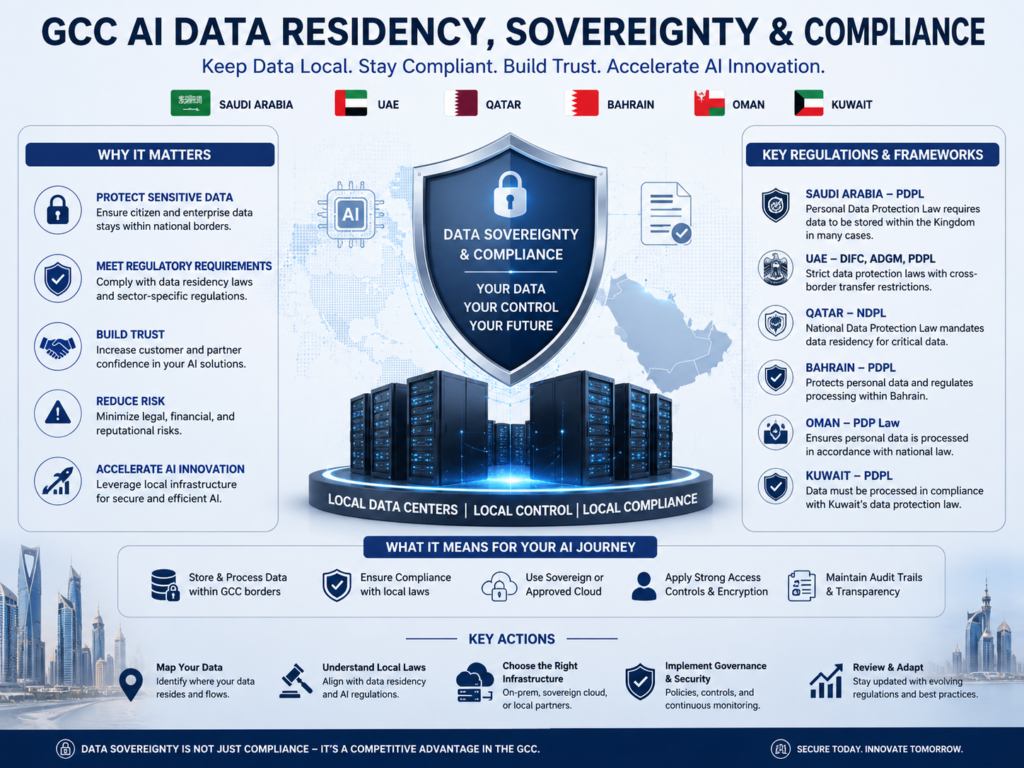
Why Data Residency Matters for AI Infrastructure GCC Decisions
AI systems process more than application databases.
Enterprises should map the location and handling of.
Prompts
Embeddings
Model weights
Training datasets
Logs
Backups
Generated outputs
A workload may appear locally hosted while one of these components is processed or stored elsewhere. Data-flow mapping should therefore happen before infrastructure selection, not after deployment.
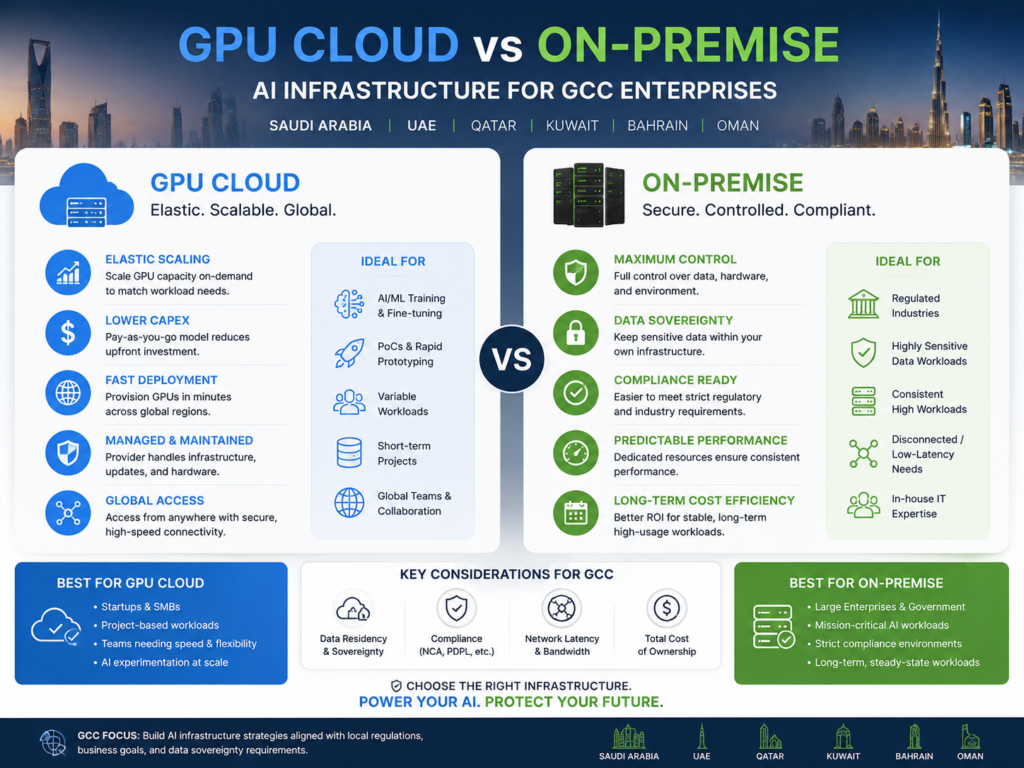
GPU Cloud vs On-Premise AI Infrastructure in the GCC
The right deployment model depends heavily on workload consistency, sensitivity and operational capability.
When GPU Cloud or GPUaaS Makes Sense
GPU cloud GCC services can suit.
Proofs of concept
Short-term training jobs
Variable inference demand
Teams that need capacity quickly
Organizations avoiding upfront hardware investment
The main advantage is flexibility. Enterprises can access specialized compute without owning and maintaining expensive infrastructure.
The trade-off is that long-term utilization, egress costs, provider dependency and contractual terms can significantly affect total cost.
When Dedicated or On-Premise GPUs Make Sense
Dedicated infrastructure may become attractive when utilization is predictable and consistently high, data is highly sensitive or latency requirements justify a private environment.
However, ownership adds responsibilities for.
Capital expenditure
Power
Cooling
Networking
Security
Hardware maintenance
Capacity planning
Hardware-refresh cycles
Owning GPUs does not eliminate infrastructure risk. It simply shifts more of that risk to the enterprise.
Compare Total Cost, Not Just GPU Pricing
GPU hourly rates are only part of the cost equation.
A realistic comparison should include compute, storage, data transfer, software licensing, engineering, cybersecurity, compliance, support and future migration costs.
Teams developing AI-connected applications should also account for the application layer, including scalable Node.js services and API development.
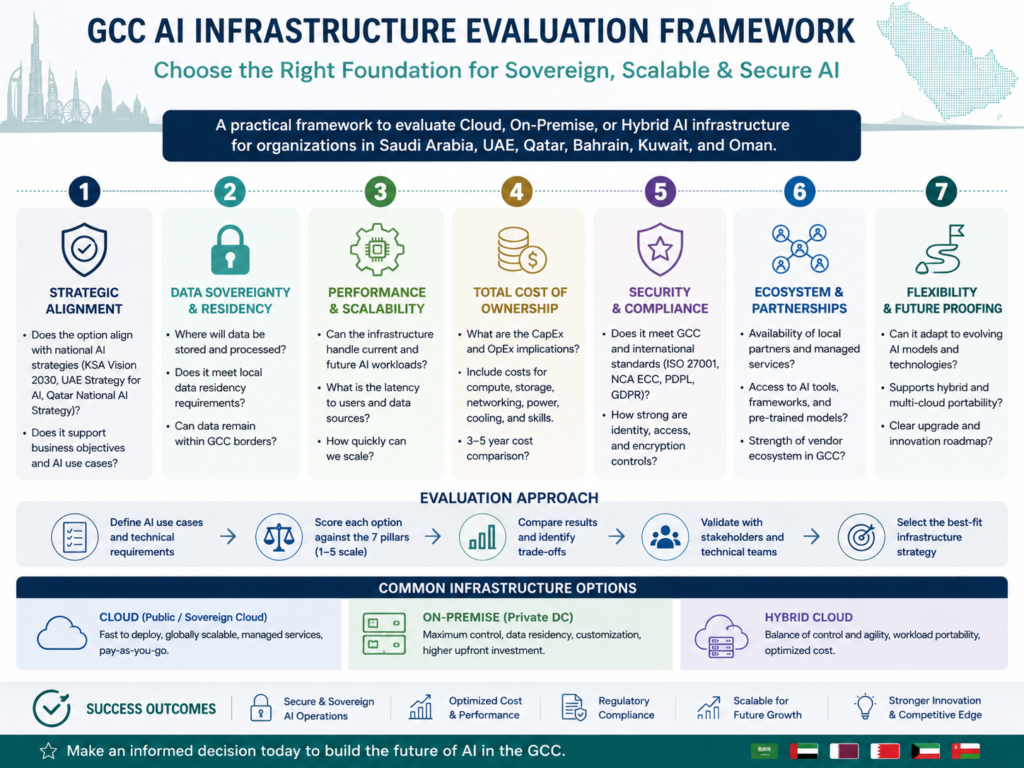
How GCC Enterprises Should Evaluate AI Infrastructure
A practical infrastructure decision can be reduced to three stages.
Define Workload, Data and Performance Requirements
Start with the workload rather than the provider.
Document:
Training versus inference requirements
GPU memory needs
Expected concurrency
Latency targets
Storage and networking requirements
Arabic-language processing requirements
Data sensitivity
Expected utilization patterns
Without this baseline, comparing GPU capacity or provider pricing becomes misleading.
Map Residency, Regulatory and Sovereignty Requirements
Map the rules that apply to the organization, industry and data involved.
That may include Saudi PDPL, NDMO and SAMA requirements; UAE federal, ADGM or DIFC obligations; and Qatar NCSA or QCB controls.
The assessment should cover prompts, embeddings, model weights, logs and backups not only the primary database.
Compare Capacity, TCO and Exit Risk
Once workload and governance requirements are clear, compare providers on.
GPU availability
Service-level agreements
Portability
Cybersecurity
Support
Total cost of ownership
Provider concentration
Migration complexity
Exit options
The best AI infrastructure GCC platform is the one that matches the organization’s workload, governance requirements, economics and operating model—not simply the platform advertising the largest amount of compute.
What Enterprises Should Do as GCC AI Capacity Expands
Treat Local AI Compute as a Strategic Option
AI infrastructure now affects application architecture, cybersecurity, procurement, compliance, business continuity and product roadmaps.
For organizations making significant AI investments, infrastructure is becoming a broader digital-strategy decision rather than a narrow data-center purchase.
Design for Portability Across Providers and Markets
Containers, portable models, interoperable APIs and hybrid architectures can reduce unnecessary dependence on a single GPU vendor, cloud provider or jurisdiction.
The same portability mindset also supports modern performance-focused web architecture, where organizations benefit from reducing tightly coupled infrastructure decisions.
Start With Workload Fit Before Chasing GPU Scale
Large GPU announcements attract attention, but enterprises should begin with a more practical question: what does the workload actually require?
Define performance targets, regulatory constraints, sovereignty requirements, utilization and economics first. Then evaluate providers.
Organizations needing broader implementation support can explore Mak It Solutions’ technology and development services or mobile application development capabilities.
Final Thoughts
The growth of AI infrastructure GCC capacity gives enterprises in Saudi Arabia, the UAE and Qatar more freedom to decide where and how AI workloads operate.
The strongest architecture will not necessarily use the newest provider or the largest GPU cluster. It will balance workload performance, data residency, regulatory requirements, portability and total cost. ( Click Here’s )
For businesses planning a long-term deployment, the next step should be to assess infrastructure readiness before committing to capacity. Mak It Solutions can support application architecture, AI integration and custom deployment planning for Saudi, UAE and Qatar environments.
FAQs
Q : Can Saudi enterprises use overseas GPU clouds for sensitive AI workloads?
A : Potentially, but infrastructure location alone does not determine compliance. Saudi organizations should evaluate PDPL requirements, applicable SDAIA or NDMO policies, data classification and cross-border transfer rules, while financial institutions may also need to consider SAMA requirements.
Q : What should UAE companies check before choosing a sovereign GPU provider?
A : Verify what “sovereign” actually covers. Review physical data location, administrator access, subcontractors, encryption-key control, model and log residency, incident response, deletion procedures and portability rather than assuming a UAE data-center address satisfies every requirement.
Q : Is GPU as a Service available for enterprises in Qatar?
A : Yes. The draft identifies locally hosted options from Ooredoo and MEEZA, including sovereign NVIDIA-powered services and MEEZA’s MAI GPUaaS platform. Organizations should still evaluate NCSA requirements and, where relevant, QCB controls before placing sensitive workloads on the service.
Q : Which GCC industries can benefit most from locally hosted AI compute?
A : Fintech, government, healthcare, retail, logistics and other data-intensive sectors are strong candidates. Local compute is especially useful where workloads combine high data volumes, latency sensitivity, persistent inference demand or strict governance requirements.
Q : Do enterprises need dedicated GPUs for Arabic-language AI models?
A : Usually not. Many Arabic-language applications can run through cloud GPU inference or GPUaaS, while dedicated hardware becomes more attractive when utilization is consistently high, latency requirements are exceptional or internal control requirements justify a private environment.
[…] Does Sovereign AI GCC Mean for […]