


Sovereign AI GCC: The Enterprise LLM Guide
Sovereign AI GCC: The Enterprise LLM Guide
Sovereign AI GCC: The Enterprise LLM Guide
GCC organizations are no longer choosing large language models on benchmark scores alone. A bank in Riyadh, a government team in Abu Dhabi, or an enterprise in Doha also has to weigh data sovereignty, data residency, Arabic language performance, security, regulatory exposure, cost and operational control.
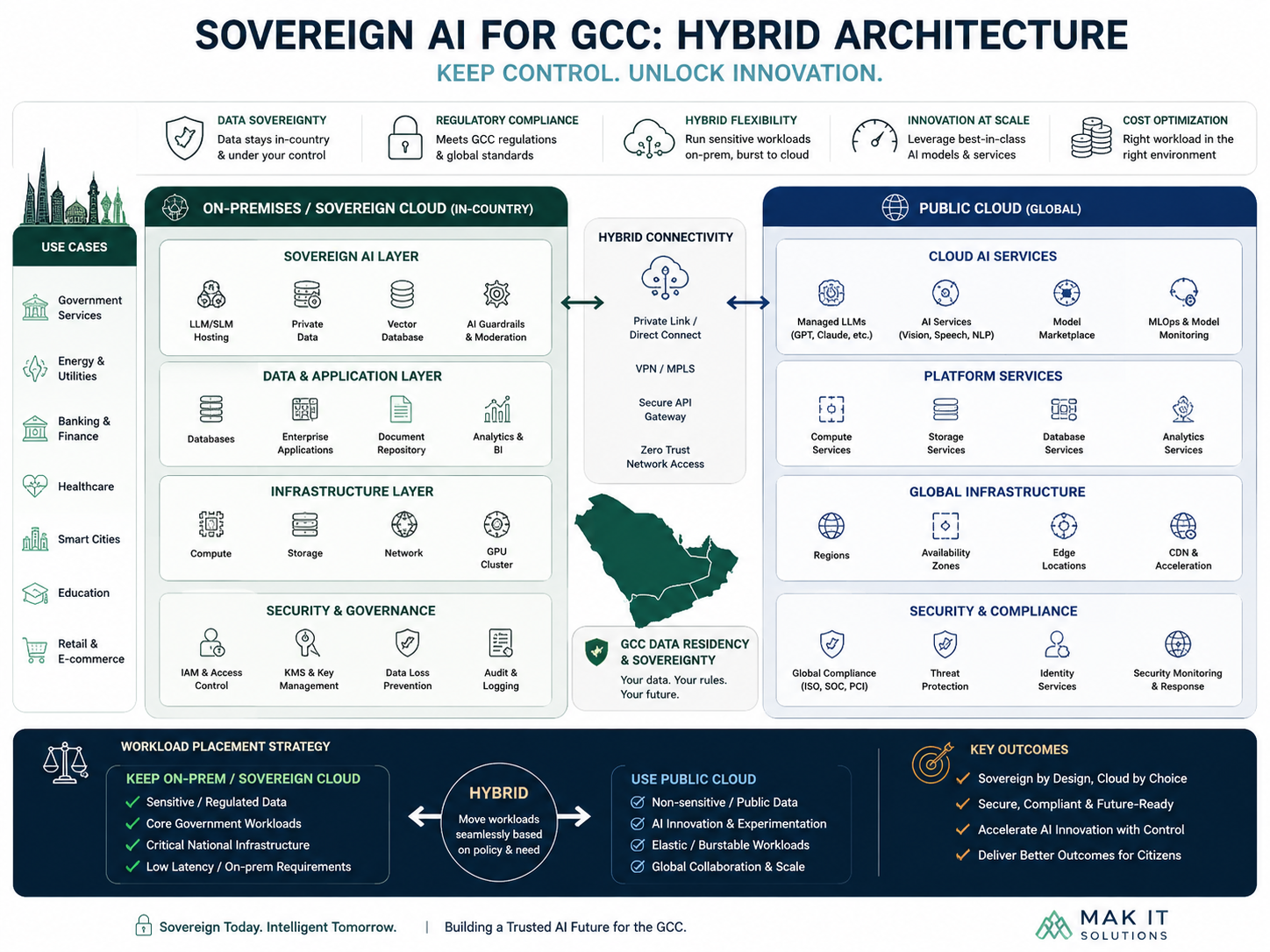
For most enterprises, the strongest sovereign AI GCC strategy is not a simple choice between a local model and a global LLM. It is a workload-based approach: keep sensitive or regulated AI workloads in controlled environments while allowing approved global models to support suitable lower-risk use cases.
What Does Sovereign AI GCC Mean for Enterprises?
Sovereign AI is about maintaining appropriate control over the data, infrastructure, model access, governance and operations behind an AI system.
A model developed inside the GCC may offer regional advantages, but its origin alone does not make a deployment sovereign. Likewise, an international LLM is not automatically unsuitable if it is deployed through an approved regional, private or isolated environment.
Local AI Models, Private LLMs and Sovereign AI Are Not the Same
These terms are often used interchangeably, but they describe different things.
A local AI model is developed within the region. A private LLM is operated in a controlled environment with restricted access. An on-premises deployment runs within an organization’s own infrastructure, while a sovereign cloud is designed around defined national or organizational control requirements.
That means an enterprise could run an international open-weight model on its own infrastructure. At the same time, a Gulf-developed model could still be consumed through infrastructure outside the organization’s preferred data boundary.
For GCC buyers, the practical question is therefore not simply, “Where was this model built?” It is, “Where does our data go, who can access it, and what controls apply?”
How Global LLMs Can Still Fit Regional Infrastructure
Private endpoints, isolated environments and regional cloud services can make global AI appropriate for certain workloads.
AWS operates its Middle East Bahrain region, Azure lists UAE Central, and Google Cloud operates a Doha region. These options illustrate why model origin and hosting location should be evaluated separately.
Teams planning regional compute capacity can also review Mak It Solutions’ AI supercomputing platforms GCC guide.
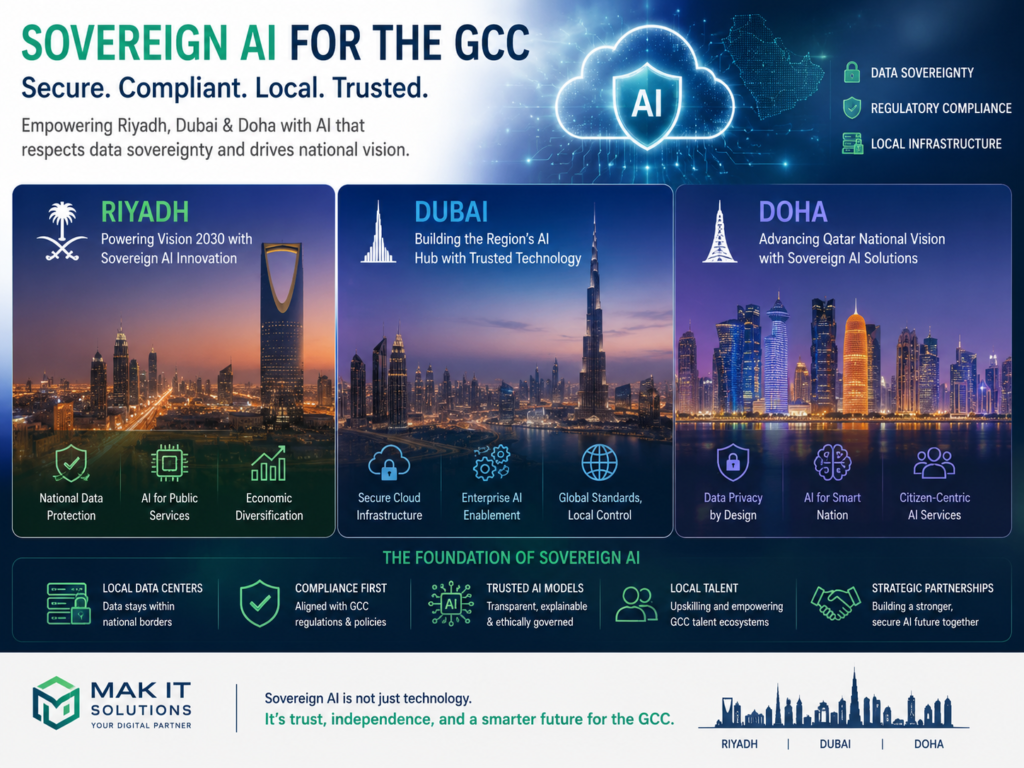
Why Sovereignty Matters in Riyadh, Dubai and Doha
Different organizations will draw their boundaries in different places.
A Riyadh fintech processing customer account information will naturally have stricter requirements than a Dubai marketing team generating public campaign copy. A Doha organization working with regulated or sensitive data may need another architecture again.
The decision usually comes down to five areas.
Data control and residency
Regulatory and governance requirements
Arabic and Gulf-dialect performance
Security and auditability
Cost, latency and operational control
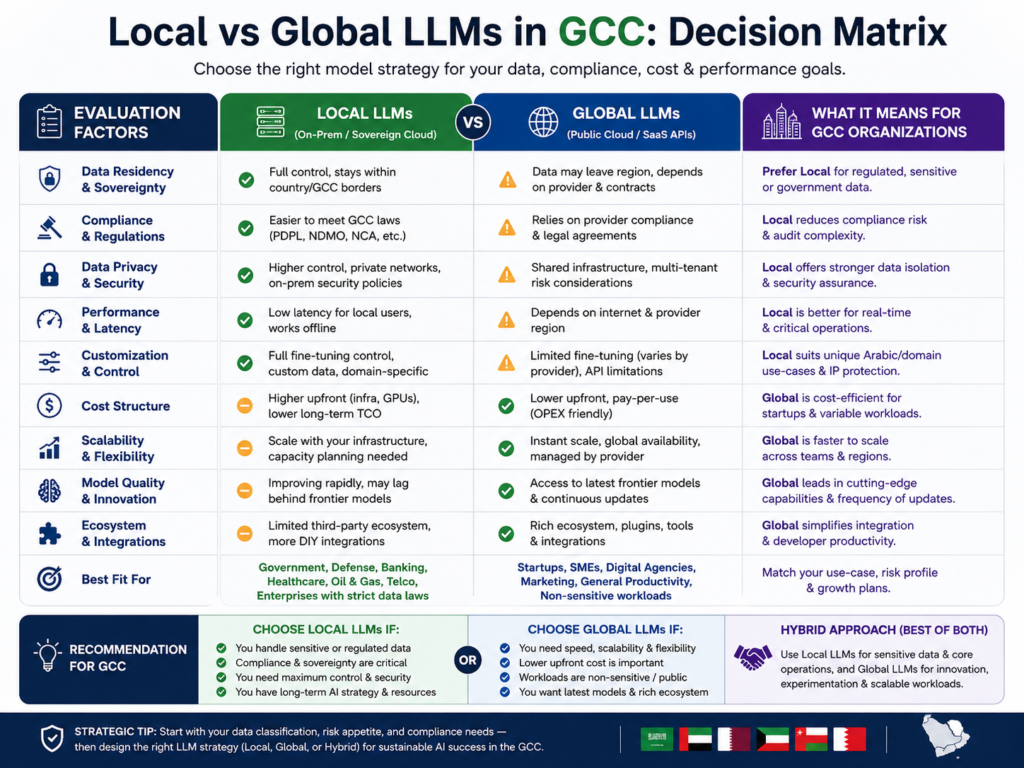
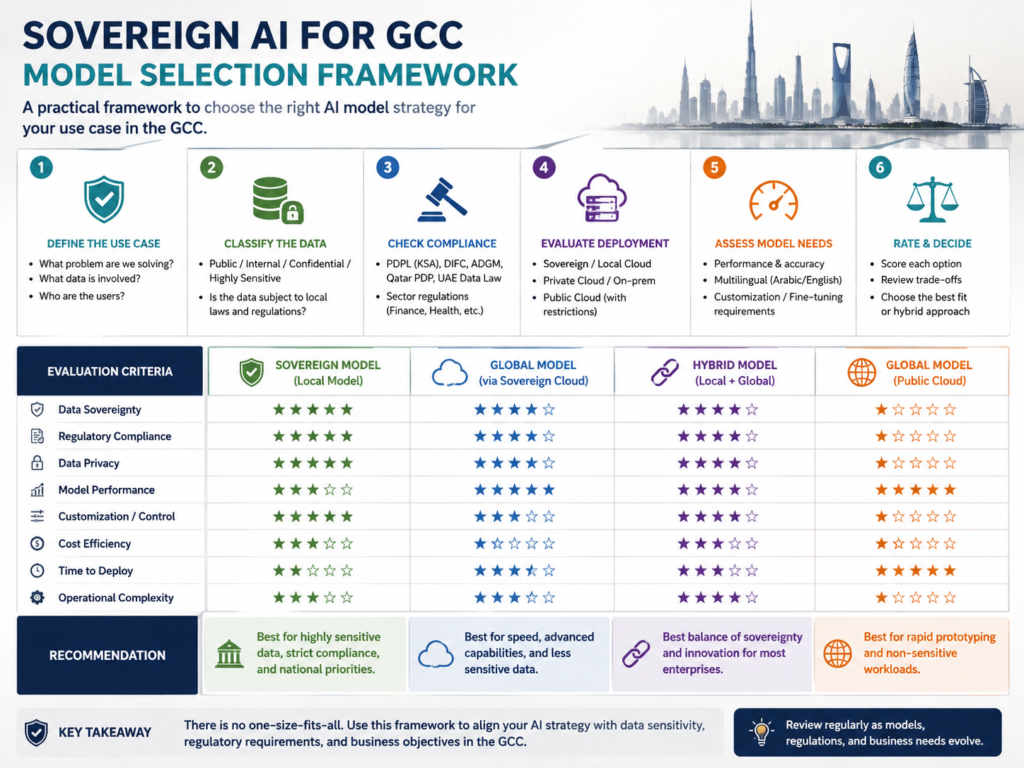
Sovereign AI GCC Decision Matrix.
There is no single deployment model that wins across every workload.
| Factor | Local / Private LLM | Global LLM | Hybrid Approach |
|---|---|---|---|
| Data control | High | Varies | High for restricted data |
| Arabic specialization | Potentially strong | Varies | Route by task |
| Capability | Varies | Often broad | Best-of-breed |
| Infrastructure responsibility | Higher | Lower | Medium |
| Customization | High | Platform-dependent | High |
| Vendor lock-in | Low–medium | Potentially higher | Reducible |
| TCO | Workload-dependent | Usage-dependent | Optimizable |
For production controls, supporting resources include Mak It Solutions’ zero trust architecture for AI-era systems and API security best practices.
Privacy, Security and Data Control
Private models can offer tighter control over access, logging, fine-tuning and data flows. The trade-off is greater responsibility for infrastructure, security, monitoring and ongoing operations.
Managed global services can reduce that operational burden, although organizations must still understand where prompts, retrieved documents, outputs and logs are processed.
A hybrid architecture creates another option: sensitive workflows remain inside approved environments, while suitable workloads use external model capability.
Arabic, Gulf Dialects and Cultural Context
An Arabic LLM for enterprises should be evaluated on more than formal Modern Standard Arabic.
GCC organizations should test Saudi and wider Gulf dialects, Arabic-English code-switching, document retrieval, domain terminology and real conversational patterns. A Gulf Arabic AI model that performs well in a controlled demo may still struggle with banking vocabulary, customer-service conversations, local expressions or industry-specific documents.
The safest evaluation set is the organization’s own representative data and workflows.
Cost, Latency, Scale and Vendor Lock-In
Local AI is not automatically cheaper.
GPU utilization, engineering resources, inference infrastructure, fine-tuning, monitoring and support all affect total cost of ownership. Global APIs may reduce infrastructure requirements, but usage-based pricing can become significant at scale.
A more useful metric is often cost per successful business task, not cost per token alone.
Mak It Solutions’ GCC cloud cost optimization guide provides a related FinOps perspective.
Saudi, UAE and Qatar AI Compliance and Data Residency
Data residency requirements across the GCC vary by country, industry and data type. Organizations should avoid treating “GCC compliance” as one universal rule.
Saudi Arabia’s PDPL allows international transfers under defined safeguards, while some sector-specific requirements are stricter. UAE organizations may need to account for federal requirements as well as financial-free-zone regimes. In Qatar, QCB requirements create specific expectations for regulated financial information.
Regulatory requirements can change and may depend on the exact workload. This article provides strategic guidance, not legal advice; organizations should validate production deployments against current regulator, contractual and legal requirements.
Saudi Arabia.
Saudi PDPL does not mean every dataset or AI workload must remain inside the Kingdom.
SDAIA’s transfer regulation permits international transfers when relevant purposes, protections, conditions and safeguards are satisfied.
Financial institutions have additional considerations. SAMA’s in-force cloud rule states that cloud services should in principle be located in Saudi Arabia, with explicit SAMA approval required for certain overseas use. NCA also maintains Cloud Cybersecurity Controls for cloud providers and tenants.
For a Riyadh fintech, that makes data classification an early architecture decision not something to address after choosing an LLM.
UAE.
The UAE Personal Data Protection Law establishes cross-border data requirements, with the UAE Data Office acting as the federal data regulator. ADGM and DIFC maintain separate data-protection regimes with their own international-transfer mechanisms.
TDRA has also operated sovereign-cloud initiatives for government environments.
As a result, a DIFC fintech, an Abu Dhabi government workload and a Dubai retailer can reasonably arrive at different AI architecture decisions even when they use similar model technology.
Qatar.
Qatar provides a clear example of why infrastructure location matters.
QCB’s Cloud Computing Regulation states that regulated entities must process PII and financial information within Qatar and obtain QCB approval before entering cloud arrangements. (Qatar Central Bank)
At the same time, Google Cloud operates a Doha region, while Qatar’s Fanar provides a locally developed AI option.
The distinction matters: locally hosted global AI and locally developed sovereign AI are not automatically the same thing.
Arabic LLMs for GCC Enterprises: ALLaM, Falcon, Jais and Fanar
The GCC now has several Arabic-focused AI ecosystems. Enterprises should treat them as candidates to evaluate rather than assuming one model will perform best everywhere.
Saudi ALLaM and UAE Falcon/Jais
Saudi Arabia’s ecosystem includes HUMAIN’s ALLAM 34B, which builds on earlier SDAIA/NCAI ALLaM development and is hosted in Saudi infrastructure.
In the UAE, TII launched Falcon-H1 Arabic in January 2026, while MBZUAI, Inception and Cerebras released Jais 2, a 70B open-weight Arabic model, in December 2025.
These models should not be declared universal winners based on vendor benchmarks alone. Enterprise performance depends on the actual workload, documents, dialects, retrieval pipeline, security requirements and latency targets.
Qatar’s Fanar and Arabic-Centric Sovereign AI
QCRI/HBKU’s Fanar 2.0 is an Arabic-centric sovereign AI stack supported by Qatar’s MCIT.
HBKU states that Fanar supports both cloud-based and on-premises AI deployment, making it relevant to government and enterprise teams seeking greater infrastructure control.
How to Benchmark Arabic LLMs Against Global Models
Do not rely on generic English leaderboards.
Build an evaluation set that reflects real GCC use cases and test.
Modern Standard Arabic
Saudi and wider Khaleeji dialects
Arabic-English code-switching
Domain terminology
Hallucination behavior
RAG and document-retrieval accuracy
Safety and policy adherence
Latency
Cost per successful task
A Jeddah logistics company, for example, needs to know whether a model understands its Arabic shipment exceptions—not whether it ranks highly on an unrelated English benchmark.
When Should GCC Organizations Use Local, Global or Hybrid AI?
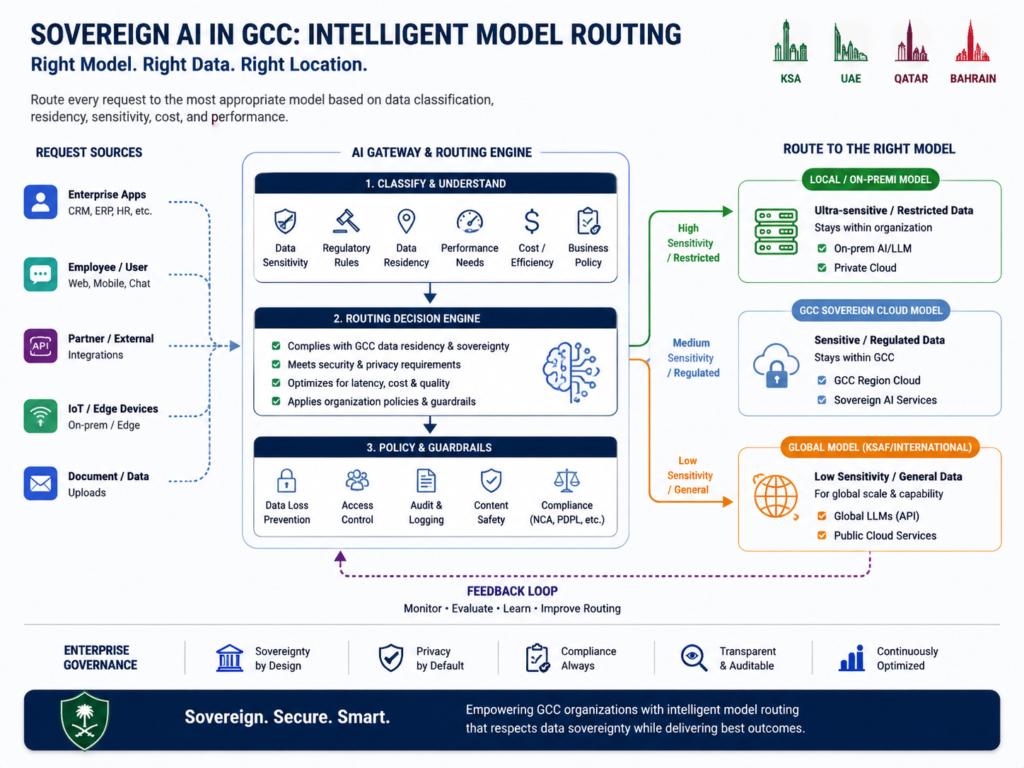
For many enterprises, hybrid AI is the most practical answer because it allows model selection to follow workload risk and business value.
Sensitive banking, government or proprietary workloads can remain in controlled environments, while approved global models can support research, experimentation and other lower-risk activities.
When Local or Private LLMs Make More Sense
Local or private models may be better suited to.
Regulated financial data
Government information
Proprietary knowledge
Confidential internal documents
Highly customized Arabic workflows
Environments requiring strong isolation or audit evidence
A Riyadh bank or Abu Dhabi public-sector department may reasonably prioritize restricted access and auditability over maximum model breadth.
When Global LLMs May Be the Better Choice
Global services can make sense for.
Public-data research
General productivity
Rapid experimentation
Non-sensitive content workflows
Tasks requiring broader frontier-model capabilities
The choice should follow data classification and enterprise AI governance, not an assumption that foreign automatically means non-compliant.
Why Hybrid LLM Architecture Often Fits GCC Enterprises
A practical AI gateway could route workloads like this.
Sensitive banking records → private model
Public market research → approved global LLM
Arabic customer support → best-performing authorized Arabic model
A Doha SME, for example, could keep its knowledge base and RAG layer in Qatar while routing approved generic tasks to another model environment.
Supporting architecture can use secure back-end development and API integration, while cloud teams should continually address cloud configuration risks.
How to Choose a Sovereign AI GCC Architecture
Classify Data and AI Workloads
Classify each workload according to its sensitivity and business context.
Useful categories can include public, internal, confidential, regulated, personal, financial, government and intellectual-property data.
Then determine what information may leave the controlled environment and which regulator, contract or internal policy applies.
Score Local, Global and Hybrid Options
Evaluate each architecture across:
Compliance
Security
Arabic performance
Model quality
Customization
Latency
Infrastructure requirements
TCO
Auditability
Vendor lock-in
Results can be connected to measurable reporting through business intelligence services.
Pilot Before Enterprise Rollout
Pilot representative workflows before standardizing a platform across the organization.
For GCC deployments, testing may need to reflect workloads in Riyadh, Dubai or Abu Dhabi, and Doha. Measure Arabic accuracy, hallucinations, latency, cost per successful task, security exceptions, integration complexity and user satisfaction.
For custom RAG, evaluation or AI application development, Python development capabilities can support the implementation layer.
Final Takeaway
The sovereign AI GCC decision is not simply “regional model versus global model.”
Local does not automatically mean sovereign. Global does not automatically mean non-compliant. And hybrid AI can provide a practical balance between control and model capability.
The strongest architecture is the one that matches each workload’s data sensitivity, Arabic requirements, regulatory scope, operational cost, security requirements and business value.
Mak It Solutions can help organizations classify AI workloads, compare private, local and global models, and design a practical GCC deployment strategy. Contact Mak It Solutions to book a consultation or request a custom sovereign AI roadmap for Saudi Arabia, the UAE or Qatar.
FAQs
Q : Does Saudi PDPL require all AI data to stay in Saudi Arabia?
A : No. Saudi PDPL does not create a blanket requirement for every piece of personal data or every AI workload to remain physically inside Saudi Arabia.
SDAIA’s transfer regulations allow overseas personal-data transfers when defined purposes, conditions and safeguards are satisfied. Sector-specific requirements can be stricter, including SAMA rules for regulated financial institutions.
Q : Is Falcon or Jais better for Arabic enterprise workloads in the UAE?
A : There is no universal winner.
A Dubai retailer may prioritize Gulf conversational Arabic and code-switching, while an ADGM financial firm may care more about RAG accuracy, safety and auditability. Organizations should benchmark both models against the same representative evaluation set before procurement.
Q : Can Qatar companies deploy Fanar on-premises?
A : Yes. HBKU describes Fanar as supporting cloud-based and on-premises deployment, which can make it relevant for organizations seeking tighter privacy and infrastructure control.
Companies should still map the deployment to applicable Qatar regulatory, security and data-governance requirements before using regulated information in production AI workflows.
Q : What type of private LLM is suitable for GCC banks?
A : The best private LLM for a GCC bank is one that satisfies its Arabic, security, audit and regulatory requirements—not necessarily the model with the largest parameter count.
Banks should test models against representative Arabic financial documents, terminology, RAG accuracy, hallucination behavior and latency while ensuring appropriate encryption, least privilege, logging and human review for high-risk workflows.
Q : How should Kuwait, Bahrain and Oman enterprises approach sovereign AI?
A : The same workload-first principle applies, but each organization should validate its own national and sector-specific requirements.
Start by classifying data, mapping prompt and output flows, reviewing vendor access and cross-border transfers, and testing Arabic quality on local terminology. Saudi and Qatar financial-sector requirements are useful regional examples, but they should not be treated as substitutes for Kuwaiti, Bahraini or Omani rules.