


Warehouse Automation GCC: Highest AI Robot ROI
Warehouse Automation GCC: Highest AI Robot ROI
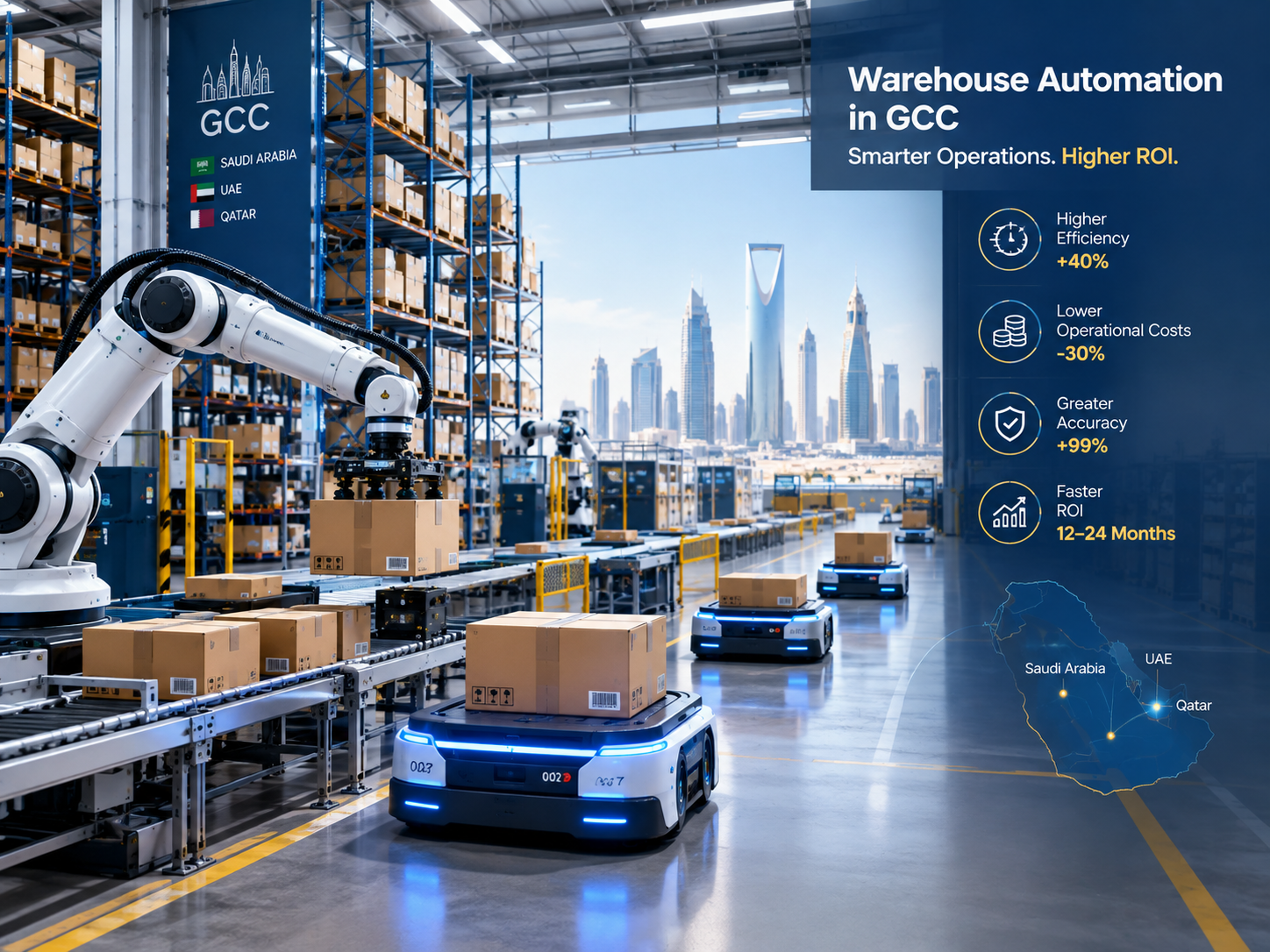
Warehouse Automation GCC: Highest AI Robot ROI
For operators evaluating warehouse automation GCC investments, the biggest question is not which robot looks most advanced. It is where automation can remove the most travel, repetitive labor, delay, errors, or capacity constraints.
Across Saudi Arabia, the UAE, and Qatar, the strongest warehouse robotics ROI is usually found in high-throughput e-commerce and 3PL environments. AMRs, goods-to-person systems, robotic sortation, and automated pallet movement tend to make the strongest business case when the underlying workflow is repetitive, measurable, and used consistently.
The practical decision hierarchy is straightforward:
Use case → throughput → integration complexity → country economics → technology choice
Where Warehouse Automation GCC ROI Is Highest
Warehouse robotics ROI is typically strongest in operations with high order volumes, repetitive movement, predictable picking patterns, and costly throughput bottlenecks.
The goal is not to automate everything. It is to identify where robots can spend productive hours taking over work that currently consumes people, floor space, or time without adding much value.
High-Throughput E-Commerce and 3PL Fulfillment
A busy fulfillment centre in Riyadh or Dubai can reach a point where order growth creates excessive walking, aisle congestion, picking pressure, and difficulty scaling labor during peaks.
This is where robotics becomes more than a hardware investment.
Connecting warehouse automation with scalable e-commerce solutions and operational data can make the business case stronger because robot activity becomes part of a wider order, inventory, and fulfillment workflow rather than an isolated system.
For e-commerce and 3PL operators, the strongest candidates are usually processes where demand is frequent enough to keep equipment productively utilized.
AMR-Based Material Movement and Goods-to-Person Picking
Autonomous mobile robots can move totes, cartons, or inventory between storage, picking, packing, and replenishment areas.
That reduces one of the least productive parts of many warehouse jobs: walking.
AMRs can be particularly attractive when SKU profiles, pick stations, storage areas, or warehouse routes change regularly. Instead of building fixed infrastructure around one permanent process, operators can adapt robot fleets and workflows as demand evolves.
Goods-to-person systems can take the same principle further by bringing inventory to workers rather than sending workers through the warehouse to find it.
Picking, Sortation, and Repetitive Pallet Handling
Robotic picking, automated sortation, autonomous forklifts, and palletizing should be evaluated against three practical questions.
Is the volume high enough?
Is the task repetitive enough?
Will the equipment be used consistently?
A robotic system working reliably across busy operating periods has a much stronger economic foundation than automation installed in a low-volume or highly irregular process.
This is why throughput comes before technology selection. A sophisticated machine cannot compensate for a weak use case.
Why AMRs Often Beat Traditional AGVs in GCC Warehouses
Many fast-changing GCC warehouses evaluate AMRs because they can operate with less fixed guidance infrastructure than traditional automated guided vehicles.
That flexibility is valuable in e-commerce, retail, and 3PL environments where routes, stations, storage configurations, and inventory profiles can change as the operation grows.
AMR vs AGV.
Traditional AGVs remain useful when routes are stable, controlled, and highly predictable.
AMRs are generally better suited to environments where warehouse traffic and workflows change. They can support more dynamic routing without requiring the same level of fixed-path infrastructure.
That does not automatically make AMRs the better choice in every facility.
The decision still depends on.
Payload requirements
Safety requirements
Warehouse traffic
Route stability
Process consistency
Integration requirements
Maintenance and local support
The right technology is the one that matches the process.
Why AMRs Fit Fast-Changing GCC Fulfillment Operations
Warehouses in Riyadh and Dubai may experience major demand shifts around Ramadan, Eid, and large promotional campaigns.
Flexible fleets give operators the option to reorganize transport capacity or alter workflows without rebuilding an entire facility around fixed automation.
That flexibility can be especially valuable for businesses whose SKU mix, order profile, or fulfillment priorities change throughout the year.
WMS, WES, and Multi-Robot Fleet Orchestration
Robots are only one part of an automated warehouse.
Their performance depends heavily on the software coordinating orders, inventory, robot tasks, and human workflows.
WMS/WES integration, APIs, fleet-management platforms, IoT sensors, and computer vision need to exchange reliable information rather than operate as disconnected systems.
Mak It Solutions’ back-end and API development capabilities and business intelligence services are relevant when warehouse information needs to flow into ERP platforms, dashboards, orchestration systems, or management reporting.
Warehouse Automation GCC by Market: Saudi Arabia, UAE, and Qatar
The fundamental ROI calculation remains similar across the GCC, but local infrastructure, logistics priorities, facility scale, integration requirements, and support conditions can change the business case.
Saudi Arabia.
Saudi Arabia presents significant warehouse automation opportunities across Riyadh, Jeddah, and Dammam as logistics modernization forms part of the Kingdom’s wider economic transformation agenda.
The National Industrial Development and Logistics Program discusses priorities including logistics efficiency, tracking and tracing, and supply-chain automation within Saudi Arabia’s development plans. See the Saudi Vision 2030 NIDLP delivery plan.
For large Saudi facilities, the practical opportunity is to evaluate AMRs, robotic picking, sortation, and autonomous pallet movement against actual operational constraints.
The question should not be, “Where can we add robots?”
It should be, “Which bottleneck is preventing this facility from processing more volume efficiently?”
UAE.
Dubai, Jebel Ali, and Abu Dhabi offer a strong environment for integrated smart-warehouse models using technologies such as AS/RS, analytics, digital twins, and robot fleet orchestration.
The UAE Ministry of Industry and Advanced Technology’s Technology Transformation Program supports industrial digitalization and advanced technology adoption.
For UAE operators, warehouse automation can also become part of a wider digital customer experience.
Businesses connecting warehouse information with delivery, commerce, or customer-facing platforms can consider Mak It Solutions’ mobile app development services and web development capabilities.
Qatar.
Qatar represents a more concentrated opportunity, particularly for operators working around Doha’s logistics, airport, port, and free-zone ecosystems.
TASMU Smart Qatar’s connected-warehouse concept describes the use of robotics, sensors, and intelligent analytics to support inventory management and goods movement.
The Qatar Free Zones Authority also identifies Ras Bufontas in the airport environment and Umm Alhoul beside Hamad Port.
For companies operating in these areas, connected warehousing can be especially relevant when real-time inventory visibility and coordinated movement matter as much as physical automation.
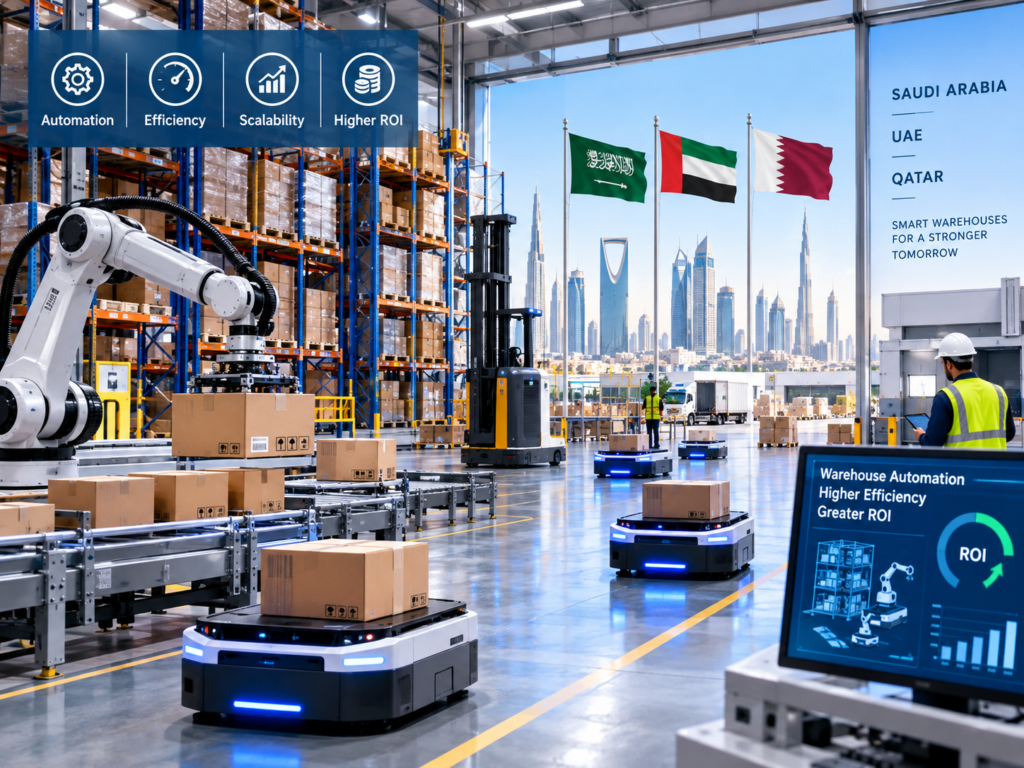
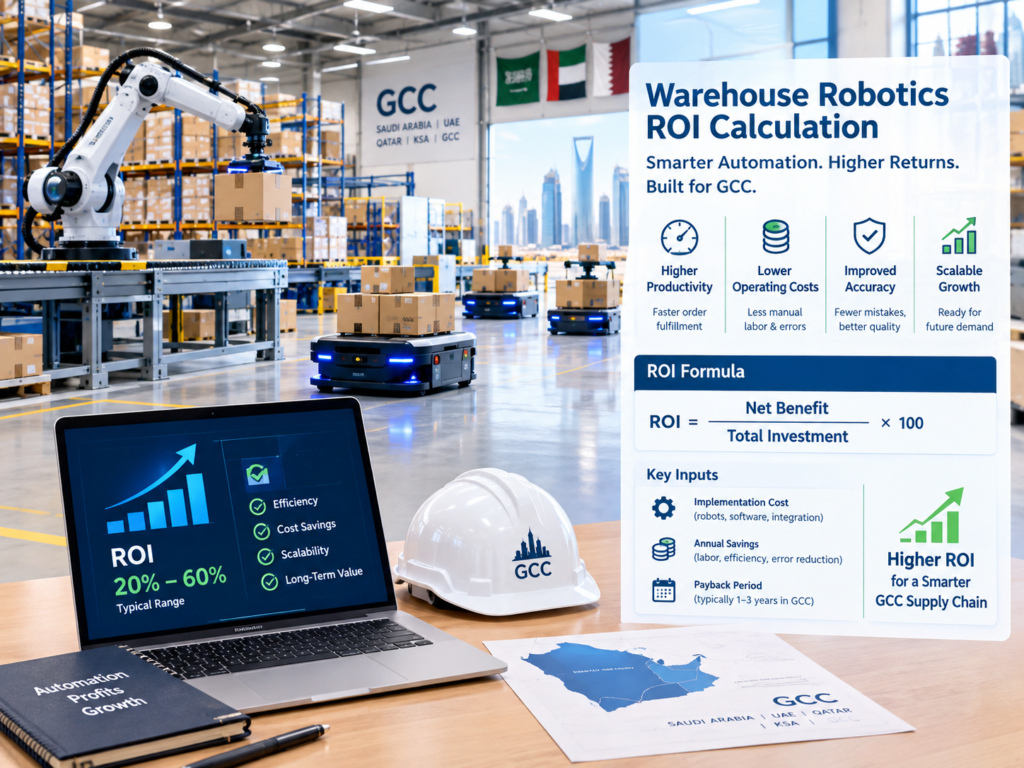
How to Calculate Warehouse Robotics ROI in the GCC
A credible business case starts with the existing process, not with vendor specifications.
Before estimating savings, establish a reliable baseline.
Calculate Labor, Travel-Time, and Picking Savings
Measure the operational variables that automation is expected to change, such as.
Labor hours per order
Worker travel distance
Picks per hour
Orders processed per hour
Picking or fulfillment errors
Peak throughput
Congestion or waiting time
Current equipment utilization
Then model what can realistically improve after automation.
The important word is realistically. ROI projections should be built around achievable process changes rather than ideal vendor demonstrations.
Compare CAPEX, OPEX, and the Payback Period
The cost of a warehouse robotics deployment extends well beyond the robot purchase price.
A proper model should consider.
Robot purchase or leasing
Charging infrastructure
Safety equipment
WMS/WES integration
API and software development
Testing and commissioning
Training
Maintenance
Spare parts
Technical support
Expected useful life
The warehouse automation payback period is therefore more meaningful than the purchase price alone.
A cheaper system can become expensive if integration is difficult, downtime is frequent, or qualified support is hard to obtain.
Adjust ROI for Saudi, UAE, and Qatar Operating Conditions
How quickly can warehouse automation pay back in Saudi Arabia?
There is no responsible universal answer.
A highly utilized Riyadh or Jeddah operation with repetitive workflows may present a much stronger business case than a low-volume facility using the same equipment.
The same principle applies in Dubai or Doha.
Payback should be calculated from verified local operating costs, utilization, integration effort, maintenance requirements, support availability, and expected annual savings.
GCC Compliance, Data, and Integration Requirements
An automated warehouse is also a connected data environment.
Robots, scanners, cameras, sensors, employees, WMS platforms, and customer systems may all exchange operational information. That makes governance, cybersecurity, and system architecture part of the automation decision.
Saudi Data Governance and OT/IoT Cybersecurity
Warehouse automation can generate operational, employee-related, and customer-related data.
Saudi Arabia’s National Data Management Office develops national data-management and governance policies. Operators should therefore assess relevant governance, privacy, security, and OT/IoT cybersecurity requirements as part of system design.
See SDAIA’s National Data Management Office for the broader governance context.
UAE Smart-Industry and Digital Infrastructure Considerations
In the UAE, MoIAT provides part of the wider industrial-transformation context, while TDRA may be relevant when warehouse projects involve telecommunications, IoT connectivity, or smart-building infrastructure.
The TDRA Telecommunications Infrastructure Guidelines cover areas including telecommunications integration, IoT, and cybersecurity considerations for smart infrastructure.
For operators, this reinforces an important point: connectivity cannot be treated as an afterthought once robots have already been selected.
Qatar Connected-Warehouse Architecture and Workforce UX
Qatar deployments should combine connected infrastructure with practical workforce usability.
That includes.
Arabic and English interfaces where appropriate
Operator training
Reliable warehouse connectivity
Legacy WMS integration
Secure data architecture
Clear system ownership and support processes
Cloud architecture and resource location should also be evaluated carefully. Google Cloud, for example, provides documentation on restricting resource locations.
Cloud location, however, should never be treated as automatic proof that a deployment satisfies every applicable regulatory or contractual requirement.
How to Roll Out Warehouse Automation Without Destroying ROI
Large automation programs can fail economically even when individual robots work exactly as designed.
A phased rollout makes it easier to test the business case before committing to a larger deployment.
Automate the Bottleneck, Not the Whole Warehouse
Start by scoring workflows against:
Volume × repeatability × labor intensity × automation feasibility
Look for excessive travel, picking congestion, sortation delays, repetitive pallet movement, or another measurable constraint affecting performance.
That bottleneck should become the first automation candidate.
Pilot Robotics Against Clear KPIs
A pilot should answer a business question, not merely demonstrate that the technology works.
Track indicators such as.
Orders per hour
Picks per hour
Labor hours per order
Robot utilization
Error rates
Downtime
Cost per fulfilled order
Dashboards built around business intelligence and existing-system integration can make pilot results easier for operations and leadership teams to evaluate.
Scale Only After Integration and Support Are Proven
Before expanding a fleet, validate the surrounding operating model.
Check WMS/WES compatibility, APIs, fleet orchestration, cybersecurity, spare-parts availability, vendor response, workforce training, and bilingual UX requirements.
The pilot should also reveal how the automation behaves during real operational disruption not only during controlled demonstrations.
For businesses that require custom integration or management layers, Mak It Solutions’ SaaS platform development expertise and full service portfolio can support the wider digital roadmap.
Final Thoughts
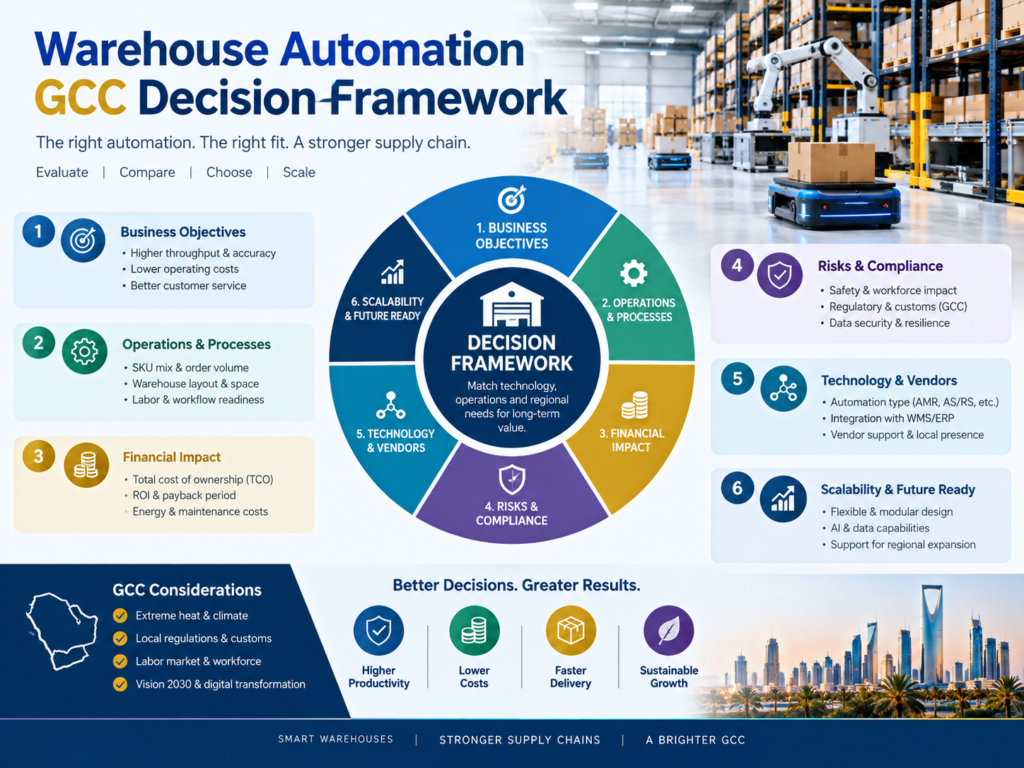
The strongest warehouse automation GCC strategy begins with the workflow costing the operation the most not with a robot catalogue.
Benchmark the current process. Identify the constraint. Model realistic savings. Validate integration and support. Then select the robotics architecture that fits the facility.
For Saudi, UAE, and Qatar operators, that process matters more than chasing the most sophisticated automation available.
Contact Mak It Solutions to explore a custom GCC automation strategy covering warehouse dashboards, APIs, system integration, business intelligence, and digital platforms.
FAQs
Q : How much does warehouse automation cost in Saudi Arabia?
A : There is no useful single price because a Riyadh AMR pilot and a large Jeddah goods-to-person deployment can have completely different scopes.
Budgeting should include robots or leasing, charging infrastructure, safety equipment, WMS/WES integration, testing, training, maintenance, and local support. Compare total lifecycle cost with measurable improvements in labor hours, travel time, throughput, and errors rather than comparing robot prices alone.
Q : Which warehouse automation systems work best for UAE e-commerce operations?
A : For fast-changing Dubai e-commerce facilities, AMRs and goods-to-person systems are often strong candidates because they support flexible movement and high picking volumes.
Larger facilities with predictable flows may also evaluate AS/RS, robotic sortation, or automated pallet handling. The right design depends on SKU profile, order velocity, available space, and WMS/WES integration requirements.
Q : Are connected warehouse systems suitable for Qatar free zones?
A : Yes, particularly for operations that need real-time inventory visibility, sensors, coordinated goods movement, and automation.
TASMU’s connected-warehouse concept provides a relevant local reference for this model. Businesses in Ras Bufontas or Umm Alhoul should still evaluate throughput, integration, connectivity, local support, and data architecture against their own operating requirements.
Q : How can GCC warehouses integrate robots with an existing WMS?
A : Start by mapping how the existing WMS releases orders, allocates inventory, assigns tasks, and records completion.
A WES, fleet-management platform, or integration layer can then exchange robot tasks, inventory events, and status information through APIs or supported connectors. The goal should be one reliable operational view rather than separate data silos for every robot vendor.
Q : What local support should robotics buyers require in Riyadh, Dubai, or Doha?
A : Buyers should look beyond remote technical support.
Assess regional spare-parts availability, preventive maintenance, emergency response, software support, cybersecurity patching, technician capability, operator training, and escalation procedures.
Even an impressive robotic system can deliver weak warehouse robotics ROI if a failure leaves equipment idle while the operator waits for parts or qualified engineers.