
Agent-Native SaaS: Build for Humans and AI Agents
Agent-Native SaaS: Build for Humans and AI Agents
Agent-Native SaaS: Build for Humans and AI Agents
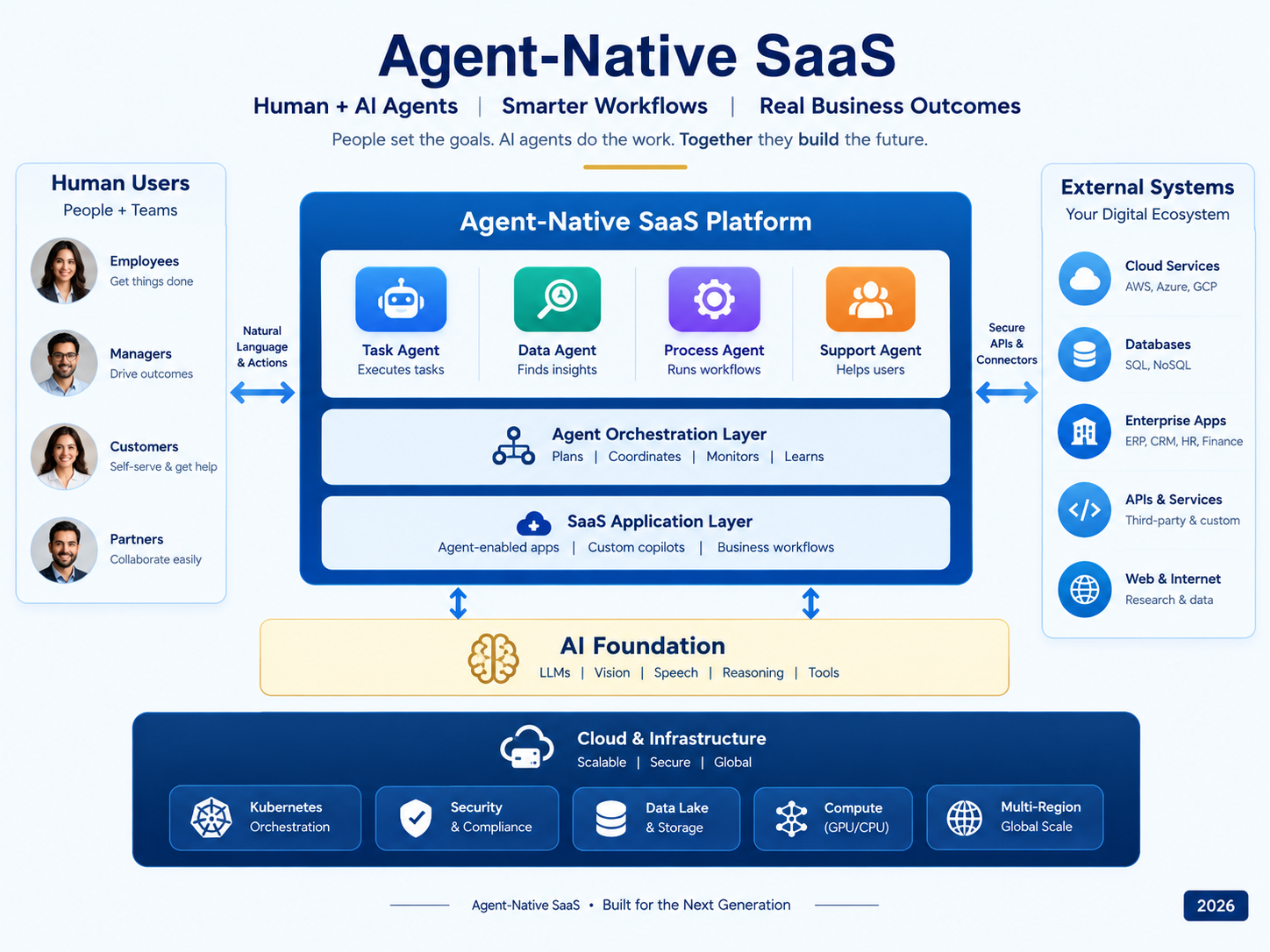
Agent-native SaaS changes a basic assumption about software: the user is no longer always a person clicking buttons. Increasingly, AI agents also need to discover capabilities, take permitted actions, understand outcomes, and recover safely when something goes wrong.
In practical terms, agent-native SaaS is software intentionally designed for both humans and AI agents. Humans interact through clear interfaces and approval flows; agents work through structured APIs, tools, permissions, and machine-readable responses. Both should rely on the same trusted capability layer.
The five foundations are straightforward: UX + AX, machine-readable interfaces, agent authentication and permissions, observability, and human oversight.
The direction was already visible in early 2024. McKinsey reported that 72% of surveyed organizations had adopted AI in at least one business function, while 65% said they were regularly using generative AI in at least one function.
What Is Agent-Native SaaS?
Agent-native SaaS is software designed from the outset for both human and machine users. Instead of exposing important functionality only through screens, it provides structured actions, predictable outputs, explicit permissions, and observable workflows that trusted AI agents can use reliably.
Agent-Native SaaS vs Traditional AI SaaS
Adding a chatbot or copilot does not automatically make a product agent-native.
Traditional AI SaaS often puts AI inside an existing application. Agent-native SaaS goes further by treating delegated or external AI agents as legitimate software users that can discover and execute approved product capabilities.
Mak It Solutions explores this broader shift in its guide to enterprise AI agents and the future beyond traditional app interfaces.
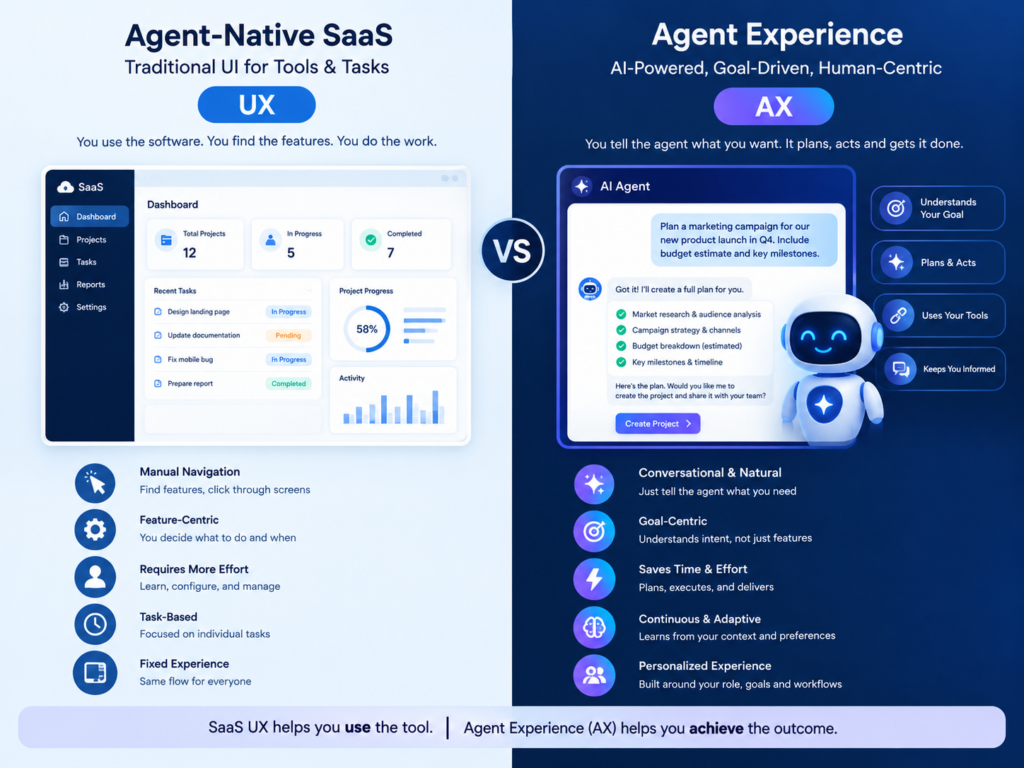
Agentic UX vs Agent Experience (AX)
Agentic UX focuses on the human side of delegation: assigning work, understanding what an agent plans to do, reviewing results, and intervening when necessary.
Agent experience (AX) focuses on the machine side. Can the agent discover an action, supply valid inputs, understand the response, and recover from failure without guessing?
Strong agent-native product design needs both.
Why AI Agents Are Becoming a SaaS User Class
Tool calling, autonomous workflows, and machine-to-machine transactions are making AI agents a meaningful software user class.
Deloitte reported in January 2025 that 26% of surveyed organizations were already exploring autonomous agent development to a large extent.
That does not mean every SaaS product needs full autonomy. It does mean product teams should start asking whether core capabilities are understandable and safely usable by machines as well as people.
How Human UX and Agent Experience Differ
Humans rely on visual context, explanation, and flexible navigation. AI agents perform better with explicit semantics, constrained actions, and predictable states.
The best architecture does not create two separate products. It creates one governed capability layer with interfaces optimized for each type of user.
Design Human UX for Context, Control, and Explanation
People need to understand what an automated system intends to do before consequential actions happen.
For higher-risk workflows, provide.
Clear previews and confirmations
Approval checkpoints
Visible status and progress
Cancel or override controls
Understandable explanations
Recovery paths when automation fails
A single “run” button may look elegant, but it is not enough when the action can move money, delete data, contact customers, or change critical records.
Design AX Around Contracts and Predictability
Agents need a different form of clarity.
Use stable identifiers, typed parameters, documented schemas, structured responses, and well-defined error states. A good semantic contract tells the agent what an operation does, what inputs are valid, what permission it requires, and how success or failure will appear.
Build One Capability Layer for Humans and Agents
Avoid duplicating business logic for a graphical interface and a separate agent interface.
Instead, expose reusable capabilities underneath both. The human UI can call those capabilities through familiar workflows, while authorized agents access the same governed operations through APIs, tools, or orchestration layers.
For more complex implementations, Mak It Solutions’ multi-agent AI architecture guide covers related architectural patterns.
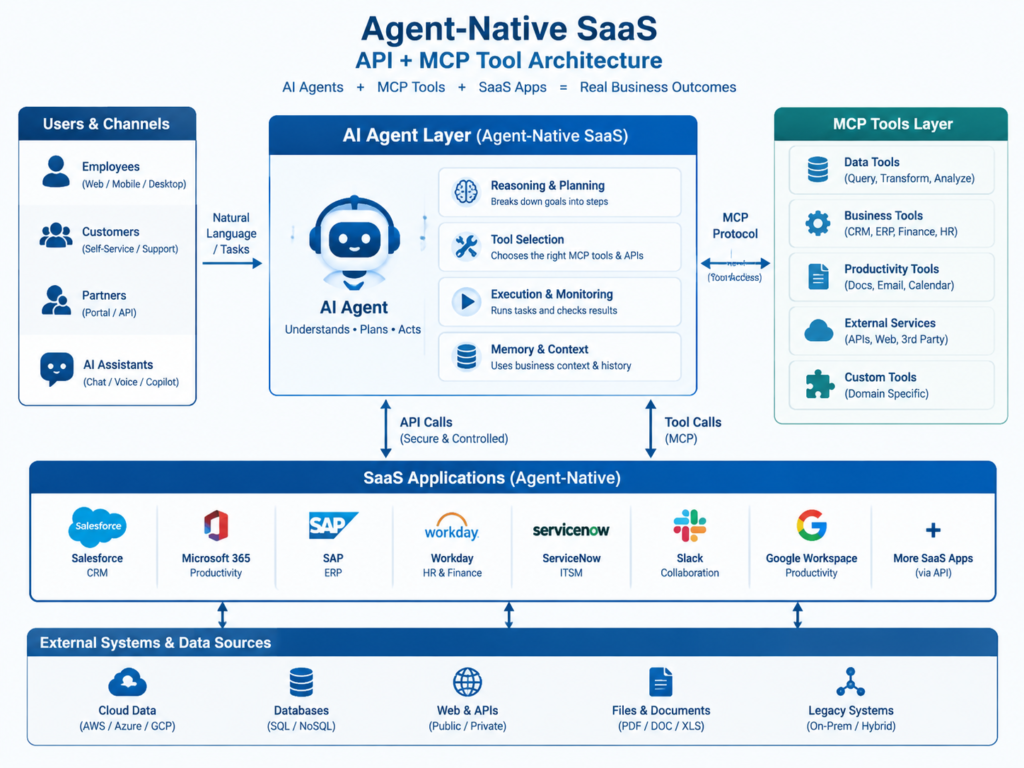
Agent-Native SaaS APIs, MCP, and Machine-Readable Architecture
Giving an AI agent permission to navigate a graphical interface is not the same as giving it a reliable software interface.
Agent-native SaaS depends on discoverable capabilities, structured schemas, deterministic operations, and machine-readable errors.
Design AI Agent APIs Around Explicit Actions
Prefer bounded operations such as create invoice, retrieve customers, or approve refunds over vague, general-purpose commands.
Useful design principles include typed parameters, structured outputs, stable action names, rate limits, explicit side effects, and idempotency. Idempotency is especially important when an autonomous workflow may retry after a timeout or partial failure.
Mak It Solutions’ API security best-practices guide covers supporting controls around these interfaces.
Where MCP Fits Into Agent-Native SaaS
Model Context Protocol can provide a standardized way for AI applications to discover and interact with tools, resources, and contextual information.
MCP continues to evolve. Its July 28, 2026 specification introduced changes including a stateless protocol core, authorization hardening, and a formal extensions framework.
MCP can improve interoperability, but it does not eliminate the need for conventional APIs, event systems, or integration layers. In many products, APIs remain the execution foundation while MCP provides a consistent agent-facing interface.
Make Failures Structured and Recoverable
A useful error should tell an agent what happened and what it can safely do next.
Return structured error codes, validation details, retry guidance, and partial-failure states. Combine them with idempotency keys and rollback or compensation logic so an automated workflow can decide whether to retry, stop, or escalate.
Permissions, Trust, and Human-in-the-Loop Controls
Agent access should follow least privilege. Authenticate agents explicitly, restrict what they can do, log consequential activity, and require human approval where automated action could create material harm.
Give Agents Identifiable Credentials
Production agents should not simply share a human login.
Depending on the architecture, use dedicated agent identities, delegated authorization, scoped service accounts, or short-lived credentials.
OAuth 2.0, for example, was designed to let applications obtain limited access to HTTP services on behalf of a resource owner or on their own behalf.
Mak It Solutions’ AI agent identity management guide covers this topic in more depth.
Add Granular Permissions and Approval Gates
Permissions should exist at the action level, not merely at the account level.
An agent might be allowed to read invoices automatically but require approval before issuing a refund or payment. Other guardrails can include spending thresholds, transaction limits, approved destinations, policy checks, and time-bound permissions.
A zero-trust strategy for AI-era security is a useful companion model.
Make Every Agent Action Observable
Record who initiated a workflow, which agent acted, which tools it called, what authority it used, and what outcome followed.
Useful audit histories should capture failures, approvals, overrides, retries, and recovery actions as well as successful operations. This makes autonomous workflows easier to debug and gives enterprise buyers evidence of accountability.
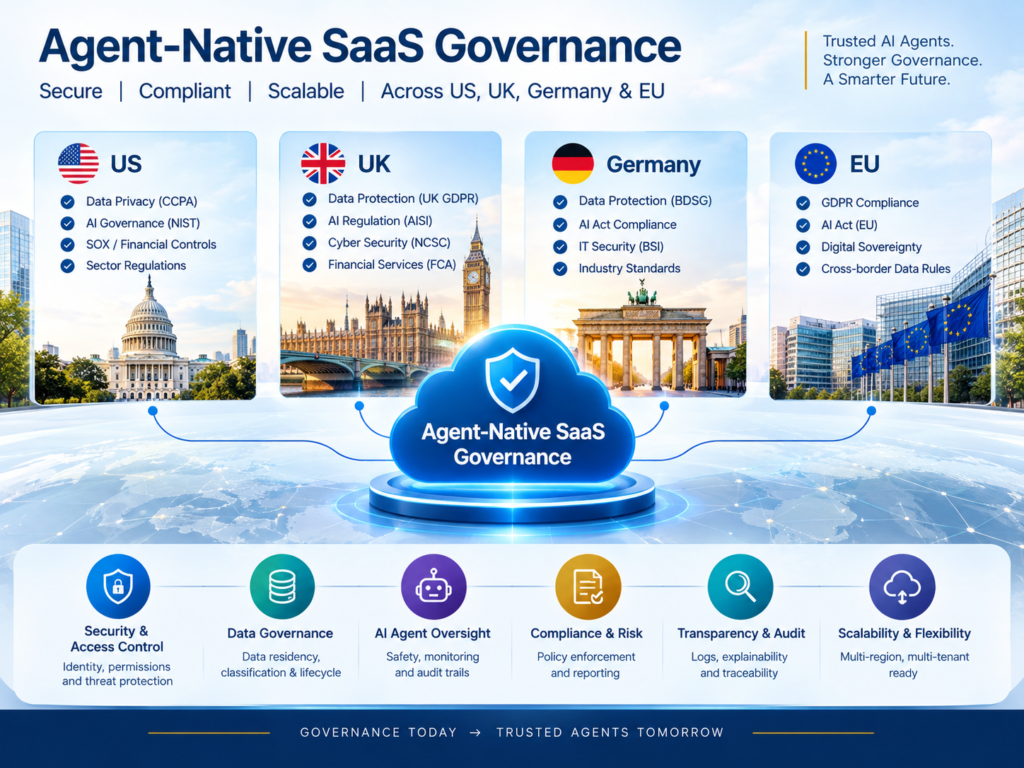
Agent-Native SaaS in the USA, UK, Germany, and EU
The underlying architecture can remain largely consistent across markets, but privacy, security, and AI-governance requirements depend on the jurisdiction, sector, and use case.
USA.
US enterprise customers may expect mature security controls and evidence such as SOC 2 reporting, alongside industry-specific requirements.
For applicable healthcare workloads, the HIPAA Security Rule requires regulated entities to use administrative, physical, and technical safeguards to protect electronic protected health information. Its technical safeguards include access controls and audit controls.
Payment environments may also bring PCI DSS requirements into scope. Regional deployments across AWS, Azure, or GCP can support isolation, resilience, and data-governance strategies when configured appropriately.
UK.
A London fintech may need to consider UK data-protection requirements, FCA expectations, and sector-specific obligations. Healthcare or NHS-related deployments introduce another set of data and governance considerations.
ICO guidance emphasizes that human involvement in significant AI-supported decisions must be meaningful. Reviewers should remain engaged, have the authority and competence to challenge recommendations, and avoid merely rubber-stamping automated outputs.
Germany and EU.
Teams serving Berlin, Munich, Frankfurt, Paris, Amsterdam, or Dublin should design with GDPR/DSGVO, data governance, and applicable sector requirements in mind. German financial services may also need to consider relevant BaFin expectations.
The EU AI Act entered into force on August 1, 2024, and became broadly applicable on August 2, 2026. The AI Office and national authorities also began exercising enforcement powers from that date. Some high-risk requirements remain on later implementation timelines, including December 2, 2027 and August 2, 2028 for specified categories.
ISO 27001-aligned controls, appropriate EU cloud regions, traceable decisions, and strong auditability can support the broader governance architecture.
Regulatory obligations vary by product and use case. This section is general information, not legal advice.
A Practical Blueprint for Designing Agent-Native SaaS
Start with capabilities, not the chatbot. Identify what humans and agents need to accomplish, expose those operations through structured interfaces, establish trust boundaries, add observability, and then design the delegation experience around them.
Map Human Jobs to Agent-Callable Capabilities
Inventory important workflows and break them into reusable actions.
Separate read-only operations from consequential actions such as sending money, deleting information, approving requests, or communicating externally.
Each capability should have clear inputs, outputs, ownership, side effects, and permission requirements.
Add Machine Interfaces, Trust Boundaries, and Testing
Expose appropriate operations through APIs or MCP. Then add authentication, permission scopes, schemas, idempotency, audit logging, rate controls, and recovery behavior.
Test with sandboxes, synthetic data, malformed inputs, unavailable dependencies, duplicate requests, and policy violations before granting production autonomy.
Mak It Solutions’ enterprise AI adoption roadmap provides a broader rollout framework.
Measure UX and AX as One Product System
Track human task success alongside agent reliability.
Useful measures include tool-call success, workflow completion, latency, retry frequency, recovery success, approval frequency, human intervention, unauthorized-action attempts, and workflows ending in ambiguous states.
Then connect technical telemetry to business outcomes. Mak It Solutions’ business intelligence services can support outcome-focused reporting.
A useful maturity test is simple:
Can an authorized agent discover, understand, execute, and verify your product’s core actions without pretending to be a human clicking through the UI?
Last Words
The move toward agent-native SaaS is not simply another interface trend. It changes how products expose capabilities, authenticate users, enforce authority, handle failures, and prove what happened after an automated action.
Teams that build the capability layer first are in a better position to support both human users and increasingly autonomous software without maintaining two disconnected products.
If your SaaS roadmap is moving from AI features toward autonomous workflows, audit the underlying capabilities before redesigning the interface.
Mak It Solutions can help product and engineering teams assess agent readiness, APIs, UX/AX, permissions, and observability. Request a scoped consultation with Mak It Solutions.
Key Takeaways
Agent-native SaaS designs human UX and agent experience as parts of the same product system.
Structured actions, APIs, schemas, and predictable responses matter more than chatbot polish.
MCP can improve agent interoperability without replacing every conventional API.
Agent identities need least-privilege permissions, audit trails, and appropriate approval controls.
US, UK, German, and EU deployments need jurisdiction- and sector-aware governance.
Reliability should be measured through outcomes, recovery, and intervention—not simply agent-call volume.
FAQs
Q : Is MCP required to make a SaaS product agent-native?
A : No. MCP can standardize how tools and resources are exposed, but a product can still be agent-native through well-designed APIs, schemas, permissions, and structured responses. Use MCP where interoperability creates a practical benefit.
Q : Should AI agents use separate accounts from human users?
A : Agents should generally have distinct identities or clearly attributable delegated credentials. That makes permissions easier to scope, revoke, monitor, and audit while preserving the link between human authorization and agent action.
Q : How should SaaS pricing change when AI agents generate more API usage?
A : Traditional per-seat pricing may become less representative when a small number of human users delegate large volumes of work to agents. Providers can evaluate usage-, workflow-, transaction-, or outcome-based components while keeping billing predictable. See Mak It Solutions’ usage-based versus per-user pricing guide.
Q : Which metrics show whether an AI agent integration is reliable?
A : Track task completion, tool-call success, latency, retries, recovery success, approval frequency, human intervention, and unauthorized-action attempts. Business metrics such as cost per completed workflow should sit alongside technical telemetry.
Q : How can SaaS teams test autonomous agent workflows before production access?
A : Start with sandbox environments, synthetic data, and tightly scoped credentials. Test malformed requests, unavailable dependencies, duplicate actions, partial failures, and policy violations before moving to monitored production pilots with human approval for consequential actions.