
AI Agent Identity: Human vs Machine vs Autonomous AI
AI Agent Identity: Human vs Machine vs Autonomous AI
AI Agent Identity: Human vs Machine vs Autonomous AI
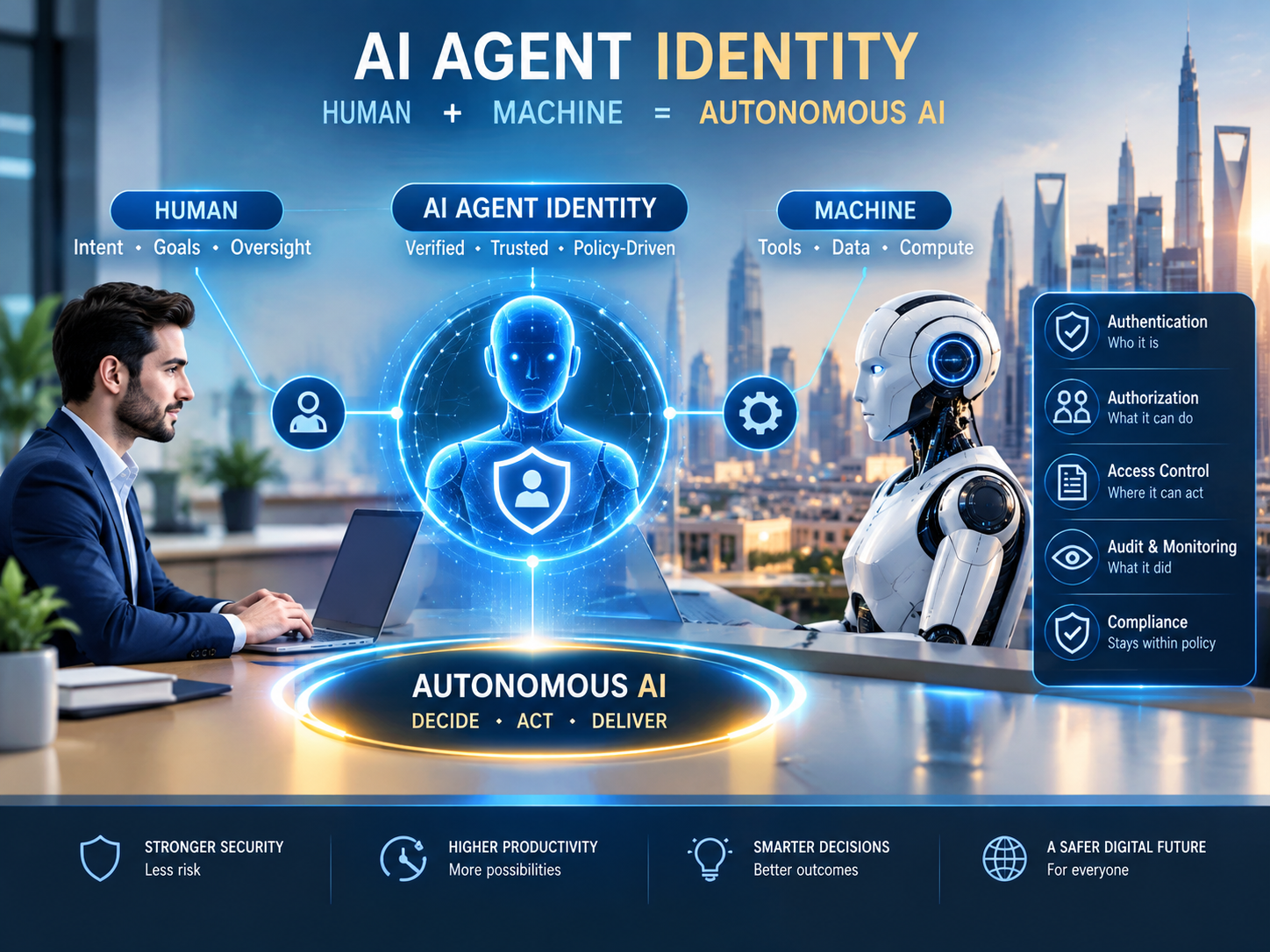
AI agent identity is the identity, authentication, authorization, ownership, and audit context assigned to an AI agent so it can securely access systems, APIs, tools, and other agents. Human identities represent people, machine identities represent software or infrastructure, while AI agent identities address autonomous software actors that can make decisions and operate with delegated authority.
That distinction is becoming important as enterprises move from AI assistants toward agents that can select tools, call APIs, initiate workflows, and delegate tasks without a person approving every individual action.
In Gartner’s 2025 survey of 360 IT application leaders, 75% said their organizations were piloting, deploying, or had already deployed some form of AI agents. Only 15%, however, were considering, piloting, or deploying fully autonomous agents, highlighting the gap between broader agent adoption and true autonomy.
What Is AI Agent Identity?
AI agent identity is a security identity assigned to an autonomous AI actor so an organization can authenticate it, control its permissions, identify who or what it represents, and audit its actions independently.
It extends familiar identity and access management concepts to software that can make runtime decisions rather than simply execute a fixed workload.
How agent identity differs from standard digital identity
A standard digital identity establishes a recognizable security principal. AI agent identity adds context around the agent’s owner, purpose, credentials, authorization, delegated authority, and lifecycle.
Identity answers which agent is acting. Authentication proves that identity. Authorization determines what the authenticated agent may do.
Microsoft Entra Agent ID, for example, provides purpose-built identity constructs for managing, authenticating, authorizing, governing, and protecting AI agents. Microsoft’s current documentation also supports owner and sponsor relationships for lifecycle accountability.
For the broader taxonomy, Mak It Solutions’ non-human identity security guide explains how bots, workloads, service accounts, and agents fit into NHI security.
Why autonomous AI changes traditional IAM assumptions
Traditional IAM usually assumes either a human making an intentional request or a workload performing relatively predictable functions.
An autonomous agent is different. It may decide which API to call, which Model Context Protocol (MCP) tool to invoke, or which downstream agent should perform part of a task. Its effective authority may therefore change with runtime context, delegation, and the tools available to it.
Where agent identity fits within non-human identity security
AI agents are non-human identities, but not every non-human identity is an AI agent.
Service accounts, application identities, workload identities, and other software principals also fall within the NHI landscape. Recent Cloud Security Alliance guidance distinguishes the identity subject from the credential used to authenticate it and specifically includes identities used by autonomous agents to access tools, APIs, and data sources.
See the related AI agent identity management guide for lifecycle and governance patterns.
Human Identity vs Machine Identity vs AI Agent Identity
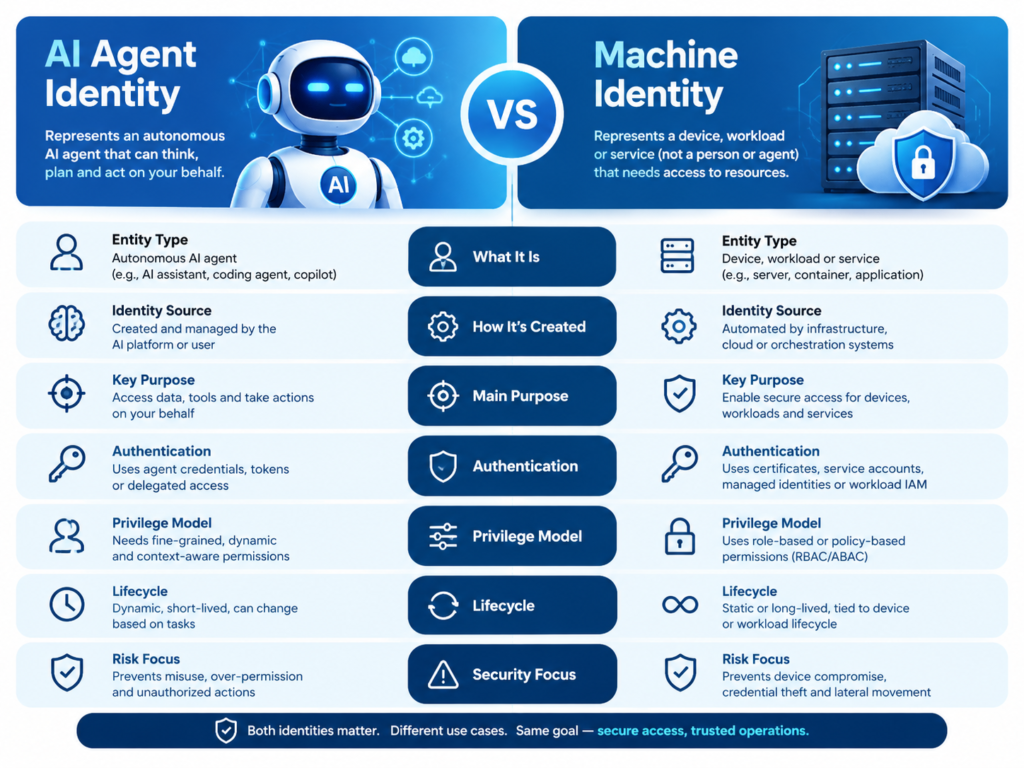
The simplest difference is this: human identity represents a person, machine identity represents software or infrastructure, and AI agent identity represents an autonomous software actor whose authority may depend on ownership, delegation, and runtime context.
| Area | Human Identity | Machine/Workload Identity | AI Agent Identity |
|---|---|---|---|
| Principal | Employee or customer | App, service, workload | Autonomous agent |
| Autonomy | Human-driven | Predetermined execution | Dynamic decisions |
| Credentials | MFA, password less, token | Certificate, secret, token | Token, federation, certificate |
| Delegation | User or role delegation | Usually limited | Often important |
| Lifecycle | HR/customer lifecycle | App/workload lifecycle | Agent and task lifecycle |
| Least privilege | User/role based | Service permissions | Agent + task + context |
| Auditability | User actions | Workload actions | Agent actions + delegation |
| Accountability | Individual | Application owner | Agent plus accountable owner |
Human identity.
Human identities represent employees, customers, administrators, and contractors. MFA, password less authentication, roles, entitlement reviews, and identity governance help determine what each person can access.
The human layer still matters. Verizon’s 2024 Data Breach Investigations Report found that 68% of breaches in its dataset involved a non-malicious human element, including social engineering or error.
Machine and workload identity.
Machine identity typically represents applications, cloud workloads, containers, services, and infrastructure.
Common examples include service accounts, service principals, managed identities, workload identities, API credentials, and X.509 certificates. Mak It Solutions’ cloud IAM security guide covers identity-centric access patterns for cloud environments.
AI agent identity.
An AI agent may reason about a task, select a tool, invoke an API, and trigger another action without a human approving every step.
Its identity therefore needs to preserve the relationship between the agent, its owner, the initiating user or system, and the authority delegated to it.
Why AI Agents Need Their Own Identity and Access Controls
AI agents need distinct access controls because authentication alone does not establish what an autonomous agent may do, whose authority it is using, how long that authority should last, or how its actions should be attributed.
Authentication.
Agents may authenticate through OAuth 2.0, OpenID Connect, short-lived tokens, PKI, X.509 certificates, managed identities, or workload identity federation.
Where architecture allows, temporary cryptographic credentials are generally preferable to permanent shared secrets.
Authorization.
Authorization should define permitted resources and actions through scopes, RBAC, ABAC, or context-aware policies.
A procurement agent, for example, might be allowed to read approved supplier records without receiving permission to modify payment instructions.
NIST’s Zero Trust Architecture treats authentication and authorization as distinct functions and emphasizes resource-focused, granular access rather than implicit trust based on network location.
The Mak It Solutions API security guide provides complementary guidance on OAuth and API authorization.
Delegation.
An enterprise should be able to answer three questions after an autonomous action:
Who initiated the workflow? Which agent performed the action? Which authority or permission allowed it?
Preserving those relationships makes incident investigation, access review, and compliance evidence much stronger.
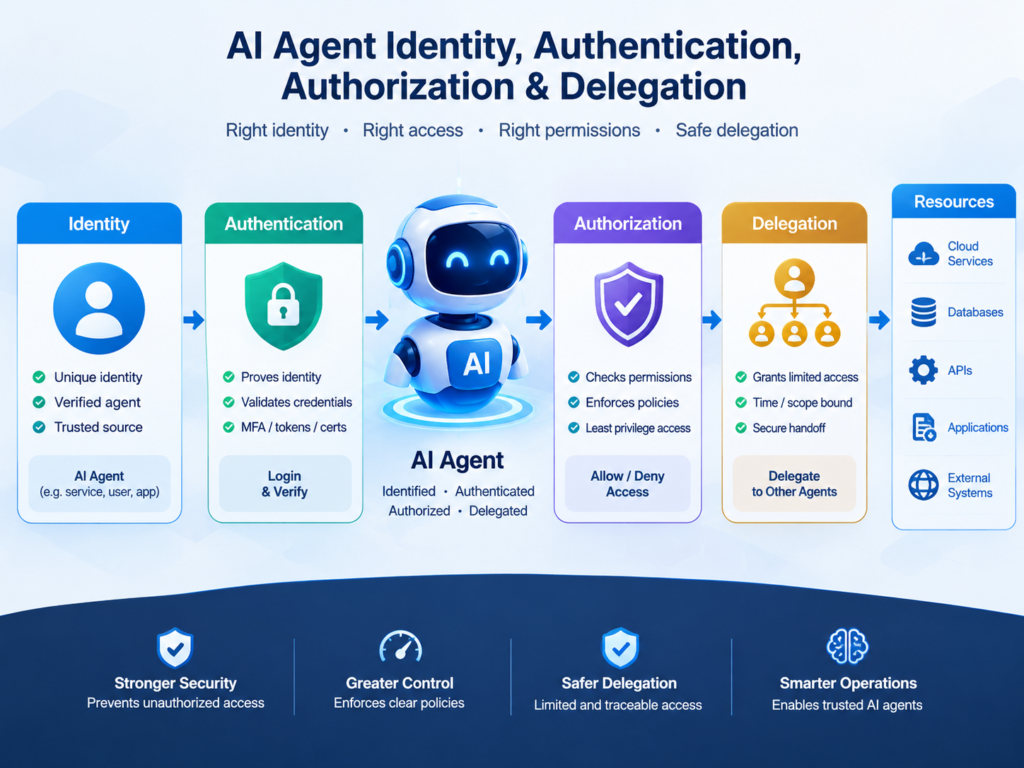
AI Agent Identity Management in Enterprise IAM
AI agent identity management should give every production agent a unique identity, narrowly scoped authority, a known owner, a governed lifecycle, and an audit trail that can be reviewed or revoked.
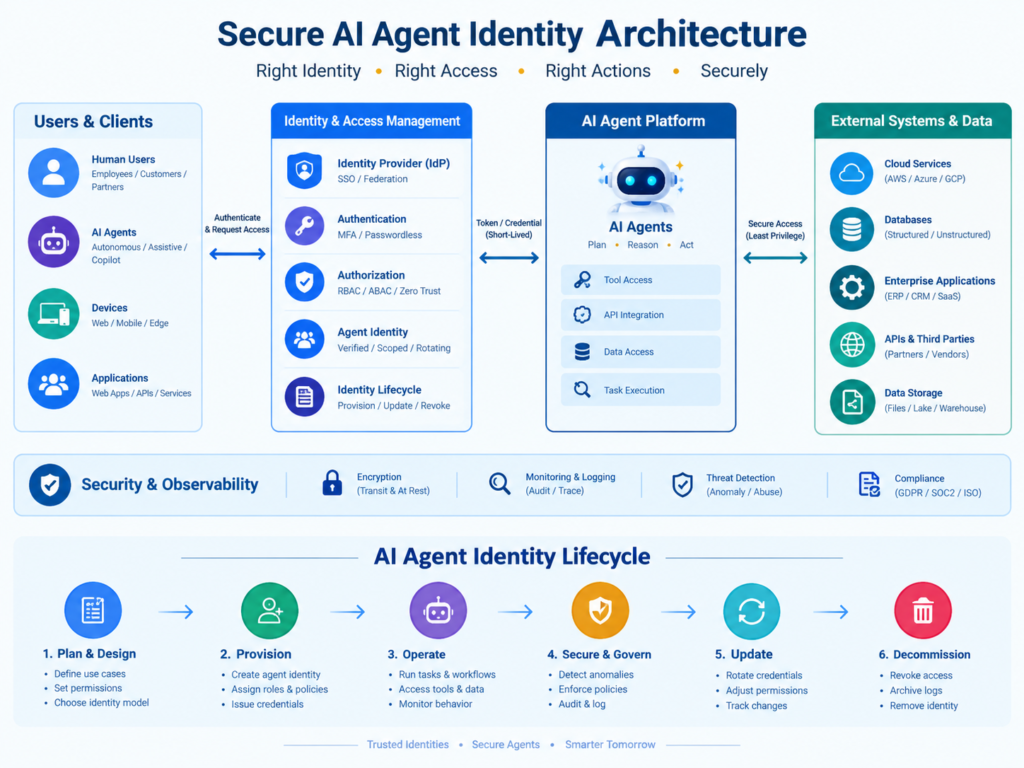
Lifecycle management from creation to revocation
Agent governance should cover registration, ownership, provisioning, credential rotation, permission changes, suspension, and retirement.
This is an existing weakness in many non-human identity environments. A 2024 Cloud Security Alliance survey found that only 20% of organizations had a formal process that was strictly followed for offboarding and revoking API keys.
Least privilege and Zero Trust for autonomous agents
Least privilege means giving an agent only the authority required for its current role or task.
Short-lived OAuth tokens, workload federation, managed identities, and granular authorization can reduce persistent access. NIST’s cloud-native Zero Trust guidance likewise emphasizes identity-based authentication and authorization policies for applications and services.
For a broader enterprise approach, see Mak It Solutions’ Zero Trust strategy for AI-era security.
Agent-to-API, agent-to-MCP, and agent-to-agent authentication
Modern agent ecosystems can cross Microsoft Entra ID, AWS IAM, Google Cloud IAM, SaaS APIs, MCP servers, and agent-to-agent systems.
Microsoft Entra Agent ID currently documents support for OAuth 2.0, MCP, and agent-to-agent communication patterns. Microsoft also recommends protecting MCP servers like APIs by requiring and validating OAuth access tokens before tools are executed.
SPIFFE/SPIRE and PKI may provide additional cryptographic workload identity patterns depending on the architecture.
AI Agent Governance, Ownership, and Auditability
Good governance gives every significant production agent an accountable owner or sponsor, restricts its permissions, records delegated authority, and maintains an audit trail distinct from human and ordinary workload activity.
Microsoft’s current Agent ID model separates technical owners from business sponsors. Sponsors are accountable for business purpose and lifecycle decisions, while owners handle technical administration.
Logs should capture the initiating principal, agent identity, resource requested, authorization decision, tools invoked, and significant downstream actions. Microsoft also documents audit and sign-in visibility for agent identities across lifecycle and permission changes.
For higher-risk actions such as exporting regulated data, modifying production environments, or authorizing financial transactions organizations may add stronger policy checks or human approval.
Organizations evaluating dedicated tooling can also review the agentic AI security platform guide.
AI Agent Identity Across the USA, UK, and Germany/EU
AI agent identity can support accountability, access limitation, and auditability across jurisdictions. It should not, however, be described as a universal legal requirement on its own.
United States.
US enterprises can align autonomous-agent access with existing Zero Trust and security-governance programs.
For organizations subject to HIPAA, the Security Rule includes requirements involving access control, audit controls, and authentication for systems handling electronic protected health information. Agent identity can support those objectives when autonomous systems interact with ePHI, although the applicable obligations depend on the organization and use case.
SOC 2 and PCI DSS environments may likewise benefit from attributable access and disciplined credential governance where those frameworks apply.
United Kingdom.
UK organizations should treat AI-agent access as part of their existing privacy and security architecture.
The ICO’s current UK GDPR guidance emphasizes accountability, appropriate technical and organizational measures, data protection by design, and limiting access to personal information based on purpose and risk.
For financial services, healthcare, Open Banking, or other regulated environments, additional sector-specific requirements may apply.
Germany and the EU.
For organizations operating in Germany or elsewhere in the EU, KI-Agenten-Identität and Identität von KI-Agenten should be integrated with existing GDPR/DSGVO, cybersecurity, and operational-resilience controls.
Depending on the organization, sector, and AI use case, frameworks such as DORA, NIS2, the EU AI Act, and national regulatory requirements may add governance obligations. DORA, for example, requires covered financial entities to maintain documented ICT risk-management frameworks and continuously monitor the security and functioning of ICT systems.
Agent identity can support traceability and access control, but the exact legal mapping should be reviewed against the specific system and regulated activity.
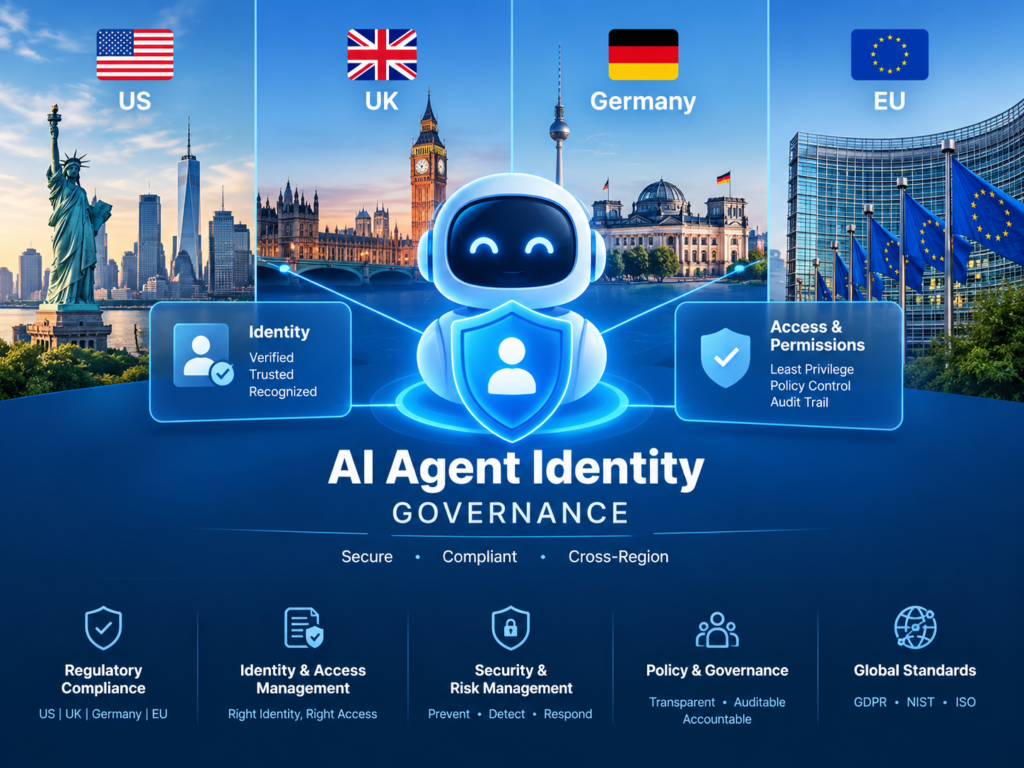
How to Build a Secure AI Agent Identity Architecture
A practical implementation can start with three steps.
Give each production agent a unique, attributable identity
Avoid shared identities when individual attribution matters.
Document the agent’s purpose, owner or sponsor, operating environment, accessible systems, and expected behavior.
Use short-lived credentials and narrowly scoped permissions
Use OAuth/OIDC, managed identities, workload federation, or cryptographic workload identity where appropriate.
Limit permissions to the resources and actions required by the workflow. Review excessive cloud permissions regularly through the same governance process used for other privileged identities.
Mak It Solutions’ cloud misconfiguration remediation guide covers related AWS, Azure, and GCP risks.
Monitor, govern, and revoke continuously
Capture authentication events, delegation context, authorization decisions, tool calls, and lifecycle changes.
Expire temporary access automatically where possible and ensure security teams can disable identities or revoke permissions quickly when behavior changes.
The enterprise AI adoption roadmap can help connect identity governance with a broader production-AI program.
Final Thoughts
Human identity tells you which person is acting. Machine identity tells you which application or workload is acting. AI agent identity adds the governance needed for software that can make decisions, invoke tools, and operate with delegated authority.
For enterprises adopting autonomous AI, the immediate priority is visibility. Inventory production agents, identify accountable owners, review credentials and permissions, confirm audit coverage, and verify that access can be revoked without disrupting unrelated workloads.
If autonomous agents are already entering your cloud, SaaS, or enterprise workflows, contact Mak It Solutions to assess agent identities, non-human access, delegation, Zero Trust controls, and lifecycle governance.
FAQs
Q : Can AI agents use existing service accounts?
A : Yes, in some architectures. The problem is attribution: a shared service account can make it difficult to distinguish an AI agent’s actions from those of other applications. Where independent ownership, delegated authority, or lifecycle governance matters, a distinct agent identity is generally stronger.
Q : Who should own an AI agent identity inside an enterprise?
A : Each production agent should have clearly documented accountability. Technical owners may manage configuration and credentials, while a business sponsor can remain responsible for the agent’s purpose, access justification, and lifecycle decisions.
Q : Should AI agent credentials be short-lived?
A : Where supported, short-lived credentials are generally preferable because they reduce how long compromised access remains useful. They should still be paired with rapid revocation, least-privilege permissions, and monitoring.
Q : How do MCP servers verify an AI agent’s identity?
A : The mechanism depends on the MCP server and identity architecture. OAuth-based access tokens, workload identities, or other cryptographic credentials may be used, followed by a separate authorization decision about which tools and resources the authenticated agent can access.
Q : What happens when an AI agent is retired?
A : Retirement should disable the identity, revoke active credentials, remove unnecessary permissions, and close downstream access paths. Relevant ownership and audit records may need to remain available for security investigations, compliance, or records-management purposes.