


AI Agent Identity: Security & Governance Guide
AI Agent Identity: Security & Governance Guide
AI Agent Identity: Security & Governance Guide
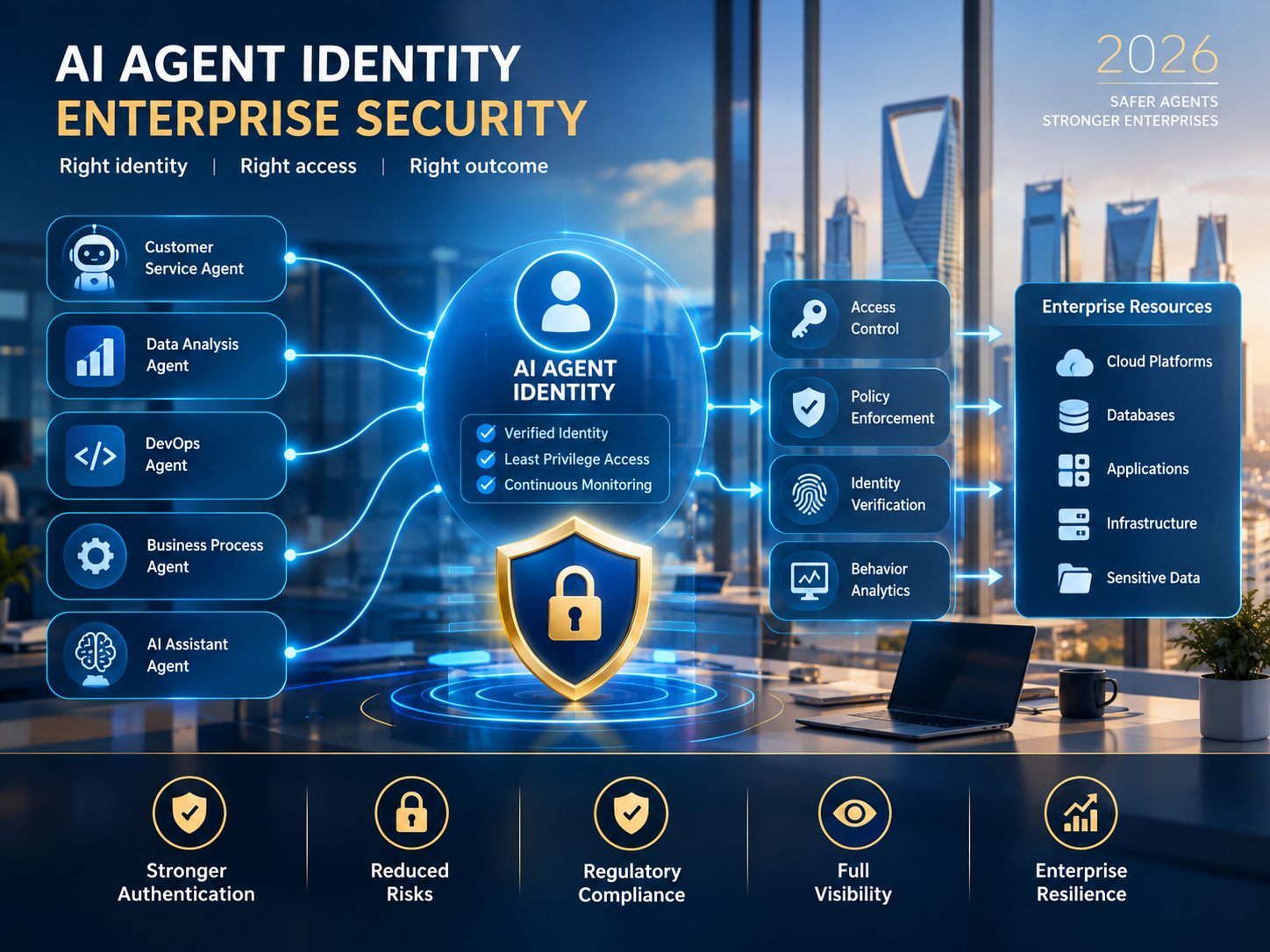
AI agent identity is becoming a core enterprise security requirement as autonomous agents gain access to APIs, SaaS platforms, databases, MCP servers, payment workflows and sensitive business data. An AI agent identity gives each autonomous software actor a unique, verifiable identity so systems can authenticate it, control its permissions, link it to an accountable owner and audit what it does.
In practical terms, organizations need to answer four questions for every production agent: Which agent is acting? Who owns it? What is it allowed to do? Can that access be revoked quickly?
Traditional IAM remains essential, but shared service accounts and long-lived credentials were not designed for autonomous software that can make decisions, delegate tasks and invoke downstream systems without a person approving every action.
The scale of AI adoption makes that distinction increasingly important. McKinsey reported that 72% of surveyed organizations had adopted AI in at least one business function in early 2024.
For related architecture patterns, see Mak It Solutions’ Non-Human Identity Security guide and AI Agent Identity Management guide.
What Is AI Agent Identity?
An AI agent identity is a digital identity assigned to an autonomous or semi-autonomous software actor. It enables IAM systems and applications to determine which agent is requesting access, authenticate it and enforce permissions independently of the credential used to prove that identity.
The distinction matters: identity tells you which agent is acting; authentication verifies that claim; authorization determines what the agent can do.
AI Agent Identity in Enterprise Security
Agent identity sits within the broader landscape of non-human identity, workload identity, machine identity and identity and access management.
An identity provider may issue tokens, certificates or other authentication evidence, while IAM and policy engines decide which resources and actions are permitted.
Microsoft Entra Agent ID, for example, now provides purpose-built identity constructs for AI agents, including authentication, authorization, lifecycle governance and enterprise security controls. Microsoft also distinguishes agent identities from conventional application and human identities.
AI Agent Identity vs Human Identity
A human identity typically maps to an employee, customer or contractor. An autonomous agent needs additional relationships and controls, such as.
An accountable human, technical or business owner
A documented business purpose
Explicit delegated authority
Machine-readable authorization policies
Automated lifecycle and expiration controls
Auditability across downstream actions
Agents may operate outside normal business hours, invoke many services in seconds or exist only for a temporary workflow. Governance cannot depend on someone manually approving every individual action.
AI Agent Identity vs Service Accounts
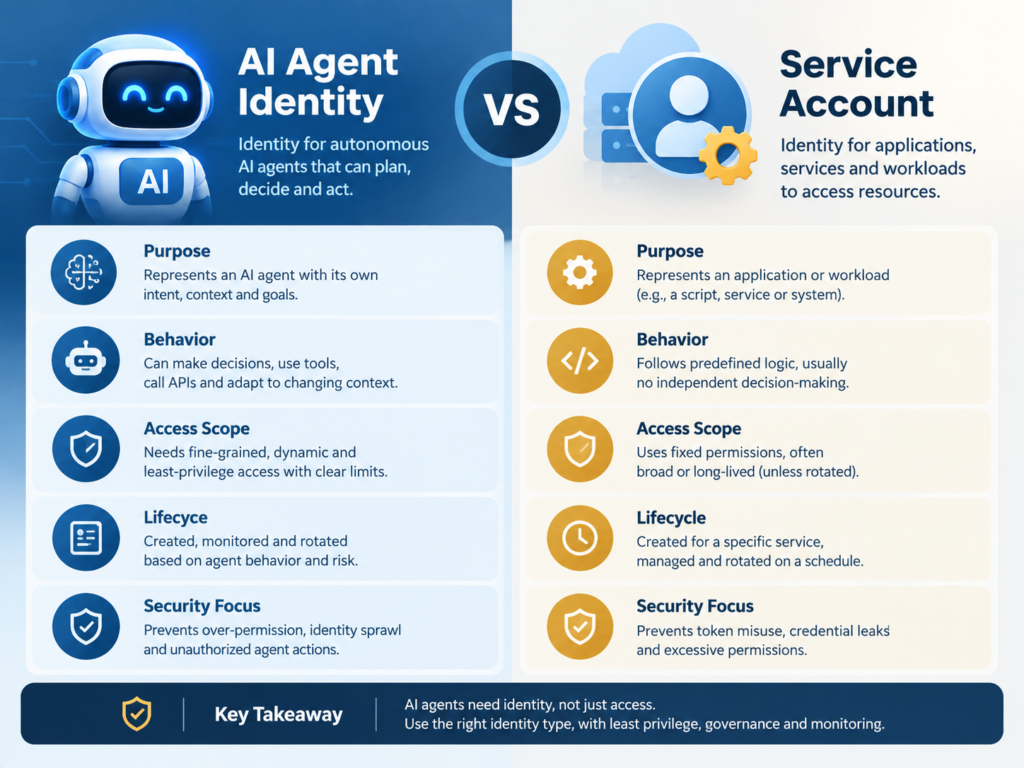
An AI agent identity represents the autonomous agent itself. A service account, by contrast, usually represents an application, service or workload and often operates with relatively stable permissions and ownership.
Agents can be more dynamic. They may be created automatically, receive temporary assignments, call other agents or tools, act on behalf of users and change operational context during a workflow.
That makes ownership, delegated authority, short-lived access and rapid revocation especially important.
How AI Agent Identity Authentication and Authorization Work
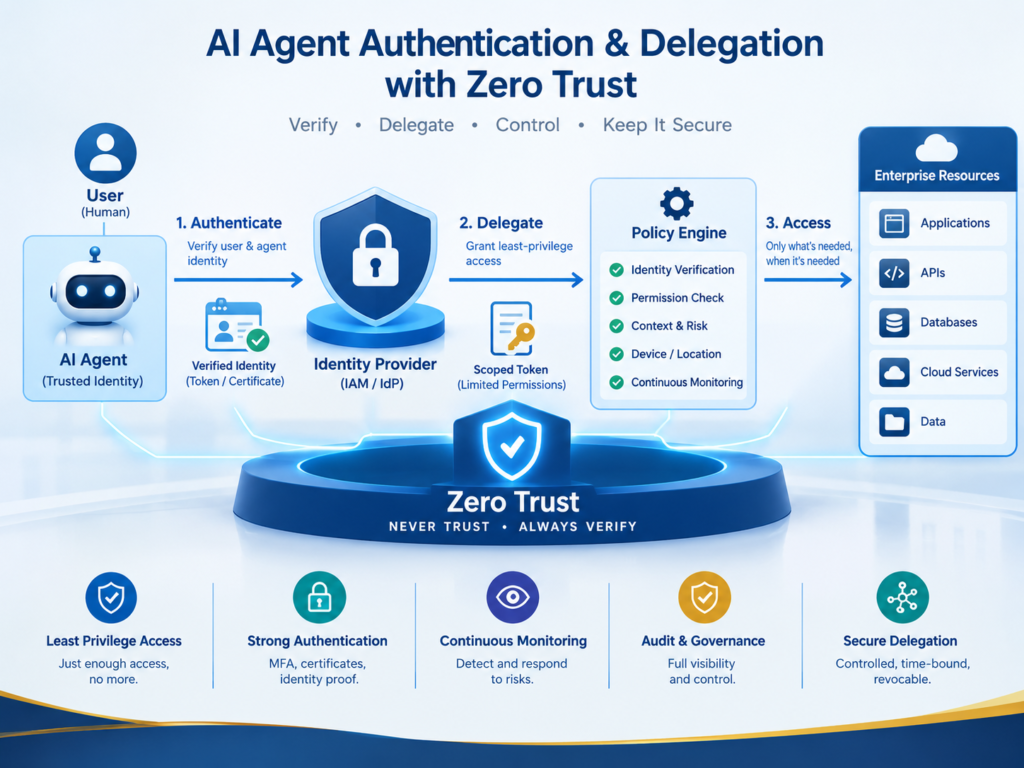
Secure AI agent identity architecture separates authentication from authorization.
Authentication establishes which agent is making a request. Authorization determines whether that authenticated agent can perform the requested action on a particular resource.
Authentication.
Depending on the platform and architecture, agents may authenticate using OAuth 2.0, access tokens, certificates, workload identity federation or other IdP-integrated mechanisms.
Where practical, organizations should prefer short-lived credentials and federated identity over permanent shared secrets. If a credential is exposed, a short validity period can reduce the window in which it can be abused.
Mak It Solutions’ cloud IAM security guide covers complementary identity-first controls for cloud environments.
Authorization.
Successful authentication should never mean unrestricted access.
Authorization policies can apply least privilege through RBAC, ABAC or other policy-based approaches that consider the agent, resource, requested action and surrounding context.
A customer-support agent that needs to read an individual customer record, for example, should not automatically receive permission to export an entire customer database.
NIST Zero Trust guidance similarly treats authentication and authorization as distinct security functions and emphasizes resource-level access controls rather than implicit trust. See NIST SP 800-207 — Zero Trust Architecture.
For API-facing agents, the Mak It Solutions API Security Best Practices guide provides additional guidance around OAuth, scopes and API authorization.
Delegation Chains and Agent-to-Agent Access
Delegation becomes more complicated when one agent invokes another agent, an MCP server, an enterprise API or a SaaS application.
The initiating authority should not disappear as the workflow moves downstream. Security teams need enough context to determine:
Who or what initiated the task
Which agent performed each action
What authority was delegated
Which downstream resources were accessed
Which policy authorized the action
Whether delegated access can be revoked
This is especially important in multi-agent environments, where a single user request may trigger actions across several security boundaries.
AI Agent Identity Management and Governance
AI agent identity management covers discovery, registration, ownership, access governance, monitoring and the full lifecycle of each agent.
The objective is straightforward: autonomous identities should not become invisible, orphaned or permanently overprivileged.
Discover, Register and Assign Ownership to Every Agent
Start with a central inventory that includes production agents, experimental agents, OAuth clients, service accounts, MCP connections and other non-human identities that participate in agent workflows.
Every material agent should have an accountable owner and documented purpose.
Current identity platforms are moving in this direction. Microsoft Entra Agent ID supports agent identity management and governance, while Okta describes capabilities for discovering agents, registering them centrally, assigning human owners and controlling their connections.
Manage the Full AI Agent Identity Lifecycle
A useful lifecycle model is:
creation → verification → permission assignment → monitoring → modification → suspension → revocation
The process should be automated where possible. Ephemeral agents can appear and disappear much faster than traditional quarterly access reviews can handle.
If an identity exists only for a temporary workflow, automatic expiration should generally be preferred over indefinite access.
What Enterprises Should Require From an Agent Identity Platform
When assessing an identity platform for autonomous agents, look beyond the feature list. Determine whether it supports.
Centralized agent discovery and inventory
IAM and IdP integration
Accountable ownership or sponsorship
Short-lived credentials and credential rotation
Delegated authorization
Least-privilege policy enforcement
Behavioral and identity-risk monitoring
End-to-end audit trails
Automated suspension and revocation
APIs and cross-platform integration
The buyer question is simple: Can your identity architecture discover, authenticate, govern and deactivate every autonomous agent operating in your environment?
Mak It Solutions’ Agentic AI Security Platform guide provides a broader evaluation framework.
AI Agent Identity Security Risks and Best Practices
Autonomous agents need identifiable, governable identities because they may access enterprise resources without a person approving each individual action.
Unique identities make it possible to restrict permissions, attribute activity, investigate incidents and disable access when an agent becomes unnecessary or compromised.
Why Traditional IAM Needs to Evolve for Autonomous Agents
Traditional IAM does not become obsolete in an agentic environment. It needs to extend to a new class of software actor.
AI agents introduce machine-speed activity, dynamic creation, delegated authority, agent-to-agent interactions and rapidly changing context. In practice, these characteristics can make a permission that looks reasonable at deployment time far more powerful when combined with downstream tools and data access.
A mature non-human identity strategy applies familiar IAM and Zero Trust principles while accounting for this new operating model.
See Mak It Solutions’ Zero Trust Strategy for AI-Era Security for the broader architecture.
Major AI Agent Identity Security Risks
Common risks include shared credentials, excessive privileges, orphaned agents, leaked secrets, unclear ownership, privilege escalation, incomplete delegation records, missing audit trails and slow revocation.
The governance gap is already visible in broader AI security research. IBM reported in 2025 that 13% of surveyed organizations experienced a breach involving AI models or applications. Among those organizations, 97% reported that they lacked proper AI access controls.
Cloud permissions can compound that exposure, so organizations should also address the IAM weaknesses covered in Mak It Solutions’ cloud misconfiguration remediation guide.
Enterprise AI Agent Identity Best Practices
A practical security baseline is to give each production agent a unique identity and accountable owner, then apply least privilege around that identity.
Prefer temporary or federated credentials where feasible. Monitor authentication and authorization continuously, rotate credentials where stored secrets remain necessary, preserve delegation context and make revocation fast enough to stop risky activity without waiting for a manual access-review cycle.
For high-impact actions—such as changing payments, exporting sensitive data or deploying to production—organizations may also require stronger authentication, additional policy checks or human approval.
AI Agent Identity Compliance in the USA, UK, Germany and EU
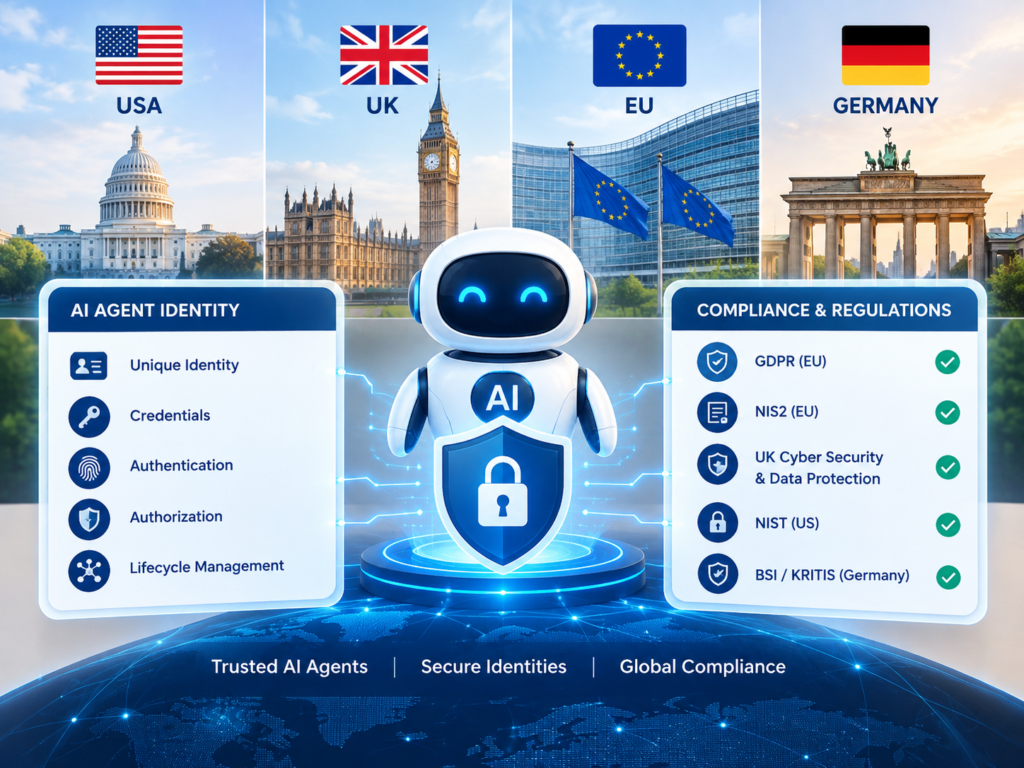
The underlying control objective is similar across jurisdictions: identify the actor, restrict its authority and retain evidence of what it did.
The legal mapping differs by location and sector, however. Security best practices should not be treated as automatically satisfying a particular regulation.
This section provides general security and compliance information, not legal advice. Organizations should assess the requirements that apply to their own systems, data and jurisdictions.
USA.
Organizations in markets such as New York, San Francisco and Washington, D.C. can map AI agent identity controls to NIST Zero Trust principles as well as relevant sector-specific requirements.
For healthcare environments, HHS guidance on the HIPAA Security Rule addresses access control, audit controls and authentication for systems handling electronic protected health information.
Payment environments should assess applicable PCI DSS v4.0.1 requirements, while SaaS providers may use identity governance, access controls and logging evidence as part of their SOC 2 assurance programs.
UK.
Organizations in London, Manchester and Edinburgh that process personal information should connect agent access controls with UK GDPR principles such as accountability, purpose limitation and data minimization.
The UK ICO emphasizes data protection by design and by default, including limiting the use of personal information to what is necessary for the intended purpose. See the ICO’s data protection by design guidance.
NHS workflows, financial services and Open Banking integrations can introduce additional requirements around delegated access, logging, security and accountability.
Germany and EU.
For enterprises in Berlin, Frankfurt and Munich, AI agent identity / KI-Agenten-Identität, Identitätsmanagement, Authentifizierung, Berechtigungen and Zugriffskontrolle should fit into existing DSGVO/GDPR security and privacy programs.
The EU AI Act applies through a phased framework. As of September 2026, enforcement powers for the European Commission’s AI Office and national authorities began applying on August 2, 2026, alongside additional transparency requirements.
For financial entities in scope, DORA has applied since January 17, 2025. NIS2, BaFin expectations and BSI guidance may also influence cybersecurity controls depending on the organization, sector and jurisdiction.
Cloud-region selection in AWS, Azure or GCP can support data-residency strategies, but residency by itself does not replace lawful processing, identity governance or privacy-by-design controls.
How to Implement AI Agent Identity Management
A practical rollout starts with visibility, establishes identity and least privilege, and then makes monitoring and revocation continuous.
Inventory Agents, Credentials and Access Paths
Identify production and experimental agents, service accounts, API keys, OAuth clients, workload identities, MCP connections and downstream applications.
For each identity, record its responsible team, accountable owner, credential type, accessible resources and the sensitivity of the data it can reach.
Establish Identity, Ownership and Least Privilege
Assign a unique identity to every material production agent.
Document its purpose and delegated authority, then replace broad persistent permissions with scoped, context-sensitive access wherever the architecture supports it.
Mak It Solutions’ AI Adoption Roadmap for Enterprise Scale can help connect identity controls with a broader production AI program.
Monitor, Audit and Revoke Continuously
Capture authentication events, authorization decisions, delegation chains, tool calls, credential use, unusual behavior and lifecycle changes.
Automate expiration and revocation wherever practical. ISC2 estimated the global cybersecurity workforce gap at approximately 4.8 million people in 2024, reinforcing why large-scale identity governance cannot depend entirely on manual administration.
Before scaling an autonomous agent, confirm that you can answer these questions:
Who owns it?
How does it authenticate?
What can it access?
Can its authority be revoked immediately?
Wrapping It Up
As autonomous AI becomes part of enterprise workflows, AI agent identity should become a first-class security and governance control rather than an afterthought.
The strongest architecture is not the one with the most identity tools. It is the one that can reliably identify every agent, connect it to an accountable owner, limit its authority, trace its actions and revoke access when circumstances change.
If your organization is deploying autonomous agents, assess whether your current IAM and non-human identity architecture can govern them at production scale. Explore Mak It Solutions services or request a scoped assessment focused on agent discovery, access architecture, governance and revocation.
Key Takeaways
Give every production AI agent a unique identity, explicit owner and documented purpose.
Prefer temporary credentials and delegated, least-privilege authorization over permanent shared secrets.
Treat APIs, MCP servers, other agents and SaaS tools as separate authorization boundaries.
Preserve identity, delegation and audit context across multi-agent workflows.
Automate expiration and revocation wherever persistent access is unnecessary.
Map controls to applicable NIST, HIPAA, PCI DSS, UK GDPR, GDPR/DSGVO, EU AI Act, NIS2 and DORA requirements.
Evaluate identity platforms on discovery, governance, monitoring and revocation—not feature count alone.
FAQs
Q : Can an AI agent have more than one identity across cloud platforms?
A : Yes. An agent may need separate workload identities in AWS, Azure, GCP or individual SaaS environments, particularly where federation is unavailable. The important control is maintaining a reliable relationship between those identities, the logical agent and its accountable owner.
Q : Who should own an AI agent identity inside an enterprise?
A : Every production agent should have a named business or technical owner who is accountable for its purpose, permissions and retirement. Security and IAM teams can set organization-wide policy, while operational ownership usually sits with the team responsible for the workflow.
Q : Should AI agent credentials expire automatically?
A : In most cases, yes. Short-lived credentials reduce the period during which stolen access can be abused. Automatic expiry should still be combined with a way to revoke or disable the agent immediately when its ownership, behavior or risk profile changes.
Q : Can existing IAM tools manage autonomous AI agents?
A : Often they can provide part of the solution, including authentication, OAuth, workload identity and access policy. The key question is whether the existing stack can also discover agents, model delegated authority, maintain ownership, govern rapidly changing identities and revoke access quickly.
Q : How should companies audit actions performed by AI agents?
A : Audit records should identify the agent, the initiating user where applicable, the requested action, affected resource, authorization decision, delegated authority and outcome. In multi-agent workflows, that context should be preserved as work moves through downstream agents and tools.
[…] Is AI Agent […]