
AI Construction Safety Monitoring for GCC Mega Projects
AI Construction Safety Monitoring for GCC Mega Projects
AI Construction Safety Monitoring for GCC Mega Projects
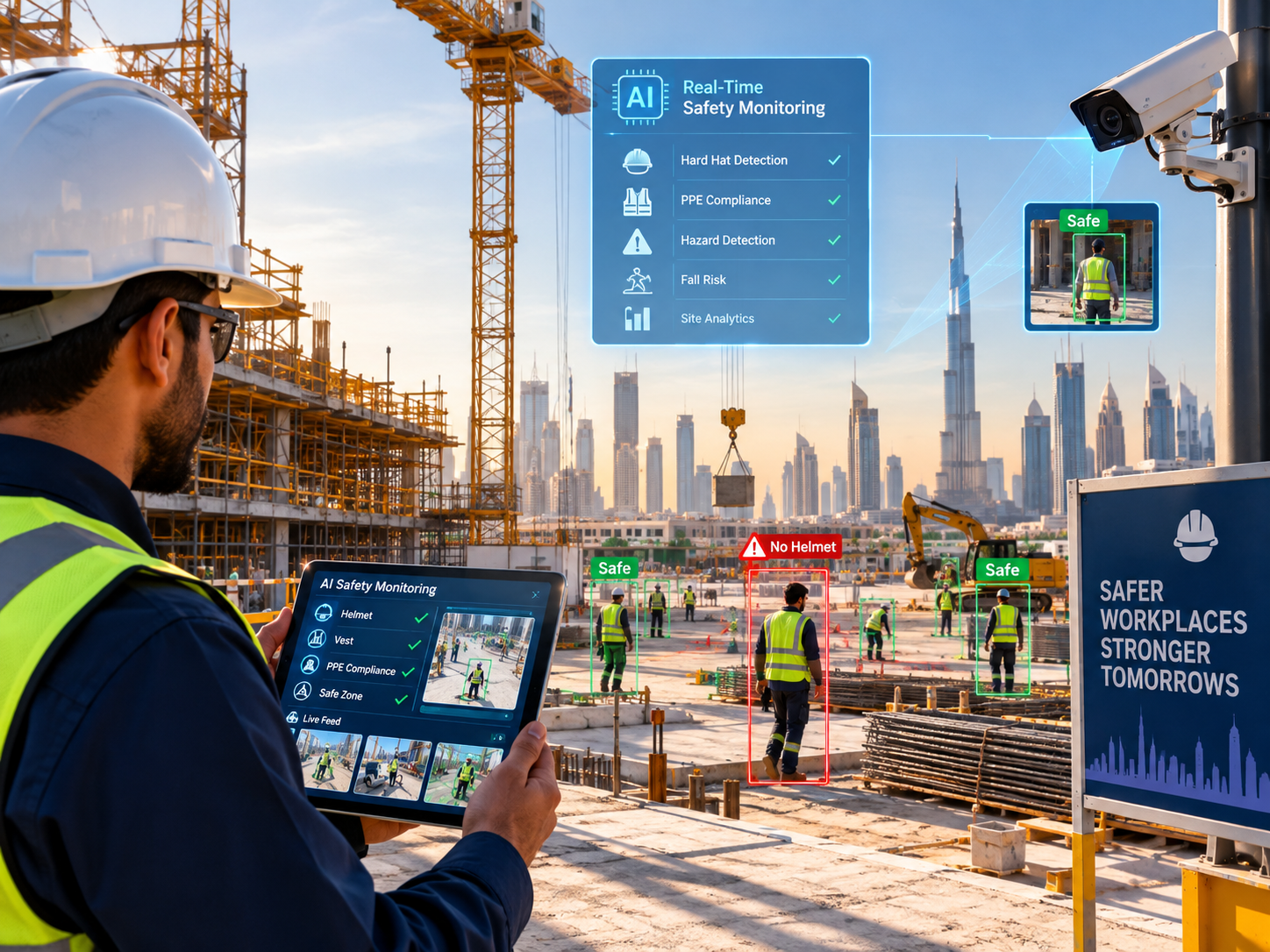
A GCC mega project can have thousands of workers, subcontractors, vehicles and constantly changing hazardous zones operating across large sites. Monitoring all of that through conventional CCTV alone puts significant pressure on control-room and HSE teams.
AI construction safety monitoring adds computer vision and AI video analytics to existing or new camera infrastructure. It can flag predefined events such as missing PPE, restricted-zone entry and dangerous worker–vehicle proximity, giving HSE teams faster visibility without replacing human safety professionals.
For major projects in Saudi Arabia, the UAE and Qatar, the value is not simply “smarter cameras.” The real benefit comes from turning video into alerts, workflows, evidence and safety trends that teams can act on.
What Is AI Construction Safety Monitoring?
AI construction safety monitoring combines CCTV, computer vision and predefined rules to identify visible safety risks in near real time.
Instead of relying entirely on an operator to notice an event across dozens or hundreds of feeds, the system can continuously analyze selected camera streams and surface events that match configured safety conditions.
The technology does not understand every site situation the way an experienced HSE professional does. Its role is to help teams identify potentially relevant events sooner and focus human attention where it matters most.
How Computer Vision Turns CCTV Into Safety Intelligence
Computer vision models can identify objects such as people, vehicles and visible PPE, as well as defined areas within a camera view. The analytics layer then evaluates those observations against project-specific rules.
For example, a system might be configured to flag a worker entering a restricted vehicle corridor or appearing in a designated PPE zone without a visible hard hat.
Where existing IP cameras offer suitable positioning, image quality and network access, organizations may be able to integrate them instead of replacing an entire CCTV estate.
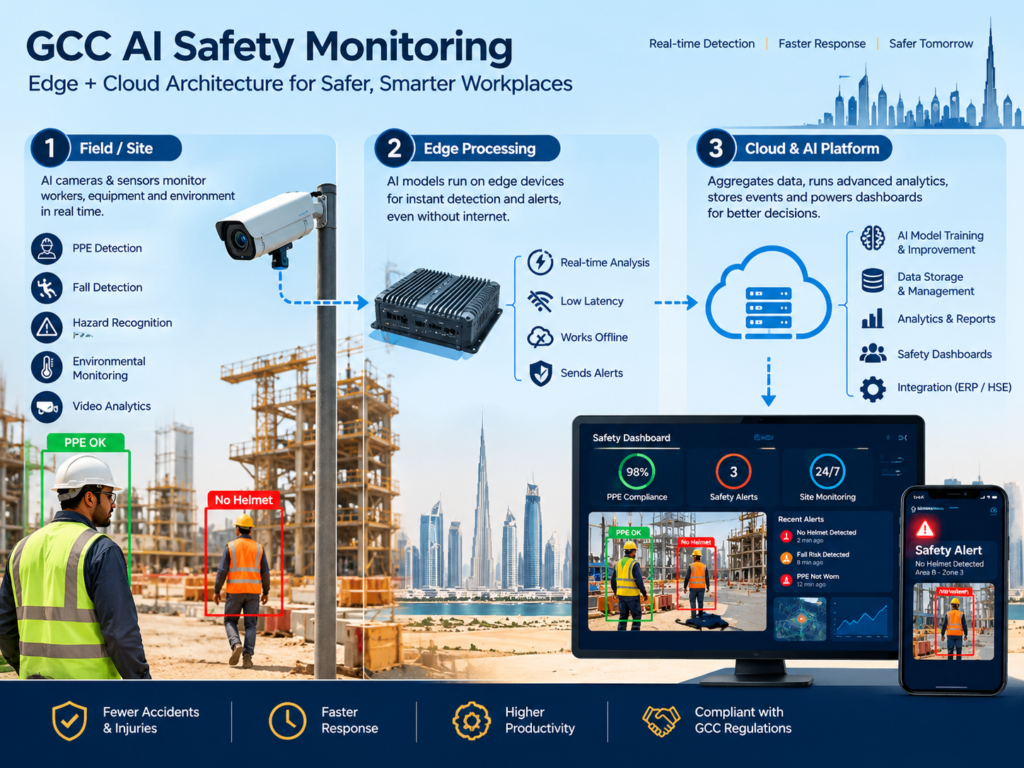
Processing can take place at the edge, on-premise, in the cloud or through a hybrid architecture. Mak It Solutions’ work in Python development and AI-driven solutions can support the analytics and application layer behind this type of deployment.
From Passive CCTV to Proactive HSE Monitoring
Traditional CCTV is largely reactive: someone must first notice an incident or review footage after an event.
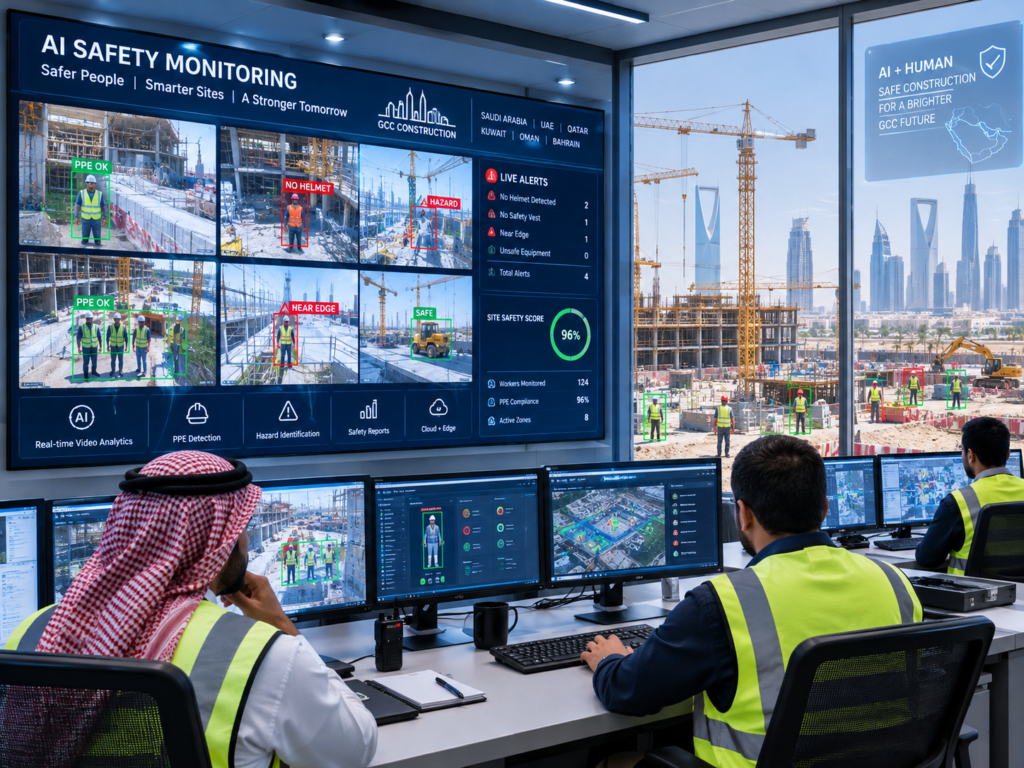
AI video analytics can make that process more proactive. A configured detection can generate an alert, place it on an HSE dashboard and retain relevant evidence for review.
The workflow around that detection is just as important as the AI itself.
Detection → validation → alert → HSE response → resolution → record → trend analysis
Over time, business intelligence dashboards can help project teams identify recurring locations, hazards or operating patterns instead of treating every alert as an isolated event.
Why AI Construction Safety Monitoring Fits GCC Mega Projects
Large GCC construction programs often combine wide project footprints, round-the-clock operations, multilingual workforces, heavy equipment, remote zones, extreme heat, dust and nighttime activity.
Those conditions make continuous manual observation difficult.
Edge processing can be particularly useful on remote Saudi or wider Gulf sites where network reliability, bandwidth and latency matter. Mak It Solutions’ guide to GCC edge computing in desert environments covers this architecture in more detail.
How Does AI Detect Construction Safety Violations?
AI detects configured visual patterns rather than making broad human-style judgments about whether a situation is “safe.”
Common use cases include PPE compliance, restricted-zone monitoring, work-at-height visibility, fire or smoke detection and worker–equipment interaction.
AI PPE Detection for Helmets, Vests and Harnesses
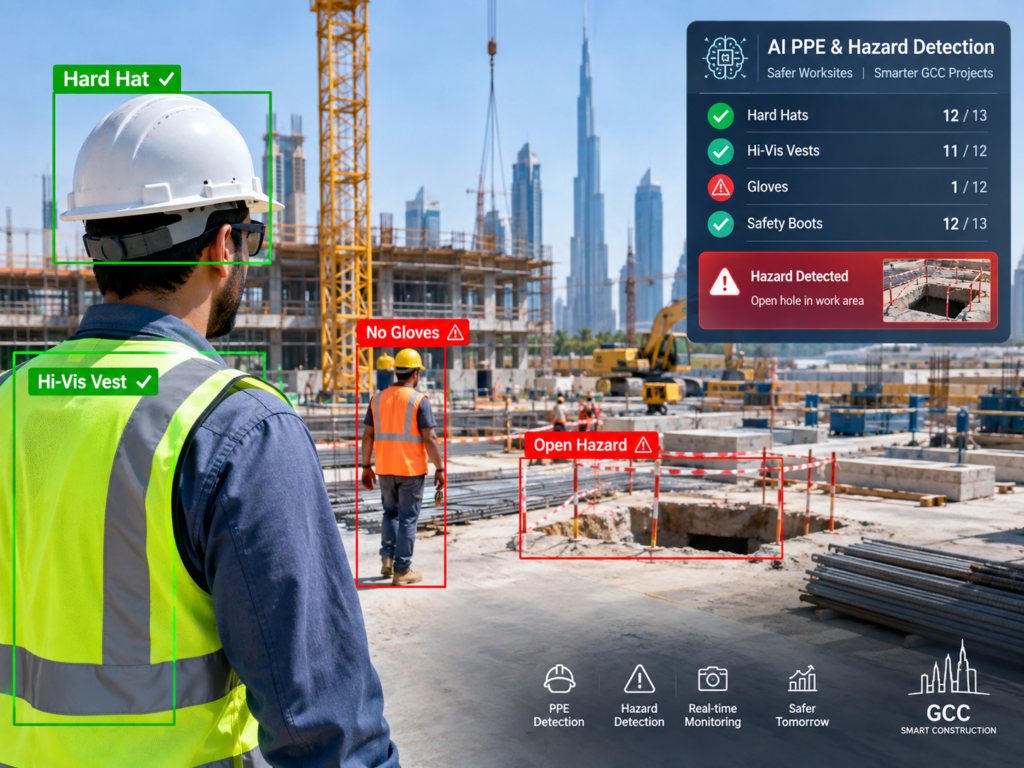
AI PPE detection systems can potentially identify hard hats, high-visibility vests and certain visible harness conditions when camera angle, lighting, distance and image quality are suitable.
That does not mean every missing item will be detected correctly.
Occlusion, poor lighting, unusual PPE colors, crowded work areas and long camera distances can all affect performance. Any automated safety-compliance system should therefore be tested against the project’s actual environment rather than generic accuracy claims.
Restricted Zones, Work at Height and Visible Hazards
Projects can configure monitoring for events such as.
Restricted-zone entry
Missing or breached barricades
Person-down events
Visible smoke or fire
Selected work-at-height conditions
Unauthorized access to defined areas
A Riyadh infrastructure project might begin with high-risk vehicle corridors before expanding into additional zones.
A large Dubai development, meanwhile, could apply different rules to loading areas, tower access points and elevated work zones.
Worker and Vehicle Proximity Monitoring
Computer vision can identify workers and moving vehicles within the same video feed and evaluate their positions against predefined proximity rules.
This can be particularly useful around forklifts, trucks, cranes and other heavy equipment where line-of-fire risks can develop quickly.
The system should support site teams by drawing attention to possible conflicts. It should not be treated as a substitute for traffic plans, physical barriers, competent supervision or established HSE procedures.
How AI Construction Safety Monitoring Works Across a GCC Mega Project
A typical deployment follows a relatively simple information flow:
Cameras → AI analytics → detection rules → alert engine → HSE dashboard/control room → site response
The technology behind each stage can vary significantly depending on site size, connectivity, privacy requirements and existing infrastructure.
Integrating AI With Existing CCTV
Existing IP cameras may be usable if their resolution, frame rate, positioning and network conditions meet the requirements of the selected detection use cases.
A camera that is perfectly suitable for general surveillance may still be poorly positioned for PPE recognition or worker–vehicle proximity monitoring.
That is why a technical camera audit should normally come before wider deployment.
The control-room layer can also be delivered as a secure web application using front-end development services and scalable back-end architecture.
Edge AI, Cloud Processing and Connectivity
Edge AI analyzes video close to the camera or construction site. This can reduce bandwidth requirements and may shorten the time between detection and alert generation.
Cloud processing can make centralized management and scaling easier, while hybrid architectures combine local processing with centralized analytics or reporting.
Remote Saudi projects may prefer more local processing where connectivity is inconsistent. UAE deployments may consider suitable regional cloud infrastructure, while Doha projects can assess Qatar-region services alongside on-premise requirements.
The appropriate architecture depends on project contracts, cybersecurity requirements, operational resilience and applicable data-protection rules.
Connecting CCTV With BIM, IoT and HSE Dashboards
AI safety monitoring can also connect with systems such as.
BIM platforms
Digital twins
IoT sensors
Incident-management tools
Command-and-control centers
Project reporting dashboards
These integrations are optional.
For example, a camera may identify a restricted-zone breach while BIM or project-control information provides context about the work package currently active in that location.
The result is a richer operational picture than video alone can provide.
AI Construction Safety Monitoring and GCC Data Governance
Video analytics may process identifiable worker imagery. Privacy and data governance therefore need to be part of the system design from the beginning.
Saudi PDPL and SDAIA Considerations
Saudi Arabia’s Personal Data Protection Law includes identifiable photographs and video within the scope of personal data.
Projects using AI-enabled CCTV should therefore assess the purpose of processing, access controls, retention, security and relevant cross-border transfer requirements under the applicable framework.
AI monitoring is not presented here as a Saudi legal requirement. It is a technology that must be deployed within applicable safety, contractual and data-governance obligations.
Official guidance should be checked through the Saudi Data & AI Authority’s Personal Data Protection Law resources.
UAE Privacy and Occupational Safety Considerations
The UAE’s Federal Decree-Law No. 45 of 2021 establishes a federal framework covering personal-data processing, security, individual rights and cross-border transfers.
A Dubai or Abu Dhabi project should consider how identifiable worker video is collected and processed, including matters such as notices, access, retention and data minimization.
Project owners and contractors should also assess the occupational-safety rules and contractual requirements that apply to the specific project.
The UAE Government’s data protection resources provide an official starting point for privacy-related review.
Qatar Data Privacy and Construction Deployment
Qatar’s Law No. 13 of 2016 addresses the protection of personal data privacy, while the National Cyber Security Agency provides related governance information.
A project in Doha or Lusail should establish who can access worker video or AI-generated events, how long information is retained and where processing takes place.
Local processing or hybrid architecture may be useful where connectivity or governance considerations favor keeping workloads closer to the site.
What Makes AI Safety Monitoring Effective?
The quality of the AI model matters, but deployment conditions often matter just as much.
Camera Coverage, Accuracy and False-Positive Control
Detection performance can be affected by.
Camera angle and height
Resolution
Lighting
Dust
Occlusion
Nighttime visibility
Worker density
PPE appearance
Site-specific calibration
No responsible deployment should promise universal accuracy.
A dusty outdoor site in Doha, for instance, can require different tuning from a controlled indoor logistics environment in Dubai.
Alert Workflows for HSE Teams and Control Rooms
A detection by itself has limited operational value.
Someone needs to know whether the alert is urgent, who should receive it and what action should follow.
Risk-based prioritization is especially important. Sending every minor detection directly to supervisors can create alert fatigue, making genuinely important events easier to miss.
The strongest deployments connect detection with clear escalation, ownership, response and closure procedures.
Arabic and English UX for Multinational Workforces
GCC deployments often operate across multinational teams.
A practical safety platform may therefore benefit from.
Arabic and English interfaces
Role-based dashboards
Mobile alerts
Contractor-specific views
Clear visual status indicators
Simple control-room workflows
A bilingual user experience usually provides more practical localization value than simply adding regional place names to generic software.
How to Deploy AI Construction Safety Monitoring
Prioritize High-Risk Safety Use Cases
Start with a small number of measurable problems.
Good initial use cases may include PPE violations, restricted-zone entry, worker–vehicle proximity, work-at-height monitoring or visible smoke and fire.
Avoid trying to “monitor everything” from the first deployment.
A focused use case is easier to test, measure and improve.
Audit Cameras, Connectivity and Data Requirements
Review.
Camera positioning
Coverage and blind spots
Lighting conditions
Network capacity
Edge-computing requirements
Data retention
User access
Dashboard requirements
Existing system integrations
For remote environments, the architecture can also be compared with proven GCC edge-computing approaches.
Pilot, Measure and Scale
Begin with one zone, hazard category or operational workflow.
Measure detection quality, false-positive behavior, HSE response, system reliability and user adoption under real site conditions.
Once the pilot has demonstrated operational value, the system can be expanded by work package, contractor, hazard category or project zone.
That staged approach is generally more manageable than attempting an immediate full-site rollout.
Building a Smarter HSE Strategy for GCC Mega Projects
Where AI Adds the Most Value
AI monitoring tends to be most useful where projects have.
Large CCTV estates
High worker density
Significant interaction with heavy equipment
Repetitive safety rules
Multiple active zones
Centralized HSE or control-room operations
Sites with limited camera coverage or highly unpredictable activities may require additional infrastructure or different safety technologies before computer vision can provide meaningful value.
AI Should Support, Not Replace, HSE Teams
Construction safety depends on context.
A camera may identify a visible condition, but it cannot replace the judgment required to investigate incidents, understand changing site activities, speak with workers or decide corrective action.
AI should therefore operate as a monitoring and decision-support layer around experienced HSE teams.
What Mega-Project Owners Should Evaluate Next
Before procurement, owners and main contractors should evaluate.
Priority hazards
CCTV compatibility
Edge, cloud or hybrid architecture
Data governance
Cybersecurity
Detection testing
False-alert management
Dashboards and integrations
Local technical support
Business continuity and recovery
Resilience deserves particular attention. A safety-monitoring platform that depends on network or cloud services needs a recovery strategy for outages and failures.
The Mak It Solutions guide to cloud disaster recovery in the GCC provides further architecture considerations.
Final Words
For GCC mega projects, successful AI construction safety monitoring is less about installing another software platform and more about matching technology to real hazards, camera conditions, HSE workflows and data-governance requirements.
A controlled pilot can help determine which detections work reliably on the actual site, how alerts should reach HSE teams and whether edge, cloud or hybrid processing is the right fit.
Planning a deployment in Saudi Arabia, the UAE or Qatar? Explore Mak It Solutions’ technology services or contact the team to discuss CCTV infrastructure, HSE priorities, edge architecture and integration requirements.
FAQs
Q : Can AI safety monitoring use existing CCTV on Saudi construction sites?
A : Often, yes. Existing cameras may be suitable when they provide adequate image quality, positioning, frame rates and network access.
A Saudi project should still audit its CCTV estate before deployment because some areas may require repositioning or improved camera coverage. Where worker video can identify individuals, projects should also review relevant Saudi PDPL requirements covering processing, access, retention and security.
Q : What PPE violations can construction AI detect on UAE projects?
A : Depending on camera visibility and system configuration, AI may identify missing helmets, high-visibility vests and certain visually observable harness conditions.
Performance varies with distance, lighting, occlusion, PPE design and camera position. UAE contractors should validate each detection category under real site conditions rather than relying solely on generic accuracy figures.
Q : How should Saudi mega projects manage worker video under PDPL?
A : Projects should clearly define why worker video is being processed, who can access it, how it is secured, how long it is retained and whether data is transferred outside Saudi Arabia.
Because identifiable video may constitute personal data, privacy governance should be designed into the AI monitoring system rather than addressed only after deployment.
Q : Can AI construction safety systems operate on remote Qatar or GCC sites?
A : Yes. Edge AI can process selected camera feeds locally instead of continuously sending all video to a distant cloud environment.
This can reduce bandwidth dependence and latency. Remote deployments still need suitable hardware resilience, cybersecurity controls, maintenance processes and compliance with applicable privacy requirements.
Q : How can GCC contractors reduce false alerts from construction safety AI?
A : Start with a controlled pilot and test the system against real site conditions.
Camera placement, dust, lighting, PPE variations, worker movements and occlusion should all be evaluated before wider rollout. Thresholds can then be tuned, and alerts can be prioritized according to risk instead of treating every detection equally.