
AI Predictive Maintenance for GCC Industrial Facilities
AI Predictive Maintenance for GCC Industrial Facilities
AI Predictive Maintenance for GCC Industrial Facilities
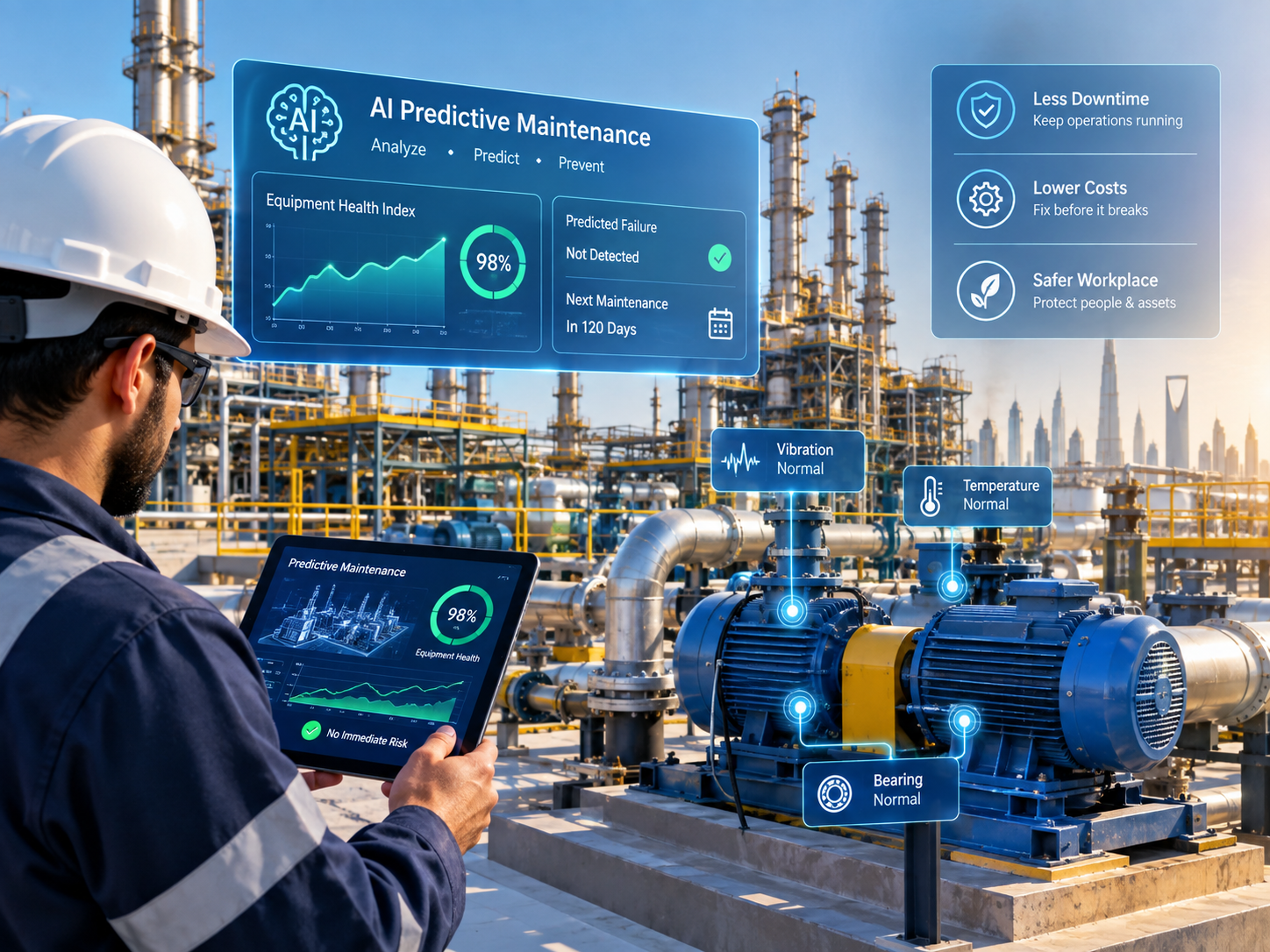
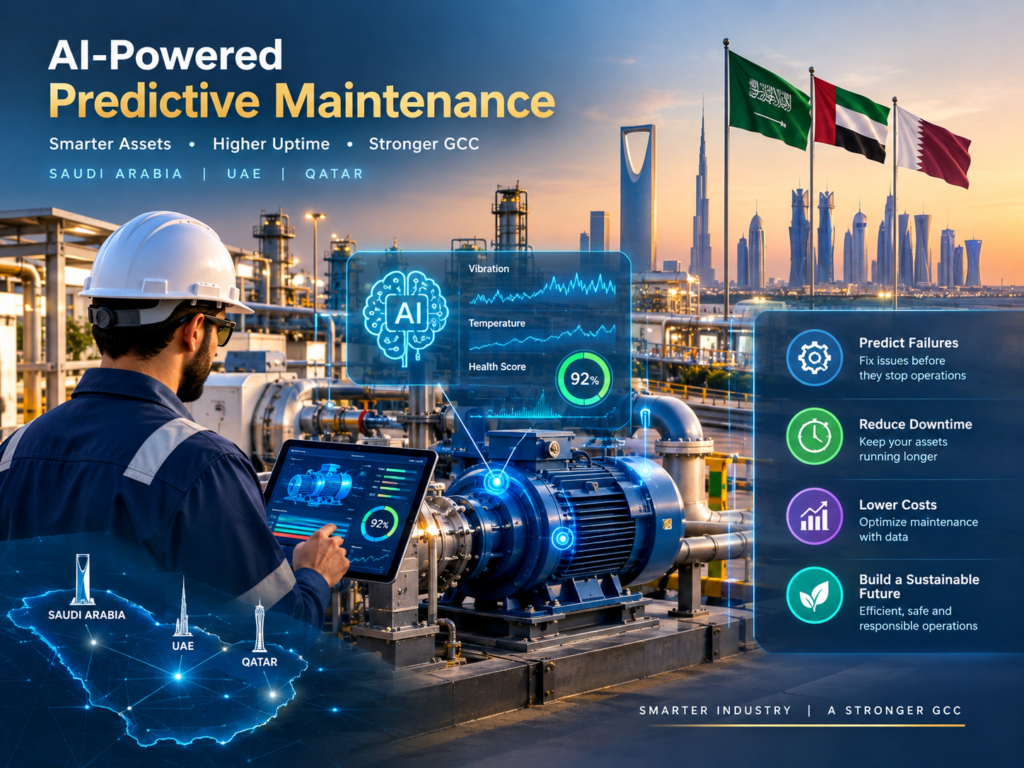
Unexpected equipment failure can stop production long before maintenance teams see an obvious warning. AI predictive maintenance helps industrial facilities identify early signs of deterioration by analyzing machine data, computer vision, thermal imaging, vibration, acoustics, and other condition-monitoring signals.
For facilities in Saudi Arabia, the UAE, and Qatar, the technology is especially relevant where operators manage high-value equipment, demanding environmental conditions, brownfield machinery, and existing SCADA or PLC infrastructure. With edge AI, many monitoring tasks can also be performed closer to the plant instead of continuously sending sensitive operational data to the cloud.
Businesses exploring broader AI adoption can also review Mak It Solutions’ enterprise AI adoption roadmap.
What Is AI Predictive Maintenance?
AI predictive maintenance uses operational and condition-monitoring data to identify patterns that may indicate equipment deterioration or an increased risk of failure.
Instead of relying only on fixed maintenance schedules, it helps teams decide when an asset actually needs attention based on its condition and changing behaviour.
How AI Predictive Maintenance Detects Equipment Problems
Machine-learning models can evaluate several types of data, including.
Vibration patterns
Temperature changes
Acoustic signals
PLC and SCADA data
Thermal images
Camera footage
Historical maintenance records
Other IIoT sensor measurements
These signals can support anomaly detection, condition assessment, Remaining Useful Life estimates, and more informed maintenance planning.
Mak It Solutions’ Python development services include machine learning, automation, and AI-driven application development that can support this type of industrial system.
Predictive vs Preventive vs Condition-Based Maintenance
The three approaches are related, but they are not the same.
Preventive maintenance follows a predefined schedule. Equipment may be serviced after a specific period or operating interval regardless of whether its condition has significantly changed.
Condition-based maintenance reacts to measured conditions. A maintenance action may be triggered when vibration, temperature, or another measurement exceeds a defined threshold.
Predictive maintenance goes further. It analyzes patterns across current and historical data to estimate when deterioration is becoming significant and when intervention may be needed.
Where Computer Vision Fits Into AI Predictive Maintenance
Computer vision gives maintenance teams another source of condition data: what is physically happening around the equipment.
Traditional sensors may detect vibration or heat changes, while cameras can identify visible signs of deterioration such as:
Leaks
Corrosion
Cracks
Belt wear
Loose components
Surface damage
Abnormal movement
Changes in equipment position
Used together, visual data and conventional condition-monitoring signals can provide a more complete picture of asset health.
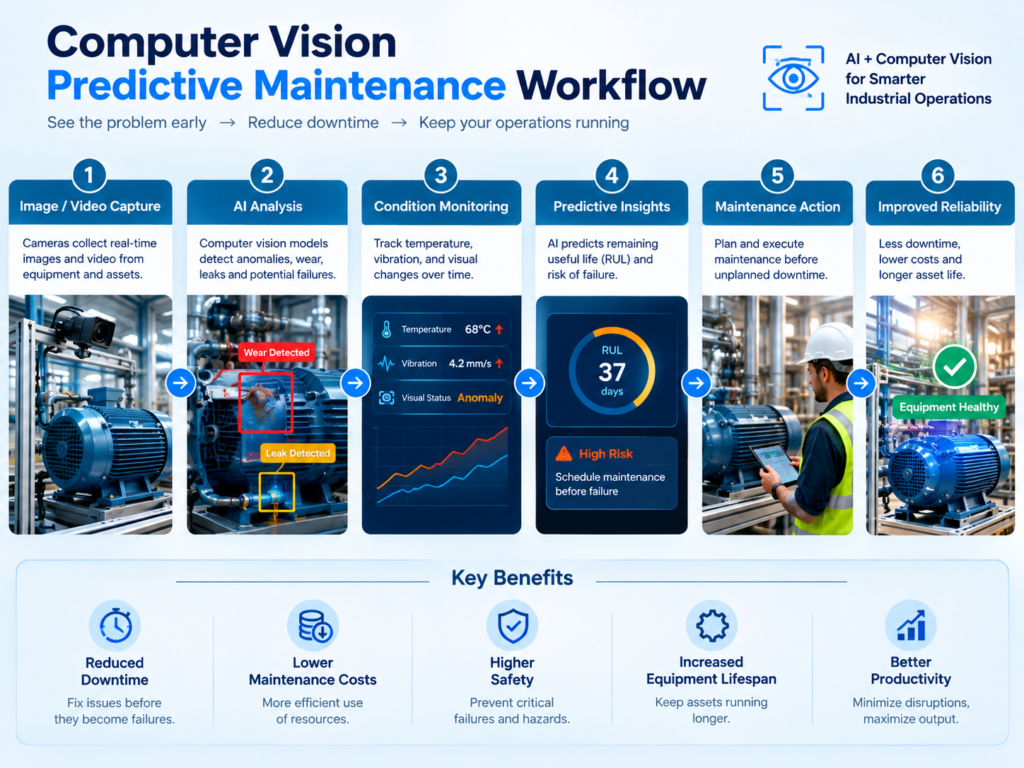
How AI Vision Can Detect Equipment Problems Before Downtime
Periodic inspections remain valuable, but they only show what is happening at the time of the inspection. AI-enabled cameras can monitor selected equipment more consistently and flag visual changes for review.
The goal is not to replace engineers or maintenance technicians. It is to help them focus attention on equipment showing unusual behaviour.
Visual Anomaly Detection for Industrial Equipment
Computer vision models can be trained to recognize normal equipment conditions and highlight deviations.
For example, an AI camera monitoring a conveyor could detect unusual belt movement or visible wear. A camera positioned near process equipment might identify a leak or surface change that deserves investigation.
These detections should normally be treated as maintenance signals rather than automatic proof that a component has failed.
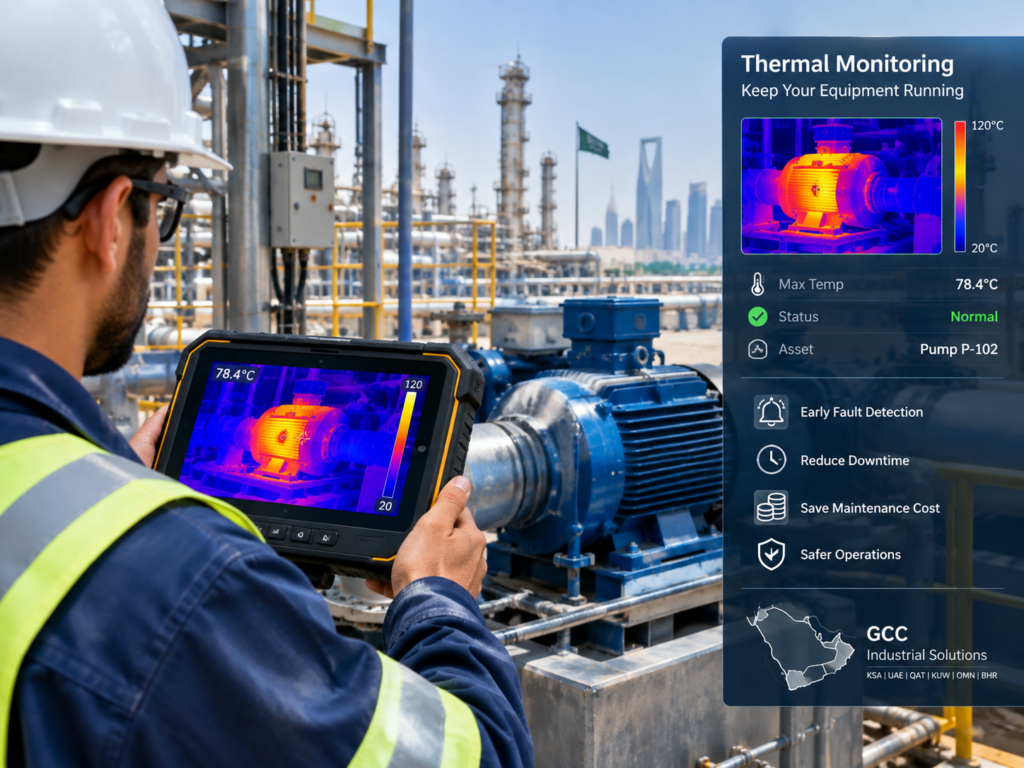
Thermal Imaging and Infrared Inspection
Thermal imaging adds another useful layer to predictive maintenance.
Motors, bearings, electrical equipment, and rotating machinery may develop unusual heat patterns as operating conditions change. Thermal cameras can help identify these hotspots so technicians can investigate them alongside vibration, load, temperature, or historical maintenance data.
Environmental conditions and equipment operating ranges must still be considered before treating a temperature difference as a fault.
Combining Cameras With IIoT and Machine Condition Data
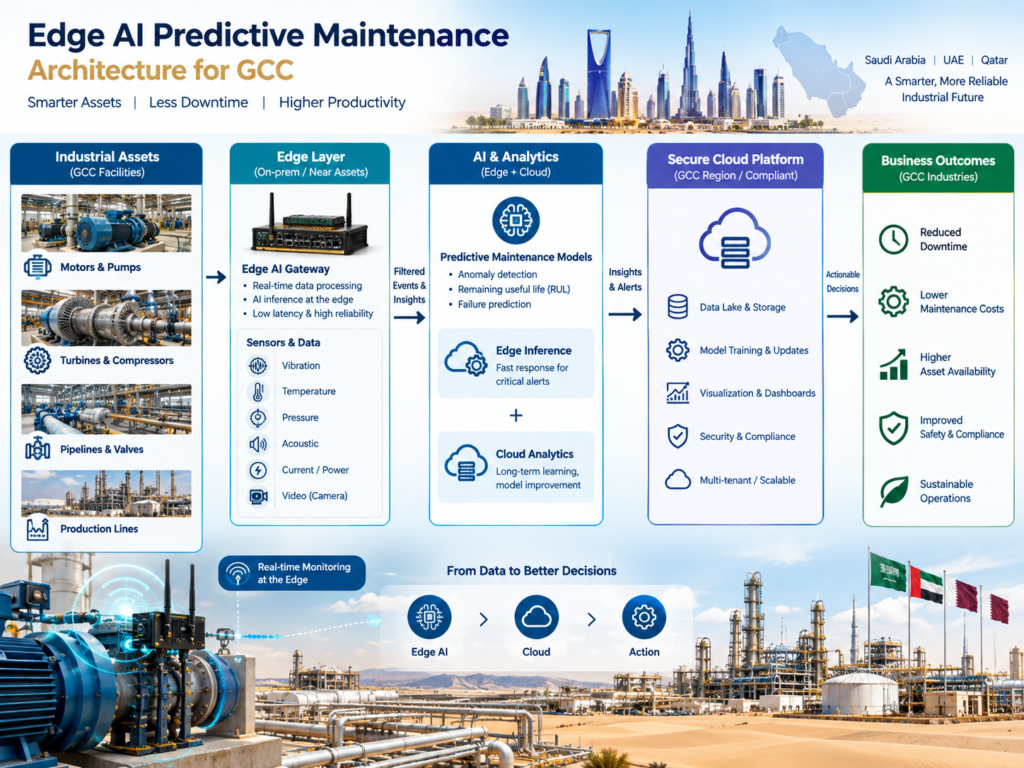
A practical AI predictive maintenance architecture might follow this flow:
Camera and sensors → edge AI → PLC/SCADA/IIoT → anomaly model → CMMS → maintenance action
Instead of allowing every individual signal to trigger a work order, the system can combine information from several sources before escalating an issue.
For example, a visual anomaly could be checked against vibration or temperature history before a maintenance ticket is created.
Integration may involve platforms such as SAP PM, IBM Maximo, MES environments, or plant-specific operator dashboards. Mak It Solutions’ Business Intelligence services can also support operational dashboards and predictive analytics.
AI Predictive Maintenance in Saudi Arabia, UAE, and Qatar
The underlying technology is similar across the GCC, but deployment priorities can vary based on industrial sector, plant architecture, environmental conditions, and data-governance requirements.
Saudi Arabia.
Manufacturers in locations such as Riyadh or Jubail can use AI predictive maintenance to monitor critical motors, conveyors, pumps, and production equipment where unexpected failure repeatedly affects operations.
Saudi deployments should also consider relevant data-classification, access-control, governance, and cybersecurity requirements before operational data is moved outside the plant environment.
Saudi Arabia’s National Data Management Office publishes national data-management standards and controls that organizations may need to consider depending on the nature of the data and deployment. See the Saudi NDMO data-management standards.
UAE.
Industrial operators in Dubai and Abu Dhabi are working within a broader national push toward advanced manufacturing and Industry 4.0 technologies.
Predictive maintenance, artificial intelligence, equipment-health monitoring, and other digital technologies are among the industrial transformation use cases highlighted by the UAE Ministry of Industry and Advanced Technology.
More information is available through UAE MoIAT.
For individual plants, however, the right architecture still depends on the facility’s OT environment, data sensitivity, latency requirements, and existing maintenance processes.
Qatar.
Process-industry environments in Doha and Ras Laffan may find predictive maintenance particularly relevant for pumps, compressors, turbines, motors, and other rotating equipment.
These assets can produce several complementary signals. Vibration data may reveal mechanical changes, thermal monitoring can expose unusual heat patterns, and computer vision can identify visible leakage, motion, or surface deterioration.
Qatar also has regional cloud infrastructure options, including Google Cloud’s Doha region. Facilities should still decide carefully which operational data belongs in the cloud and which processing is better kept on-site or at the edge.
GCC Compliance, Data Governance, and Edge AI Requirements
AI predictive maintenance is not only a machine-learning project. In industrial environments, architecture, OT security, data ownership, and governance can be equally important.
Saudi Industrial Data Governance and NDMO Considerations
Saudi industrial organizations handling sensitive operational information should define how data is classified, stored, accessed, retained, and shared before expanding predictive maintenance across multiple assets or facilities.
Governance questions should be addressed early rather than after cameras and sensors have already been deployed.
UAE OT Security and Deployment Models
Facilities in the UAE may choose on-premises or edge inference when continuous cloud connectivity is unnecessary or undesirable.
This can be useful where.
OT networks are intentionally isolated
Low latency is important
Video streams contain sensitive information
Internet connectivity should not affect monitoring
Operational data should remain within the facility
A hybrid model can still send selected alerts, metadata, reports, or aggregated results to cloud services.
Data Residency and Plant-Edge Processing in the GCC
Edge AI processes data close to the equipment rather than sending every camera frame or sensor reading to a remote cloud environment.
For predictive maintenance, this can reduce bandwidth requirements and support faster local decisions. It may also help organizations keep high-volume video and operational data inside the facility while transmitting only selected events.
Regional cloud infrastructure is available from major providers, including AWS, Microsoft Azure, and Google Cloud. Deployment decisions should be based on technical, regulatory, cybersecurity, and operational requirements rather than cloud availability alone.
Relevant references include AWS regional infrastructure, Microsoft Azure regions, and Google Cloud locations.
Industrial Use Cases for AI Vision Predictive Maintenance
AI predictive maintenance can support different industries as long as the selected assets produce measurable signs of deterioration.
Manufacturing and Smart Factory Equipment
Common candidates include.
Motors
Bearings
Conveyors
Robotics
Packaging machinery
Production-line equipment
These assets often operate repeatedly under similar conditions, making changes in vibration, motion, temperature, sound, or appearance easier to monitor.
Oil, Gas, Petrochemical, and Process Industries
High-criticality assets such as pumps, compressors, valves, turbines, motors, and selected pipe systems can benefit from multimodal condition monitoring.
Computer vision becomes particularly useful when physical changes such as leaks, surface deterioration, overheating, or abnormal movement complement conventional sensor signals.
Logistics, Utilities, and Infrastructure Assets
The same principles can be applied to warehouse automation, material-handling equipment, utility systems, and infrastructure assets.
Plant and maintenance interfaces can also be supported through Mak It Solutions’ web development services and React development services.
How to Implement AI Predictive Maintenance in a GCC Facility
A successful project usually begins with a clearly defined operational problem rather than a plant-wide AI rollout.
Choose High-Cost Failure Assets
Start with assets where failure has a measurable operational impact.
Useful selection criteria include.
Downtime cost
Equipment criticality
Failure history
Maintenance frequency
Inspection difficulty
Availability of sensor or visual data
A recurring problem on one critical machine can be a better pilot than attempting to monitor every asset at once.
Select Cameras, Sensors, and Edge Architecture
The monitoring setup should match the failure mode being investigated.
A project may require RGB cameras, thermal cameras, vibration sensors, microphones, existing PLC data, or a combination of these signals.
GCC facilities should also account for real environmental conditions such as high temperatures, airborne dust, changing lighting, equipment vibration, and camera contamination.
Industrial enclosures, appropriate hardware ratings, positioning, cleaning routines, and calibration can therefore matter just as much as the AI model.
Integrate Alerts With Existing Maintenance Workflows
An AI system becomes useful when its outputs fit into the way maintenance teams already work.
Validated alerts can be integrated with systems such as.
CMMS platforms
SAP PM
IBM Maximo
SCADA
MES
Operator dashboards
Teams should define confidence thresholds, human-review steps, escalation procedures, and work-order rules.
Not every anomaly should automatically become a maintenance ticket.
AI Predictive Maintenance Cost, ROI, and Deployment Challenges
The business case for predictive maintenance depends on the equipment, failure mode, current maintenance process, and cost of downtime.
What Determines AI Predictive Maintenance Cost?
Typical cost drivers include.
Number of monitored assets
Camera and sensor requirements
Thermal imaging requirements
Edge hardware
Networking
Data storage
Cybersecurity controls
Model complexity
Software development
SCADA, CMMS, or MES integration
Ongoing monitoring and model maintenance
A tightly scoped pilot makes it easier to understand the real technical and financial requirements before expansion.
Where Predictive Maintenance ROI Comes From
Potential value may come from.
Reducing unplanned downtime
Improving maintenance scheduling
Avoiding unnecessary inspections
Detecting deterioration earlier
Extending usable asset life
Improving spare-parts planning
Giving technicians better information before inspection
The strongest business case usually comes from connecting the technology to a specific failure mode and a measurable operational cost.
Common GCC Deployment Challenges
Industrial AI projects can underperform when teams focus on the algorithm but overlook the operating environment.
Common challenges include:
Brownfield machinery
Legacy SCADA systems
Limited historical failure data
Dust and high temperatures
Changing lighting conditions
False positives
Sensor-quality problems
Network restrictions
Equipment modifications
Model drift
A practical approach is to begin with one well-defined failure mode, validate the results under real plant conditions, and expand only when the system proves useful.
Final Thoughts
AI predictive maintenance does not need to begin as a plant-wide transformation project.
For many GCC industrial facilities, a more practical starting point is one high-value asset with a recurring failure pattern, measurable downtime impact, and reliable data.( Click Here’s )
Once the monitoring approach has been validated, the same architecture can be extended to other equipment, production lines, or facilities.
Mak It Solutions can support organizations evaluating AI predictive maintenance through its technology services portfolio, including AI development, analytics, software integration, and operational dashboards.
FAQs
Q : Can Saudi factories use AI predictive maintenance with existing SCADA systems?
A : Yes. Existing SCADA or PLC signals can often become inputs to an AI predictive maintenance layer without replacing the underlying control system. A plant can combine those measurements with vibration, thermal, acoustic, or camera data while maintaining appropriate OT security boundaries and applicable data-governance controls.
Q : Do UAE industrial facilities need cloud connectivity for AI vision monitoring?
A : No. Computer vision models can run on edge devices or on-premises servers when latency, network isolation, or operational-data confidentiality makes continuous cloud connectivity undesirable. A hybrid design can still send selected events, reports, or aggregated data to cloud systems when appropriate.
Q : Which equipment is well suited to predictive maintenance in Qatar’s oil and gas sector?
A : High-criticality equipment with measurable deterioration signals is often a strong starting point. Examples can include pumps, compressors, turbines, motors, bearings, and selected valves, particularly where unexpected downtime is costly or inspections are difficult.
Q : Can AI cameras work reliably in dusty and high-temperature GCC factories?
A : Yes, provided the deployment is engineered for the environment. Industrial enclosures, suitable temperature ratings, camera positioning, lighting, calibration, and regular cleaning may all be necessary because dust or heat can reduce image quality and contribute to false alarms.
Q : How can GCC plants reduce false alarms from AI predictive maintenance systems?
A : Using multiple signals is often more reliable than relying on a single camera or sensor. Plants can compare visual anomalies with vibration, temperature, PLC history, or operator context, then apply confidence thresholds and human review before creating maintenance work orders. Models should also be monitored over time for changing equipment and operating conditions.
[…] Where Are Autonomous Delivery Robots Used in the GCC? […]
[…] Is AI Construction Safety […]