


Digital Twins for Physical AI: GCC Guide 2026
Digital Twins for Physical AI: GCC Guide 2026
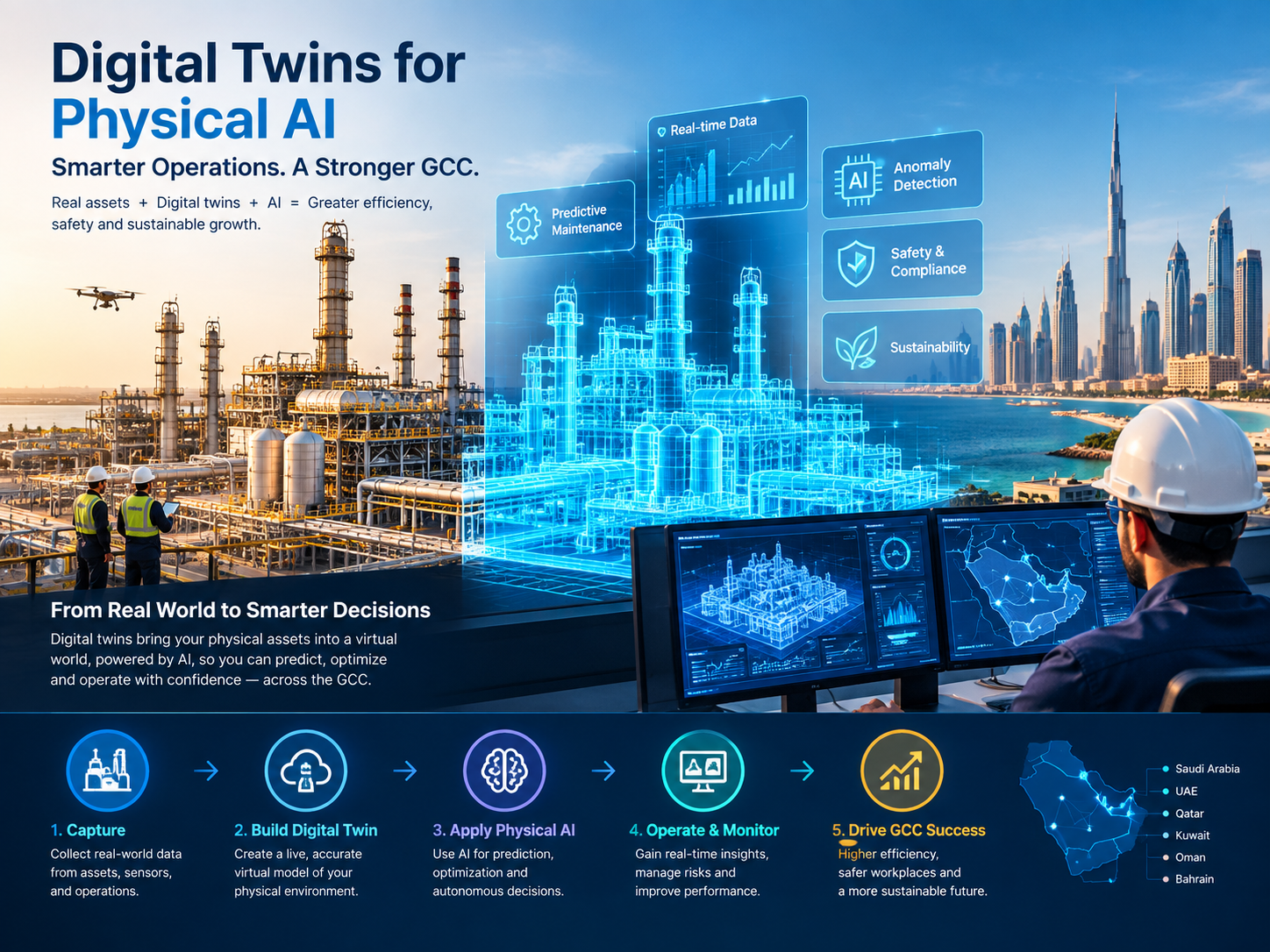
Digital Twins for Physical AI: GCC Guide 2026
Physical AI takes artificial intelligence beyond software and puts it into robots, autonomous machines and connected infrastructure. For GCC organizations, digital twins for Physical AI create a practical bridge between AI models and complex real-world operations.
Put simply, a digital twin gives Physical AI a realistic virtual environment in which to learn, generate synthetic data, test decisions and validate safety before deployment. That can reduce the risks and disruption associated with physical testing while supporting robotics, logistics, industrial automation and smart-city projects across Saudi Arabia, the UAE and Qatar.
What Are Digital Twins for Physical AI?
What Is Physical AI?
Physical AI refers to AI systems that can perceive, reason about and act within physical environments. Examples include warehouse robots, autonomous vehicles, computer-vision systems, edge AI applications and intelligent infrastructure.
NVIDIA describes Physical AI as AI capable of perceiving, reasoning and acting in the physical world.
What Is a Digital Twin?
A digital twin is a dynamic virtual representation of a physical asset, process, facility or environment.
Unlike a static 3D model, a modern digital twin can incorporate live or historical operational data from sources such as:
IoT sensors
Building information modelling (BIM)
Cameras and computer-vision systems
Business and operational databases
SCADA and BMS platforms
AI models
Simulation environments
For businesses already bringing operational datasets together, Mak It Solutions’ Business Intelligence Services can support the wider data foundation needed for connected applications.
Digital Twin vs Physical AI: What’s the Difference?
| Digital Twin | Physical AI |
|---|---|
| Represents and simulates a physical environment | Perceives, reasons and acts within an environment |
| Uses operational, sensor and simulation data | Uses AI models, perception systems and learned policies |
| Allows teams to test scenarios virtually | Makes decisions virtually or in physical systems |
| Models how the environment behaves | Determines how an intelligent system should respond |
The easiest way to think about it is this: the digital twin provides the world, while Physical AI provides the intelligence operating inside that world.
How Digital Twins for Physical AI Work Together
Build a Physically Accurate Virtual Environment
The process usually starts by modelling a factory, warehouse, road network, building, robot or other physical system.
Platforms such as Open USD and NVIDIA Omniverse can connect 3D assets and simulation workflows within realistic virtual environments.
Accuracy matters. If the simulated environment behaves very differently from the real one, an AI system trained inside it may struggle when it moves into physical operations.
Train Physical AI With Simulation and Synthetic Data
A virtual environment allows teams to create large numbers of controlled scenarios without repeatedly putting physical equipment, workers or infrastructure at risk.
Synthetic data can reproduce different:
Camera viewpoints
Lighting conditions
Sensor readings
Robot positions
Obstacles
Failure conditions
Environmental scenarios
NVIDIA Isaac Sim supports robotics simulation, testing and synthetic-data generation, while Isaac Lab supports reinforcement and imitation-learning workflows.
This is particularly useful when a real-world scenario is expensive, dangerous or difficult to reproduce consistently.
Validate Through Sim-to-Real Deployment
A typical Physical AI workflow can look like this:
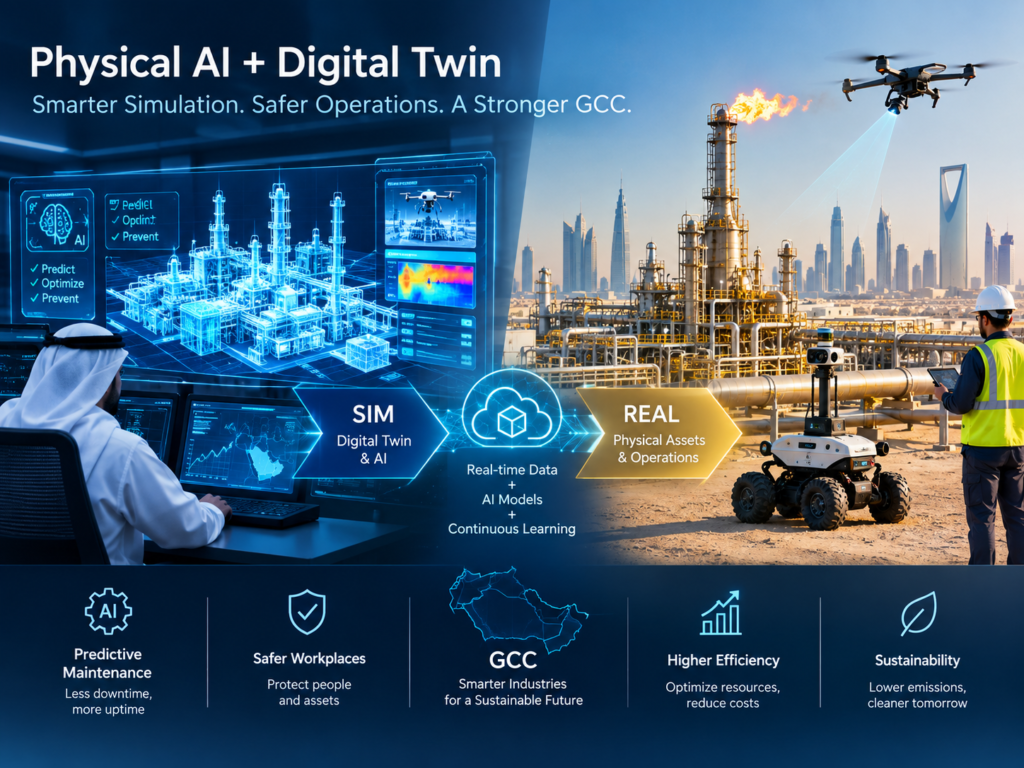
Digital Twin → Simulation → Synthetic Data → AI Training → Validation → Sim-to-Real → Physical Deployment
Instead of testing every new behavior directly on a working robot or live facility, engineers can first assess it inside the virtual environment.
That makes digital twins for Physical AI especially useful for testing edge cases, safety boundaries and unusual operating conditions before deployment.
Why Digital Twins Matter for Physical AI in the GCC
GCC projects often combine ambitious infrastructure investment with demanding physical conditions, large logistics networks and growing interest in automation.
That makes simulation particularly relevant: systems can be tested against local operating conditions before they are introduced into live facilities.
Saudi Arabia.
Saudi Arabia presents potential applications across logistics, industrial facilities, healthcare, smart developments and autonomous infrastructure.
A logistics operator in Riyadh, for example, could model warehouse traffic and autonomous mobile robots before altering routes inside an operational facility.
Data governance also needs to be considered at the architecture stage. Saudi projects should assess applicable SDAIA and NDMO requirements according to the data type, business activity and sector involved rather than assuming that every workload has identical hosting requirements.
Saudi rules include mechanisms governing certain transfers of personal data outside the Kingdom.
UAE.
The UAE provides strong regional examples of digital-twin applications, particularly in Dubai.
Dubai Municipality has documented the use of digital-twin technology for urban management and city-level platforms incorporating geospatial information, IoT, AI and analytical data. (Dubai Municipality)
For businesses building portals, control layers or connected services around these systems, scalable back-end development and API integration can form part of the wider platform architecture.
Qatar.
Doha and other Qatar developments offer potential use cases in transport, energy, connected buildings and infrastructure management.
Qatar’s Ministry of Communications and Information Technology describes TASMU Smart Qatar as a national program built around advanced technologies and shared digital infrastructure across priority sectors.
For Physical AI projects, that broader digital foundation can support simulation, operational monitoring and intelligent infrastructure use cases.
Physical AI and Digital Twin Use Cases Across GCC Industries
Robotics, Warehouses and Logistics
Warehouses are one of the clearest applications.
A Riyadh logistics hub could simulate autonomous mobile robots before changing live routes. A Dubai facility could model congestion between workers, forklifts and robots. Infrastructure operators in Doha could test inspection robots virtually before sending them into difficult or sensitive environments.
Digital twins can also help evaluate.
Robot navigation
Fleet coordination
Picking and packing workflows
Worker interaction
Charging schedules
Warehouse layout changes
Failure and recovery scenarios
Smart Cities, Buildings and Government Infrastructure
Urban digital twins can support traffic modelling, building operations, infrastructure planning and emergency simulations.
In practice, the twin can bring information from multiple systems into one operational view, giving planners a way to explore possible changes before making them in the physical environment.
For GCC projects, interfaces may also need Arabic and English support across mobile and desktop environments. Those operational layers can connect with mobile app development services where field teams need access to live system information.
Industrial Operations, Energy and Predictive Maintenance
Factories, utilities and energy operators can connect operational twins with SCADA, BMS, IoT and equipment data.
Instead of relying only on alarms after something goes wrong, teams can use a digital representation to investigate anomalies, compare scenarios and evaluate maintenance decisions before taking critical equipment offline.
The value is not simply having a visual model. The real benefit comes from connecting the model with reliable operational data and decision-making workflows.
What Technologies Connect Physical AI With Digital Twins?
Simulation Platforms and World Models
The Physical AI ecosystem can include technologies such as.
Open USD
NVIDIA Omniverse
Isaac Sim
Isaac Lab
Cosmos world foundation models
Together, these technologies can support interoperable 3D environments, robotics simulation, synthetic-data generation and AI learning workflows. (NVIDIA Perspectives)
The exact stack will depend on the use case. A warehouse robot does not require the same architecture as a city-scale infrastructure twin.
IoT, Computer Vision and Edge AI
Sensors and cameras connect the physical environment with its digital representation.
Computer vision helps machines understand objects, people and movement, while edge AI can process time-sensitive information close to the device.
This becomes important when a robot cannot afford to wait for every control decision to travel to a distant cloud system and back.
Cloud, Data Platforms and Real-Time Operational Data
A GCC Physical AI architecture may combine cloud, private infrastructure and edge computing.
The balance depends on factors such as.
Latency
Cybersecurity
Data classification
Availability requirements
Regulatory obligations
Connectivity
Computing demand
Secure APIs and supporting data services can also be built using technologies such as Python development and Django application development where appropriate.
GCC Challenges When Deploying Digital Twins for Physical AI
Data Governance, Residency and Cybersecurity
Digital twins can bring together sensitive operational information from cameras, sensors, buildings, employees and industrial systems.
Depending on the use case, that information may include personal data, regulated datasets or critical-infrastructure information.
Saudi SDAIA and NDMO requirements, UAE frameworks including relevant TDRA, DIFC and ADGM rules, and Qatar sector-specific requirements such as QCB rules in applicable financial environments should therefore be evaluated case by case.
The safest architectural approach is to classify data first and then determine where it can be processed, stored and transferred.
Legacy BMS, SCADA and IoT Integration
Many facilities were not designed for real-time AI integration.
Older BMS, SCADA and industrial systems may have limited APIs, inconsistent sensor formats or proprietary interfaces. As a result, integration architecture can become just as important as the AI model.
A sophisticated simulation is of limited value if the underlying operational data is incomplete, delayed or unreliable.
Climate, Safety and Local Operating Conditions
A GCC-focused simulation should reproduce local conditions rather than assuming ideal laboratory environments.
Depending on the project, that may include.
Extreme heat
Dust
High cooling loads
Outdoor robotics conditions
Glare and changing light
Variable wireless connectivity
For sim-to-real deployment, these details matter. A robot that performs well under controlled virtual conditions may behave differently when sensors are exposed to heat, dust or difficult lighting.
How GCC Companies Can Start With Digital Twins for Physical AI
Start With One High-Value Physical System
Avoid trying to model an entire city, factory or enterprise on day one.
Start with one measurable physical system, such as a warehouse robot, production line, building, vehicle fleet or infrastructure component.
A focused pilot makes it easier to define success criteria and identify whether the digital twin is improving safety, efficiency, testing or operational decision-making.
Build the Data, Simulation and Validation Loop
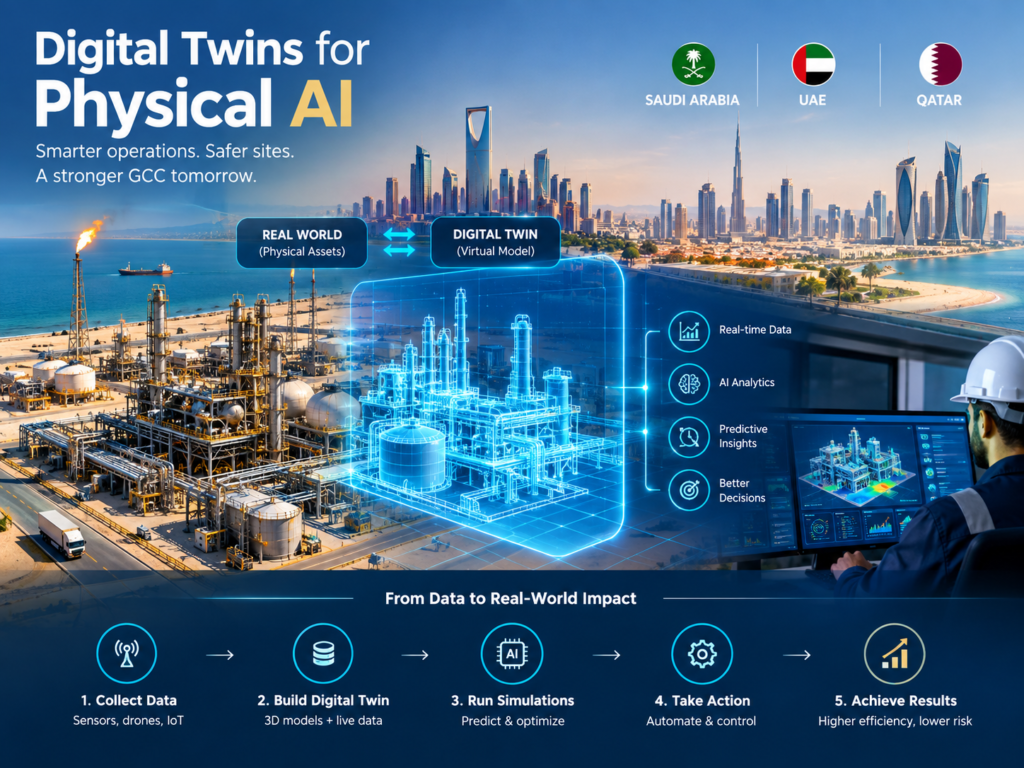
A practical implementation can follow these steps.
Connect the relevant operational and sensor data.
Create a digital representation of the physical system.
Simulate normal, abnormal and edge-case scenarios.
Generate synthetic or supplementary training data where useful.
Train and test the required AI models.
Validate simulated behaviour against physical requirements.
Deploy into a controlled real-world environment.
Feed operational results back into the twin and improve the system.
For organizations building the wider software platform around these workflows, Mak It Solutions provides software and development services, including web development and scalable application architecture.
Scale From Pilot to GCC-Wide Operations
After the pilot has been validated, the architecture can be extended across additional facilities or markets.
That may mean adapting infrastructure, language, integrations, cybersecurity controls and data-governance processes for operations in Riyadh, Dubai, Abu Dhabi or Doha.
The core progression remains consistent
Model the environment → simulate → train AI → validate safely → deploy into real operations.
Used well, digital twins for Physical AI give GCC organizations a controlled way to connect AI development with the realities of physical operations rather than moving directly from a model to a live environment.
Final Thoughts
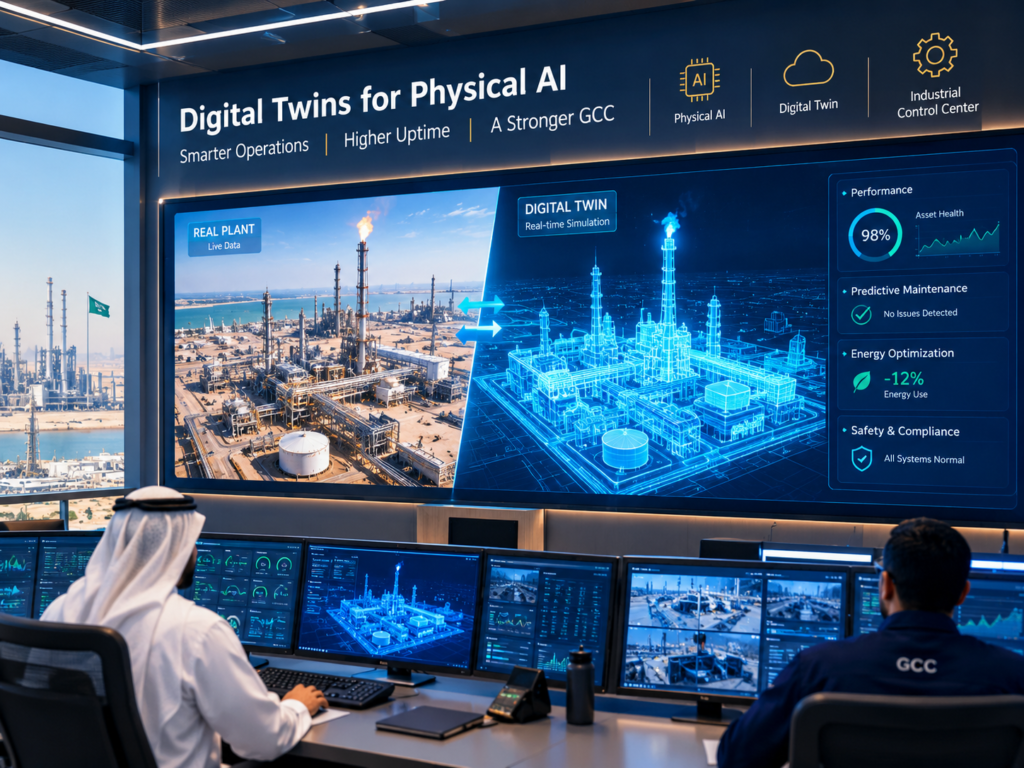
Digital twins for Physical AI give GCC organizations a practical way to test, train and validate intelligent systems before introducing them into live environments. By combining simulation, synthetic data, IoT, robotics and real-time operational information, businesses in Saudi Arabia, the UAE and Qatar can reduce deployment risk while improving planning, safety and system performance.
As adoption grows, successful projects will depend on accurate data, realistic simulation, secure infrastructure and strong integration with existing systems. Starting with a focused pilot allows organizations to prove value first, refine the workflow and then scale digital twins for Physical AI across wider operations. ( Click Here’s )
Planning a robotics, AI, data or smart-infrastructure initiative in the GCC?
Mak It Solutions can help you explore the software, data and application architecture surrounding digital twins for Physical AI across Saudi Arabia, the UAE and Qatar. Start with a focused use case, validate it carefully, then scale what works.
FAQs
Q : Can Physical AI work without digital twins in Saudi Arabia?
A : Yes. Physical AI can operate without a digital twin, but simulation can make training and validation more repeatable and reduce the need for disruptive physical testing.
For Saudi industrial, logistics and infrastructure projects, organizations should also assess applicable SDAIA and NDMO requirements according to the actual data and use case.
Q : What industries can use Physical AI simulation in the UAE?
A : Potential sectors include manufacturing, logistics, government, energy, construction, mobility, retail and smart infrastructure.
For example, a Dubai warehouse could simulate robot navigation and worker interaction before changing a live operational environment.
Q : How are digital twins used in Dubai smart-city projects?
A : Dubai Municipality has documented the use of digital-twin technology for geospatial planning and smart-city management.
Its published material describes digital environments that combine technologies such as IoT, machine learning, AI and analytics to support urban planning and operational evaluation.
Q : What are the main challenges of digital twin deployment in Qatar?
A : Typical challenges include legacy-system integration, cybersecurity, data quality, connectivity, simulation accuracy, governance and the ongoing effort needed to maintain a useful operational twin.
Organizations should also evaluate any sector-specific requirements that apply to their environment rather than treating all Qatar deployments the same way.
Q : Do GCC digital twin projects require local cloud or edge infrastructure?
A : Not universally.
A robot may require edge processing for low-latency control while heavier simulation runs in a cloud or private environment. The right architecture depends on latency, cybersecurity, data classification, operational resilience and applicable sector requirements.
[…] IoT Sensors Build the Connected GCC […]