
Smart Manufacturing GCC: An Industry 4.0 Guide
Smart Manufacturing GCC: An Industry 4.0 Guide
Smart Manufacturing GCC: An Industry 4.0 Guide
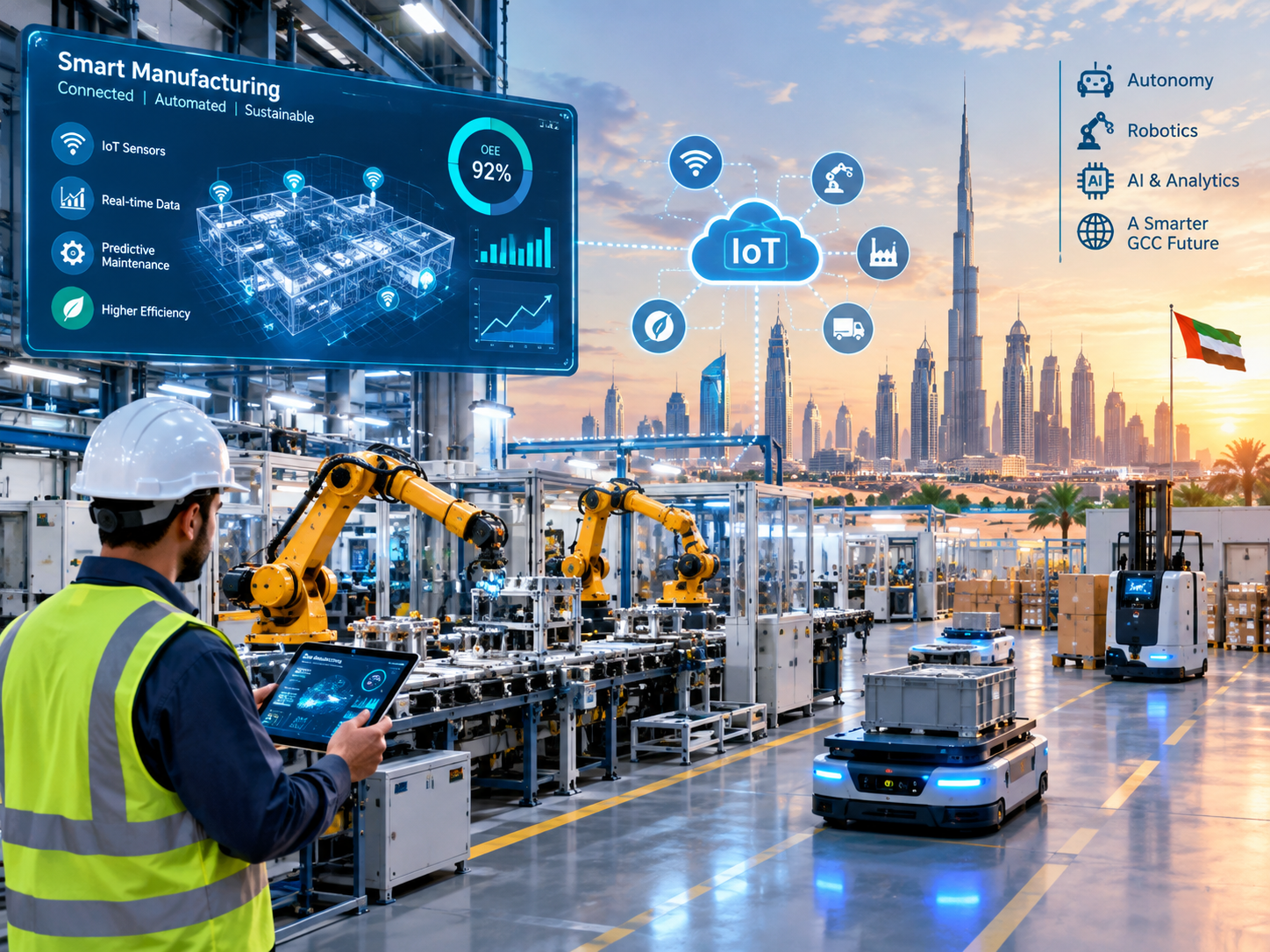
Smart manufacturing GCC is moving factories beyond isolated automation. By connecting industrial IoT sensors, production systems, analytics, AI and robotics, manufacturers can monitor operations in real time, predict problems earlier and automate selected decisions safely.
The practical journey is not about building a fully autonomous factory overnight. It usually develops in stages: connected assets → operational visibility → predictive insights → adaptive processes → controlled autonomy.
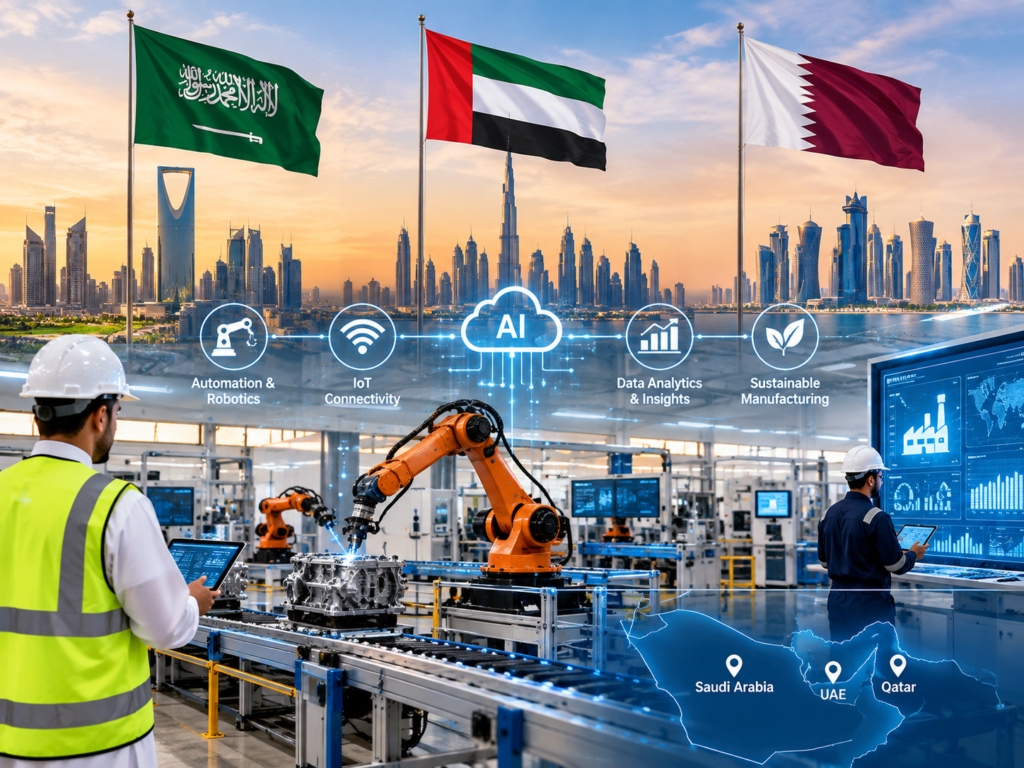
Across Saudi Arabia, the UAE and Qatar, national industrial strategies are also encouraging manufacturers to adopt advanced technologies and improve digital readiness. Saudi Arabia’s Future Factories program, for example, targets the transformation of 4,000 factories toward greater automation, operational efficiency and advanced industrial practices.
What Is Smart Manufacturing in the GCC?
Smart manufacturing GCC combines industrial IoT, automation, manufacturing execution systems, enterprise data and AI to improve how factories operate.
Traditional automation is typically built around predefined rules: a machine receives an instruction and performs the same action repeatedly. A smart factory adds connected data and analytics so operators—and, in selected cases, automated systems can respond to changing production conditions.
That means information can move between.
Industrial sensors and PLCs
SCADA systems
MES or MOM platforms
ERP and business applications
Analytics and AI platforms
Robotics and automated material-handling systems
The result is a factory where production data becomes useful operational intelligence rather than remaining trapped inside individual machines.
Why Industry 4.0 Matters in Saudi Arabia, the UAE and Qatar
Industrial transformation is increasingly part of the region’s broader manufacturing agenda.
Saudi Arabia’s Future Factories initiative focuses on automation and advanced industrial solutions. In the UAE, Industry 4.0 is positioned as a core pillar of Operation 300Bn, while Qatar’s Ministry of Commerce and Industry is promoting factory digital readiness and Fourth Industrial Revolution adoption.
For manufacturers, however, the strongest reason to adopt Industry 4.0 is operational rather than fashionable: less downtime, better visibility, improved quality and faster decision-making.
How IoT Sensors Build the Connected GCC Factory
Every smart factory needs reliable operational data.
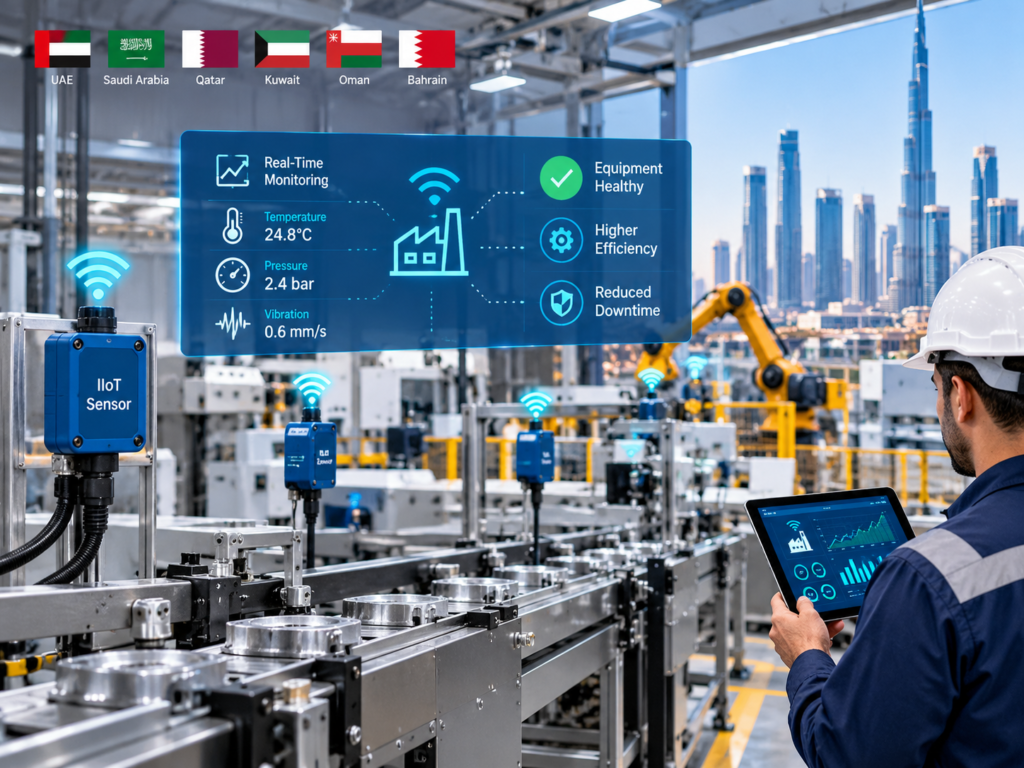
Industrial IoT sensors can monitor variables such as vibration, temperature, pressure, speed, energy consumption and equipment condition. PLCs, industrial gateways and edge systems then convert those signals into information that operators and software platforms can use.
Connecting Legacy Equipment Without Replacing Everything
A common misconception is that smart manufacturing requires completely new production machinery.
In practice, many brownfield factories can modernize gradually.
Existing equipment may be connected using retrofit sensors, protocol converters, PLC interfaces or industrial gateways. Data can then flow into SCADA, MES and analytics platforms without replacing an entire production line.
For factories in established industrial areas such as Dammam, Jubail, Dubai or Doha, this phased model can make modernization more practical.
Mak It Solutions’ business intelligence services can support the analytics and reporting layer around connected operational data.
Predictive Maintenance as an Early Smart-Factory Use Case
Predictive maintenance is often a practical starting point because its business objective is easy to understand.
Instead of servicing equipment only on a fixed schedule or waiting until it fails manufacturers can monitor equipment condition and identify unusual patterns.
For example, increasing vibration and temperature on a critical motor may indicate developing mechanical problems. Maintenance teams can investigate before the issue turns into unplanned downtime.
A Riyadh manufacturer could begin with one important production line, track equipment condition and compare downtime against the previous operating baseline before expanding the system.
How AI Moves Smart Manufacturing GCC Beyond Automation
IoT gathers data. AI helps interpret it.
Once a factory has reliable operational information, AI and advanced analytics can support use cases including.
Predictive maintenance
Machine-vision quality inspection
Production anomaly detection
Scheduling optimization
Yield improvement
Energy optimization
Process-performance analysis
The important point is sequencing. AI cannot compensate for unreliable sensors, fragmented data or poorly integrated production systems.
Digital Twins Add a Simulation Layer
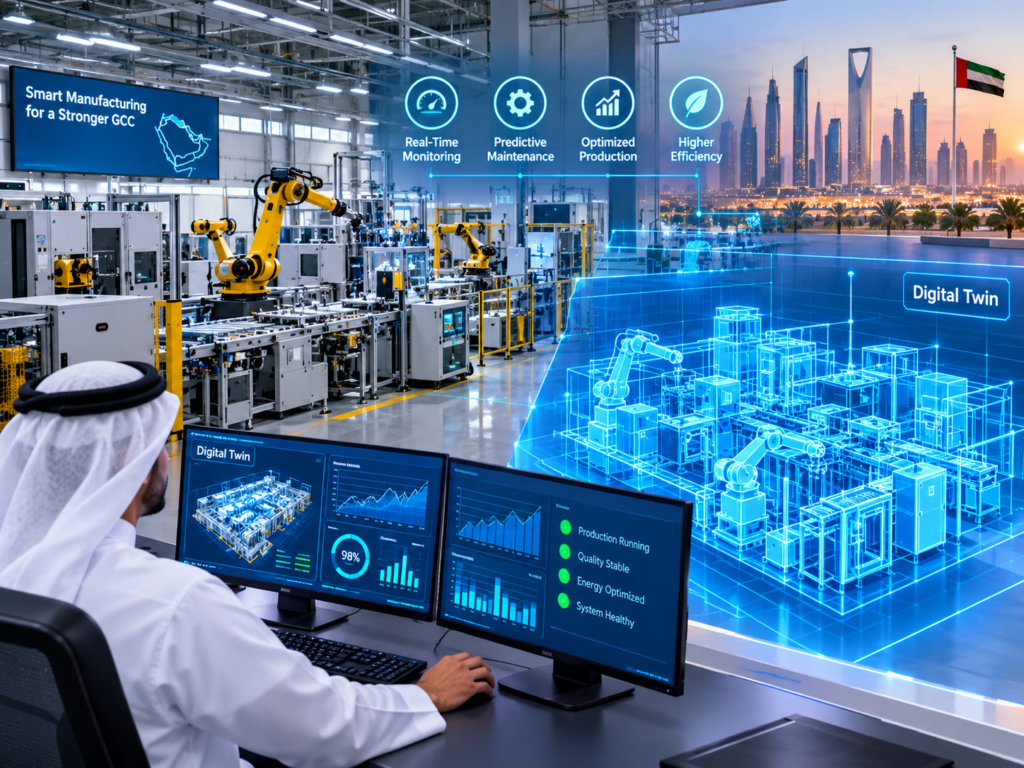
A digital twin is a digital representation of a physical machine, production line or process.
When connected to operational data, a digital twin can help engineers examine bottlenecks, simulate capacity changes and test possible adjustments without immediately disrupting physical production.
This can be especially valuable where shutdowns are expensive or production processes are complex.
Robotics, Machine Vision and Adaptive Automation
Robots and cobots can also become more capable when connected to factory data.
Rather than operating as isolated programmable machines, advanced production cells can combine robotics, machine vision, sensors and AI-assisted decision support.
Supporting applications may require custom integration and data-processing layers. Mak It Solutions’ backend development services and Python development services can support these surrounding software requirements.
From Automation to Autonomous Manufacturing
An autonomous factory does not have to mean a factory without people.
A more realistic objective is controlled autonomy: systems monitor operating conditions, evaluate approved responses and execute selected actions within defined safety and governance limits.
The progression may look like this:
Monitor → Recommend → Predict → Optimize → Execute → Learn
At earlier stages, the system may simply alert an operator. Later, it might recommend a production adjustment. In a mature environment, selected low-risk decisions may be executed automatically.
Potential applications include dynamic scheduling, material-flow optimization, automated quality adjustments and energy-management controls.
Where Humans Still Matter
Engineers, technicians and operators remain essential.
They provide safety oversight, maintenance expertise, exception handling, process knowledge and governance. High-impact decisions also require carefully defined escalation procedures.
The aim of smart manufacturing should therefore be to strengthen human decision-making first and automate only where the process is sufficiently reliable and controlled.
Smart Manufacturing GCC: Saudi Arabia, UAE and Qatar
Saudi Arabia.
Saudi Arabia’s Future Factories program aims to transform 4,000 factories toward greater automation, operational efficiency and advanced industrial practices. The country’s National Platform has also identified AI, IoT and advanced manufacturing technologies as important elements of industrial modernization.
For manufacturers in Riyadh and industrial centers around Dammam and Jubail, the opportunity is not limited to robotics. Connecting equipment, improving production visibility and building reliable industrial data foundations can be equally important early steps.
UAE.
The UAE’s Operation 300Bn strategy aims to raise the industrial sector’s contribution to GDP to AED300 billion by 2031. UAE Industry 4.0 is one of the strategy’s main pillars and focuses on accelerating industrial digital transformation and technology adoption.
Transform 4.0 adds a more targeted implementation mechanism. MoIAT launched the initiative to support high-potential manufacturers in accelerating digitalization and developing Industry 4.0 capabilities.
Factories in Abu Dhabi or Dubai may also need customer portals, production interfaces or connected business applications around their operational systems. Mak It Solutions’ web development services and mobile app development services can support those surrounding digital experiences.
Qatar.
Qatar is also strengthening its smart-manufacturing agenda.
At Web Summit Qatar on February 4, 2026, the Ministry of Commerce and Industry highlighted factory digital readiness, SME transformation, Fourth Industrial Revolution adoption and the Smart Industry Readiness Index as part of its industrial digital-transformation priorities.
Qatar’s manufacturing strategy also includes initiatives aimed at increasing the adoption of Fourth Industrial Revolution tools and assessing factories’ readiness for transformation.
For manufacturers in Doha and surrounding industrial areas, this makes digital maturity assessment a useful starting point before committing capital to large automation projects.
How to Implement Smart Manufacturing in a GCC Factory
Technology selection should come after the business problem is clear.
A practical roadmap is.
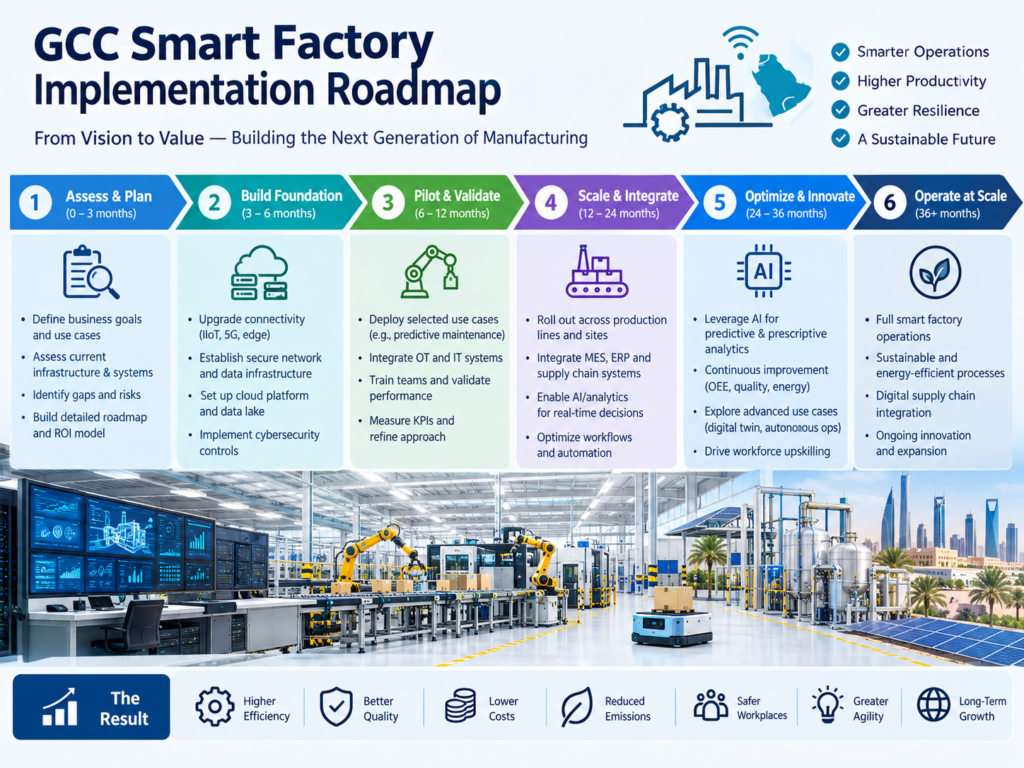
Assess → Prioritize → Connect → Secure → Integrate → Pilot → Measure → Scale
Select a Measurable Operational Problem
Start with one issue that matters financially or operationally.
That may be.
Excessive downtime
High scrap rates
Poor production visibility
Energy consumption
Quality variation
Maintenance cost
Throughput constraints
Establish a baseline using appropriate metrics such as OEE, yield, scrap, energy intensity or downtime.
Without a baseline, it is difficult to prove whether the technology actually created value.
Build the Data, Connectivity and Security Foundation
Connect sensors, PLCs and edge systems before attempting sophisticated automation.
Then integrate relevant operational platforms such as SCADA and MES with enterprise systems where required.
Cybersecurity should be designed into this architecture rather than added later. Important controls can include OT network segmentation, controlled remote access, backups, identity management and governance of industrial data.
Saudi implementations should also evaluate which national data-management and governance requirements apply to the organization and data involved. The National Data Management Office develops data policies, standards and governance controls within Saudi Arabia.
Arabic and English operator interfaces can also be useful in GCC production environments where multilingual teams work across engineering, operations and maintenance functions.
Prove the Pilot Before Scaling
Avoid trying to digitize an entire plant in one project.
A stronger sequence is:
Pilot → Validate → Integrate → Standardize → Scale → Automate
Measure the pilot against its original baseline. If downtime falls, throughput improves or quality becomes more consistent, the manufacturer has a clearer business case for expansion.
Mak It Solutions’ broader technology services, React development services and e-commerce integration services can support surrounding applications and business-system integrations where relevant.
Smart Manufacturing ROI.
Smart manufacturing should ultimately improve operational performance.
Depending on the use case, manufacturers may track.
Equipment availability and downtime
OEE
Maintenance costs
Scrap and defect rates
Production throughput
Yield
Energy consumed per unit
Mean time between failures
Time required to identify production problems
ROI varies significantly between factories. Existing equipment, integration complexity, data quality and workforce readiness all affect results.
For that reason, manufacturers should avoid adopting technology simply because it is associated with Industry 4.0. Each investment should connect to a measurable operational objective.
Common Smart-Factory Challenges
Technology is rarely the only challenge.
GCC manufacturers may also encounter legacy equipment, fragmented OT and IT environments, poor data quality, cybersecurity exposure, skills shortages and vendor lock-in.
Another common issue is the pilot trap: a proof of concept works on one machine or production line but cannot be scaled economically across the plant.
Standardized architecture, clear ownership and measurable KPIs help reduce that risk.
The GCC Factory of the Future
Sensors create visibility. Connected platforms create context. Analytics and AI create intelligence. Automation turns approved decisions into action.
That combination is what makes smart manufacturing GCC more than a collection of new technologies.
The strongest transformation programs usually begin with a real operational problem, establish reliable industrial data and scale only after measurable value has been demonstrated. Over time, manufacturers can move from connected operations toward predictive, adaptive and increasingly autonomous production while keeping people involved wherever safety, judgment and accountability matter.
Last Words
Smart manufacturing GCC is reshaping how factories operate by connecting sensors, industrial systems, analytics, AI and automation into a more intelligent production environment. For manufacturers in Saudi Arabia, the UAE and Qatar, the strongest approach is to start with measurable business problems, build reliable data foundations and scale proven use cases gradually.
The path toward autonomous manufacturing should remain practical, secure and value-driven. Predictive maintenance, digital twins, machine vision and connected operations can improve efficiency, visibility and decision-making, but successful transformation depends on integration, cybersecurity and workforce readiness. Smart manufacturing GCC works best when technology supports clear operational goals and controlled growth. ( Click Here’s )
Planning a smart manufacturing GCC project in Saudi Arabia, the UAE or Qatar?
Mak It Solutions can help assess digital maturity, identify practical use cases and build the software, analytics and integration layers around a staged Industry 4.0 roadmap. Start with the business problem, prove the value and scale from there rather than investing in disconnected technologies.
FAQs
Q : What technologies are needed for a smart factory in Saudi Arabia?
A : A Saudi smart factory may combine industrial sensors, PLC connectivity, gateways, SCADA, MES or MOM, ERP integration, analytics and cybersecurity. AI, digital twins and robotics can be added where the business case justifies them. Saudi Arabia’s Future Factories initiative supports greater automation and advanced industrial practices.
Q : How does Saudi Arabia’s Future Factories Program support Industry 4.0?
A : The program supports the transition toward more efficient and technologically advanced manufacturing. The official Saudi government service describes a target of transforming 4,000 factories toward automation, operational efficiency and advanced industrial solutions.
Q : What is the difference between UAE Industry 4.0 and Transform 4.0?
A : UAE Industry 4.0 provides the broader industrial digital-transformation direction under Operation 300Bn. Transform 4.0 is a targeted MoIAT initiative designed to help selected manufacturers accelerate technology adoption and increase their digital maturity.
Q : Can older GCC factories use industrial IoT without replacing their machinery?
A : Yes. Many brownfield factories can retrofit sensors, gateways and industrial interfaces onto existing machinery. Compatibility, cybersecurity and integration with SCADA, MES or ERP should be assessed before deployment.
Q : What are the main cybersecurity risks for smart factories?
A : Typical risks include insecure remote access, outdated industrial devices, poorly segmented networks, weak authentication and insufficient governance of connected data. Cybersecurity controls should therefore be included from the earliest connectivity and pilot stages.