
AI Agent Authentication: Zero-Trust Architecture
AI Agent Authentication: Zero-Trust Architecture
AI Agent Authentication: Zero-Trust Architecture
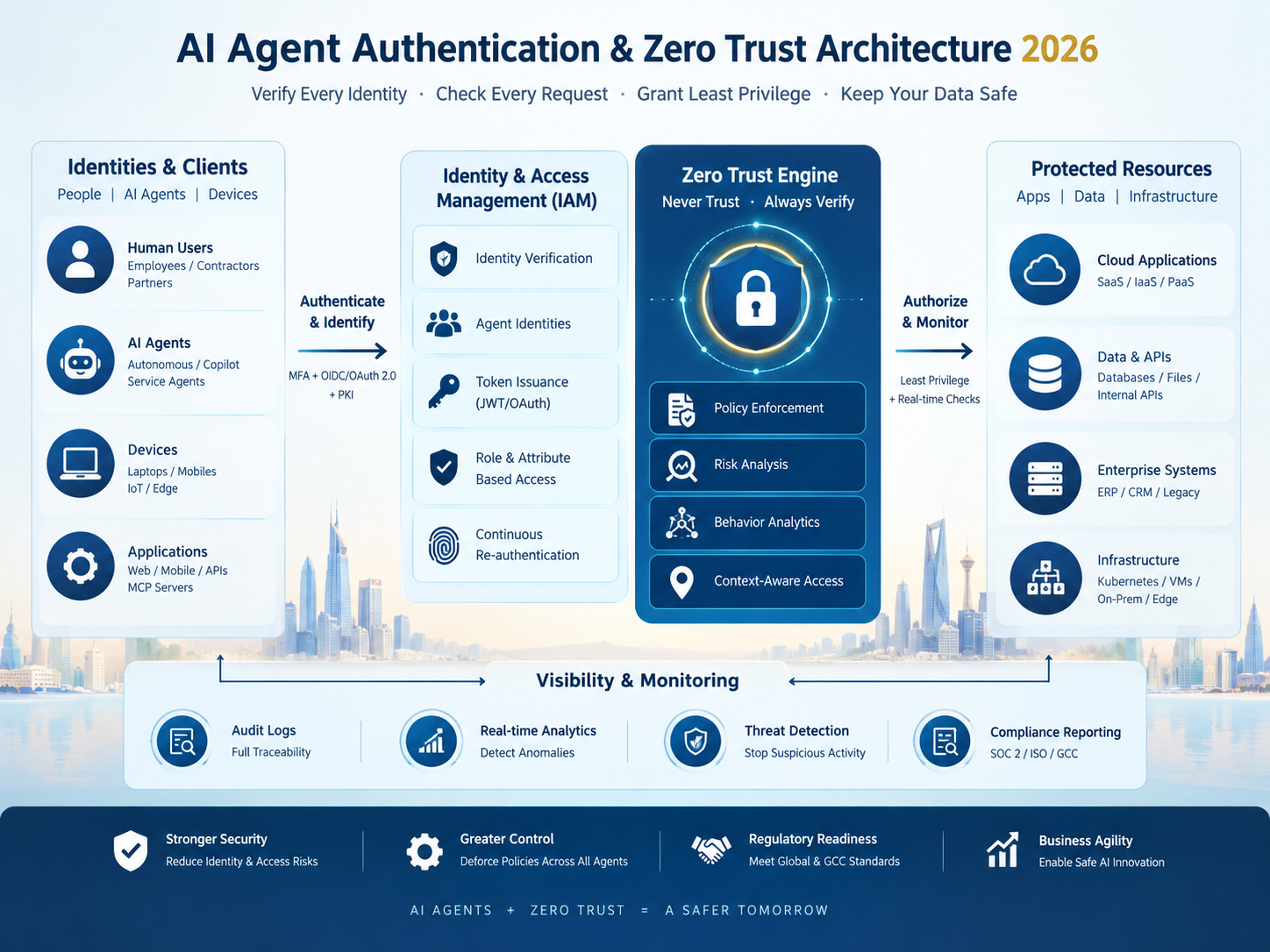
AI agent authentication is becoming a core security requirement as autonomous agents move beyond chat interfaces and start calling APIs, querying databases, updating SaaS records and coordinating with other agents.
At its simplest, AI agent authentication cryptographically verifies which autonomous software agent is requesting access to a tool, API, service or another agent. A secure enterprise design gives each agent a unique non-human identity, short-lived credentials and scoped permissions while keeping that identity separate from any human authority delegated to it.
That distinction matters. Authentication verifies which agent is acting; authorization determines what that authenticated agent may do and whose authority it may exercise.
An agent operating in New York, London or Berlin should not inherit unlimited trust simply because it runs inside a company network or has access to an employee’s credentials. Mak It Solutions’ guide to AI agent identity management explores the wider governance challenge; here, the focus is specifically on authentication architecture.
Microsoft’s 2024 multicloud security research found that workload identities made up 83% of cloud identities discovered through Microsoft Entra Permissions Management. That scale makes machine identity a security problem enterprises can no longer treat as an edge case.
What Is AI Agent Authentication?
AI agent authentication is the process of verifying an autonomous software agent before allowing it to access tools, APIs, data or another agent. In production environments, each independently governed agent should ideally have a distinguishable identity instead of borrowing a human login or sharing a reusable secret.
An agent identity might be represented by a workload identity provider, cryptographic key, certificate, signed token or an entry in an approved agent registry.
AI Agent Identity vs Human and Service Identity
An autonomous agent should generally be treated as a non-human identity with its own lifecycle.
That differs from human identity because an agent can execute actions independently. It may also differ from a conventional service identity because an agent can dynamically choose tools, construct multi-step workflows and initiate downstream actions based on changing context.
Enterprise teams therefore need a clear mapping between.
The agent.
Its owner or responsible team.
Its business purpose.
Its execution environment.
Its approved resources; and
any user or service authority delegated to it.
The goal is not to invent an entirely separate identity system for AI. It is to apply strong workload-identity principles while accounting for the autonomy and delegation patterns that agentic systems introduce.
Authentication vs Authorization for AI Agents
Authentication answers:
“Which agent is this?”
Authorization answers.
“Can this agent perform this action?”
Delegation adds a third question.
“Whose authority is the agent exercising?”
Keeping these concepts separate makes policy enforcement and incident investigation much clearer.
OAuth 2.0 access tokens, scopes, resource policies and policy decision points can restrict an authenticated agent to approved operations. The objective is least privilege rather than blanket access.
This distinction also supports a mature Zero Trust strategy for AI-era environments.
Why Shared API Keys Are Not Enough
Shared API keys weaken attribution, complicate revocation and increase blast radius.
If several agents reuse one credential, an audit log may prove that the credential performed an action without proving which individual agent initiated it.
That becomes particularly risky when agents can modify records, trigger workflows or access sensitive data.
Prefer architectures built around.
Unique workload identities.
Short-lived credentials.
Signed tokens.
Managed identities.
Workload federation; and
centrally controlled credential issuance and revocation.
Microsoft’s 2024 report found that only 2% of human and workload identity permissions were used in 2023, meaning the remaining permissions represented substantial unused access.
How AI Agent Authentication Works Between Agents
AI agents can authenticate each other using verifiable workload identities, signed OAuth tokens, certificates or federated trust.
A receiving service should validate more than the presence of a token. Depending on the architecture, it may need to verify the caller, credential issuer, intended audience, freshness, permitted scope and trust domain before processing the request.
Mutual Authentication Between Agent A and Agent B
A simplified flow looks like this.
Agent A → identity provider or trust anchor → Agent B → policy decision point
Agent A obtains verifiable credentials from a trusted identity system. Agent B verifies those credentials before applying authorization rules.
In higher-assurance environments, Agent A should also authenticate Agent B. That prevents the calling agent from submitting sensitive information or privileged requests to an unexpected workload.
The UK National Cyber Security Centre’s Zero Trust guidance says service-to-service requests should be authenticated and recommends mutual authentication so both communicating services can be trusted.
OAuth, mTLS and Workload Identity for AI Agents
There is no requirement to choose one authentication mechanism for every agent.
Different controls can work together.
OAuth 2.0 can provide narrowly scoped access tokens.
OpenID Connect can supply identity-related claims where appropriate.
Signed JWTs can carry verifiable claims between systems.
mTLS can authenticate communicating workloads using certificates.
DPoP or other proof-of-possession approaches can bind tokens to cryptographic keys.
Managed workload identities can reduce or eliminate long-lived credentials embedded in applications.
For example, an agent may authenticate at the transport layer with mTLS while also presenting an OAuth token scoped to a specific API operation.
The IETF’s Workload Identity in Multi System Environments, or WIMSE, working group is actively developing workload-identity architecture and related mechanisms. As of September 2026, the relevant WIMSE documents remain Internet-Drafts or other works in progress rather than finalized standards.
Cross-Domain Trust Between Organizations
Agent-to-agent communication becomes more complicated when the agents belong to different companies or cloud environments.
The question is no longer only, “Is this credential valid?”
It also becomes.
“Do we trust the organization that issued it?”
Cross-domain architectures may use certificate authorities, federated identity providers, token exchange and explicitly configured trust anchors.
Credential issuer, audience, trust domain and federation policy should all be checked. A workload running in one company’s AWS environment should not automatically trust a credential simply because another workload can present it from an unrelated Azure tenant.
AI Agent Authentication, Authorization and Delegation
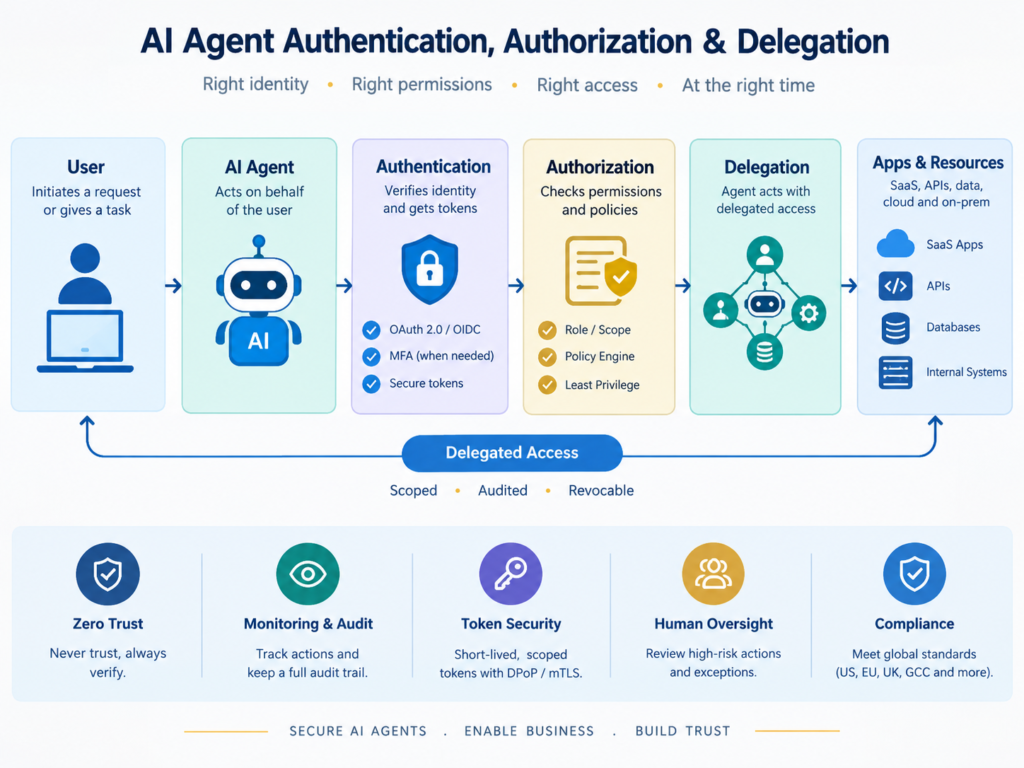
Authentication establishes the agent’s identity. Authorization controls what it can do. Delegation establishes whose permissions it may exercise.
Keeping all three visible is essential when agents act for employees, customers or other services.
Delegated Authorization When Agents Act for Users
Suppose an expense-management agent acts on behalf of Jane.
A useful audit trail should distinguish.
The AI agent that performed the action.
Jane as the delegated principal.
The permission or scope granted.
The target system; and
The resulting authorization decision.
The agent should not permanently become “Jane” simply because Jane approved a workflow.
OAuth grants and token-exchange patterns can communicate delegated authority while preserving the agent’s independent workload identity.
Apply Least Privilege to Autonomous Agents
Give the agent only the access required for its current business function.
A London finance agent that reads invoices does not automatically need payment-approval permissions. A San Francisco customer-service agent that reads CRM records does not automatically need bulk-export privileges.
Restrict.
Resources.
Allowed operations.
Token audiences.
Credential lifetimes.
Environments; and
Delegation scope.
Least privilege matters even more for autonomous systems because an agent can potentially perform many actions before a human reviews the result.
Revocation, Credential Rotation and Human Approval
Short credential lifetimes reduce exposure, but they are not a substitute for immediate revocation.
Security teams should be able to suspend an agent, invalidate its credentials where supported and block subsequent calls through policy enforcement points.
High-impact operations may also justify explicit human approval. Examples include payment execution, destructive infrastructure changes and disclosure of highly sensitive records.
Security Architecture for Agentic AI
Protect Agent Credentials and Reduce Blast Radius
Secrets should not live inside prompts or source code.
Where the platform supports them, prefer ephemeral credentials, managed workload identity, workload federation and automated certificate or key rotation.
Design the system so that compromise of one agent does not expose the entire environment.
Build Audit Trails Around Agent Identity
A useful audit event should capture enough context to reconstruct what happened.
That can include.
Agent identity.
Initiating or delegated principal.
Authentication method.
Credential issuer.
Requested action.
Target resource.
Authorization or policy decision.
Timestamp; and
Relevant trust-domain or session information.
This makes agent activity more attributable during incident response and governance reviews.
Mak It Solutions’ AI agent identity security guide covers the surrounding IAM, PAM, IGA and monitoring considerations.
Microsoft’s 2025 Digital Defense Report says its systems analyze approximately 38 million identity-risk detections on an average day, illustrating the scale at which modern identity-security systems operate.
Authentication Is Only One Part of Agent Governance
Strong authentication does not make an agent safe by itself.
Agentic environments may also need.
Prompt-injection defenses.
Tool allow lists.
Runtime isolation.
Authorization policy enforcement.
Anomaly monitoring.
Secure agent registries; and
Approval controls for sensitive actions.
Authentication tells the system who is asking. The rest of the security architecture determines whether the requested behavior should be allowed.
AI Agent Authentication Requirements in the USA, UK and EU
There is no single regulation that universally defines an “AI agent authentication standard.”
Requirements depend on the organization, jurisdiction, sector, data being processed and actions the agent performs.
United States.
US organizations commonly map security architecture to Zero Trust and identity-management principles while also considering sector-specific requirements.
For organizations subject to HIPAA, the Security Rule requires safeguards for electronic protected health information, including access controls, audit controls and authentication-related procedures. It does not establish a standalone AI-agent authentication specification, so agents handling ePHI need to fit into the organization’s broader regulated security architecture.
Other obligations, including payment-security requirements, may become relevant depending on where the agent operates and what information it can access.
United Kingdom.
The NCSC’s Zero Trust guidance recommends authenticating connections that access data or services and specifically addresses service-to-service authentication.
For UK deployments, authentication architecture may also need to align with UK GDPR, sector governance and internal audit requirements.
The practical implication is straightforward: unique service identities, controlled credentials, traceable delegation and least-privilege access are easier to govern than shared credentials.
Germany and the EU.
For Berlin, Munich, Frankfurt and wider EU deployments, KI-Agenten Sicherheit increasingly overlaps with Identitäts- und Zugriffsmanagement, Berechtigungsmanagement, Zugriffskontrolle, Least-Privilege-Prinzip and Zero-Trust-Architektur.
Depending on the organization’s scope and sector, GDPR/DSGVO, NIS2, DORA, national supervisory requirements and the EU AI Act may all affect the broader governance environment.
These frameworks should not be treated as universally interchangeable or automatically applicable to every company.
The EU AI Act entered into force on August 1, 2024 and became generally applicable on August 2, 2026, with specific provisions following different application timelines and some high-risk categories receiving extended transition periods.
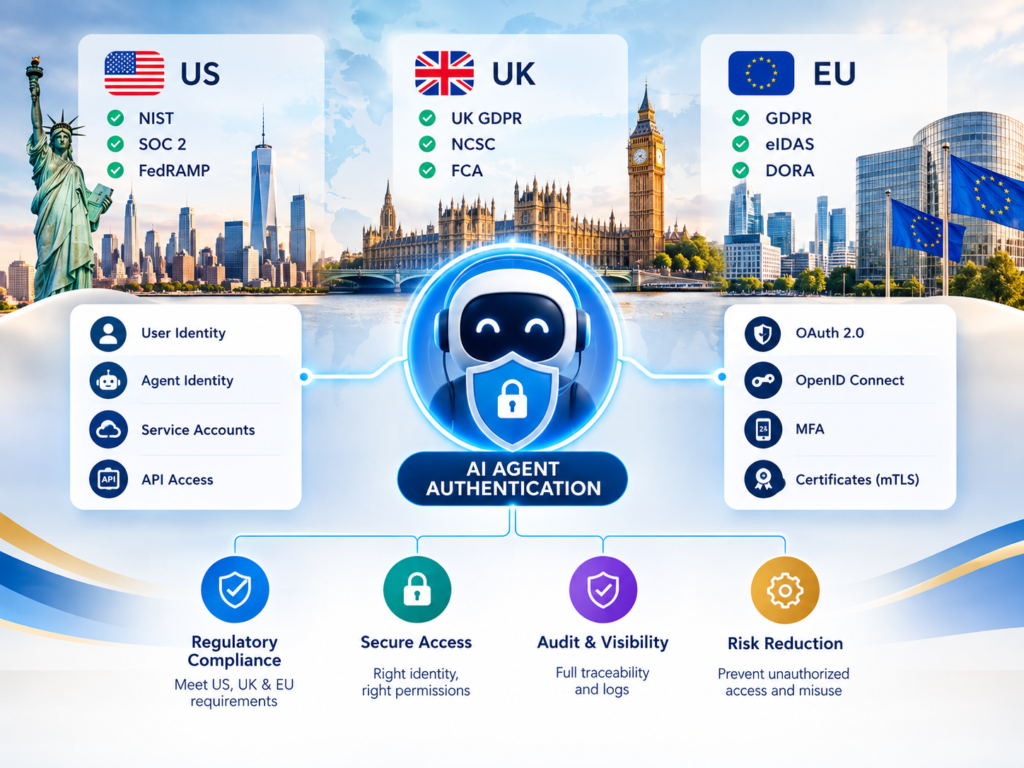
AI Agent Authentication Best-Practice Architecture
Give Every Agent a Unique, Verifiable Identity
Production agents should have distinguishable identities because shared employee or service credentials weaken attribution, revocation and policy enforcement.
Register agents with an approved identity provider, workload-identity platform or agent registry.
Keep the agent’s identity separate from employee identities and from any authority temporarily delegated to it.
Use Short-Lived, Scoped and Context-Bound Credentials
Choose OAuth tokens, signed JWTs, mTLS certificates, managed identities or related workload-authentication methods according to the trust model.
Where possible.
Keep credentials short-lived.
Restrict token audiences.
Minimize scopes.
Bind credentials to their intended workload or context.
Automate renewal; and
Avoid permanent stored secrets.
Enforce Policy at Every Agent Boundary
Do not authenticate only the first agent in a multi-agent workflow.
Every downstream boundary should independently evaluate identity and authorization.
A practical implementation sequence is.
Register each production agent as a unique non-human identity.
Issue scoped, preferably short-lived credentials through a trusted identity provider.
Authenticate agent-to-agent and agent-to-service requests.
Validate delegated authority separately from agent identity.
Apply least-privilege policy before executing the action.
Log security decisions and maintain rapid revocation capability.
Teams incorporating these controls into new platforms can also review Mak It Solutions’ web development services and broader technology services.
Choosing an AI Agent Identity and Authentication Approach
Questions to Ask IAM and Agent-Security Vendors
Before buying an “AI security” platform, ask what identity capabilities it actually provides.
Useful questions include whether it supports.
Unique agent or workload registration
OAuth/OIDC.
MTLS
Sender-constrained or proof-of-possession credentials
Workload federation
Token exchange
Immediate revocation
External policy engines. and
Detailed authentication and authorization logs.
An AI-focused label does not automatically mean the product solves workload identity.
Architecture Checklist for Enterprise Teams
Confirm that every production agent has a clear owner and distinguishable identity.
Then verify that.
Credentials are short-lived where practical.
Delegated authority is traceable.
Permissions follow least privilege.
Federation has explicit trust boundaries.
Downstream requests are authenticated and policy-checked
Sensitive operations can require additional approval. and
Security teams can revoke access and reconstruct events from logs.
The agentic AI security platform guide covers additional considerations for broader platform evaluation.
When to Modernize Existing Service-Account Patterns
Legacy identity patterns become especially difficult to defend when agents.
Reuse employee accounts.
Share API keys.
Depend on long-lived static secrets.
Cannot be individually revoked. or
Create downstream actions that cannot be traced to a specific identity.
At that point, adding another shared credential only postpones the problem.
Moving toward workload identity, bounded delegation and policy-based authorization creates a cleaner foundation for agentic systems.
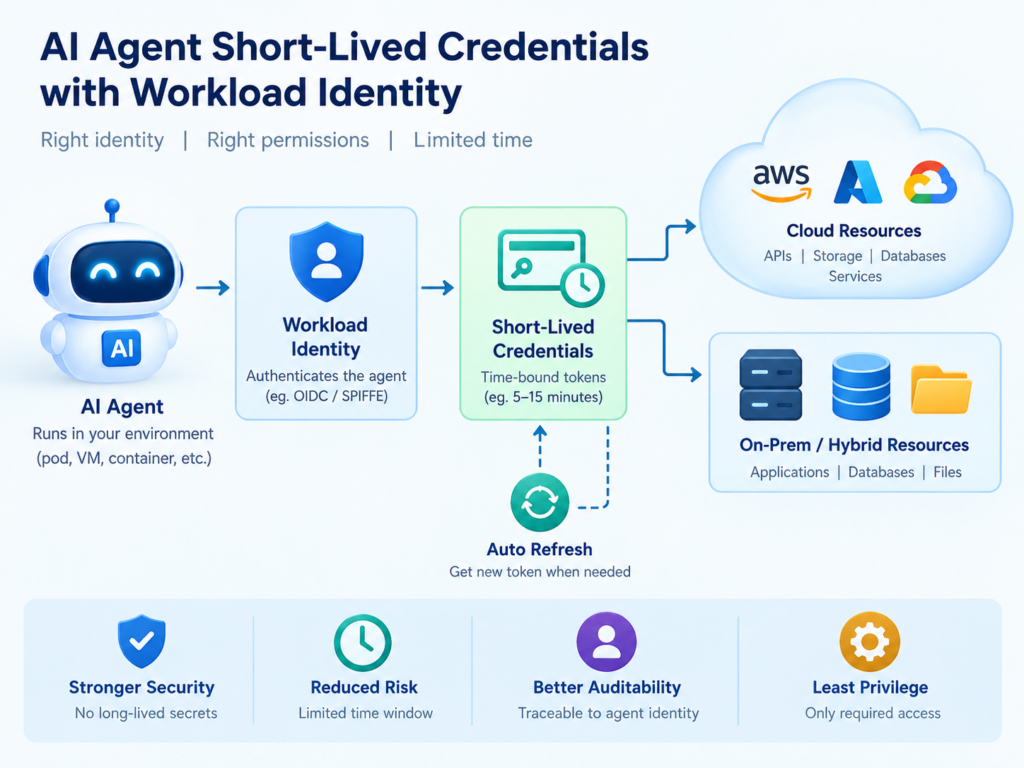
Final Words
If your agents already connect to SaaS platforms, APIs or enterprise data, map their identities and trust boundaries before shared-access patterns become difficult to unwind.
Mak It Solutions can help assess existing authentication architecture, identify shared-credential risks and design scoped identity, delegation and authorization patterns aligned with a Zero Trust approach.
Discuss your project with Mak It Solutions.
Key Takeaways
AI agent authentication should make autonomous activity identifiable, scoped and revocable.
Give each production agent a verifiable non-human identity. Keep authentication separate from authorization and delegated human authority. Prefer ephemeral or short-lived credentials over shared secrets, authenticate downstream calls, and enforce least privilege at every important trust boundary.
Regional and sector requirements still depend on actual scope, so HIPAA, NIS2, DORA or other frameworks should not be treated as universally applicable.
Above all, evaluate identity architecture on federation, policy enforcement, revocation and auditability—not on whether a product happens to carry an “AI security” label.
FAQs
Q : Can an AI agent use a human user’s OAuth token safely?
A : An agent can use delegated OAuth authority when the architecture explicitly supports acting on behalf of a user, but the user’s token should not become the permanent identity of the agent.
Keep the agent’s workload identity distinguishable and record the delegated principal, granted scopes and authorization context. Sensitive operations benefit from narrow scopes, short lifetimes and additional policy checks.
Q : How long should AI agent credentials remain valid?
A : There is no universal credential lifetime.
Use the shortest lifetime that remains operationally practical for the workload and combine it with automated renewal, restricted audiences and rapid revocation. Higher-risk agents may justify especially short-lived or transaction-specific credentials.
Q : Should every AI agent have a separate service account?
A : Every independently governed production agent should generally have a distinguishable identity, but that does not necessarily mean creating a traditional static service account.
Managed workload identities, federated identities or other modern mechanisms can provide individual attribution without requiring persistent stored secrets.
Q : How can an enterprise revoke a compromised AI agent identity?
A : Suspend or disable the identity through its identity provider or registry, invalidate active credentials where the platform supports it, and block the identity at relevant policy enforcement points.
Security teams should also rotate related secrets or certificates and review audit logs for downstream sessions or actions performed before revocation.
Q : What should an AI agent authentication audit log contain?
A : At minimum, record the agent identity, any delegated human or service principal, authentication method, credential issuer, target resource, requested action, authorization result and timestamp.
Higher-risk environments can also record policy context, trust domain, session identifiers and revocation events to make incident reconstruction easier.