


OAuth for AI Agents: Secure Delegated Access
OAuth for AI Agents: Secure Delegated Access
OAuth for AI Agents: Secure Delegated Access
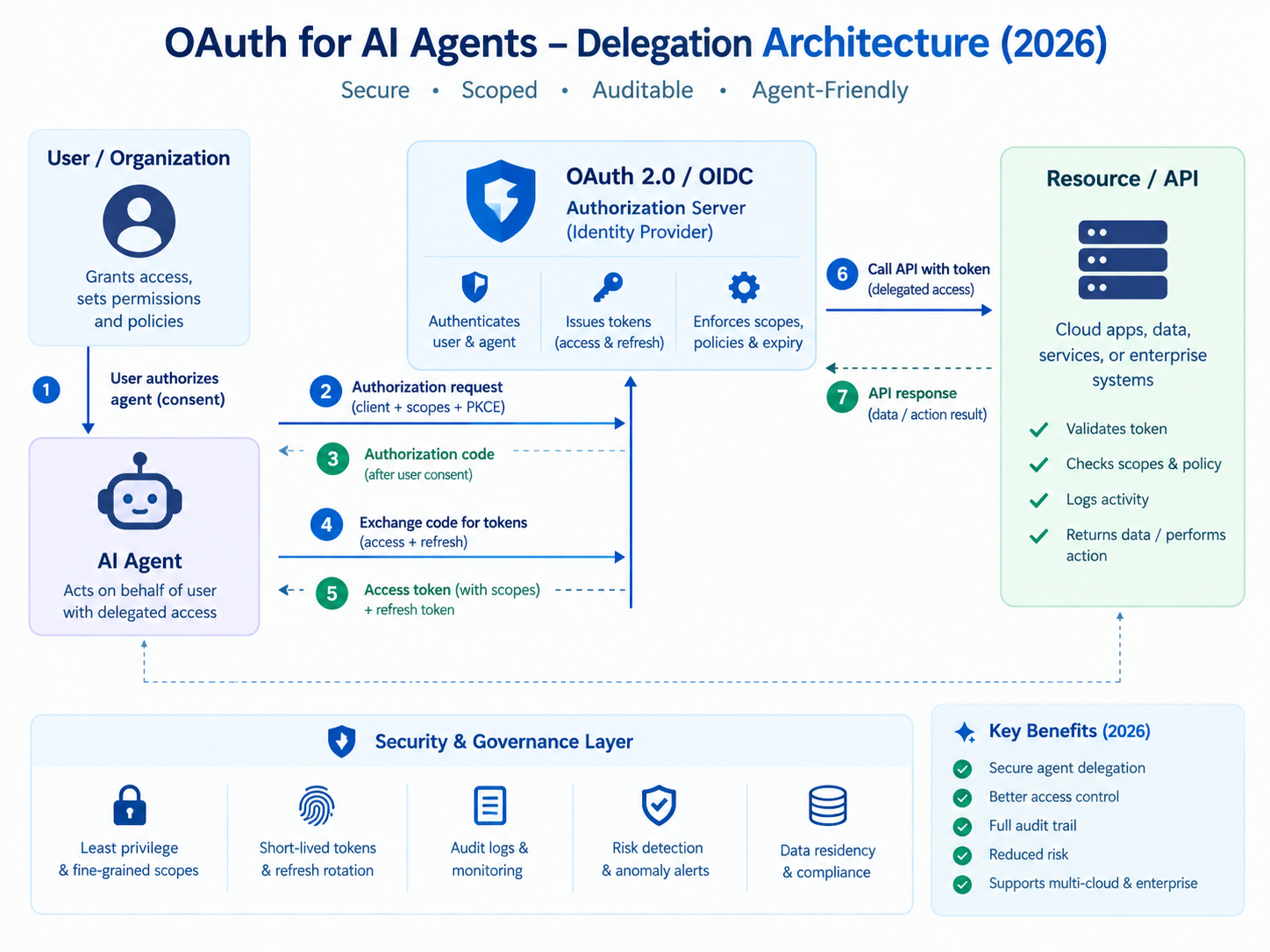
OAuth for AI agents lets autonomous software access APIs, applications, and MCP servers through delegated permissions. The challenge is that an agent can retain, reuse, exchange, and act on OAuth-granted authority without a human approving every API call.
A secure OAuth for AI agents architecture therefore separates human and agent identities, limits permissions, uses short-lived and resource-specific tokens, protects refresh credentials, and preserves a clear audit trail.
AI agents can query databases, send messages, update CRM records, invoke payment APIs, and coordinate with other agents. OAuth is no longer just a login integration in these environments. It becomes part of the identity, authorization, and governance architecture.
What Is OAuth for AI Agents?
OAuth for AI agents is the use of OAuth-based authorization to let an AI agent access an API, application, MCP server, or another protected resource under explicitly delegated permissions.
A secure implementation distinguishes three things that are easy to blur together: the user granting authority, the agent performing the work, and the permissions actually delegated to that agent.
Authentication vs Authorization vs Agent Identity
AI agent authentication proves which agent or workload is acting. Authorization determines what that identity may do.
The user identity represents the human or organization behind the request. The agent identity represents the software carrying it out. In production systems, treating them as separate identities makes policy enforcement, revocation, and auditing much clearer.
Mak It Solutions’ API security best practices similarly emphasize identity-aware, least-privilege authorization.
How Human-to-Agent Delegated Access Works
A typical trust chain looks like this.
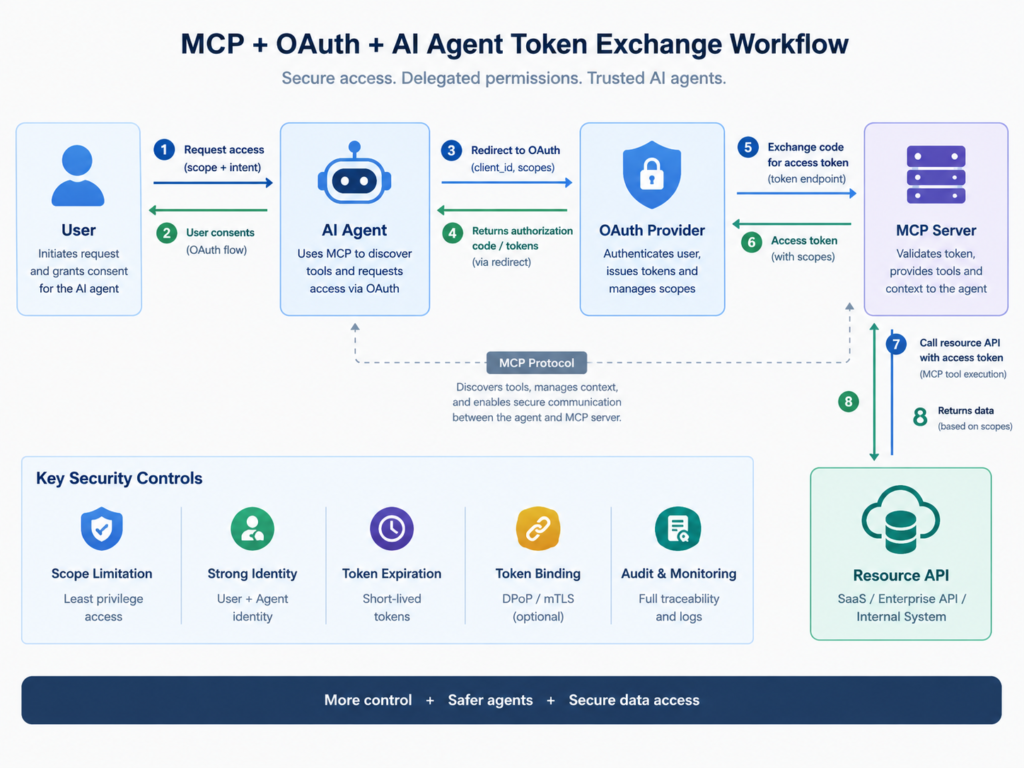
User → Agent → Authorization Server → API or MCP Server
The user authorizes defined permissions. The authorization server issues an access token, and the agent presents that token to the intended protected resource.
Refresh tokens can maintain longer-lived authorization, but they need stronger controls around storage, rotation, monitoring, and revocation.
Why Traditional OAuth Assumptions Change With Agents
Many conventional OAuth flows assume a human remains reasonably close to the transaction. Autonomous agents can behave differently.
They may.
Continue operating after the original interaction ends.
Call tools repeatedly.
Retain credentials or delegated authority.
Hand work to another agent or service.
Cross application and resource boundaries.
That autonomy can increase the blast radius of excessive permissions or compromised credentials. A zero trust strategy for AI-era systems should therefore treat agents and other non-human identities as independently governable actors.
The Biggest OAuth Security Risks for AI Agents
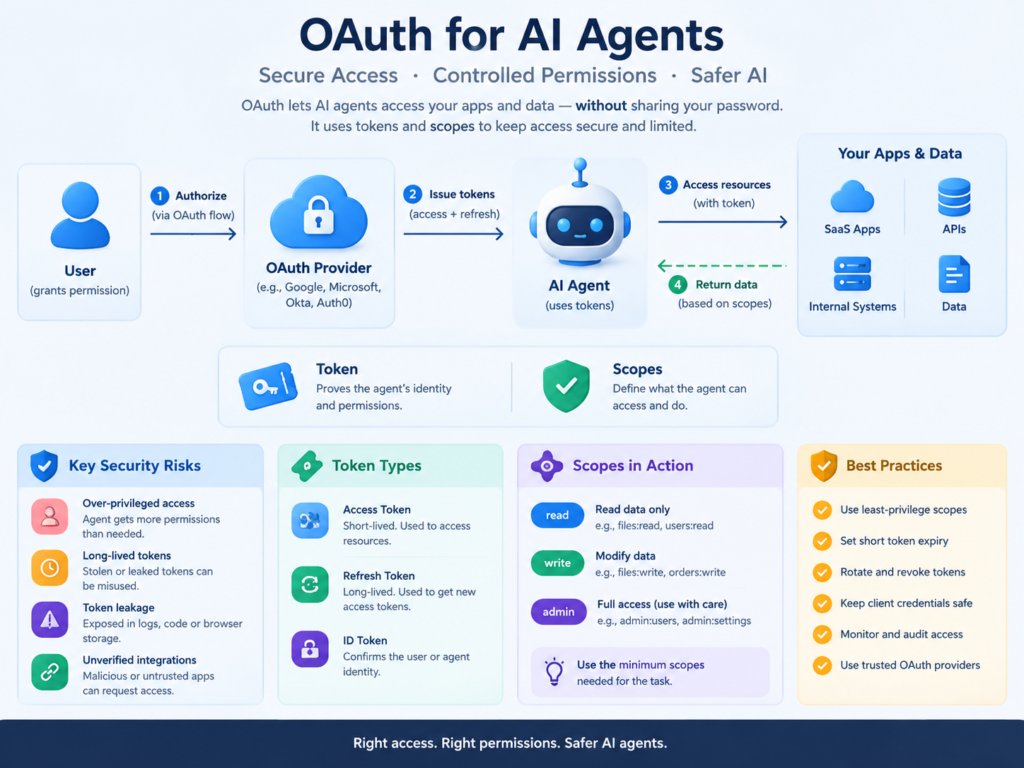
The most important OAuth security risks for AI agents include token leakage, replay, excessive scopes, persistent refresh credentials, privilege escalation, and uncontrolled delegation.
Because an agent can execute continuously, credential misuse may produce repeated actions before a human notices anything unusual.
Token Leakage, Replay and Credential Exposure
Bearer tokens can leak through prompts, logs, traces, tool output, subprocesses, local storage, debugging systems, or poorly isolated agent memory.
If an attacker obtains an unrestricted bearer token, possession may be enough to use it until it expires or is revoked.
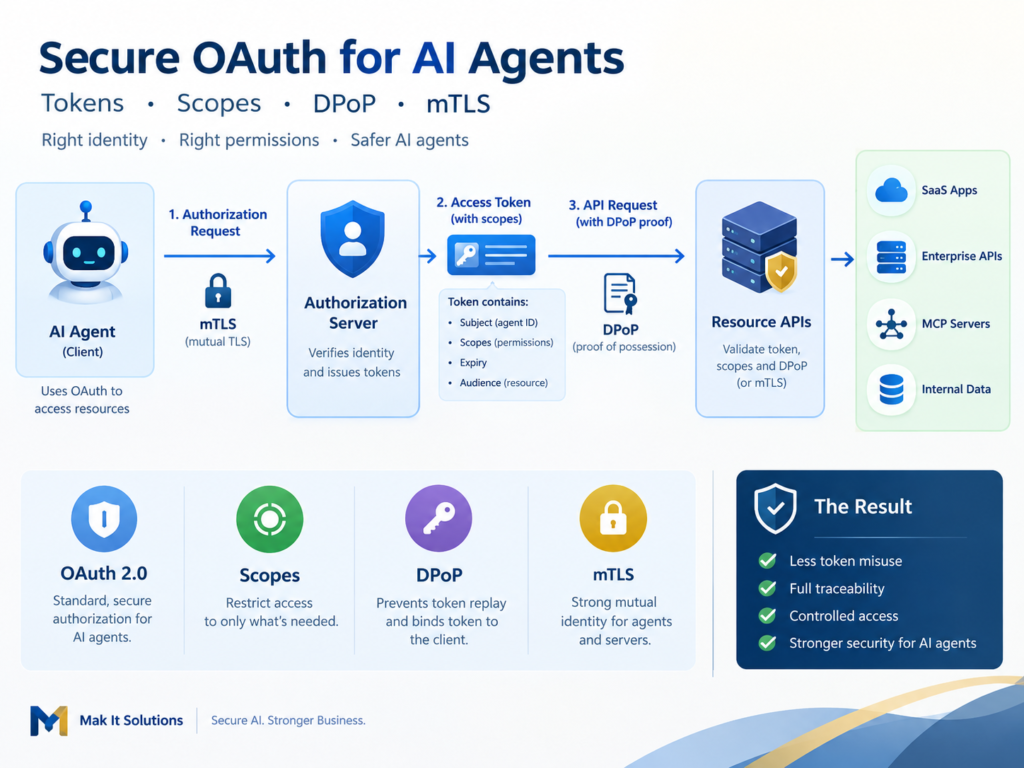
RFC 9700, the OAuth 2.0 Security Best Current Practice published in January 2025, recommends sender-constrained access tokens through mechanisms such as DPoP or mutual TLS to reduce misuse of stolen or leaked tokens.
The broader identity threat environment reinforces the need for careful credential handling. Microsoft’s 2024 Digital Defense Report states that Microsoft Entra data showed more than 600 million identity attacks per day, with password-based attacks accounting for more than 99% of them.
Excessive Scopes and Agent Privilege Escalation
An agent that needs to read one document should not automatically receive organization-wide file access, deletion privileges, payment permissions, or unrestricted messaging rights.
Rather than granting a broad permission such as files:*, authorize the specific resources and operations required for the task.
This follows the same least-privilege discipline used in secure cloud IAM and misconfiguration remediation.
Verizon’s 2024 DBIR reported that 68% of breaches involved a non-malicious human element, including mistakes and credential exposure.
Long-Lived Refresh Tokens and Cross-Agent Sharing
Persistent refresh tokens can turn a short authorization event into long-term access.
Risk increases when organizations reuse service accounts, share credentials across unrelated agents, or forward the same broad user token through multiple services.
The potential impact is not trivial. IBM’s 2024 Cost of a Data Breach Report placed the global average cost of a breach at approximately USD 4.88 million.
How to Secure OAuth for AI Agents.
Developers should give an agent only the authority needed for its current task. Access tokens should be short-lived, audience-aware, resource-specific, and sender-constrained where the environment supports it.
Refresh credentials belong in controlled infrastructure—not in prompts, model context, or agent memory.
Design Least-Privilege OAuth Scopes for Each Task
Create task-specific permissions and separate read operations from write or destructive operations.
Where possible.
Limit access to individual resources or resource groups;
Request permissions incrementally;
Avoid organization-wide scopes by default;
Enforce authorization on the server side;
Require new approval when a task materially expands in scope.
For production applications, secure back-end development architecture can keep authorization decisions outside the LLM’s reasoning and prompt context.
Use Short-Lived, Sender-Constrained and Resource-Bound Tokens
Keep access-token lifetimes as short as practical and validate the expected token audience.
For higher-risk systems, DPoP or mutual TLS can bind access tokens to their intended sender, making the stolen token value alone less useful to an attacker.
RFC 9700 explicitly recommends sender-constraining access tokens where appropriate and also strengthens current OAuth guidance around PKCE.
Protect Refresh Tokens and Secrets in a Secure Vault
Refresh tokens, client secrets, signing keys, and private keys should remain outside the model context.
Instead.
Store secrets in centralized secret-management systems.
Restrict which workloads may retrieve them.
Rotate credentials.
Monitor credential use.
support immediate revocation.
For custom automation, Python development and API integration can place credential retrieval behind a controlled application layer rather than exposing OAuth secrets to the model.
Separate User Identity, Agent Identity and Delegated Authority
A production AI agent should have an identity distinct from the human it represents.
A practical model is:
User identity ≠ Agent identity ≠ Workload identity
This separation helps an organization determine who initiated an action, which agent executed it, what authority was delegated, which resource was accessed, and what happened as a result.
It also makes it possible to disable a compromised agent without unnecessarily removing the user’s access elsewhere.
Control Human-to-Agent and Agent-to-Agent Delegation
Delegation should normally reduce or preserve authority—not silently expand it.
In a multi-hop workflow, Agent A may receive delegated access and then require a narrower token for Agent B or a downstream service. Passing the original broad user bearer token through every component creates unnecessary lateral-access risk.
Add Human Approval for High-Risk Actions
Human approval is appropriate when an agent is about to perform an action with materially higher consequences, such as.
Moving money.
Changing credentials or permissions.
Deleting important records.
Publishing content publicly.
Accessing highly sensitive data.
Expanding its OAuth scopes.
This reflects a core zero-trust principle: successful authentication does not imply unlimited continuing authorization.
Mak It Solutions’ cyber incident response guidance also highlights rapid containment and credential revocation as important parts of incident response.
MCP OAuth Authentication and Secure Agent-to-Tool Access
MCP does not remove the need for authentication or authorization.
For protected HTTP-based MCP environments, clients and servers still need controlled authorization, narrow credentials, proper resource boundaries, and secure token handling.
The July 28, 2026 MCP authorization specification describes a protected MCP server as an OAuth resource server and an MCP client as an OAuth client acting on behalf of a resource owner. It also requires Protected Resource Metadata for authorization-server discovery.
How OAuth Fits Into MCP Authentication
In a protected MCP flow, the authorization server issues an access token intended for the MCP server.
The client should not assume that a credential issued for one protected resource can safely be reused elsewhere. Resource and audience restrictions help prevent tokens from becoming portable credentials across unrelated services.
OAuth Token Exchange for Multi-Hop Agent Workflows
A safer conceptual pattern is.
User authority → Agent A → constrained downstream authority → Agent B or MCP server
The original broad credential should not simply pass through every component.
Each downstream service should receive only the authority appropriate to its own resource and purpose.
PKCE, OIDC and Token Handling Best Practices
For authorization-code flows, use PKCE where applicable, validate issuers and audiences, secure redirect URIs, protect refresh credentials, and keep access tokens outside LLM prompts.
RFC 9700 requires PKCE for public clients and recommends it for confidential clients. It also emphasizes protection against authorization-code injection and token replay.
OAuth for AI Agents in the USA, UK and EU
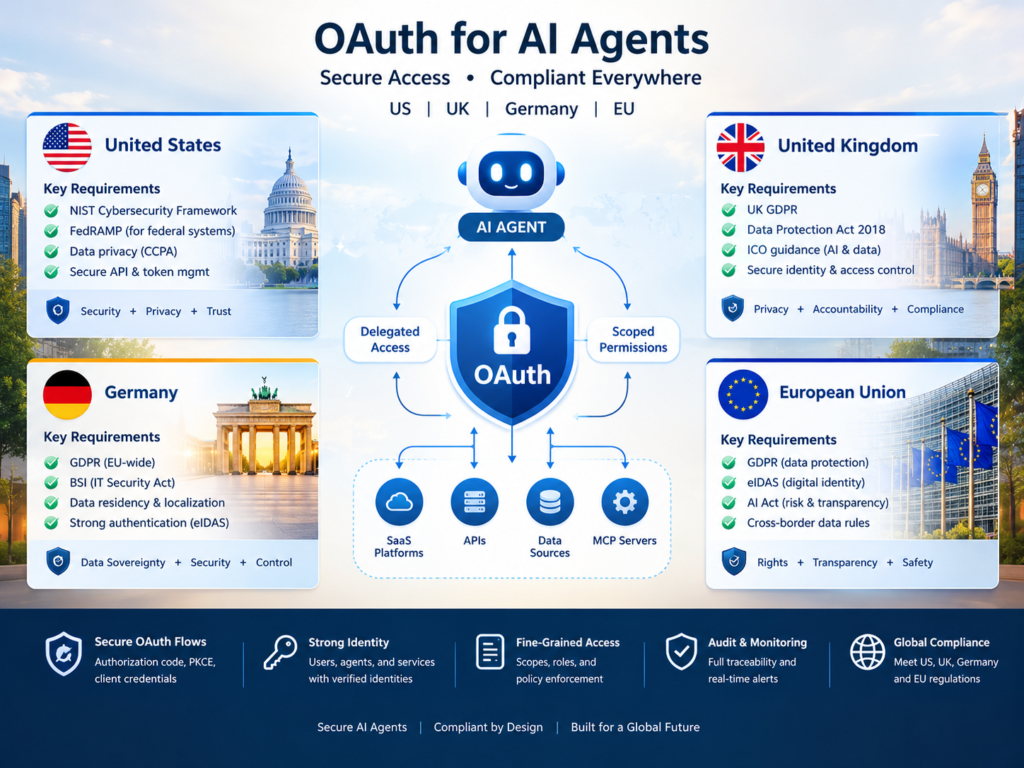
The core security architecture can remain consistent across regions, but privacy, auditability, sector requirements, and documentation obligations can differ.
USA.
Consider a healthcare agent accessing electronic protected health information in New York.
The HIPAA Security Rule requires regulated entities to apply appropriate administrative, physical, and technical safeguards to ePHI. Its technical safeguards include access controls, authentication, and mechanisms to record and examine system activity.
For an AI agent, that makes traceable identities, appropriate permissions, and comprehensive authorization logging especially important.
Payment or SaaS environments may also need to map their architecture to PCI DSS, SOC 2, contractual requirements, and internal risk policies where applicable.
UK.
For organizations in London, Manchester, or elsewhere in the UK, agents processing personal information need controls aligned with data-protection principles such as purpose limitation, data minimisation, security, and accountability.
The ICO’s AI guidance specifically discusses how AI can increase security risk and emphasizes processing only the personal data required for the intended purpose. The ICO notes that parts of its AI guidance are currently under review following the Data (Use and Access) Act, so organizations should confirm the latest applicable guidance during implementation.
Germany and the EU.
For Berlin, Munich, Frankfurt, and wider EU deployments, OAuth Sicherheit für KI-Agenten should support least privilege, purpose limitation, Datenschutz, and auditable Zugriffskontrolle.
Avoid placing unnecessary personal information in token claims. Document why each KI-Agent receives particular Autorisierung, and assess cross-border data access separately when relevant.
Regulated financial organizations should also evaluate applicable sector-specific requirements rather than assuming OAuth implementation alone establishes compliance.
A Practical OAuth Security Checklist for AI Agents
Before an Agent Receives API Access
Assign the agent a distinguishable identity.
Define its exact business task.
Identify the APIs and resources required.
Grant only the minimum scopes.
Set appropriate token lifetimes.
Record consent or delegated authority.
Define which actions require human approval.
For broader implementation planning, see Mak It Solutions’ software development services and web application development services.
During Agent Execution
Validate the token’s issuer, audience, intended resource, and relevant sender constraint.
Keep secrets in a vault, monitor unusual access patterns, enforce rate limits, preserve the delegation chain, and stop or escalate workflows that cross predefined risk thresholds.
After Access Is Granted
Centralize audit records, rotate credentials, revoke unused grants, remove inactive identities, and periodically review scopes.
A useful audit trail should answer five questions:
Who was the user? Which agent acted? What authority was delegated? Which resource was targeted? What action resulted?
Final Thoughts
Secure OAuth for AI agents depends on more than issuing access tokens. Organizations need clear separation between user identities, agent identities, and delegated authority, supported by least-privilege scopes, short-lived credentials, secure secret storage, and reliable audit trails. These controls reduce the risk of token misuse, excessive permissions, and unauthorized actions across APIs, MCP servers, and enterprise systems.
As AI agents gain more autonomy, OAuth and IAM architectures must become more deliberate. Strong delegation controls, human approval for sensitive actions, continuous monitoring, and fast revocation help keep agent access manageable, traceable, and aligned with security and compliance requirements.
If your AI agents already connect to SaaS platforms, enterprise APIs, MCP servers, or internal data, review whether every sensitive action can be traced back to a user, an agent identity, a defined permission, and an intended resource.
Mak It Solutions can help scope secure API, IAM, and agent-integration architecture. Request a scoped consultation from Mak It Solutions.
Key Takeaways
Secure OAuth for AI agents is less about giving autonomous software a token and more about controlling how authority flows through the system.
The strongest architectures.
Give production agents distinguishable identities;
Grant narrowly scoped permissions;
Prefer short-lived and resource-specific access tokens;
Use sender constraints such as DPoP or mTLS where appropriate;
Keep access and refresh credentials outside model context;
Reduce authority during downstream delegation;
Require human authorization for high-impact actions;
Design logging and revocation before production deployment.
FAQs
Q : Should every AI agent have its own OAuth client ID?
A : Not every temporary agent instance necessarily needs a separate OAuth client registration. Production agents should, however, be distinguishable and independently governable where their functions, permissions, owners, or risk profiles differ.
Separate client identities or workload credentials can simplify policy enforcement, auditing, incident investigation, and revocation.
Q : Can an AI agent safely use a user’s refresh token?
A : Technically, an agent can operate with a refresh token, but directly giving the model or agent runtime long-term possession of it increases risk.
A safer architecture keeps refresh credentials inside a trusted token or secrets service and gives the agent short-lived, constrained access credentials as needed.
Q : Should OAuth tokens appear inside an LLM context window?
A : They should generally remain outside it.
Access tokens, refresh tokens, client secrets, private keys, and similar credentials can leak through prompt histories, traces, debugging systems, tool outputs, or downstream providers. A trusted application layer should handle credential retrieval and API presentation.
Q : How should OAuth access be revoked when an AI agent is disabled?
A : Disable the relevant agent or workload identity, revoke associated grants and refresh credentials, invalidate relevant sessions, rotate exposed secrets, and review downstream credentials created through delegation.
Centralized IAM and secrets management make this substantially easier.
Q : Can multiple AI agents share the same service account?
A : They can, but doing so weakens attribution and can increase the blast radius of a compromised credential.
Separate identities are preferable when agents have different functions, owners, data access, or risk levels. Where sharing is unavoidable, keep permissions narrow and preserve reliable per-agent audit context.