


Zero Trust Strategy 2026 for AI-Era Security
Zero Trust Strategy 2026 for AI-Era Security
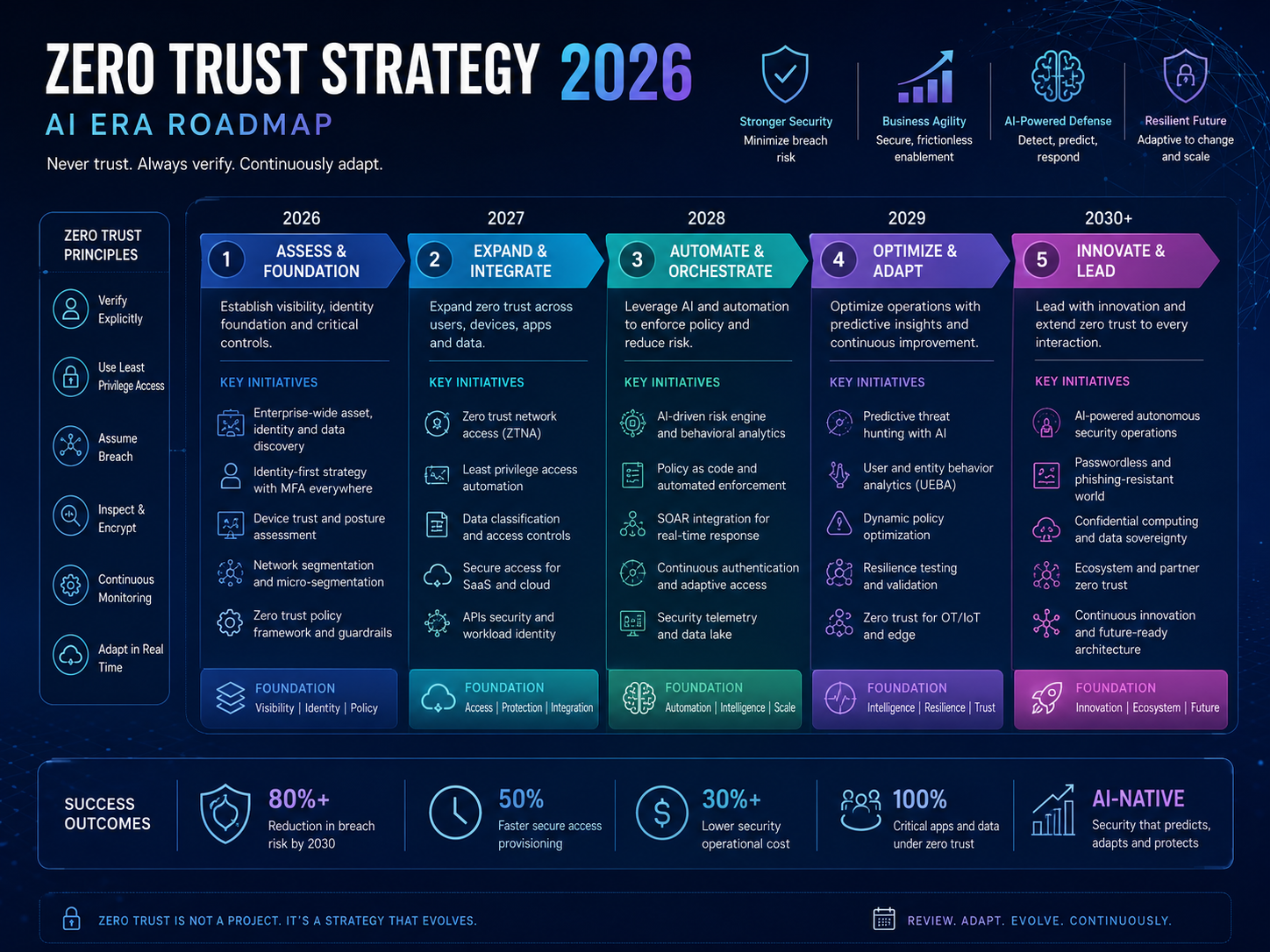
Zero Trust Strategy 2026 for AI-Era Security
A zero trust strategy 2026 is no longer just about “verifying everything.” It is an identity-first operating model for controlling access across users, devices, workloads, APIs, AI agents, cloud platforms, and sensitive data.
A strong zero trust strategy 2026 helps enterprises move from one-time verification to continuous authorization. That means access is re-evaluated based on identity, device health, behavior, data sensitivity, workload context, and live risk signals—not just a successful login.
NIST SP 800-207 defines zero trust as a shift away from static, network-based perimeter defenses toward users, assets, and resources. It also states that no implicit trust should be granted based only on network location or asset ownership.
Why Zero Trust Strategy 2026 Goes Beyond “Verify Everything”
“Never trust, always verify” is still useful, but it is now the starting point. In 2026, enterprises need more than MFA at login. They need access decisions that can change during a session.
That matters because modern environments are messy. Employees work remotely. SaaS tools connect to internal systems. APIs move data across platforms. AI agents can query databases, call tools, and trigger workflows. A static access check cannot handle that level of risk.
For CISOs, architects, and compliance teams in the USA, UK, Germany, and the wider EU, zero trust now has to support security, resilience, and audit evidence at the same time.
What Comes After Verify Everything in Zero Trust?
What comes after “verify everything” is continuous, context-aware authorization.
Instead of asking, “Did this user pass MFA?” the better question is:
“Should this user, device, service, workload, or AI agent still have this exact level of access right now?”
That decision should consider.
Identity and role
Device posture
Session behavior
Location and network signals
Data sensitivity
Application or workload context
Threat intelligence
Business risk
Compliance requirements
The UK NCSC describes zero trust as an architectural approach where inherent trust in the network is removed, the network is treated as hostile, and each request is verified against access policy. Its guidance also highlights users, devices, services, data, policies, monitoring, and authorization as core design areas.
In practice, zero trust architecture is not just a VPN replacement or a ZTNA rollout. It is a wider operating model that connects identity, endpoint security, network controls, cloud workloads, data protection, monitoring, and governance.
For secure digital platforms, Mak It Solutions can align zero trust principles with web development services, APIs, cloud workloads, and enterprise applications.
Continuous Authorization and Identity Fabric
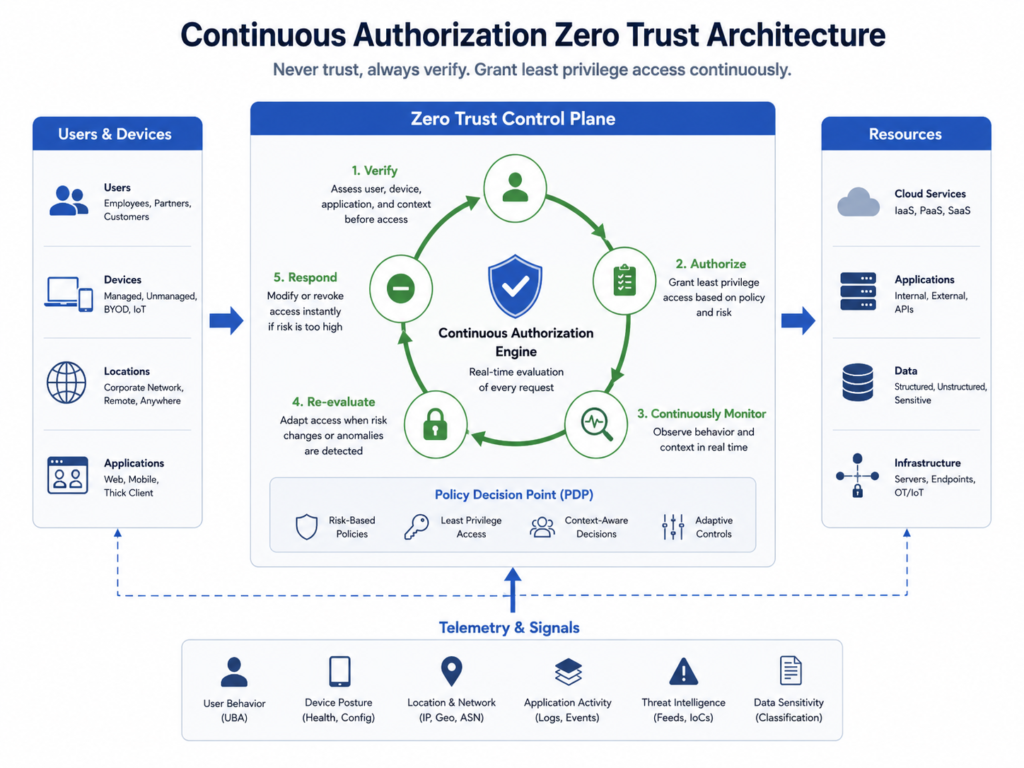
Continuous authorization means access is evaluated before, during, and after a session. It connects identity, endpoint, network, application, and data signals so policies can adapt when risk changes.
For example, a user may pass MFA in the morning. But if the same session later shows impossible travel, abnormal file downloads, risky device posture, or suspicious admin activity, the system should be able to step up authentication, restrict access, block downloads, or terminate the session.
This is where an identity fabric becomes important. It connects IAM, PAM, endpoint protection, SIEM, EDR/XDR, data classification, and policy engines into one decision-making layer.
Common platforms in this ecosystem may include Microsoft Entra, Okta, Zscaler, Palo Alto Networks, CrowdStrike, Cloudflare, and other identity, access, and security tools. The vendor mix matters less than the architecture. The goal is to reduce standing privilege, enforce least privilege, and make risky access visible.
For custom portals, SaaS dashboards, APIs, and backends, secure engineering should be designed into the application stack from the beginning through services such as Node.js development and Python development.
IBM’s 2025 Cost of a Data Breach Report puts the business case into sharper focus. IBM reported a global average breach cost of USD 4.4 million, a 9% decrease from the previous year, and USD 1.9 million in cost savings for organizations using AI extensively in security compared with those that did not.
Zero Trust for AI, Agents, and Non-Human Identities
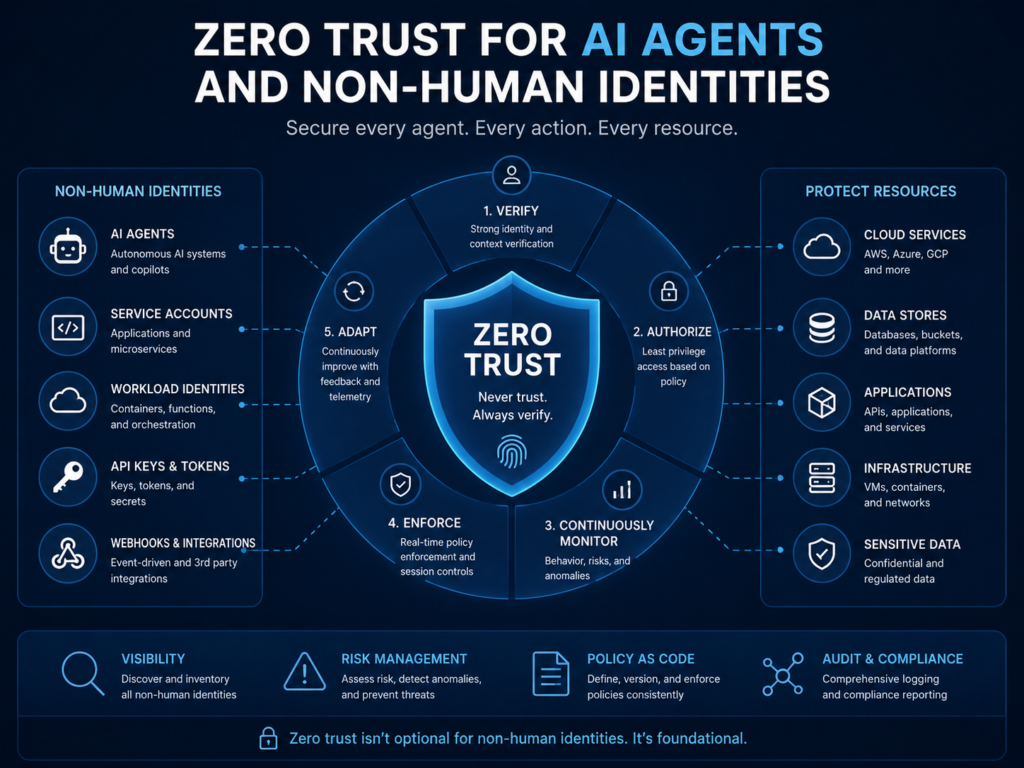
Zero trust for AI applies identity, least privilege, monitoring, policy enforcement, and data controls to AI systems, agents, APIs, plugins, models, service accounts, and automated workflows.
AI agents are not just chat interfaces. They can summarize contracts, update CRM records, query data warehouses, call APIs, generate code, create tickets, and interact with business tools. That makes them powerful and risky.
A zero trust strategy 2026 should treat AI agents as non-human identities. Each agent needs.
A clear owner
Scoped permissions
Approved tools
Restricted data access
Secrets rotation
Logging and monitoring
Human approval for sensitive actions
Rate limits
Kill-switch controls
IBM reported that 97% of organizations with an AI-related security incident lacked proper AI access controls, while 63% lacked AI governance policies to manage AI or prevent shadow AI.
That is why AI access governance should not be bolted on later. It should be part of the identity fabric, cloud architecture, data governance model, and incident response plan.
For AI-enabled products, Mak It Solutions’ artificial intelligence resources and data engineering expertise can support governed data flows, RAG pipelines, analytics controls, and secure automation.
Zero Trust Maturity Model and Implementation Roadmap
A mature zero trust program is not a one-time tool purchase. It is a phased roadmap that turns principles into measurable controls.
Start by assessing five core domains.
| Domain | What to Assess |
|---|---|
| Identity | Users, admins, service accounts, AI agents, MFA, PAM |
| Devices | Managed devices, BYOD, endpoint health, posture checks |
| Networks | Segmentation, ZTNA, encrypted traffic, lateral movement |
| Applications & Workloads | SaaS, APIs, cloud workloads, containers, CI/CD |
| Data | Classification, encryption, access control, monitoring |
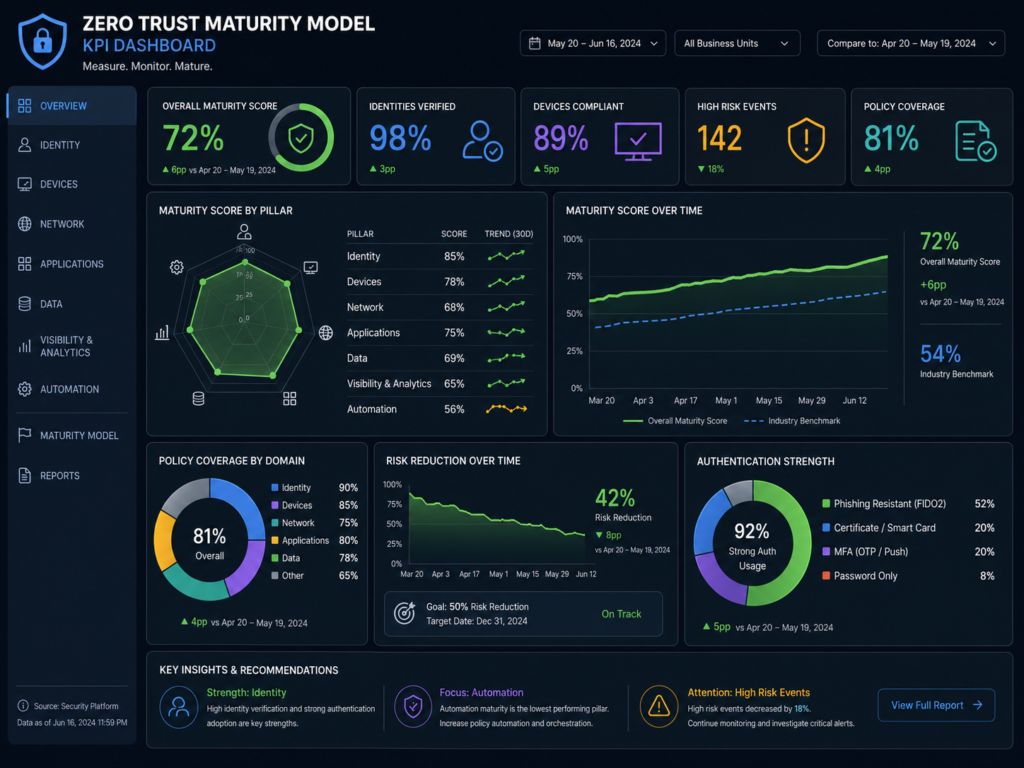
CISA’s Zero Trust Maturity Model includes five pillars and three cross-cutting capabilities: visibility and analytics, automation and orchestration, and governance. This makes it useful for planning practical maturity improvements instead of treating zero trust as a vague security slogan.
Useful KPIs include.
MFA coverage
Privileged access reduction
Unmanaged device access
Risky sessions blocked
Sensitive data exposure
Mean time to revoke access
Policy exception volume
AI agent access reviews
Service account ownership
The point is not to “finish” zero trust. The point is to show measurable risk reduction quarter by quarter.
GEO Compliance: USA, UK, Germany, and EU
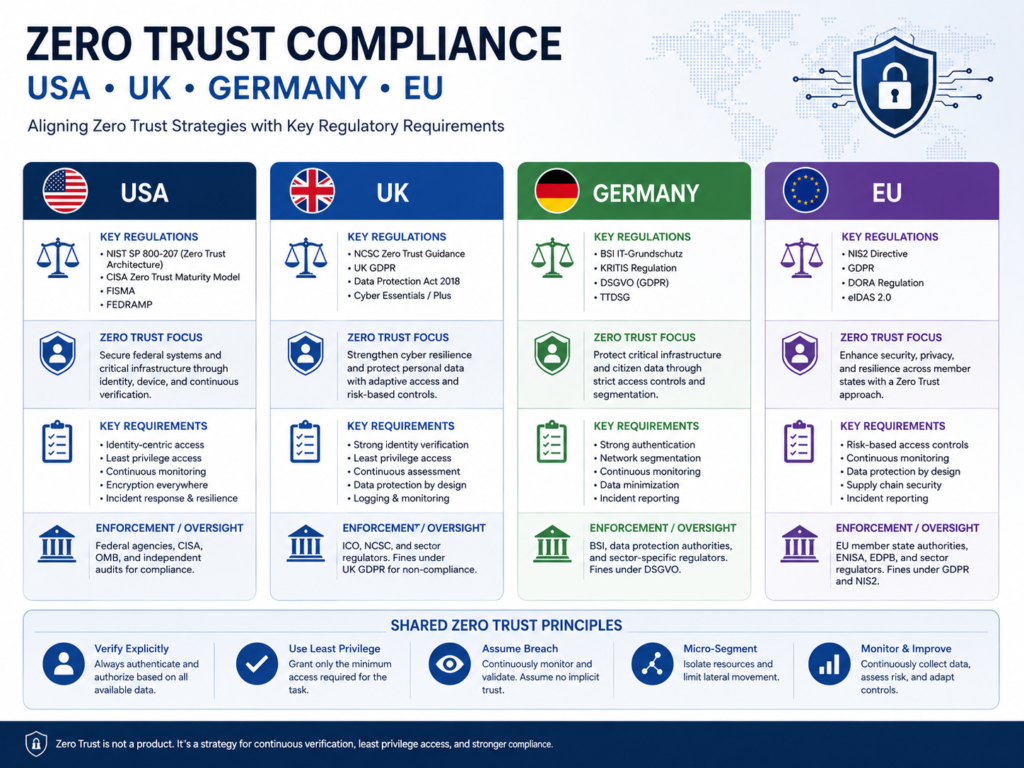
Zero trust does not automatically make an organization compliant. It does, however, support compliance by improving access control, segmentation, monitoring, logging, evidence collection, and operational resilience.
This section is general guidance, not legal advice. Regulated organizations should map zero trust controls to their own legal, contractual, and audit obligations.
USA.
For USA enterprises in Washington DC, New York, Austin, and San Francisco, zero trust programs often align with NIST SP 800-207 and CISA maturity guidance.
Healthcare organizations should map controls to HIPAA Security Rule safeguards for electronic protected health information, while payment environments should consider PCI DSS v4.0.1 requirements. The PCI Security Standards Council published PCI DSS v4.0.1 as a limited revision in June 2024.
SOC 2 teams can also use zero trust evidence around access reviews, logging, least privilege, change management, and incident response to support audit readiness.
UK.
UK businesses in London, Manchester, Birmingham, and Edinburgh should align zero trust with NCSC design principles, UK GDPR accountability, NHS supplier expectations, Open Banking APIs, and FCA-regulated resilience.
The ICO highlights UK GDPR principles including data minimization, integrity and confidentiality, and accountability. These fit naturally with zero trust controls such as least privilege, access logging, data classification, and secure processing.
Germany and EU.
For Germany and EU teams in Berlin, Munich, Frankfurt, Paris, Amsterdam, Dublin, and Zurich, zero trust should be mapped to DSGVO/GDPR, NIS2, DORA, ISO 27001, BSI guidance, ENISA measures, BaFin expectations, and sector-specific obligations.
DORA entered into application on 17 January 2025 and applies to banks, insurance companies, investment firms, other financial entities, and ICT third-party service providers in scope. It focuses on digital operational resilience, ICT risk management, incident reporting, testing, third-party risk, and information sharing.
For regulated financial, healthcare, SaaS, and critical infrastructure teams, this makes zero trust more than a security upgrade. It becomes part of resilience planning.
How to Build a Zero Trust Strategy 2026 Roadmap
A zero trust roadmap should start with business risk, not vendor selection. The right question is not “Which tool should we buy?” It is “Which access risks create the most business, compliance, and operational exposure?”
Define Identity, Data, Workload, AI, and Compliance Priorities
Identify crown-jewel systems, sensitive data, privileged roles, third-party access, AI workflows, and regulated obligations.
For many organizations, the first priority is not advanced automation. It is basic visibility: who has access, which devices are trusted, where sensitive data lives, and which non-human identities are unmanaged.
Mak It Solutions can support discovery across business intelligence services, SaaS platforms, mobile apps, and data pipelines.
Choose the Right Architecture Patterns
Choose architecture patterns based on workload reality.
ZTNA can help secure private application access. SSE and SASE can improve secure connectivity. IAM and PAM support identity governance. CNAPP helps with cloud-native workloads. Data security posture management helps teams understand where sensitive data is exposed.
For customer-facing products, include mobile app development security from the beginning rather than treating it as a final-stage checklist.
Measure Maturity and Reduce Risk by Quarter
The strongest zero trust programs show measurable progress.
A practical roadmap should reduce standing privilege, improve visibility, govern AI agents, strengthen device trust, segment critical workloads, and make compliance evidence easier for auditors.
A simple quarterly roadmap may look like this.
| Phase | Focus | Outcome |
|---|---|---|
| Discovery | Identity, data, devices, apps, AI agents | Risk map and maturity baseline |
| Foundation | MFA, PAM, access reviews, device posture | Reduced obvious access risk |
| Expansion | ZTNA, segmentation, monitoring, data controls | Better protection across workloads |
| Optimization | Automation, continuous authorization, AI governance | Adaptive access and stronger evidence |
Final Thoughts
A strong zero trust strategy 2026 is no longer a single security project or a one-time verification model. It is a continuous operating approach that connects identity, devices, workloads, AI agents, data, and compliance into one adaptive security framework. For modern enterprises, the goal is simple: reduce implicit trust, limit unnecessary access, and respond faster when risk changes.
As AI adoption, cloud platforms, APIs, and regulatory pressure grow, zero trust gives security and compliance teams a practical roadmap for safer digital operations. Start with maturity, prioritize high-risk access, and build controls that improve quarter by quarter.
Ready to Build a Practical Zero Trust Strategy 2026?
Planning a zero trust strategy 2026 for a regulated, cloud-first, or AI-enabled environment? Mak It Solutions can help you scope a maturity assessment, architecture workshop, or AI security readiness review.
Start with a focused discovery session through our services team or contact Mak It Solutions to request a practical roadmap.
Key Takeaways
Zero trust in 2026 is a continuous operating model, not a one-time verification slogan.
Continuous authorization combines identity, device, behavior, workload, session, and data signals.
AI agents and non-human identities need scoped access, logging, approvals, monitoring, and kill-switch controls.
CISA and NIST provide practical structure for maturity, especially across identity, devices, applications, networks, workloads, and data.
USA, UK, Germany, and EU compliance programs can use zero trust to strengthen audit evidence and operational resilience.
Vendor choice should follow architecture, business risk, and maturity goals not the other way around.
FAQs
Q : Is zero trust the same as ZTNA or SASE?
A : No. Zero trust is the security strategy. ZTNA and SASE are architecture patterns that can support it. A complete zero trust strategy also includes IAM, endpoint posture, data protection, monitoring, governance, and least privilege access.
Q : How long does zero trust implementation usually take for enterprises?
A : Most enterprises should treat zero trust as a phased program, not a single project. A practical first phase may take 8–16 weeks for assessment, roadmap, and priority controls. Broader implementation across identity, devices, applications, cloud, data, and AI governance can take 12–36 months depending on complexity.
Q : What are the biggest mistakes companies make with zero trust?
A : The biggest mistake is buying a tool and calling it zero trust. Other common mistakes include ignoring data classification, leaving service accounts unmanaged, allowing excessive admin privileges, treating MFA as “done,” and failing to monitor sessions.
Q : Does zero trust help with GDPR, NIS2, and DORA compliance?
A : Yes, zero trust can support GDPR, NIS2, and DORA by improving access control, segmentation, logging, monitoring, data protection, and operational resilience. It does not replace legal compliance work, vendor due diligence, policies, or incident reporting.
Q : How should companies secure AI agents with zero trust?
A : Companies should treat AI agents as non-human identities. Give each agent a clear owner, scoped permissions, approved tools, restricted data access, logging, rate limits, and human approval for sensitive actions. High-ris
[…] Trust architecture and tested disaster recovery can strengthen long-term resilience. See the Zero Trust strategy for AI-era systems and GCC cloud disaster recovery […]
[…] AI agent identity management guide and zero trust strategy for AI-era security provide complementary approaches to identity and access […]
[…] for its approved purpose, for only as long as that authority is needed. Mak It Solutions’ Zero Trust Strategy for AI-Era Security provides a complementary […]
[…] organizations developing broader identity controls, Mak It Solutions’ Zero Trust Strategy 2026 for AI-Era Security provides additional […]