


AI Governance in GCC: Human Approval vs Autonomy
AI Governance in GCC: Human Approval vs Autonomy
AI Governance in GCC: Human Approval vs Autonomy
AI systems can analyze information, communicate with customers, recommend decisions and increasingly take actions on their own. But technical capability does not automatically justify decision-making authority.
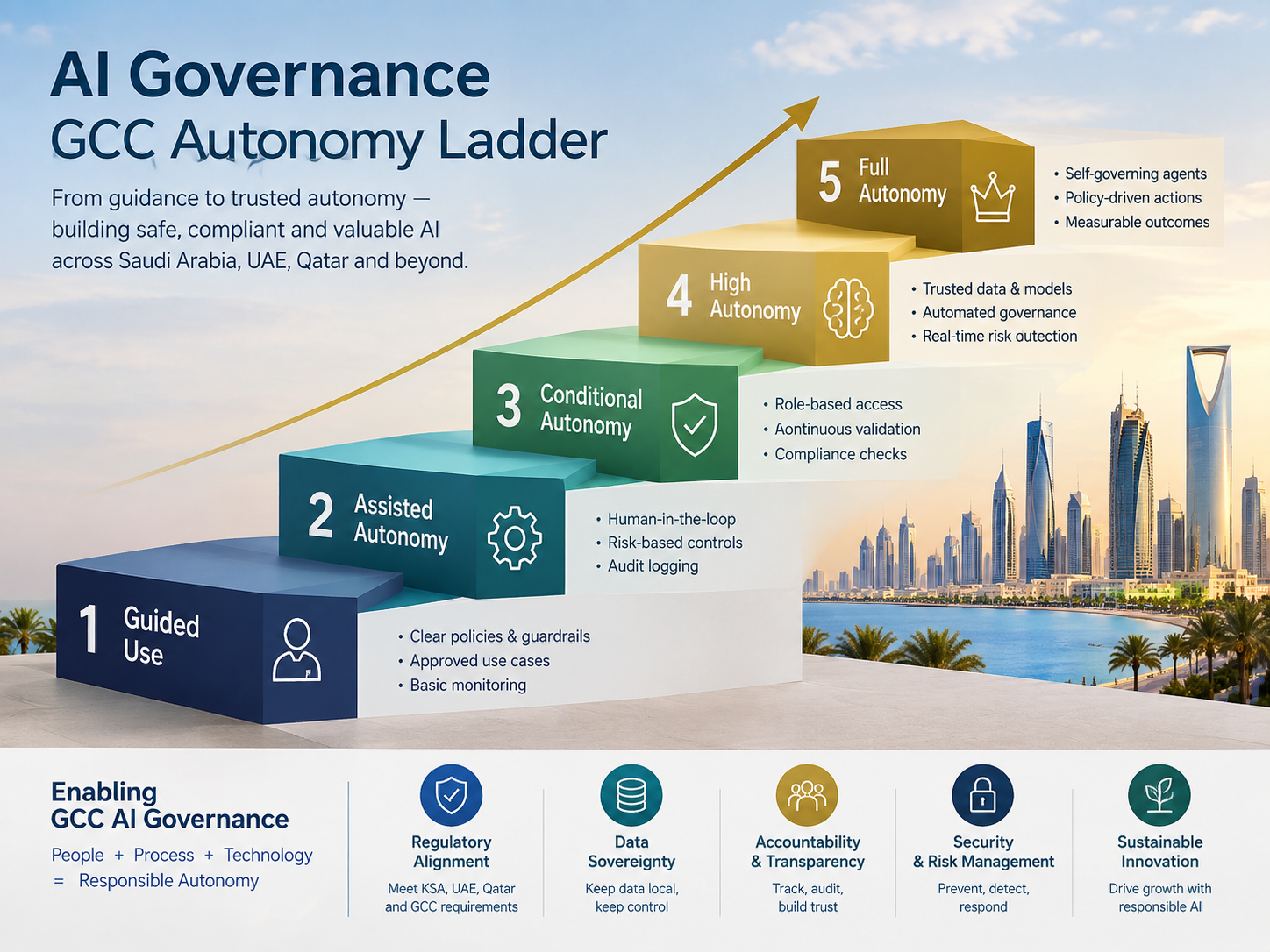
For organizations in Saudi Arabia, the UAE and Qatar, AI governance is about deciding what AI can do independently, what needs monitoring, and what should remain under human control. A practical model is a five-level GCC AI Autonomy Ladder: Autonomous → Monitor → Review Exceptions → Human Approval → Human Decision Only.
The core principle is simple: as impact, irreversibility, sensitive-data exposure and regulatory risk increase, human oversight should generally increase as well.
What Does AI Governance Mean for GCC Companies?
AI governance goes beyond policies and ethics
AI governance is more than publishing an ethics policy. It establishes who has authority, who remains accountable and what controls apply when an AI system recommends or performs an action.
A practical governance framework typically covers.
Decision rights and accountability
Risk classification
Monitoring and escalation
Human intervention and override
Audit evidence and recordkeeping
Privacy and security controls
Transparency and explain ability
Saudi Arabia’s SDAIA, for example, takes a risk-based approach to responsible AI, with principles covering areas such as privacy, security, transparency, explain ability and accountability. Pasted text
For organizations building the analytics layer behind these controls, Mak It Solutions’ Business Intelligence services can support reporting and data-driven workflows.
Human-in-the-loop vs human-on-the-loop AI
Not every AI workflow needs the same degree of human involvement.
Human-in-the-loop AI generally means the AI provides a recommendation, but a person retains approval authority. Human-on-the-loop AI allows a system to perform routine activities while people monitor it and retain the ability to intervene.
A third model, human-out-of-the-loop, gives the system substantially greater independence. The draft’s cited CBUAE guidance for licensed financial institutions frames this approach as appropriate for low-risk, non-material processes when suitable controls are in place. Pasted text

Why agentic AI makes governance more important
Traditional AI often stops at producing an answer or recommendation. Agentic AI can go further by initiating workflows, communicating with other systems and executing actions.
That changes the governance question.
Before deployment, organizations should define clear AI decision rights.
What can the AI recommend?
What can it execute?
What must it escalate?
What is it never allowed to decide independently?
The GCC AI Autonomy Ladder: How Much Control Should AI Get?
A useful way to structure AI governance in GCC organizations is to assign each AI action an appropriate level of autonomy.
| Level | Control Model | Typical Use |
|---|---|---|
| 1 | Autonomous | Low-risk, reversible routine tasks |
| 2 | Monitor | Automated tasks with ongoing supervision |
| 3 | Review Exceptions | Automation with predefined escalation triggers |
| 4 | Human Approval | AI recommends or prepares; a person authorizes |
| 5 | Human Decision Only | Consequential decisions remain with authorized people |
The important point is that autonomy should be assigned to individual actions and workflows not simply to an entire AI platform.
Autonomous and monitored AI
Lower-risk activities can often operate with greater autonomy when appropriate logging, access controls and monitoring are in place.
Examples may include document classification, internal summaries, workflow routing, demand forecasting and operational recommendations.
The common thread is reversibility. If an error is relatively easy to identify and correct, greater automation may be practical.
Exception review and human approval
As consequences increase, so should oversight.
Customer communications, payment-related actions, sensitive-data workflows and material commercial decisions may require exception queues or explicit human authorization.
A Dubai e-commerce company, for example, might automate routine product recommendations while escalating unusual refunds or sensitive account actions.
Mak It Solutions’ e-commerce solutions and mobile app development services can support digital workflows where these controls need to be built into customer-facing systems.
Human decision only
The strongest human controls should be considered where AI influences consequential legal, employment, safety or regulatory outcomes.
AI can still assist with analysis, prioritization or information retrieval. The final decision and accountability, however, remain clearly assigned to an authorized person.
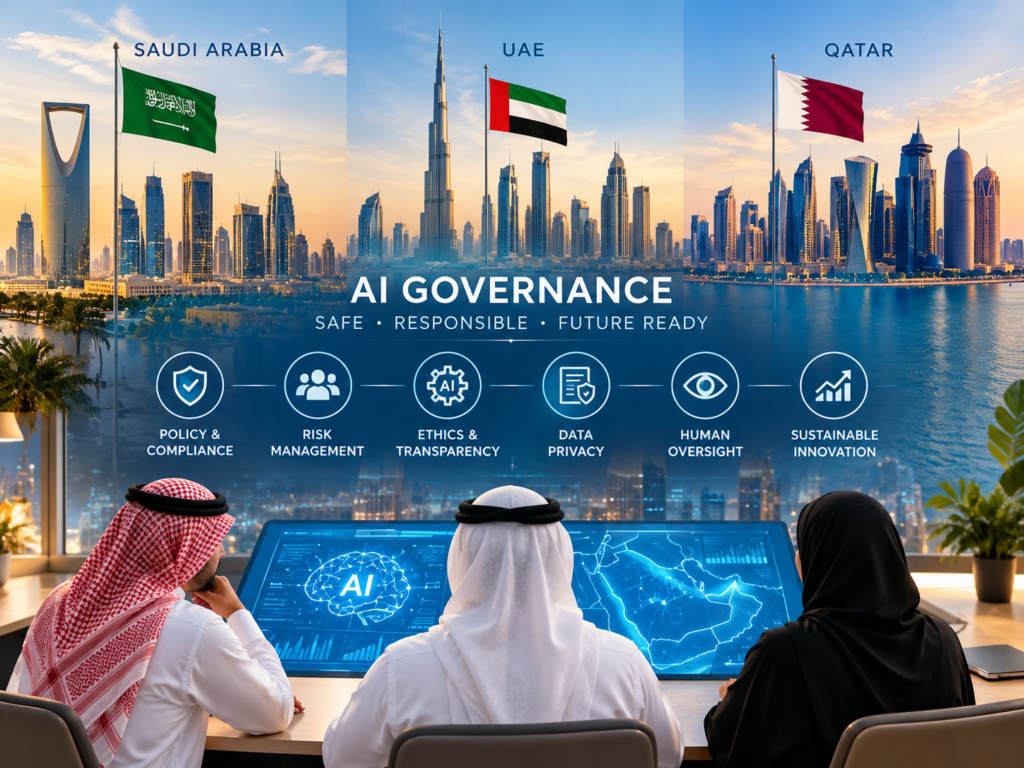
How Saudi Arabia, UAE and Qatar Approach Human Oversight
There is no single GCC-wide AI governance checklist that fits every organization. Companies need to consider their jurisdiction, industry, data, customers and the specific consequences of each AI use case.
Saudi Arabia.
Saudi Arabia’s SDAIA framework emphasizes responsible AI adoption, including privacy and security, transparency, explain ability, accountability and risk management. The supplied draft also notes the introduction of a national AI risk-management framework in July 2026, structured around identifying, assessing, treating and continuously monitoring AI risks. Pasted text
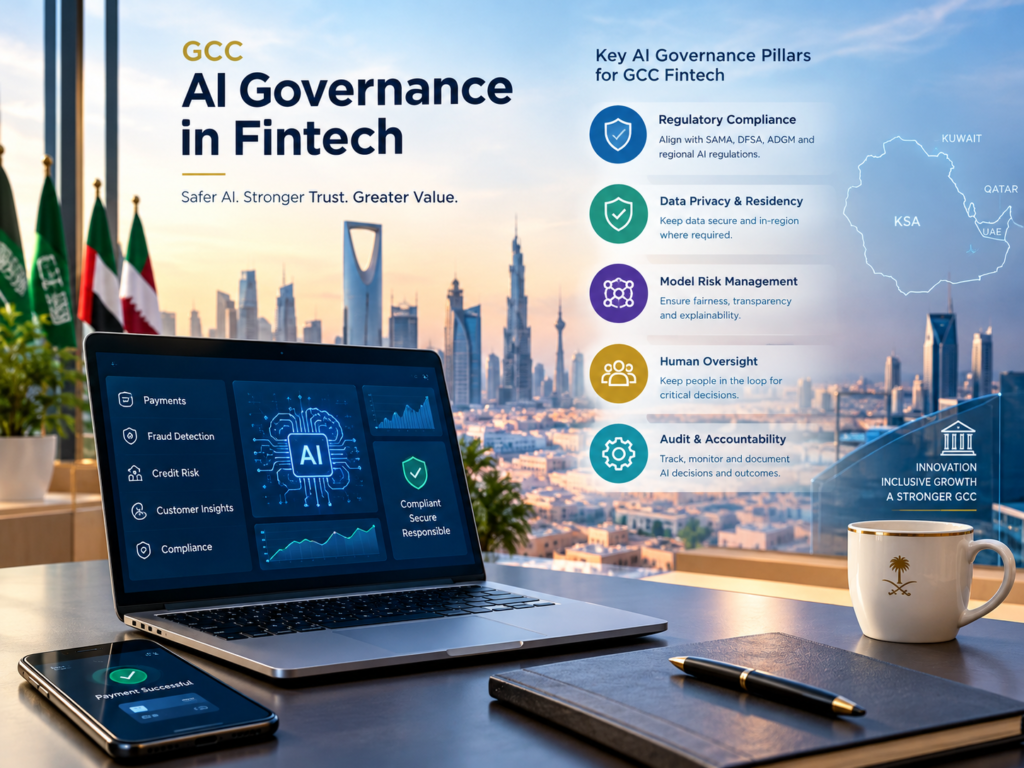
In practice, a Riyadh fintech might therefore use stronger approval controls around lending, payments or compliance-related decisions while also considering applicable financial-sector and data-governance requirements.
UAE.
The supplied CBUAE material distinguishes between human-in-the-loop, human-on-the-loop and human-out-of-the-loop approaches, with the degree of human involvement linked to consumer risk. Pasted text
For companies in Dubai or Abu Dhabi, the applicable governance landscape may also depend on the sector and jurisdiction. Relevant requirements can include those associated with bodies or frameworks such as TDRA, ADGM or DIFC.
The practical lesson is not to treat “UAE compliance” as one universal checklist.
Qatar.
Organizations in Doha should similarly map AI systems against the Qatari requirements relevant to their activities, including applicable financial, privacy, cybersecurity and technology requirements.
For consequential workflows, governance should make three things clear: who owns the decision, when a person can intervene and how exceptions are escalated.
Automation should not make accountability ambiguous.
Which AI Decisions Need Human Approval?
A useful rule is to give AI autonomy according to risk rather than capability.
An AI system might technically be capable of performing a task from start to finish. That does not mean it should have unrestricted authority to do so.
Before assigning autonomy, evaluate five factors.
Impact: How serious are the consequences if the AI is wrong?
Reversibility: Can the action be quickly and reliably undone?
Data sensitivity: Does the workflow involve confidential or personal information?
Regulatory exposure: Is the decision governed by sector-specific or legal requirements?
Confidence: How reliable is the model for this specific scenario?
Together, these factors provide a practical basis for choosing an appropriate human-control level.
Financial, legal and regulatory decisions
A Riyadh fintech might allow AI to flag unusual transactions automatically while routing consequential account or financial actions to authorized reviewers.
The goal is not to eliminate automation. It is to place human authority at the points where mistakes become materially harder to reverse.
Customer, employee and personal-data decisions
Employment screening, customer eligibility and sensitive personalization require additional scrutiny because their outcomes can directly affect individuals.
For GCC customer-facing systems, governance should also consider the user experience. Clear Arabic communication, understandable explanations and practical escalation routes can be just as important as back-end controls.
Use materiality and reversibility as approval triggers
Instead of asking, “Can AI do this?”, ask, “What happens if AI gets this wrong?”
That shift makes governance much more practical.
A low-impact inventory recommendation and a customer account restriction may use similar underlying technology, yet they should not automatically receive the same autonomy.
Building an AI Governance Framework Without Killing Automation
Good governance does not require putting a human approval step in front of every AI action. Doing that can erase much of the operational value AI is supposed to create.
The better approach is selective control.
Define AI decision rights and escalation thresholds
For every meaningful AI workflow, document what the system may.
Recommend
Execute automatically
Execute only within defined limits
Escalate for review
Never decide independently
Teams should know these boundaries before the system goes live rather than improvising after an incident.
Build audit trails, monitoring and human override
Organizations should maintain evidence showing how important AI-assisted actions occurred.
Depending on the use case, this can include model monitoring, decision logs, approval records, exception queues, access records and override mechanisms.
For organizations developing governance dashboards and reporting layers, Mak It Solutions’ Business Intelligence services can support the underlying analytics environment.
Align data, infrastructure and Arabic UX controls
Infrastructure choices should reflect the actual jurisdiction, data and workload.
The supplied draft references regional cloud infrastructure such as Azure UAE Central and Qatar Central. But regional hosting alone should not be treated as proof of regulatory compliance; organizations still need to assess residency, security, contractual and sector-specific obligations. Pasted text
Customer-facing platforms can combine these governance controls with secure web development services and localized mobile experiences.
GCC AI Governance Examples by Industry
Fintech.
Consider a Riyadh fintech using AI for fraud monitoring.
The system could continuously analyze transactions and flag suspicious patterns. A consequential action such as restricting an account or taking a material financial step could then move to an authorized reviewer.
AI handles scale and speed. Human authority remains at the higher-impact decision point.
Government and citizen services: automate the workflow, not accountability
A UAE government workflow might use AI to classify documents and route service requests automatically.
When a decision materially affects a citizen, however, the workflow can provide human review or escalation.
This allows routine administration to move faster without making consequential decisions opaque or difficult to challenge.
Retail and logistics: where greater autonomy can make sense
Retail and logistics often provide stronger candidates for higher autonomy because many decisions are measurable and reversible.
A Doha retailer could use AI for inventory forecasting, while a Dubai e-commerce business might automate merchandising or product recommendations.
Higher-risk customer or payment actions can remain behind predefined approval thresholds.
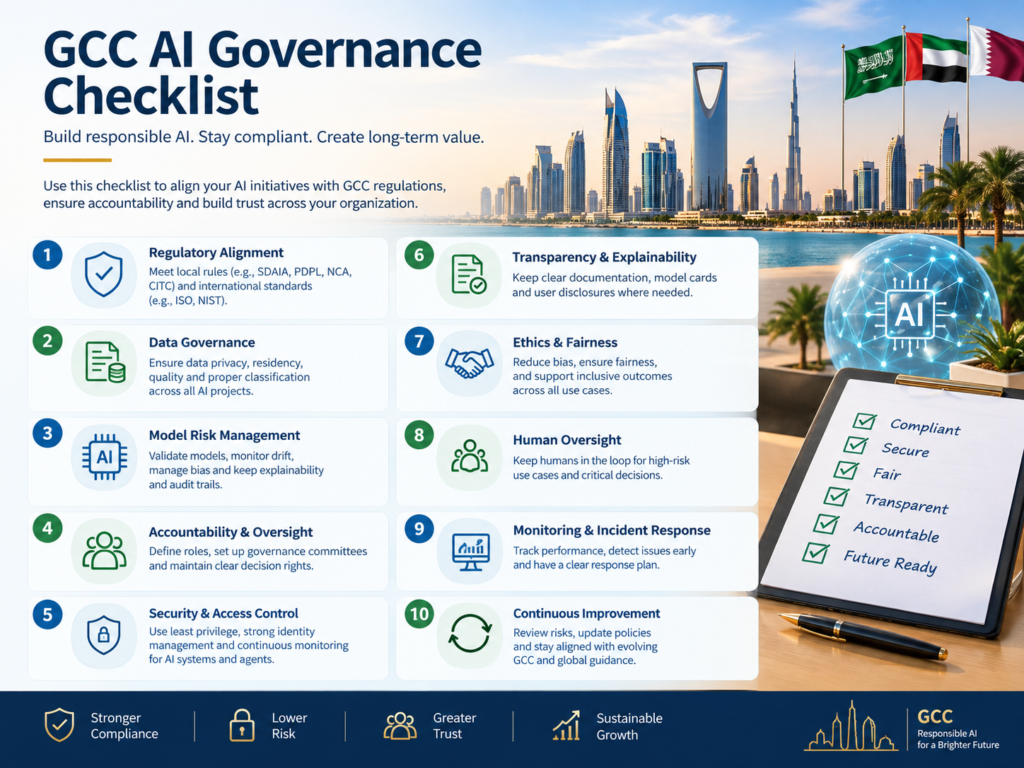
A Practical GCC AI Governance Checklist
Classify the AI system by impact and risk
Identify the people affected, data involved, business process and applicable regulatory environment.
Then assess both the overall system and the individual actions it can perform.
Assign the right human-control model
Map each important workflow to one of the five levels.
Autonomous → Monitor → Review Exceptions → Human Approval → Human Decision Only
Avoid assigning one blanket autonomy level to an entire AI platform.
Test, document and review governance continuously
Define accountable owners, performance indicators, audit evidence, escalation procedures and reassessment processes.
AI systems change. Their use cases change. Regulations and organizational risk tolerances can change too.
For that reason, AI governance should be treated as an ongoing operating discipline rather than a one-time compliance exercise.
Concluding Remarks
The goal of AI governance in GCC organizations is not to choose between complete automation and constant human intervention. It is to put human control where it matters most.
Routine, reversible and measurable actions may be suitable for greater autonomy. As financial impact, personal-data sensitivity, legal consequences or regulatory exposure rise, stronger review and approval mechanisms become more important.
Before giving an AI agent more authority, define exactly what it can do, when it must escalate and who remains accountable.
Explore Mak It Solutions‘ technology and development services or contact Mak It Solutions to discuss a GCC-focused digital and AI governance strategy.
FAQs
Q : Does Saudi Arabia require human oversight for enterprise AI systems?
A : The supplied regulatory material describes Saudi AI governance as risk-based rather than applying one identical oversight model to every system. SDAIA’s principles address accountability, transparency, privacy, security and responsible use, while the draft’s July 2026 risk-management framework emphasizes ongoing assessment and monitoring. Pasted text
Organizations should determine the appropriate level of human oversight based on system risk, impact and any applicable sector-specific requirements.
Q : What is human-in-the-loop AI for UAE companies?
A : Human-in-the-loop AI means an AI system can produce a recommendation while an authorized person retains authority to approve or reject the outcome.
The supplied CBUAE material recognizes this model alongside human-on-the-loop and human-out-of-the-loop approaches for licensed financial institutions. Pasted text
Q : Can AI make customer decisions autonomously in Qatar?
A : It depends on the decision, applicable requirements, data involved and potential consequences.
Routine and reversible processes may justify greater autonomy, while sensitive financial, customer or personal-data decisions can require stronger controls. Organizations should map each workflow against the Qatari rules that apply to their specific activities.
Q : How should GCC fintech companies document AI approval decisions?
A : An AI audit trail can record the system involved, relevant inputs and outputs, approval or intervention, responsible person, timestamp and material exceptions.
The exact evidence required should be aligned with the organization’s jurisdiction, regulator and risk profile.
Q : What AI governance controls should Dubai and Riyadh companies use for AI agents?
A : Core controls can include risk classification, explicit AI decision rights, access controls, monitoring, audit logs, exception handling, human override and incident-response procedures.
A Dubai customer-service agent and a Riyadh financial AI system should not automatically receive identical autonomy because their consequences and regulatory exposure can differ.