


Post-Quantum Cryptography Migration: Risk-First Guide
Post-Quantum Cryptography Migration: Risk-First Guide
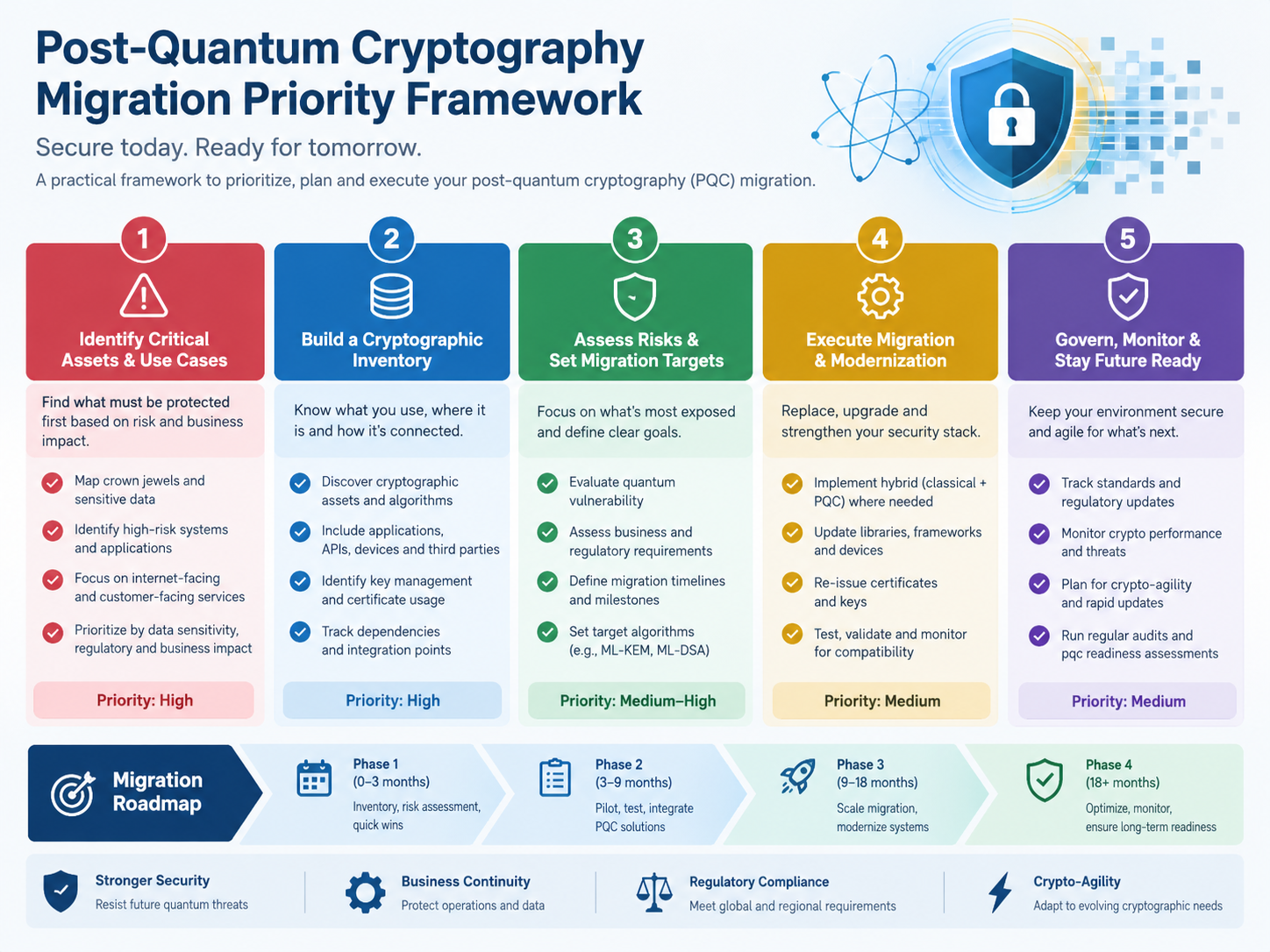
Post-Quantum Cryptography Migration: Risk-First Guide
Post-quantum cryptography migration is no longer just a future-facing research exercise. For enterprises in the US, UK, Germany and wider EU, it is becoming a practical security, architecture and procurement program.
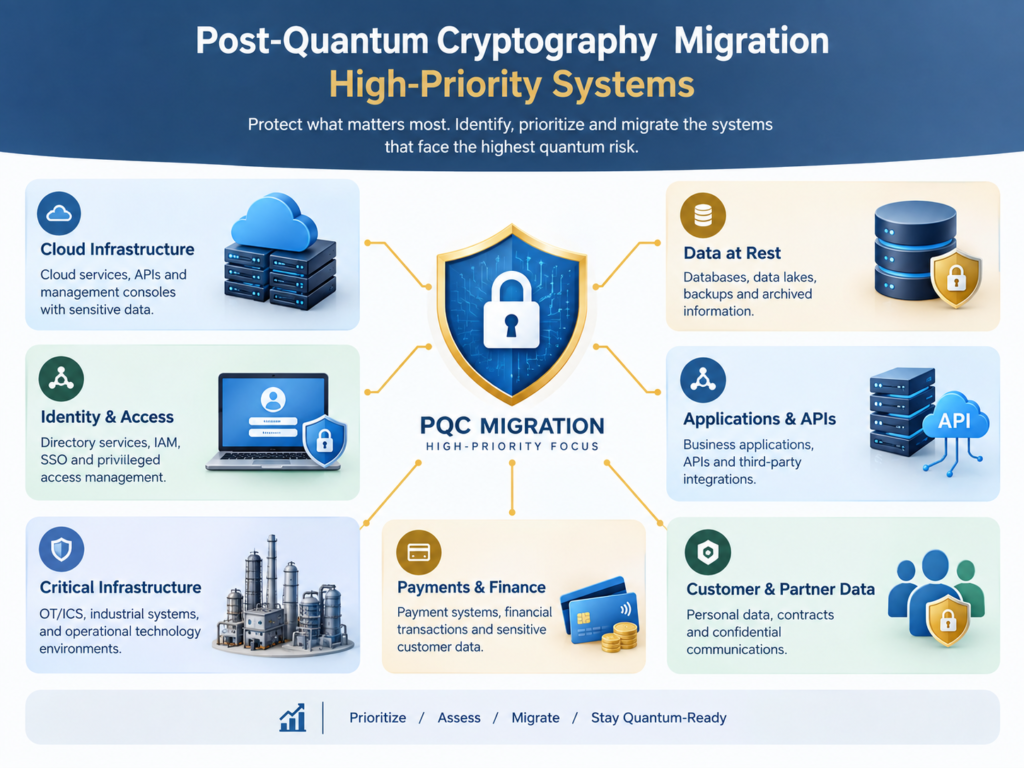
The first systems to assess are those protecting long-lived sensitive data, exposed communications, PKI and digital identity, critical operations, and hardware with long replacement cycles. The goal is not to replace every RSA or ECC implementation at once. A better approach is to rank systems by data lifespan, sensitivity, exposure, cryptographic dependency, business criticality and migration lead time.
NIST finalized its first three post-quantum cryptography standards in August 2024 and encouraged organizations to begin integrating them rather than waiting for a cryptographically relevant quantum computer to arrive.
What Makes an Application a Post-Quantum Cryptography Migration Priority?
Long-lived sensitive information deserves early attention because encrypted data captured today may remain valuable years from now. If sufficiently capable quantum computers eventually undermine widely used public-key algorithms, previously collected traffic could become vulnerable.
That is the logic behind harvest now, decrypt later.
But confidentiality lifetime is only one part of the decision. A useful PQC priority model considers.
How long the information must remain confidential.
Sensitivity and regulatory impact.
Internet, partner or third-party exposure.
Dependence on RSA, ECC or other affected public-key cryptography.
Business and operational criticality.
Identity and trust dependencies.
Migration difficulty and replacement lead time.
A highly sensitive platform that can be upgraded quickly may be easier to address than an embedded system that will remain in production for another decade.
Data Lifespan and Harvest-Now-Decrypt-Later Risk
Electronic health records, government information, merger documents, pharmaceutical research, financial records, legal archives and intellectual property may retain value for many years.
That changes the risk calculation.
A healthcare database in New York, an NHS-connected service in London or an industrial research platform in Munich may have a much longer confidentiality requirement than ordinary short-lived operational data.
Organizations should therefore ask a simple question: Will this information still matter if an attacker stores it today and gains stronger decryption capabilities years later?
Sensitivity, Exposure and Business Criticality
Encryption type alone does not determine migration priority.
HIPAA-regulated health information, GDPR/DSGVO personal data, payment environments and sensitive financial systems may warrant earlier assessment because compromise could create regulatory, financial and operational consequences.
PQC work should also connect with existing API security practices, especially where APIs expose sensitive data across organizational or cloud boundaries.
Migration Complexity and Replacement Lead Time
Risk must be balanced against how difficult a system is to change.
Legacy PKI, HSMs, firmware, embedded devices, network appliances and vendor-controlled platforms can have long upgrade cycles. The UK NCSC estimates that large organizations and those operating their own infrastructure may require roughly 2–3 years for discovery, assessment, migration strategy and an initial plan.
That means difficult systems may need attention early even when immediate exposure appears moderate.
Which Applications Should Migrate to Post-Quantum Cryptography First?
The strongest early candidates combine long confidentiality requirements, intercept able communications, foundational trust responsibilities or long technology lifecycles.
Long-Lived Confidential Data Systems
Begin with repositories where information must remain protected well into the future.
Common examples include.
EHR and clinical research platforms.
Financial and payment records.
Government-sensitive information.
Legal and regulatory archives.
Intellectual-property repositories.
Product designs, formulas and trade secrets.
A US hospital may prioritize long-retention HIPAA-protected records. An NHS supplier may focus on patient information with extended retention requirements. German healthcare, financial and industrial organizations should map sensitive data against GDPR/DSGVO and applicable sector obligations.
Internet-Facing TLS, APIs and Critical Communications
Internet-facing encrypted traffic deserves early discovery because an attacker may be able to capture communications without first compromising the endpoints.
TLS 1.3 services, APIs, remote-access infrastructure and sensitive service-to-service communications should therefore be mapped alongside the data they carry.
NIST’s FIPS 203 specifies ML-KEM, a post-quantum key-encapsulation mechanism designed for establishing shared secrets across public channels.
For API-heavy SaaS and cloud environments, PQC planning should complement existing cloud security and configuration controls rather than become a separate security silo.
PKI, Identity, Certificates and Roots of Trust
PKI deserves special attention because large parts of the technology estate may depend on it.
Map.
Certificate authorities.
Enterprise identity infrastructure.
Code-signing systems.
Authentication services.
Digital certificates.
HSM-backed keys.
Firmware-signing systems.
Long-lived roots of trust.
NIST’s initial standards include FIPS 204 for ML-DSA and FIPS 205 for SLH-DSA, both designed for digital signatures.
Signature migration can have downstream effects on certificate size, firmware verification, code signing, bandwidth, storage and established trust chains.
High-Risk Industries and Systems by Region
US Healthcare, Finance and Federal Environments
US organizations can anchor PQC programs around NIST standards and their existing cybersecurity governance.
NIST finalized FIPS 203, FIPS 204 and FIPS 205 on August 13, 2024, covering ML-KEM, ML-DSA and SLH-DSA.
Healthcare organizations should identify long-retention patient information and the systems protecting it. Financial institutions should examine banking APIs, payment infrastructure, HSMs, certificates and long-lived sensitive records.
Federal and heavily regulated environments can integrate cryptographic inventory work with broader asset, risk and security-governance programs rather than treating PQC as a standalone technical initiative.
UK Critical Infrastructure, NHS and Financial Services
The NCSC provides a clear migration framework for UK organizations.
By 2028: complete discovery and assessment and create an initial migration plan.
By 2031: complete the highest-priority migration activities and refine the roadmap.
By 2035: complete migration across systems, services and products, subject to limited difficult exceptions.
For financial services, NHS ecosystems and critical infrastructure, these milestones make cryptographic discovery a current governance requirement rather than something to postpone until quantum hardware matures.
Germany and EU Critical, Financial and Identity Systems
German organizations should connect Post-Quanten-Kryptografie with their wider resilience, digital-trust, procurement and regulatory programs involving frameworks such as BSI guidance, DORA, NIS2, GDPR/DSGVO and eIDAS-related environments.
EU Member States adopted the coordinated PQC implementation roadmap in June 2025. The roadmap says Member States should start transitioning by the end of 2026, while high-risk use cases should transition as soon as possible and no later than the end of 2030.
Stakeholder feedback published in September 2026 also highlighted risk-based prioritization, clear milestones, hybrid approaches and crypto-agility as useful elements of the roadmap.
Build a Cryptographic Inventory Before You Migrate
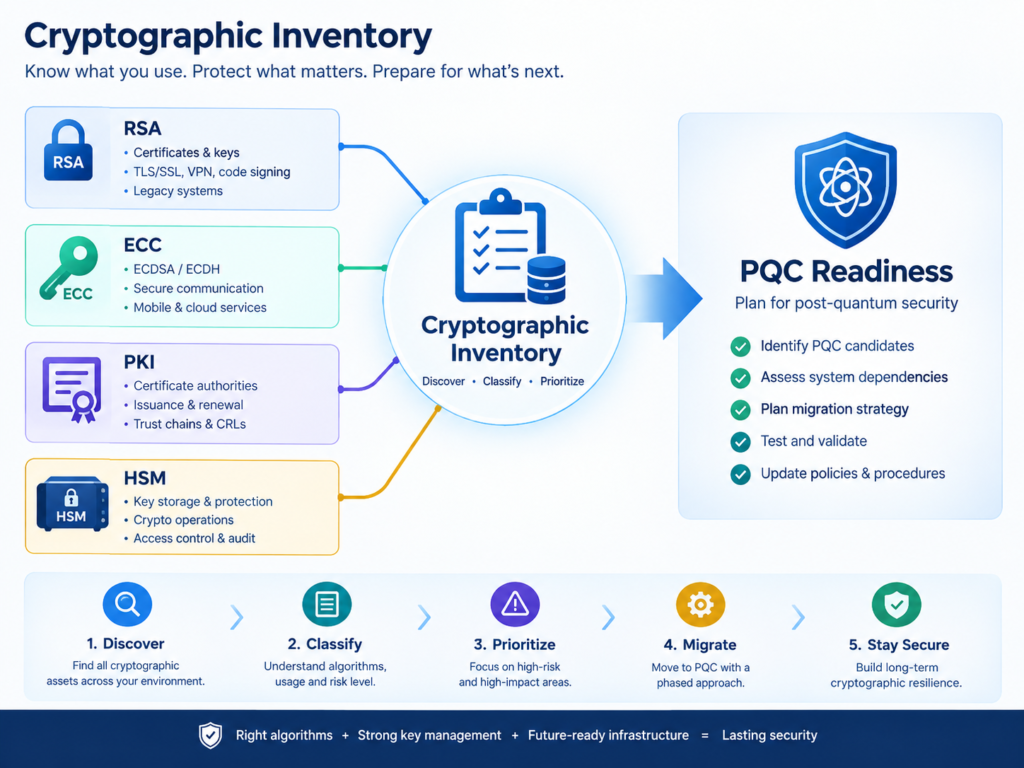
A cryptographic inventory tells you where vulnerable cryptography exists. Crypto-agility tells you how difficult it will be to replace.
Both are essential.
Find RSA, ECC and Other Cryptographic Dependencies
Inventory public-key cryptography across.
TLS endpoints and APIs.
PKI and certificates.
Code-signing infrastructure.
HSMs and key-management systems.
Application and operating-system libraries.
Mobile applications
Network appliances.
Databases and cloud services.
Embedded and OT equipment.
Third-party SaaS products.
Do not assume cryptography exists only where the security team directly manages certificates.
Map Owners, Data Flows and Dependencies
Each inventory entry should ideally capture the algorithm, key characteristics, certificate chain, system owner, data classification, retention requirement, vendor, lifecycle status and downstream dependencies.
The result becomes a practical cryptographic bill of materials that can support risk decisions, modernization planning and procurement.
Existing asset inventories and response processes can supply useful ownership context. Mak It Solutions’ EDR implementation guide for US, UK and EU teams and cyber incident response checklist show the value of connecting technologies with owners, responsibilities and affected assets.
Make Crypto-Agility a Design Requirement
Crypto-agility is the ability to change cryptographic algorithms, implementations or providers without redesigning an entire application.
In practice, that favors.
Configurable cryptography.
Modular libraries.
Upgradeable firmware.
Clearly defined cryptographic interfaces.
Documented dependencies.
Procurement requirements covering future PQC support.
Crypto-agility matters beyond this migration. Cryptographic standards will continue to evolve.
Create a Risk-Based Post-Quantum Cryptography Migration Roadmap
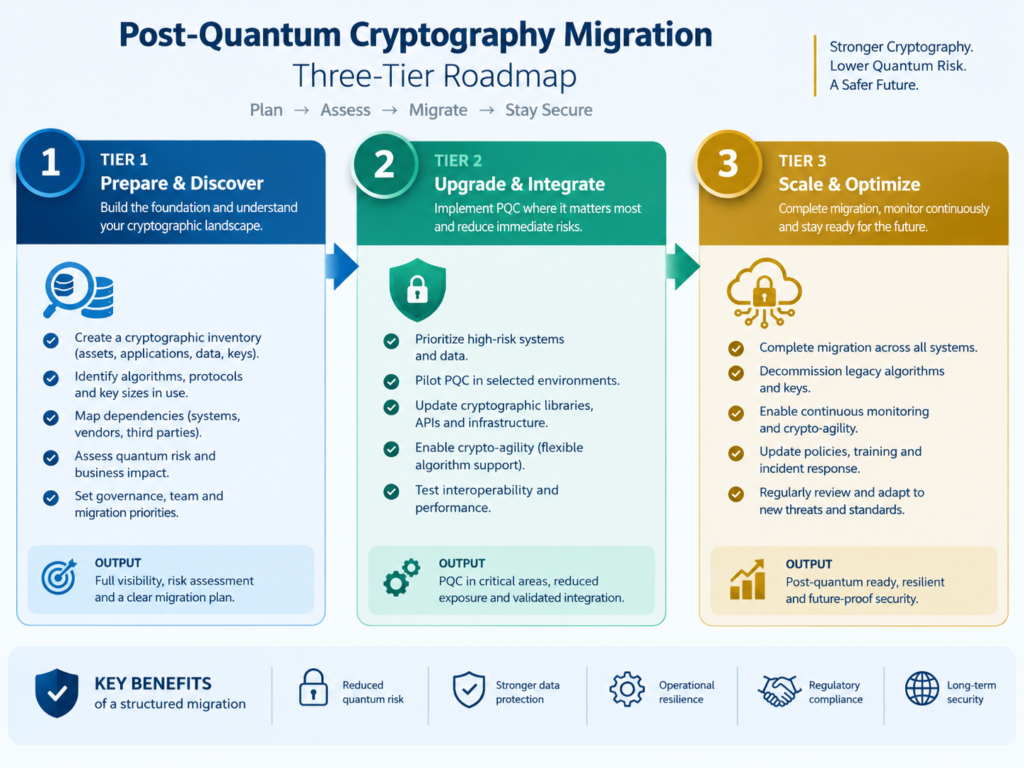
Trying to migrate the entire technology estate simultaneously is rarely practical.
Rank systems by confidentiality lifetime, exposure, business impact, dependency and migration lead time, then organize the work into clear tiers.
Highest-Risk Systems
Prioritize long-lived confidential-data platforms, exposed critical communications, core PKI, high-value identity services, critical financial or operational infrastructure, and equipment with unusually long service lives.
Pilot these environments early enough to expose certificate, HSM, protocol and interoperability problems before large-scale deployment.
High-Dependency Enterprise Platforms
The next group includes systems whose migration depends heavily on vendors or integration work.
Common blockers include.
Vendor cryptographic libraries.
HSM upgrades.
SaaS provider support.
Certificate infrastructure.
Cloud platforms.
Cross-system compatibility.
Executives can include these dependencies in broader cyber-risk reporting using the same business-oriented principles covered in Mak It Solutions’ cybersecurity metrics guide for leadership teams.
Lower-Risk, Easily Replaceable Workloads
Short-lived, low-sensitivity, isolated or easily upgraded systems can generally follow later.
They should still remain in the migration inventory. Low priority should mean deliberately scheduled, not forgotten.
Plan for Hybrid PQC, ML-KEM, ML-DSA and Technical Constraints
Where Hybrid Classical/PQC Deployment Fits
Hybrid deployments combine classical and post-quantum mechanisms during transition periods where compatibility, assurance requirements or ecosystem maturity make an immediate PQC-only deployment impractical.
The European Commission’s coordinated-transition recommendation explicitly identifies hybrid schemes as one possible migration approach.
Hybrid designs still require careful testing. Adding additional algorithms may improve transition flexibility, but it can also increase implementation and operational complexity.
Prepare for Certificate, Signature and Performance Changes
PQC migration is not just an algorithm-name replacement.
Teams need to test changes involving.
Key, ciphertext or signature sizes.
Certificate growth.
Handshake behavior.
Bandwidth and network overhead.
Latency.
Memory usage.
Constrained-device performance.
These effects may become particularly important in high-volume APIs, edge infrastructure and embedded systems.
Test HSMs, Vendors and Long-Lived Devices Early
The hardest migrations are often systems that cannot be upgraded quickly.
Test HSMs, network appliances, firmware, OT environments, embedded systems and hardware roots of trust before procurement cycles lock organizations into another long-lived dependency.
Equipment expected to operate for 10–20 years may need PQC requirements written into purchasing decisions today.
That approach also fits broader preemptive cybersecurity planning: address difficult future risks while architecture and procurement choices are still flexible.
Regional Deadlines and Governance for PQC Migration
US.
US programs should combine NIST standards with cryptographic discovery, data-lifetime analysis and technology governance.
NIST has explicitly encouraged organizations to begin transitioning to the finalized standards rather than waiting for a quantum computer capable of breaking today’s widely deployed public-key cryptography.
UK.
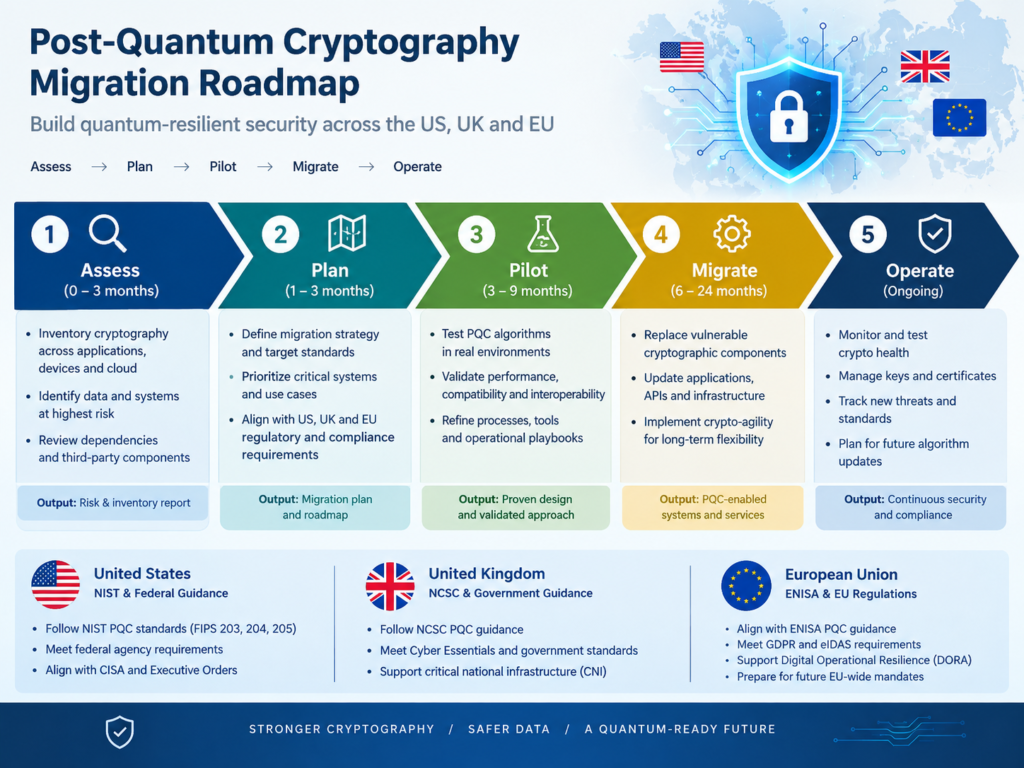
A practical internal roadmap can follow the NCSC milestones:
Now–2028: inventory, ownership mapping, supplier discovery, planning and pilots.
2028–2031: complete the highest-priority migration activities and prepare infrastructure for broader PQC deployment.
2031–2035: migrate the remaining estate and retire affected legacy dependencies wherever feasible.
Germany and EU.
German and wider EU organizations should connect PQC with existing vendor-risk, resilience, procurement and digital-identity programs.
The European roadmap was published in June 2025, while stakeholder feedback published in September 2026 reinforced the value of timelines, risk-based prioritization, hybrid approaches and crypto-agility.
Embedding PQC into existing technology-risk governance is usually more practical than building a disconnected cryptography project.
Final Words
Post-quantum cryptography migration should be treated as a structured risk-management program, not a rushed replacement exercise. Organizations should begin with long-lived sensitive data, exposed communications, PKI, identity systems and infrastructure with extended replacement cycles. A clear cryptographic inventory, strong ownership and crypto-agile architecture make it easier to prioritize investments and reduce future disruption.
The most effective roadmap is phased, practical and aligned with recognized standards and regional guidance. By testing ML-KEM, ML-DSA, HSMs, certificates and vendor dependencies early, enterprises can uncover technical limitations before large-scale rollout and build a more resilient path toward quantum-safe security.
Mak It Solutions can help structure a cryptographic inventory, quantum-risk assessment, PQC readiness review or phased migration roadmap. Explore the Mak It Solutions technology services portfolio to define a scoped assessment covering applications, PKI, APIs, cloud environments and long-lived systems. ( Click Here’s )
Key Takeaways
Prioritize long-lived sensitive data, exposed communications, PKI, identity infrastructure and long-lifecycle devices.
Build a cryptographic inventory before committing to broad technology deployment.
Combine quantum exposure with migration complexity when assigning priorities.
Make crypto-agility part of application architecture and procurement.
Test ML-KEM, ML-DSA, certificates, HSMs and vendor interoperability before wide rollout.
Align programs with NIST in the US, NCSC milestones in the UK, and BSI/EU transition planning in Germany and the wider EU.
FAQs
Q : Does post-quantum cryptography migration mean replacing every RSA and ECC system immediately?
A : No. Migration should be risk-based rather than a simultaneous replacement of every RSA and ECC implementation. Start with long-lived confidential data, intercept able communications, foundational PKI and identity services, critical systems and technology with long replacement cycles.
Q : How can enterprises identify hidden cryptography in third-party software and SaaS?
A : Build an inventory covering applications, TLS endpoints, APIs, certificates, libraries, HSMs and vendor services. Then ask suppliers which algorithms they use, where keys are managed, whether cryptography is configurable and what their PQC support roadmap looks like.
Q : Should data at rest and data in transit receive the same migration priority?
A : Not automatically. Priority depends on confidentiality lifetime, exposure and the protections around the data. Internet-facing traffic may be vulnerable to harvest-now-decrypt-later collection, while long-retention databases may carry their own durable confidentiality requirements.
Q : Can existing HSMs and certificate authorities support ML-KEM and ML-DSA?
A : Support varies by platform and vendor. Some products may gain PQC capabilities through software or firmware upgrades, while others may require infrastructure replacement. Test algorithm support, certificate handling, key storage, performance and vendor roadmaps before assuming compatibility.
Q : What should organizations do when vendors do not yet support PQC?
A : Document the dependency and request a dated vendor roadmap. For high-risk systems, consider architectural alternatives or replacement planning if support is unlikely to arrive within required migration windows. Lower-risk dependencies can remain scheduled and monitored within the broader roadmap.