


Cryptographic Inventory: Build a Quantum-Ready Map
Cryptographic Inventory: Build a Quantum-Ready Map
Cryptographic Inventory: Build a Quantum-Ready Map
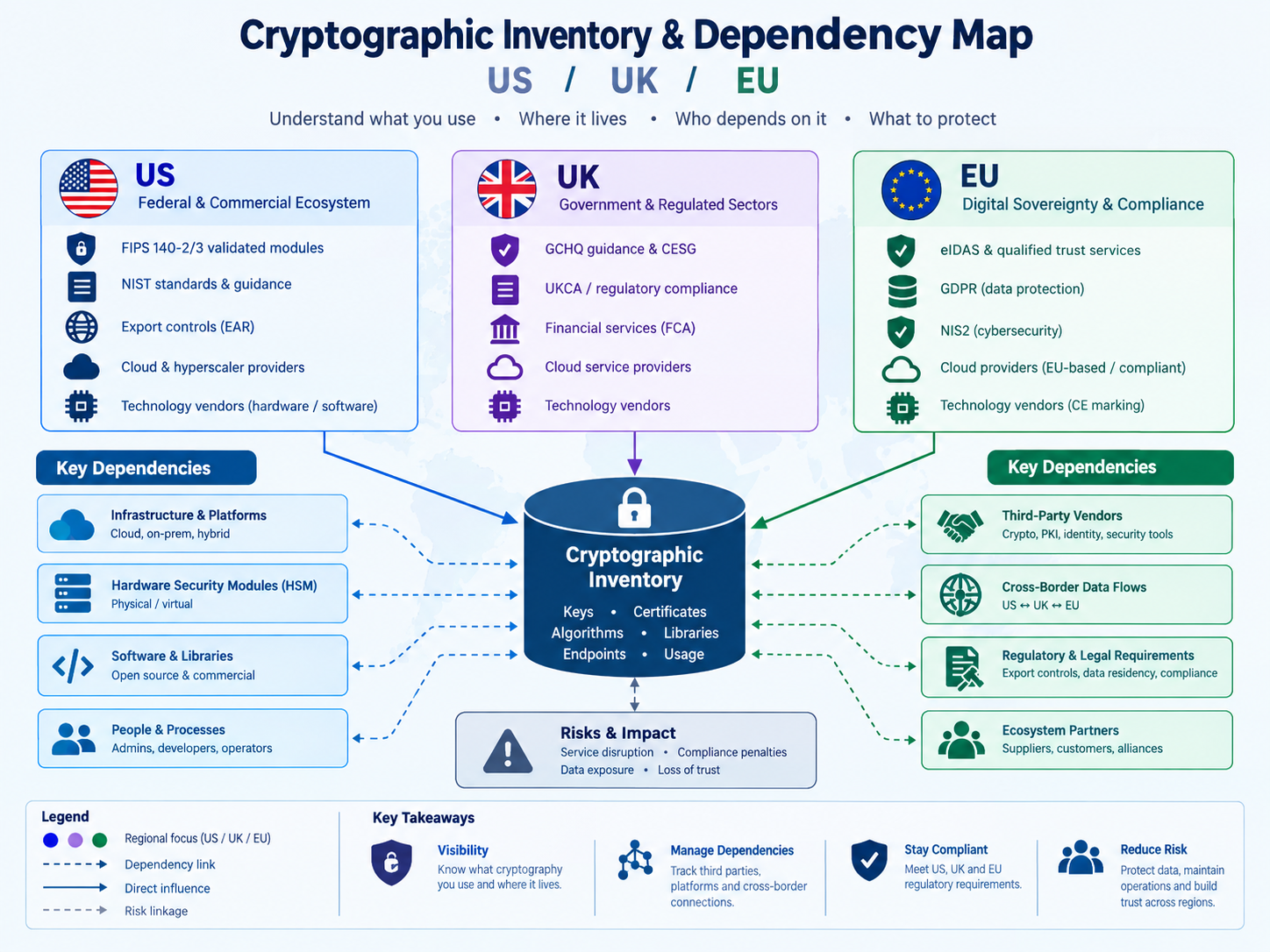
A cryptographic inventory gives enterprises a clear record of where cryptography exists, what depends on it, who owns it, and how difficult it may be to replace. For post-quantum cryptography (PQC) readiness, that visibility is essential: you cannot safely migrate vulnerable cryptography if you do not know where RSA, ECC, Diffie-Hellman, certificates, keys, protocols, libraries, and vendor dependencies are hiding.
NIST finalized its first three PQC standards ML-KEM, ML-DSA, and SLH-DSA in August 2024. The standards are defined in FIPS 203, FIPS 204, and FIPS 205 respectively.
The challenge now is not simply choosing new algorithms. It is mapping the enterprise dependencies that must change with them.
What Should an Enterprise Cryptographic Inventory Include?
A useful enterprise cryptographic inventory records more than cryptographic assets. It connects those assets to applications, infrastructure, business services, protected data, suppliers, and accountable owners.
That operational context turns a technical inventory into a migration tool.
Algorithms, Protocols, Keys, Certificates, and Libraries
Start with obvious cryptographic components, including.
RSA, ECC/ECDSA, and Diffie-Hellman
TLS, SSH, VPN/IPsec, and application protocols
PKI certificates and trust stores
Encryption and signing keys
Cryptographic libraries
Hardware Security Modules (HSMs)
Cloud Key Management Services (KMS)
Certificate authorities
Application-specific cryptographic implementations
A certificate and key inventory alone is not enough. Vulnerable cryptography may be embedded in source code, firmware, authentication workflows, proprietary protocols, or supplier-controlled platforms.
Applications, Cloud, Networks, OT/IoT, and CI/CD
Discovery should extend well beyond traditional PKI.
Inventory web and mobile applications, APIs, containers, cloud workloads, service meshes, CI/CD pipelines, databases, network appliances, OT/ICS environments, and long-lived IoT devices.
This matters even more in complex cloud estates. Flexera’s 2024 State of the Cloud research reported that 89% of surveyed organizations used multi-cloud environments, up from 87% the previous year.
Related architectures such as Mak It Solutions’ cloud IAM security guidance illustrate why identities, workloads, and services now cross traditional network boundaries.
Ownership, Data Lifetime, and Business Criticality
Technical discovery becomes actionable when business context is added.
For each record, capture the application, business service, asset owner, supplier, data classification, retention period, availability requirement, replacement path, and known migration constraints.
A database protecting seven-year financial records deserves different treatment from an ephemeral development workload.
That distinction is where crypto asset discovery becomes migration planning.
How to Discover Cryptography Across the Enterprise
No single scanner will identify every cryptographic dependency.
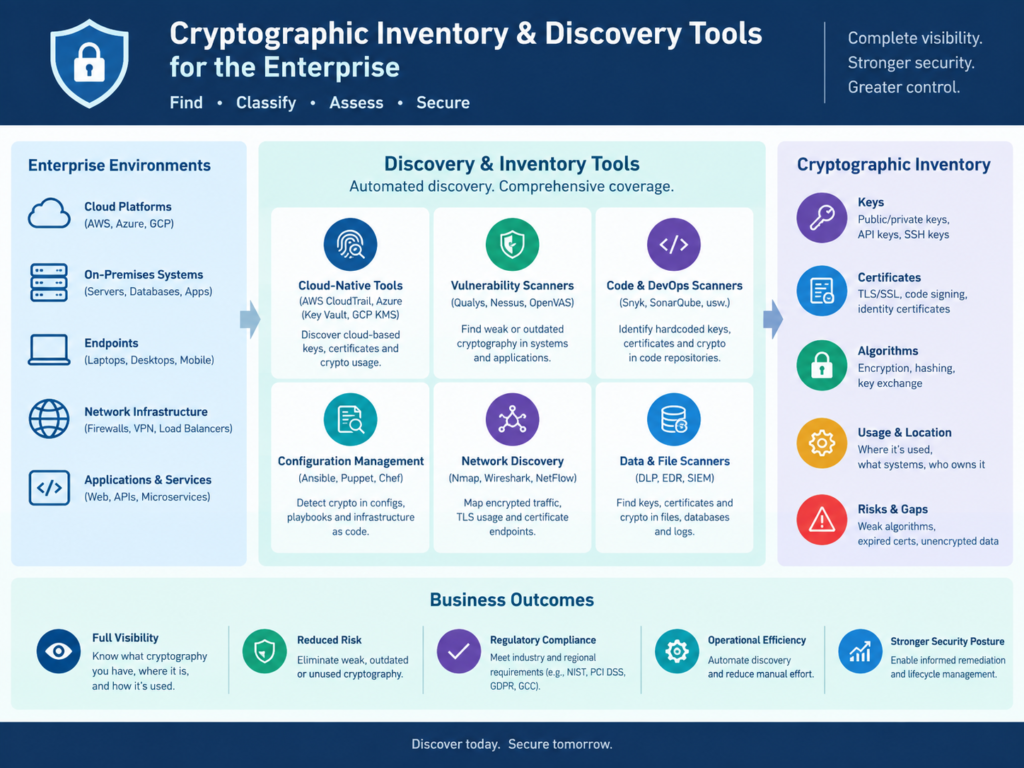
Source analysis can find embedded libraries. Network tools expose protocols and certificates. Cloud APIs reveal managed cryptographic services. Architecture reviews and supplier assessments uncover dependencies that technical scanners cannot see.
Start With Automated Cryptographic Discovery
Combine techniques such as.
Software Composition Analysis (SCA)
SAST and DAST
Source-code scanning
Network and protocol discovery
API discovery
Certificate discovery
Cloud configuration analysis
KMS and HSM telemetry
Code scanners can identify cryptographic libraries. Network tools can reveal TLS, SSH, and VPN configurations. Certificate-management platforms can surface expiring certificates or implementations using algorithms targeted for replacement.
For cloud-heavy environments, existing operational processes may also provide valuable discovery feeds. See Mak It Solutions’ cloud optimization practices.
Combine Automation With Architecture Reviews and Owner Interviews
Automated discovery has blind spots.
A scanner might identify a cryptographic library without showing that replacing it will affect a payment workflow, hardware appliance, authentication system, or supplier integration.
Architecture diagrams, CMDB records, engineering interviews, and application-owner workshops help fill those gaps.
The practical approach is validation: compare what tools detect with what system owners believe exists, then investigate the differences.
Find Shadow, Legacy, and Third-Party Cryptography
Pay particular attention to unmanaged certificates, unsupported systems, old VPN appliances, backup platforms, identity providers, MSP-controlled environments, SaaS services, embedded libraries, and vendor-managed infrastructure.
IBM’s 2024 Cost of a Data Breach research found that 40% of breaches involved data stored across multiple environments, including public cloud, private cloud, and on-premises systems.
That fragmentation is one reason cryptographic dependency mapping cannot stop at the primary data center.
How to Map Cryptographic Dependencies End to End
A cryptographic inventory becomes much more valuable when individual records are connected.
Use a consistent relationship model.
Business service → application → library/protocol → key/certificate/HSM → infrastructure → supplier → data → owner → migration constraint
Consider a customer portal. It might rely on TLS certificates, an identity provider, an application cryptographic library, cloud KMS keys, and a third-party payment API.
Changing one layer may require coordinated changes across several others.
Mak It Solutions’ mobile app development services provide another example of how multiple technical components can sit behind a customer-facing service.
Trace Cloud, SaaS, Identity, and Vendor Dependencies
Include managed services such as AWS, Azure, and GCP KMS, managed PKI, SaaS encryption, identity providers, payment processors, MSPs, and supplier APIs.
Ask suppliers.
Which cryptographic algorithms are currently used?
What PQC capabilities are planned or available?
Will migration require software or firmware updates?
Are new certificates or trust chains required?
Will hardware need to be replaced?
What dependencies exist further down the supplier chain?
Long-lived systems deserve special attention. Modern applications can often be updated quickly; embedded hardware may remain in service for years.
Link Cryptography to Data and Migration Constraints
Map each cryptographic component to the information it protects.
Capture data sensitivity, confidentiality lifetime, retention requirements, uptime needs, hardware dependencies, interoperability limitations, and supplier roadmaps.
This reveals sequencing.
If an HSM must be upgraded before an application can adopt a new signature scheme, the HSM is part of the migration critical path.
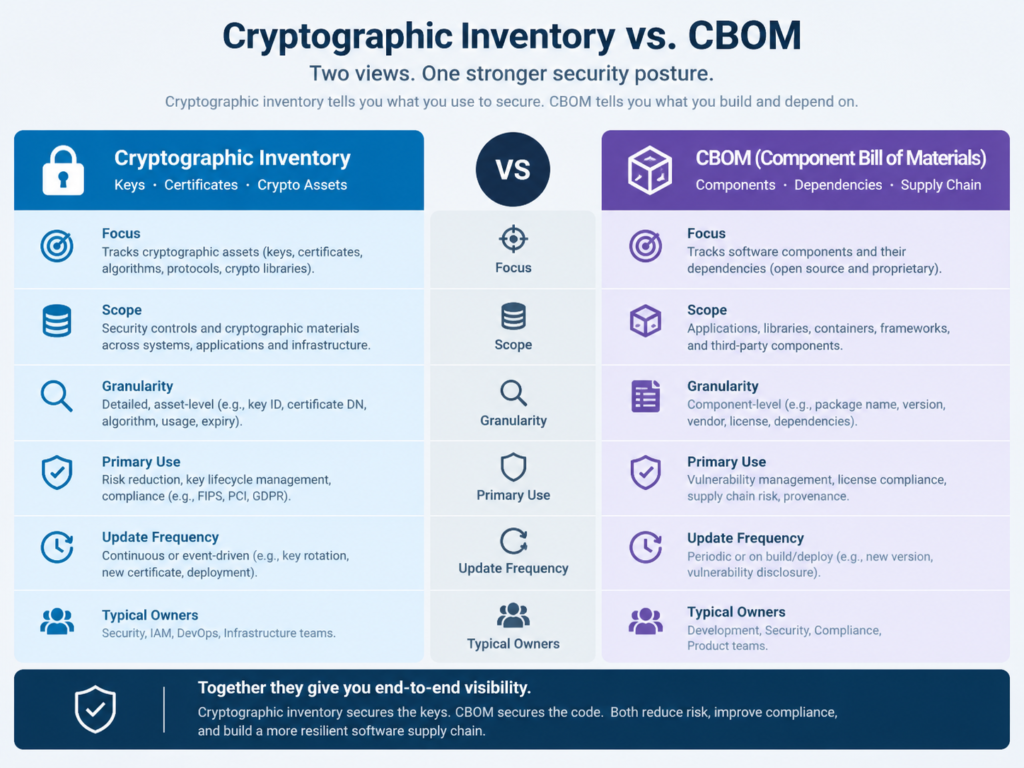
Cryptographic Inventory vs CBOM.
A cryptographic inventory is the broader operational view of cryptographic assets and their dependencies.
A Cryptographic Bill of Materials (CBOM) provides a more structured, machine-readable representation of cryptographic components that can support automated analysis and remediation.
What a Cryptographic Bill of Materials Contains
Depending on the implementation, a CBOM can describe.
Algorithms
Protocols
Certificates
Keys
Libraries
cryptographic implementations
Locations
Dependency metadata
The goal is not simply to create another spreadsheet. Machine-readable cryptographic data becomes valuable when security policies or cryptographic standards change.
How CBOM Extends SBOM for Cryptographic Risk
A Software Bill of Materials (SBOM) identifies software components and their dependencies.
A CBOM focuses specifically on cryptographic mechanisms.
The two can overlap. An SBOM may show that an application contains OpenSSL or another cryptographic library, while a CBOM adds the cryptographic context required to determine what algorithms, protocols, certificates, or implementations are actually relevant.
Move From Spreadsheet Inventory to Continuous CBOM
A practical maturity path looks like this.
Manual register → automated discovery → normalized inventory → continuously refreshed CBOM → policy and remediation workflows
The same principle appears in broader enterprise-data practices: provenance, ownership, and current metadata are more valuable than a one-time export.
See Mak It Solutions’ enterprise data and RAG patterns for related data-governance thinking.
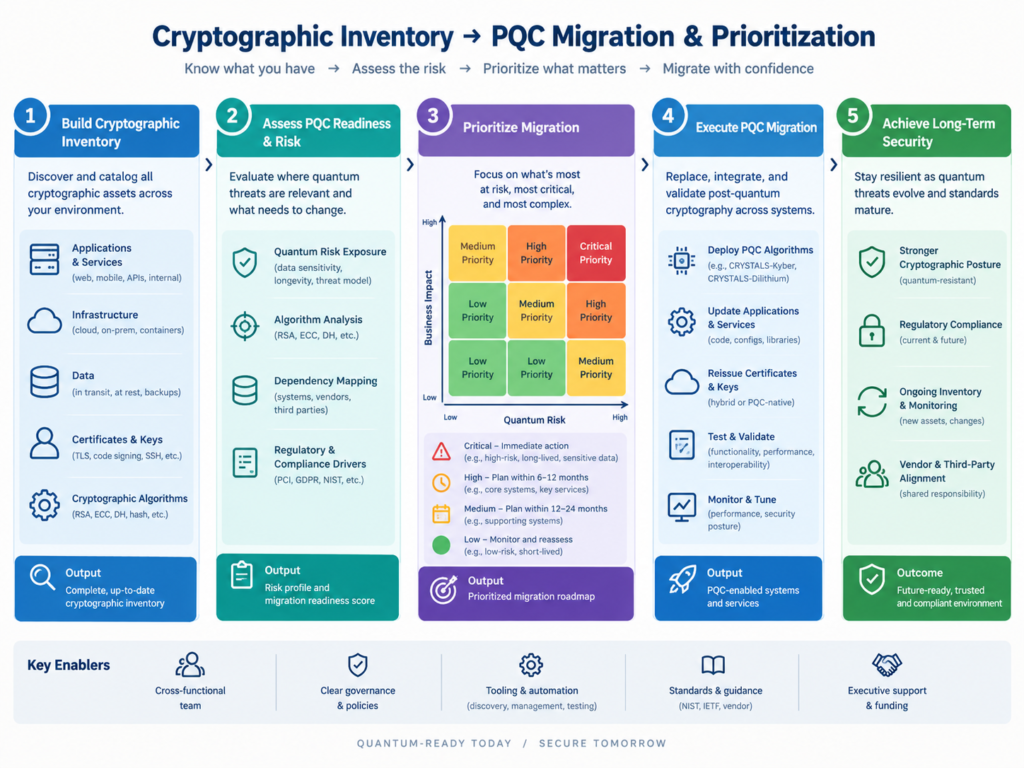
Use the Cryptographic Inventory to Prioritize PQC Migration
Cryptographic discovery should happen before large-scale PQC migration.
Otherwise, teams risk treating migration as an algorithm replacement exercise when the real work involves protocols, applications, certificates, hardware, suppliers, and interoperability.
Identify Quantum-Vulnerable Cryptography First
Prioritize uses of RSA, ECC/ECDSA, and Diffie-Hellman, particularly where sensitive information must remain confidential for years.
Long-lived information deserves extra attention because of “harvest now, decrypt later” risk: encrypted information captured today could potentially be decrypted later if sufficiently capable quantum systems become available.
Business impact should also influence prioritization. IBM reported an average global data-breach cost of USD 4.88 million in its 2024 study.
Map Migration Paths to ML-KEM, ML-DSA, and SLH-DSA
NIST’s first finalized PQC standards define.
FIPS 203 — ML-KEM: a module-lattice-based key-encapsulation mechanism for key establishment
FIPS 204 — ML-DSA: a module-lattice-based digital signature standard
FIPS 205 — SLH-DSA: a stateless hash-based digital signature standard
Do not blindly map every classical algorithm to a single replacement.
Record protocol compatibility, certificate ecosystem dependencies, performance requirements, HSM support, implementation maturity, and vendor readiness first.
Prioritize by Exposure, Data Lifetime, and Replacement Difficulty
A practical prioritization model can consider.
Business criticality
Quantum-vulnerable cryptography
Confidentiality lifetime
External exposure
Vendor readiness
Hardware dependencies
Migration complexity
The result is a migration backlog based on operational risk rather than scanner severity alone.
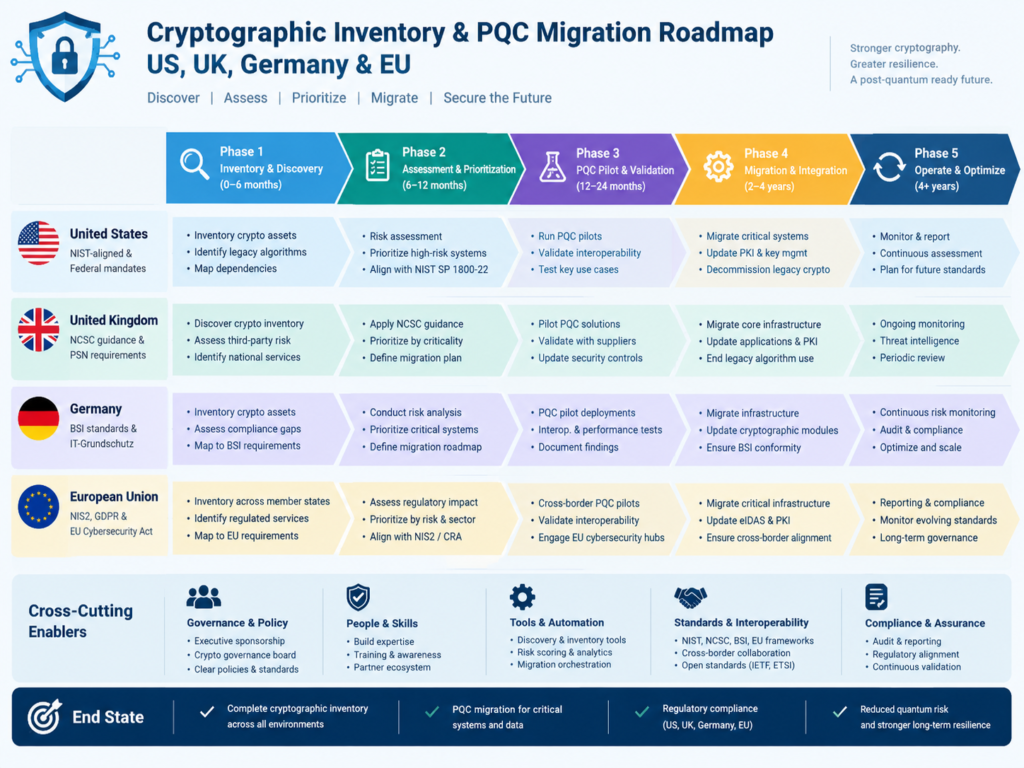
Regional PQC Requirements: USA, UK, and Germany/EU
The technical foundations of a cryptographic inventory are broadly similar across regions, but governance and regulatory considerations differ.
USA.
U.S. enterprises can anchor PQC programs around NIST standards and migration guidance.
Healthcare organizations must also account for HIPAA safeguards. Under the current HIPAA Security Rule framework, encryption is an addressable implementation specification, meaning regulated entities must evaluate whether it is reasonable and appropriate and document their decision and any alternative safeguards.
Payment, SaaS, and regulated environments may need additional inventory fields for PCI DSS, contractual obligations, or other sector-specific controls.
UK.
The UK’s NCSC has established a staged PQC migration timeline.
Organizations are encouraged to.
Complete discovery and assessment and build an initial migration plan by 2028
Complete their highest-priority migration activities and refine the roadmap by 2031
Complete PQC migration across systems, services, and products by 2035
For a London financial-services organization, that makes cryptographic dependency discovery a current planning requirement rather than something to postpone until the next major application refresh.
Germany/EU.
German organizations can treat the Kryptografie-Inventar as the foundation for understanding kryptografische Abhängigkeiten, PQC readiness, CBOM adoption, and crypto agility.
BSI states that migration toward quantum-safe methods should prioritize post-quantum cryptography.
A 2025 international joint statement hosted by BSI also recommends inventorying assets and cryptographic applications, developing a risk-oriented transition roadmap, considering information sensitivity and protection periods, and incorporating crypto agility into migration planning.
ENISA similarly emphasizes that PQC migration does not end with algorithm selection; new cryptographic mechanisms must be integrated into existing protocols and systems.
For organizations operating in Frankfurt, Munich, Berlin, Paris, Amsterdam, or Dublin, cryptographic inventory governance can also support broader cybersecurity and operational-resilience work under NIS2, DORA, and GDPR/DSGVO.
For hybrid environments, Mak It Solutions’ confidential computing guidance covers related workload-security considerations.
How to Keep a Cryptographic Inventory Accurate Over Time
A cryptographic inventory should be a living security dataset, not a one-time PQC project.
Applications change. Certificates rotate. Vendors introduce new services. Cloud resources appear and disappear. Libraries are upgraded.
Your inventory has to move with them.
Integrate Discovery Into CI/CD and Infrastructure Workflows
Feed findings from CI/CD pipelines, cloud APIs, certificate platforms, KMS/HSM systems, network controls, and software-composition tools into a central inventory.
New code containing cryptographic libraries should create or update records automatically. Material cloud or certificate changes should do the same.
Application-modernization projects are also natural checkpoints. Mak It Solutions’ Flutter development services provide one example of where cryptographic dependencies can be reviewed before a new release.
Assign Owners and Change Triggers
Every important cryptographic asset needs an accountable owner.
Trigger a review when.
Certificates are issued or replaced
Libraries are upgraded
Suppliers change
Applications are redesigned
Hardware is replaced
Architectures change
New cryptographic standards or policies are adopted
Vendor-managed systems should not disappear into a generic “third-party” category. Someone inside the organization still needs responsibility for tracking the dependency.
Build Toward Crypto Agility
Continuous crypto asset discovery reduces inventory decay and makes future cryptographic changes easier.
The long-term goal is crypto agility: the ability to identify affected cryptography, understand dependencies, and replace algorithms or implementations without rediscovering the enterprise from scratch.
For hybrid estates, the dependency thinking used in cloud repatriation and hybrid-cloud planning can also support cryptographic migration decisions.
Final Thoughts
A practical starting point is a scoped cryptographic discovery assessment covering one critical business service and the applications, infrastructure, data, and suppliers behind it.
From there, the organization can build a structured dependency map, identify quantum-vulnerable cryptography, prioritize migration work, and establish a continuously maintained cryptographic inventory.
Mak It Solutions can help turn that first discovery exercise into a practical migration backlog and operating model. Explore About Mak It Solutions to discuss a scoped assessment.
Key Takeaways
A useful cryptographic inventory maps dependencies and business context, not just algorithms and certificates.
Combine automated scanning, cloud APIs, network discovery, architecture reviews, and supplier assessments.
Map the chain from business service to application, crypto component, infrastructure, supplier, data, and accountable owner.
Use a CBOM alongside the broader enterprise inventory when machine-readable cryptographic data will support automation.
Prioritize PQC migration according to quantum exposure, confidentiality lifetime, criticality, vendor readiness, and replacement difficulty.
Keep discovery continuous so the organization builds crypto agility instead of maintaining a static spreadsheet.
FAQs
Q : How often should an enterprise update its cryptographic inventory?
A : Update it whenever cryptographic dependencies change rather than relying only on an annual review. CI/CD releases, certificate changes, library upgrades, cloud modifications, new suppliers, and hardware replacements should trigger updates where practical.
Q : Who should own cryptographic inventory data?
A : Security architecture or cryptography teams can govern the overall model, but individual records need accountable technical and business owners. Application, infrastructure, procurement, and third-party risk teams should maintain the dependencies they control.
Q : Can an SBOM identify all cryptographic dependencies?
A : No. An SBOM may identify software packages containing cryptographic libraries, but it does not necessarily show active algorithms, configurations, certificates, keys, negotiated protocols, or SaaS-based cryptography. A CBOM and broader cryptographic inventory provide that additional context.
Q : How do you inventory cryptography used by third-party SaaS providers?
A : Identify SaaS services connected to important applications and data, then request details about algorithms, TLS configurations, key management, certificates, PQC roadmaps, and relevant subcontractors. Record those answers alongside ownership, renewal dates, and migration dependencies.
Q : Which cryptographic inventory fields are most useful for PQC migration?
A : Useful fields include algorithm, protocol, key length, certificate type, cryptographic library, application, business service, owner, supplier, data classification, retention period, exposure, hardware dependency, vendor PQC readiness, and replacement difficulty.
[…] Makes an Application a Post-Quantum Cryptography Migration […]