


Crypto Agility: Build Quantum-Ready Security Now
Crypto Agility: Build Quantum-Ready Security Now
Crypto Agility: Build Quantum-Ready Security Now
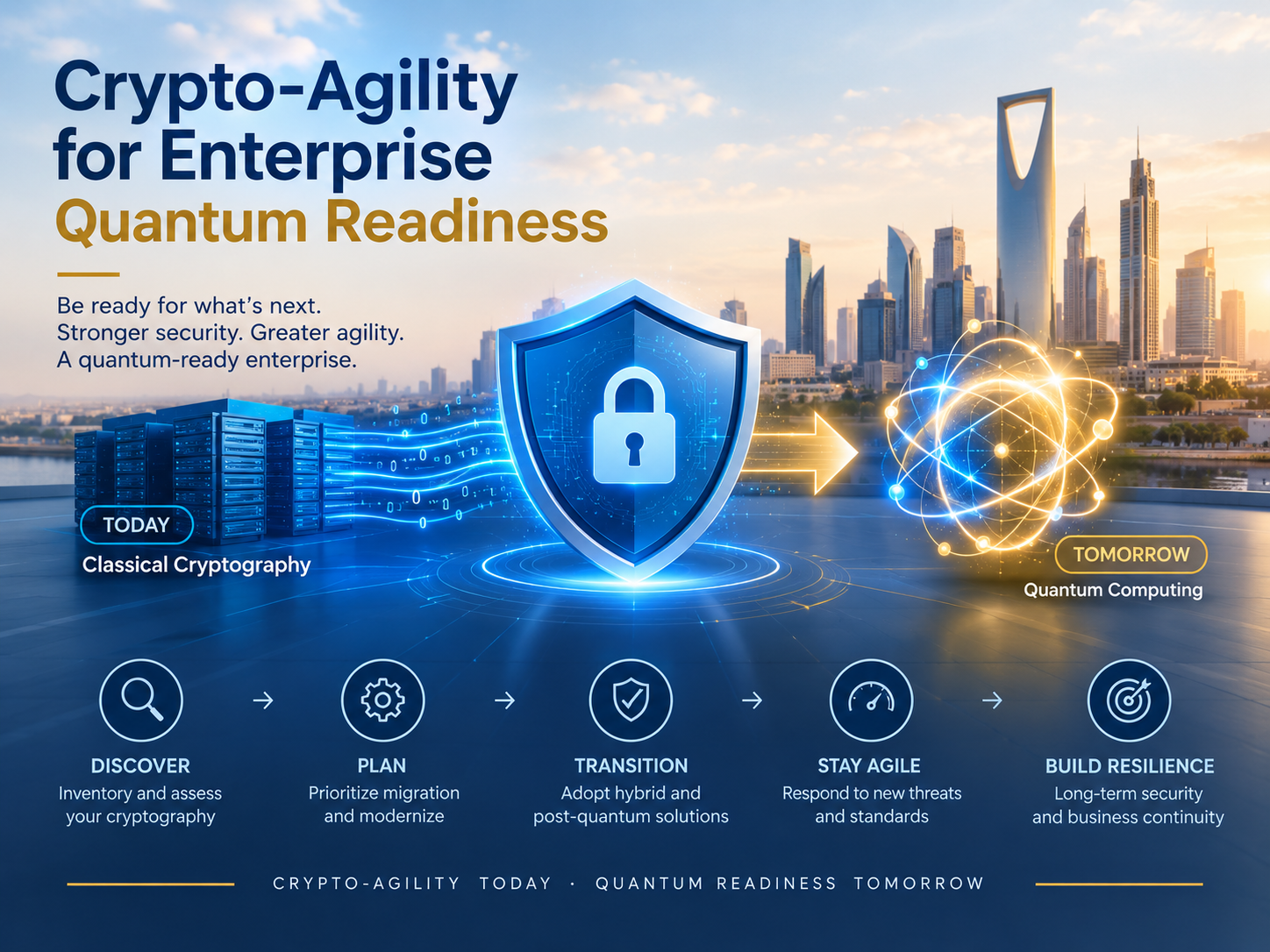
Crypto agility is an organization’s ability to replace or adapt cryptographic algorithms, keys, certificates, protocols, software, hardware, and infrastructure without disrupting security or business operations. For enterprises, it is the operational foundation for moving toward post-quantum cryptography (PQC) while staying ready for future algorithm, compliance, and security changes.
Crypto agility matters because the coming transition is bigger than replacing one encryption algorithm. Organizations need to know where cryptography lives, which systems depend on it, and how those systems can be upgraded safely.
Why Crypto Agility Is Becoming an Enterprise Priority
Cryptography can no longer be treated as static infrastructure.
Algorithms are deprecated. Certificates expire. Standards change. Vulnerabilities appear. Vendors update their platforms. And the shift toward post-quantum cryptography introduces another major transition across enterprise technology.
The goal is not simply to replace RSA or ECC once. A mature organization needs a repeatable way to discover cryptography, understand dependencies, change algorithms, test interoperability, and manage cryptographic risk without rebuilding every application from scratch.
That applies across cloud platforms, SaaS applications, APIs, PKI, mobile systems, databases, operational technology, embedded devices, and third-party services.
What Is Crypto Agility in Cybersecurity?
NIST defines cryptographic agility in operational terms: the capability to replace and adapt cryptographic algorithms in protocols, applications, software, hardware, firmware, and infrastructure while preserving security and ongoing operations. Its current guidance is NIST CSWP 39upd1, finalized on June 29, 2026.
In practice, crypto agility means reducing dependence on hard-coded cryptography so future migrations can happen with less disruption.
Crypto Agility vs. Cryptographic Agility
“Crypto agility” and “cryptographic agility” generally describe the same capability.
Standards bodies such as NIST often use cryptographic agility, while enterprise security teams frequently shorten the phrase to crypto agility.
What a Crypto-Agile Architecture Looks Like
A crypto-agile architecture separates business logic from specific cryptographic algorithms wherever practical.
That may involve.
Configurable cryptographic libraries
Stable abstraction layers and APIs
Flexible PKI architecture
Centralized certificate and key management
Policy-driven cryptographic controls
Automated rotation and lifecycle management
Clear ownership of cryptographic dependencies
This approach complements broader practices such as API security and lifecycle controls and identity-first security architecture.
Why Crypto Agility Matters Beyond Quantum Computing
Quantum risk is a major driver, but it is not the only reason to build crypto agility.
The same capability helps organizations respond to algorithm deprecation, certificate changes, security vulnerabilities, regulatory requirements, supplier transitions, and accumulated cryptographic technical debt.
IBM reported that the global average cost of a data breach reached USD 4.88 million in 2024, up from USD 4.45 million the previous year. That figure does not measure cryptographic failures specifically, but it illustrates the wider financial importance of resilient security architecture.
Why Quantum Computing Makes Crypto Agility Urgent
Enterprises need crypto agility before cryptographically relevant quantum computers become a practical threat because replacing algorithms, certificates, hardware, protocols, and dependent applications can take years.
Building migration mechanisms early allows organizations to move in controlled stages instead of attempting a rushed cryptographic replacement later.
How Quantum Computing Threatens RSA and ECC
A sufficiently capable quantum computer could undermine widely used public-key cryptography based on problems that protect technologies such as RSA and elliptic-curve cryptography.
The exposure extends beyond encryption. It can affect TLS connections, PKI, digital signatures, authentication systems, software signing, and long-lived confidential information.
In August 2024, NIST finalized its first three PQC standards.
FIPS 203 — ML-KEM for key establishment
FIPS 204 — ML-DSA for digital signatures
FIPS 205 — SLH-DSA for digital signatures
NIST has encouraged organizations to begin transitioning rather than wait for future standards.
Harvest-Now-Decrypt-Later Risk
“Harvest now, decrypt later” describes a scenario in which an attacker captures encrypted information today and stores it in the hope of decrypting it later with more capable technology.
That makes the confidentiality lifetime of data important.
Organizations handling intellectual property, government information, financial records, healthcare data, or other information that must remain confidential for many years should assess their exposure before the quantum threat becomes immediate.
Crypto Agility vs. Post-Quantum Cryptography
The difference is straightforward.
Post-quantum cryptography provides algorithms designed to resist known quantum attack methods. Crypto agility provides the organizational and technical capability to deploy those algorithms and replace them again when requirements change.
PQC is therefore not a substitute for crypto agility. The two capabilities work together.
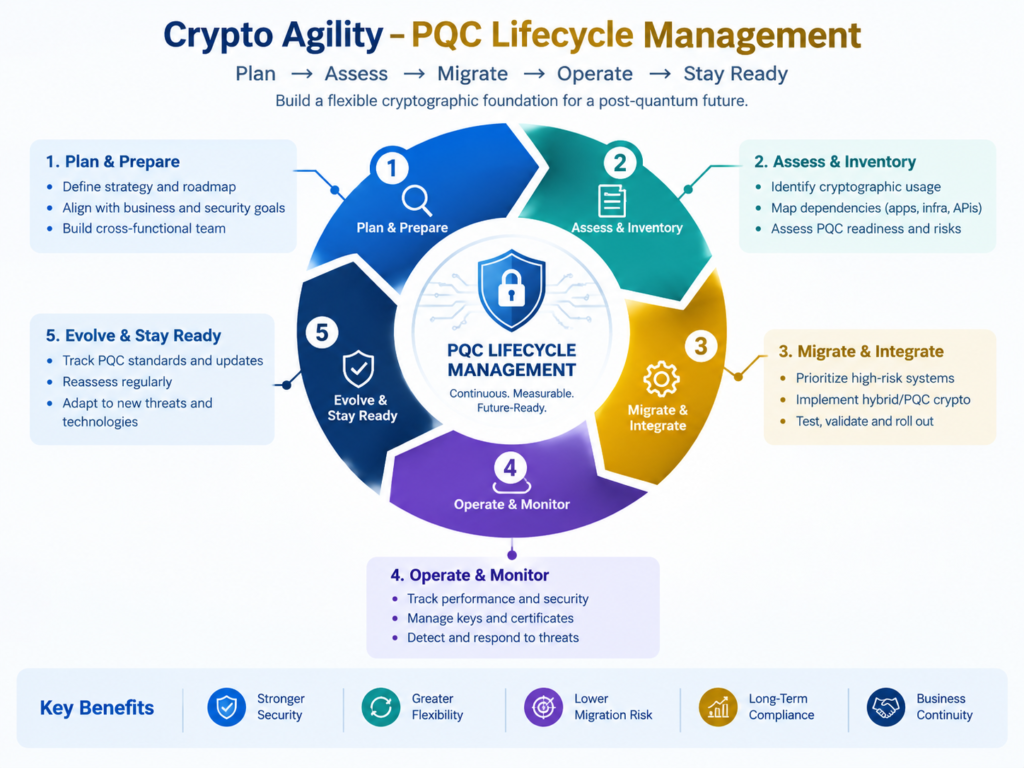
Start With a Cryptographic Inventory and Discovery Program
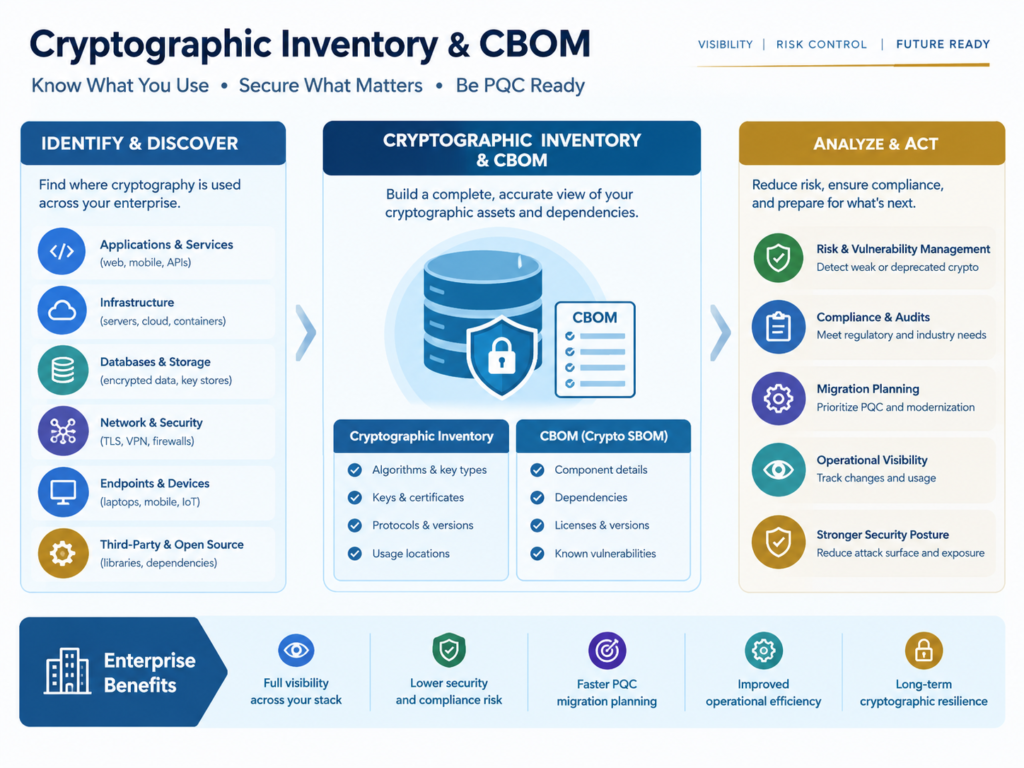
A cryptographic inventory is the foundation of quantum readiness because an organization cannot migrate cryptography it cannot locate.
Enterprises need visibility into algorithms, certificates, keys, libraries, protocols, hardware, cloud services, PKI, and third-party dependencies before they can prioritize migration.
What to Include in a Crypto Asset Inventory
A useful inventory should look beyond obvious certificates and encryption settings.
Consider identifying.
RSA and ECC implementations
TLS certificates
Digital-signature systems
Cryptographic libraries
Hardware Security Modules (HSMs)
Firmware and embedded cryptography
APIs and authentication services
Databases and storage encryption
Mobile applications
SaaS platforms
Cloud workloads
OT and IoT devices
Code-signing systems
Third-party software and managed services
This discovery work fits naturally alongside cloud posture reviews such as Mak It Solutions’ cloud misconfiguration guidance.
CBOM and Automated Cryptographic Discovery
A Cryptographic Bill of Materials, or CBOM, can help document cryptographic components and dependencies in a structured way.
Automated discovery tools can then connect cryptographic assets with application owners, data classifications, certificate authorities, infrastructure, vendors, and migration dependencies.
The goal is not merely to create another spreadsheet. The inventory should become a living source of security and migration data.
Prioritize Assets by Risk, Lifetime, and Migration Complexity
Not every system should be migrated in the same order.
Prioritization should consider.
Confidentiality lifetime
Business criticality
External exposure
Regulatory requirements
Hardware replacement cycles
Supplier dependencies
Migration complexity
Availability requirements
A long-lived embedded device protecting sensitive data may require attention earlier than an easily upgraded internal service, even when both use the same vulnerable algorithm.
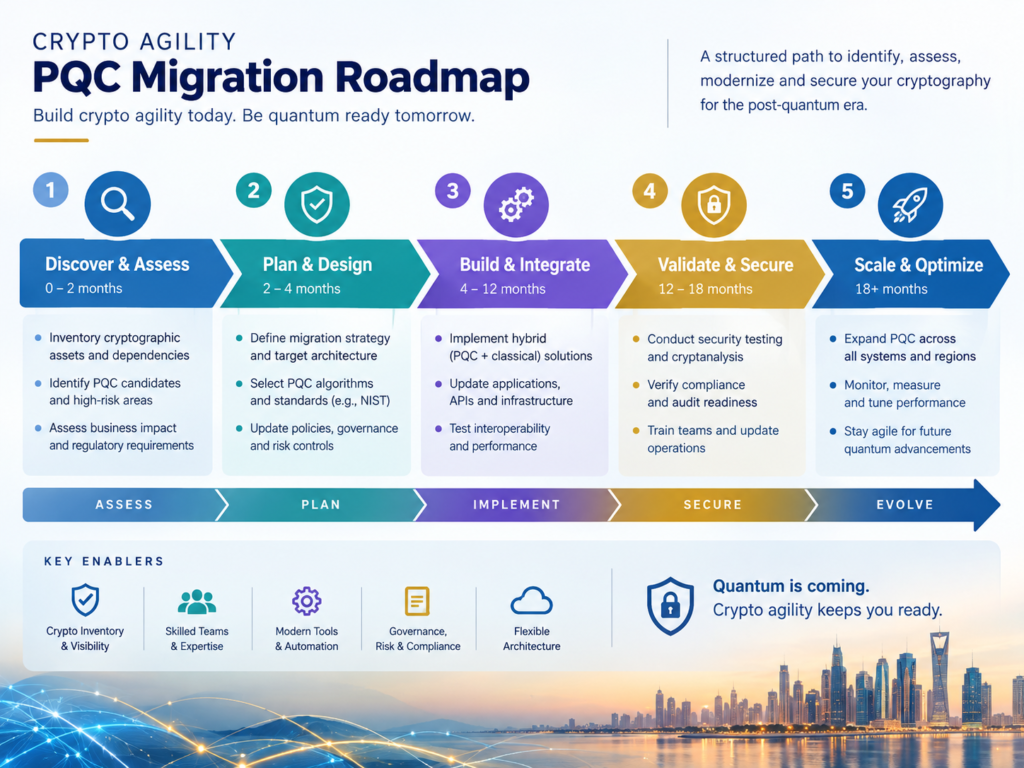
How to Build a Crypto Agility Roadmap
An enterprise can build a crypto-agile architecture without replacing everything at once.
The practical approach is to combine discovery, clear ownership, cryptographic abstraction, centralized lifecycle controls, compatibility testing, and phased migration.
Decouple Cryptography From Applications and Infrastructure
Where practical, move cryptographic choices behind stable APIs, abstraction layers, configurable libraries, centralized services, or policy controls.
This reduces application-level hard coding and makes future changes less invasive.
A similar architecture-first principle appears in modern Zero Trust strategy, where reusable identity and policy controls are preferred over isolated application-specific exceptions.
Modernize PKI, Certificates, Keys, and Lifecycle Management
Crypto agility depends heavily on the maturity of existing certificate and key-management processes.
Teams should review.
Certificate issuance and renewal
Key rotation
Revocation
Cryptographic policies
Ownership and accountability
Auditability
HSM compatibility
Trust-chain dependencies
Certificate-profile flexibility
Organizations should also determine whether current platforms can support different key sizes, certificate formats, signing algorithms, and trust mechanisms before production migration begins.
Test Hybrid and Post-Quantum Migration Paths
Do not assume that supporting a PQC algorithm automatically makes an application PQC-ready.
Testing should cover areas such as.
ML-KEM and ML-DSA support
Hybrid cryptographic approaches where appropriate
Protocol interoperability
Rollback procedures
Latency and throughput
Certificate and message sizes
Hardware compatibility
Vendor support
Failure behavior
Phased testing matters because post-quantum readiness involves entire technology ecosystems, not algorithms in isolation.
Common Crypto Agility and PQC Migration Challenges
Hidden Cryptography and Legacy RSA/ECC Dependencies
Some of the hardest migration problems come from cryptography that nobody actively manages.
Examples include undocumented libraries, custom protocols, embedded certificates, legacy applications, forgotten integrations, and shadow dependencies.
Security inventories should therefore connect to ownership and incident-management processes. Mak It Solutions’ cyber incident response checklist offers a useful parallel for defining responsibilities and escalation paths.
Hardware, OT, IoT, and Long Replacement Cycles
HSMs, industrial equipment, firmware, embedded systems, and constrained IoT devices may remain operational for many years.
Some platforms may not accept larger cryptographic objects or new implementations without firmware updates. Others may require complete hardware replacement.
These constraints make early discovery especially important.
Third-Party Vendors and Hybrid Interoperability
An enterprise does not control its entire cryptographic environment.
Cloud providers, SaaS platforms, PKI vendors, API providers, outsourced applications, and security products all form part of the cryptographic supply chain.
Procurement and security teams should ask vendors about supported algorithms, PQC roadmaps, upgradeability, migration mechanisms, interoperability testing, dependency documentation, and lifecycle commitments.
Crypto Agility Requirements Across the USA, UK, Germany, and EU
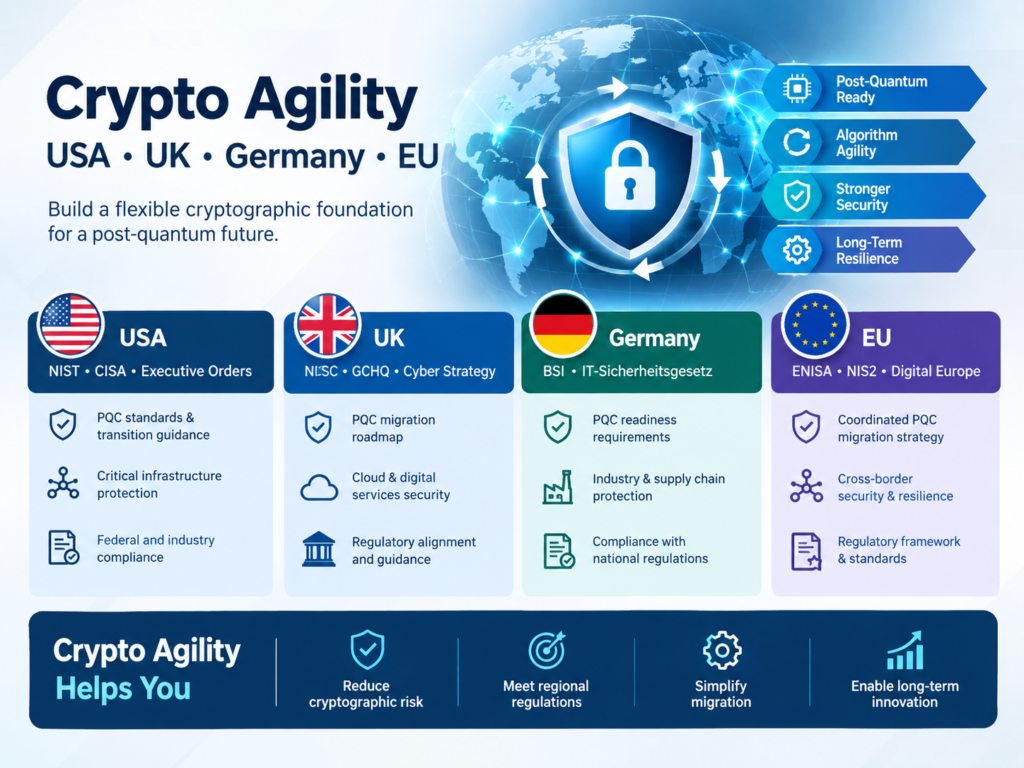
Regional guidance differs, but the underlying message is increasingly consistent: organizations should discover cryptographic dependencies early and plan migration before existing cryptography becomes an emergency.
United States.
US organizations can anchor technical planning around NIST’s PQC standards and its updated crypto-agility guidance.
NIST CSWP 39upd1 describes crypto agility as an operational capability spanning protocols, applications, software, hardware, firmware, and infrastructure. NIST also advises organizations to begin moving toward its finalized PQC standards rather than waiting for a cryptographically relevant quantum computer to arrive.
For organizations in markets such as New York, Washington DC, or San Francisco, the practical starting point remains consistent: locate cryptographic dependencies, identify long-lived sensitive data, assess suppliers, and build a controlled migration path.
United Kingdom.
The UK National Cyber Security Centre has published clear milestones for PQC migration.
Its guidance recommends.
By 2028: complete discovery and assessment and build an initial migration plan
By 2031: complete the highest-priority migration activities and refine the roadmap
By 2035: complete migration to PQC across systems, services, and products
The NCSC estimates that discovery, assessment, strategy development, and initial planning may take large organizations 2–3 years on their own.
For organizations in London, Manchester, and other UK business centers, that timeline makes cryptographic discovery a current planning issue rather than a future research exercise.
Germany and the EU.
Germany’s BSI explicitly recommends crypto agility when developing and maintaining systems so cryptographic mechanisms can be replaced as standards and security requirements change.
At EU level, Member States adopted a coordinated PQC implementation roadmap in June 2025.
The roadmap states that Member States should start transitioning to PQC by the end of 2026, while high-risk use cases should transition as soon as possible and no later than the end of 2030.
For financial firms in Frankfurt, technology companies in Berlin or Munich, and enterprises operating across the EU, PQC planning should therefore be considered alongside wider security, resilience, data-protection, and sector-specific obligations.
From Quantum Readiness to Continuous Cryptographic Resilience
Crypto agility should not end when the first PQC migration is complete.
Algorithms will continue to evolve. New weaknesses may emerge. Standards will change. Vendors will replace technologies. Cryptographic resilience therefore needs to become an ongoing engineering and governance capability.
Make Crypto Agility a Design and Procurement Requirement
New applications, platforms, and supplier contracts should support.
Algorithm flexibility
Documented cryptographic dependencies
Upgrade mechanisms
Configurable security controls
Certificate and key lifecycle management
Clear vendor migration commitments
Secure mobile application development benefits from the same principle: cryptography should be maintainable rather than buried permanently inside application code.
Track Cryptographic Risk as an Ongoing Enterprise Program
Assign clear owners and maintain the cryptographic inventory as systems change.
Organizations can track indicators such as algorithm usage, certificate status, unsupported dependencies, migration readiness, exceptions, vendor commitments, and technical debt.
Mak It Solutions’ Business Intelligence services can support reporting and dashboard layers where security teams need centralized visibility into operational metrics.
When to Run a Crypto Agility or PQC Readiness Assessment
A readiness assessment is particularly useful when.
Cryptographic exposure is poorly understood
PKI estates are large or fragmented
Sensitive data must remain confidential for years
Legacy infrastructure is significant
Hardware replacement cycles are long
Third-party dependencies are difficult to map
PQC responsibilities are spread across multiple teams
A useful assessment should produce a cryptographic inventory, risk classification, architecture-gap analysis, supplier dependency map, migration priorities, and phased roadmap.
Concluding Remarks
Crypto agility gives enterprises something more valuable than a one-time algorithm upgrade: the ability to change cryptography safely when technology, standards, or risk changes.
If your organization cannot yet answer where RSA, ECC, certificates, keys, and embedded cryptography are being used, start with discovery.
Mak It Solutions can help scope a cryptographic discovery and PQC-readiness assessment, map dependencies, identify migration risks, and turn those findings into a phased crypto agility roadmap. ( Click Here’s )
Start with the systems carrying the highest long-term risk rather than attempting an enterprise-wide replacement in one move.
Key Takeaways
Crypto agility makes cryptographic change manageable instead of disruptive.
Cryptographic discovery should happen before broad PQC deployment.
PQC and crypto agility solve related but different problems.
PKI, HSMs, certificates, applications, APIs, cloud systems, hardware, and vendors must be assessed together.
The US, UK, Germany, and EU now have concrete standards or migration guidance organizations can use for planning.
Crypto agility should become a permanent architecture, procurement, and risk-management capability rather than a one-time quantum project.
FAQs
Q : How long does it take an enterprise to become crypto agile?
A : There is no universal timeline because the answer depends on PKI size, legacy applications, hardware, suppliers, and cryptographic technical debt. As one useful benchmark, the UK NCSC expects discovery, assessment, migration strategy, and initial planning to take large organizations around 2–3 years.
Q : Which systems should be prioritized first for PQC migration?
A : Start with systems that protect long-lived sensitive data, business-critical infrastructure, externally exposed services, digital signatures, identity platforms, PKI, and technologies with long hardware replacement cycles. Regulatory requirements and supplier dependencies should also influence sequencing.
Q : Can existing PKI infrastructure support post-quantum cryptography?
A : Some components may be upgradeable, while others may require changes to software, certificate profiles, HSMs, protocols, or hardware. Test certificate sizes, signing algorithms, trust chains, issuance workflows, revocation, and application interoperability before assuming an existing PKI can support PQC unchanged.
Q : What should organizations ask vendors about crypto agility?
A : Ask which algorithms are supported, whether cryptography is configurable, how keys and certificates are managed, what PQC or hybrid migration options are planned, how upgrades are delivered, and whether cryptographic dependencies can be documented.
Q : How often should a cryptographic inventory be updated?
A : Treat the inventory as a living security dataset rather than a one-time project. Update it whenever applications, certificates, libraries, cloud services, vendors, firmware, hardware, or cryptographic policies change, with automated discovery used where practical.
[…] Should an Enterprise Cryptographic Inventory […]