
AI Model Documentation: GCC Compliance Checklist
AI Model Documentation: GCC Compliance Checklist
AI Model Documentation: GCC Compliance Checklist
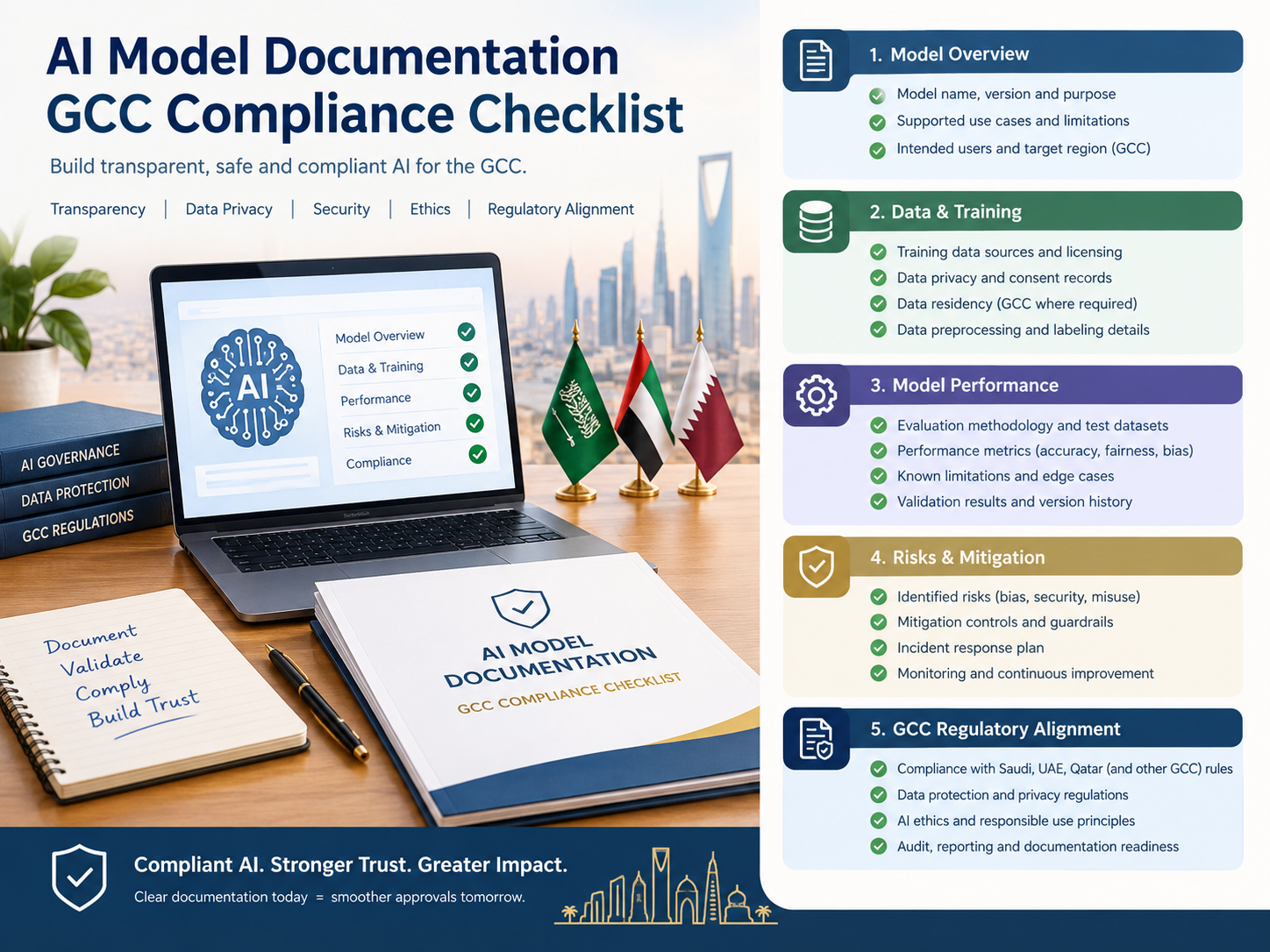
For GCC compliance teams, AI model documentation needs to do more than describe how a model works. It should create a defensible evidence trail showing who owns the system, what data it uses, how it was tested, what risks were identified, who approved it, and how it will be monitored after deployment.
For organizations operating in Saudi Arabia, the UAE, and Qatar, that evidence should also reflect local privacy, data-governance, cybersecurity, vendor-management, and sector-specific requirements. Arabic-language performance and GCC deployment conditions deserve particular attention.
What Is AI Model Documentation?
AI model documentation is the evidence package maintained for a specific AI model or AI-enabled system. It typically covers its purpose, ownership, data, validation, limitations, risks, approvals, changes, and ongoing monitoring.
That is different from broader AI governance documentation, which may include enterprise policies, AI inventories, committees, approval frameworks, and organization-wide controls.
A model card can be useful, but it is only one artifact. Compliance teams may also need.
AI risk and impact assessments
Data-lineage and privacy records
Validation and testing evidence
Security reviews
Human-oversight requirements
Vendor due-diligence records
Approval and exception logs
Monitoring and incident evidence
For broader implementation considerations, Mak It Solutions’ AI governance and secure technology services provide related context.
What Should AI Model Documentation Include?
Model identity, purpose, ownership, and version history
Start with the basics: model name, provider, version, deployment environment, business owner, technical owner, intended uses, prohibited uses, approval status, and review history.
For third-party models, record both the underlying provider version and any configuration, prompt, fine-tuning, retrieval, or orchestration layer added by your organization.
Data sources and lineage
Document where relevant training, fine-tuning, retrieval, evaluation, and production data come from. The record should address provenance, quality controls, personal-data handling, retention, licensing considerations, and cross-border transfers where applicable.
Saudi organizations should map these controls to the privacy and data-governance requirements that apply to their use case. SDAIA’s AI Ethics Principles emphasize integrity and fairness, privacy and security, reliability and safety, transparency and interpretability, and accountability.
Performance, validation, and limitations
Documentation should show what was tested—not simply state that the model “passed.”
Record relevant performance metrics, test populations, acceptance criteria, known failure modes, edge cases, limitations, and remediation decisions. Higher-risk use cases may justify stronger independence between model development and validation.
AI Model Documentation for Arabic and GCC Testing
A model that performs well on a global benchmark may still fail in a real GCC deployment.
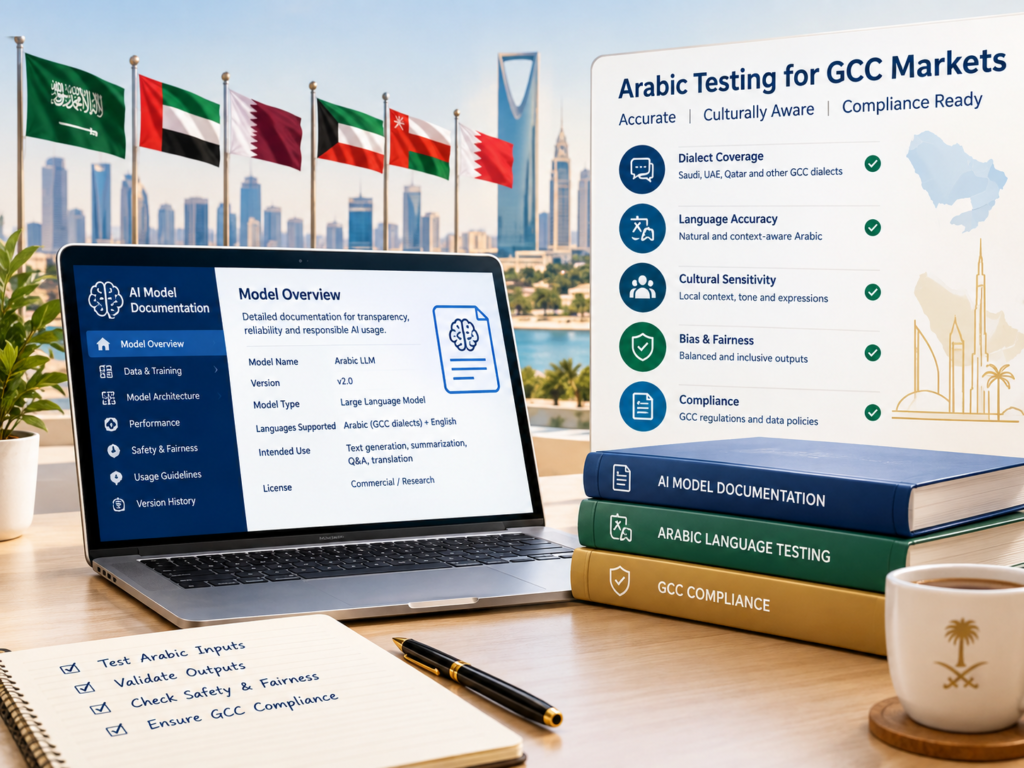
Test Arabic-language performance
Where relevant, evaluation should include Modern Standard Arabic, Gulf or Saudi dialects, Arabic-English code-switching, transliteration, and local terminology.
A customer-service model used in Dubai or Riyadh, for example, should be tested for whether changing from English to Arabic materially affects answer quality, accuracy, safety, or customer outcomes.
Test local context and fairness
Use realistic GCC scenarios rather than relying only on imported datasets. Depending on the use case, testing may include local names, addresses, business terminology, cultural context, and legally appropriate demographic scenarios.
The goal is not simply to prove that Arabic inputs work. Documentation should show whether the model is suitable for the environment in which it will actually operate.
Record hosting and data flows
Document hosting locations, sub processors, external APIs, storage arrangements, and data flows.
Regional cloud hosting can support a compliance strategy, but choosing a GCC data center does not by itself establish compliance. Teams still need to assess contractual, privacy, security, sector, and cross-border requirements. Related infrastructure considerations are covered in Mak It Solutions’ GCC cloud strategy guide and confidential-computing guidance.
How GCC Requirements Affect AI Documentation
Saudi Arabia
Saudi organizations should identify the SDAIA, data-governance, privacy, cybersecurity, and sector-specific requirements that apply to the system.
A regulated fintech in Riyadh, for example, should be able to produce evidence covering model validation, data governance, risk assessment, vendor controls, approvals, monitoring, and material changes rather than relying on a vendor’s broad “AI compliant” claim.
SDAIA’s published framework notes that its AI Ethics Principles were issued in 2023 and places responsibility on organizations for responsible AI adoption and oversight.
UAE
UAE organizations need to determine which federal, emirate-level, free-zone, and sector requirements apply to their deployment.
Depending on the organization, this can include frameworks or rules connected with DIFC, ADGM, financial regulators, privacy obligations, or digital-government requirements. TDRA’s digital-government function includes developing policies, frameworks, and standards and monitoring government-entity compliance with them.
Because the UAE governance landscape continues to evolve, approval teams should verify the rules applicable to the specific entity and use case rather than treating “UAE compliance” as one uniform standard.
Qatar
For Qatar Central Bank-regulated entities, the documentation expectations are particularly concrete. QCB’s Artificial Intelligence Guideline for 2024, effective September 4, 2024, defines AI Trust, Risk & Security Management around governance, trustworthiness, fairness, reliability, robustness, transparency, and data protection.
That makes model, vendor, validation, risk, security, and monitoring evidence especially important for regulated financial deployments in Qatar.
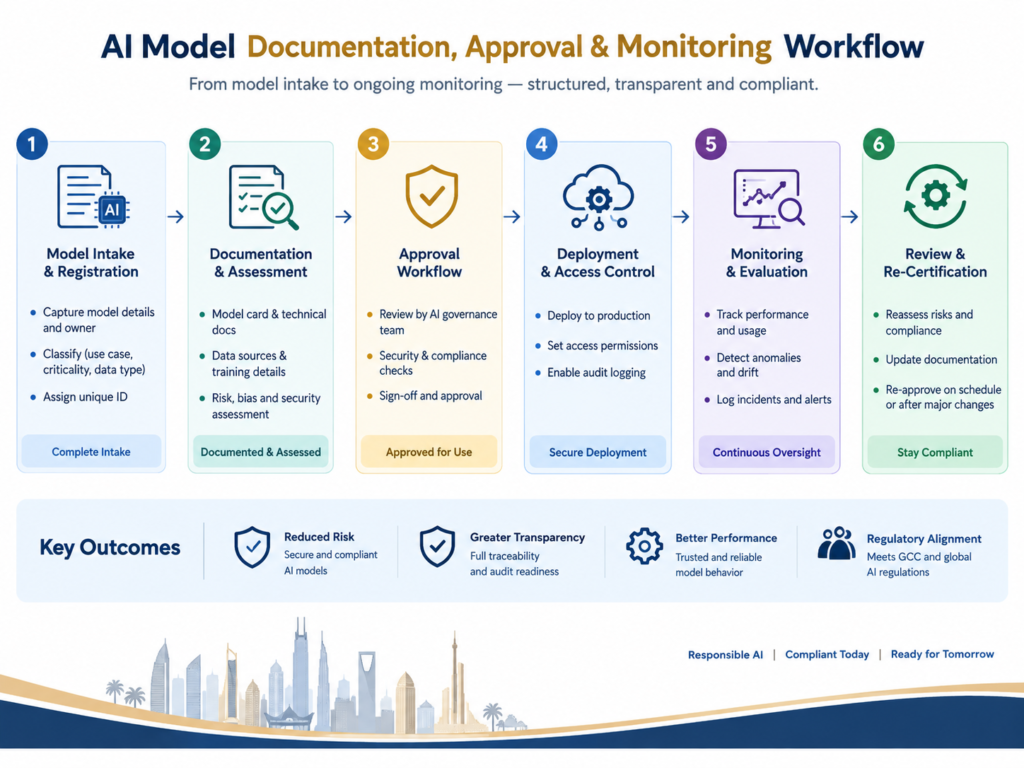
AI Risk Assessment and Audit Evidence
Strong documentation should connect identified risks to actual controls.
Maintain records of.
Risk classification and impact assessment
Control owners and mitigations
Residual risks and approved exceptions
Required human review and escalation
Material configuration or model changes
Monitoring results and drift indicators
Incidents, complaints, and corrective actions
Revalidation decisions
The NIST AI Risk Management Framework can provide a useful voluntary structure for governance, measurement, and risk management, although it does not replace applicable GCC laws or regulatory obligations. NIST also notes that AI RMF 1.0 is currently being revised.
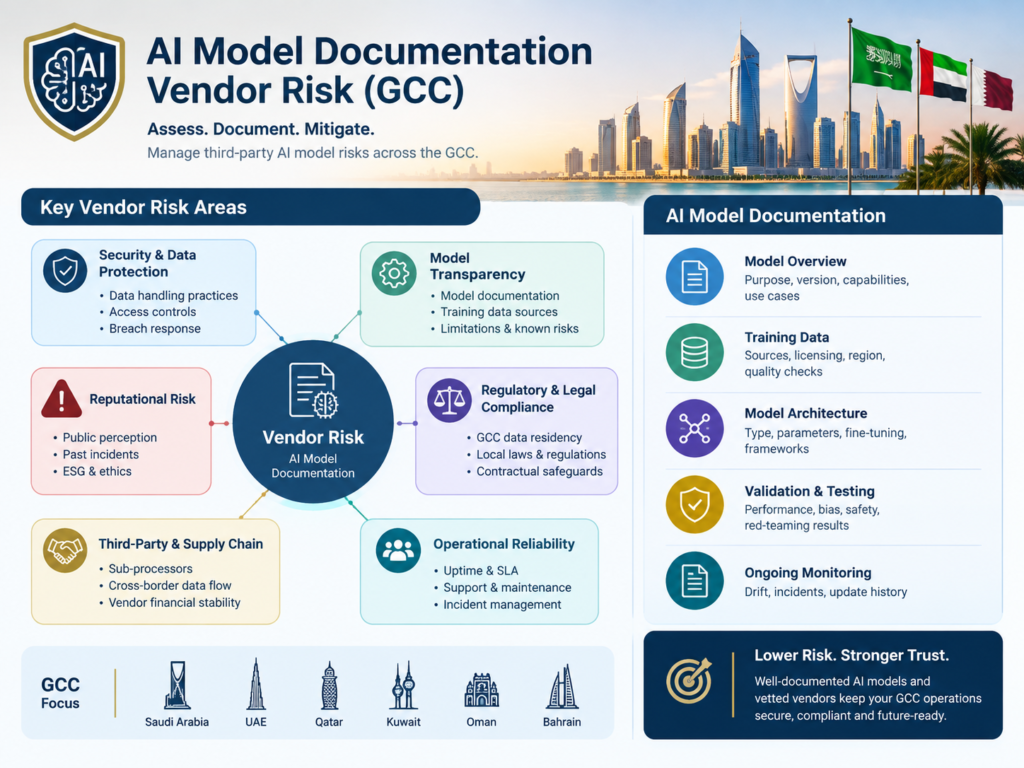
How to Document Third-Party and Foundation Models
Using a foundation model does not transfer accountability entirely to the provider.
Request enough vendor information to assess the system responsibly, including.
Model and version details
Performance and limitation evidence
Security and privacy controls
Data-use terms
Hosting and sub processors
Material-change notifications
Incident procedures
If the provider will not disclose training data or other requested details, document the gap. Record what information is unavailable, what alternative testing was performed, what compensating controls were introduced, and why the residual risk was accepted.
Related operational controls are covered in Mak It Solutions’ AI agent identity management guide and AI data leakage prevention guidance.
AI Model Documentation Checklist Before Approval
Before deployment, compliance teams should confirm that they can.
Identify the AI system, model, provider, version, and accountable owners.
Document intended and prohibited uses.
Review relevant data lineage, privacy, and transfer risks.
Validate performance, limitations, and failure modes.
Test Arabic and locally relevant GCC scenarios where applicable.
Complete the risk assessment and control mapping.
Define human oversight, escalation, and override requirements.
Review third-party and vendor risks.
Record approvals, exceptions, and revalidation triggers.
Production controls should then monitor performance, drift, incidents, vendor changes, and other events that could invalidate the original approval.
Compliance should escalate deployment when ownership is unclear, critical validation is missing, material privacy or security issues remain unresolved, local-language performance is inadequate for the use case, monitoring is absent, or significant model changes have not been reviewed.
Concluding Reamrks
Effective AI model documentation is not paperwork for its own sake. It gives compliance, risk, security, technical, and business teams a shared record of why an AI system was approved and whether it remains safe and appropriate to use.
For organizations deploying AI across Saudi Arabia, the UAE, and Qatar, the strongest approach combines local regulatory mapping with documented validation, Arabic and GCC-specific testing, vendor accountability, human oversight, and continuous monitoring. ( Click Here’s )
Mak It Solutions can support organizations building practical GCC AI governance workflows and compliance-ready technology services around AI deployment.
This article provides general governance and compliance information and is not legal or regulatory advice. Organizations should verify requirements applicable to their jurisdiction, sector, and specific AI use case.
FAQs
Q : What AI documentation should Saudi financial firms maintain?
A : Documentation should be proportionate to the AI system’s risk and applicable financial-sector requirements. Useful evidence commonly includes ownership, data lineage, validation, security and privacy controls, vendor due diligence, risk assessments, approvals, monitoring, incidents, and model-change records.
Q : Does every UAE AI model require independent validation?
A : There is no single universal validation rule covering every AI deployment in the UAE. The appropriate level of validation depends on the organization, jurisdiction, sector, and risk of the use case. Higher-impact systems generally justify stronger validation controls and clearer separation of responsibilities.
Q : What should QCB-regulated firms request from AI vendors?
A : They should obtain enough information to evaluate governance, performance, security, data protection, reliability, and suitability for the intended use. QCB’s AI Guideline makes governance, fairness, robustness, transparency, and data protection central elements of AI trust and risk management.
Q : How should GCC companies document Arabic AI testing?
A : Record the Arabic varieties and scenarios tested, datasets or test cases used, relevant metrics, failure cases, acceptance criteria, differences compared with English performance, and any remediation decisions.
Q : How often should AI model documentation be reviewed?
A : Use a risk-based review schedule together with event-driven reviews. Material model updates, vendor changes, new data sources, performance drift, incidents, regulatory changes, or expansion of the approved use case should trigger reconsideration.