
AI Transparency Policy: Essential GCC Guide
AI Transparency Policy: Essential GCC Guide
AI Transparency Policy: Essential GCC Guide
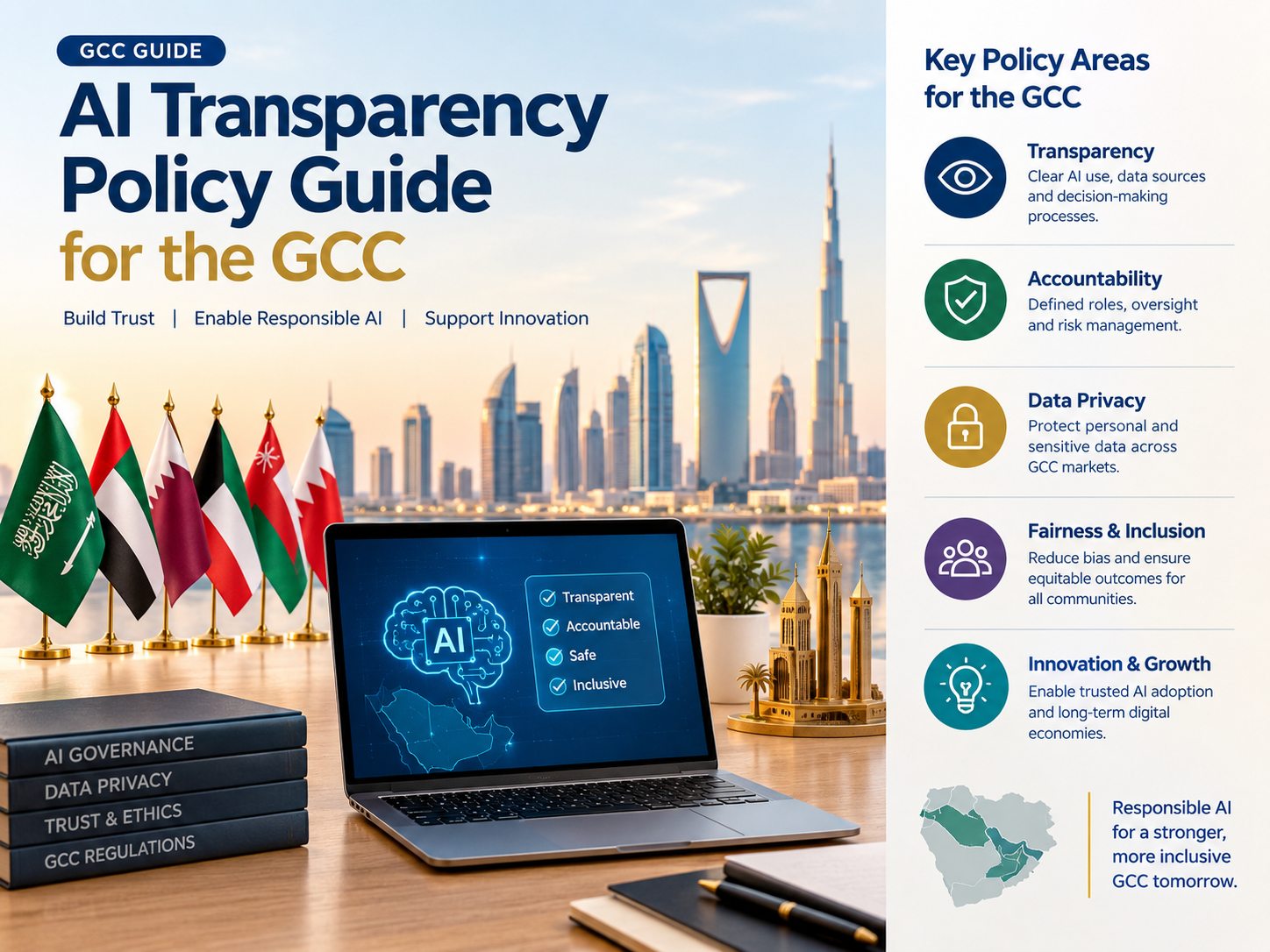
An AI transparency policy explains when customers are interacting with AI, how important AI-assisted outcomes are communicated, and when human review or escalation is available.
For companies operating in Saudi Arabia, the UAE and Qatar, a practical policy should also account for Arabic and English customer experiences, privacy obligations, sector-specific rules, and the different AI governance approaches used across GCC markets.
Introduction
AI is already part of everyday customer journeys across Riyadh, Jeddah, Dubai, Abu Dhabi and Doha. Chatbots answer support questions, recommendation engines personalize products, copilots assist service teams, and automated systems increasingly influence business decisions.
That makes an AI transparency policy more than a small “powered by AI” label.
A useful policy should tell customers when AI is involved, explain significant AI-assisted outcomes in understandable language, provide clear routes to human support, and connect those practices with privacy, security and governance controls.
There is also an important GCC-specific point: Saudi Arabia, the UAE and Qatar do not operate under one unified AI transparency law. Businesses need to distinguish between legislation, regulatory requirements, national guidance, ethical principles and sector-specific rules rather than treating them as interchangeable.
What Is an AI Transparency Policy?
An AI transparency policy defines how an organization communicates the role, limitations and accountability of artificial intelligence to customers, employees and other stakeholders.
In practice, it answers questions such as.
When should a customer be told they are interacting with AI?
Which AI-assisted decisions require an explanation?
What information should that explanation contain?
When can a customer request human review?
Who inside the organization is responsible for AI-related complaints or incidents?
How should transparency requirements be handled across different countries and regulated sectors?
AI Transparency vs. General AI Governance
Transparency is one part of broader responsible AI governance. A complete governance framework may also cover privacy, security, fairness, reliability, accountability, risk management and human oversight.
Saudi Arabia’s SDAIA AI Adoption Framework, for example, identifies transparency and interpretability as responsible-use principles alongside accountability, privacy, safety and fairness.
An organization can therefore have extensive internal AI controls while still falling short on customer transparency. The two areas should support each other.
What Customer-Facing AI Transparency Covers
A policy may apply to.
AI chatbots and conversational agents
Recommendation engines
Generative AI content
Automated or AI-assisted decisions
Customer-service copilots
Fraud or risk-detection systems
AI-enabled onboarding
Personalization and eligibility tools
Companies developing these experiences can connect governance requirements directly to their web development workflows and mobile application development.
Why Transparency Matters in GCC Customer Journeys
Customers should be able to understand when they are dealing with AI, what role the system is playing, and where automation ends and human responsibility begins.
This matters especially in bilingual GCC environments. Arabic and English interfaces should communicate the same essential information rather than giving one audience a simplified or incomplete version of the disclosure.
Clear transparency can also reduce confusion when an AI assistant gives recommendations, generates content or contributes to an outcome that affects the customer.
What Should a GCC AI Transparency Policy Include?
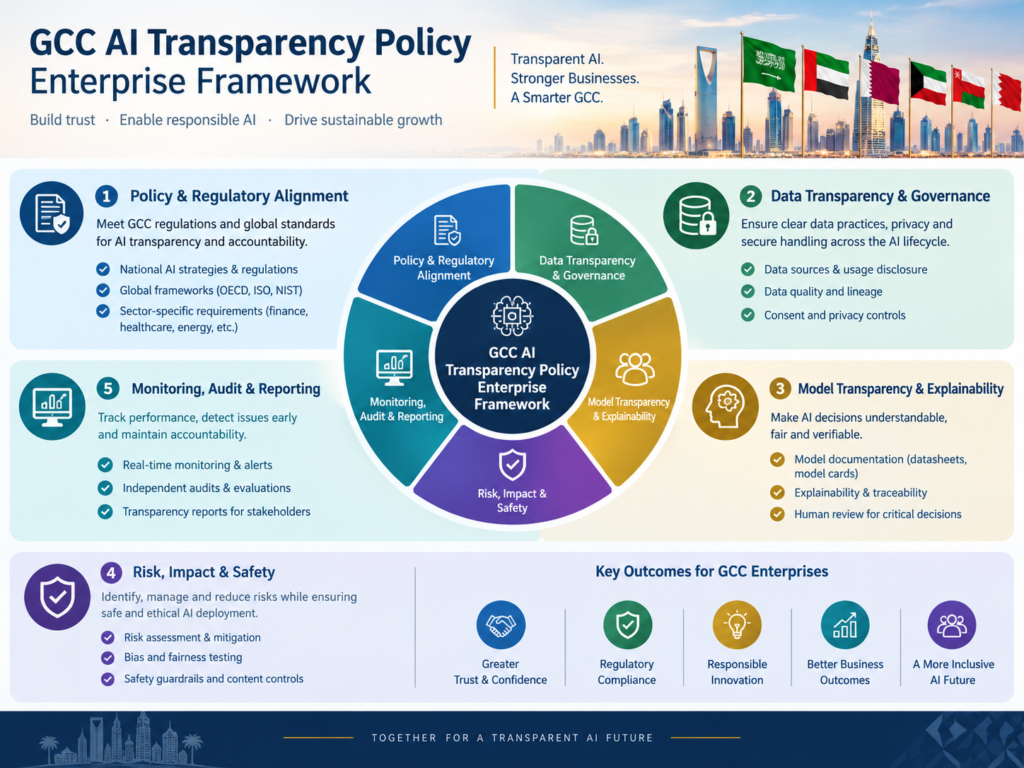
A strong AI transparency policy should turn high-level responsible-AI principles into practical customer and operational controls.
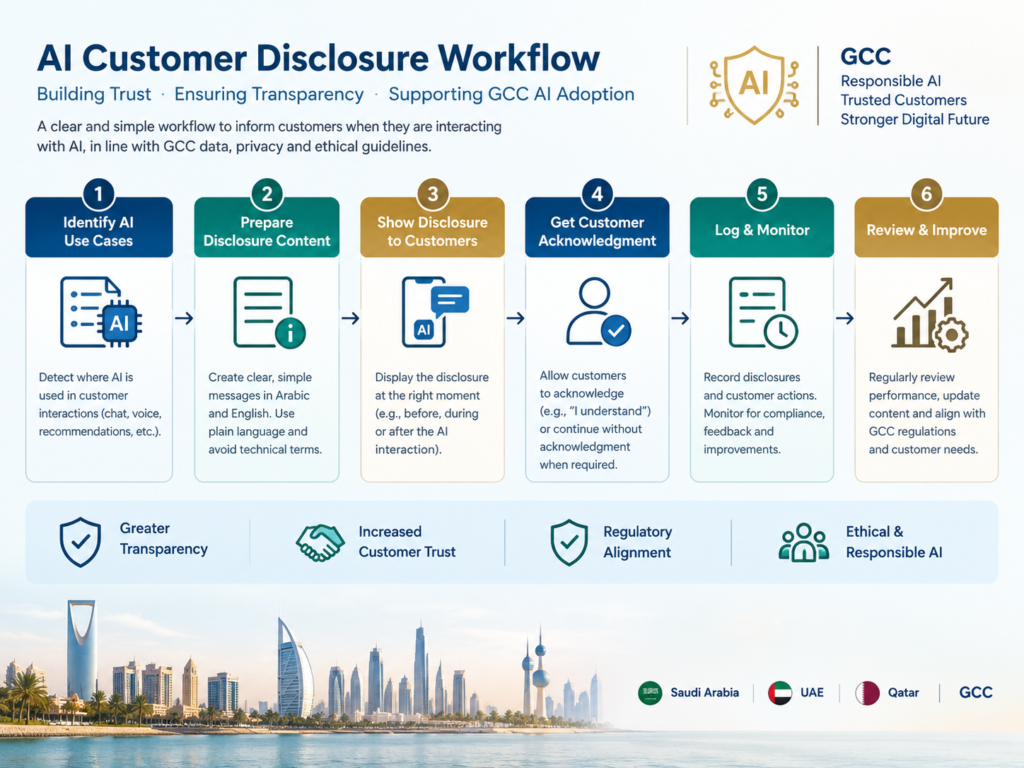
Clear Disclosure When Customers Interact With AI
Customers should not have to guess whether they are speaking to a person or an automated system.
Simple wording such as “You are chatting with an AI-powered assistant” can often provide more clarity than a lengthy technical notice.
The disclosure should appear at the point where it matters: inside the chatbot, application flow, voice interaction or other relevant customer journey.
For significant interactions, companies may also need to explain what the AI can and cannot do.
Explain ability for Automated or AI-Assisted Decisions
Customers generally do not need a technical description of model architecture.
They need a meaningful explanation of the factors that influenced an important outcome.
That becomes more relevant when AI contributes to areas such as.
Financial eligibility
Customer onboarding
Pricing
Risk assessments
Account restrictions
Service access
Other consequential decisions
The UAE’s AI Ethics Principles and Guidelines, for example, state that people should be informed when significant decisions affecting them are made by AI and that such decisions should be explainable as far as technically possible. The guidance also discusses providing understandable information about important factors influencing outcomes.
Human Review, Escalation and Accountability
Transparency without a practical escalation route can leave customers stuck.
The policy should define when a customer can.
Ask to speak with a person
Request additional explanation
Challenge an AI-assisted outcome
Submit a complaint
Request review by an appropriate team
Internal ownership matters too. Product, compliance, legal, risk and customer-experience teams should know who is responsible when an AI-related issue is escalated.
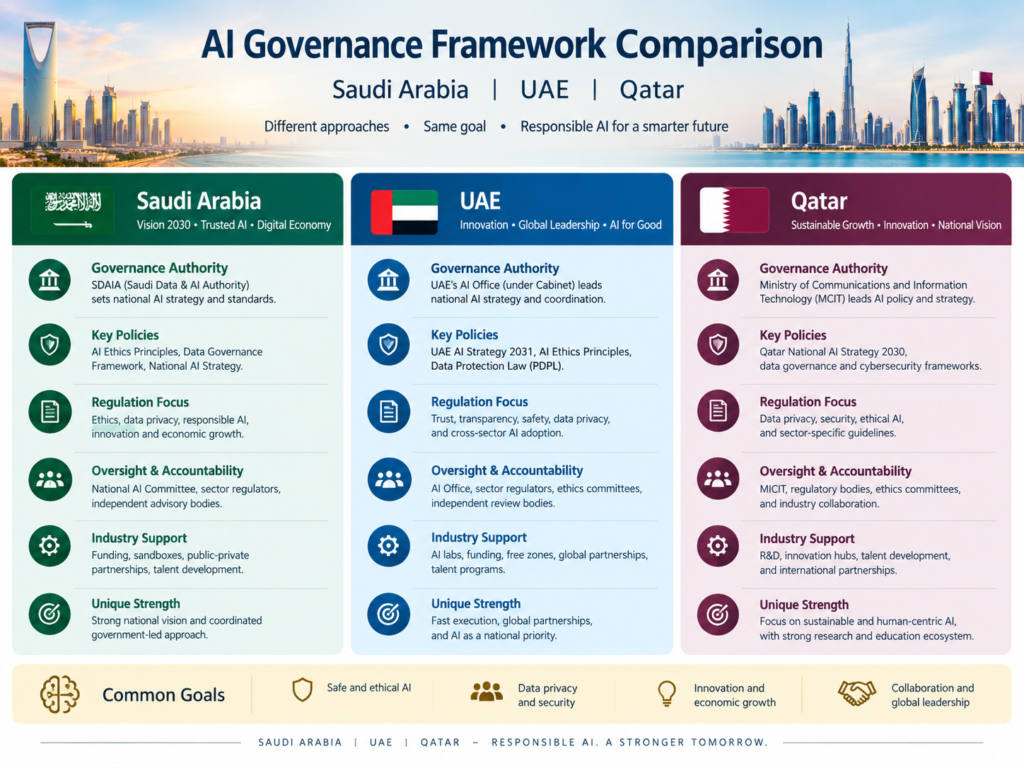
AI Transparency Policy Requirements in Saudi Arabia, UAE and Qatar
There is no single GCC-wide framework that creates identical AI transparency obligations across Saudi Arabia, the UAE and Qatar.
A company should therefore map requirements by country, sector, data type and AI use case.
Saudi Arabia.
Saudi Arabia’s AI governance environment includes SDAIA’s AI ethics and responsible-adoption materials, which emphasize principles such as transparency, interpretability and accountability. SDAIA guidance also discusses documenting decisions, maintaining traceability and providing explanatory information to stakeholders where appropriate.
AI deployments involving personal information should also be reviewed alongside Saudi privacy and data-governance requirements. SDAIA materials on the Personal Data Protection Law emphasize lawful, fair and transparent processing of personal data.
Sector-specific requirements may create additional obligations.
A Riyadh fintech, for example, should not rely only on a general AI ethics document. It should connect customer-facing AI notices with privacy controls, risk governance, audit processes and the requirements that apply to its regulated financial activities.
UAE.
The UAE’s AI Ethics Principles and Guidelines emphasize transparency and explain ability, particularly where AI contributes to decisions with a significant effect on individuals. The guidance also discusses informing people when they interact with AI systems capable of convincingly appearing human.
The UAE’s wider AI policy framework continues to treat ethics and transparency as central responsible-AI themes.
Businesses in Dubai, Abu Dhabi and the wider UAE should separately assess applicable privacy, telecommunications and sector requirements, including rules that may apply within financial free zones or regulated industries.
Digital teams can incorporate disclosures directly into customer-facing web design rather than leaving transparency solely to legal terms and conditions.
Qatar.
Qatar’s NCSA guidance on secure AI adoption discusses human oversight and adaptive risk management as important components of responsible AI deployment. It also emphasizes monitoring systems as technology, customer expectations and regulatory requirements evolve.
For regulated financial institutions, Qatar Central Bank’s AI Guideline is more specific. It applies to QCB-regulated entities using AI and includes requirements around AI strategy, governance, risk assessment and ongoing oversight.
A Doha fintech should therefore distinguish between broad responsible-AI guidance and requirements that apply directly to regulated financial entities.
How to Design AI Disclosures for GCC Customers
Writing a policy is only part of the job. Customers experience transparency through interfaces, prompts, support journeys and explanations.
Build Arabic and English AI Disclosure UX
Arabic and English notices should communicate equivalent meaning.
For Arabic experiences, teams should also consider.
Right-to-left layouts
Natural Arabic terminology
Button and menu placement
Sentence length on mobile screens
Consistency between Arabic and English explanations
Literal translation is not always enough. The goal is equal understanding.
Match Disclosure Depth to AI Risk
Not every AI feature needs the same disclosure.
A shopping recommendation may require a lighter explanation than an AI-assisted credit, eligibility or account-access decision.
A useful working principle is simple: the greater the potential effect on the customer, the stronger the case for clearer disclosure, explanation, documentation and human oversight.
Make Human Escalation Visible and Easy
Do not hide escalation options inside lengthy policies.
Where human review is appropriate, customers should be able to find options such as.
Speak to a person
Request a review
Ask why this happened
Report a problem
Submit a complaint
These controls are more useful when they appear inside the relevant journey rather than on a separate legal page.
Customer-Facing AI Use Cases Across GCC Industries
The right transparency approach depends heavily on how AI is being used.
Fintech and Banking
Banks and fintech’s may use AI for onboarding, fraud detection, customer assistants, transaction monitoring and eligibility assessments.
Higher-impact financial use cases generally require stronger governance because customers may be affected by decisions involving access, risk or financial services.
Applicable requirements from Saudi, UAE or Qatari regulators should be mapped to the specific activity rather than treated as generic GCC rules.
Government and Digital Public Services
Government-facing AI may support virtual assistants, application processing, form completion, service routing or internal decision support.
Clear AI identification, accessible escalation and appropriate documentation become especially important when citizens depend on a service or cannot easily choose an alternative provider.
Retail, Logistics and Digital Platforms
Retailers can use lighter-touch disclosures for AI-powered recommendations while still making automated assistance clear.
A Dubai e-commerce business, for example, may identify its AI shopping assistant at the beginning of a conversation and provide a straightforward route to human support. Its team can incorporate that experience through its wider e-commerce and digital development capabilities.
Logistics businesses in Riyadh or Doha can apply similar principles to delivery assistants, automated support and operational recommendations.
How to Build and Implement an AI Transparency Policy
A practical implementation process can be organized into three steps.
Inventory Customer-Facing AI Systems
Start by identifying where AI actually touches customers.
Map systems such as.
Chatbots
AI agents
Recommendation engines
Generative content tools
Copilots
Automated decisions
AI-assisted eligibility or risk systems
For each system, record its purpose, users, data inputs, vendor or model owner, customer impact and jurisdiction.
Classify Risk and Define Disclosure Rules
Not every use case carries the same level of risk.
Assess factors including.
Personal-data use
Significance of the customer outcome
Hallucination or misinformation risk
Sector sensitivity
Ability to obtain human review
Customer vulnerability
Jurisdiction
Vendor dependency
Then define the disclosure, explanation and escalation standard that applies to each category.
Implement Notices, Explanations and Human Oversight
Turn the policy into operational controls.
That may include.
Arabic and English disclosure templates
AI-assistant identification
Explanation templates
Human escalation routes
Complaint handling
Audit trails
Model and vendor documentation
Change-management procedures
Monitoring and incident review
Data and reporting teams can support these controls through business intelligence services, while technical teams can strengthen logging and governance through secure backend development practices.
AI Transparency Policy Best Practices for GCC Enterprises
Align Transparency With Privacy and Data Governance
AI transparency should not become an isolated compliance project.
Connect disclosures with.
Privacy notices
Consent or other lawful-processing mechanisms where relevant
Data-retention rules
Customer rights processes
Cybersecurity controls
Vendor governance
Internal data policies
This creates a more consistent customer experience and reduces duplicated governance work.
Review Vendors, Models and AI Audit Trails
Many businesses depend on external models, APIs or AI platforms.
Maintain records of:
Model or system owners
External vendors
Intended uses
Known limitations
Testing results
Significant model or prompt changes
Customer complaints
Escalation events
Unexpected outcomes
Saudi AI ethics guidance, for example, specifically discusses documentation, traceability and due diligence where third-party AI systems are involved.
Review the Policy as AI Systems and GCC Rules Evolve
An AI transparency policy should be a living governance document.
Review it whenever.
A new AI use case launches
A model changes materially
Customer impact increases
A new vendor is introduced
Regulators publish relevant guidance
Complaints expose a transparency gap
The company enters another GCC market
A Riyadh fintech, Dubai digital platform and Doha SME may use similar AI technology but operate under different compliance and sector contexts.
Final Takeaway
A strong AI transparency policy gives customers clarity without overwhelming them with technical detail.
For GCC businesses, the most practical approach is to build one responsible-AI baseline while adapting disclosure, explain ability, privacy and human-oversight controls to Saudi Arabia, the UAE and Qatar individually. Mak It Sol
The result should be visible in the customer journey not only inside a governance document.
Need a GCC-ready AI governance framework rather than a generic template? Explore Mak It Solutions services or contact the team to discuss an AI transparency gap assessment, customer-journey review or custom strategy for Saudi Arabia, the UAE and Qatar.
FAQs
Q : Does Saudi Arabia require businesses to disclose the use of AI chatbots?
A : Saudi AI ethics and responsible-adoption materials emphasize transparency and interpretability, but companies should not treat those materials as a universal chatbot-disclosure rule applying identically to every business. Applicable obligations depend on the use case, data involved and regulated sector.
Clear identification of an AI chatbot remains a useful governance practice because it helps customers understand when they are dealing with automation rather than a human representative.
Q : How should UAE companies label AI-generated customer content?
A : The UAE’s AI Ethics Principles and Guidelines support clear communication about AI involvement, particularly when a significant AI-supported decision affects an individual or an AI system could be mistaken for a human.
A Dubai e-commerce business, for example, could identify its AI assistant at the start of a conversation and clearly label AI-generated recommendations when that context materially affects customer understanding.
Q : What should a Qatar company include in an AI customer notice?
A : A practical Qatar-focused notice should explain that AI is being used, its purpose, important limitations and how the customer can reach a human where appropriate.
Higher-impact deployments may require stronger governance. Qatar’s NCSA guidance addresses human oversight and AI risk management, while the QCB AI Guideline establishes specific requirements for QCB-regulated entities.
Q : Can one AI governance policy cover Saudi Arabia, the UAE and Qatar?
A : A group-level framework can establish common principles, but local controls should reflect the country, sector, data involved and AI use case.
A practical model is to maintain one responsible-AI baseline supported by country-specific and sector-specific compliance matrices rather than assuming the same requirement applies throughout the GCC.
Q : Should Arabic AI disclosures differ from English disclosures in GCC markets?
A : The essential meaning and transparency level should remain consistent, but Arabic disclosures should be properly localized rather than translated word for word.
Teams should account for right-to-left interfaces, familiar terminology, sentence structure and customer expectations while ensuring that Arabic and English users receive the same core information about AI involvement, limitations and human escalation.
[…] Is AI Model […]