


Post-Quantum Cryptography for Financial Services: Key Risks
Post-Quantum Cryptography for Financial Services: Key Risks

Post-Quantum Cryptography for Financial Services: Key Risks
Post-quantum cryptography for financial services is becoming an essential part of long-term cybersecurity planning. Banks, payment providers and fintech companies rely on cryptographic systems that future quantum computers could potentially compromise.
Post-quantum cryptography (PQC) protects financial information, digital identities and secure communications using algorithms designed to resist attacks from both classical and quantum computers. Financial institutions can prepare by identifying vulnerable systems, assessing business risks and adopting a phased migration strategy based on recognized security standards.
The urgency is not just theoretical.
IBM’s 2024 Cost of a Data Breach research estimated the average financial-sector breach cost at $6.08 million, compared with a global cross-industry average of $4.88 million. These figures reflect conventional cybersecurity incidents, not quantum attacks, but they highlight the financial consequences of inadequate protection.
Quantum-safe banking therefore begins with understanding where existing cryptography is used, which information needs long-term protection and how security systems can evolve without disrupting critical services.
What Is Post-Quantum Cryptography for Financial Services?
Post-quantum cryptography refers to cryptographic algorithms designed to withstand attacks from sufficiently powerful quantum computers.
Financial institutions use encryption and digital signatures to protect customer information, authenticate transactions and secure communication between interconnected systems.
Many of these services depend on public-key technologies that will eventually need to be replaced or upgraded.
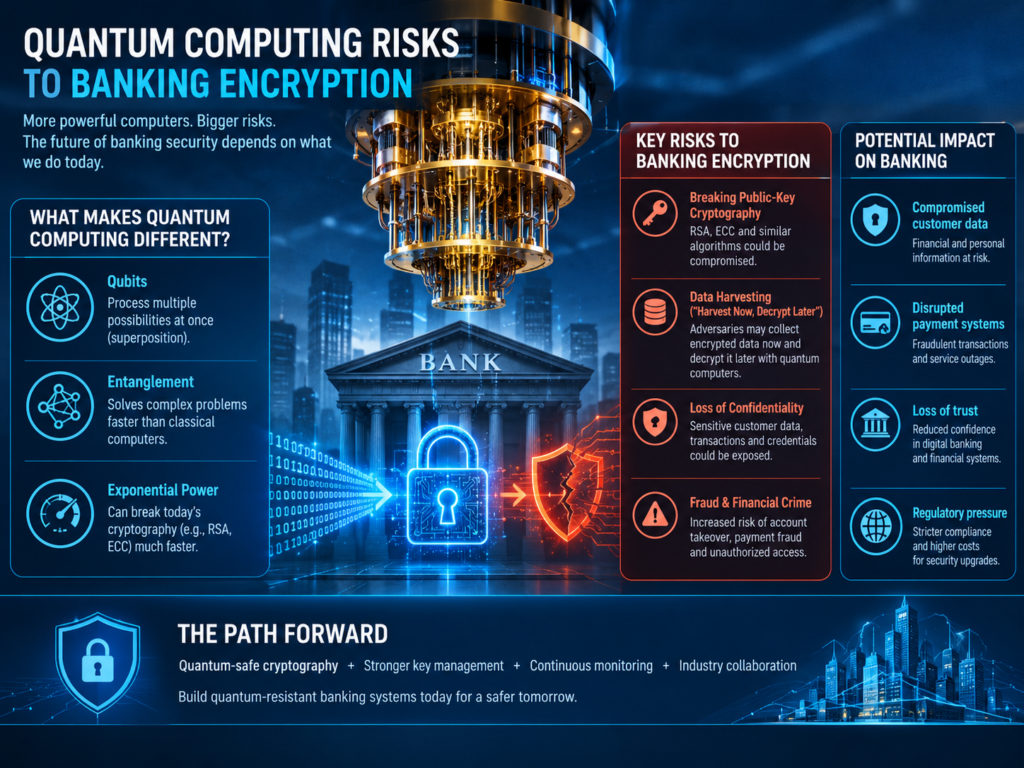
How Quantum Computing Threatens Banking Encryption
Traditional public-key cryptography relies on mathematical problems that conventional computers cannot efficiently solve.
Two widely used technologies are.
RSA: Used in certain encryption, authentication and digital-signature systems.
Elliptic-curve cryptography (ECC): Common in digital signatures, secure communications and key establishment.
A sufficiently advanced quantum computer running appropriate algorithms could undermine the security assumptions behind both technologies.
However, symmetric encryption such as AES faces a different and generally less severe quantum threat.
Banks do not need to replace every cryptographic mechanism. They need to identify vulnerable algorithms and modernize the systems that depend on them.
Harvest Now, Decrypt Later: Why Financial Data Is at Risk
One particularly important concern is harvest now, decrypt later (HNDL).
In this scenario, attackers collect encrypted information today, store it and attempt to decrypt it once capable quantum computers become available.
Long-lived financial records, identity information and confidential communications are especially relevant.
For example, encrypted customer information captured today might remain sensitive well into the future.
This creates a security challenge even before cryptographically relevant quantum computers exist.
Learn more about harvest-now-decrypt-later attacks and data retention.
Which Financial Systems Face the Greatest Risk?
Financial institutions should review cryptographic dependencies across.
Public key infrastructure (PKI), certificates and digital signatures.
Secure banking APIs, TLS connections and VPNs.
Payment gateways and financial messaging infrastructure.
Customer authentication and identity management.
Long-term encrypted records and archived communications.
Cloud services, hardware security modules (HSMs) and third-party integrations.
The priority depends on data sensitivity, operational importance, exposure and replacement complexity.
How to Assess Post-Quantum Readiness in Banks
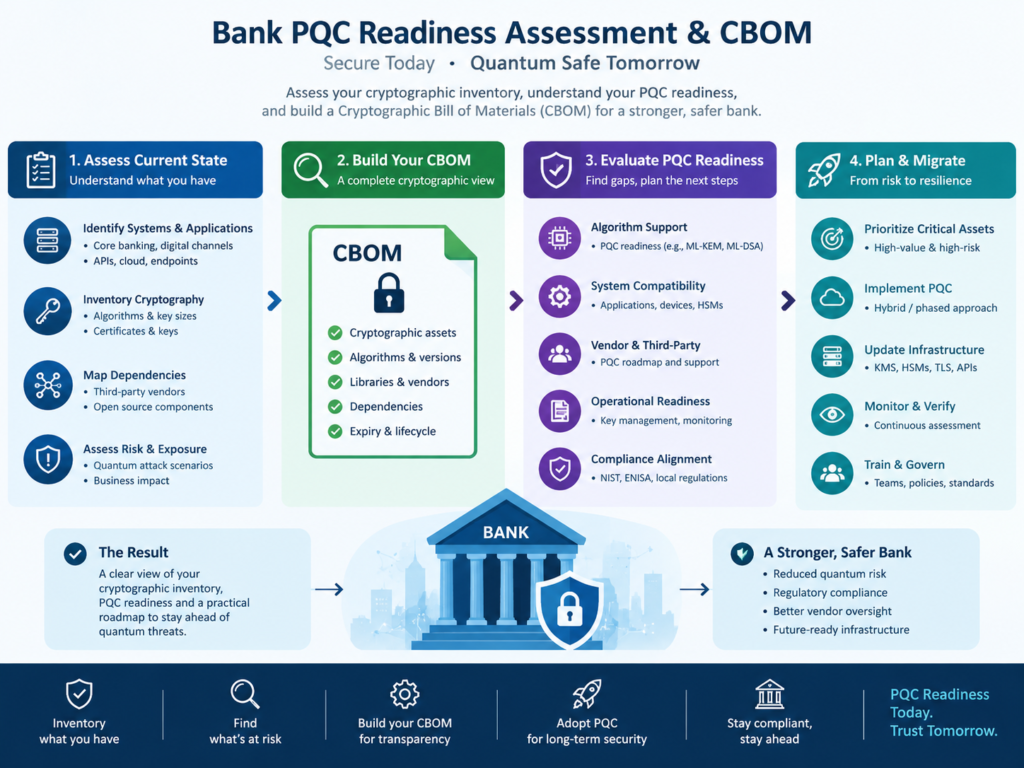
A post-quantum readiness assessment helps banks understand their cryptographic exposure and determine which systems need attention first.
The assessment should connect technical vulnerabilities with business risk rather than treating every cryptographic asset equally.
Build a Cryptographic Inventory and CBOM
Start by identifying where cryptography exists across applications, infrastructure and connected services.
A cryptographic bill of materials (CBOM) can document algorithms, certificates, libraries, keys, security hardware, software dependencies and external integrations.
For example, a New York financial institution might initially prioritize customer authentication, cloud-hosted banking applications and payment APIs.
Where legacy applications complicate discovery, Python development services may support automated inventory and software modernization workflows.
A reliable inventory gives security teams a clearer picture of what needs replacing and which suppliers must participate.
Prioritize Cryptographic Risks
Once the inventory is established, evaluate systems using consistent criteria.
Consider.
How long protected information must remain confidential.
Whether the system uses quantum-vulnerable public-key algorithms.
Its importance to payments, authentication or customer operations.
Exposure to external networks.
Dependencies on vendors, certificates and legacy infrastructure.
The difficulty of replacing existing cryptography safely.
A public-facing payment authentication service with complex integrations may demand attention earlier than an isolated internal application.
Measure Crypto-Agility and Supplier Readiness
Crypto-agility is the ability to replace or update cryptographic algorithms without rebuilding entire applications.
Banks should assess certificate lifecycle management, HSM capabilities, cloud key management services and supplier support for PQC.
The following editorial maturity model offers a practical starting point.
|
Level |
Readiness stage |
Evidence |
|---|---|---|
|
1 |
Unaware | No formal PQC inventory |
|
2 |
Discovering | Cryptographic assets being identified |
|
3 |
Planning | Risk-ranked migration roadmap |
|
4 |
Piloting | PQC testing and supplier validation |
|
5 |
Transitioning | Controlled deployment and monitoring |
This is an editorial assessment model, not an official NIST maturity framework.
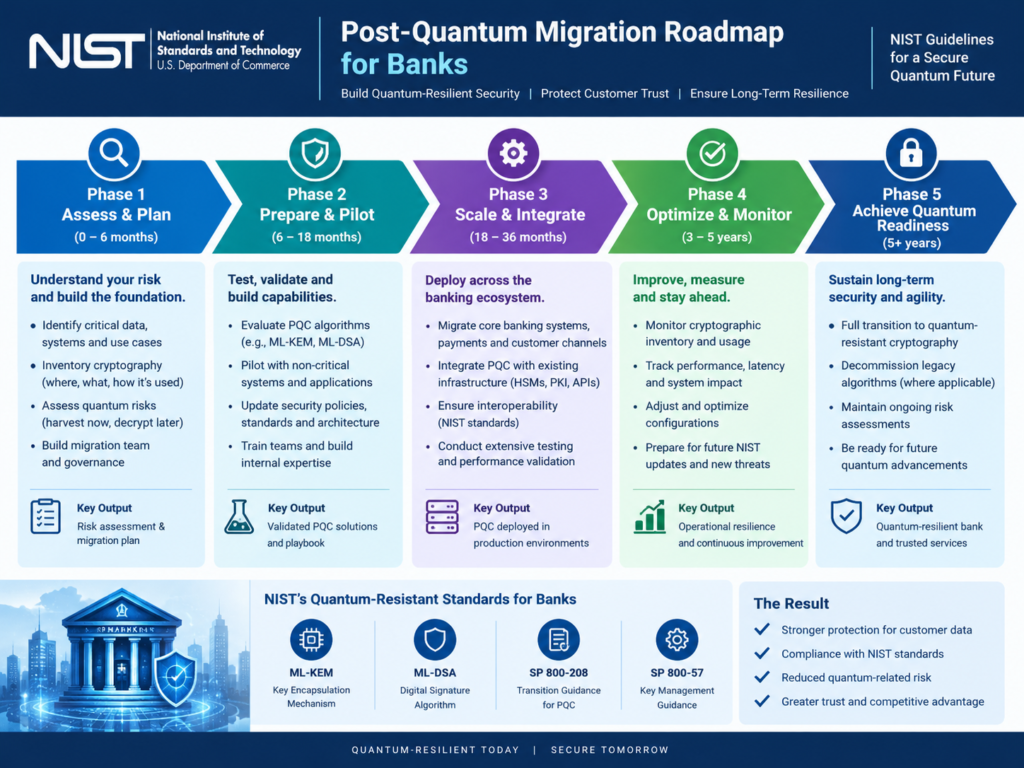
Building a Post-Quantum Cryptography Migration Roadmap
A successful migration requires more than selecting a new encryption algorithm.
Banks must coordinate technology changes, suppliers, security testing and operational risk management.
A phased approach can make the transition more manageable.
Discover, Inventory and Prioritize
Begin by assigning responsibility to security and technology leaders.
Document cryptographic assets, critical applications, legacy systems and third-party dependencies.
Then develop a migration backlog based on confidentiality requirements, business impact and technical complexity.
Financial institutions operating internationally may also draw useful lessons from post-quantum cryptography planning for banking environments.
Pilot NIST-Standardized PQC Algorithms
The US National Institute of Standards and Technology (NIST) finalized three foundational post-quantum cryptography standards in August 2024.
|
NIST standard |
Algorithm |
Primary purpose |
|---|---|---|
| FIPS 203 | ML-KEM | Key establishment |
| FIPS 204 | ML-DSA | Digital signatures |
| FIPS 205 | SLH-DSA | Hash-based digital signatures |
Banks should test suitable implementations in controlled environments before production deployment.
Important considerations include interoperability, system performance, certificate sizes, cryptographic library support, key management and rollback procedures.
Hybrid cryptography, which combines classical and post-quantum mechanisms, may also support transitional deployments where supported by the relevant protocols and systems.
Deploy, Monitor and Maintain Crypto-Agility
After successful testing, deploy validated solutions gradually.
Prioritize systems handling sensitive information and critical financial operations.
Coordinate with certificate authorities, cloud providers, HSM vendors and external financial networks.
Maintain operational monitoring, migration documentation and recovery procedures.
Most importantly, build crypto-agility into long-term architecture. Cryptographic modernization should be a repeatable capability, not a one-time project.
Post-Quantum Standards and Compliance: USA, UK and EU
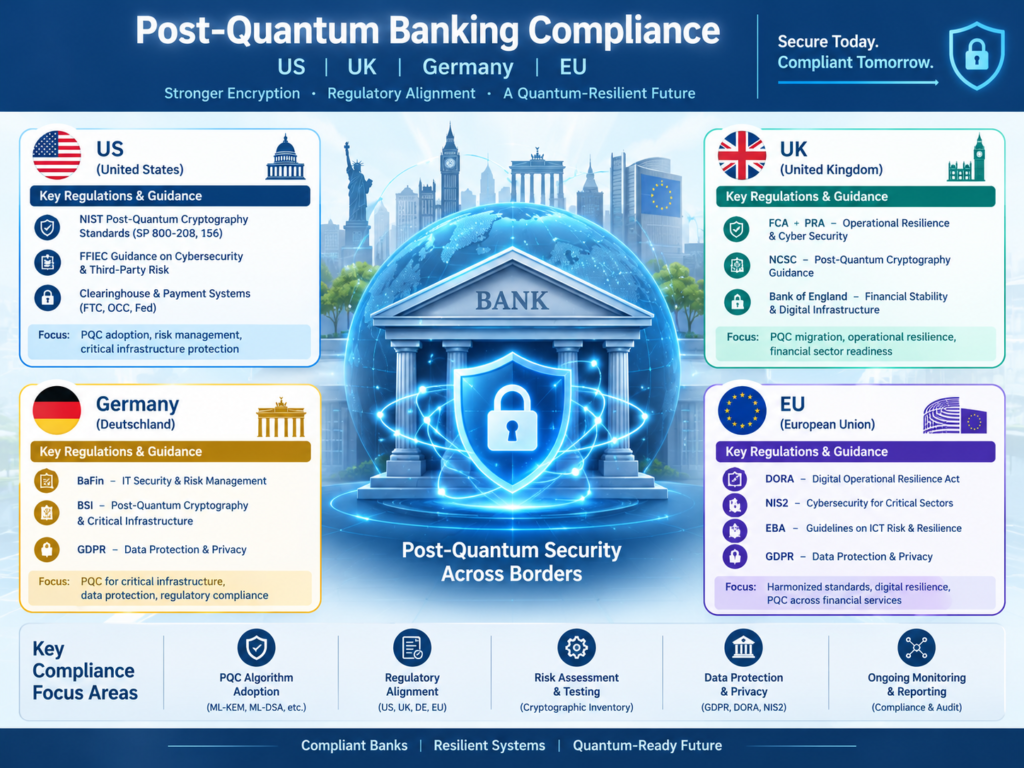
Post-quantum migration expectations differ across jurisdictions.
Financial institutions should distinguish technical standards, government guidance and legally binding regulatory obligations.
USA.
US financial institutions can use NIST FIPS 203, 204 and 205 as foundations for selecting standardized post-quantum cryptographic mechanisms.
They should also consider applicable FFIEC supervisory guidance, financial-sector cybersecurity expectations and relevant Gramm-Leach-Bliley Act safeguards.
Existing risk management obligations may support PQC planning, but they do not establish a universal deployment deadline for every US bank.
UK.
The UK National Cyber Security Centre (NCSC) published post-quantum migration guidance in March 2025.
Its recommended milestones are.
2028: Complete cryptographic discovery, define migration goals and develop an initial plan.
2031: Complete highest-priority migration activities and refine the broader roadmap.
2035: Target completion of migration across systems, services and products.
These are NCSC migration targets, rather than universal statutory deadlines.
Banks operating in London and elsewhere in the UK should align their plans with operational resilience requirements, relevant FCA/PRA expectations and data protection responsibilities.
Germany and EU.
German financial institutions should consider BSI cryptographic recommendations alongside applicable BaFin supervisory requirements.
Across the European Union, the Digital Operational Resilience Act (DORA) establishes ICT risk management and resilience obligations.
However, DORA does not impose a blanket requirement to adopt specific PQC algorithms.
The EU’s coordinated implementation roadmap, adopted in June 2025, calls for Member States to start transitioning to PQC by the end of 2026 and protect high-risk use cases as soon as possible, no later than the end of 2030.
These policy targets should not be confused with identical legal deadlines for every financial institution.
Regional PQC Guidance at a Glance
|
Region |
Relevant authorities |
Main consideration |
|---|---|---|
| USA | NIST, FFIEC | Standards-based modernization and risk governance |
| UK | NCSC, FCA, PRA | Migration milestones through 2035 |
| Germany | BSI, BaFin | Technical assurance and financial-sector oversight |
| Wider EU | European Commission, national authorities | Transition activity by 2026 and high-risk priorities by 2030 |
The G7 Cyber Expert Group also issued a financial-sector post-quantum transition roadmap in January 2026.
It encourages coordinated, risk-based preparation but explicitly does not establish new regulatory expectations.
Building Quantum-Safe Banking Infrastructure
Post-quantum readiness affects more than encryption software.
Banks must evaluate payment infrastructure, digital identity, communications and supplier ecosystems together.
Quantum-Safe Payments and Banking APIs
Financial institutions should assess public-key dependencies across payment gateways, secure APIs and financial messaging integrations.
Relevant ecosystems include SWIFT, ISO 20022, Fed Now in the USA, Faster Payments in the UK and SEPA/TARGET Services in Europe.
These interconnected environments require careful coordination because cryptographic changes may affect interoperability.
Secure API architecture and web development services can support broader application modernization.
Post-Quantum PKI, HSMs and Hybrid TLS
PQC implementation can affect certificate formats, authentication systems, key establishment and hardware compatibility.
Hybrid TLS may help organizations introduce quantum-resistant key establishment while maintaining classical protection during migration, where properly supported.
Before deployment, banks should test certificates, HSM compatibility, protocol behavior, performance and recovery options.
Choosing a Post-Quantum Readiness Partner
Financial institutions should request clear technical evidence when evaluating vendors or consulting partners.
|
Evaluation area |
Evidence to request |
|---|---|
| Standards | Support for relevant NIST PQC standards |
| Integration | PKI, HSM, TLS and API compatibility |
| Security | Testing results and deployment controls |
| Resilience | Monitoring, recovery and rollback plans |
| Delivery | Pilot documentation and migration experience |
| Support | Maintenance commitments and upgrade roadmaps |
Security reporting and management visibility also matter. Business intelligence services may support modernization dashboards and decision-making, although cryptographic implementation requires specialized security expertise.
The First 90 Days of Post-Quantum Readiness
Financial institutions do not need to complete an enterprise-wide migration immediately.
They do need an actionable starting point.
Days
1–30
Establish governance
Assign accountable owners, define objectives and identify business-critical systems.
Days
31–60
Assess cryptographic exposure
Inventory priority assets, evaluate data sensitivity and identify supplier dependencies.
Days
61–90
Plan controlled pilots
Select suitable workloads, request vendor roadmaps and approve a prioritized migration backlog.
Responsibility should be shared across the CISO, CTO, infrastructure architects, compliance teams, procurement and operational risk functions.
Organizations handling long-lived confidential information may also find relevant lessons in post-quantum cryptography planning for healthcare.
Final Words
Post-quantum cryptography for financial services is a long-term modernization challenge, but the most useful first steps are practical: identify cryptographic dependencies, prioritize sensitive systems and establish a realistic migration roadmap.
For financial institutions in the USA, UK, Germany and wider EU, aligning technical planning with relevant standards and regional guidance can help avoid rushed, disruptive changes later.
Mak It Solutions can discuss application modernization requirements, cryptographic inventory needs and the technical foundations of a post-quantum readiness program.
Contact Mak It Solutions to request a scoped readiness-assessment discussion.
Note: This content provides general technical and regulatory information, not legal or compliance advice. Institutions should confirm obligations with qualified specialists and relevant authorities.
Key Takeaways
Post-quantum cryptography helps protect financial information and authentication systems against future quantum threats.
Cryptographic inventories and risk assessments provide the foundation for migration.
NIST standards support the selection and testing of quantum-resistant algorithms.
Regional guidance and regulatory obligations must be evaluated separately.
Crypto-agility, supplier readiness and controlled deployment reduce transition risks.
Migration budgets should reflect business criticality and technical complexity rather than assumptions about universal costs.
FAQs
Q : Can banks combine classical and post-quantum cryptography?
A : Yes. Hybrid cryptographic approaches can combine classical and quantum-resistant mechanisms during migration. However, deployment requires compatible protocols, secure implementations and careful testing of certificates, cryptographic libraries and connected systems.
Q : Does DORA require banks to adopt post-quantum cryptography?
A : No. DORA establishes ICT risk management and operational resilience requirements but does not mandate a specific PQC algorithm for every bank. European institutions should nevertheless consider quantum-related exposure within their broader technology risk assessments.
Q : What is the difference between ML-KEM and ML-DSA?
A : ML-KEM, standardized in NIST FIPS 203, supports cryptographic key establishment. ML-DSA, standardized in FIPS 204, provides digital signatures for authentication and integrity verification. They serve different purposes within a post-quantum security architecture.
Q : Should smaller fintech companies prepare for PQC before 2030?
A : Yes. Smaller fintech companies should begin by identifying cryptographic dependencies and assessing sensitive information, even if deployment will occur later. Starting early helps teams understand vendor capabilities, technical constraints and potential migration costs.
Q : How can financial institutions evaluate cloud PQC readiness?
A : Banks should request service-specific documentation from cloud providers such as AWS, Microsoft Azure and Google Cloud. Important considerations include supported algorithms, KMS and HSM capabilities, TLS compatibility, deployment regions and upgrade plans. Availability in one cloud service does not guarantee complete provider-wide quantum-resistant protection.