

Post-Quantum Cryptography for Healthcare: 2026 Guide
Post-Quantum Cryptography for Healthcare: 2026 Guide
Post-Quantum Cryptography for Healthcare: 2026 Guide
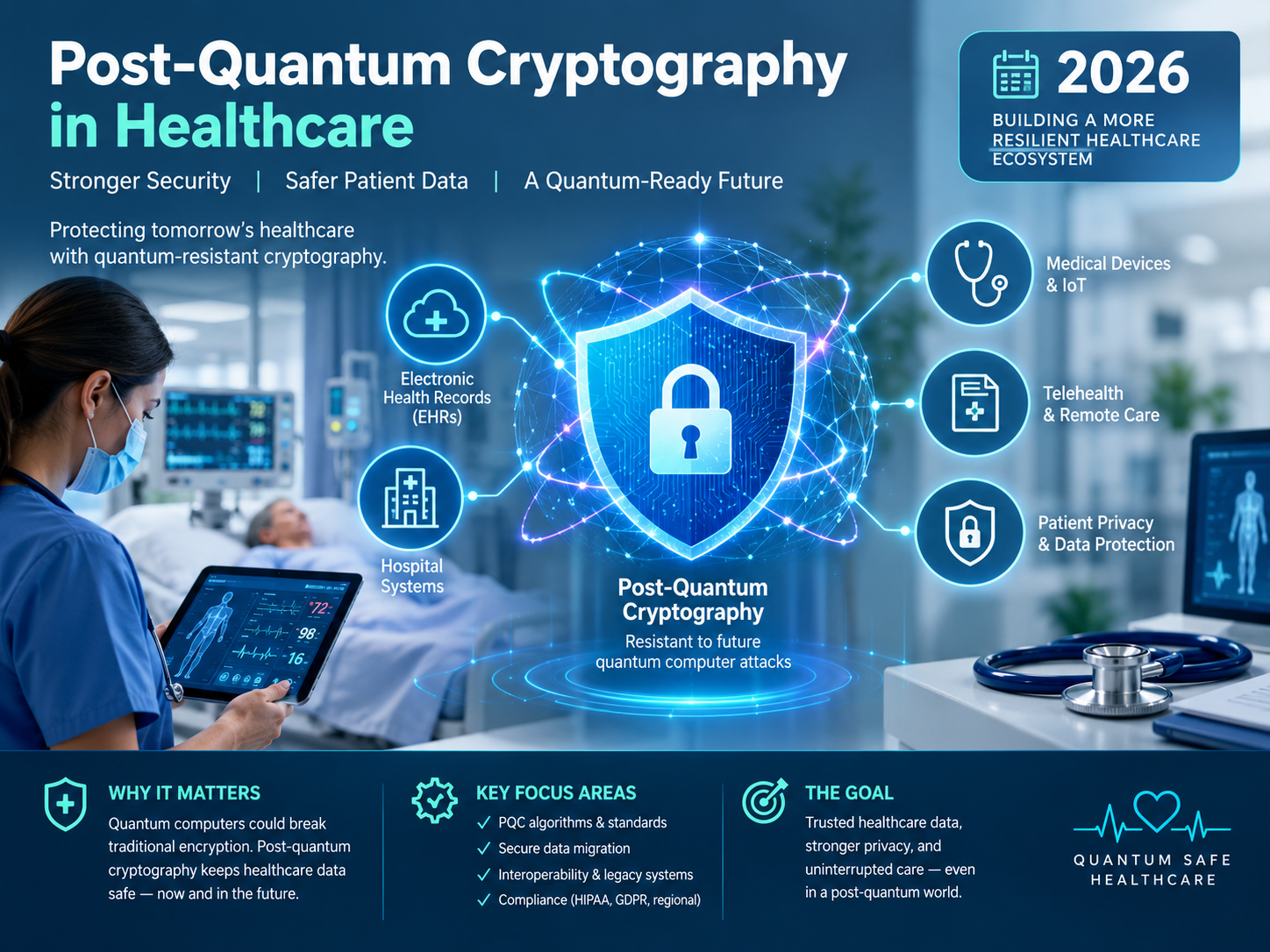
Post-quantum cryptography for healthcare replaces or supplements quantum-vulnerable public-key cryptography with algorithms designed to resist attacks from future quantum computers. Healthcare organizations should start by identifying RSA and ECC dependencies, prioritizing long-lived medical data, and building crypto-agile migration plans around standardized post-quantum cryptography.
Why Healthcare Must Prepare for Post-Quantum Cryptography Now
Post-quantum cryptography for healthcare has moved beyond the research stage. NIST finalized its first three major post-quantum cryptography standards in August 2024, giving hospitals, health-tech vendors and medical-device manufacturers a practical foundation for testing and migration.
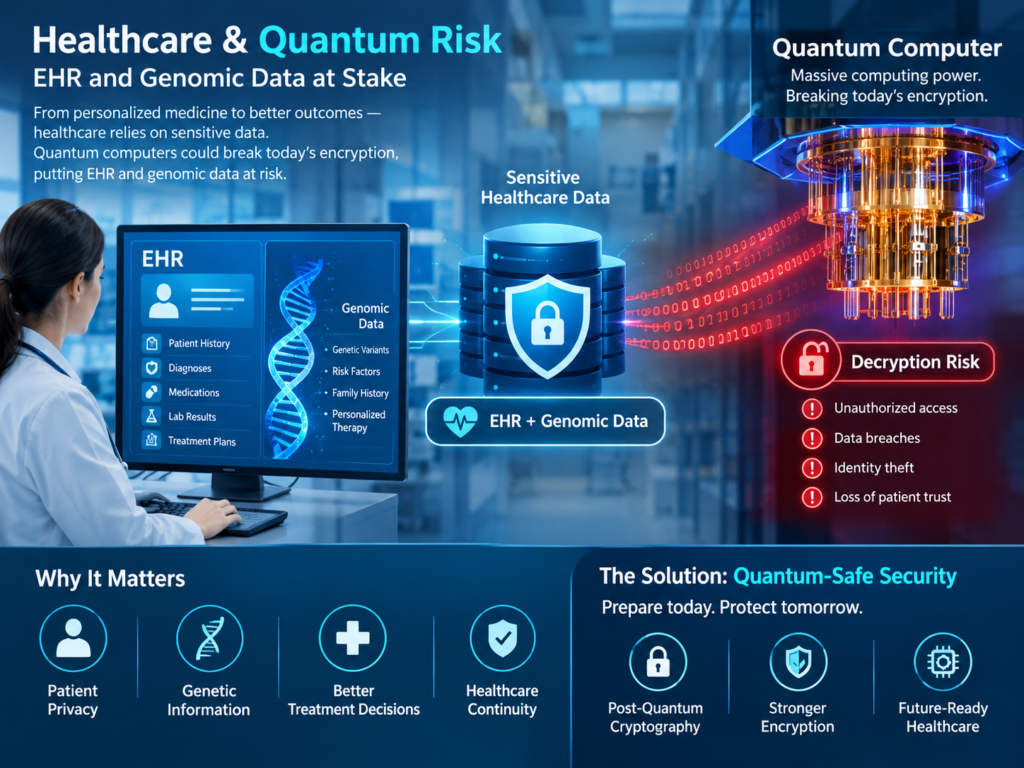
Healthcare has an unusual problem: its most sensitive data can remain valuable for decades. Electronic health records, genomic information, psychiatric records, pediatric histories, digital identities and medical-device credentials may all outlive the cryptographic protections securing them today.
That makes waiting a risky strategy. Healthcare organizations should begin by finding where vulnerable cryptography is used, identifying systems with the longest confidentiality requirements, and building crypto-agility into future technology decisions.
The current cybersecurity environment already shows why long-term planning matters. HHS reported about 663 breaches affecting 500 or more people that occurred during 2024.
Those incidents affected approximately 243 million individuals.
Hacking and IT incidents accounted for about 81% of those large reported breaches.
What Is Post-Quantum Cryptography for Healthcare?
Post-quantum cryptography for healthcare uses algorithms designed to resist attacks from both conventional and future quantum computers. Its role is to protect medical records, identities, communications, connected devices and digital signatures as organizations gradually move away from vulnerable public-key techniques.
How Quantum Computing Threatens RSA and ECC in Healthcare
RSA and elliptic-curve cryptography, commonly known as ECC, support certificates, authentication, key exchange, VPNs, TLS connections and digital signatures across modern healthcare infrastructure.
A sufficiently capable quantum computer could undermine the mathematical assumptions protecting these systems.
That does not mean every encryption mechanism suddenly becomes obsolete. The most urgent migration challenge involves public-key cryptography and the infrastructure built around it.
Why Healthcare Faces a Greater Long-Term Data Risk
Healthcare is especially exposed to the “harvest now, decrypt later” threat.
An attacker could collect encrypted health information today, store it for years, and attempt to decrypt it once sufficiently powerful quantum technology becomes available.
Longitudinal EHRs and genomic datasets deserve particular attention because their confidentiality requirements can extend far beyond those of a password, payment transaction or short-lived business record.
ML-KEM, ML-DSA and the NIST PQC Standards Healthcare Teams Should Know
NIST’s FIPS 203 defines ML-KEM for key establishment. FIPS 204 defines ML-DSA for digital signatures, while FIPS 205 defines the hash-based SLH-DSA signature standard.
Healthcare teams do not need to rebuild every application immediately. A better starting point is understanding where vulnerable algorithms are embedded and whether existing platforms, libraries and vendors can support standardized replacements.
Which Healthcare Data and Systems Face the Greatest Quantum Risk?
The highest-priority assets are those that must remain confidential or trustworthy for many years: genomic data, longitudinal EHRs, sensitive PHI, digital identities, certificates and long-lived connected medical devices.
EHR, PHI and Genomic Data Exposed to “Harvest Now, Decrypt Later”
Post-quantum encryption for medical data matters most where confidentiality must outlast today’s cryptographic assumptions.
A health network in New York, for example, may need to protect patient histories across multiple generations of EHR, cloud and archival platforms.
Genomic information is particularly sensitive. A compromised password can be changed; a person’s genetic profile cannot.
Medical Devices and IoMT With Long Operational Lifecycles
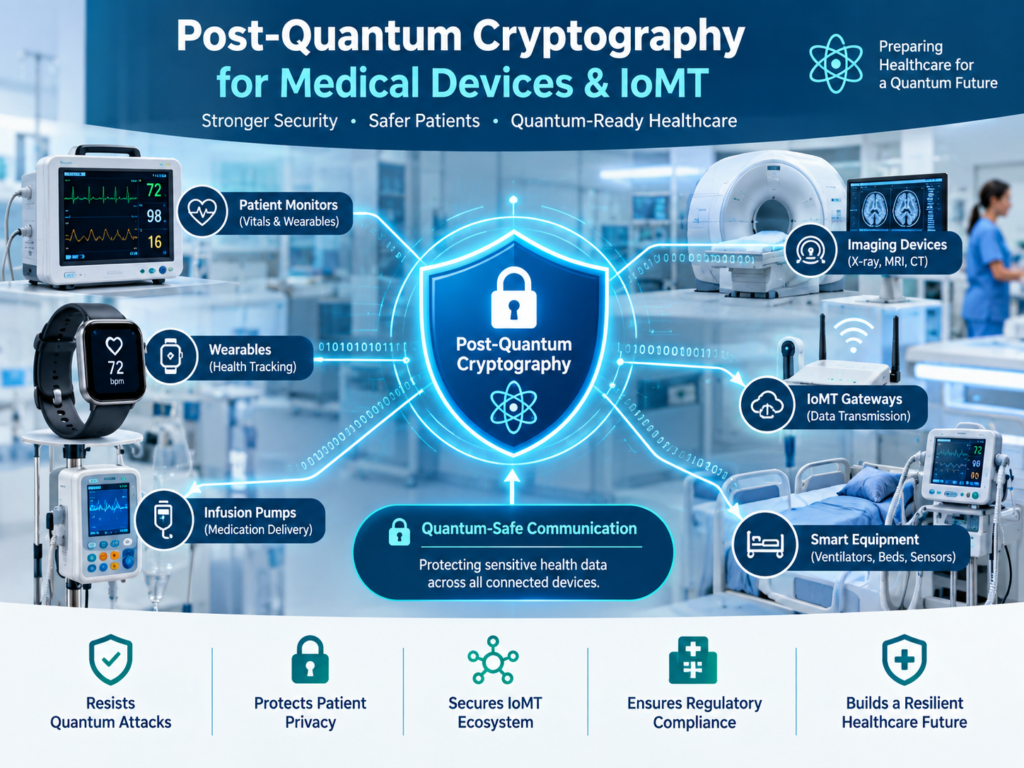
PQC migration becomes more complicated in medical devices because IoMT equipment may remain operational for many years while offering limited CPU capacity, memory or upgrade flexibility.
Healthcare teams need to consider.
Device certificates and identities.
Secure onboarding.
Firmware signatures.
Cryptographic libraries.
Supported upgrade mechanisms.
Vendor support across the product lifecycle.
The FDA already emphasizes lifecycle cybersecurity, vulnerability management and update capabilities for connected cyber devices.
Healthcare PKI, APIs, HL7 FHIR, DICOM/PACS and Third-Party Connections
Cryptographic discovery should extend well beyond databases.
Healthcare organizations should examine PKI, TLS, VPNs, APIs, HL7 FHIR connections, DICOM/PACS environments, identity services, AWS/Azure/GCP deployments and third-party integrations.
Teams modernizing these environments can combine cryptographic assessments with Mak It Solutions’ broader Web Development Services.
Why Healthcare Organizations Should Start PQC Migration Now
Healthcare organizations should begin migrating incrementally because cryptographic transformation can take years, while health information may need protection for decades.
Starting with discovery, prioritization and crypto-agility reduces the risk of rushed upgrades later.
NIST Standards Have Shifted PQC From Research to Implementation
NIST now encourages organizations to begin applying its standardized PQC algorithms. The conversation has therefore shifted from choosing candidate algorithms to planning implementation, interoperability and migration.
Crypto-Agility Reduces Future Migration Cost and Vendor Lock-In
Crypto-agility in healthcare means applications and infrastructure are not permanently tied to one cryptographic algorithm, certificate format or library.
When systems are crypto-agile, algorithms can be updated without rebuilding entire clinical applications.
This matters for SaaS platforms, healthcare APIs and modern applications built with technologies such as Python and Node.js.
The Cost of Waiting: Data Longevity, Procurement Cycles and Device Lifetimes
Healthcare procurement often moves slowly. Medical-device replacement can take even longer.
If organizations delay cryptographic discovery until quantum risk becomes urgent, they may find themselves dependent on hardware, software or vendors that cannot migrate quickly enough.
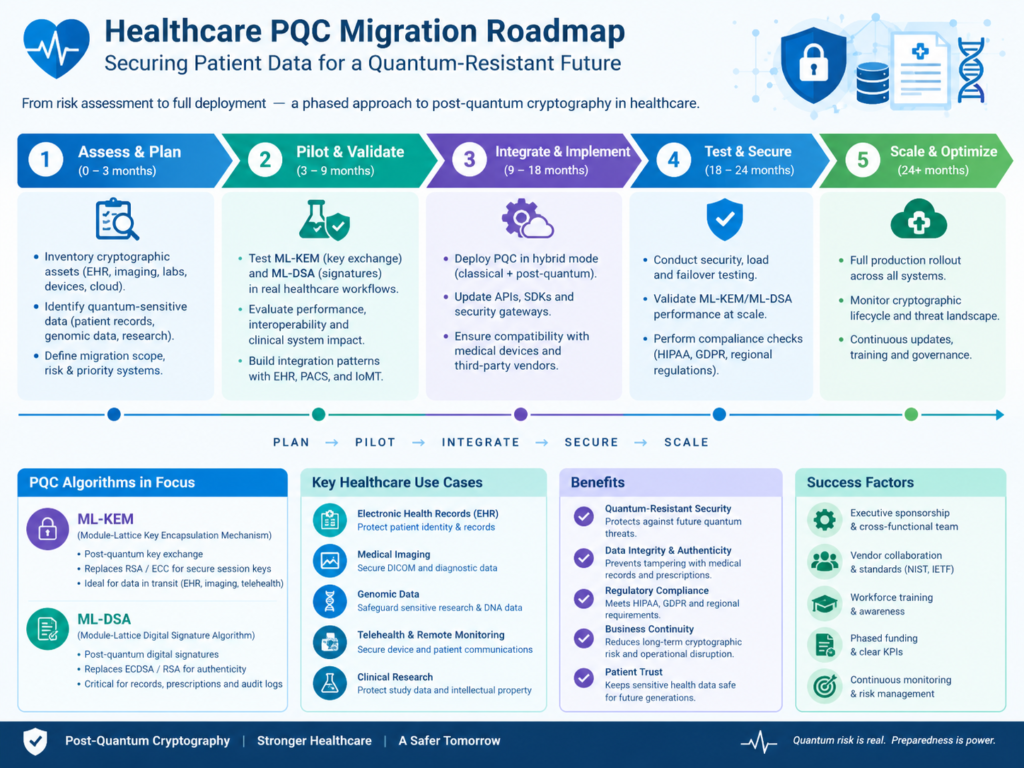
How to Build a Post-Quantum Cryptography Healthcare Roadmap
Hospitals can migrate from RSA and ECC by locating cryptographic dependencies, ranking systems according to risk and data lifetime, and testing standardized PQC in controlled environments.
A staged or hybrid approach can preserve interoperability while applications, devices and vendors gradually catch up.
Build a Cryptographic Inventory and Dependency Map
Document cryptography across.
Applications.
Certificates.
Databases.
APIs.
VPNs.
EHR platforms.
PACS environments.
Identity systems.
Medical devices.
Cloud services.
Third-party connections.
For each dependency, record the algorithm, key size, certificate authority, cryptographic library, system owner, expiration date and realistic replacement path.
Prioritize Systems by Data Lifetime, Exposure and Clinical Impact
Do not attempt to migrate everything simultaneously.
Rank systems according to factors such as.
Confidentiality lifetime.
Internet exposure.
Patient-safety impact.
RSA or ECC dependency.
Vendor readiness.
Replacement complexity.
Genomic repositories, high-value PHI, identity infrastructure and internet-facing systems will often deserve early attention.
Pilot Hybrid PQC, Crypto-Agility and TLS Modernization
Test hybrid post-quantum technologies in controlled, non-production environments before expanding deployment.
Measure practical issues such as latency, certificate sizes, interoperability, monitoring, compatibility and rollback procedures.
Organizations modernizing their wider technology estate can also review Mak It Solutions’ Development and Technology Services and Business Intelligence Services.
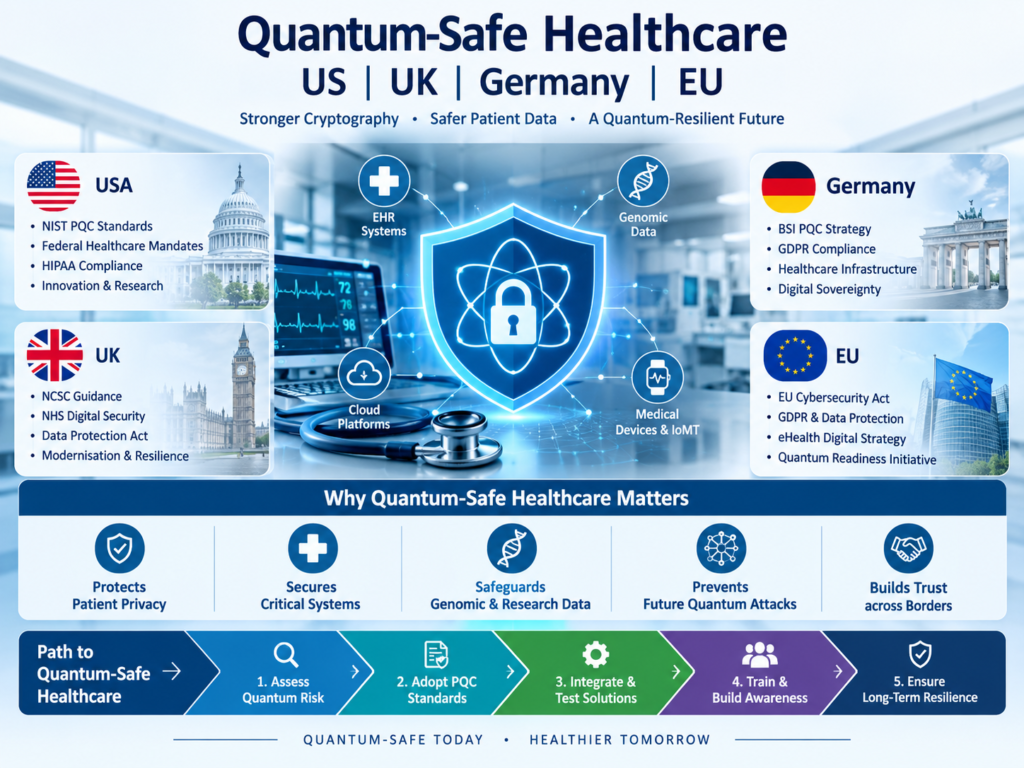
PQC Compliance in the USA, UK, Germany and EU
HIPAA and GDPR do not simply mandate post-quantum cryptography today. A more accurate approach is to treat quantum readiness as part of risk-based security planning, cryptographic lifecycle management and protection against evolving threats.
USA HIPAA, HITECH, HHS, NIST and FDA-Regulated Devices
HIPAA’s Security Rule requires reasonable and appropriate protections for ePHI, including confidentiality, integrity, availability, authentication and transmission security.
HHS/OCR also requires risk analysis and risk management. It does not currently prescribe blanket PQC deployment.
Hospitals from Washington, D.C. to Austin can therefore treat post-quantum readiness as part of forward-looking cybersecurity risk management rather than describing it as a specific HIPAA mandate.
FDA-regulated connected devices add another layer because their cybersecurity requirements must be considered across the product lifecycle.
UK NHS, NCSC, UK GDPR and TLS Modernization
For NHS organizations, health-tech suppliers and private healthcare providers in London or Manchester, NCSC guidance provides a clearer post-quantum migration horizon.
Its current milestones target estate-wide discovery and initial planning by 2028, priority migrations by 2031, and migration completion by 2035.
TLS modernization, asset discovery and crypto-agile procurement can prepare UK healthcare environments without incorrectly suggesting that UK GDPR itself explicitly mandates PQC.
Germany and EU DSGVO, BSI, gematik, ePA, NIS2 and ENISA
In Germany, Post-Quanten-Kryptografie im Gesundheitswesen should be considered alongside BSI guidance, gematik, ePA, GesundheitsID and the wider Telematikinfrastruktur ecosystem.
BSI expects post-quantum cryptography to become an important long-term standard and supports risk-based migration planning. ENISA likewise highlights that migration is complex and can require years of preparation.
For organizations operating across Berlin, Bonn and Brussels, quantensichere Verschlüsselung für Gesundheitsdaten should complement not be confused withGDPR/DSGVO, NIS2 and wider security obligations.
Post-Quantum Cryptography for Medical Devices and IoMT
Why Device Lifecycles Make PQC Migration Harder
Embedded healthcare devices can have constrained processors, limited memory and long regulatory or validation cycles.
Some existing equipment may struggle with larger keys, certificates or new cryptographic libraries. That makes device-level discovery and vendor coordination essential.
Firmware Signing, Device Identity and Quantum-Safe PKI
PQC planning must protect more than encrypted network traffic.
Firmware authenticity, device identity, certificate chains and secure onboarding all rely heavily on digital signatures and PKI.
If signature mechanisms are compromised, attackers may be able to impersonate trusted software, updates or devices—a problem that can move from cybersecurity into patient-safety territory.
Supporting Legacy and Quantum-Safe Devices During Transition
Healthcare organizations can use segmented migration strategies rather than expecting every device to change at once.
Gateways or crypto-agile middleware may help isolate legacy equipment while newer devices adopt quantum-resistant cryptography.
Mobile clinical interfaces also need secure architecture throughout this transition. Mak It Solutions provides Mobile App Development Services for modern application environments.
A Practical 2026–2030 Quantum-Safe Healthcare Action Plan
Next 90 Days Discover Cryptography and Identify Must-Protect Data
Assign an executive owner, begin the cryptographic inventory, identify long-lived PHI and genomic information, and send PQC-readiness questions to strategic technology vendors.
The objective is visibility: know where RSA, ECC, certificates, signing keys and other cryptographic dependencies exist before deciding what to replace.
Next 12–24 Months Pilot PQC and Add Crypto-Agility to Procurement
Pilot ML-KEM- and ML-DSA-compatible technologies where support is sufficiently mature.
New procurement requirements should address.
Crypto-agility.
Algorithm replacement.
Certificate lifecycle management.
Upgrade commitments.
Interoperability.
Vendor support periods.
Long Term Make Quantum-Safe Readiness a Continuous Security Capability
Cryptography should be managed as a lifecycle, not treated as a one-time migration project.
Build regular cryptographic reviews into architecture governance, cloud modernization, medical-device procurement, SaaS development and third-party vendor management.
Final Thoughts
A post-quantum cryptography for healthcare migration becomes far more manageable once you know where cryptography lives, how long sensitive data must remain protected, and which dependencies create the greatest risk.
Mak It Solutions can help structure a Healthcare PQC Readiness Assessment, Cryptographic Inventory Workshop or Quantum-Safe Migration Roadmap around your application, API and data environment.
Contact Mak It Solutions to discuss your existing systems and migration priorities.
Key Takeaways
Post-quantum cryptography for healthcare is now an implementation-planning issue, not merely theoretical research.
Start with a cryptographic inventory before purchasing or deploying PQC products.
Prioritize genomic information, long-lived PHI, identity infrastructure, PKI and long-lifecycle IoMT devices.
Build crypto-agility so algorithms can change without redesigning entire clinical systems.
Do not describe HIPAA, GDPR or UK GDPR as explicitly mandating PQC today.
Evaluate technology vendors on interoperability, upgrade paths, certificate management and long-term cryptographic support.
FAQs
Q : Will post-quantum cryptography replace AES in healthcare systems?
A : Not necessarily. The main near-term quantum migration challenge involves public-key algorithms such as RSA and ECC. Symmetric cryptography such as AES is affected differently by quantum attacks and can generally maintain strong protection when suitable key sizes are used.
Q : How should healthcare vendors prove their products are crypto-agile?
A : Ask vendors to document supported cryptographic libraries, algorithms, certificate formats, key-management interfaces and update mechanisms. They should be able to show that cryptographic components can be changed without replacing the entire product.
Contracts should also address security updates, interoperability, migration testing and support periods.
Q : What should hospitals ask EHR and medical-device vendors about PQC readiness?
A : Hospitals should ask where RSA and ECC are used, whether NIST-standardized PQC is supported, and what the vendor’s roadmap is for ML-KEM and post-quantum signatures.
They should also ask whether upgrades require new hardware and how firmware signing, PKI, TLS, APIs, rollback and long-term security updates are handled.
Q : Can existing healthcare PKI support post-quantum certificates?
A : Some PKI environments can evolve toward post-quantum or hybrid certificates, but compatibility varies among certificate authorities, clients, network appliances, medical devices and clinical applications.
Before deployment, test certificate size, handshake behavior, trust-chain validation and legacy interoperability. Quantum-safe PKI should be treated as an ecosystem migration rather than a simple certificate-algorithm change.
Q : Which healthcare systems should be upgraded to quantum-safe cryptography first?
A : Prioritize systems that use vulnerable public-key cryptography and either hold long-lived sensitive information or create significant clinical risk if compromised.
Likely candidates include genomic repositories, longitudinal EHR archives, patient and workforce identity systems, internet-facing gateways, VPN infrastructure, high-value APIs, certificate authorities and long-lived medical-device fleets.
[…] Is Post-Quantum Cryptography for Financial […]