


Harvest Now Decrypt Later: Rethink Data Retention
Harvest Now Decrypt Later: Rethink Data Retention
Harvest Now Decrypt Later: Rethink Data Retention
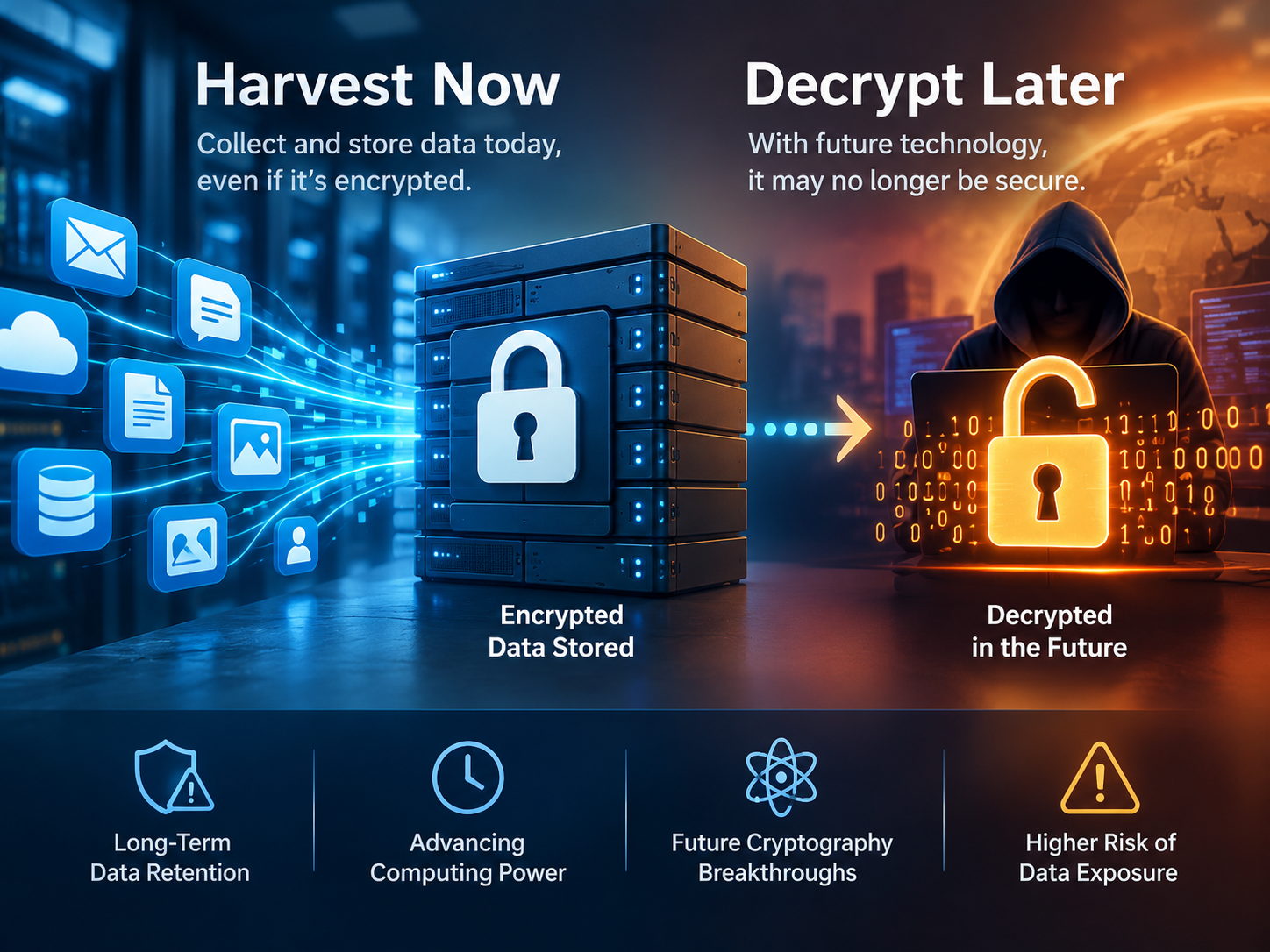
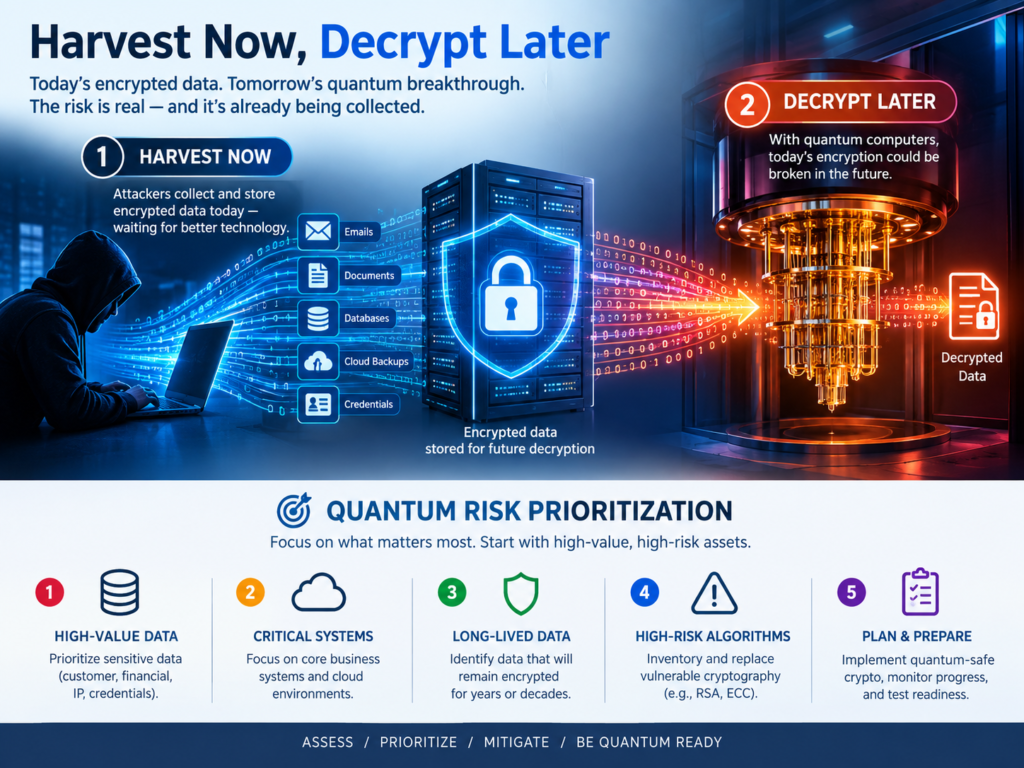
Harvest Now Decrypt Later (HNDL) means attackers can capture encrypted information today, store it, and potentially decrypt it later if sufficiently capable quantum computers can break the public-key cryptography protecting it. That makes data retention, confidentiality lifetime, and post-quantum cryptography (PQC) migration part of the same cybersecurity decision.
Encryption protects data against today’s capabilities. The harder question is whether that protection will remain strong for as long as the information needs to stay confidential.
An attacker does not need a cryptographically relevant quantum computer today. They only need access to valuable ciphertext that can be stored until better decryption capabilities exist.
The practical risk model is straightforward:
Data confidentiality lifetime → retention period → quantum exposure window → migration priority
For organizations in New York, London, Berlin, and across the EU, “Is this encrypted?” is no longer enough. Security teams also need to ask: How long must this information remain unreadable?
What Is Harvest Now, Decrypt Later?
Harvest Now, Decrypt Later describes a strategy in which an attacker captures encrypted information now and preserves it in anticipation of future decryption capabilities.
The concern is especially relevant to data protected by public-key systems such as RSA and elliptic-curve cryptography (ECC). A sufficiently capable quantum computer could threaten these widely deployed cryptographic approaches.
How a Harvest Now Decrypt Later Attack Works
The basic sequence looks like this:
Capture ciphertext → retain it → wait for stronger computing → attack vulnerable cryptography → recover historical information
Potential targets can include encrypted network traffic, archives, backups, certificate-based systems, VPN infrastructure, identity systems, and other environments that depend on quantum-vulnerable public-key cryptography.
The risk does not require “Q-Day” to arrive next year. It only requires the stolen information to remain valuable long enough.
Harvest Now Decrypt Later vs. Store Now Decrypt Later
“Harvest Now, Decrypt Later” and “Store Now, Decrypt Later” generally describe the same underlying threat.
HNDL is common terminology in US cybersecurity discussions, while European policy material also uses “store now, decrypt later.” The European Commission explicitly recognizes this threat in its PQC guidance.
In Germany, related planning may also appear under terms such as Post-Quanten-Kryptografie, Quantensicherheit, Schutzbedarf, and long-term cryptographic risk.
Why HNDL Matters Before Quantum Computers Arrive
Some information remains sensitive for years or decades: healthcare records, trade secrets, intellectual property, identity data, financial information, government records, and legal archives.
That is why PQC migration is already an operational issue rather than something to begin after a large-scale quantum computer appears.
NIST finalized FIPS 203, FIPS 204, and FIPS 205 on August 13, 2024, establishing standards for quantum-resistant key establishment and digital signatures. NIST has encouraged organizations to begin transitioning rather than wait for the threat to mature.
Which Data Is Most Exposed to Harvest Now Decrypt Later?
Not every dataset deserves the same migration priority.
Organizations should consider four factors together.
Sensitivity of the information
Required confidentiality lifetime
Cryptography currently protecting it
Time and complexity required to migrate the system
Long-lived sensitive information protected by quantum-vulnerable cryptography should generally move ahead of short-lived data that can be deleted or easily reprojected.
Data Confidentiality Lifetime vs. Cryptographic Shelf Life
Two different clocks matter.
Retention period is how long an organization keeps information.
Confidentiality lifetime is how long unauthorized disclosure could still cause meaningful harm.
Those periods may be very different.
A document may need to be retained for regulatory reasons for several years while its commercial sensitivity continues well beyond the formal retention deadline. Quantum exposure becomes more serious when the required confidentiality lifetime could outlast the cryptographic protection surrounding the information.
Long-Lived Sensitive Data That Deserves Priority
Common high-priority categories include.
Patient and healthcare records
Banking and financial information
Trade secrets and intellectual property
Government and defense information
Identity data
Employee histories
Legal archives
Long-lived customer information
A healthcare provider in New York, an NHS supplier in Manchester, and a BaFin-regulated financial institution in Munich may operate under very different rules. Yet they share one important problem: confidential information can remain valuable longer than the encryption protecting it.
A Simple Harvest Now Decrypt Later Risk Formula
A useful prioritization model is:
Sensitivity × confidentiality lifetime × cryptographic exposure × migration time = priority
For example, a highly sensitive dataset that must stay confidential for 20 years and depends on difficult-to-replace RSA infrastructure deserves earlier attention than low-value information scheduled for deletion next year.
How Harvest Now Decrypt Later Changes Data Retention
Data retention is usually discussed through the lenses of compliance, privacy, storage cost, litigation, and business need. HNDL adds another factor: future cryptographic exposure.
Every unnecessary copy of sensitive data creates another asset that may be stolen, archived, and attacked later.
Why Extra Retention Can Increase Quantum Exposure
Data should not remain stored indefinitely simply because storage is cheap.
A defensible retention policy asks two questions.
Does the organization still have a legitimate legal, contractual, operational, or historical reason to retain this information?
Can its cryptographic controls protect the information for the full period in which disclosure would still matter?
This becomes even more important when information is duplicated across SaaS platforms, cloud environments, vendors, archives, backups, and third-party systems.
Verizon’s 2025 Data Breach Investigations Report found third-party involvement in 30% of breaches, up from 15% in the previous report. That wider dependency surface matters when evaluating long-term confidentiality risk.
For related controls, see Mak It Solutions’ cloud security misconfiguration remediation and enterprise API security guidance.
Data Minimization as a Quantum-Security Control
Deletion is not merely housekeeping. It can be a security control.
GDPR/DSGVO storage-limitation principles already push organizations to avoid retaining personal information longer than necessary. HNDL gives security teams another reason to connect retention schedules, Löschkonzept, backup governance, archive policies, and cryptographic key lifecycles.
The principle is simple:
Data securely deleted from systems you control cannot later be decrypted from those deleted copies.
Of course, deletion cannot recover ciphertext that an attacker has already stolen. That is why retention reduction and PQC migration need to work together.
Retention Deadline vs. Confidentiality Deadline
Suppose a financial record must be retained for seven years but could remain commercially sensitive for 20 years.
Those requirements are not interchangeable.
Teams should separately document:
How long must we keep it?
And.
How long must unauthorized parties be prevented from reading it?
That distinction is useful across GDPR, UK GDPR, healthcare, financial-services, and regulated archive environments.
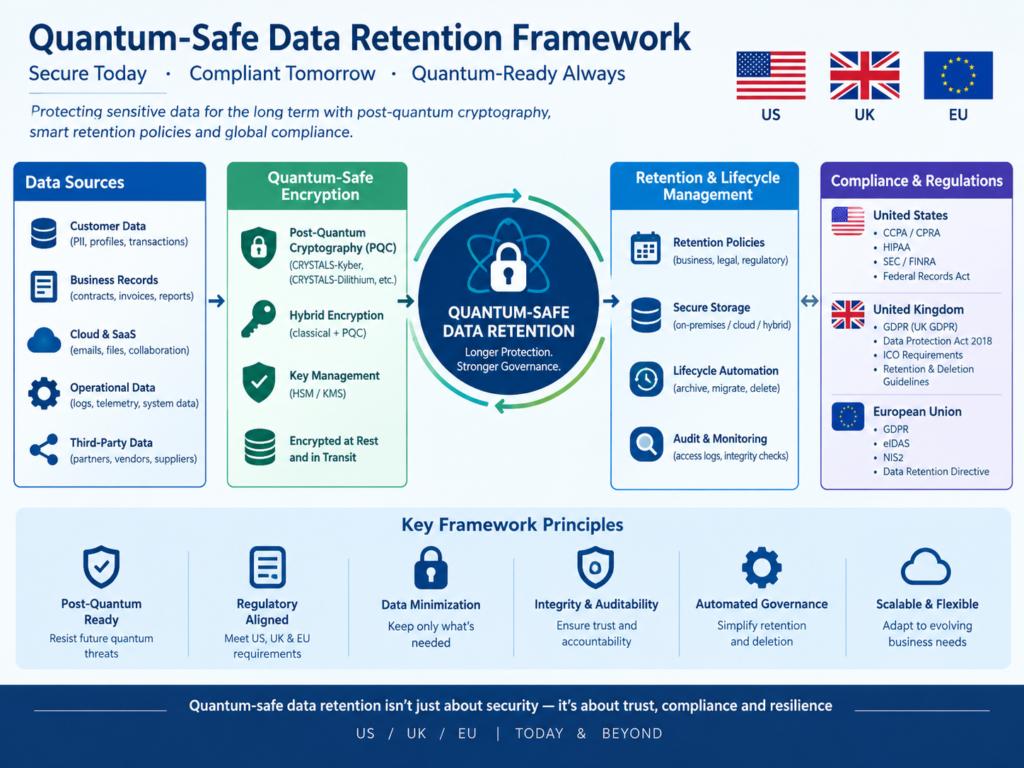
How to Build a Quantum-Safe Data Retention Framework
A practical framework combines data classification, cryptographic discovery, retention schedules, confidentiality requirements, migration dependencies, and defensible deletion.
The objective is not to migrate every system at once. It is to find the places where long-lived confidentiality and vulnerable cryptography produce the greatest exposure.
For broader preparation, Mak It Solutions’ Quantum Computing for Business guide provides additional context.
Inventory Data, Cryptography, and Protection Periods
Map sensitive datasets alongside the technologies protecting them, including.
RSA and ECC
TLS
PKI and certificates
VPNs
HSM integrations
Encrypted backups
Long-term archives
Application-level encryption
Identity infrastructure
Key-management platforms
Vendors and managed services
The inventory should answer more than where cryptography exists.
It should also show what information each cryptographic dependency protects, who owns it, and how long that information needs protection.
Classify Data by Quantum Exposure
A straightforward classification model can help.
Priority 1: Highly sensitive data + long confidentiality lifetime + vulnerable cryptographic dependency
Priority 2: Sensitive data + medium confidentiality lifetime or manageable migration dependency
Priority 3: Short-lived, low-impact, or easily re protected information
This turns an abstract quantum threat into a migration queue that business and technical teams can defend.
Reduce, Re protect, or Migrate
For each data class or system, choose the appropriate response.
Delete information that no longer needs to exist.
Shorten excessive retention periods.
Rekey or re-encrypt appropriate archives.
Isolate sensitive historical stores.
Replace vulnerable cryptographic dependencies.
Pilot PQC or hybrid approaches where suitable.
Build crypto-agility into new systems and procurement.
Prioritization matters because cybersecurity resources are already constrained. ISC2’s 2024 workforce study estimated a global cybersecurity workforce gap of approximately 4.8 million people.
Post-Quantum Cryptography Migration and Crypto-Agility
Why PQC Is Only Part of the HNDL Answer
PQC can protect future communications and cryptographic operations, but it cannot retroactively change ciphertext that an attacker already possesses.
Organizations therefore still need.
Data minimization
Archive governance
Cryptographic inventory
Strong key management
Legacy-system remediation
Supplier management
Incident-response capabilities
Mak It Solutions’ cyber incident response checklist provides a complementary operational layer.
Build a Cryptographic Inventory Before Migrating
For important systems, record at least.
Algorithm and key parameters
Protocol
Certificates
Application or service
Business owner
Data classification
Retention requirement
Confidentiality lifetime
Vendor dependency
Migration dependency
NIST’s finalized PQC standards mean organizations now have concrete standardized mechanisms around which migration programs can be designed.
Design for Crypto-Agility, Hybrid PQC, and Future Change
The goal should not be a one-time RSA-to-PQC replacement.
Crypto-agility means systems can change algorithms, certificates, key mechanisms, and cryptographic providers without requiring a fundamental redesign.
Hybrid approaches may also support transition in suitable environments, but interoperability, performance, vendor support, implementation maturity, and applicable regulatory expectations should be tested carefully.
The same design mindset fits naturally with zero trust architecture and continuous authorization.
Harvest Now Decrypt Later Priorities in the US, UK, Germany, and EU
United States.
US organizations should pay particular attention to systems holding healthcare information, government data, payment-related information, financial records, and valuable intellectual property.
NIST’s PQC standards provide the technical foundation for migration. Organizations working under frameworks or requirements such as HIPAA, PCI DSS, or federal cybersecurity programs should connect quantum-readiness work with existing data classification, risk management, procurement, and security architecture.
United Kingdom.
The UK NCSC has published clear migration milestones.
Organizations should aim to.
By 2028: complete discovery and assessment and establish an initial migration plan.
By 2031: complete the highest-priority migration activities and refine the roadmap.
By 2035: complete migration to PQC across systems, services, and products, subject to limited exceptional technologies.
For London financial services firms, NHS ecosystems, Open Banking providers, and regulated organizations, that means cryptographic discovery should happen well before the final migration deadline.
Germany and the EU.
German and EU organizations should connect PQC planning with existing concepts such as Schutzbedarf, Aufbewahrungsfrist, Löschkonzept, supplier risk, NIS2 resilience, GDPR/DSGVO, BaFin requirements where applicable, and digital identity infrastructure.
The EU’s coordinated PQC work stream was co-chaired by Germany, France, and the Netherlands. The roadmap calls for Member States to begin transitioning to PQC by the end of 2026, with high-risk use cases moving as soon as possible and no later than the end of 2030.
That timetable makes cryptographic inventory and retention analysis immediate planning issues rather than distant research projects.
What Should Organizations Do Now?
Start With a Quantum Readiness Assessment
A useful assessment should evaluate.
High-value and long-lived data
Required confidentiality lifetime
Actual retention practices
RSA/ECC dependencies
Cryptographic migration complexity
Third-party exposure
Backup and archive practices
Regulatory requirements
Supplier PQC readiness
The goal is to produce decisions and priorities—not another inventory that sits unused.
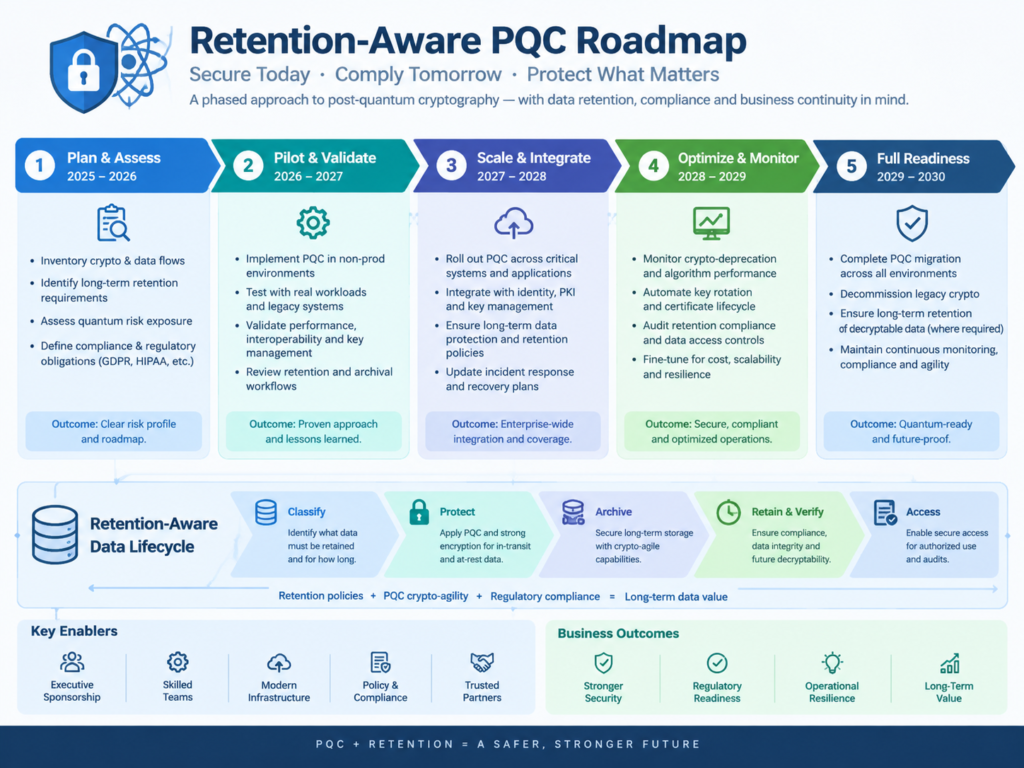
Create a Retention-Aware PQC Roadmap
A practical sequence is.
Discover cryptography and sensitive information.
Map confidentiality requirements separately from retention periods.
Delete data without a defensible retention need.
Prioritize long-lived sensitive information.
Pilot standardized PQC or suitable hybrid protection.
Establish crypto-agility across architecture and procurement.
Track changing standards, regulations, and vendor capabilities.
For broader implementation support, review Mak It Solutions’ services portfolio and preemptive cybersecurity guide.
Measure Quantum Readiness as an Ongoing Risk Program
Useful KPIs include.
Percentage of the cryptographic estate inventoried
Percentage of long-lived sensitive data classified
RSA/ECC dependencies identified and prioritized
Archives reviewed against legitimate retention requirements
High-priority systems with documented migration plans
Critical vendors with documented PQC readiness
New systems meeting crypto-agility requirements
Quantum readiness should become part of normal architecture, procurement, risk, and data-governance reviews rather than remaining a separate theoretical exercise.
Final Thoughts
Harvest Now Decrypt Later changes the question organizations should ask about encrypted data. It is no longer enough to know whether information is protected today; teams need to understand whether that protection can survive for the entire period in which the data remains valuable.
Start with the information that must stay confidential longest. Map the cryptography protecting it, challenge unnecessary retention, identify difficult migration dependencies, and prioritize systems where future disclosure would cause the greatest harm. ( Click Here’s )
Mak It Solutions can help structure a quantum readiness assessment, cryptographic inventory, or retention-risk review for US, UK, German, and EU environments.
A focused review of your highest-value data is a more useful starting point than waiting for quantum risk to become an emergency.
Key Takeaways
Harvest Now Decrypt Later makes data lifetime part of cybersecurity risk.
Long-lived healthcare, financial, government, identity, and intellectual-property data deserves early attention.
Retention period and confidentiality lifetime are different requirements.
Data minimization and defensible deletion can reduce future exposure.
PQC migration should begin with cryptographic discovery and prioritization rather than indiscriminate algorithm replacement.
The US, UK, Germany, and wider EU now have concrete standards or migration milestones around which organizations can plan.
Crypto-agility matters because post-quantum migration is a multi-year lifecycle, not a one-time technology swap.
FAQs
Q : Can previously captured encrypted data be protected after attackers steal it?
A : Usually, no. An organization cannot retroactively replace the encryption around a ciphertext copy that is already in an attacker’s possession. That is why HNDL makes migration timing important. Organizations can still reduce future exposure through stronger cryptography, better archive protection, reduced unnecessary retention, and PQC migration.
Q : Does forward secrecy eliminate Harvest Now Decrypt Later risk?
A : No. Forward secrecy can reduce the risk that compromise of a long-term key exposes earlier session keys, but it does not address every HNDL scenario. Backups, encrypted files, application-layer encryption, identity systems, certificates, vendor protocols, and legacy deployments can still create long-term exposure.
Q : Should encrypted backups be retained differently for post-quantum security?
A : Yes. Backups should be classified by sensitivity, required retention, confidentiality lifetime, encryption method, restore requirements, and legal obligations. A backup required for three years should not automatically remain accessible for fifteen years without a documented reason.
Q : Which legacy encryption systems should enterprises inventory first?
A : Start with internet-facing TLS, VPNs, PKI, certificates, HSM integrations, RSA/ECC dependencies, identity platforms, encrypted databases, backups, code-signing infrastructure, embedded devices, and long-lived vendor products. Prioritize systems protecting data with long confidentiality lifetimes or long migration lead times.
Q : Do organizations need to replace RSA and ECC immediately?
A : Most organizations should follow a risk-based, phased migration rather than attempting an abrupt enterprise-wide replacement. Begin with discovery, prioritize high-value and long-lived data, test standardized PQC mechanisms, evaluate suitable hybrid approaches, and build crypto-agility into future architecture and procurement.
[…] PHI and Genomic Data Exposed to “Harvest Now, Decrypt […]