
Post-Quantum PKI: A Guide to Quantum-Safe Certificates
Post-Quantum PKI: A Guide to Quantum-Safe Certificates
Post-Quantum PKI: A Guide to Quantum-Safe Certificates
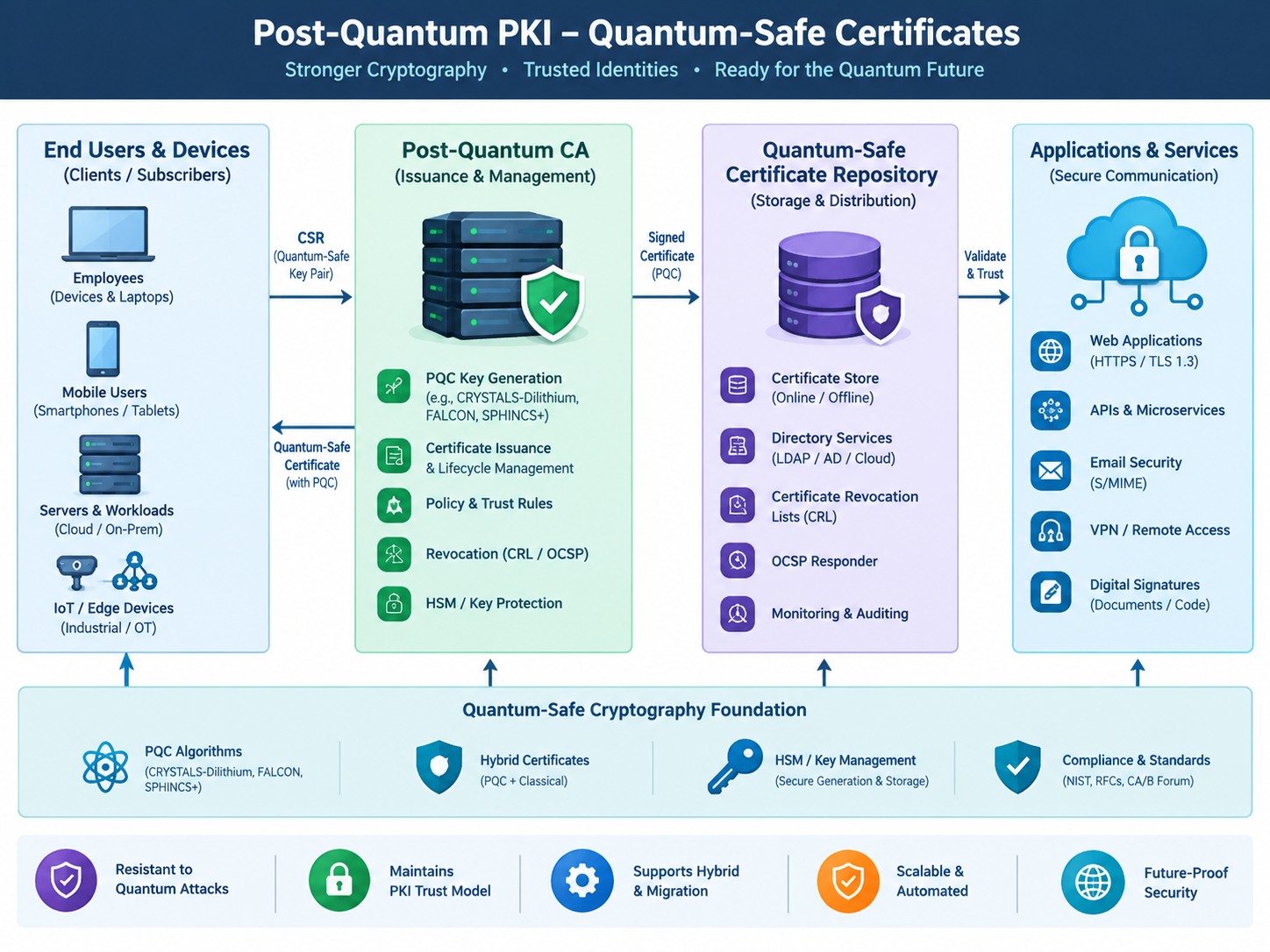
Post-quantum PKI is not simply about replacing RSA or ECC with a newer algorithm. It means adapting the full public key infrastructure from Certificate Authorities and HSMs to X.509 certificate workflows, revocation, automation and relying applications to work safely with quantum-resistant cryptography.
For enterprises, the practical goal is a controlled migration to quantum-safe certificates without breaking existing services. That requires cryptographic discovery, interoperability testing and crypto agility long before a mandatory cutover becomes necessary.
What Is Post-Quantum PKI?
Post-quantum PKI is public key infrastructure designed to support cryptographic algorithms that are expected to resist attacks from sufficiently capable quantum computers.
Quantum-safe certificates are the certificate layer of that architecture. They use, or are designed to support, post-quantum cryptographic mechanisms while preserving familiar PKI functions such as identity validation, certificate issuance, renewal, revocation and trust-chain verification.
The X.509 certificate model does not simply disappear. What changes are the cryptographic algorithms, public-key and signature sizes, certificate profiles, hardware requirements and compatibility expectations throughout the trust chain.
Why RSA and ECC Create Long-Term Quantum Risk
Traditional PKI commonly relies on RSA and elliptic-curve cryptography such as ECDSA.
These algorithms are not considered quantum-resistant because a sufficiently powerful quantum computer running Shor’s algorithm could undermine the mathematical problems on which their security depends.
The immediate concern is not that every RSA or ECC certificate suddenly becomes unsafe today. The operational risk comes from systems, data and trust anchors that may remain in service for years.
Long-lived devices, embedded systems and sensitive information with extended retention periods deserve particular attention because replacing their cryptography can require lengthy procurement, testing and deployment cycles.
Why Post-Quantum PKI Is More Than an Algorithm Swap
A production PKI includes much more than the signing algorithm.
Root and Intermediate Certificate Authorities
Trust anchors and trust stores
Hardware Security Modules
Certificate enrollment services
Certificate Lifecycle Management platforms
OCSP responders
Certificate Revocation Lists
TLS termination points
VPN and device identities
Code-signing infrastructure
Applications and relying parties
If one critical component cannot process the selected post-quantum algorithm or certificate profile, the trust path may fail.
That is why post-quantum PKI should be treated as an infrastructure migration, not as a certificate-renewal project.
This dependency-first approach also applies to modern identity architecture. Mak It Solutions’ identity-first cloud IAM security guide explains why machine identities, trust decisions and lifecycle controls work best when they are managed as connected parts of the security architecture.
Which Algorithms Matter for Post-Quantum PKI?
NIST finalized its first three post-quantum cryptography standards on August 13, 2024: FIPS 203, FIPS 204 and FIPS 205.
Understanding their different roles matters because not every PQC algorithm performs the same job.
ML-DSA for Post-Quantum Digital Signatures
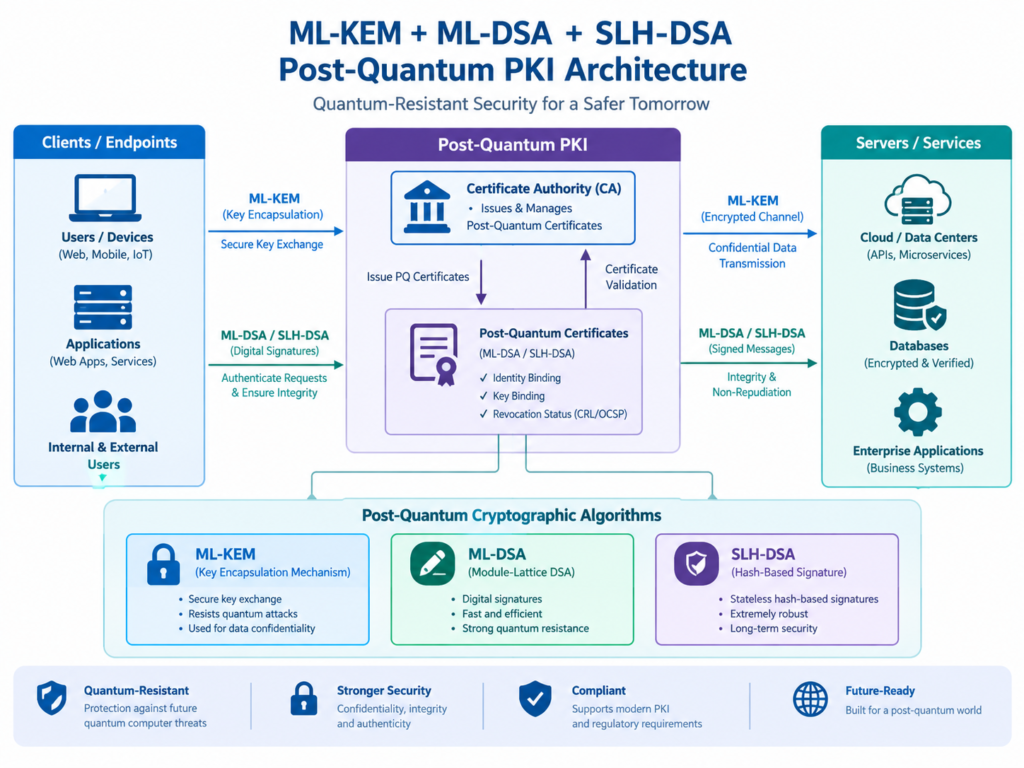
ML-DSA is a post-quantum digital-signature algorithm standardized in NIST FIPS 204.
Digital signatures are directly relevant to PKI because Certificate Authorities use signatures to establish trust in certificates and certificate chains.
For PKI teams, ML-DSA therefore matters when evaluating future CA signing, certificate profiles, code signing and other trust services requiring digital signatures.
Where ML-KEM Fits
ML-KEM is a key-establishment mechanism, not a certificate-signature algorithm.
NIST FIPS 203 defines ML-KEM for establishing shared secret keys over a public channel. It is therefore particularly important to secure protocols and encrypted communications, but it should not be confused with ML-DSA’s digital-signature role.
Organizations reviewing TLS, APIs and service-to-service encryption should look at both authentication and key establishment. Mak It Solutions’ API Security Best Practices 2026 covers related controls around APIs, identities and secure communication.
SLH-DSA and Algorithm Diversity
FIPS 205 standardizes SLH-DSA, a stateless hash-based digital-signature algorithm.
Its importance is not simply that it provides another signature option. Algorithm diversity supports a wider crypto-agility strategy by reducing dependence on a single mathematical construction.
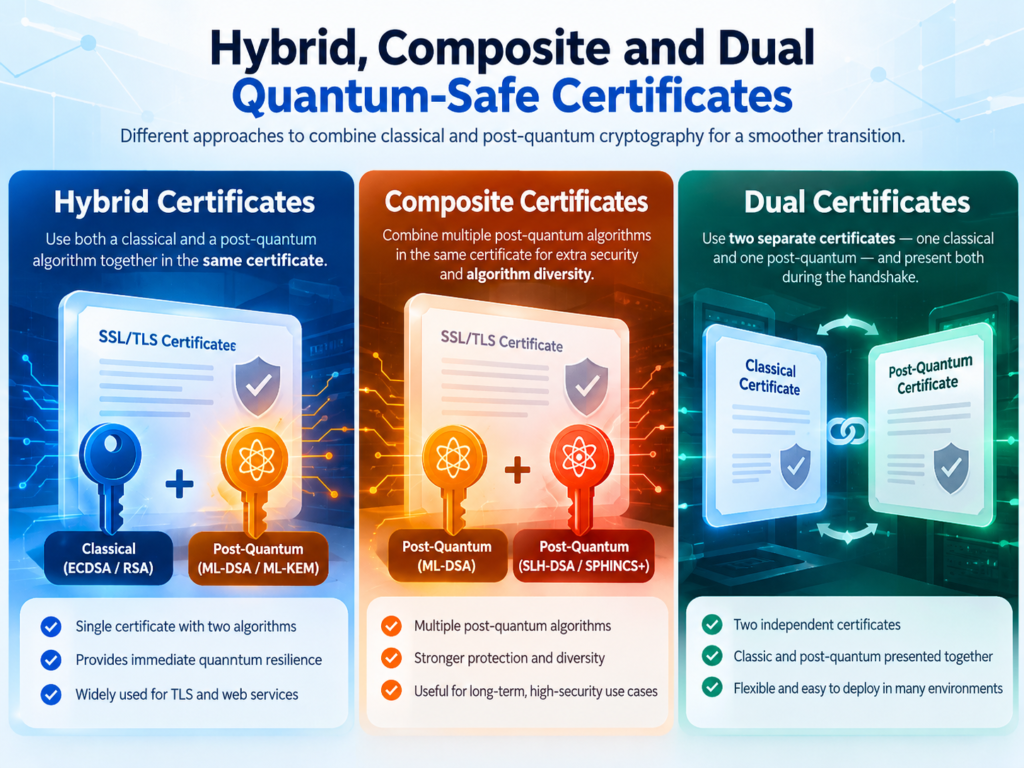
Hybrid, Composite or Dual Quantum-Safe Certificates?
Most enterprises will not move every system from classical cryptography to PQC at the same moment.
Legacy applications, network appliances, HSMs, embedded devices and third-party platforms may all move at different speeds. Transitional architectures therefore matter.
Hybrid and Parallel PKI
A hybrid or parallel PKI approach allows classical and post-quantum mechanisms to coexist while organizations test new trust chains.
For example, an enterprise may preserve an existing RSA or ECC hierarchy for legacy applications while establishing a separate PQC test hierarchy for compatible workloads.
The objective should be controlled interoperability—not maintaining duplicate infrastructures indefinitely.
Composite Certificates vs. Dual Certificates
Composite certificate approaches combine more than one cryptographic component within a certificate or related trust model. Dual-certificate approaches maintain separate classical and post-quantum certificates.
Each model creates different operational trade-offs.
Composite approaches can offer a more unified logical model, but they depend on ecosystem and profile support. Dual certificates can make classical and PQC environments easier to isolate, but they increase issuance, renewal, monitoring and troubleshooting work.
Architecture decisions should therefore be based on tested compatibility rather than broad claims that a product is simply “PQC-ready.”
The same principle applies to wider security transitions: validate the actual application and identity path before forcing a universal cutover. See Mak It Solutions’ Zero Trust Strategy 2026.
How Does Post-Quantum PKI Change Certificate Operations?
A CA that can technically issue an ML-DSA certificate does not automatically make an enterprise PQC-ready.
Every system that creates, stores, distributes, validates, renews or revokes certificates has to work with the chosen cryptography.
Root CAs, Intermediate CAs and Trust Anchors
Some organizations may eventually introduce PQC Root CAs, Intermediate CAs or parallel hierarchies while retaining classical trust anchors during migration.
That creates questions around.
Trust-store distribution
Cross-certification
Certificate-profile support
Signing policies
Intermediate-CA design
Application validation
Recovery and rollback
A new algorithm only becomes useful when the relying party can validate the complete chain.
Certificate Size and Application Compatibility
Many post-quantum public keys and signatures are larger than today’s ECC equivalents.
That can affect certificate sizes, protocol messages, constrained devices, network appliances and some enrollment or transport workflows.
PKI teams should test representative certificate chains against systems such as.
Load balancers
Reverse proxies
VPN appliances
API gateways
Java runtimes
Operating systems
LoT and embedded devices
TLS termination services
Legacy enterprise applications
Cloud architecture matters too because the system terminating TLS may be operated outside the central PKI team’s direct control. Mak It Solutions’ Cloud Security Misconfigurations guide covers the wider dependency problem across cloud environments.
HSMs, OCSP, CRLs and Lifecycle Automation
HSM support deserves particular attention.
If a CA generates or protects private keys inside an HSM, teams need to confirm whether the required PQC operations are actually supported in hardware, which software or firmware versions are required, and whether backup, replication and disaster-recovery processes work with the new key types.
The same testing should cover.
Automated enrollment
Certificate renewal
Revocation
OCSP validation
CRL generation and publication
Monitoring
Certificate discovery
Key recovery where applicable
Operational resilience remains part of the business case. IBM reported that the global average cost of a data breach reached USD 4.88 million in 2024, a 10% increase from 2023.
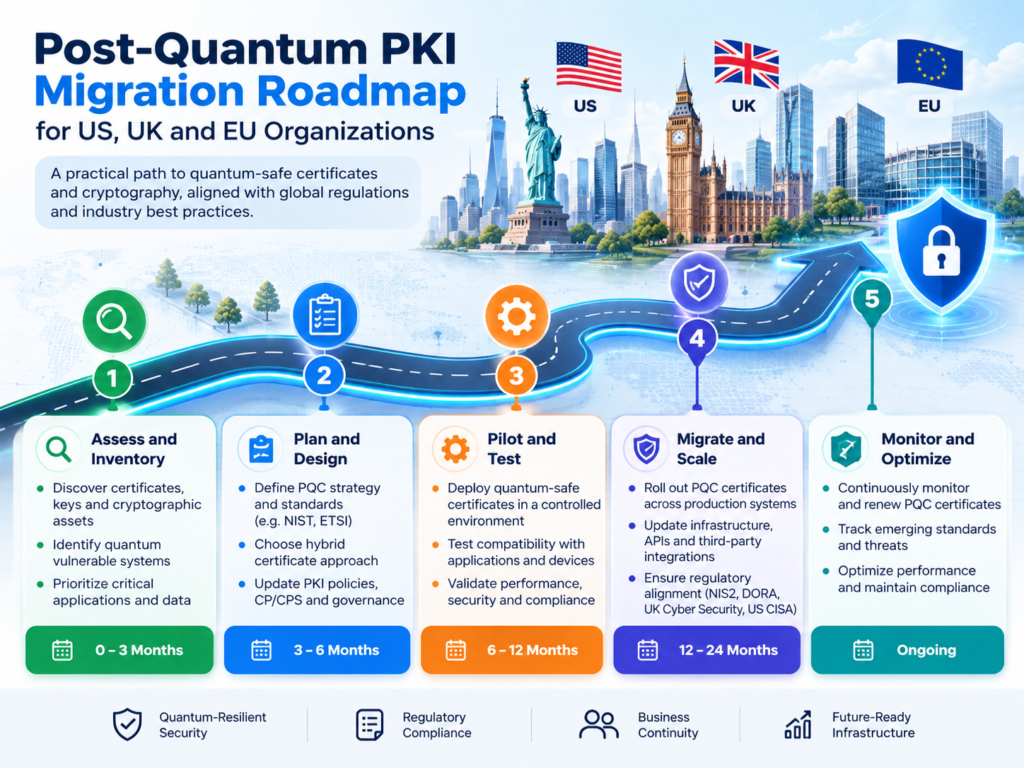
How to Build a Post-Quantum PKI Migration Roadmap
A practical post-quantum PKI migration starts with discovery and dependency mapping not bulk certificate replacement.
Build a Cryptographic and Certificate Inventory
Identify where public-key cryptography exists across the organization.
Include.
Public and private CAs
TLS certificates
Device certificates
Code-signing certificates
VPN and IKE dependencies
HSMs
Certificate-management platforms
Cryptographic libraries
Embedded systems
Cloud services
Long-lived hardware roots of trust
Where practical, build a cryptographic bill of materials so algorithm dependencies can be linked to systems and owners.
Certificate discovery can also be connected to broader endpoint inventory. See the EDR Implementation Guide for USA, UK & EU.
Prioritize by Risk, Lifetime and Dependency
Not every system needs to move first.
Prioritize workloads based on.
Data sensitivity
Regulatory exposure
Internet exposure
Certificate or key lifetime
Hardware replacement cycles
Machine-identity dependencies
Third-party dependencies
Difficulty of remediation
The “harvest now, decrypt later” threat is especially relevant to information that needs to remain confidential for years.
Thales’ 2026 Data Threat Report says 61% of respondents identified harvest-now-decrypt-later as the leading quantum concern, while 59% reported prototyping and evaluating post-quantum cryptographic algorithms.
Test Parallel PKI and Crypto Agility
Build non-production PQC trust chains before changing critical production services.
Test.
CA issuance
HSM key operations
Certificate enrollment
Automated renewal
Revocation
Chain validation
Application behavior
Performance
Monitoring
Rollback procedures
Crypto agility should be measurable. A mature environment should be able to change approved algorithms or certificate profiles without requiring a redesign of every dependent application.
Document failure and recovery procedures as carefully as the migration itself. Mak It Solutions’ Cyber Incident Response Checklist offers a useful model for structured operational planning.
Post-Quantum PKI Guidance in the US, UK, Germany and EU
PQC migration is global, but regulatory and technical priorities differ by region.
United States: NIST and FIPS
US organizations can anchor technical planning around NIST’s finalized PQC standards.
FIPS 203 — ML-KEM
FIPS 204 — ML-DSA
FIPS 205 — SLH-DSA
All three were finalized on August 13, 2024.
A financial organization in New York or a SaaS company in San Francisco may also need to map the migration against sector-specific requirements such as PCI DSS, FedRAMP, healthcare obligations or SOC 2 controls where applicable.
United Kingdom.
The UK National Cyber Security Centre has published clear PQC migration milestones.
Its guidance calls for organizations to complete discovery and initial planning by 2028, complete the highest-priority migration activities by 2031, and work toward completing migration across systems, services and products by 2035.
For organizations in sectors such as financial services, government or healthcare, supplier and legacy-system dependencies make early discovery particularly important.
Germany and the European Union
German organizations should connect Post-Quanten-Kryptographie, quantensichere Zertifikate, PQ-Migration and Kryptoagilität with applicable BSI guidance and sector requirements.
Depending on the organization, requirements and governance may also intersect with frameworks or regulations such as BaFin expectations, BSI technical guidance, KRITIS, DSGVO/GDPR, DORA, NIS2 and eIDAS.
The key lesson is not that every framework mandates the same certificate architecture. It is that multinational organizations need evidence showing how cryptographic dependencies, migration decisions and third-party risks are being governed.
Mak It Solutions’ Cloud Repatriation Strategy for US & Europe discusses related infrastructure and workload-placement considerations.
What Should PKI Teams Do Now?
Start by assessing PQC readiness across the entire certificate stack.
Record what your CAs, HSMs, certificate lifecycle platforms, applications and critical vendors support today, what is only on a product roadmap, and what your team has actually tested.
When discussing PQC with vendors, ask specific questions.
Which standardized PQC algorithms are supported?
Which product and firmware versions provide that support?
Can the HSM generate and protect the required keys?
Can the CA issue test post-quantum certificates?
Are hybrid, composite or dual-certificate models supported?
Can automated workflows renew and revoke the certificates?
Which relying-party environments have been validated?
How do backup and disaster-recovery workflows handle PQC keys?
“PQC-ready” should never be accepted as the complete answer.
Final Thoughts
Post-quantum PKI migration is ultimately an infrastructure and crypto-agility program, not a last-minute certificate replacement exercise.
Organizations that begin with certificate discovery, dependency mapping, HSM and application testing, and staged interoperability work will be in a much stronger position as post-quantum standards and vendor support mature. ( Click Here’s )
Mak It Solutions can help scope a post-quantum PKI readiness assessment, identify CA, HSM, application and automation dependencies, and turn those findings into a staged testing and migration roadmap. Starting with focused discovery now is far safer than discovering hidden cryptographic dependencies during a mandatory cutover.
Key Takeaways
Post-quantum PKI affects the complete certificate ecosystem, not just the CA’s signature algorithm.
ML-DSA and SLH-DSA are post-quantum digital-signature mechanisms, while ML-KEM is designed for key establishment.
Hybrid, composite and dual-certificate approaches may help bridge compatibility gaps during migration.
CAs, HSMs, applications, trust stores and certificate automation should be inventoried before large-scale replacement begins.
NIST’s finalized standards provide an important US technical baseline.
The UK NCSC’s 2028, 2031 and 2035 milestones provide useful migration planning checkpoints.
Long-term readiness depends on crypto agility and verified interoperability rather than one-time certificate replacement.
FAQs
Q : Can an existing Certificate Authority issue both RSA and post-quantum certificates?
A : Potentially, yes. It depends on the CA platform, software version, certificate profiles, HSM integration and relying-party support. Test issuance, chain validation, renewal, revocation and application compatibility before using mixed certificate models in production.
Q : Do post-quantum certificates require PQC-enabled HSMs?
A : If PQC private keys are generated or protected inside an HSM, the HSM environment needs to support the required key type and operations. Teams should verify implementation details, firmware requirements, certification boundaries, backup and disaster-recovery behavior rather than relying on software-level CA support alone.
Q : Will quantum-safe certificates be larger than today’s certificates?
A : Often, yes. Many PQC public keys and signatures are larger than ECC equivalents. The practical impact varies by algorithm and protocol, so enterprises should test certificate chains, handshakes, gateways, VPNs, constrained devices and legacy clients.
Q : How can PKI teams find applications that cannot support PQC certificates?
A : Begin with a cryptographic inventory, then use non-production PQC trust chains to test representative applications, runtimes, operating systems, gateways and network appliances. Map every failure to an application owner and dependency so remediation can be prioritized.
Q : Should organizations renew long-lived certificates before starting a PQC migration?
A : Not automatically. Replacing a certificate with another certificate using a quantum-vulnerable algorithm does not eliminate the underlying risk. Review certificate lifetime, data sensitivity, hardware lifecycle and application dependencies first, with special attention to long-lived trust anchors and devices.