
AI Metadata Management: The Essential Enterprise Guide
AI Metadata Management: The Essential Enterprise Guide
AI Metadata Management: The Essential Enterprise Guide
Enterprise AI systems are only as reliable as the data they use. A dataset may contain millions of records, but without clear ownership, business definitions, access permissions, and source history, even advanced AI applications can produce misleading results.
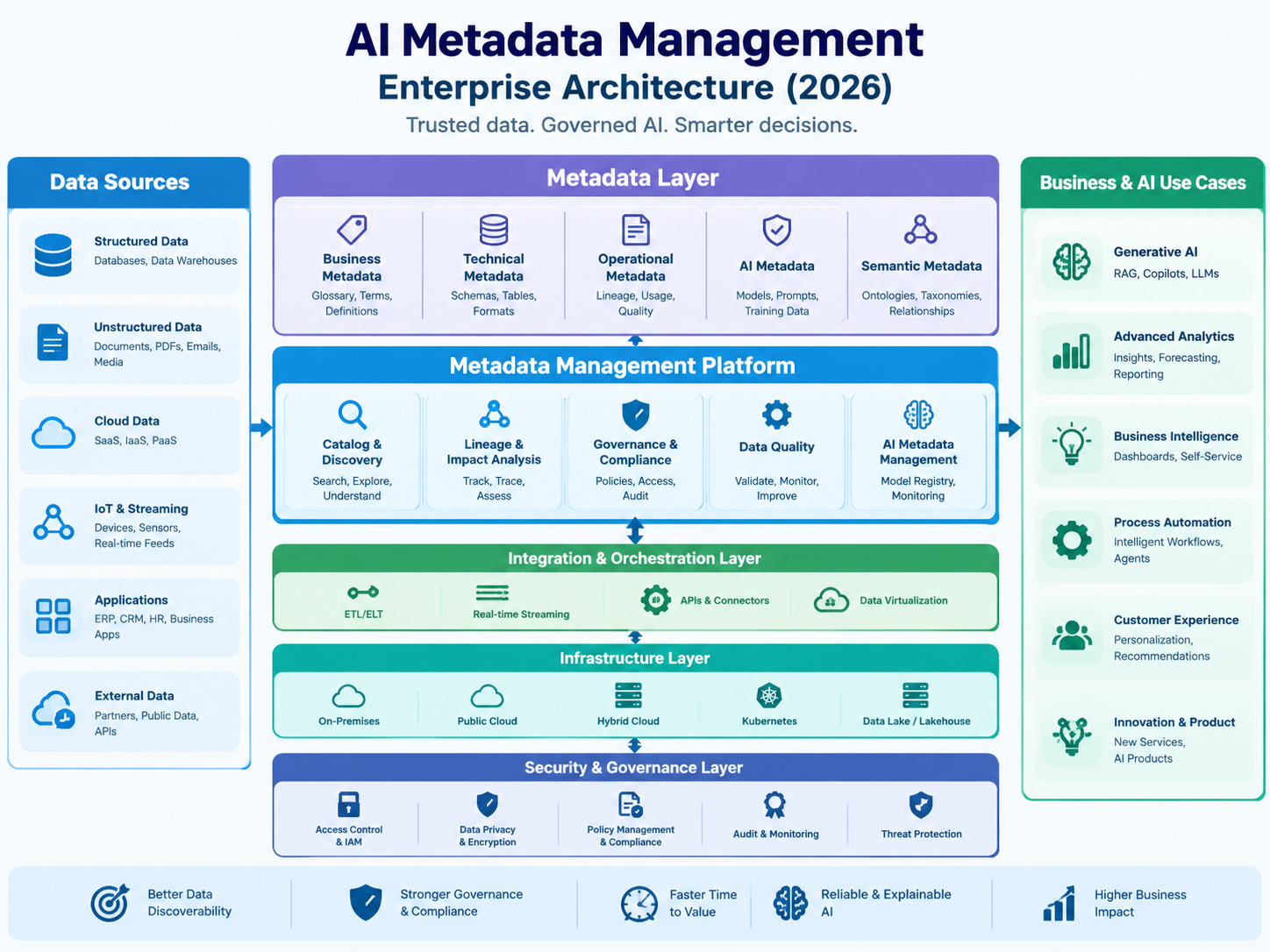
AI metadata management helps enterprises organize, understand, secure, and govern their data for AI applications. It captures essential information about data sources, quality, lineage, sensitivity, ownership, and permitted usage.
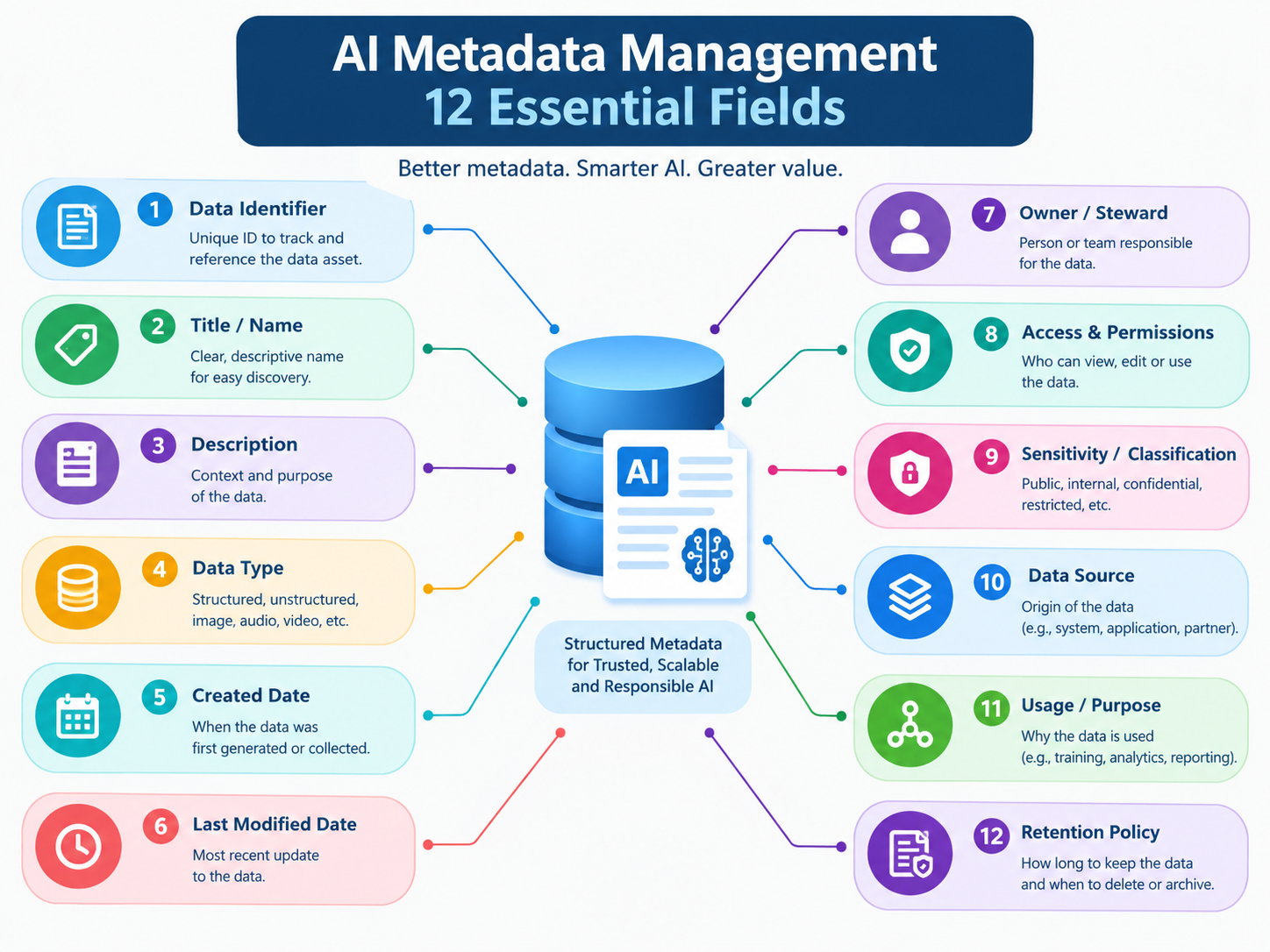
For most enterprises, capturing 12 core metadata categories provides a practical foundation for trustworthy AI, retrieval-augmented generation (RAG), and AI agents.
The challenge is significant. According to Gartner’s February 2025 research, 63% of surveyed organizations either lacked or were uncertain whether they had appropriate data management practices for AI.
For CIOs, chief data officers, enterprise architects, and governance leaders, the priority is clear: make enterprise data understandable, traceable, and appropriately accessible before scaling AI initiatives.
What Is AI-Ready Metadata and Why Does It Matter?
AI-ready metadata is structured information that helps AI systems and their supporting services discover, interpret, evaluate, and appropriately use enterprise data.
Traditional metadata describes technical characteristics such as file formats, database tables, storage locations, and modification dates. AI-ready metadata goes further by introducing business context, data quality, security policies, lineage, and AI-specific usage restrictions.
Traditional Metadata vs. AI-Ready Metadata
|
Traditional metadata |
AI-ready metadata |
|---|---|
| Table name and format | Business meaning and relationships |
| Storage location | Source provenance and transformations |
| Last modified date | Quality and freshness indicators |
| Basic access information | AI usage permissions and restrictions |
| Dataset description | Model and retrieval associations |
Why AI Metadata Management Improves Data Reliability
Consider an enterprise in San Francisco using AI to analyze customer revenue.
One system might calculate revenue before refunds, while another reports net revenue after adjustments. Without standardized definitions, the AI application may produce inconsistent financial conclusions.
A governed semantic layer for AI agents helps establish consistent business definitions across enterprise systems.
Well-managed metadata also supports accountability. When an AI-generated answer appears incorrect, teams can investigate its underlying data sources instead of treating the model as the only possible cause.
The 12 Essential Fields for AI Metadata Management
Enterprises should capture 12 core metadata categories: identification, ownership, provenance, lineage, semantic context, quality, classification, access governance, lifecycle, AI usage context, monitoring, and model associations.
These categories provide a practical framework for making enterprise information easier to discover, evaluate, govern, and reuse.
Enterprise AI Metadata Capture Checklist
| # |
Metadata category |
Example fields |
Primary purpose |
|---|---|---|---|
|
1 |
Identification |
Asset ID, version | Data discovery |
|
2 |
Ownership |
Owner, steward | Accountability |
|
3 |
Provenance |
Source, ingestion date | Source traceability |
|
4 |
Lineage |
Upstream dependencies | Explainability |
|
5 |
Semantic context |
Business definition | Accurate interpretation |
|
6 |
Quality |
Completeness, freshness | Reliability |
|
7 |
Classification |
PII, sensitivity labels | Risk identification |
|
8 |
Access governance |
Roles, policy IDs | Authorization |
|
9 |
Lifecycle |
Retention, deletion rules | Lifecycle management |
|
10 |
AI usage context |
Approved uses, RAG eligibility | Responsible AI usage |
|
11 |
Monitoring |
Retrieval events, exceptions | Operational oversight |
|
12 |
Model associations |
Model and dataset versions | Reproducibility |
This framework is a recommended enterprise checklist, not a universally mandated regulatory schema.
Identification, Ownership, Provenance, and Lineage
These fields answer fundamental questions: What is this data, who is responsible for it, where did it come from, and how has it changed?
Every important enterprise data asset should have a stable identifier, an accountable owner, and documented source information.
Lineage should identify relevant upstream systems, transformations, and dependencies. This becomes especially useful when teams investigate data quality problems or changes affecting downstream AI applications.
These principles are central to building AI-ready data architectures.
Semantic Context, Quality, Classification, and Access
These categories establish what enterprise data means, how reliable it is, and which users or systems can access it.
Semantic metadata provides consistent business definitions. Quality metadata identifies missing values, outdated information, and other reliability concerns.
Classification metadata describes sensitivity, including personally identifiable information (PII), confidential records, and regulated datasets.
Access governance connects this context to policies that authorized systems must enforce.
Without these controls, an AI application might retrieve relevant information that it should never have been permitted to access.
Lifecycle, AI Usage, Monitoring, and Model Associations
The remaining categories govern how data is retained, used, monitored, and associated with AI systems.
Lifecycle metadata documents retention and deletion requirements. AI usage metadata identifies approved applications, restrictions, and retrieval eligibility.
Monitoring records help teams investigate access exceptions or unexpected retrieval behavior.
Model associations connect relevant data versions with AI models, configurations, or evaluations, supporting reproducibility and operational reviews.
Together, these categories make AI metadata management an ongoing governance practice rather than a one-time documentation exercise.
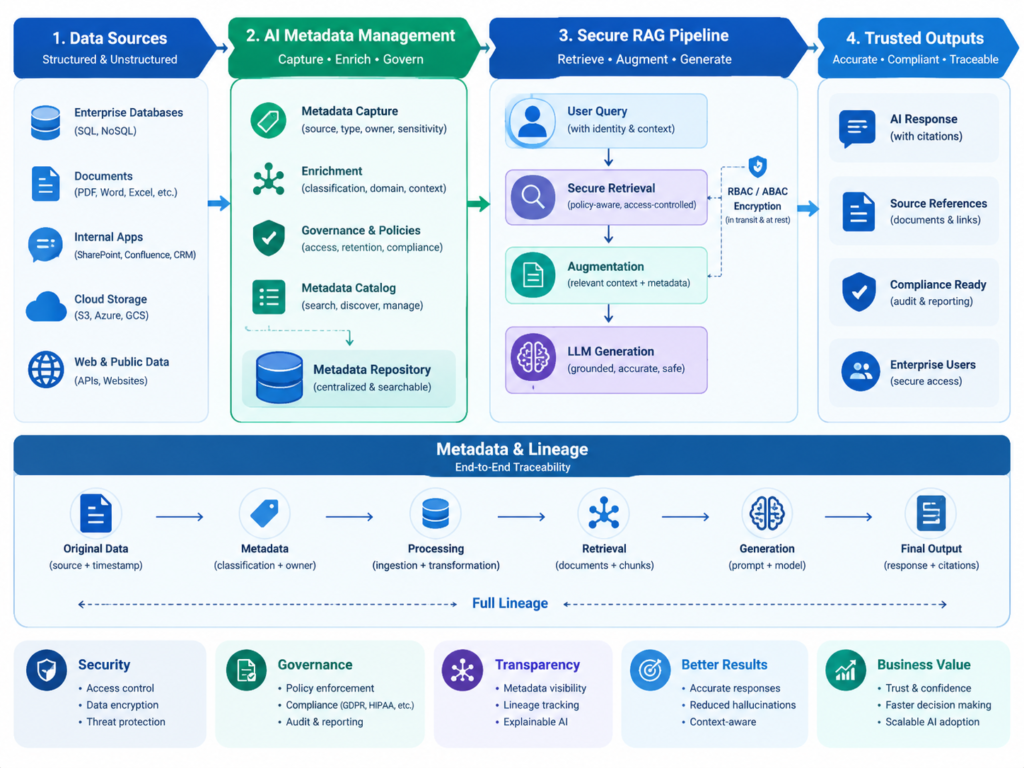
How Data Lineage and Metadata Support RAG and AI Agents
Retrieval-augmented generation allows AI applications to retrieve information from external knowledge sources before generating responses.
However, successful RAG implementation requires more than indexing documents or generating vector embeddings.
Enterprise applications need trustworthy source information, document permissions, and appropriate retrieval controls.
Source Provenance and AI Explainability
When an AI system produces an incorrect financial figure, investigators need to identify whether the problem came from the source data, an outdated transformation, or the model’s interpretation.
Data lineage helps trace information through ingestion pipelines, transformations, and downstream systems.
It provides evidence for investigations, although metadata alone cannot guarantee that every AI-generated conclusion will be explainable.
Document Permissions and Retrieval Context
Enterprise RAG systems should preserve metadata such as.
Original document identifiers and source locations.
Document-level permissions and sensitivity labels.
Chunk-to-source relationships.
Content freshness and modification timestamps.
Applicable retrieval and usage restrictions.
Vector embeddings can identify semantically similar content, but they do not independently enforce access authorization.
Trusted retrieval services must apply permission checks before protected information reaches an AI model.
Organizations exploring knowledge graphs and vector databases should evaluate how these technologies preserve business context and source traceability.
AI-Generated Records and Model Traceability
For higher-impact AI workflows, enterprises may also need to record model versions, configuration references, source identifiers, evaluation outcomes, and appropriate audit events.
These records can help teams reproduce previous results and investigate unexpected outputs.
However, logging should be proportional. Storing sensitive prompts or generated content without clear retention and security controls can introduce additional privacy risks.
This is particularly important when preparing business data for AI agents that operate across multiple enterprise systems.
AI Metadata Governance Across the USA, UK, and EU
Enterprises operating internationally must account for different privacy, security, and AI governance requirements.
Metadata can support regulatory documentation, access control, and accountability. However, collecting metadata does not automatically establish legal compliance.
IBM’s Cost of a Data Breach Report 2024 found that the global average data breach cost reached USD 4.88 million in 2024. This historical benchmark illustrates the potential financial consequences of weak information security practices.
USA.
US enterprises can use the NIST AI Risk Management Framework to structure AI risk management activities.
Organizations processing protected health information must also evaluate applicable HIPAA requirements.
For example, a New York healthcare organization using AI to analyze patient records needs appropriate information classification, access restrictions, and security controls.
Payment-processing environments may face additional PCI DSS obligations.
UK.
UK organizations should document data ownership, processing purposes, access permissions, and applicable retention requirements.
A London-based AI project involving NHS-related health information may require additional security assessments, approvals, and sector-specific governance evidence.
The Information Commissioner’s Office provides guidance on applying data protection principles to AI.
Germany and the EU.
German and wider EU enterprises must assess GDPR obligations when processing personal data.
The EU AI Act introduces requirements for AI systems within its scope, while the Digital Operational Resilience Act (DORA) establishes ICT risk-management obligations for covered financial entities.
For a Frankfurt financial institution, documented lineage, access evidence, and retention policies can support internal governance and regulatory reviews.
The EU AI Act operates through phased application and enforcement dates. Enterprises should check the provisions applicable to their AI systems rather than assuming all requirements begin simultaneously.
Regional Metadata Governance Comparison
|
Region |
Governance context |
Metadata priorities |
|---|---|---|
| USA | NIST AI RMF, HIPAA, PCI DSS | Classification, access, auditability |
| UK | UK GDPR, ICO guidance, NHS requirements | Ownership, processing permissions |
| Germany | GDPR/DSGVO, BaFin, DORA | Lineage, retention, accountability |
| Wider EU | GDPR, EU AI Act | Documentation, risk governance |
A clearly defined AI governance operating model helps translate these requirements into enterprise responsibilities.
Regulatory requirements depend on organizational activities, jurisdiction, and use case. This guidance is informational and should not replace professional legal advice.
How to Implement AI Metadata Management at Scale
Enterprise metadata management becomes difficult when information is spread across cloud platforms, databases, SaaS applications, and AI pipelines.
Manual documentation alone rarely scales well.
A practical implementation combines automated technical metadata collection with human review of business definitions, classifications, and governance decisions.
Build a Centralized AI-Ready Metadata Catalog
A shared catalog gives teams a consistent way to discover enterprise assets and understand their business context.
It does not necessarily require copying all enterprise data into another storage platform.
Instead, organizations can connect existing repositories through metadata connectors, standardized APIs, and federated discovery services.
Data owners and stewards should agree on common naming conventions, ownership responsibilities, and minimum metadata requirements.
Automate Discovery, Lineage, and Policy Updates
Metadata scanners and pipeline integrations can detect database schemas, dependencies, timestamps, and technical changes.
Event-driven processes can flag stale documentation or trigger reviews when source systems change.
Organizations with complex requirements may use custom integrations, including Python development services, to connect unsupported platforms or automate metadata workflows.
Human review remains necessary for business meaning, policy exceptions, and sensitive governance decisions.
Evaluate Enterprise Metadata Management Tools
Enterprise platforms such as Microsoft Purview, Collibra, Atlan, Informatica, and SAP metadata solutions offer different capabilities and integration ecosystems.
When comparing platforms, evaluate integration coverage, lineage depth, semantic support, access-policy integration, deployment options, APIs, and total cost of ownership.
The best platform is the one that fits the organization’s existing architecture, governance maturity, and operational requirements—not necessarily the one with the longest feature list.
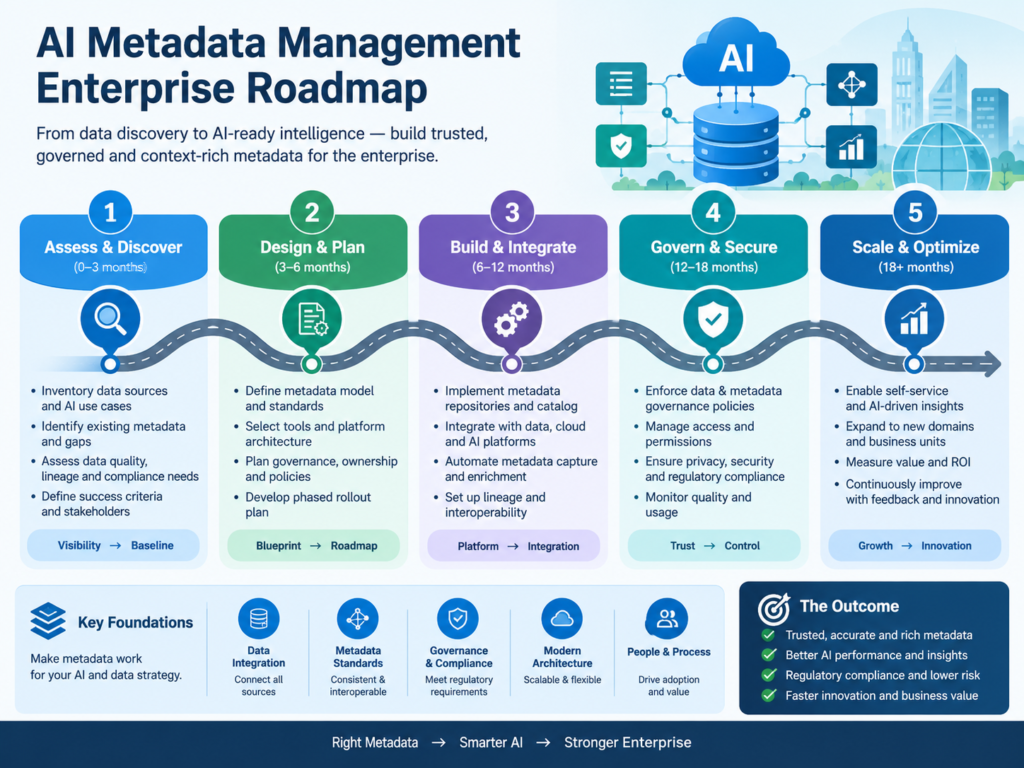
A Practical Enterprise AI Metadata Implementation Roadmap
Rolling out metadata governance across every system simultaneously can create unnecessary complexity.
A phased approach helps enterprises establish core controls, test them on high-value datasets, and expand based on measurable results.
Inventory Assets and Define Minimum Fields
Identify priority datasets, assign accountable owners, document existing metadata, and classify sensitive information. Establish the minimum fields needed for the intended AI use cases.
Connect Systems and Enforce Governance
Integrate ERP, CRM, cloud storage, and RAG pipelines. Connect lineage records and apply access restrictions through trusted services. Custom backend development and API integration can support complex environments.
Monitor Metadata Quality and AI Readiness
Measure ownership coverage, lineage completeness, metadata freshness, and policy exceptions. Resolve significant gaps before expanding AI access to additional data sources.
Measure Progress Through Practical KPIs
Useful indicators include the percentage of datasets with approved owners, completeness of sensitivity classifications, metadata update latency, and unresolved policy exceptions.
Consider a hypothetical London financial-services company introducing an internal RAG assistant.
Rather than indexing every corporate document immediately, the organization could begin with approved policy repositories, preserve document-to-chunk references, enforce employee permissions, and monitor unauthorized retrieval attempts.
Once those controls perform reliably, the organization can expand to additional information sources.
Enterprise AI-Ready Metadata Checklist Before Deployment
Not every AI application requires the same level of metadata maturity.
A low-risk internal pilot may need fewer supporting records than an AI system handling sensitive financial or healthcare information.
Still, organizations should confirm that fundamental governance controls are in place before deployment.
Interactive AI Metadata Readiness Assessment
Mark the controls currently implemented in your organization. Items needing validation are treated as incomplete until reviewed.
Your readiness assessment
0 of 7 controls present
0%
Coverage
Stable asset identifiers and approved data ownership
Validated business definitions and data quality
Current sensitivity classifications
Enforced data and document access permissions
Traceable sources, transformations, and lineage
Documented AI usage and retention restrictions
Monitoing, model versions, and review evidence
This checklist is an operational self-assessment, not a regulatory compliance certification.
For regulated or higher-risk workloads, teams should additionally review retention evidence, model associations, audit requirements, and documented governance approvals.
Concluding Remarks
Reliable enterprise AI requires more than powerful models and large datasets.
AI metadata management provides the context needed to understand data, trace its origins, evaluate quality, and enforce appropriate usage restrictions.
Capturing the 12 essential metadata categories is a practical starting point. Enterprises should prioritize high-value data assets, automate technical collection, retain accountable stewardship, and continuously monitor governance effectiveness.
The goal is not to document everything. It is to make the right information available, understandable, and appropriately governed for each AI application.
Before investing in another AI platform, assess whether your existing data architecture, integrations, and governance practices can support production AI.
Mak It Solutions can help organizations evaluate metadata maturity, identify architecture gaps, and plan practical implementation improvements.
Request an Enterprise AI Metadata Readiness Assessment to discuss your organization’s priorities.
FAQs
Q : Can enterprises deploy generative AI without a centralized metadata catalog?
A : Yes. A centralized catalog is useful but not universally required. Enterprises can begin with documented ownership, reliable source information, consistent metadata standards, and enforceable permissions.
As AI applications expand, shared catalogs or federated discovery layers can improve governance and reduce duplicated work.
Q : How often should AI metadata be updated?
A : Metadata should be updated whenever relevant source systems, business definitions, or governance policies change.
Technical metadata can often be refreshed automatically. Business definitions and sensitivity classifications may require scheduled reviews by responsible data stewards.
Q : Should enterprises store AI prompts and generated-output provenance?
A : Yes, when justified by operational, security, or audit requirements.
Useful records may include model versions, configuration identifiers, timestamps, and source references. Sensitive prompts and outputs should be protected through appropriate access, logging, and retention controls.
Q : What metadata should UK organizations retain for AI audits?
A : Depending on their activities, UK organizations may need records covering processing purposes, data sources, ownership, permissions, retention, and security measures.
UK GDPR obligations, ICO guidance, and applicable sector-specific requirements help determine the appropriate documentation.
Q : Can existing data catalogs support multilingual German and European AI systems?
A : Yes. Enterprise catalogs can support multilingual business glossaries, translated definitions, and relationships between equivalent terms.
For example, the German term Umsatz must be mapped carefully to the enterprise’s approved English revenue definition.
Consistent meanings should be maintained without weakening jurisdiction-specific access, privacy, or retention requirements.