
How to Prepare Business Data for AI Agents: 2026 Guide
How to Prepare Business Data for AI Agents: 2026 Guide
How to Prepare Business Data for AI Agents: 2026 Guide
Imagine an AI sales agent retrieving an outdated customer contract, calculating renewal revenue incorrectly, or updating a CRM record without permission. The technology might function exactly as designed, but the business consequences could be expensive.
Knowing how to prepare business data for AI agents helps organizations avoid these problems before introducing autonomous workflows.
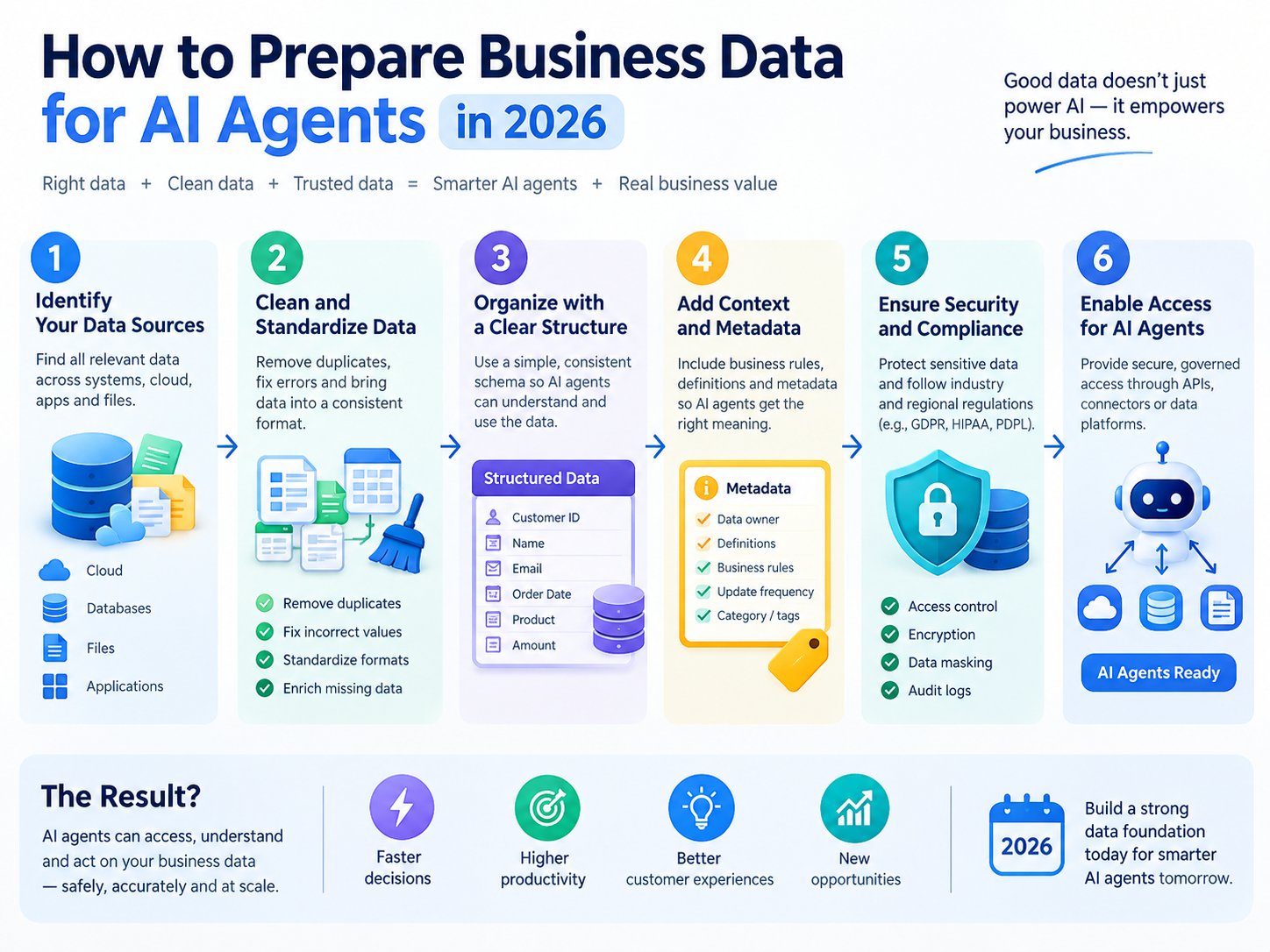
Preparing business data for AI agents means identifying reliable information sources, cleaning and organizing records, defining business terms, building secure integrations, and controlling what agents can access or change. It also requires testing, monitoring, and ongoing governance to ensure agents operate safely.
For businesses in the USA, UK, Germany, and the wider European Union, data preparation must also account for applicable privacy, security, and regulatory requirements.
Here are seven practical steps to build a reliable foundation for enterprise AI agents.
What Is Agent-Ready Business Data?
Agent-ready business data is information that AI agents can find, understand, retrieve, and use safely within approved business processes.
Unlike traditional reporting systems, AI agents may use retrieved information to recommend decisions, trigger workflows, or update operational systems. That makes accuracy, context, and authorization particularly important.
What Makes Business Data Agent-Ready?
Five characteristics matter most.
Discoverability: Agents can identify and retrieve relevant datasets, records, and documents.
Data quality: Information is accurate, complete, consistent, and sufficiently current.
Semantic context: Business terms, relationships, and metrics have clearly documented meanings.
Governed access: Agents retrieve information and execute actions only within authorized permissions.
Actionability and auditability: Approved tasks can be completed while maintaining traceable records of system activity.
Consider a sales agent answering a question about monthly revenue. If different departments define revenue differently, the agent could provide misleading figures despite retrieving technically correct data.
A governed semantic layer for AI agents helps maintain consistent business definitions across systems.
AI-Ready vs. Agent-Ready Data: What’s the Difference?
| Dimension | AI-ready data | Agent-ready data |
|---|---|---|
| Primary purpose | Analysis and information retrieval | Governed decisions and actions |
| Business context | Dataset descriptions | Operational definitions and relationships |
| Access | General data availability | Permission-aware access |
| Integration | Training and retrieval pipelines | APIs, tools, and business workflows |
| Oversight | Data-quality monitoring | Action controls and audit trails |
Agent-ready data builds on traditional AI readiness. The difference is that agents may act on information, not simply analyze it.
Why Data Readiness Matters for AI Agents
An AI agent is only as dependable as the information and controls supporting its work.
Duplicate customers, outdated financial reports, inconsistent product codes, and conflicting definitions can all produce unreliable results.
For example, an agent managing customer renewals might select the wrong account because multiple CRM records share similar names. In a more sensitive workflow, incomplete authorization checks could allow an agent to change information it should only read.
These risks become more important as enterprise AI adoption grows.
According to Eurostat’s December 2025 report, AI technology adoption among EU enterprises with at least 10 employees increased as follows:
Percentage of enterprises with at least 10 employees, based on Eurostat data.
0%6%12%18%24%202320242025
Source: Eurostat, December 11, 2025. These figures measure enterprise AI technology usage, not specifically autonomous AI agent adoption.
Business Benefits of Reliable Agent Data
Preparing data properly can improve.
Accuracy of business recommendations and information retrieval.
Consistency across CRM, ERP, and analytics systems.
Efficiency by reducing manual corrections and repeated data cleanup.
Security through permission-aware integrations.
Accountability through monitoring and audit records.
Consider an illustrative example: A New York sales team connects an AI assistant to verified Salesforce records. By standardizing renewal dates, identifying account owners, and restricting contract changes, the team can generate more dependable renewal recommendations without giving the agent unrestricted control.
Structured data-quality processes and business intelligence services can help establish this foundation.
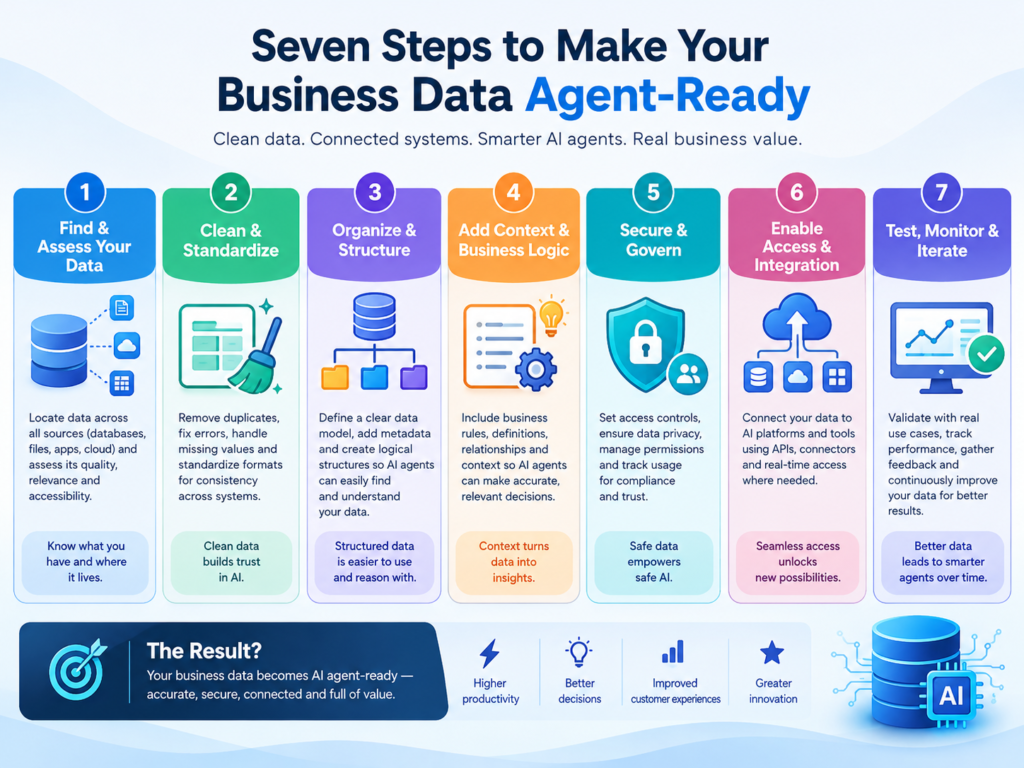
How to Prepare Business Data for AI Agents in 7 Steps
The most practical approach is to start with a specific business workflow and prepare only the information required to support it safely.
STEP 01
Inventory
Identify trusted sources
STEP 02
Clean
Validate business records
STEP 03
Structure
Define business meaning
STEP 04
Connect
Build secure integrations
STEP 05
Control
Enforce permissions
STEP 06
Test
Evaluate real scenarios
STEP 07
Monitor
Improve continuously
Define Your Use Case and Inventory Data Sources
Start by identifying what the AI agent needs to accomplish.
An agent supporting customer renewals requires different information from one processing invoices or answering internal HR questions.
Identify the relevant sources, including.
CRM and ERP platforms.
SQL databases and cloud warehouses.
Spreadsheets and financial records.
Internal knowledge bases and document repositories.
Relevant APIs and third-party applications.
Assign a responsible owner to each important source. Record where the data is stored, how often it changes, and who is authorized to use it.
Deliverable: A use-case-specific data inventory with documented ownership.
Clean and Validate Business Records
Before integrating business data with an AI agent, resolve quality problems that could affect its decisions.
Check for duplicate customer records, missing fields, inconsistent date formats, outdated information, and incorrect identifiers.
Create measurable validation rules for accuracy, completeness, consistency, and freshness.
For example, an agent preparing invoice summaries should not treat invoices with missing currency information as complete financial records.
Prioritize the issues that pose the greatest operational risk rather than attempting to perfect every dataset immediately.
Deliverable: A data-quality report listing issues, owners, and remediation priorities.
Structure Data and Define Business Semantics
Clean data still needs context.
An AI agent must understand what business fields mean, how different systems relate to each other, and which definitions take priority.
Document important concepts such as customer IDs, recognized revenue, active subscriptions, contract status, and product categories.
Use metadata catalogs, data dictionaries, data contracts, and semantic layers where appropriate.
For example, if a US SaaS company uses separate billing and CRM systems, both should reference a consistent customer identity or a governed mapping between identifiers.
Deliverable: An approved data dictionary and documented relationships between relevant systems.
Connect Trusted Data Through Secure Integrations
Once data is organized, connect the AI agent to approved information sources.
Common integration approaches include.
| Integration method | Best suited for |
|---|---|
| Governed SQL connections | Structured business analytics |
| Retrieval-augmented generation (RAG) | Policies, reports, and internal documents |
| Enterprise APIs | Current transactional information and authorized actions |
| Semantic layers | Consistent business metrics and definitions |
RAG can help agents retrieve relevant information from enterprise documents. APIs are often better suited for accessing current operational records or performing controlled transactions.
Depending on the technical environment, Python development can support data pipelines and orchestration, while Node.js development can support authenticated service integrations.
Deliverable: A validated retrieval or integration workflow with clearly defined access boundaries.
Enforce Permission-Aware Agent Access
Not every agent needs access to every business record.
Apply the principle of least privilege: agents should receive only the information and capabilities required for their assigned tasks.
Important safeguards include strong authentication, role-based or attribute-based permissions, sensitive-data restrictions, and approval mechanisms for consequential actions.
For example, an invoice-reading agent should not automatically receive permission to update supplier bank details.
Keep read and write permissions separate wherever practical.
Deliverable: A documented, tested access-control policy for agent tools and connected systems.
Test AI Agents Against Realistic Business Scenarios
Testing should go beyond checking whether an agent produces a plausible answer.
Evaluate how it behaves when information is missing, outdated, contradictory, sensitive, or outside its authorized scope.
Test retrieval accuracy, source attribution, permission boundaries, and tool execution. Include attempts to manipulate the agent through malicious instructions embedded in retrieved documents, commonly known as prompt injection.
For high-impact workflows, verify that the agent can stop safely and request human approval when necessary.
Deliverable: Documented test results showing failures, corrections, and remaining risks.
Monitor, Audit, and Improve Continuously
Data preparation is not a one-time project.
Source systems change, customer information becomes outdated, permissions evolve, and new business rules are introduced.
Monitor retrieval failures, data freshness, authorization events, tool execution, and agent performance.
Maintain audit logs and establish a review schedule. Include user feedback and business outcomes when assessing whether an agent remains reliable.
Deliverable: A monitoring dashboard and recurring governance review process.
Before-and-After Example: Customer Renewal Data
| Before preparation | After preparation |
|---|---|
| Duplicate customer entries | Validated customer identifiers |
| Inconsistent renewal dates | Standardized date formats |
| Unclear account ownership | Documented responsible owners |
| Conflicting revenue definitions | Approved business glossary |
| Broad system access | Permission-controlled API access |
| Limited execution visibility | Logged retrieval and actions |
After preparation, an AI agent has a stronger foundation for producing reliable renewal recommendations with clearer accountability.
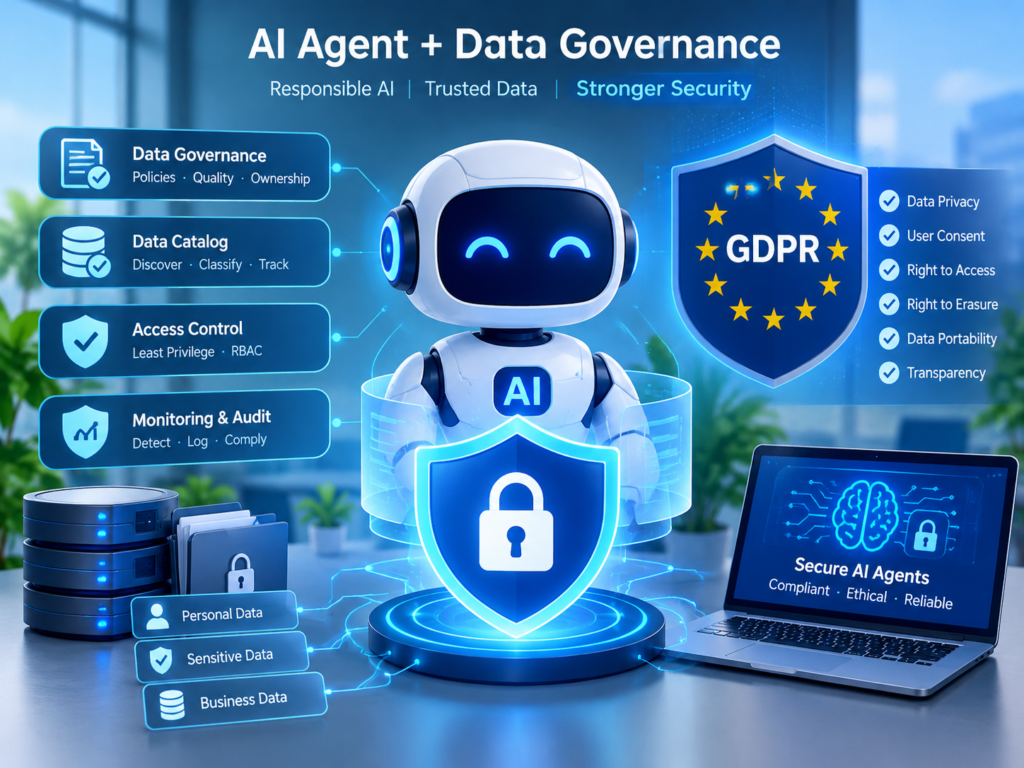
AI Agent Data Governance, Security, and Compliance
Business data preparation must also address who controls information, how agents handle sensitive records, and what safeguards apply when they perform actions.
Security should be part of the agent architecture from the beginning, not an addition after deployment.
Essential Data Governance Controls
Organizations should consider implementing.
Role-based or attribute-based access controls.
Encryption, strong authentication, and data minimization.
Data lineage and tamper-resistant audit logs.
Human approval for sensitive transactions.
Regular permission reviews and security testing.
The NIST AI Risk Management Framework provides voluntary guidance for identifying and managing AI-related risks.
USA.
US organizations should assess which privacy, security, and sector-specific requirements apply to their AI agent deployments.
Healthcare workflows involving protected health information may be subject to HIPAA. Payment-card environments may require PCI DSS controls.
SOC 2 reports can help assess relevant service-provider controls, although SOC 2 is an assurance framework rather than a generally applicable federal law.
Organizations should also consider relevant state privacy laws, contractual requirements, and internal security policies.
UK.
UK organizations processing personal data must assess obligations under UK GDPR and the Data Protection Act 2018.
For London financial institutions or NHS-related workflows, sector-specific governance and confidentiality requirements may also apply.
The UK Information Commissioner’s Office provides AI and data protection guidance addressing lawful processing, accountability, transparency, and individual rights.
Germany and EU.
German and other EU organizations must consider GDPR requirements when AI agents process personal data.
These include lawful processing, data minimization, appropriate security, individual rights, and international data transfer requirements.
For example, a Berlin manufacturer connecting SAP records to an AI agent should review access permissions, data-processing arrangements, and applicable transfer restrictions.
The EU AI Act introduces risk-based obligations depending on the system, its intended purpose, and the organization’s role. The legislation has a phased application schedule, with certain obligations applying from August 2025 and August 2026 and other high-risk provisions subject to later implementation dates.
Regulated financial organizations may also need to consider the Digital Operational Resilience Act (DORA) and applicable supervisory expectations, including those involving BaFin in Germany.
Consult the European Commission’s AI Act guidance for current requirements.
Compliance note: These are general considerations, not legal advice. Organizations should confirm applicable obligations with qualified privacy, security, and legal professionals.
Best Data Architectures and Tools for AI Agents
There is no single architecture suitable for every AI agent.
The right combination of platforms depends on whether the agent needs to answer questions, analyze historical business information, or perform authorized transactions.
Choosing Between Data Platforms, Semantic Layers, and RAG
Governed SQL interfaces work well for structured analytics, while semantic layers help standardize business metrics.
RAG supports document-based information retrieval. Enterprise APIs can provide more controlled access to live records and business operations.
For a deeper comparison of retrieval architectures, see Knowledge Graph vs. Vector Database.
Connecting CRM, ERP, and Enterprise Systems
Salesforce, SAP, Microsoft Fabric, Snowflake, AWS, and Azure provide technologies that may support enterprise data workflows.
A US SaaS company may prioritize Salesforce integration, while a German manufacturer may rely primarily on SAP.
More complex environments may require backend development services to connect existing systems with controlled AI agent tools.
Avoiding Unnecessary Vendor Lock-In
When comparing platforms, evaluate permission enforcement, open APIs, metadata portability, interoperability, data lineage, deployment flexibility, and ongoing operating costs.
A solution should work with your current infrastructure while allowing reasonable flexibility as business needs evolve.
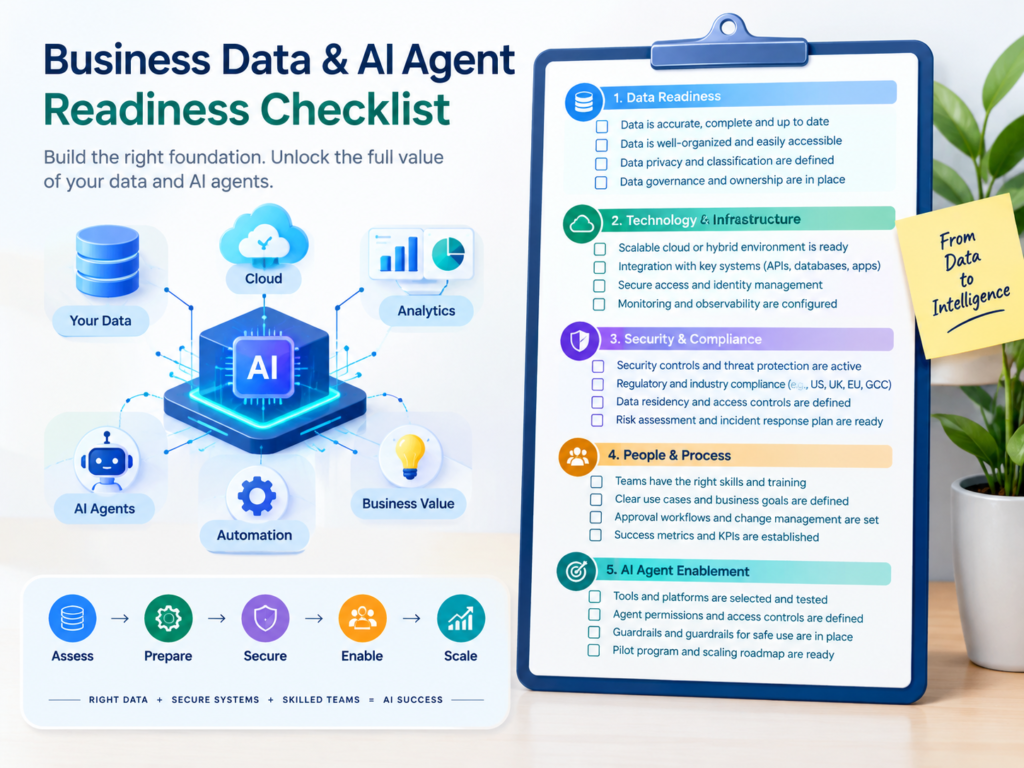
Agent-Ready Data Checklist, Costs, and ROI
Before launching an AI agent, assess whether the underlying information and operational safeguards are ready.
AI Agent Data Readiness Scorecard
Use the following simple diagnostic to identify preparation gaps. Score each area from 0 to 2.
Business Data Readiness Assessment
Choose a score for each dimension.
0/10
Total score
Data quality and freshness
0/2
0 · Missing1 · Partial2 · Ready
Metadata and shared definitions
0/2
0 · Missing1 · Partial2 · Ready
Secure retrieval and integration
0/2
0 · Missing1 · Partial2 · Ready
Authorization and compliance
0/2
0 · Missing1 · Partial2 · Ready
Testing, monitoring, and auditability
0/2
0 · Missing1 · Partial2 · Ready
Foundation work required
Prioritize data cleanup, business definitions, and authorization before deploying an agent.
Scoring: 0 = missing, 1 = partially established, 2 = implemented and evidenced. This is an editorial diagnostic, not a certified readiness or compliance assessment.
What Does AI Agent Data Preparation Cost?
Costs depend on the complexity of existing systems, data quality, integration requirements, security controls, cloud infrastructure, licensing, and maintenance.
A small internal knowledge assistant typically involves a different level of effort from an agent authorized to update financial transactions across multiple enterprise systems.
Rather than relying on generic price estimates, request a scoped assessment based on the systems, data sources, and business outcomes involved.
How to Measure ROI from Your First AI Agent Pilot
Start with a clearly defined workflow and establish baseline performance before introducing automation.
Measure changes in task completion, manual review time, data-related errors, operating costs, and compliance exceptions.
Compare the pilot against the original process, including the effort required for human oversight and error correction.
Expand only when the agent consistently meets agreed business, technical, and security requirements.
To Sum Up
Reliable AI agents require more than capable models. They need trustworthy information, shared business definitions, secure integrations, and carefully controlled permissions.
Understanding how to prepare business data for AI agents gives organizations a practical starting point for safer, more dependable automation.
Begin with one business workflow, validate the records it depends on, test the agent’s behavior, and measure the results before expanding.
The goal isn’t simply to give AI agents access to more data. It’s to make sure they use the right information, for the right purpose, with the right safeguards.
Ready to assess whether your business information can support reliable AI automation?
Mak It Solutions can help evaluate your data quality, integration complexity, and technical readiness.
Contact Mak It Solutions to discuss a scoped AI data readiness assessment and identify a practical first pilot.
Key Takeaways
Agent-ready data combines quality, business context, accessibility, and governance.
The seven-step process covers inventory, cleaning, structuring, integration, authorization, testing, and monitoring.
Least-privilege permissions and human approval help reduce operational risks.
USA, UK, Germany, and EU deployments require appropriate regional compliance assessments.
Architecture choices should prioritize interoperability, security, and business value.
A controlled pilot is a more manageable starting point than unrestricted autonomous access.
FAQs
Q : Can AI agents work with unstructured business documents?
A : Yes. AI agents can retrieve information from PDFs, contracts, emails, reports, and other unstructured documents using parsing tools and retrieval-augmented generation (RAG).
However, documents need appropriate indexing, metadata, access permissions, and freshness controls. Organizations should also test source attribution and answer accuracy.
Q : Do businesses need a data warehouse before using AI agents?
A : No. A data warehouse is not mandatory for every AI agent implementation.
Secure APIs, existing CRM integrations, or governed database connections may be enough for a limited workflow. Warehouses and lake houses become more useful when agents need cross-system analytics, historical data, or standardized enterprise metrics.
Q : How often should business data be refreshed for AI agents?
A : Refresh frequency depends on how the information is used.
Inventory availability, financial transactions, and authorization records may require real-time or near-real-time access. Internal policies and reference documents may support scheduled updates.
Define acceptable freshness limits for each important source and prevent consequential actions when necessary information is outdated.
Q : Can small businesses prepare data for AI agents without a dedicated data team?
A : Yes. Small businesses can begin with a limited use case using existing cloud applications, CRM records, and managed integrations.
The priorities are clear data ownership, reliable records, consistent field definitions, and appropriate permissions. External technical support can help when specialized integration or security expertise is required.
Q : Should AI agents receive direct write access to CRM or ERP systems?
A : AI agents generally should not receive unrestricted write access.
Begin with read-only access when possible. For approved updates, use narrowly scoped, authenticated tools with enforced business rules, audit logs, and rollback procedures.
Sensitive changes, such as modifying bank details or contractual terms, should require appropriate human approval.