


Business Continuity Plan for Network Outages: GCC Guide
Business Continuity Plan for Network Outages: GCC Guide
Business Continuity Plan for Network Outages: GCC Guide
A network outage can bring business operations to a halt faster than most companies expect. Payment systems stop responding, cloud applications become inaccessible, and customer support teams struggle to communicate.
For organizations operating in Saudi Arabia, the UAE, and Qatar, the consequences can extend across multiple offices and service providers.
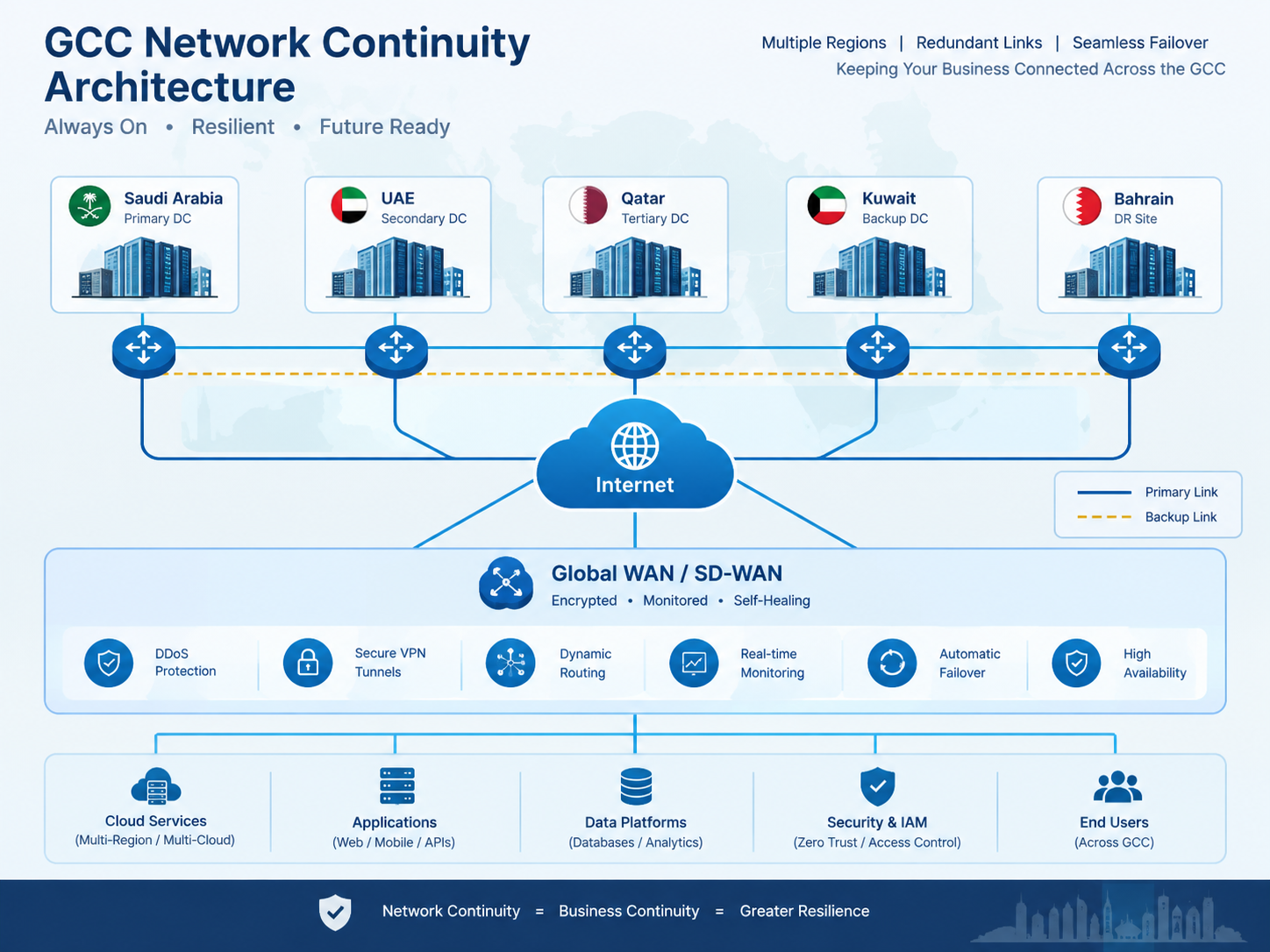
A business continuity plan for network outages helps organizations maintain essential operations when internet or telecommunications services fail. An effective plan combines backup connectivity, clearly defined recovery priorities, incident response procedures, and regular testing.
For GCC businesses, the goal is straightforward: keep critical services running, even when the primary network is unavailable.
Why GCC Businesses Need a Business Continuity Plan for Network Outages
What Is a Business Continuity Plan for Network Outages?
A business continuity plan (BCP) explains how an organization will maintain essential activities during connectivity disruptions.
It covers the people, processes, systems, and communication channels needed to continue operations.
Although related, business continuity, disaster recovery, and network redundancy serve different purposes.
| Approach | Primary purpose |
|---|---|
| Business continuity | Maintain essential business operations |
| Disaster recovery | Restore affected IT systems and data |
| Network redundancy | Provide alternative connectivity when a connection fails |
ISO 22301 provides an internationally recognized framework for managing business continuity.
A comprehensive plan combines these approaches rather than relying on backup internet alone.
Common Causes of Network Outages in Saudi Arabia, UAE, and Qatar
Connectivity interruptions can occur for several reasons.
Fiber-optic cable damage: Construction activities or infrastructure failures may interrupt connectivity.
Power disruptions: Network equipment and telecommunications facilities can become unavailable.
Cyberattacks: DDoS attacks and other security incidents may interrupt access to business services.
Routing or configuration errors: Incorrect network changes can affect multiple sites.
Submarine cable disruptions: International connectivity may be affected when critical cable routes experience failures.
Shared provider dependencies: Different internet providers may rely on overlapping physical infrastructure.
Consider a fintech company in Riyadh, an e-commerce platform in Dubai, and a logistics business in Doha.
Each depends on connectivity, but the operational consequences differ. The fintech company may struggle to process transactions, the e-commerce platform may lose access to orders, and the logistics business may experience shipment coordination delays.
This is why a generic outage checklist is rarely enough.
How Network Outages Affect Critical Business Operations
Network interruptions can affect.
Online payments and financial transactions
ERP and CRM applications
Cloud-hosted business systems
Customer support and communications
Logistics and supply chain coordination
Employee access and authentication services
A business impact analysis (BIA) helps identify which processes are most important, what resources they depend on, and how long the organization can operate without them.
For example, a company may tolerate temporary delays in internal reporting but require payment services and customer communications to remain available.
Understanding these differences helps teams direct recovery resources where they matter most.
How to Build a Business Continuity Plan for Network Outages
An effective GCC network continuity plan begins with identifying dependencies, defining recovery expectations, and assigning clear responsibilities.
Identify Connectivity Risks and Dependencies
Start by documenting the infrastructure supporting everyday operations.
Review.
Primary and backup internet service providers
WAN connections between regional offices
Cloud applications and hosting environments
DNS and identity authentication services
Third-party telecommunications providers
Network equipment and power dependencies
Pay particular attention to shared infrastructure.
A company operating offices in Riyadh, Dubai, and Doha might purchase connectivity from different providers while still depending on common upstream routes or services.
The business impact analysis should also cover suppliers, external platforms, and critical backend integrations.
Reviewing business applications and backend integrations can help identify dependencies that are easy to overlook during infrastructure planning.
Define Recovery Objectives and Priorities
Recovery planning requires clear expectations about how quickly services must return and how much data loss is acceptable.
Three important measurements are.
| Metric | Meaning |
|---|---|
| Recovery Time Objective (RTO) | Target maximum time to restore a service |
| Recovery Point Objective (RPO) | Maximum acceptable data loss, expressed as time |
| Maximum Tolerable Period of Disruption (MTPD) | Longest interruption the business can tolerate before consequences become unacceptable |
These measures should reflect actual business needs.
For example, payment processing, authentication services, and customer communications may require tighter recovery objectives than noncritical internal applications.
Management, IT, and business owners should agree on these priorities before an outage occurs.
Document Incident Response and Recovery Procedures
A business continuity plan should clearly explain who makes decisions when connectivity fails.
Assign responsibilities to an incident commander, network team, business process owners, compliance personnel, and communications coordinator.
Document.
Conditions that trigger plan activation
Incident escalation procedures
Backup connectivity activation
Emergency contacts and provider details
Manual operating procedures
Recovery verification requirements
Internal and customer notifications
For regional operations, Arabic and English communications may help teams coordinate more effectively.
Keep essential recovery instructions available offline. A plan stored only in an inaccessible cloud environment may offer little practical value during a major outage.
Network Redundancy and Backup Connectivity for GCC Enterprises
Backup connectivity is a central part of network resilience. However, adding another connection does not automatically eliminate downtime.
Dual ISP Connections, Diverse Fiber Routes, and SD-WAN
Using two internet service providers can reduce dependency on a single operator.
However, separate providers may share underground cables, exchange facilities, or upstream infrastructure.
Companies should verify physical route diversity wherever possible.
Software-defined wide area networking (SD-WAN) can help manage traffic across available connections and support automated failover.
Border Gateway Protocol (BGP) may also support routing redundancy where the network architecture and provider arrangements allow it.
The key is to test whether the alternative route actually works when the primary connection becomes unavailable.
4G/5G and Satellite Backup Connectivity
Cellular backup connections can provide a practical alternative for branch offices in Riyadh, Jeddah, Dubai, Abu Dhabi, and Doha.
A properly configured 4G or 5G connection may support essential applications during a primary fiber failure.
However, performance depends on local coverage, available capacity, network congestion, and equipment configuration.
Satellite services offer another potential connectivity path, especially where terrestrial infrastructure is limited or vulnerable.
Organizations should evaluate satellite licensing, service availability, bandwidth, latency, and cost before deployment.
| Connectivity option | Main advantage | Key limitation |
|---|---|---|
| Dual ISP | Alternative provider | Potential shared infrastructure |
| Diverse fiber | Independent physical routes | Route verification required |
| SD-WAN | Automated traffic switching | Requires available transport |
| 4G/5G | Flexible emergency connection | Variable performance and capacity |
| Satellite | Alternative access technology | Cost, latency, and licensing |
For many enterprises, the strongest approach combines independent connectivity options with tested recovery procedures.
Building Resilient Cloud Connectivity Across the GCC
Cloud hosting can improve application availability, but it does not guarantee that employees can access those applications during a network outage.
Organizations may evaluate regional infrastructure such as AWS Bahrain, Microsoft Azure UAE Central, or Google Cloud Doha, depending on workload availability, security requirements, and data residency obligations.
Recovery planning should consider.
Alternative network paths to cloud applications
DNS and authentication availability
Secure remote access
Cloud-region and provider dependencies
Application recovery and data synchronization
Cross-border data transfer restrictions
For customer-facing services, scalable web development and reliable backend architecture can support wider operational resilience.
GCC Business Continuity Compliance: Saudi Arabia, UAE, and Qatar
Regulatory requirements are an important part of business continuity planning, particularly for financial institutions, telecommunications providers, and businesses handling sensitive information.
Requirements differ by country, industry, and regulatory classification.
Saudi Arabia.
Saudi Arabia’s Communications, Space and Technology Commission (CST) approved Business Continuity Management Regulations in February 2024.
These regulations apply within the relevant telecommunications regulatory scope and should not automatically be treated as universal requirements for every enterprise.
Organizations regulated by the Saudi Central Bank (SAMA) should assess applicable operational resilience, cybersecurity, and business continuity requirements.
Businesses must also consider relevant National Data Management Office (NDMO) policies and other applicable data protection or cybersecurity requirements when implementing recovery arrangements.
For example, a Riyadh-based fintech organization should evaluate how backup connectivity affects transaction security, regulatory reporting, and access to sensitive customer information.
UAE.
The UAE’s Telecommunications and Digital Government Regulatory Authority (TDRA) has initiatives addressing telecommunications business resilience and continuity.
Financial institutions face additional sector-specific requirements.
The Central Bank of the UAE’s Operational Risk Management Regulation, effective September 14, 2026, requires covered licensed financial institutions to maintain business continuity and disaster recovery plans for critical operations.
These plans must address relevant disruption scenarios, operational dependencies, and recovery responsibilities.
Organizations regulated by the Abu Dhabi Global Market (ADGM) Financial Services Regulatory Authority or Dubai Financial Services Authority in the DIFC should review their respective obligations separately.
For enterprises operating across Dubai and Abu Dhabi, continuity planning should consider shared telecommunications dependencies, alternative-site access, and secure recovery of critical applications.
Qatar.
In Qatar, business continuity obligations depend on an organization’s regulated activities.
Qatar Central Bank (QCB) oversees relevant banking-sector requirements, while the Communications Regulatory Authority (CRA) regulates telecommunications.
A Doha-based financial institution may need more stringent controls for transaction continuity, incident management, and technology recovery than an ordinary commercial office.
Enterprises should document.
Recovery ownership and escalation procedures
Service provider dependencies
Approved backup connectivity
Data protection and access controls
Evidence of recovery testing
Cross-border organizations should also assess requirements in each country where they operate.
Regulatory note.
This overview provides general information, not legal or compliance advice. Organizations should confirm applicable obligations with their regulators and qualified advisers.

Network Outage Incident Response and Recovery Testing
A business continuity plan becomes valuable when employees can follow it during an actual disruption.
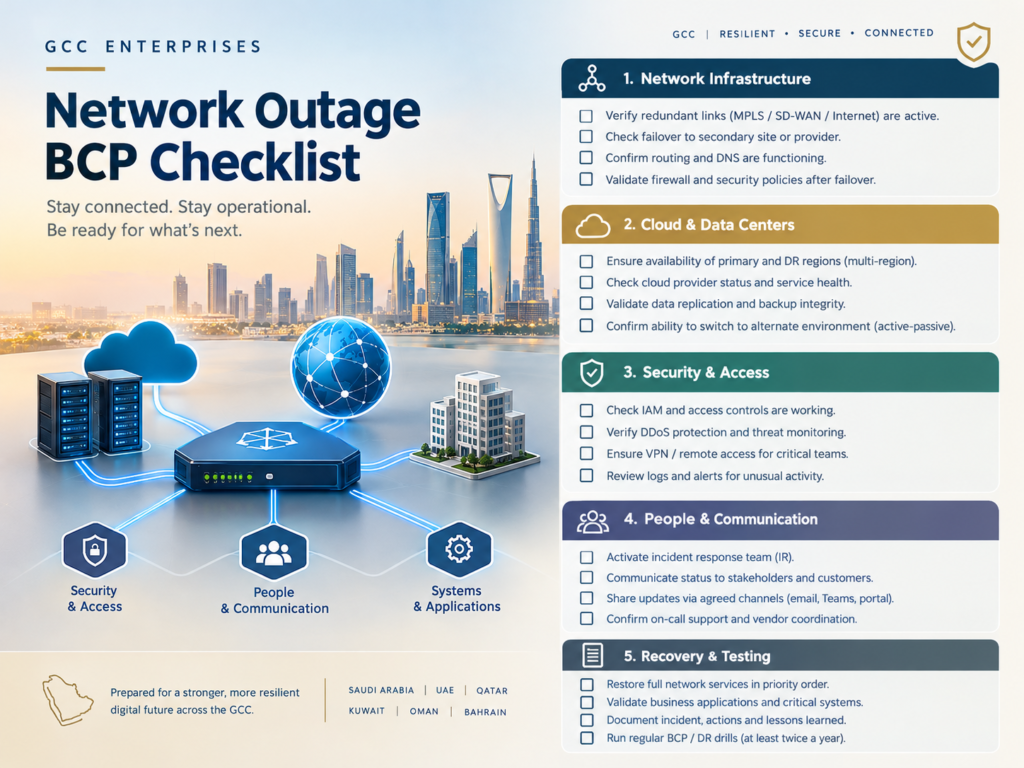
GCC Network Outage Incident Response Checklist
When a network failure occurs, use the following sequence.
Confirm the outage. Identify affected offices, applications, and network services.
Activate the response team. Assign incident ownership and establish communications.
Enable backup connectivity. Switch to approved alternative network paths.
Notify stakeholders. Communicate operational impacts and recovery progress.
Verify restoration. Confirm that critical applications and security controls function correctly.
Record major decisions, incident timelines, and recovery results for subsequent review.
Test Network Failover Before an Actual Outage
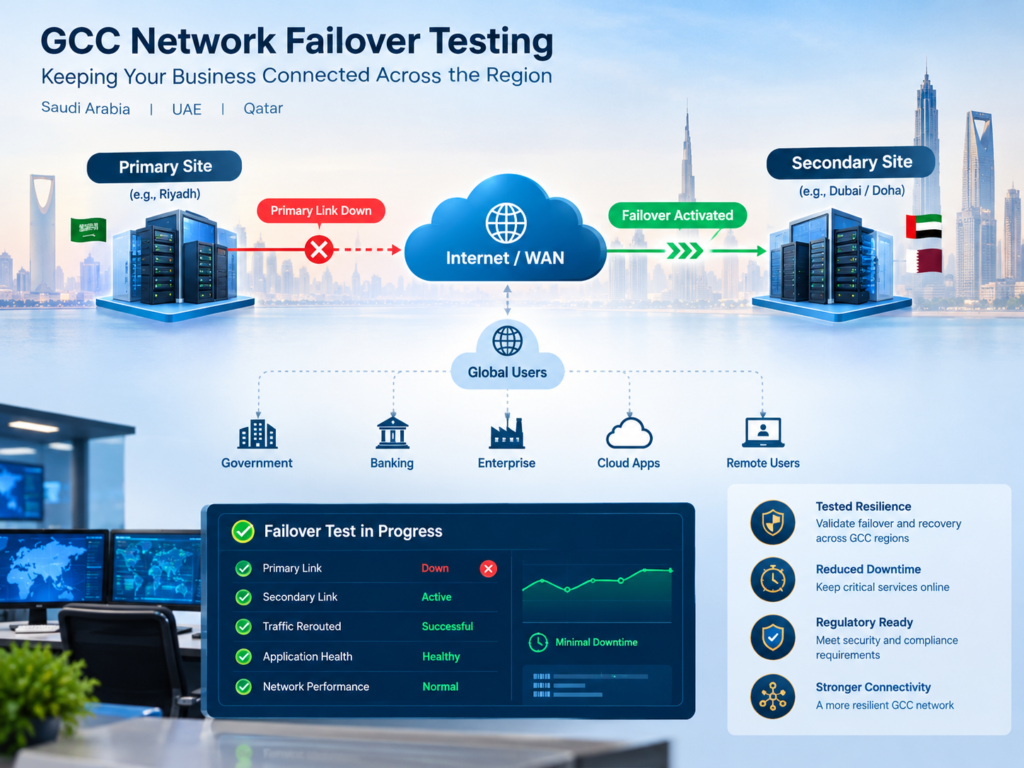
Recovery arrangements should be tested through tabletop exercises and controlled technical drills.
Consider a logistics company operating across Riyadh, Dubai, and Doha.
If its primary WAN connection becomes unavailable, the team must know whether branch offices can activate cellular backup, access essential shipment information, and communicate through independent channels.
A realistic test should verify those capabilities rather than assume they will work.
Testing should also include failure scenarios involving DNS, authentication systems, or cloud connectivity.
Measure Recovery Performance
After each exercise or incident, review:
Outage detection time
Backup connection activation time
Actual service restoration time
RTO achievement
Service-level agreement (SLA) performance
Recurring failures and unresolved dependencies
Recovery testing should inform improvements to infrastructure, employee training, and incident procedures.
Major application migrations, telecommunications changes, or office expansions should also trigger a review of the continuity plan.
Cost, Implementation, and Best Practices for GCC Network Resilience
What Affects the Cost of a Business Continuity Plan?
Business continuity costs depend on organizational complexity and recovery expectations.
Important factors include branch locations, required bandwidth, provider diversity, SD-WAN equipment, cellular or satellite backup, technical support, and testing requirements.
Companies should distinguish initial deployment expenses from recurring connectivity, maintenance, and support costs.
An office with basic communication requirements may need a different solution from a financial institution processing business-critical transactions.
Recommended Implementation Phases
A practical rollout can be organized into four phases.
Risk discovery
Identify critical business processes, connectivity dependencies, and potential failure points.
Recovery design
Define RTOs, RPOs, backup network architecture, incident roles, and relevant compliance requirements.
Deployment and training
Implement approved connectivity alternatives and train responsible employees.
Testing and continuous improvement
Run recovery exercises, measure results, correct weaknesses, and obtain relevant management approvals.
Implementation schedules will vary depending on procurement, provider installation, regulatory approvals, and infrastructure complexity.
Best Practices for Multi-Country GCC Operations
Organizations operating across multiple GCC countries should avoid unnecessary dependence on shared infrastructure and untested recovery arrangements.
Useful practices include maintaining offline incident playbooks, evaluating third-party risks, verifying cloud access, and reassessing connectivity after major business changes.
Applications also need to remain usable during periods of reduced bandwidth.
Well-designed frontend development services, mobile application solutions, and appropriate monitoring can complement wider continuity planning.
Wrap It Up
A reliable business continuity plan for network outages is more than a secondary internet connection.
It brings together risk assessment, independent connectivity, recovery priorities, employee responsibilities, regulatory awareness, and practical testing.
For businesses operating in Saudi Arabia, the UAE, and Qatar, these measures help protect critical workflows and support more dependable service during unexpected disruptions.
The most effective time to evaluate network resilience is before an outage exposes a weakness.
Explore Mak It Solutions’ technology services to strengthen your digital infrastructure and application resilience.
You can also contact our team to discuss your business requirements and explore a tailored GCC continuity approach, including specialist network connectivity assessments where needed.
FAQs
Q : Can businesses in Saudi Arabia use 5G backup internet during fiber outages?
A : Yes. Businesses can use 5G backup where suitable coverage, equipment, and network capacity are available. However, cellular connections may experience congestion or reduced performance during widespread disruptions. Test essential applications, routers, SIM configurations, and VPN access before relying on cellular failover.
Q : Are two different internet providers enough to prevent downtime in Dubai?
A : Not always. Different providers may share physical fiber routes or upstream network infrastructure. Dubai businesses should verify actual route diversity, test failover procedures, and consider backup power and alternative communication methods.
Q : What backup connectivity options are available for enterprises in Doha?
A : Doha enterprises can evaluate dual-provider connections, diverse fiber routes, SD-WAN, cellular backup, and eligible satellite services. The right solution depends on bandwidth needs, security requirements, recovery objectives, and applicable telecommunications regulations.
Q : How often should UAE financial institutions test their business continuity plans?
A : Testing should follow applicable regulatory requirements and the institution’s risk profile. The CBUAE Operational Risk Management Regulation requires regular review of critical business continuity and disaster recovery plans, including reviews at least annually by relevant second- and third-line functions. Institutions must separately assess the regulation’s testing requirements and conduct additional exercises when necessary.
Q : How can GCC companies maintain cloud access across Saudi Arabia, Bahrain, and Oman?
A : Companies should diversify internet connectivity, test DNS and identity services, and establish secure alternative access paths to critical cloud applications. Regional hosting may support resilience, but data residency, contractual obligations, and jurisdiction-specific requirements must be evaluated. Cloud availability alone does not guarantee uninterrupted office connectivity.