


Cloud Vendor Concentration Risk: GCC Action Guide
Cloud Vendor Concentration Risk: GCC Action Guide
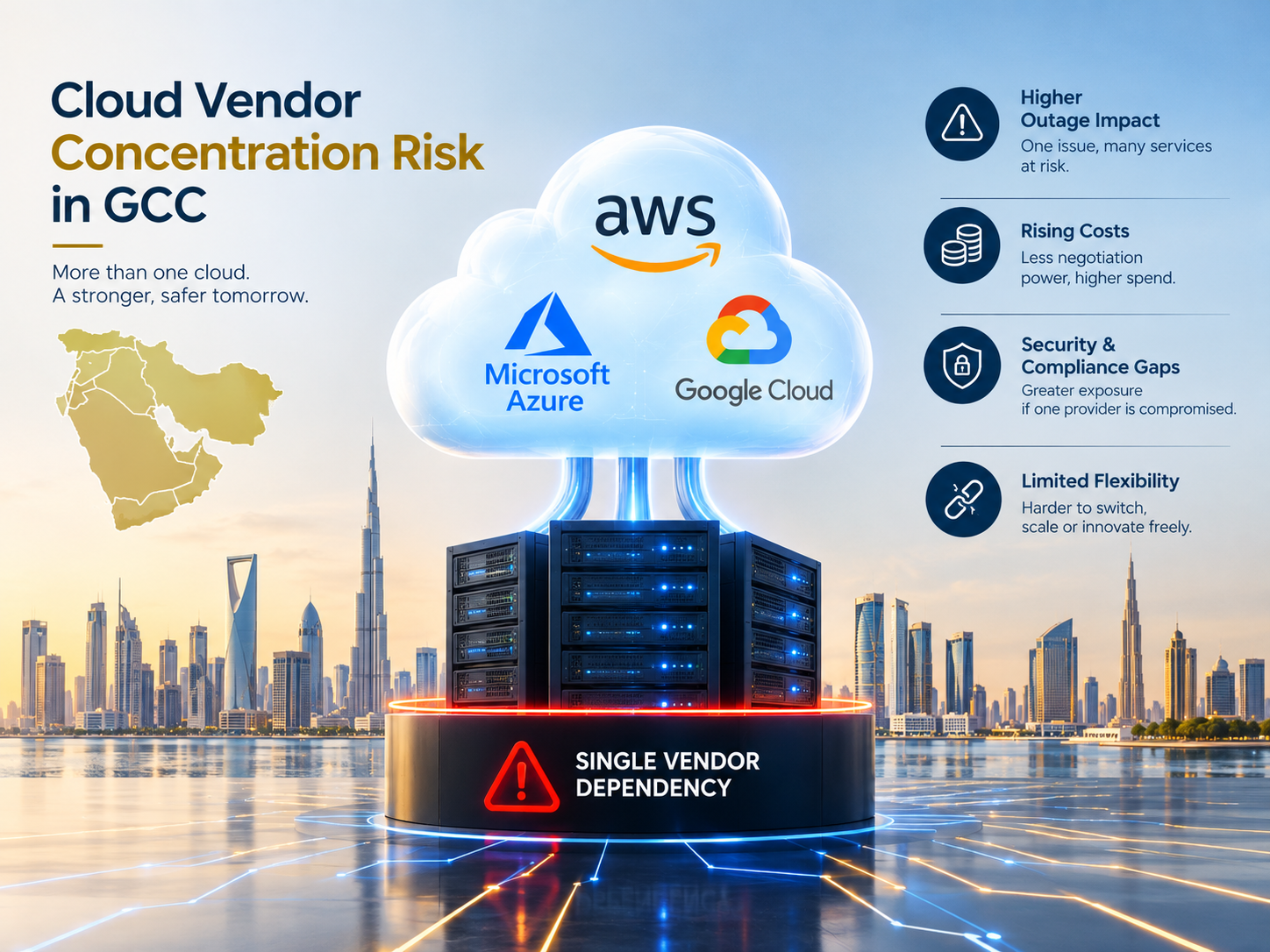
Cloud Vendor Concentration Risk: GCC Action Guide
Imagine a financial institution in Riyadh suddenly losing access to its payment processing platform, customer authentication system, and cybersecurity monitoring dashboard.
The problem? All three services depend on the same cloud provider.
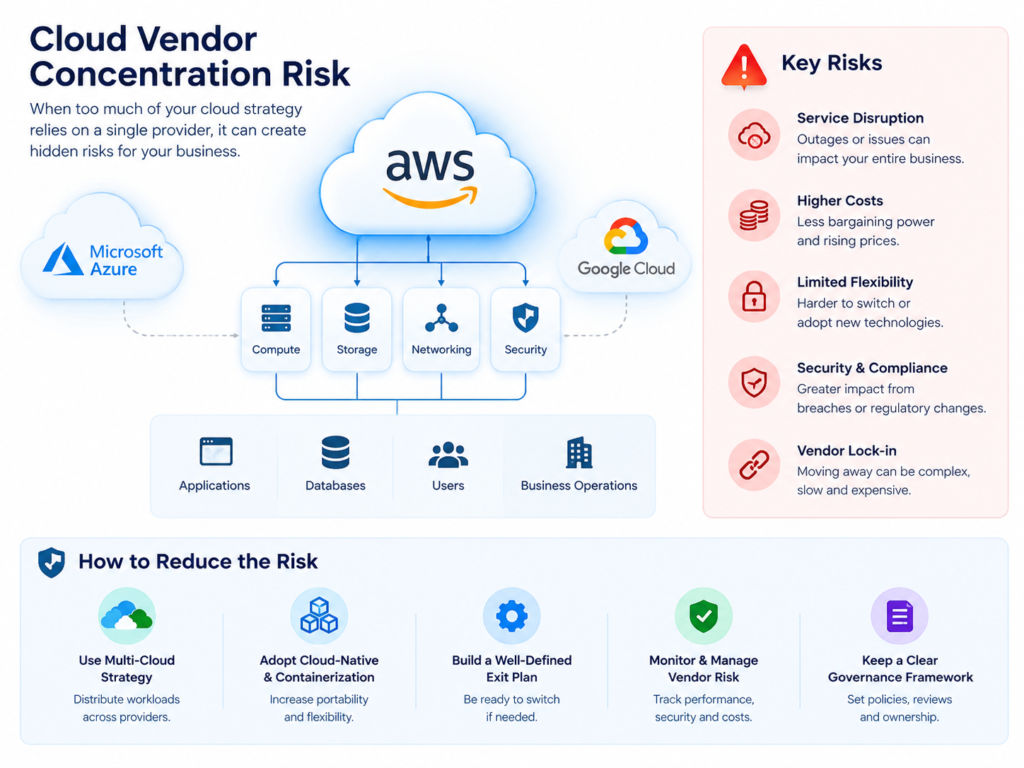
This is cloud vendor concentration risk the operational exposure that arises when critical business applications, cybersecurity systems, or essential services depend heavily on one provider or a small group of interconnected suppliers.
For enterprises in Saudi Arabia, the UAE, and Qatar, managing this risk means identifying shared dependencies, maintaining independent recovery capabilities, assessing third-party suppliers, and testing vendor exit strategies.
A cloud provider may offer excellent uptime, advanced cybersecurity, and regional data centers. But even a reliable provider can experience an outage, security incident, or operational disruption.
The real question is whether your business can continue operating when that happens.
What Is Cloud Vendor Concentration Risk in the GCC?
Cloud vendor concentration risk occurs when an organization relies too heavily on a particular technology provider for essential operations.
This exposure is not limited to cloud hosting. It can also involve managed security service providers (MSSPs), identity management platforms, cybersecurity monitoring tools, and subcontractors supporting multiple vendors.
Cloud Concentration Risk vs. Vendor Lock-In
These risks are related, but they are not interchangeable.
|
Risk type |
Meaning |
|---|---|
| Concentration risk | Several critical business services depend on the same supplier. |
| Vendor lock-in | Switching providers is technically, financially, or operationally difficult. |
| Third-party risk | A contracted supplier introduces operational, security, or compliance exposure. |
| Fourth-party risk | A supplier relies on another organization that supports your critical services. |
Consider an enterprise running multiple applications on one cloud platform. Each application may have separate backups and availability configurations, yet all could be affected by a disruption involving shared cloud infrastructure or management services.
Vendor lock-in creates a different challenge: even when an alternative provider is available, migrating applications and data may require significant time and investment.
How Cybersecurity Vendors Create Hidden Dependencies
Cloud infrastructure is only part of the picture.
A company may use different hosting providers but depend on one MSSP for threat detection, incident escalation, security reporting, and compliance monitoring.
If that MSSP becomes unavailable, cybersecurity visibility across otherwise independent cloud environments can deteriorate.
This is why resilient backend application architecture, independent security monitoring, and alternative incident-response procedures deserve attention during supplier risk assessments.
Why GCC Enterprises Should Pay Attention
Businesses across Riyadh, Jeddah, Dubai, Abu Dhabi, and Doha increasingly operate through connected digital platforms.
A technology supplier disruption may affect.
Payment processing and financial transactions
E-commerce orders and inventory synchronization
Mobile applications and customer authentication
Cybersecurity alerts and incident response
Regulatory reporting and business communications
For enterprises operating across GCC markets, supplier resilience is therefore a business continuity concern not simply an IT infrastructure decision.
Where Do Cloud and Cybersecurity Dependencies Build Up?
Organizations often identify obvious dependencies, such as cloud hosting contracts, while overlooking connections between identity systems, networks, monitoring platforms, and outsourced technology services.
Single-Cloud, Multi-Cloud, and Hybrid-Cloud Exposure
Different cloud deployment models introduce different forms of risk.
|
Cloud model |
Potential concentration risk | Practical mitigation |
|---|---|---|
| Single-cloud | Critical workloads depend on one provider. | Maintain independent backups and recovery options. |
| Multi-cloud | Different providers share identity, networking, or security services. | Separate critical controls and test failure scenarios. |
| Hybrid-cloud | Cloud and on-premises systems rely on interconnected infrastructure. | Validate network isolation and independent recovery. |
Multi-cloud architecture can reduce concentration risk, but only when essential dependencies are genuinely independent.
For example, deploying applications across different cloud providers offers limited protection if both environments depend on the same authentication platform.
MSSP, SOC, Identity, and Security Platform Concentration
A centralized security operations center (SOC), security information and event management (SIEM) platform, or identity provider can become a critical failure point.
Enterprises should consider maintaining emergency administrative access, protected security log exports, independent incident-response procedures, and recovery capabilities outside the primary provider’s environment.
These safeguards help preserve security visibility when a major supplier is disrupted.
Practical Dependency Scenarios Across the GCC
The following examples are illustrative scenarios, not documented customer incidents.
Riyadh Financial technology: A fintech business cannot process transactions because its primary cloud environment becomes unavailable. Its recovery systems also depend on the affected provider.
Dubai — E-commerce
An online retailer experiences simultaneous interruptions to ordering, stock updates, and delivery tracking after a shared infrastructure failure.
Doha — Banking.
A financial institution receives delayed security alerts because its outsourced monitoring provider experiences a service disruption.
These scenarios show why organizations should review the resilience of their e-commerce platforms and mobile applications alongside their cloud and cybersecurity infrastructure.
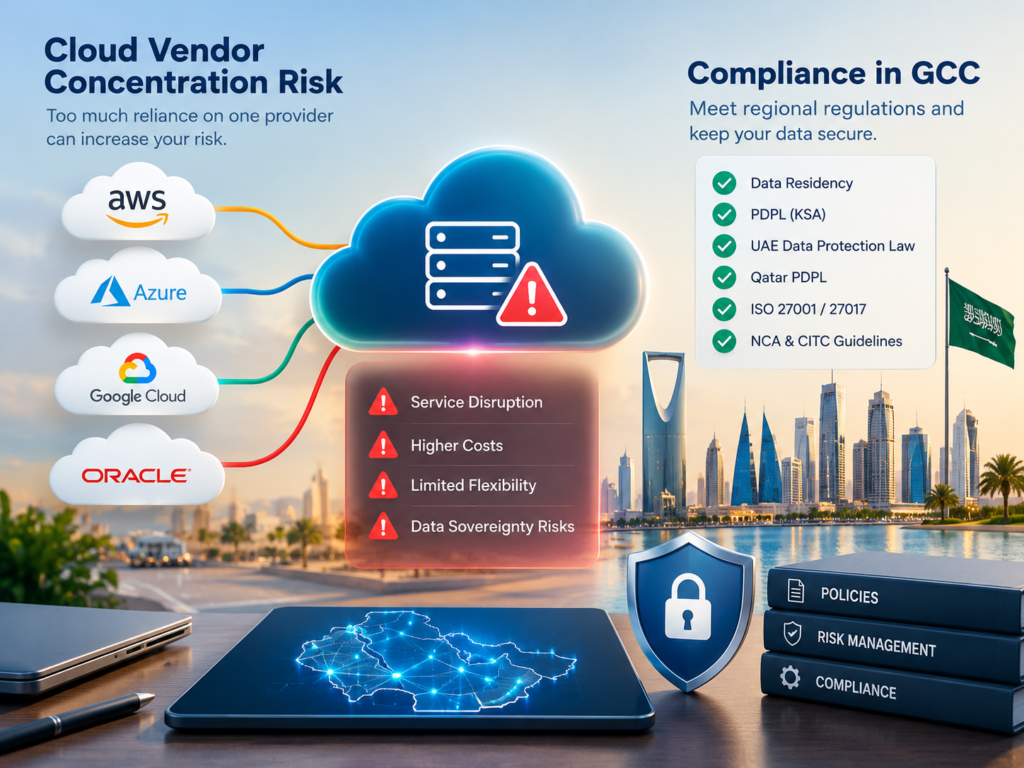
GCC Cloud Vendor Concentration Risk and Compliance
Regulatory requirements add another dimension to cloud vendor risk management.
Saudi Arabia, the UAE, and Qatar have distinct cybersecurity, outsourcing, and cloud governance requirements. Applicable obligations vary by sector, licensing status, data classification, and organizational activities.
|
Country |
Relevant authorities | Key considerations |
|---|---|---|
| Saudi Arabia |
SAMA, NCA, NDMO |
Cybersecurity governance, cloud security, third-party oversight, and data management |
| UAE |
CBUAE, FSRA, DFSA, TDRA |
Outsourcing governance, operational resilience, and sector-specific requirements |
| Qatar |
QCB |
Cloud governance, outsourcing exposure, operational security, and service continuity |
Saudi Arabia.
Saudi financial institutions should review the SAMA Cyber Security Framework, which addresses cybersecurity governance and third-party security risks.
The National Cybersecurity Authority’s Cloud Cybersecurity Controls establish requirements for applicable cloud service providers and cloud service tenants.
The NCA’s 2025 cloud controls update also addresses data-localization requirements.
NDMO-related data governance requirements may introduce additional considerations depending on the organization and information involved.
For a Riyadh-based financial institution, the priority is to identify which requirements apply before finalizing cloud architecture, outsourcing contracts, or recovery arrangements.
UAE.
The UAE has different regulatory arrangements depending on the industry and jurisdiction.
The Central Bank of the UAE Outsourcing Regulation addresses outsourcing risk, including concentration risk in cloud arrangements and subcontractor dependencies.
Financial institutions operating within Abu Dhabi Global Market (ADGM) or Dubai International Financial Centre (DIFC) must separately consider requirements administered by their respective financial regulators.
TDRA responsibilities apply within relevant telecommunications and digital-government contexts.
Importantly, hosting applications in a UAE cloud region does not automatically satisfy every regulatory requirement or eliminate vendor concentration risk.
Qatar.
Qatar Central Bank issued cloud computing regulations in April 2024 covering governance, lifecycle management, and operational security for relevant financial institutions.
The QCB Cloud Computing Regulation provides a reference for applicable institutions evaluating cloud arrangements.
A Doha-based financial institution should examine provider due diligence, data-location obligations, contractual oversight, recovery capabilities, and supplier exit arrangements before outsourcing critical technology functions.
Compliance note: These references provide general context, not a definitive assessment of an organization’s regulatory obligations. Enterprises should confirm current rules with qualified legal, compliance, and cybersecurity professionals.
How to Assess Cloud Vendor Concentration Risk
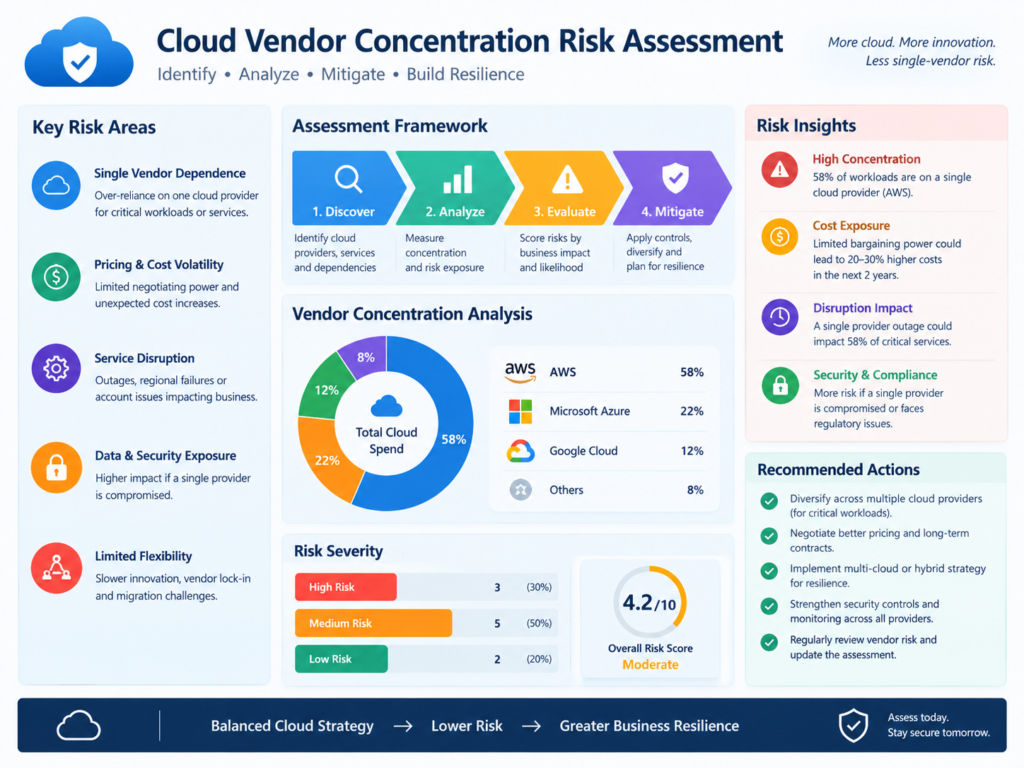
A practical cloud vendor concentration risk assessment should establish which services are essential, identify supplier dependencies, evaluate business impact, and determine whether recovery remains possible during a provider outage.
Map Critical Vendors, Workloads, and Fourth Parties
Begin with a dependency inventory covering essential business services.
Document cloud providers, hosting regions, identity systems, security monitoring suppliers, MSSP contracts, and important subcontractors.
Include the infrastructure supporting custom web applications, financial systems, and customer-facing platforms.
The goal is to understand not only which suppliers the organization uses, but also how those suppliers depend on one another.
Score Vendor Dependency and Business Impact
A simple scoring framework can help organizations prioritize areas requiring attention.
Consider these five assessment factors.
|
Assessment factor |
Example score (1–5) |
|---|---|
| Business criticality |
5 |
| Supplier dependency share |
5 |
| Migration difficulty |
4 |
| Recovery limitations |
4 |
| Fourth-party exposure |
3 |
| Total risk score |
21/25 |
In this illustrative model, a higher score indicates greater dependency-related exposure and a stronger need for mitigation.
The score should support management decisions rather than replace detailed technical analysis.
This framework is an example, not a regulator-prescribed risk assessment formula.
Test Recovery and Exit Readiness
A documented business continuity plan is useful only when its recovery arrangements work under realistic conditions.
Organizations should validate.
Backup accessibility when the primary cloud provider is unavailable
Recovery time objectives (RTO) and recovery point objectives (RPO)
Emergency administrative access and security monitoring
Availability of alternative infrastructure or suppliers
Data export, application restoration, and contractual exit procedures
The essential test: Can your organization restore critical services without depending on the supplier that has failed?
A Practical Five-Step Assessment Checklist
Identify essential business services and critical workloads.
Map direct vendors and material fourth-party dependencies.
Evaluate concentration, business impact, and migration difficulty.
Test recovery procedures, backup independence, and provider outage scenarios.
Assign remediation owners and verify vendor exit readiness.
Repeat the assessment when major vendors, architectures, contracts, or business requirements change.
How Can GCC Enterprises Reduce Cloud Vendor Concentration Risk?
Reducing concentration risk does not necessarily require abandoning established technology providers.
It requires designing critical services so that an individual supplier failure does not automatically become an enterprise-wide disruption.
Diversify Providers Without Creating Unnecessary Complexity
Multi-cloud and hybrid-cloud deployments can improve resilience when implemented carefully.
However, introducing additional suppliers also increases integration requirements, monitoring responsibilities, operational costs, and security management complexity.
Prioritize diversification where business impact justifies the investment.
Independent backups, portable workloads, and alternative security monitoring may deliver more practical resilience than duplicating every application across multiple providers.
Build Effective Cloud and Cybersecurity Vendor Exit Strategies
Vendor exit planning should begin before a contract becomes difficult to replace.
An effective strategy covers data portability, accessible configuration exports, contractual transition assistance, alternative suppliers, and independent incident-response arrangements.
Application design matters as well.
For example, interoperable APIs and appropriately designed Python-based services may make future migration easier, although using a particular programming language does not guarantee portability.
Organizations should test exit procedures rather than assume that written contractual provisions are sufficient.
Apply Sector-Specific Mitigation Measures
Risk priorities differ across GCC industries.
|
Industry |
Recommended resilience priority |
|---|---|
| Financial services and fintech | Independent payment processing recovery and transaction continuity |
| Government | Classified data protection, supplier oversight, and service continuity |
| Retail and e-commerce | Order processing, inventory, and transaction recovery |
| Logistics | Alternative connectivity and operational platform resilience |
| Healthcare | Availability of critical clinical systems and secure patient data access |
A cybersecurity vendor risk management strategy should reflect the actual consequences of disruption for each business service.
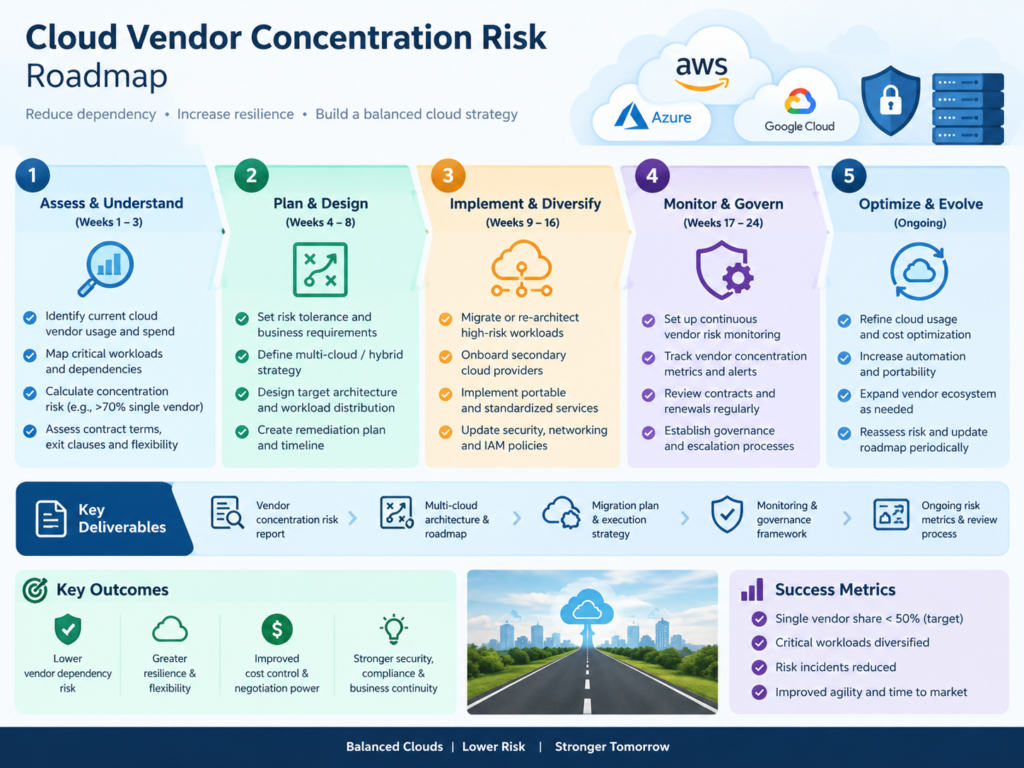
Building a GCC Cloud Resilience Roadmap
Improving operational resilience is easier when the work is organized into manageable phases.
Enterprises do not need to redesign their entire technology environment immediately. The more useful starting point is to identify critical dependencies and address the highest-impact exposures.
Prioritize Critical Services Across GCC Operations
Begin with systems that support revenue, customer access, regulated activities, and essential business operations.
Involve cybersecurity, infrastructure, procurement, legal, enterprise risk, and business continuity teams.
Shared ownership helps prevent technical improvements from overlooking contractual or operational dependencies.
Plan Assessment and Implementation Timelines
Actual costs and delivery schedules depend on the size of the technology environment, number of vendors, contractual arrangements, and complexity of resilience testing.
The following is an illustrative roadmap.
|
Timeline |
Priority activities |
|---|---|
| Days 1–30 | Inventory suppliers, map dependencies, and identify critical workloads |
| Days 31–60 | Score concentration risks, establish priorities, and develop mitigation plans |
| Days 61–90 | Test recovery capabilities, review vendor exit arrangements, and assign outstanding actions |
These phases provide a planning example rather than guaranteed delivery commitments.
Monitor Cloud Concentration Risk With Meaningful KPIs
Once initial risk mitigation is underway, organizations should monitor whether dependency exposure is actually decreasing.
Useful performance indicators include dependency-map coverage, completed vendor exit plans, successfully tested recovery arrangements, and unresolved high-risk findings.
Enterprise dashboards supported by business intelligence services can help leadership track progress and identify overdue remediation actions.
The emphasis should remain on verified resilience, not simply the number of controls documented.
Concluding Remarks
Cloud vendor concentration risk extends beyond choosing a reliable infrastructure provider.
Identity platforms, MSSPs, cybersecurity monitoring tools, subcontractors, and interconnected business applications can all introduce shared failure points.
For enterprises in Saudi Arabia, the UAE, and Qatar, effective cloud resilience starts with understanding these relationships, identifying critical supplier dependencies, and testing whether business operations can continue when a provider becomes unavailable.
Adding more vendors is not automatically the answer.
The objective is to build operational independence where it matters most.
Concerned about hidden dependencies in your cloud architecture or business applications?
Explore Mak It Solutions’ technology services to understand available application development and technology capabilities.
You can also contact the Mak It Solutions team to discuss your application architecture, operational requirements, and technology resilience objectives.
A structured cloud vendor concentration risk review can help identify where specialist cybersecurity, cloud architecture, or regulatory assessment support may be necessary.
FAQs
Q : Can Saudi banks use multiple cloud providers under SAMA oversight?
A : Saudi banks may consider multi-cloud arrangements, subject to applicable SAMA requirements, outsourcing conditions, and cybersecurity controls.
They should assess data classification, supplier governance, regulatory approvals where required, and operational continuity. Using multiple cloud providers does not automatically establish compliance or reduce concentration risk.
Q : Does using UAE cloud regions eliminate vendor lock-in?
A : No. Hosting applications within UAE cloud regions may support latency, service delivery, or applicable data-location requirements, but it does not eliminate technical dependencies.
Dubai businesses can still experience vendor lock-in through proprietary databases, identity platforms, and cloud-specific application interfaces. Data portability, contractual flexibility, and recovery independence remain important.
Q : What should Qatar financial institutions check before outsourcing cybersecurity monitoring?
A : Financial institutions should review MSSP security capabilities, subcontractor dependencies, incident-response procedures, log retention, data handling, and business continuity arrangements.
Applicable QCB requirements should inform the assessment. Institutions should also verify that security evidence and alternative response capabilities remain accessible during a monitoring provider disruption.
Q : How should Bahrain and Kuwait enterprises assess fourth-party cloud dependencies?
A : Enterprises should identify critical subcontractors supporting their technology suppliers and determine whether multiple vendors depend on shared infrastructure.
Supplier assurance reviews, incident notification provisions, and subcontractor outage testing can help reveal hidden concentration risks. Financial institutions should also evaluate relevant Central Bank of Bahrain or Central Bank of Kuwait requirements.
Q : What should Oman enterprises include in a cybersecurity vendor exit plan?
A : A cybersecurity vendor exit plan should cover contractual termination, secure data exports, transition ownership, replacement suppliers, and tested recovery procedures.
Organizations should examine applicable data protection and sector-specific requirements. For businesses contributing to Oman Vision 2040 digital transformation initiatives, technology portability can also support longer-term resilience.