


Technology Supply Chain Risk: Essential GCC CIO Guide
Technology Supply Chain Risk: Essential GCC CIO Guide
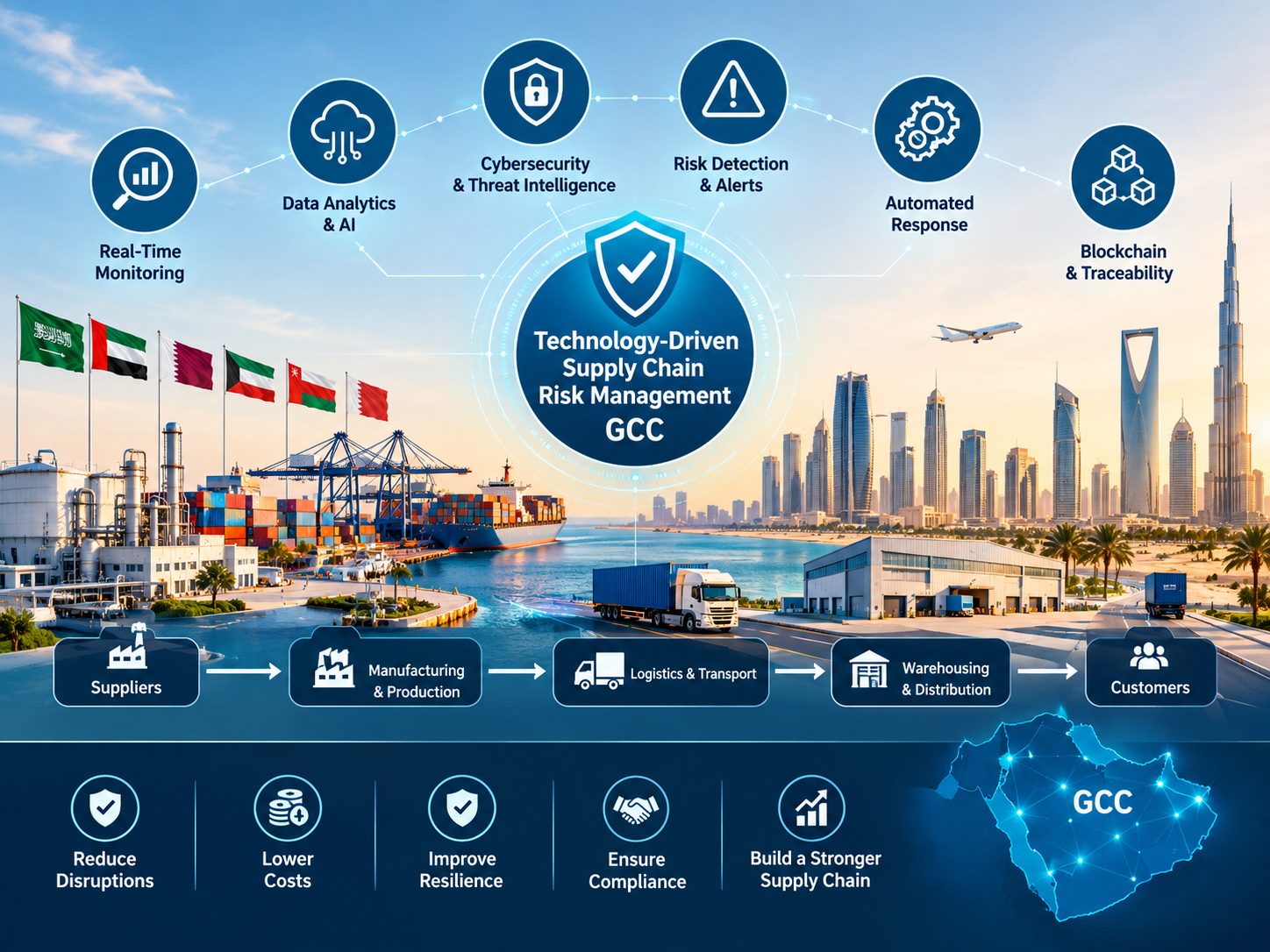
Technology Supply Chain Risk: Essential GCC CIO Guide
One compromised software update, an unexpected cloud outage, or a failing technology vendor can disrupt an entire business. For CIOs across Saudi Arabia, the UAE, and Qatar, these are operational risks that demand executive attention.
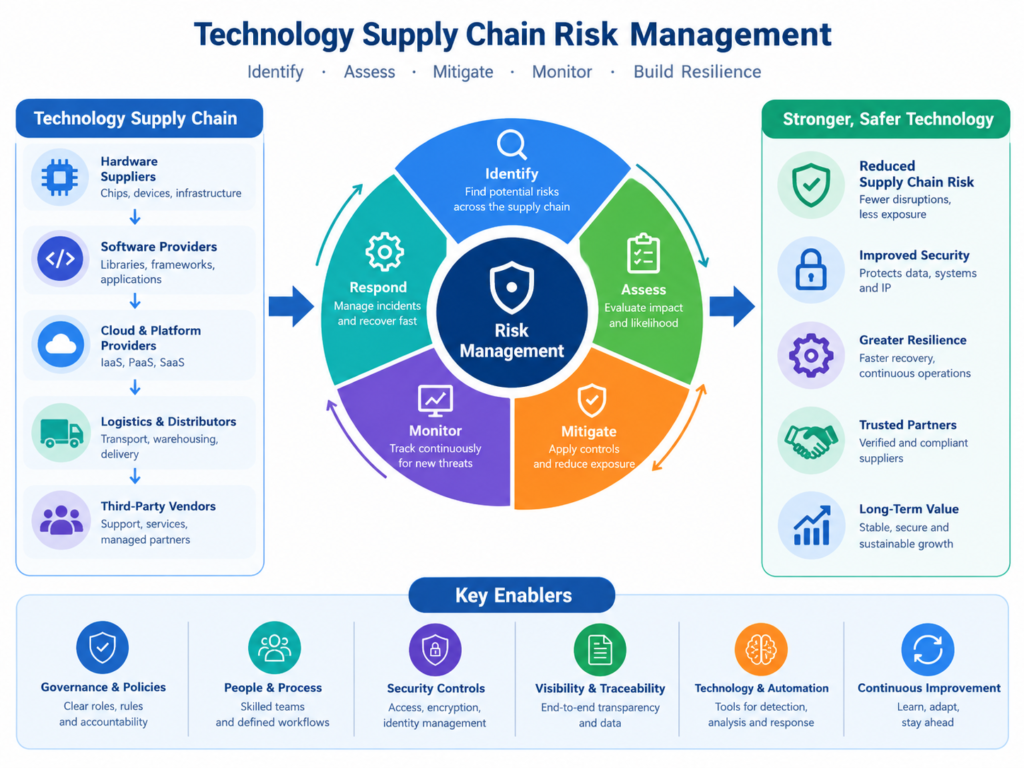
Technology supply chain risk management is the process of identifying, assessing, monitoring, and reducing risks associated with external technology suppliers, software, cloud infrastructure, and outsourced services. It helps GCC organizations protect critical operations, meet applicable regulatory requirements, and maintain business continuity when suppliers experience problems.
From Riyadh’s fintech companies to Dubai’s e-commerce businesses and Doha’s infrastructure providers, the challenge is similar: organizations rely on technology ecosystems they do not fully control.
The priority is not to eliminate every supplier risk. It is to understand which dependencies matter most, monitor them effectively, and prepare for disruptions before they affect the business.
What Is Technology Supply Chain Risk Management?
Technology supply chain risk management involves identifying and controlling threats introduced through third-party technology products, services, infrastructure, and supplier relationships.
These dependencies can include cloud hosting providers, software developers, cybersecurity vendors, hardware manufacturers, managed IT services, and external application integrations.
A company may maintain strong internal security controls while remaining vulnerable to weaknesses in a supplier’s systems.
For example, a Riyadh-based enterprise using outsourced ERP software and cloud infrastructure could experience operational disruption if either provider suffers an outage or security breach.
This is why supplier risk assessments should extend beyond procurement and become part of enterprise technology governance.
Why Should GCC CIOs Treat Supplier Risk as an Enterprise Issue?
Technology supplier failures can affect several business functions simultaneously.
Operational continuity.
Unavailable services may interrupt essential business processes.
Cybersecurity.
A compromised vendor can provide an indirect route into internal systems.
Regulatory compliance.
Supplier practices may conflict with applicable security or data-protection obligations.
Financial performance.
Disruptions can create recovery costs and revenue losses.
Customer trust.
Service interruptions and data breaches can damage confidence.
For organizations investing in Web Development and System Integration, understanding external dependencies during application design can reduce avoidable operational exposure.
Which Technology Supply Chain Risks Should GCC CIOs Monitor?
CIOs should prioritize the risks most likely to affect critical systems, sensitive information, and business continuity.
Seven areas deserve particular attention.
Third-Party Cybersecurity Vulnerabilities
Technology vendors may have access to sensitive data, internal networks, or privileged administrative accounts.
Weak access controls, delayed security patches, and inadequate incident-response processes can expose the organization to threats outside its direct control.
CIOs should monitor supplier security assessments, unresolved vulnerabilities, privileged access, reported incidents, and remediation progress.
Software and Open-Source Dependencies
Modern applications depend on third-party libraries, APIs, development frameworks, and software components.
A vulnerability in one component can affect multiple applications, even when internal development practices are otherwise secure.
Requesting a Software Bill of Materials (SBOM), where appropriate, helps organizations understand software dependencies and investigate known vulnerabilities.
Teams managing Node.js Development and Application Integrations should also consider third-party packages, update procedures, and software maintenance responsibilities.
Cloud Infrastructure Concentration
Dependence on a single cloud provider, geographic region, or critical service creates potential concentration risk.
Even established providers experience technical interruptions.
CIOs should identify workloads without tested recovery options, assess backup arrangements, and evaluate whether alternative services could support essential operations.
Multi-cloud environments may reduce certain dependencies, but they introduce additional integration, security, and operational complexity.
Hardware Supply and Infrastructure Disruption
Technology operations depend on physical equipment, including servers, networking devices, storage systems, and replacement components.
Long delivery periods, counterfeit hardware, unsupported devices, or supplier financial difficulties can delay essential projects and maintenance.
Track critical equipment lead times, spare-part availability, vendor support status, and replacement options.
Data Residency and Cross-Border Processing
GCC organizations frequently use global cloud platforms and technology service providers.
However, data storage, processing, transfer, and subcontractor access must align with applicable national and sector-specific requirements.
CIOs should document where sensitive data resides, who can access it, and whether supplier arrangements create unresolved compliance exceptions.
Artificial Intelligence and External API Dependencies
AI-enabled platforms introduce additional dependencies involving models, APIs, data-processing services, and supporting infrastructure.
Unapproved AI tools or poorly controlled integrations may expose confidential business information.
Monitor sensitive-data access, third-party AI integrations, contractual data-use provisions, and vendor security controls.
Business Continuity and Disaster Recovery
A supplier may demonstrate good cybersecurity practices without having reliable recovery capabilities.
CIOs should verify whether critical providers maintain continuity plans, test recovery procedures, and meet agreed service restoration expectations.
A documented recovery plan is useful. Evidence that the plan works is more valuable.
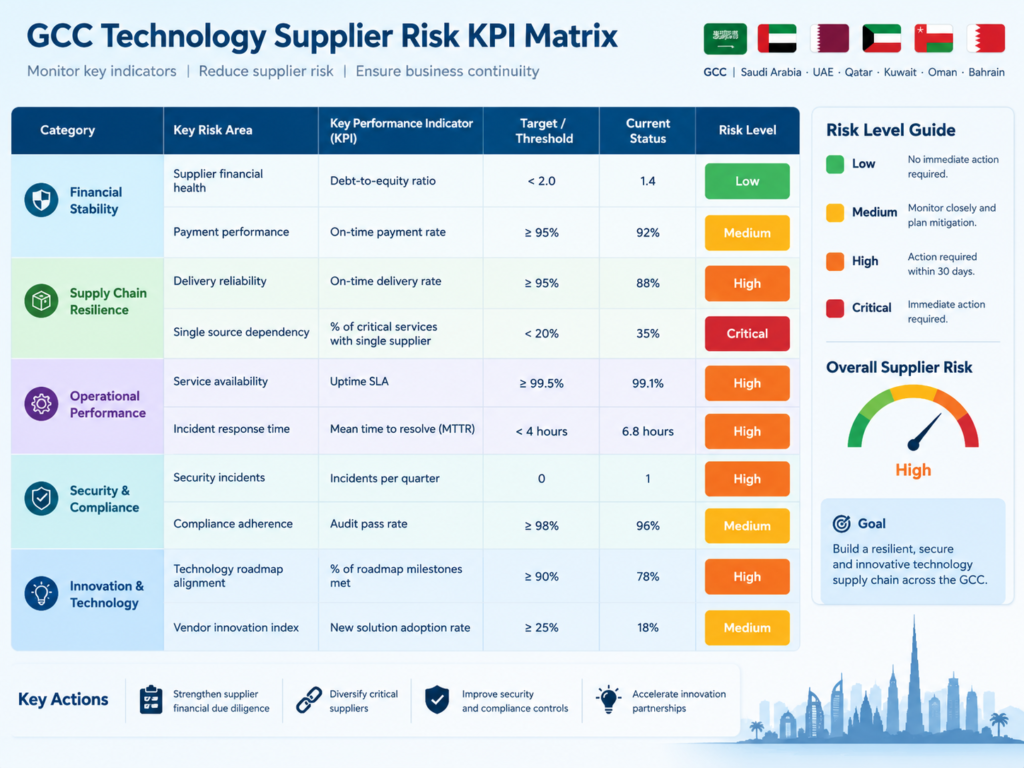
Technology Supplier Risk Monitoring Matrix
| Technology risk | Recommended KPI |
|---|---|
| Third-party cybersecurity | Percentage of critical suppliers assessed |
| Software security | Unresolved critical vulnerabilities |
| Cloud concentration | Critical workloads without tested recovery alternatives |
| Hardware sourcing | Critical equipment lead times |
| Data sovereignty | Unresolved data-location exceptions |
| AI dependencies | Unapproved AI access to sensitive information |
| Operational resilience | Critical suppliers with tested continuity plans |
These are recommended management indicators, not published GCC industry benchmarks.
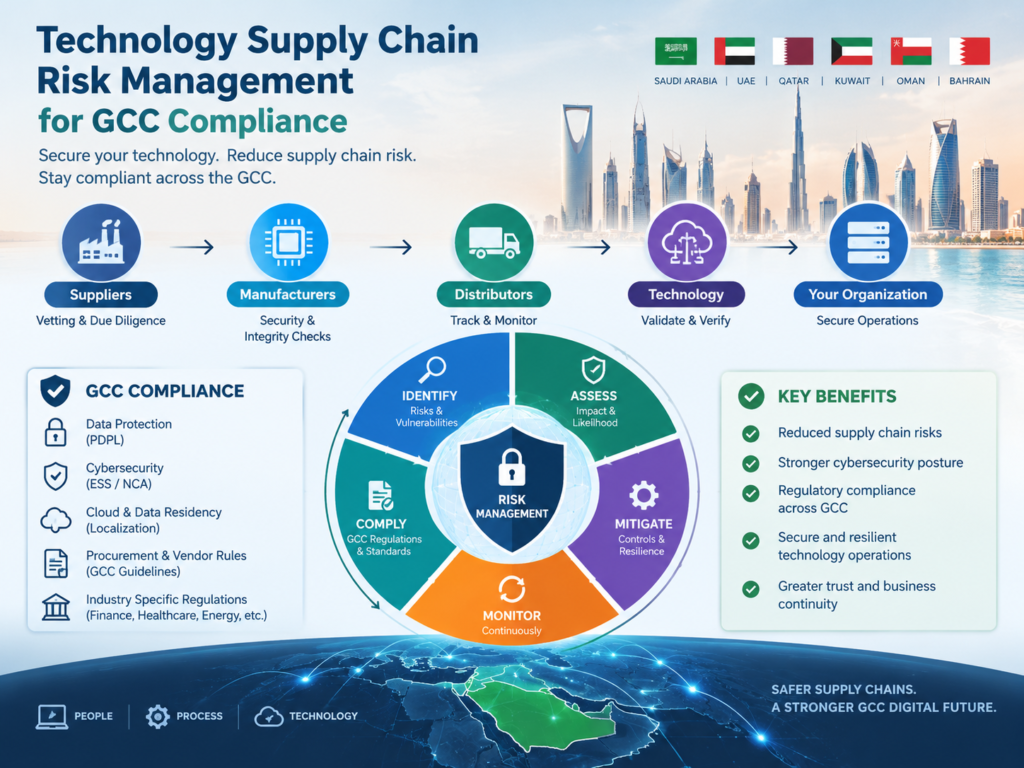
How Do Saudi Arabia, UAE, and Qatar Regulations Affect Technology Suppliers?
Technology supplier compliance requirements differ across GCC markets.
CIOs should assess their organization’s jurisdiction, industry, data classifications, and applicable regulatory obligations before developing supplier controls.
Saudi Arabia.
Saudi Arabia’s National Cybersecurity Authority (NCA) publishes cybersecurity controls relevant to organizations within their applicable scope.
Applicable Saudi Central Bank (SAMA) requirements also matter for regulated financial institutions.
Relevant National Data Management Office (NDMO) policies should be considered when assessing data governance and related obligations.
A Saudi fintech business outsourcing payment-processing infrastructure should examine supplier access, security assurance, recovery capabilities, and applicable data-handling obligations before onboarding.
UAE.
The UAE’s National Third Party Security Policy addresses supplier governance, risk assessments, contractual controls, security monitoring, and resilience.
The Telecommunications and Digital Government Regulatory Authority (TDRA) oversees relevant telecommunications and digital-government matters.
Organizations operating in the Abu Dhabi Global Market (ADGM) or Dubai International Financial Centre (DIFC) must also consider the regulatory frameworks relevant to their activities.
For a Dubai e-commerce company, vendor oversight may include cloud hosting, payment integrations, customer-data processing, and recovery testing.
Related [E-Commerce Solutions – Internal Link] should account for these dependencies during system planning and maintenance.
Qatar.
Qatar’s National Cyber Security Agency (NCSA) administers the National Information Assurance (NIA) framework.
The NIA Certification Program includes independent assessment against defined requirements and an agreed certification scope.
Certification does not automatically establish that every subcontractor used by a supplier is covered.
Organizations should verify relevant certification boundaries and investigate material fourth-party dependencies.
Qatar Central Bank (QCB) requirements may also apply to relevant financial-sector entities.
GCC Supplier Governance Comparison
| Country | Key governance considerations |
|---|---|
| Saudi Arabia | NCA cybersecurity controls, applicable SAMA requirements, and data governance |
| UAE | Third-party governance, contractual security, and sector-specific oversight |
| Qatar | NCSA assurance, certification scope, and relevant sector requirements |
Regulatory applicability depends on the organization, activity, and legal framework. Confirm current requirements before making compliance decisions.
What Should a GCC CIO Supplier Risk Dashboard Track?
A useful supplier risk dashboard should help executives answer three questions.
Which technology dependencies present the greatest business risk?
Which supplier issues require immediate attention?
Can essential operations recover if a critical supplier fails?
Rather than displaying every technical alert, the dashboard should emphasize material exposure, trends, accountability, and business impact.
Which Supplier Risk KPIs Matter Most?
Start with the risk indicators outlined earlier, then add overdue assessments, open remediation actions, supplier incidents, and recovery-test results.
Every KPI needs an accountable owner, reporting frequency, and appropriate escalation threshold.
Organizations can use Business Intelligence Dashboards to consolidate supplier assessments, incident data, and operational risk reporting.
How Should CIOs Prioritize Critical and Fourth-Party Suppliers?
Not every technology supplier requires the same level of oversight.
A practical risk-scoring approach considers.
Business impact if the supplier becomes unavailable.
Access to sensitive information or critical systems.
Likelihood and potential consequences of disruption.
Availability of replacement suppliers.
Quality of existing security and continuity controls.
Fourth-party providers organizations relied upon by direct suppliers should receive attention when their failure could affect essential business operations.
For example, a managed service provider might depend on a separate cloud platform or monitoring service. That underlying dependency can matter as much as the direct contract.
How Should CIOs Report Supplier Risk to the Board?
A concise executive scorecard should highlight critical dependencies, risk trends, unresolved issues, recovery readiness, and decisions requiring leadership approval.
Consider these illustrative scenarios.
Riyadh: A fintech CIO tracks payment-processing vendors and associated cloud dependencies.
Dubai: An e-commerce CIO monitors payment gateways, hosting availability, and customer-facing integrations.
Doha: A logistics CIO evaluates cloud recovery and subcontractor exposure affecting essential operations.
The goal is to connect technical supplier risks with decisions about business continuity, investment, and accountability.
How Much Does Technology Supplier Risk Management Cost?
There is no universal cost for implementing supplier risk management across GCC enterprises.
Investment depends on supplier portfolio size, regulatory obligations, technical complexity, available expertise, and monitoring requirements.
Typical cost drivers include supplier assessments, evidence collection, security testing, governance platforms, audit support, and remediation activities.
Smaller organizations may begin with structured manual tracking, while enterprises with extensive supplier ecosystems may benefit from integrated governance, risk, and compliance platforms.
The most practical starting point is to focus resources on critical suppliers rather than assessing every vendor with equal intensity.
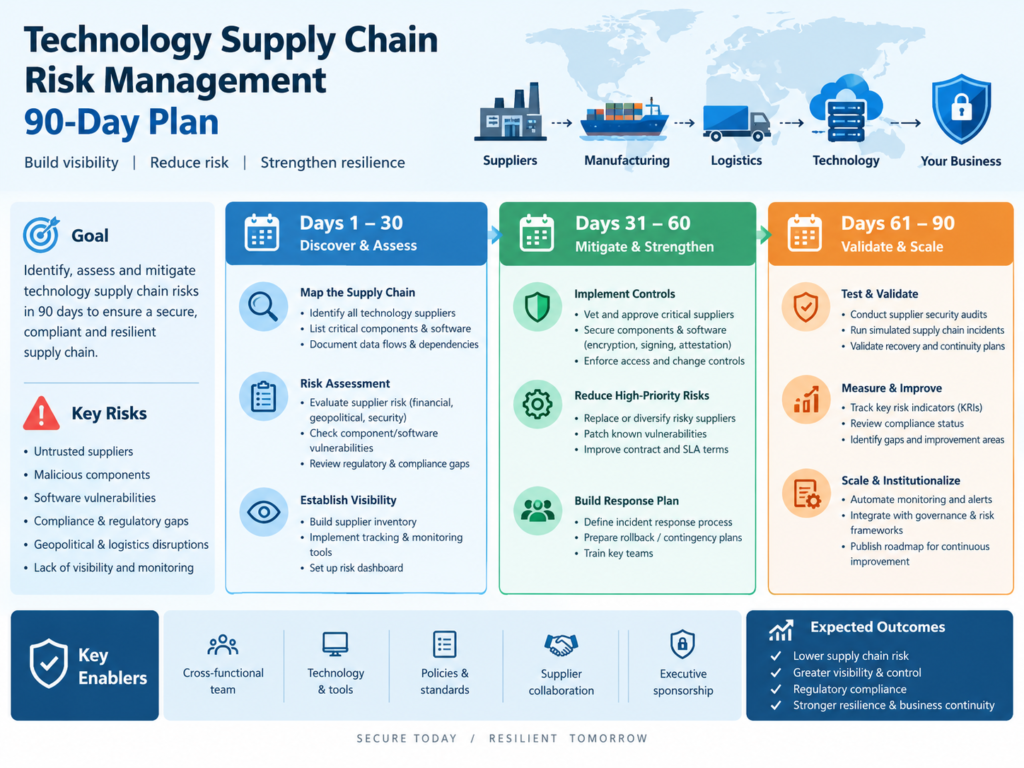
How Can GCC Enterprises Build a Practical 90-Day Supplier Risk Program?
A phased approach makes technology supply chain risk management easier to implement without overwhelming procurement, IT, security, and compliance teams.
Identify Critical Dependencies
Build an inventory of important technology suppliers, systems, contracts, subcontractors, and sensitive data flows.
Identify which suppliers support business-critical services and which dependencies would be difficult to replace.
Assess and Prioritize Risks
Classify suppliers according to operational importance and risk exposure.
Review available security evidence, identify compliance gaps, assess recovery capabilities, and assign remediation responsibilities.
Focus first on weaknesses that could materially disrupt essential operations.
Launch Monitoring and Test Recovery
Introduce a supplier risk dashboard and agree on escalation procedures.
Test selected failure scenarios, validate backup and recovery arrangements, and present material findings to executive leadership.
This is an illustrative implementation roadmap, not a guaranteed delivery timeline. Larger or highly regulated organizations may require additional assessment and implementation work.
How Can GCC CIOs Strengthen Long-Term Supply Chain Resilience?
Supplier assessments should not become a yearly paperwork exercise.
Meaningful resilience depends on clearly defined responsibilities, practical recovery testing, and regular updates as technology dependencies change.
Strengthen Supplier Contracts
Contracts with critical technology providers should address incident notifications, subcontractor disclosures, audit rights, data-handling requirements, recovery expectations, and termination assistance.
Legal, procurement, cybersecurity, and IT teams should coordinate these provisions before finalizing supplier agreements.
Test Cloud and Software Recovery
Recovery capabilities should be demonstrated through practical exercises rather than accepted solely from written assurances.
Teams can simulate outages, restore backups, validate replacement services, and measure recovery performance.
The updated NIST SP 800-161 Rev. 1, Update 1 provides useful guidance on cybersecurity supply chain risk management.
Recovery testing should also cover dependencies supporting Mobile App Development and Laravel Development for Enterprise Systems.
Maintain Continuous Supplier Assurance
Critical suppliers should be reassessed according to their risk profile and following significant operational or contractual changes.
Important triggers include security incidents, ownership changes, major infrastructure migrations, and contract renewals.
CIOs, CISOs, procurement teams, and legal stakeholders should share responsibility for maintaining supplier visibility and resolving material risks.
Final Thoughts
Technology supply chain risk management is no longer just a cybersecurity concern for GCC CIOs. It is an essential part of enterprise resilience, operational planning, and responsible technology governance.
Organizations in Saudi Arabia, the UAE, and Qatar can strengthen their position by identifying critical supplier dependencies, monitoring practical KPIs, understanding applicable compliance obligations, and testing recovery capabilities.
The strongest programs begin with business-critical systems and expand as supplier visibility improves.
Managing external technology dependencies requires reliable infrastructure, secure integrations, and informed technology planning.
Explore Mak It Solutions to learn about our development, integration, and business intelligence capabilities.
You can also Contact Mak It Solutions to discuss your technology requirements and explore a tailored GCC technology strategy, supplier-dependency review, or executive reporting solution.
FAQs
Q : Is an SBOM necessary when evaluating software vendors in Saudi Arabia?
A : A Software Bill of Materials helps organizations identify components, third-party libraries, and potentially vulnerable software dependencies.
It is not automatically mandatory for every Saudi technology vendor. Organizations should review applicable NCA controls, relevant SAMA requirements, and contractual obligations before deciding what evidence is required.
Q : Can UAE enterprises use overseas cloud providers for critical workloads?
A : UAE organizations may use overseas cloud providers when applicable laws, contractual arrangements, data classifications, and sector-specific requirements permit.
CIOs should assess cross-border data transfers, data residency, subcontractor access, and disaster recovery. Organizations operating under ADGM or DIFC frameworks should also review their relevant regulatory obligations.
Q : Does Qatar’s NIA certification automatically cover a vendor’s subcontractors?
A : No. NIA certification applies to an assessed scope and does not automatically extend to every subcontractor associated with the certified organization.
CIOs should review certification boundaries and request additional assurance evidence for subcontractors supporting critical services.
Q : How often should Dubai enterprises reassess critical technology vendors?
A : Reassessment frequency should reflect supplier criticality, changing risk exposure, and applicable regulatory requirements.
Annual formal assessments can provide a useful planning baseline, but they are not a universal legal requirement. Significant security incidents, infrastructure changes, and contractual amendments may require additional reviews.
Q : What should a Saudi fintech company request before onboarding an outsourced technology provider?
A : A Saudi fintech company should request relevant security assurance evidence, incident-response procedures, access-control documentation, subcontractor information, continuity plans, and data-handling arrangements.
Where applicable, SAMA cybersecurity and outsourcing requirements should be mapped to contractual and operational controls before approval.