


Cloud Disaster Recovery Solutions in the Middle East
Cloud Disaster Recovery Solutions in the Middle East
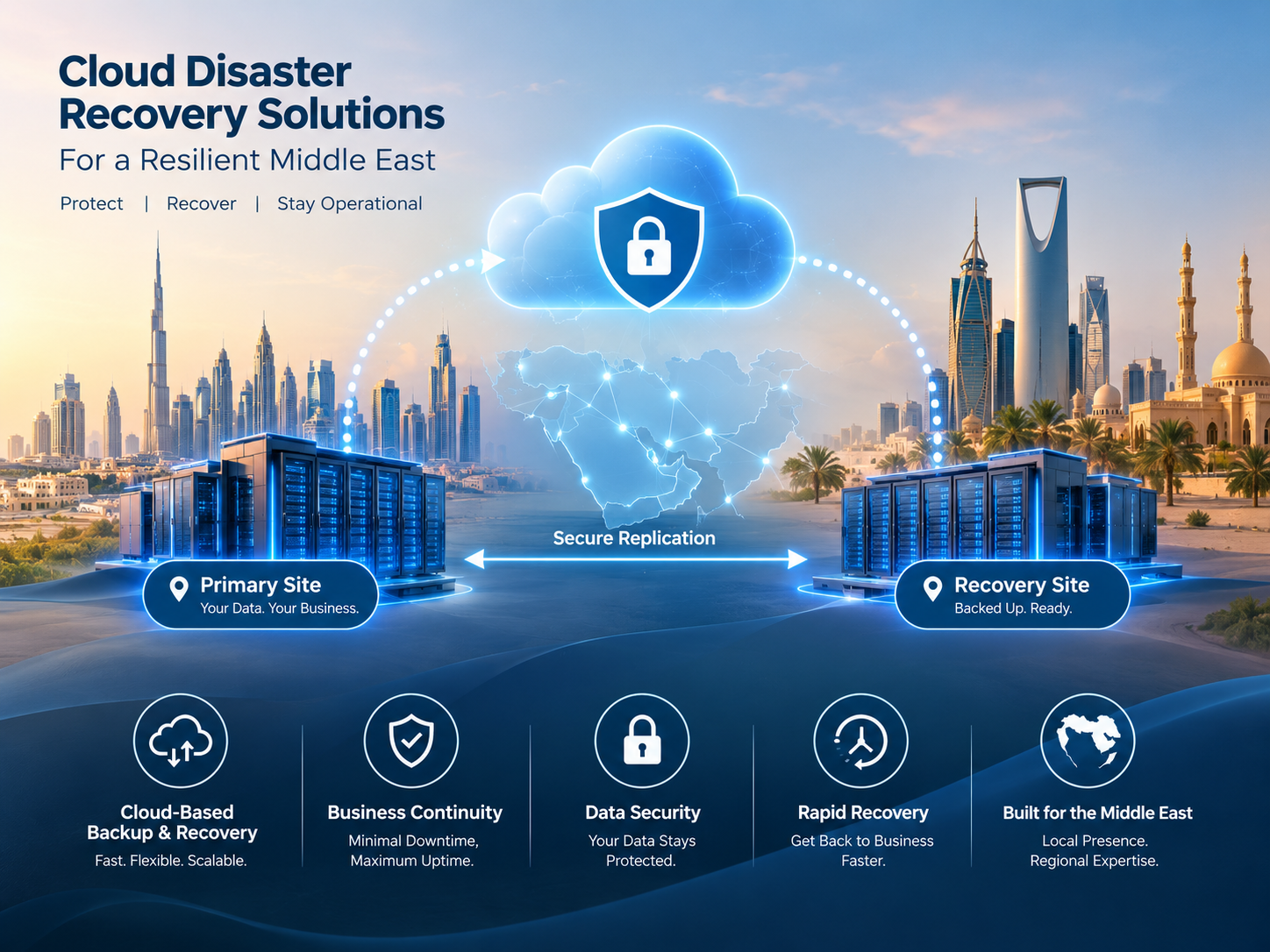
Cloud Disaster Recovery Solutions in the Middle East
A payment gateway goes offline in Riyadh. A hospital loses access to patient records in Abu Dhabi. A logistics platform stops processing shipments in Doha. These disruptions can affect revenue, customer confidence and essential operations.
Cloud disaster recovery solutions in the Middle East help businesses restore critical applications and data after outages, cyberattacks or infrastructure failures. They combine redundant cloud architecture, secure replication, reliable backups and tested failover procedures to reduce downtime and data loss.
For companies operating across Saudi Arabia, the UAE and Qatar, cloud recovery planning also involves local data residency rules, regulatory requirements and network reliability.
The challenge is not simply keeping another copy of your data. It is making sure your business can continue operating when its primary infrastructure becomes unavailable.
What Is Redundant Cloud Architecture for GCC Businesses?
Redundant cloud architecture means running or maintaining critical services across independent infrastructure so that a single failure does not bring down an entire application.
A well-designed recovery environment protects applications, databases, network connections and authentication services. Depending on business needs, it may use automated failover or controlled restoration procedures.
How Cloud Redundancy Prevents Single Points of Failure
Cloud redundancy supports business continuity by reducing reliance on individual servers, storage systems or network connections.
It helps to understand the difference between three related concepts.
High availability: Keeps applications running through routine infrastructure failures with minimal interruption.
Disaster recovery: Restores applications and business services after more serious disruptions.
Cloud backup: Maintains recoverable copies of data, helping businesses restore information after deletion, corruption or other incidents.
These capabilities work together, but they are not interchangeable. A business might have reliable backups yet still experience prolonged downtime if its application servers, identity systems or networking cannot be restored.
For a more technical explanation, explore our guide to practical disaster recovery architecture patterns.
Availability Zones, Cloud Regions and Geographic Redundancy
Cloud recovery designs typically use different levels of infrastructure independence.
|
Architecture |
Main advantage | Main limitation |
|---|---|---|
| Multi-Availability Zone | Protection against localized infrastructure failures | May remain exposed to wider regional disruption |
| Multi-Region | Greater geographic separation | Higher costs and replication complexity |
| Multi-Cloud | Reduces dependence on a single provider | More complex networking, operations and security management |
GCC businesses can evaluate regional infrastructure options such as AWS Bahrain, Microsoft Azure UAE Central and Google Cloud Doha.
However, the presence of a regional cloud location does not guarantee that every service is available or that every recovery configuration meets local requirements. Azure UAE Central, for example, has restricted access for certain recovery scenarios.
Before selecting a recovery region, verify service availability, provider dependencies and the legal permissions for storing or replicating data there.
Understanding RTO, RPO and Recovery SLAs
Recovery planning starts with defining acceptable downtime and data loss.
Recovery Time Objective (RTO) is the targeted amount of time needed to restore a service after disruption.
Recovery Point Objective (RPO) is the maximum acceptable period of data loss, measured backward from the incident.
Consider a hypothetical payment platform in Riyadh.
RTO target: 15 minutes.
RPO target: 5 minutes.
The business would aim to restore service within 15 minutes while limiting lost transactions or data to the preceding 5 minutes.
These are illustrative targets, not guaranteed service-level agreements. Achieving them depends on replication, system dependencies, network performance and regular recovery testing.
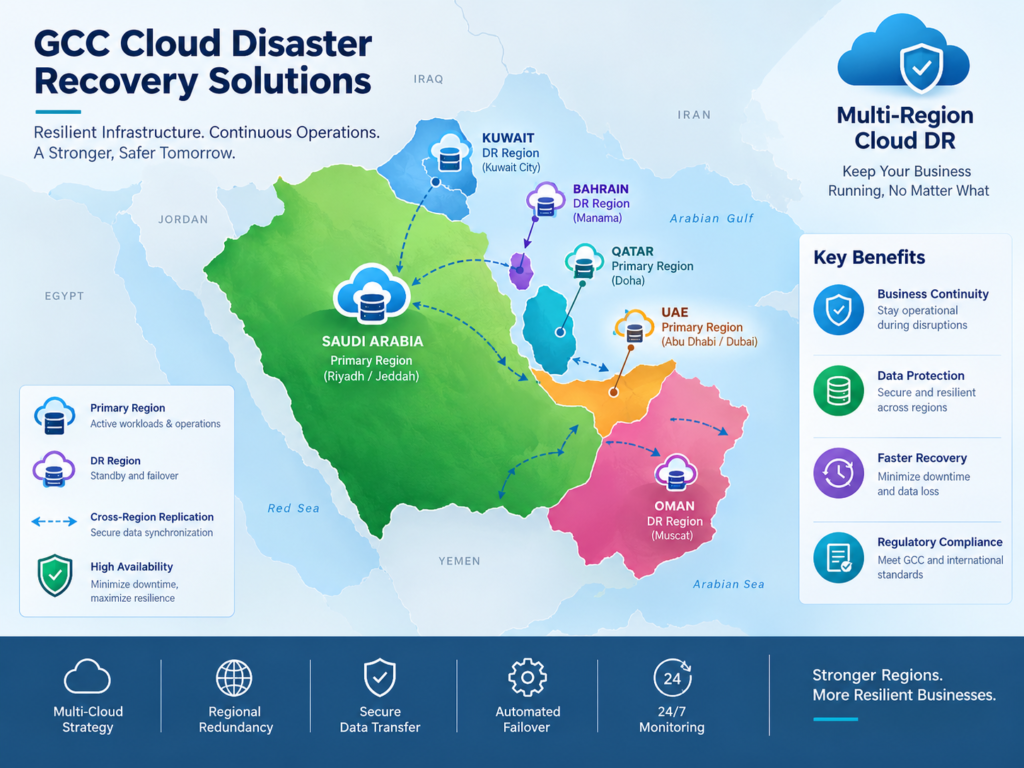
Cloud Disaster Recovery Solutions Across Saudi Arabia, UAE and Qatar
Although GCC countries share an increasing focus on digital infrastructure, their cloud governance and recovery requirements are not identical.
Businesses should assess local regulations alongside application criticality, infrastructure availability and operational costs.
Saudi Arabia.
Organizations in Riyadh and Jeddah often need to consider data localization, sector-specific cybersecurity controls and supplier governance when designing recovery environments.
Providers such as SITE Cloud, stc and sccc by stc may be evaluated for hosting capabilities, connectivity, recovery support and procurement suitability.
Saudi-hosted infrastructure may simplify some residency considerations, particularly for workloads with location restrictions.
However, local hosting alone does not establish regulatory compliance. Organizations must still review encryption, access management, third-party arrangements and recovery procedures.
UAE.
Businesses in Dubai and Abu Dhabi may combine multi-zone applications, geographically separated backups and managed disaster recovery services.
For example, an e-commerce business could operate its primary application in one approved environment while maintaining replicated data and recovery capabilities in another.
Providers such as du and e& enterprise can be evaluated for enterprise connectivity and disaster recovery-related services.
The key is to verify that backup connectivity, identity infrastructure and operational support do not depend entirely on the same systems being protected.
Read our guide to multi-region application architecture for GCC resilience.
Qatar.
For organizations in Doha, data governance, network resilience and recovery-site suitability deserve particular attention.
MEEZA, Ooredoo Qatar and Vodafone Qatar provide relevant infrastructure or connectivity options that businesses can assess against their disaster recovery requirements.
A Qatar-based company may benefit from combining locally managed recovery infrastructure with a secondary environment approved for its data and industry.
Whichever approach is chosen, teams should test actual restoration performance rather than assuming that replicated data guarantees business continuity.
| GCC market | Primary consideration |
Recommended recovery focus |
|---|---|---|
| Saudi Arabia | Data localization and sector controls | Approved hosting and recovery locations |
| UAE | Enterprise continuity and operational resilience | Multi-region, multi-cloud or managed DR |
| Qatar | Data governance and cloud sovereignty | Approved recovery sites and independent connectivity |
GCC Cloud Compliance, Data Residency and Disaster Recovery
Compliance is an important part of cloud disaster recovery in the GCC, especially for businesses handling financial information, healthcare records or government data.
Recovery architecture can affect where information is stored, processed, backed up and accessed during an emergency.
Saudi Arabia.
Saudi businesses should identify which regulatory requirements apply to their sector and data classification.
Relevant authorities include.
SAMA: Supervises financial institutions and establishes applicable regulatory expectations.
NCA: Develops cybersecurity controls, including cloud security requirements.
NDMO: Addresses national data governance requirements.
CST: Regulates relevant communications and cloud computing services.
The Saudi NCA’s Cloud Cybersecurity Controls (CCC – 2: 2024), updated in July 2025, include changes related to data localization requirements.
Organizations within the applicable scope should review recovery locations, cloud suppliers, data classifications and cross-border replication arrangements against the relevant controls.
UAE.
Cloud-related obligations in the UAE depend on the organization’s business activities, jurisdiction and regulatory status.
TDRA provides relevant digital infrastructure and telecommunications guidance, while regulated financial institutions must also assess requirements from their supervisory authorities.
The Central Bank of the UAE’s Operational Risk Management Regulation, effective September 14, 2026, establishes operational risk and resilience requirements for licensed financial institutions.
Organizations operating under ADGM or DIFC frameworks should separately examine their applicable business continuity, outsourcing and information security obligations.
A recovery environment that works technically is not automatically appropriate from a regulatory perspective.
Qatar.
Businesses in Qatar must consider applicable data protection, outsourcing and sector-specific rules when adopting cloud recovery services.
QCB-regulated financial institutions should assess their relevant cloud outsourcing and operational continuity obligations.
Qatar’s Communications Regulatory Authority published its Cloud Policy Framework in June 2022, addressing areas including security, privacy, data protection and transparency.
Cross-border replication should be reviewed against applicable legal requirements rather than treated as universally permitted or prohibited.
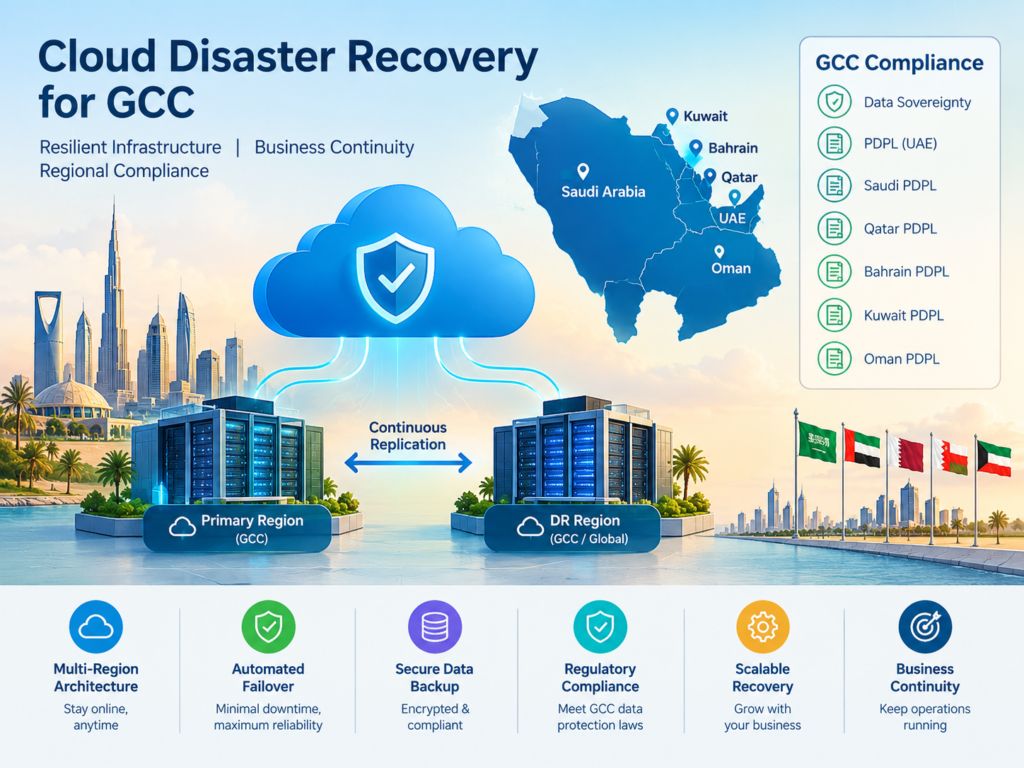
Redundant Cloud Architecture for Mission-Critical GCC Industries
Different industries need different recovery priorities. The consequences of downtime for an online store are not necessarily the same as those for a banking platform or healthcare system.
Banking and Fintech: Protecting Payments and Transactions
Financial applications depend on accurate transaction records, reliable authentication and continuous access to essential services.
A fintech business in Riyadh might replicate transaction databases to an approved recovery environment while maintaining protected backups.
Synchronous replication may reduce potential data loss, but it can also introduce latency and availability trade-offs.
Recovery testing should verify transaction consistency, payment gateway connections and integration with external financial services.
Healthcare and Government: Maintaining Essential Services
Healthcare platforms may need to restore patient records, appointment systems, medication information and other essential applications.
An Abu Dhabi healthcare organization could prioritize encrypted backups, controlled access and carefully sequenced restoration of clinical systems.
Independent identity and authentication capabilities are particularly important. Restoring a database provides little practical value if authorized staff cannot securely access it.
Energy, Retail and Logistics: Managing Regional Disruption
Energy operators, retailers and logistics companies often rely on interconnected applications.
A Doha energy company might prioritize ERP and operational monitoring services, while a Dubai retailer focuses on inventory management, payment processing and checkout availability.
Both would benefit from documented network failover procedures, tested application dependencies and clear Arabic-English incident communications.
For additional industry context, explore digital resilience across GCC enterprises.
Cloud Disaster Recovery Costs, RTO/RPO and Deployment Timelines
There is no universal price for disaster recovery. Costs depend on workload size, infrastructure architecture, recovery requirements, cloud provider pricing and ongoing testing.
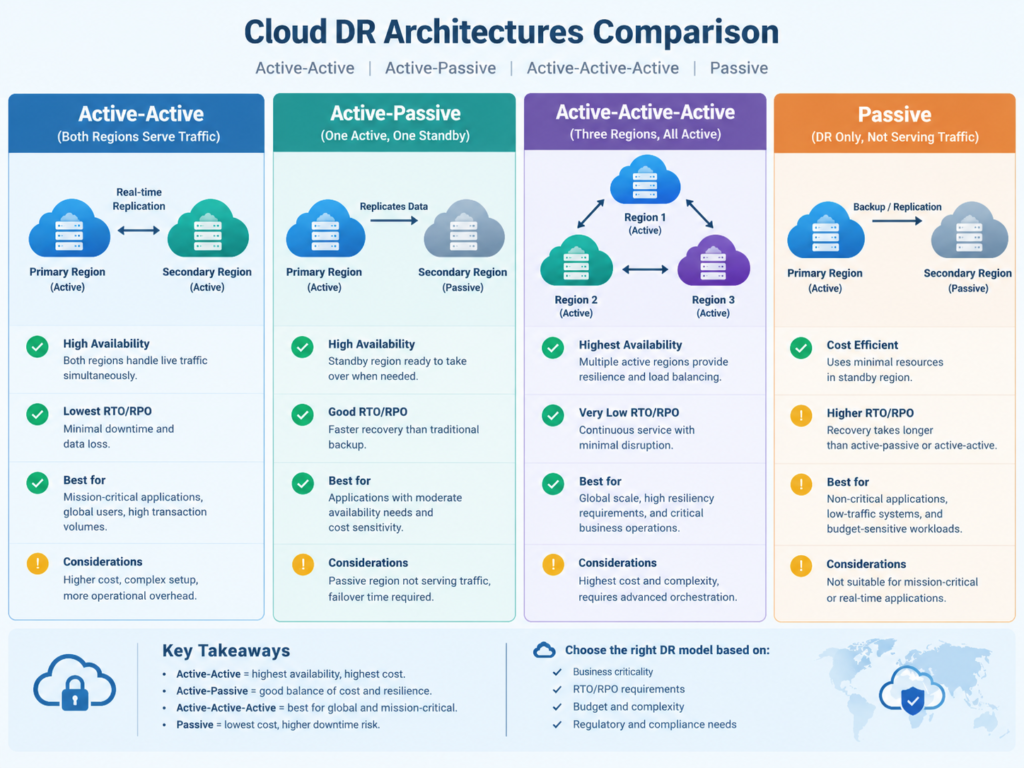
Active-Active vs Active-Passive vs DRaaS
|
Recovery model |
Relative cost | Main benefit | Main trade-off |
|---|---|---|---|
| Active-active |
High |
Stronger potential service continuity | Greater infrastructure and operational complexity |
| Active-passive |
Medium |
Lower standby resource requirements | Failover and restoration delays |
| Managed DRaaS |
Variable |
Reduced internal management burden | Dependence on service provider capabilities |
Active-active architecture runs services across multiple active environments. It can support demanding availability objectives but requires careful management of traffic, application state and data consistency.
Active-passive architecture maintains a secondary environment that takes over when the primary environment becomes unavailable.
Disaster Recovery as a Service (DRaaS) transfers some recovery infrastructure or operational responsibilities to a managed provider.
Businesses should evaluate the full cost of ownership, including storage, compute, networking, data transfers, licenses, recovery drills and provider support.
Choosing Recovery Objectives Without Overspending
Not every application needs the most expensive recovery configuration.
A practical approach is to classify workloads according to business impact:
Critical workloads: Payment processing, essential transactions and systems with demanding continuity requirements.
Important workloads: Customer portals and applications where limited interruption may be acceptable.
Noncritical workloads: Reporting tools and other systems suitable for slower, backup-based restoration.
Shorter RTO and RPO targets usually require additional investment.
Business impact assessment helps determine where that investment provides meaningful value.
Typical Phases of a GCC Disaster Recovery Deployment
A cloud disaster recovery project generally includes workload discovery, business impact assessment, architecture design, regulatory review, infrastructure implementation and recovery testing.
The deployment timeline depends on system complexity, technical dependencies, migration requirements and internal approvals.
Businesses should avoid committing to aggressive recovery deadlines without validating actual workload behavior.
Our guide to cloud recovery and continuity considerations provides additional planning context.
How to Build and Test a GCC Cloud Disaster Recovery Strategy
A reliable strategy combines technical architecture with governance, clear responsibilities and repeatable recovery procedures.
Assess Critical Workloads and Local Compliance
Begin with a complete inventory of important business systems.
Identify the applications, databases, network connections, identity services and external providers that operations depend on.
Classify sensitive data and determine applicable requirements in Saudi Arabia, the UAE or Qatar.
Then establish provisional RTO and RPO targets based on the business impact of downtime.
Design Replication, Failover and Backup Protection
Choose recovery infrastructure with appropriate geographic and operational independence.
Implement secure data replication, protected backups and documented failover procedures.
Where suitable, use isolated or immutable backups to reduce exposure to accidental deletion, malicious changes or ransomware.
Verify encryption, recovery-site permissions and network requirements before approving the design.
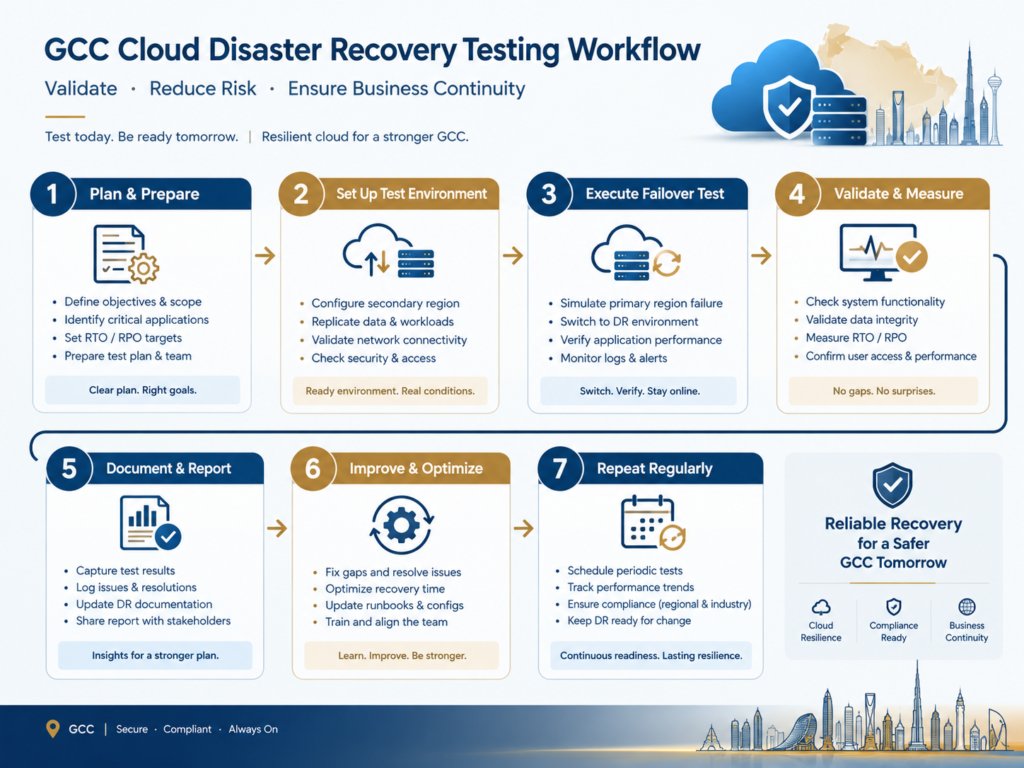
Test Recovery and Improve Resilience Continuously
Disaster recovery planning is incomplete until the organization has tested its ability to restore services.
Conduct tabletop exercises and controlled technical failover drills.
Measure actual restoration time, potential data loss, application availability and data integrity.
After each exercise, update recovery documentation, resolve weaknesses and assign responsibility for outstanding actions.
Use an incident response runbook for GCC teams to support coordinated testing and communication.
Practical GCC Disaster Recovery Checklist
Before considering a recovery environment production-ready, confirm that.
Recovery locations satisfy applicable hosting and data governance requirements.
Critical systems have documented RTO and RPO targets.
Backups are protected and restoration has been verified.
Authentication and network dependencies have been assessed.
Failover procedures have been tested.
Responsible teams and escalation contacts are documented.
Incident communication procedures are available in appropriate languages.
Recovery plans are reviewed after significant infrastructure changes.
The objective is not simply to create a technically impressive recovery environment. It is to establish a recovery capability the business can rely on during a real disruption.
Last Words
Reliable cloud infrastructure requires more than redundant servers and automated backups.
Businesses must understand their critical workloads, define realistic recovery objectives and verify that their chosen architecture works within applicable regulatory and operational constraints.
For organizations across Saudi Arabia, the UAE and Qatar, cloud disaster recovery solutions in the Middle East can provide a structured approach to reducing downtime, protecting important information and improving business continuity.
The most effective strategy is one that balances resilience, cost, compliance and practical recovery testing.
Mak It Solutions can help your organization assess application architecture, infrastructure dependencies and disaster recovery requirements through a tailored technical consultation.
Contact Mak It Solutions to discuss your business continuity requirements, explore our services or request a custom GCC cloud resilience strategy.
FAQs
Q : Can Saudi banks use disaster recovery cloud infrastructure outside Saudi Arabia?
A : Saudi banks must evaluate applicable SAMA requirements, data classification rules, outsourcing obligations and cybersecurity controls before adopting offshore disaster recovery. Cross-border storage and replication may require additional assessments or approvals. Saudi-hosted recovery may be preferable for workloads subject to restrictions.
Q : Which disaster recovery setup is best for a Dubai fintech startup?
A : Active-passive recovery or managed DRaaS may offer a suitable balance of cost and continuity for a Dubai fintech startup. Organizations with demanding transaction availability requirements may consider active-active architecture. The final choice should reflect workload criticality, budget, application dependencies and applicable CBUAE, DIFC or ADGM requirements.
Q : Can Qatar businesses use multiple cloud providers for business continuity?
A : Yes, businesses in Qatar can consider multi-cloud recovery where applicable regulations and data governance requirements permit it. Multi-cloud strategies may reduce dependence on one provider but introduce networking, security and operational complexity. Recovery locations, provider contracts and restoration capabilities should be evaluated before deployment.
Q : How often should Abu Dhabi healthcare organizations test cloud failover?
A : Healthcare organizations should establish recovery testing schedules based on clinical criticality, regulatory obligations, system changes and internal risk assessments. Essential patient services may need more frequent validation than less critical administrative applications. Major infrastructure changes or incidents should also trigger a recovery-plan review.
Q : What is the difference between cloud backup and disaster recovery for Riyadh businesses?
A : Cloud backup preserves recoverable copies of data, while disaster recovery addresses the restoration of complete business services. A Riyadh retailer may restore deleted inventory files from backup but still need failover arrangements for applications, payment processing, authentication and connectivity. Effective recovery planning combines both capabilities with documented objectives and regular testing.