


Enterprise Internet Redundancy: GCC Survival Guide
Enterprise Internet Redundancy: GCC Survival Guide
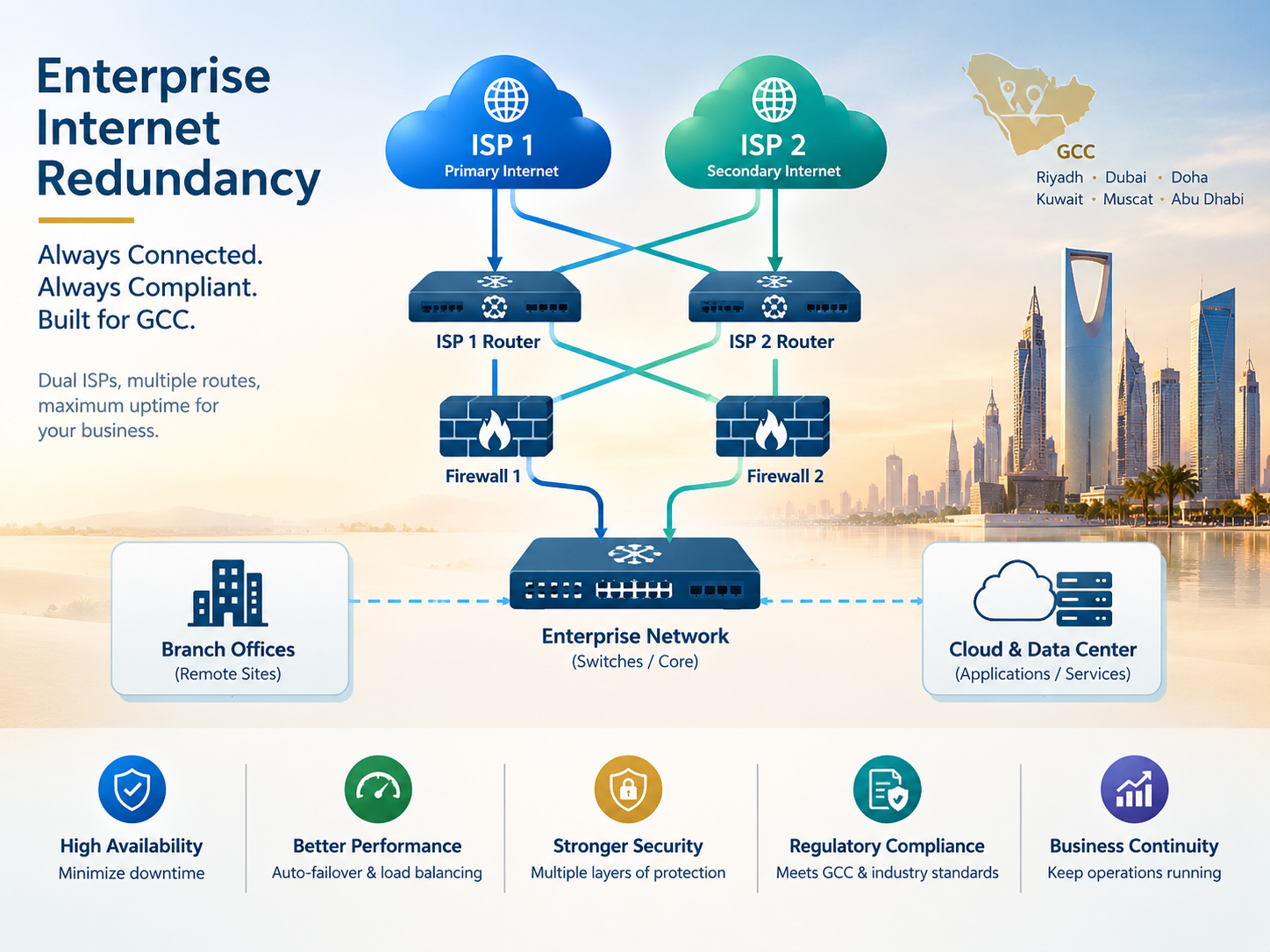
Enterprise Internet Redundancy: GCC Survival Guide
A single internet outage can bring business operations to a halt. Imagine a Riyadh headquarters losing connectivity while its Jeddah branches process payments and Dubai teams depend on cloud applications. One damaged fibre route could disrupt critical services across multiple locations.
Enterprise internet redundancy helps GCC businesses maintain connectivity through independent internet connections, automatic failover, and continuous network monitoring. For companies in Saudi Arabia, the UAE, and Qatar, the goal is to reduce service disruptions, protect business applications, and keep essential operations running when a primary connection fails.
However, having two internet service providers (ISPs) does not automatically guarantee resilience. Both connections may use the same underground fibre infrastructure, creating a hidden single point of failure.
A reliable strategy combines physical route diversity, intelligent failover, appropriate service-level agreements (SLAs), and regularly tested recovery procedures.
What Is Enterprise Internet Redundancy?
Enterprise internet redundancy is a network design approach that uses alternative connectivity paths to maintain internet access when the primary connection becomes unavailable or unreliable.
The objective is straightforward: prevent a single network failure from interrupting essential business operations.
How Enterprise Internet Redundancy Prevents Single Points of Failure
A well-designed redundancy solution minimizes dependence on a single ISP, fibre route, network exchange, or building entry point.
For example, a business with connections from two different ISPs may still experience a complete outage if both providers share the same last-mile infrastructure.
Physical diversity matters as much as provider diversity.
It’s also important to recognize that internet connectivity is only one part of business continuity. Even when backup connectivity works correctly, problems with DNS, authentication systems, or cloud services can still affect application availability.
How Automatic WAN Failover Works During an ISP Outage
Automatic WAN failover continuously checks connection health and redirects traffic when a primary connection fails or its performance falls below acceptable thresholds.
Businesses generally use two approaches.
Active-passive failover: A secondary connection remains on standby until the primary connection becomes unavailable.
Active-active connectivity: Multiple connections carry traffic simultaneously, allowing traffic distribution and potentially more efficient bandwidth use.
Both methods can improve availability. However, existing application sessions may still be interrupted during a connection switch.
The actual recovery experience depends on routing configuration, network equipment, and application behavior.
Why GCC Enterprises Need High-Availability Connectivity
Business operations across the Gulf increasingly depend on cloud platforms, digital payments, and connected enterprise systems.
A Saudi fintech company may require reliable access to transaction-processing services, while a UAE retailer depends on uninterrupted checkout integrations. In Qatar, customer-service teams may rely heavily on cloud communications and CRM platforms.
Reliable connectivity also supports Arabic-English customer communications and access to essential business intelligence applications.
For these businesses, network availability directly influences the customer experience and operational continuity.
Enterprise Internet Redundancy Solutions Compared
There is no universal redundancy design suitable for every organization. The right approach depends on application requirements, site locations, budget, and acceptable recovery times.
Dual ISP Connectivity vs. Dedicated Internet Backup
Dual ISP connectivity provides connections through separate internet service providers.
This reduces dependence on one provider, but only when common infrastructure risks are properly assessed.
Dedicated Internet Access (DIA) can offer more predictable bandwidth, business-grade support, and contractual performance commitments.
However, a DIA connection does not automatically provide a physically independent backup route. Enterprises must confirm how each connection reaches their premises.
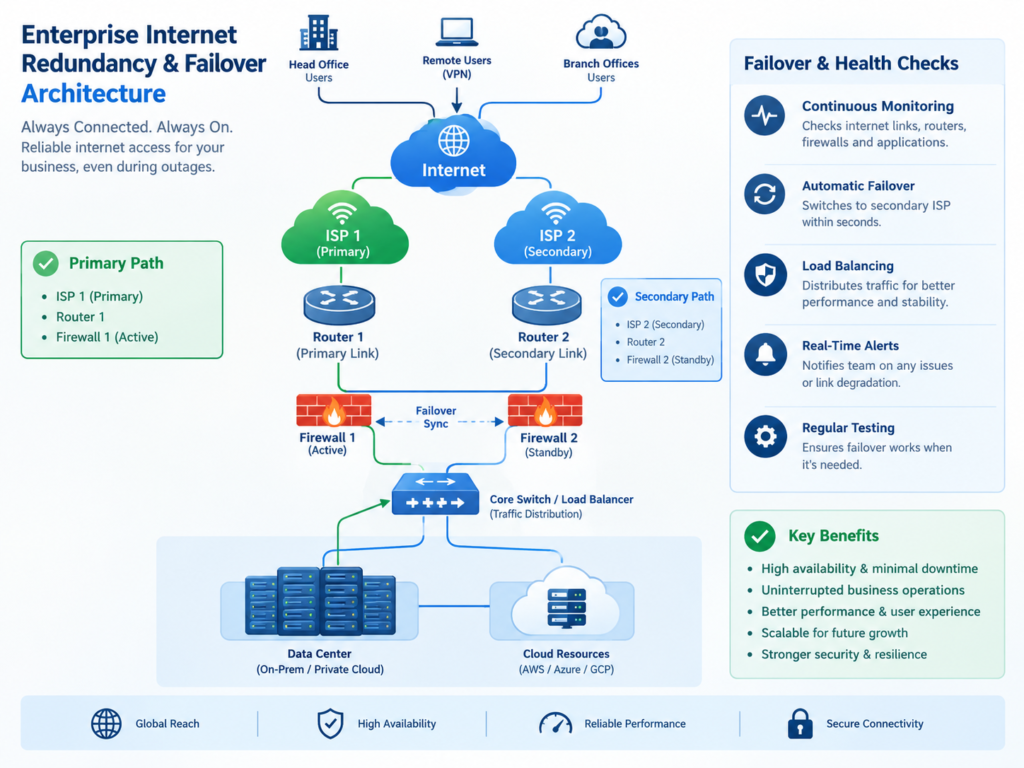
SD-WAN vs. Traditional Failover for Multi-Site GCC Networks
Software-Defined Wide Area Networking (SD-WAN) helps organizations manage connectivity across multiple locations.
It supports centralized network policies, application-aware traffic routing, and monitoring across different connections.
Traditional router-based failover may be sufficient for smaller environments with straightforward requirements.
Larger enterprises with advanced routing needs may also consider BGP-based connectivity architectures.
5G, LTE, and Satellite Backup for Remote Enterprise Sites
Fibre is not always available through genuinely independent routes, particularly at remote industrial, construction, and logistics facilities.
In these situations, alternative access technologies can provide useful backup options.
5G and LTE can support branch-office continuity, while satellite connectivity may be suitable for locations where terrestrial infrastructure is limited.
| Solution | Main advantage | Key limitation | GCC example |
|---|---|---|---|
| Dual ISP | Alternative provider connectivity | Possible shared fibre infrastructure |
Riyadh corporate office |
| DIA backup | Business-grade connection and support | Potentially higher costs |
Dubai headquarters |
| SD-WAN | Intelligent routing and centralized management | Greater operational complexity |
Multi-country GCC enterprise |
| 5G/LTE | Flexible deployment | Variable bandwidth and network congestion |
Doha branch office |
| Satellite | Alternative connectivity path | Latency, cost, and regulatory approvals |
Remote logistics warehouse |
Before selecting any option, assess performance under real application workloads rather than relying only on advertised bandwidth.
GCC Connectivity Resilience and Compliance
Network redundancy decisions in the Gulf should account for local telecommunications rules, cybersecurity requirements, and sector-specific business-continuity obligations.
Requirements vary by jurisdiction and industry. Not every organization is subject to the same controls.
Saudi Arabia.
Saudi Arabia’s Communications, Space and Technology Commission (CST) addresses telecommunications regulation and continuity.
The National Cybersecurity Authority (NCA) also establishes cybersecurity controls that include resilience-related considerations for organizations within their applicable scope.
Financial institutions regulated by the Saudi Central Bank should review the SAMA Business Continuity Management Framework.
Organizations handling regulated data should separately assess applicable National Data Management Office (NDMO) requirements.
These frameworks should inform network architecture and recovery planning, but businesses must confirm which specific obligations apply to their operations.
UAE.
The UAE’s Telecommunications and Digital Government Regulatory Authority (TDRA) addresses telecommunications resilience, including through its Business Resilience and Continuity initiative.
Enterprises operating in the Dubai International Financial Centre (DIFC) or Abu Dhabi Global Market (ADGM) may face additional operational resilience requirements, depending on their regulated activities.
A practical compliance review should consider third-party connectivity dependencies, incident escalation, cybersecurity controls, and tested recovery procedures.
Qatar.
Qatar’s Communications Regulatory Authority (CRA) oversees telecommunications regulation, while Qatar Central Bank (QCB) supervises relevant financial institutions.
Businesses should review connectivity contracts, information-security controls, provider dependencies, and applicable sector-specific requirements.
Importantly, organizations should not assume that every business in Qatar is legally required to maintain dual internet connections. Requirements depend on the organization and its regulatory obligations.
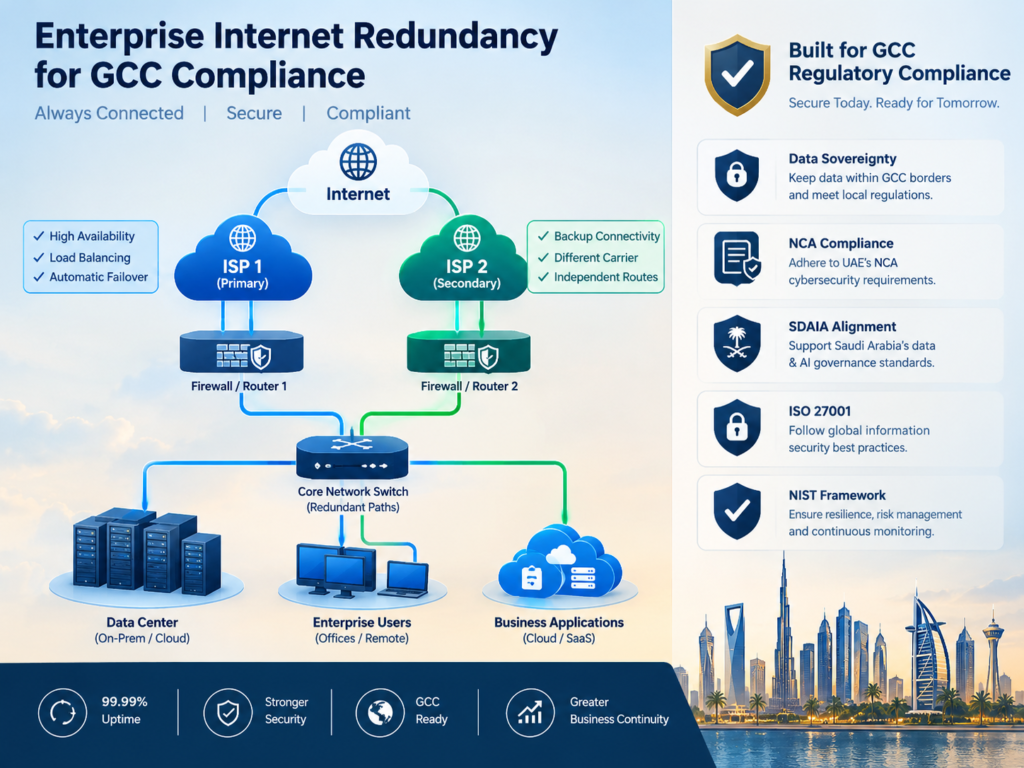
Enterprise Internet Redundancy Use Cases Across the GCC
Saudi Fintech and Government Service Continuity
Consider a Riyadh-based fintech company processing customer payments through cloud-hosted systems.
A primary connectivity failure could interrupt authentication, transaction processing, or access to operational dashboards.
The company could reduce this risk through physically diverse connections and automated failover, supported by regular testing of critical workflows.
Its Jeddah offices may require separate recovery procedures because branch applications and network dependencies can differ.
UAE Retail and Logistics Networks in Dubai and Abu Dhabi
A Dubai retail business may use secondary connectivity to protect point-of-sale integrations and e-commerce platforms.
Similarly, an Abu Dhabi logistics company may prioritize warehouse management, inventory synchronization, dispatch systems, and ERP access.
The backup connection should support the applications that matter most during an outage, even when full primary-link bandwidth is unavailable.
Qatar Enterprise and Cloud Connectivity in Doha
A Doha-based SME could combine fibre connectivity with a 5G backup to support essential cloud applications.
Businesses using Google Cloud’s Doha region should assess end-to-end access, including DNS, authentication, application dependencies, and routing.
Ooredoo and Vodafone Qatar are potential connectivity providers. However, selecting different brands does not, by itself, prove that their physical network paths are independent.
Enterprise Internet Redundancy Costs, SLAs, and Vendor Selection
What Drives Redundancy Costs in Saudi Arabia, UAE, and Qatar?
The cost of enterprise internet redundancy depends on several factors.
Required bandwidth and performance
Fibre construction and installation requirements
Physical route diversity
Firewalls, routers, and SD-WAN equipment
Managed network support
SLA coverage and restoration commitments
Costs should be assessed against the potential business impact of an outage.
For example, if a company estimates disruption costs at SAR 8,000 per hour, a two-hour outage creates SAR 16,000 in estimated operational exposure.
This is an illustrative calculation, not a GCC industry benchmark. Actual losses depend on the organization’s operations, revenue exposure, and recovery capabilities.
How to Compare Uptime SLAs, Failover Times, and Route Diversity
An effective SLA review goes beyond the headline uptime percentage.
Evaluate service availability, packet loss, latency, jitter, restoration targets, exclusions, and escalation procedures.
It is equally important to measure how quickly essential applications recover after connectivity switches.
The following illustrative vendor-scoring framework can help organize procurement decisions.
|
Vendor assessment criterion |
Suggested weight |
|---|---|
| Physical route diversity |
30% |
| Recovery performance |
25% |
| SLA and technical support |
20% |
| Security and monitoring |
15% |
| Total cost |
10% |
These weights are suggested evaluation priorities and should be adjusted to match business risks.
How to Evaluate Local ISPs and Managed Connectivity Providers
GCC enterprises can evaluate providers such as stc, Mobily, and Salam in Saudi Arabia; e& and du in the UAE; and Ooredoo and Vodafone Qatar.
When comparing proposals, request documented evidence of physical route diversity and upstream network dependencies wherever available.
Separate contracts do not necessarily mean separate infrastructure.
Procurement teams should also clarify equipment ownership, support responsibilities, planned maintenance arrangements, and fault-escalation processes.
How to Build an Enterprise Internet Redundancy Plan
A practical network resilience strategy starts with business priorities rather than equipment purchases.
Audit Critical Business Applications
Identify the services that cannot tolerate extended connectivity interruptions.
These may include payment processing, ERP, cloud communications, customer-service platforms, and authentication systems.
Define recovery objectives based on actual business impact.
Identify Network Failure Points
Map the existing network, including ISP connections, building entry points, fibre routes, routers, firewalls, power supplies, and upstream dependencies.
Look for infrastructure shared between primary and backup connections.
Select Diverse Connectivity Paths
Choose backup technologies appropriate for each location.
Where possible, confirm separate physical access routes and avoid concentrating both connections within the same failure domain.
For remote sites, consider cellular or suitably authorized satellite connectivity.
Configure Automatic WAN Failover
Set up health monitoring, routing policies, firewall configurations, and secure backup connectivity.
Account for DNS and authentication dependencies.
Include application recovery testing for web applications and mobile apps that rely on external APIs.
Test Failover and Application Recovery
Conduct controlled tests that simulate primary connection failures.
Measure connection switching, user authentication, transaction continuity, and application recovery.
Document unexpected behavior and assign corrective actions.
Monitor Performance and Review SLAs
Continuously monitor connection health and review provider performance against contractual commitments.
Update recovery procedures after network changes and prepare operational communications in Arabic and English where appropriate.
For higher-risk environments, technical failover testing should complement broader business-continuity and disaster-recovery exercises.
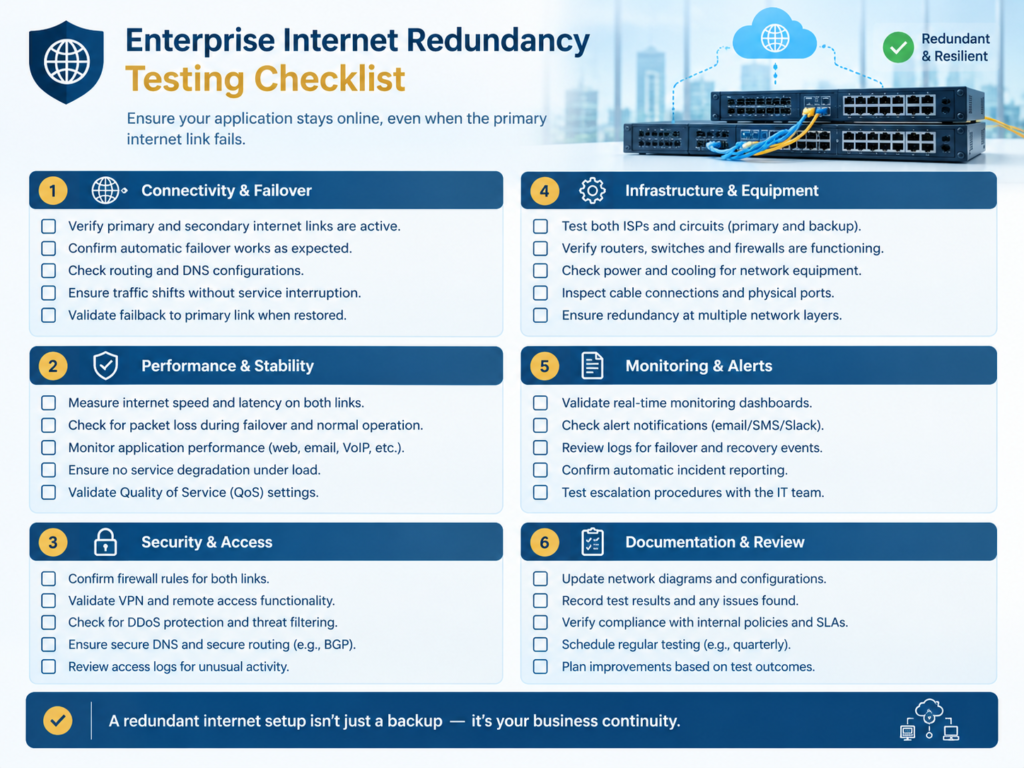
Outlook
Reliable internet connectivity is not simply about buying an additional connection. It requires independent infrastructure, well-configured failover, clear recovery objectives, and evidence that critical applications can continue operating during disruptions.
For organizations across Saudi Arabia, the UAE, and Qatar, enterprise internet redundancy is a practical part of business-continuity planning.
Start by identifying the network dependencies most likely to interrupt your operations.
Explore Mak It Solutions’ technology services or contact our team to discuss an Enterprise Network Resilience Assessment.
Our team can help you assess business application dependencies, connectivity risks, and recovery priorities, with specialist network-provider validation where required.
FAQs
Q : Can Saudi enterprises use 5G as backup for dedicated business internet?
A : Yes. Saudi businesses can use suitable 5G services as secondary internet connectivity where enterprise coverage and equipment support the required applications.
However, network congestion, signal quality, and data-plan restrictions can affect performance. Regulated financial institutions should also review applicable SAMA requirements and test failover under realistic workloads.
Q : How can Dubai offices confirm that two ISP links use separate fibre routes?
A : Request written confirmation of route diversity from each ISP, including building entry points, last-mile infrastructure, and shared upstream dependencies.
Where detailed routes cannot be disclosed, ask for documented diversity assurances and common-failure-risk assessments. Controlled failover testing validates switching behavior but cannot independently prove underground route separation.
Q : What should Qatar businesses check in an Ooredoo or Vodafone connectivity SLA?
A : Review service availability, fault response, repair targets, support hours, latency, packet loss, jitter, and contractual exclusions.
Also confirm whether proposed links depend on shared infrastructure. Regulated financial businesses should consider relevant QCB operational risk and outsourcing requirements.
Q : How frequently should a Riyadh fintech company test automatic internet failover?
A : Quarterly technical failover testing is a practical starting point, with additional testing after significant network changes.
Actual test frequency should reflect business risk and applicable regulatory requirements. Tests should measure application recovery, authentication, transaction behavior, and restoration of the preferred connection.
Q : Can an Abu Dhabi logistics company use satellite internet as an enterprise backup?
A : Satellite connectivity may be suitable for remote logistics operations where independent terrestrial connections are difficult to obtain.
However, businesses should evaluate latency, capacity, weather exposure, operating costs, and application suitability. The selected service and deployment must also meet applicable UAE telecommunications authorization requirements.