


Multi-Region Application Architecture: GCC Resilience
Multi-Region Application Architecture: GCC Resilience
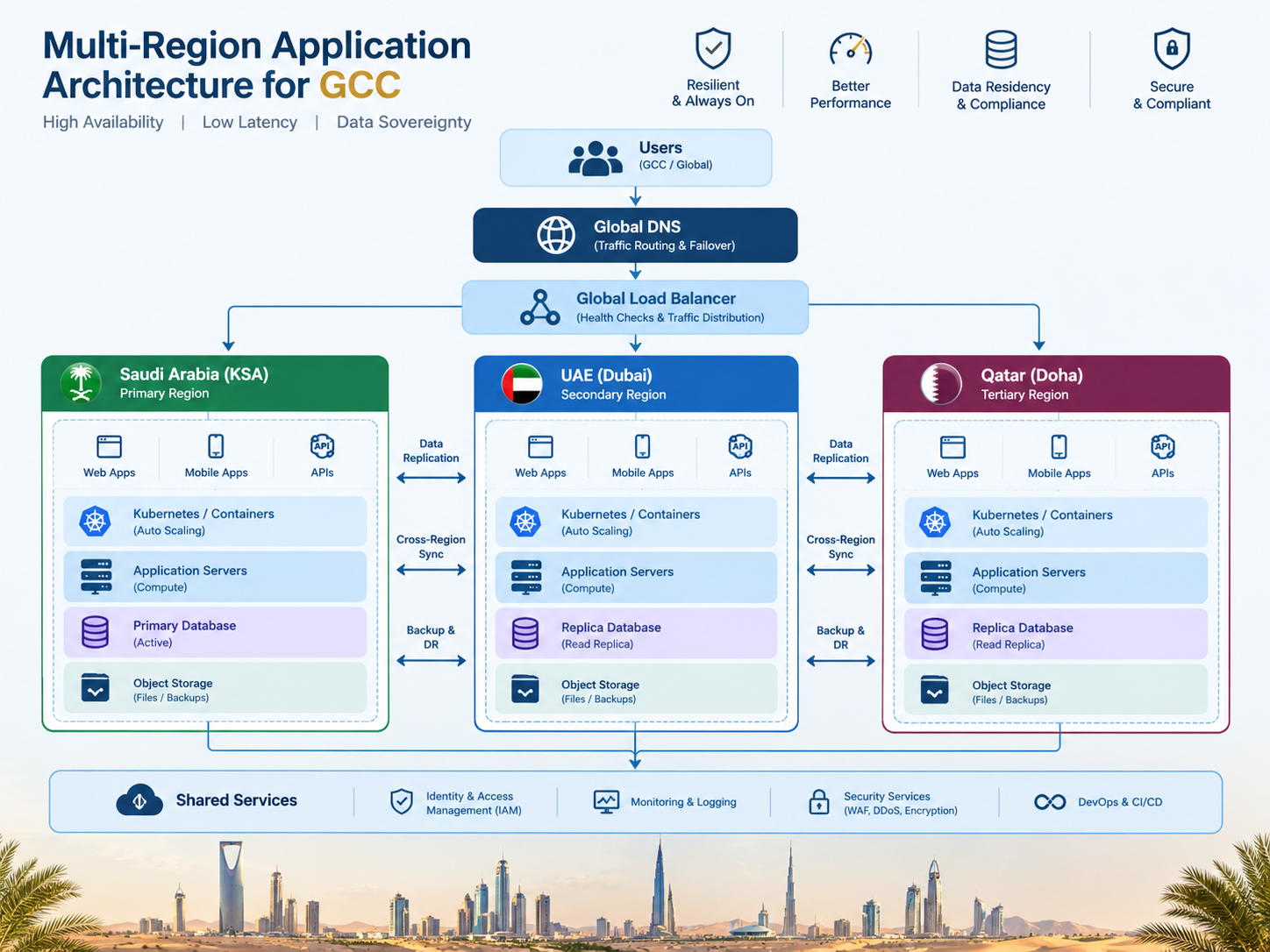
Multi-Region Application Architecture: GCC Resilience
Imagine a payment platform serving Riyadh, Dubai, and Doha suddenly losing access to its primary cloud region. Transactions stop, customers cannot complete payments, and support teams scramble to restore services. Even a short disruption can affect customer confidence and business operations.
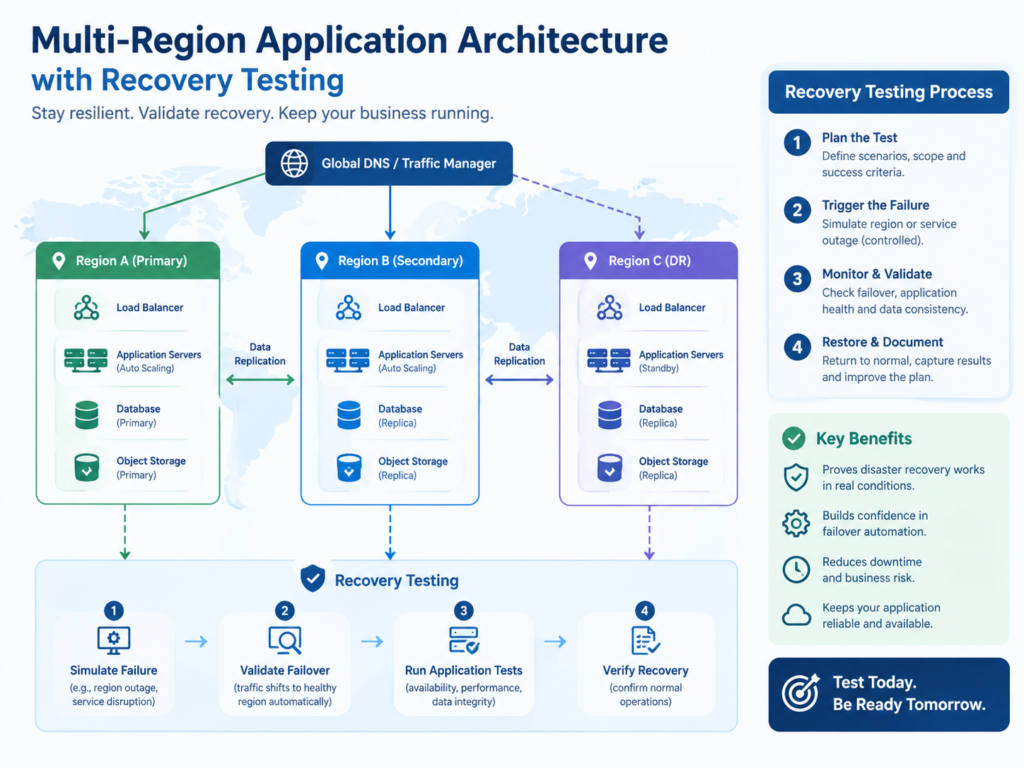
Multi-Region Application Architecture helps businesses reduce these risks by distributing critical application infrastructure across geographically separate cloud regions. It combines independent infrastructure, data replication, traffic management, and tested disaster recovery processes to keep essential services available when a region experiences an outage.
For businesses operating across Saudi Arabia, the UAE, and Qatar, the challenge goes beyond keeping applications online. Recovery systems must also protect sensitive information, satisfy applicable regulatory requirements, and maintain reliable performance.
The goal is straightforward: build applications that can recover from serious infrastructure failures without creating unnecessary complexity or compliance risks.
What Is Multi-Region Application Architecture?
Multi-Region Application Architecture is a cloud deployment approach that places application components across geographically separate cloud regions.
Instead of depending entirely on a single location, businesses establish independent environments capable of supporting application recovery when primary infrastructure becomes unavailable.
A well-designed architecture typically includes.
Geographic redundancy: Infrastructure deployed across independent cloud regions.
Data replication: Controlled synchronization between primary and recovery databases.
Traffic management: Routing requests toward healthy application environments.
Disaster recovery: Documented procedures for restoring essential services.
Continuous monitoring: Detecting infrastructure failures and validating system health.
Simply deploying servers in different regions is not enough. Applications may still depend on shared identity systems, databases, network services, or third-party APIs that create hidden points of failure.
How Multi-Region Architecture Supports Business Continuity
Regional cloud outages can affect payment processing, healthcare systems, retail platforms, logistics networks, and customer-facing applications.
Geographic redundancy reduces reliance on a single infrastructure location. Combined with tested recovery procedures, it helps businesses restore critical functions within agreed recovery objectives.
Multi-Region vs. Multi-Availability-Zone Deployment
| Deployment model | Protection offered | Main limitation |
|---|---|---|
| Single availability zone | Limited infrastructure redundancy | Vulnerable to zone-level failures |
| Multiple availability zones | Better protection against individual zone failures | Still depends on the same cloud region |
| Multiple cloud regions | Protection against regional disruptions when dependencies are sufficiently independent | Requires additional coordination, replication, and recovery planning |
Availability zones improve resilience within a region. Multi-region deployment addresses the broader risk of losing an entire region.
Why Saudi, UAE, and Qatar Enterprises Need Regional Resilience
Business continuity requirements vary by industry and location.
A Riyadh fintech platform may prioritize payment authorization and transaction integrity. A Dubai retailer needs reliable checkout and inventory synchronization, while a Doha government service may need dependable access to essential digital services.
Regional businesses must also consider Arabic and English interfaces. Customer notifications, right-to-left layouts, authentication screens, and transaction confirmations should remain functional after failover.
Active-Active vs. Active-Passive Architecture in the GCC
Businesses typically choose between active-active and active-passive architectures based on availability targets, operating costs, and application complexity.
Active-Active Architecture for High-Availability Applications
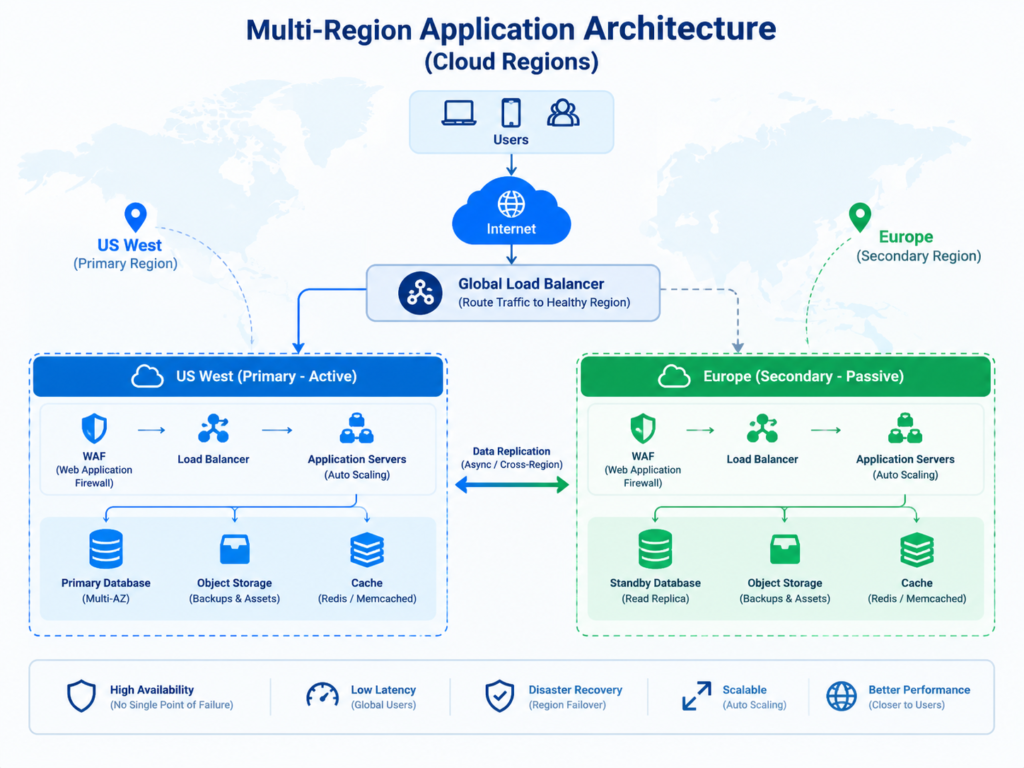
In an active-active setup, multiple regions handle production traffic simultaneously.
For example, an e-commerce platform serving customers in Dubai and Riyadh could distribute traffic across independent application environments.
If one region fails, the remaining environment can handle redirected requests, provided it has sufficient capacity and the required data is available.
Advantages.
Potentially faster traffic redistribution.
Better geographic workload distribution.
Reduced reliance on a single production region.
Challenges.
More complex database consistency management.
Risk of conflicting writes.
Higher infrastructure and operating costs.
Greater monitoring and testing requirements.
Active-active architecture is particularly relevant for workloads where even brief interruptions have significant operational consequences.
Active-Passive Architecture for Disaster Recovery
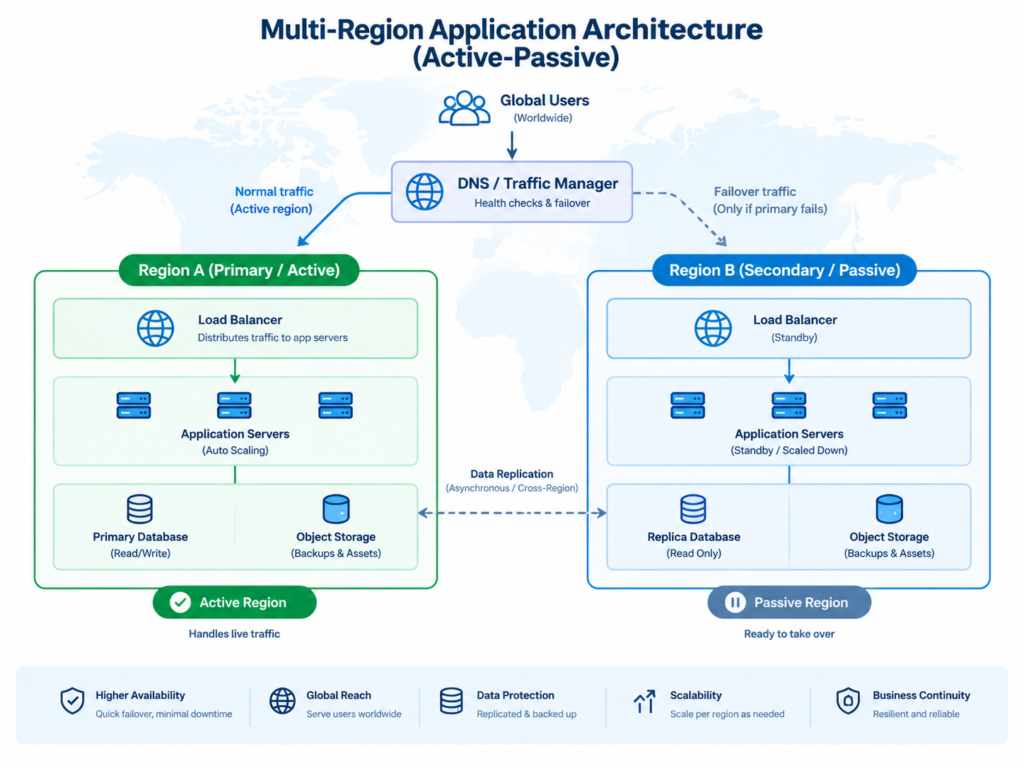
In an active-passive design, one region serves production traffic while another maintains recovery resources.
The secondary environment may operate as a warm standby, with critical application components and replicated data ready for activation.
A Saudi enterprise could, for example, maintain recovery infrastructure in another permitted Saudi cloud region where the relevant services and regulatory conditions allow it.
This approach often provides a practical balance between continuity and expenditure, although failover generally requires more preparation than an active-active configuration.
Choosing Architecture Based on RTO, RPO, and Budget
Two recovery measurements should influence the architecture decision.
Recovery Time Objective (RTO): The maximum targeted duration for restoring a service after disruption.
Recovery Point Objective (RPO): The maximum acceptable amount of data loss, expressed as a period of time.
| Architecture | Typical recovery profile | Relative cost |
|---|---|---|
| Active-active | Potentially fastest | High |
| Warm standby | Moderate recovery time | Medium |
| Backup and restore | Usually slower | Lower |
These are general comparisons, not guaranteed recovery outcomes.
Actual performance depends on system configuration, database technology, replication delays, external dependencies, and successful recovery testing.
Choosing Cloud Regions Across Saudi Arabia, UAE, and Qatar
Selecting cloud regions requires more than comparing geographic distance.
Organizations should evaluate data residency, service availability, network latency, operational independence, pricing, and legal requirements before deciding where production and recovery environments belong.
Saudi Cloud Regions and In-Country Resilience
Saudi Arabia offers several cloud infrastructure options for businesses planning resilient applications.
Google Cloud operates a region in Dammam, while Oracle Cloud Infrastructure provides regions in Riyadh and Jeddah.
Oracle’s Saudi regions create possibilities for geographically separated, in-country recovery designs using supported Oracle services. However, organizations must still validate available services, configuration limitations, and regulatory applicability.
Google Cloud’s Dammam region has specific access and purchasing considerations that should be reviewed before deployment.
For Saudi financial institutions and other regulated organizations, cloud-region selection should begin with data classification and permitted processing locations.
UAE Multi-Region Options with AWS and Azure
The UAE has several cloud deployment options for organizations planning regional resilience.
AWS operates infrastructure regions in the UAE and Bahrain. Microsoft Azure offers UAE North in Dubai and UAE Central in Abu Dhabi.
However, Azure UAE Central has restricted access conditions, so businesses cannot assume that every subscription or application can use it without approval.
A Dubai-based enterprise considering a secondary region must verify supported services, network connectivity, replication capabilities, and applicable cross-border data-transfer requirements.
For retail businesses, resilient checkout and inventory systems can be especially important during seasonal sales and high-traffic shopping periods.
Qatar Cloud Deployment with Doha Infrastructure
Qatar-based businesses can deploy workloads using Google Cloud’s Doha region and Microsoft Azure Qatar Central.
These options support local cloud infrastructure strategies, but deploying across availability zones within Doha does not provide the same geographic separation as using an independent cloud region.
A Doha-based business seeking protection from a region-wide outage should evaluate legally permitted alternatives, including hybrid infrastructure, approved recovery facilities, or suitable secondary regions.
The appropriate solution depends on data sensitivity, industry obligations, and recovery requirements.
GCC Cloud Region Comparison
| Market | Example cloud infrastructure | Important consideration |
|---|---|---|
| Saudi Arabia | Google Cloud Dammam; Oracle Riyadh and Jeddah | Data residency, regulatory approval, and service access |
| UAE | AWS UAE and Bahrain; Azure UAE North and Central | Cross-border transfers and regional access restrictions |
| Qatar | Google Cloud Doha; Azure Qatar Central | Geographic independence and permitted recovery locations |
Cloud availability and supported services can change. Confirm provider documentation before committing to a production architecture.
Cross-Region Replication and Automated Cloud Failover
Multi-region infrastructure is useful only when applications can access consistent data and recover their dependencies during disruption.
Designing Cross-Region Database Replication
Database replication is one of the most important technical decisions in distributed architecture.
Synchronous replication generally prioritizes consistency by coordinating data writes across participating systems. It can increase latency, particularly when regions are geographically distant.
Asynchronous replication allows primary database operations to proceed without waiting for every remote replica. It can improve write performance but may introduce potential data loss if replication is incomplete when an outage occurs.
Businesses must choose replication methods according to transaction sensitivity and recovery objectives.
For example, a financial transaction system may require stricter integrity guarantees than a product catalog or reporting dashboard.
Replication should also include encryption, lag monitoring, approved storage locations, transaction validation, and clearly defined failback procedures.
Implementing Health Checks, Routing, and Failover
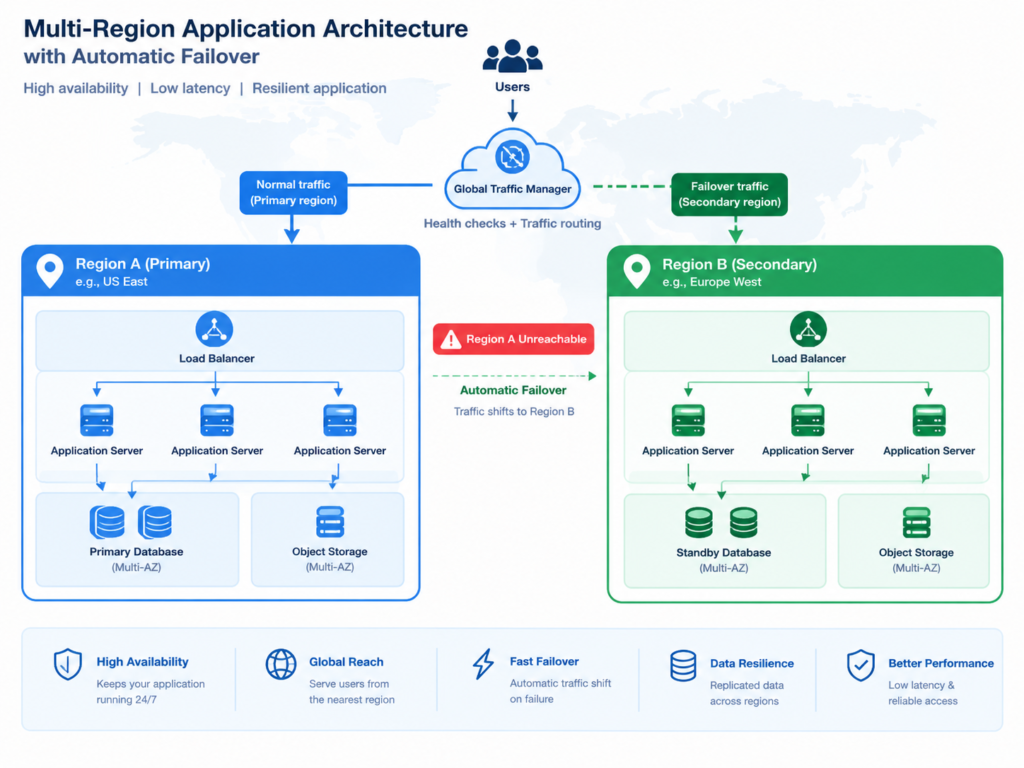
Failover systems identify unhealthy environments and redirect traffic or activate recovery resources according to established policies.
An effective design includes.
Independent health checks that verify application functionality.
Traffic-routing rules for healthy application environments.
Automated or controlled recovery runbooks.
Capacity planning for unexpected workload transfers.
Monitoring for database replication and application dependencies.
Successful failover must account for identity providers, payment gateways, DNS, and external APIs.
A healthy web server does not necessarily mean that the entire application is functioning correctly.
Preventing Cascading Failures in Distributed GCC Systems
Distributed systems introduce communication failures that can spread between services.
Circuit breakers help prevent repeated requests to unhealthy dependencies. Timeouts and bounded retries reduce the risk of overwhelming already struggling infrastructure.
Graceful degradation is another useful technique. For example, an e-commerce platform might temporarily disable product recommendations while preserving essential checkout functionality.
Teams should also plan failback carefully. Returning traffic to the original region without validating database state can cause conflicting writes or inconsistent application data.
GCC Data Residency and Cloud Compliance Requirements
Deploying data inside a country does not automatically establish regulatory compliance.
Cloud architecture decisions should consider data classification, organizational licensing, permitted processing locations, contractual requirements, cybersecurity controls, and cross-border transfer rules.
The relevant obligations depend on both the business and the information being processed.
Saudi Data Residency, SAMA, and NDMO Requirements
Saudi enterprises should assess the Personal Data Protection Law (PDPL), applicable international transfer requirements, and relevant National Data Management Office (NDMO) data classification rules.
National Cybersecurity Authority (NCA) controls may also apply depending on the organization and workload.
Institutions regulated by the Saudi Central Bank (SAMA) must consider relevant cybersecurity, cloud computing, and business continuity requirements.
For applicable institutions, SAMA’s Business Continuity Management Framework addresses disaster recovery arrangements, alternative data center locations, approval considerations, and recovery testing.
These obligations can directly influence whether an organization may replicate sensitive information outside Saudi Arabia.
Official references: SAMA Business Continuity Management Framework and SAMA Cyber Security Framework.
UAE Cloud Compliance: CBUAE, TDRA, ADGM, and DIFC
UAE cloud compliance depends on the organization’s activities and jurisdiction.
Financial institutions should evaluate applicable Central Bank of the UAE (CBUAE) requirements.
The Telecommunications and Digital Government Regulatory Authority (TDRA) provides relevant national digital infrastructure and regulatory context.
Organizations operating within Abu Dhabi Global Market (ADGM) or Dubai International Financial Centre (DIFC) must also consider their respective data protection frameworks.
Cross-border replication should therefore be assessed according to the applicable legal and regulatory requirements rather than a single GCC-wide assumption.
Qatar Cloud Policy, QCB, and Cross-Border Data Transfers
Qatar businesses should consider the country’s applicable personal data protection legislation, sector-specific requirements, and cloud governance policies.
Organizations regulated by the Qatar Central Bank (QCB) must assess relevant cloud computing and technology risk obligations.
The Communications Regulatory Authority (CRA) Cloud Policy Framework also provides important policy context.
Before using an external recovery region, businesses should confirm that the proposed arrangement supports lawful processing, appropriate security controls, and any applicable regulatory requirements.
Regional Compliance Reference Table
| Market | Relevant regulatory references | Key architectural concern |
|---|---|---|
| Saudi Arabia | PDPL, SAMA, NDMO, NCA | Data classification, approved locations, and transfer restrictions |
| UAE | CBUAE, TDRA, ADGM, DIFC | Sector-specific requirements and cross-border processing |
| Qatar | QCB, CRA, data protection legislation | Permitted recovery environments and lawful data handling |
Compliance note: This information provides general architectural guidance, not legal or regulatory advice. Obtain jurisdiction-specific professional review before implementing regulated cloud workloads.
GCC Multi-Region Deployment Blueprint and Recovery Testing
A successful architecture starts with understanding business requirements before choosing cloud services.
The following process provides a practical foundation for enterprise deployment.
Assess Workloads and Define Recovery Objectives
Begin with a business impact analysis.
Identify essential applications, sensitive data, customer-facing services, and dependencies that could interrupt operations.
Then establish measurable RTO and RPO targets for each critical workload.
A payment authorization service may need tighter recovery objectives than internal analytics or administrative reporting.
Document which services must recover first and which can tolerate temporary disruption.
Design Infrastructure and Automate Deployment
Use repeatable infrastructure configurations to reduce differences between production and recovery environments.
Terraform can help manage infrastructure as code, while Kubernetes may support container orchestration where appropriate.
Configure networking, identity access, encryption, database replication, application deployment, monitoring, and recovery runbooks.
For suitable projects, Node.js Development can support modular application services designed for independently deployed environments.
Security controls should remain effective during both normal operations and disaster recovery.
Simulate Failures, Measure Recovery, and Validate Compliance
Recovery plans should be tested against realistic failure scenarios.
Simulate unavailable regions, database interruptions, network failures, and third-party dependency problems.
Measure actual recovery performance against the agreed objectives.
Verify transaction integrity, customer access, monitoring, and Arabic and English incident communications.
Retain evidence of exercises and document any weaknesses requiring remediation.
Multi-Region Disaster Recovery Checklist
Primary and recovery locations approved
Sensitive data classified and transfer permissions assessed
Database replication verified
Application dependencies tested
Health checks and routing validated
RTO and RPO results measured
Failback procedures tested
Audit evidence and remediation actions recorded
Testing must demonstrate that systems work under failure conditions, not simply that infrastructure resources exist in different locations.
Multi-Region Architecture Costs and GCC Best Practices
What Drives Multi-Region Cloud Deployment Costs?
Multi-region systems introduce additional infrastructure and operating expenses.
Major cost factors include duplicated compute capacity, database replicas, storage, network transfers, monitoring, security controls, and recovery automation.
Active-active systems generally require more continuously available resources, while warm standby configurations can reduce ongoing expenditure depending on their capacity and service requirements.
Businesses should also budget for engineering, testing, compliance review, and operational support.
Cost decisions should reflect the business impact of downtime rather than infrastructure pricing alone.
How Deployment Timelines Differ by Complexity
Deployment effort depends on existing application architecture.
A modern cloud-native application with modular services and automated deployments may need less redesign than a legacy banking platform with tightly coupled databases and integrations.
Applications that depend on shared identity services, proprietary network connections, or manual recovery processes often require more engineering effort.
A realistic implementation plan should therefore follow technical discovery and dependency assessment rather than a fixed deployment promise.
Best Practices for Enterprise Resilience in the Middle East
The strongest multi-region strategies share several characteristics.
Define recovery objectives through business impact analysis.
Eliminate unnecessary shared failure points.
Validate cloud-region and service availability.
Confirm legal and regulatory obligations before replication.
Automate repeatable deployment and recovery activities.
Monitor application functionality, not just server health.
Test regional failure and failback scenarios regularly.
Review the architecture after major infrastructure changes.
Business continuity reporting also benefits from reliable operational dashboards.
Concluding Reamrks
Multi-Region Application Architecture can improve business continuity, but its effectiveness depends on careful engineering, realistic recovery objectives, and regular testing.
For Saudi businesses, data residency and regulated recovery arrangements require particular attention. UAE organizations have several regional cloud infrastructure options to assess, while Qatar enterprises must carefully evaluate geographically independent recovery locations.
Across all markets, businesses need to balance reliability, data integrity, security, recovery speed, and operating costs.
A well-tested recovery process is ultimately more valuable than an impressive cloud architecture diagram that has never been exercised.
An unexpected outage should not be the first real test of your application architecture.
Mak It Solutions helps businesses explore practical cloud resilience strategies, application development, and disaster recovery planning tailored to their operational requirements. ( Click Here’s )
If your business serves customers in Saudi Arabia, the UAE, or Qatar, start by evaluating your existing architecture, critical dependencies, and recovery objectives.
FAQs
Q : Can Saudi financial institutions replicate regulated application data outside Saudi Arabia?
A : Not automatically.
Financial institutions must assess applicable SAMA requirements, PDPL transfer rules, data classification, and required approvals before implementing cross-border replication.
Where appropriate, businesses can first evaluate permitted in-country recovery options, including Oracle’s Riyadh and Jeddah regions.
Final decisions should undergo legal, cybersecurity, and regulatory review.
Q : Is Azure UAE North suitable as a disaster recovery location for Dubai-based applications?
A : Azure UAE North can support production or recovery workloads, depending on the application’s existing deployment and supported services.
For an application already hosted in UAE North, Azure UAE Central may be worth evaluating as a recovery location, subject to Microsoft’s restricted-access conditions.
Teams should confirm service compatibility, networking, replication, and compliance requirements.
Regional pairing does not automatically guarantee application-level disaster recovery.
Q : Can Qatar businesses achieve disaster recovery using only cloud availability zones in Doha?
A : Availability zones can protect against certain localized infrastructure failures, but they do not provide the same geographic independence as a separate cloud region.
Qatar businesses can improve resilience using zone-redundant applications, distributed databases, and automated recovery mechanisms.
For broader regional disruption scenarios, organizations should assess permitted alternatives such as hybrid recovery facilities, approved external regions, and secure backups.
Q : What RTO and RPO targets should UAE fintech companies consider?
A : There is no universally suitable recovery target for every fintech application.
Payment authorization and transaction processing may require tighter recovery objectives than reporting or internal administration.
UAE fintech businesses should establish targets through business impact analysis, assess applicable regulatory obligations, and validate recovery performance through practical testing.
Q : How often should Saudi enterprises test cloud disaster recovery failover?
A : Testing frequency should reflect business criticality, technical risk, and applicable regulatory requirements.
SAMA’s Business Continuity Management Framework requires relevant institutions to evaluate IT disaster recovery plans at least annually and includes requirements for periodic disaster recovery exercises.
Additional testing may be appropriate after major architecture changes or for highly critical services.
Every exercise should document actual recovery performance, discovered weaknesses, and remediation actions.