


Physical AI vs Traditional Robotics: The Real Divide
Physical AI vs Traditional Robotics: The Real Divide
Physical AI vs Traditional Robotics: The Real Divide
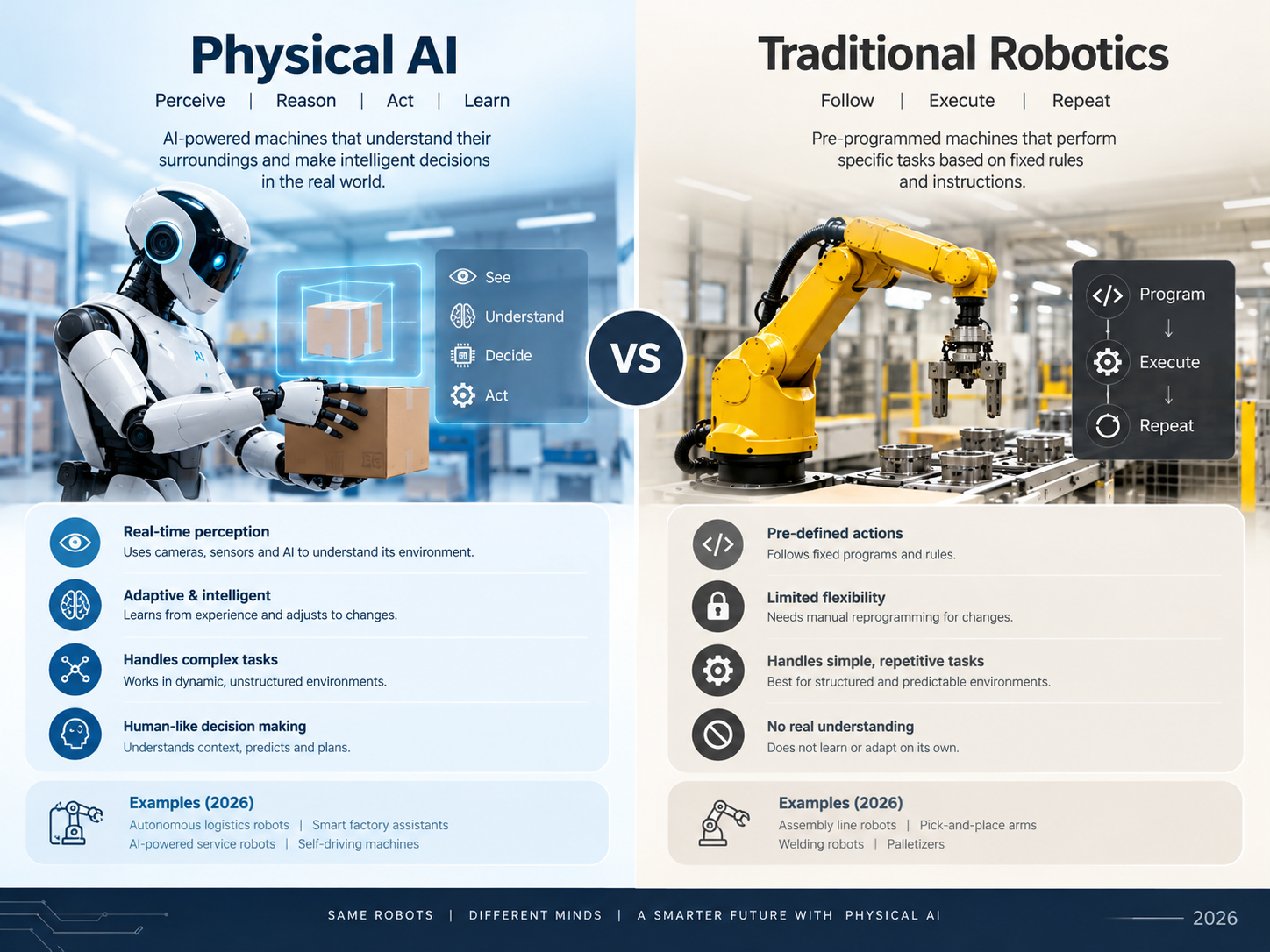
Imagine two robots on an automotive production line. One repeatedly picks up identical components from fixed positions, following a programmed sequence. The other recognizes differently shaped parts, adjusts its grip, and responds when an object moves unexpectedly.
Both are useful. But they approach automation differently.
The central difference in physical AI vs traditional robotics is how machines learn, make decisions, and adapt to their surroundings. Traditional robotics typically relies on engineered instructions, motion planning, and feedback control. Physical AI places greater emphasis on learned perception, intelligent decision-making, and adapting to changing environments.
Neither approach is automatically better. For manufacturers and warehouse operators, the right choice depends on task complexity, safety requirements, reliability, and expected return on investment (ROI).
What Is Physical AI vs Traditional Robotics?
Traditional robotics uses programmed logic, engineered control systems, and sensor feedback to perform physical tasks. Physical AI incorporates learning-based intelligence that helps machines interpret their environment and select appropriate actions.
There is considerable overlap. Modern conventional robots can already use computer vision, adaptive control, and artificial intelligence.
What Is Physical AI and How Is It Related to Embodied AI?
Physical AI refers to artificial intelligence systems designed to perceive, reason about, and act in physical environments.
It is closely related to embodied AI, which focuses on intelligence expressed through interaction with the physical world.
Instead of relying entirely on predefined instructions, physical AI systems may use.
Machine learning to recognize objects and patterns.
Computer vision to understand physical surroundings.
Learned robot policies to select actions.
Reinforcement learning to improve task performance during training.
Simulation to practice and evaluate behavior before deployment.
For example, a physical AI-powered robot may identify differently shaped packages and adjust its grasping strategy based on their positions.
For a broader enterprise perspective, read Mak It Solutions’ Physical AI enterprise guide.
What Is Traditional Robotics and How Does It Work?
Traditional robotics uses engineered instructions, motion planning, mechanical systems, and feedback control to carry out tasks.
Industrial robotic arms commonly handle welding, assembly, packaging, and material movement.
A conventional factory robot might repeatedly position a component with high precision because its working environment and task parameters are well defined.
This approach offers dependable performance when operating conditions remain consistent.
However, traditional robotics is not necessarily limited to rigid, unchanging instructions. Many conventional systems incorporate sensors, vision, and adaptive algorithms.
Is Physical AI the Same as Robotics or Automation?
No. These terms describe related but different concepts.
Robotics focuses on machines that perform physical actions. Automation is a broader concept covering processes completed with limited human intervention.
Physical AI brings learning-based intelligence into physical systems, including robotic arms, autonomous vehicles, and specialized industrial equipment.
A traditional robotic system might retrieve components from known coordinates. A learning-based system may recognize objects arranged in unfamiliar positions and decide how to grasp them.
Physical AI vs Traditional Robotics: 8 Key Differences
The most useful comparison looks beyond whether a robot uses AI. The differences become clearer when examining programming, learning, perception, control, and deployment.
Programming.
Traditional robotics usually depends on explicitly designed task sequences, control logic, and operating parameters.
Engineers define what the robot should do and how it should respond within its intended operating conditions.
Physical AI can use learned policies that map observations to actions. These policies may be developed through demonstrations, training datasets, or simulated experiences.
This reduces the need to manually specify every possible situation, although substantial engineering and testing are still required.
Learning.
Conventional robotic systems can require engineering changes when tasks or operating conditions change significantly.
Physical AI can learn capabilities from data and reuse previously trained models for related tasks.
For example, imitation learning allows a robot to learn from demonstrations, while reinforcement learning can improve behavior through a reward-based training process.
Importantly, not every physical AI robot continues learning during normal operation. Many deployed systems use trained models that remain fixed until formally updated and validated.
Perception.
Traditional robotic systems often use engineered sensing pipelines to identify objects, measure positions, or inspect products.
Physical AI may combine information from cameras, depth sensors, language instructions, and spatial models.
This is known as multimodal perception.
It can help a robot understand more complex situations, such as identifying an object from a verbal instruction and locating it among unfamiliar items.
Decision-Making.
Conventional robotics commonly uses engineered motion planning, task logic, and mathematical models.
Physical AI can supplement these methods with machine learning models that predict outcomes or select actions.
For instance, an AI-enabled robotic arm might evaluate different grasping approaches based on an object’s shape and orientation.
In practice, the strongest systems often combine learned decision-making with established planning methods.
Adaptability.
Traditional robots perform particularly well when products, positions, and operating conditions remain consistent.
Physical AI aims to handle greater variation.
This makes learning-based systems relevant to applications involving changing object shapes, unfamiliar arrangements, or less structured workspaces.
However, adaptability does not guarantee reliable performance in every unfamiliar situation. Unexpected conditions still require careful testing.
Control.
Traditional robots rely heavily on established feedback controllers to regulate movement, speed, position, and force.
Physical AI systems often retain these controllers while adding learned higher-level decision-making.
For example, an AI model may select which object to grasp, while conventional control software manages the robot’s actual movement.
This hybrid approach combines flexible task selection with established motion-control techniques.
Reliability.
Traditional robotic workflows can provide highly predictable results after thorough engineering and validation.
Learning-based systems face additional challenges because their behavior depends on training data and model performance.
A robot that performs well during testing may encounter unfamiliar lighting, materials, or object arrangements in production.
Physical AI therefore requires extensive evaluation, safety testing, and monitoring before deployment in demanding environments.
Deployment.
Traditional robotics benefits from mature industrial integration methods.
Physical AI may introduce extra requirements, including training data, computing hardware, model updates, simulation, monitoring, and cybersecurity.
These additions can increase implementation complexity.
However, the additional investment may be worthwhile when flexible automation reduces repeated programming or manual intervention.
Physical AI vs Traditional Robotics Comparison Table
|
Dimension |
Traditional robotics |
Physical AI emphasis |
|---|---|---|
| Programming | Engineered task logic | Learned policies |
| Learning | Often task-specific | Data-driven adaptation |
| Perception | Engineered sensing pipelines | Learned multimodal perception |
| Decision-making | Model-based planning | Learned or hybrid planning |
| Adaptability | Strong in defined environments | Designed for greater variability |
| Control | Classical feedback control | AI combined with classical control |
| Reliability | Predictable validated workflows | Broader model validation requirements |
| Deployment | Established industrial integration | Additional data and computing needs |
These are typical engineering differences, not absolute boundaries. Many modern robotic systems combine capabilities from both approaches.
How Does Physical AI Work in Real-World Robots?
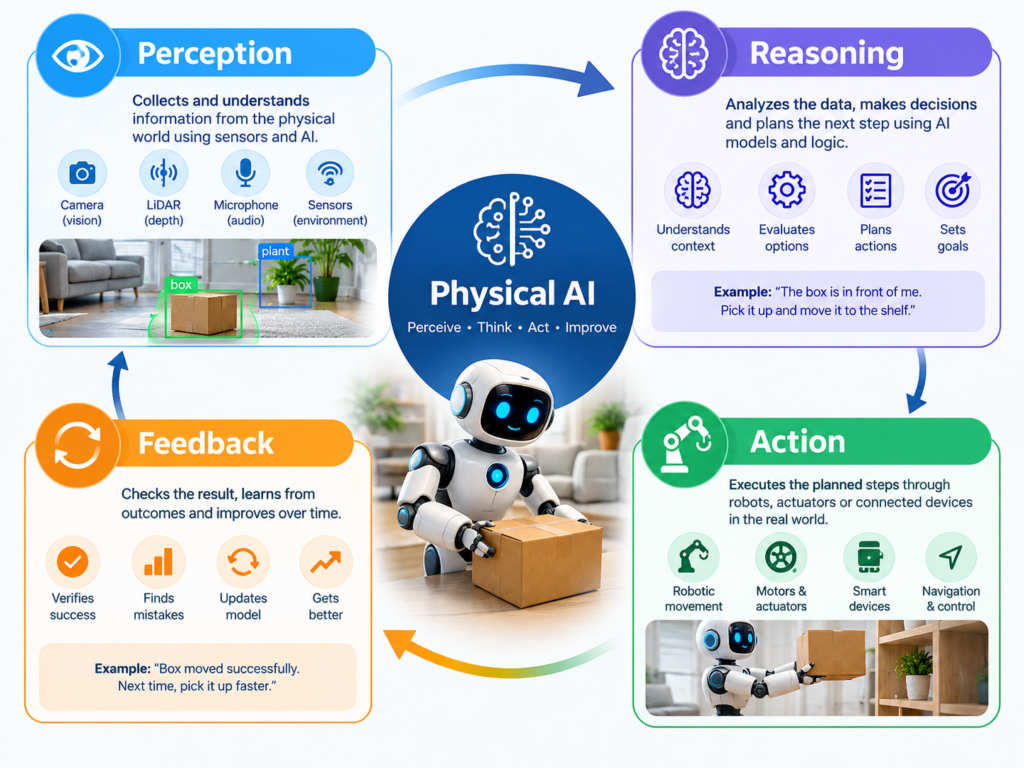
Physical AI connects sensing, intelligent decision-making, and physical action.
A robot observes its surroundings through sensors, processes that information using trained models, selects an action, and executes the movement through its control system.
Feedback helps the system respond to subsequent changes.
Sensors, Vision-Language-Action Models and Robot Planning
A physical AI system generally follows a continuous process:
Perception
Sensors collect data
Reasoning
Models select action
Action
Controllers move robot
Feedback
New observations
Continuous perception–action feedback loop
Cameras and depth sensors help robots identify objects and understand spatial relationships.
Vision-language-action (VLA) models can connect visual observations and language instructions with robotic actions.
Low-level controllers then execute those actions while regulating movement and physical constraints.
Reinforcement Learning, Imitation Learning and Simulation
Physical AI robots can develop capabilities through several training methods.
Imitation learning uses examples of successful behavior. Reinforcement learning uses rewards and penalties during training to encourage desired actions.
Simulation provides a controlled environment for training and testing before working with physical machinery.
Platforms such as NVIDIA Isaac and Omniverse can support robotic simulation and digital-twin development.
Learn more about digital twins for physical AI.
Why Hybrid AI and Classical Control Matter
Physical AI does not replace conventional robotics engineering.
A learned model might decide how to pick up an unfamiliar component, but traditional control systems can still regulate movement and force.
Safety interlocks, emergency stops, bounded actions, and human supervision remain essential.
Physical AI Applications in Manufacturing and Warehouses
Physical AI offers opportunities in tasks where frequent variation makes conventional programming difficult or expensive.
Its most promising industrial applications involve flexible handling, inspection, navigation, and manipulation.
Physical AI in Automotive Manufacturing and Smart Factories
Automotive manufacturers already use traditional industrial robots extensively for welding, painting, and assembly.
These systems perform well because production processes are carefully engineered.
Physical AI can add flexibility to tasks such as handling mixed components, recognizing variable parts, and adapting to changing production arrangements.
Industrial technology companies including Siemens, Bosch, and ABB operate in the broader automation ecosystem where these technologies may be integrated.
According to the International Federation of Robotics, approximately 542,000 industrial robots were installed worldwide in 2024, according to its World Robotics 2025 report. This figure covers industrial robotics generally, not physical AI systems specifically.
Physical AI in Warehouse Robotics and Logistics
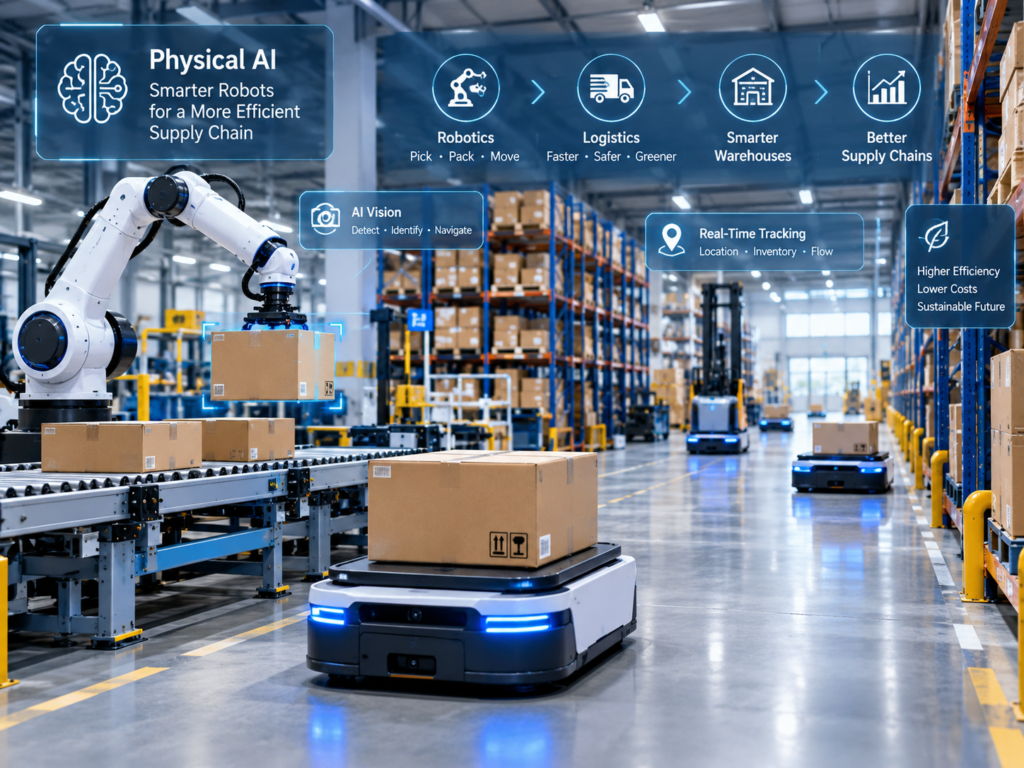
Warehouses present a particularly useful setting for adaptable robotics.
Packages vary in size, orientation, and positioning. Inventory changes, and mobile equipment must navigate shared working environments.
Physical AI can support:
Robotic picking of differently shaped items.
Object identification and classification.
Autonomous warehouse navigation.
Flexible handling of mixed inventory.
Adaptive inspection and sorting.
A learning-based picking system may be more flexible than a machine that depends on fixed object positions.
Warehouse performance data can also support business intelligence and performance analytics.
Physical AI Adoption in the USA, UK, Germany and Europe
Adoption conditions differ across industrial markets.
United States: Detroit’s automotive manufacturing ecosystem and Pittsburgh’s robotics research community provide relevant environments for intelligent automation. IFR recorded approximately 34,200 new industrial robot installations in the USA in 2024.
United Kingdom: Manufacturing regions around Birmingham and Sheffield, alongside Cambridge’s technology research ecosystem, provide opportunities for advanced robotics. The UK recorded approximately 2,500 industrial robot installations in 2024.
Germany: Munich and Stuttgart have established industrial engineering ecosystems closely connected to Industrie 4.0 and the development of Physische KI, or physical AI.
European Union: Manufacturers must consider machinery safety, interoperability, cybersecurity, data protection, and applicable AI regulations when introducing intelligent robotic systems.
Physical AI vs Traditional Robotics: Cost, Safety and ROI
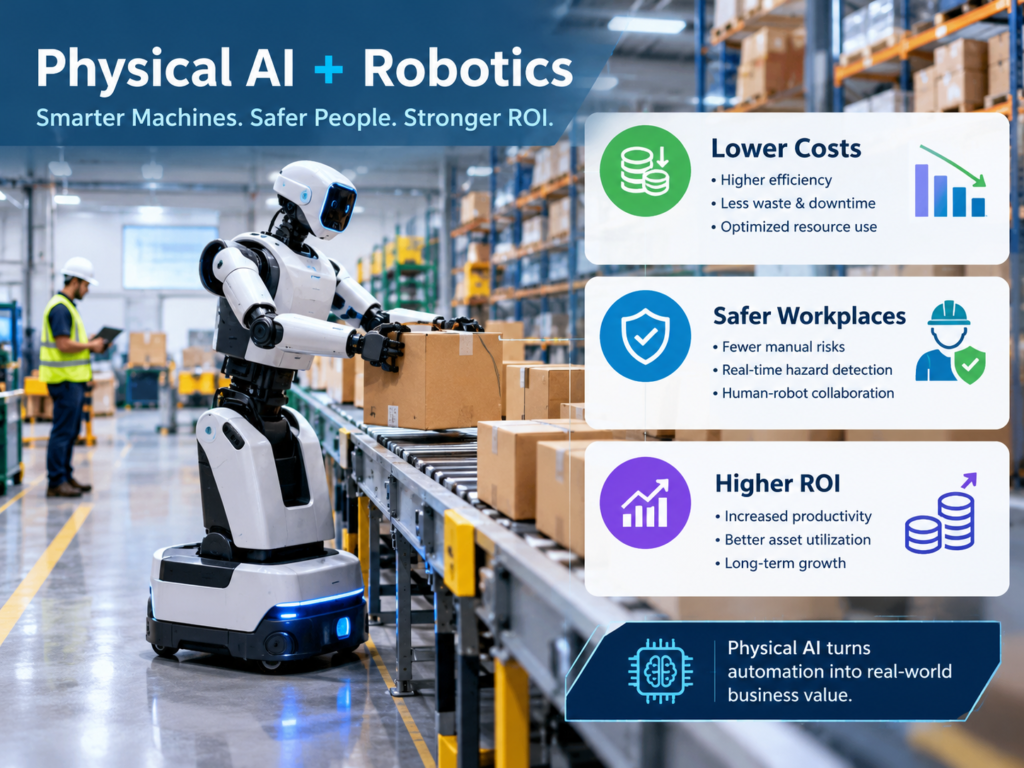
Physical AI may involve greater upfront complexity, but its flexibility can create value in applications where operating conditions frequently change.
Traditional robotics often remains more economical for stable, repetitive processes.
Implementation Costs and Integration Complexity
The total cost of industrial robotics depends on more than hardware.
Businesses need to assess robot equipment, sensors, computing infrastructure, data preparation, software integration, maintenance, and technical support.
Existing systems may require integration with PLCs, SCADA, MES, ERP, ROS 2, or OPC UA.
For learning-based applications, organizations should also consider model training, monitoring, and retraining costs.
Software integration may involve Python development services for data processing, AI workflows, and industrial system connectivity.
Robot Safety, Reliability and Regulatory Requirements
Safety requirements depend on the robot, its intended application, and where it operates.
In the United States, organizations should consider applicable OSHA requirements, ANSI/RIA standards, and relevant risk management practices, including the NIST AI Risk Management Framework.
In the United Kingdom, HSE guidance, PUWER, machinery safety rules, and UK GDPR may apply.
Germany and other EU countries must evaluate applicable requirements including ISO 10218, ISO/TS 15066, GDPR, IEC 62443, machinery legislation, and the EU AI Act.
Under the amended EU AI Act timetable, relevant high-risk AI requirements apply from December 2, 2027, for Annex III systems and August 2, 2028, for certain product-related systems covered by Annex I. The EU Machinery Regulation generally applies from January 20, 2027.
Not every AI-enabled robot automatically qualifies as a high-risk AI system.
Businesses should assess regulatory classification, machinery safety, and product-specific requirements before deployment.
When Does Physical AI Deliver Better ROI?
Physical AI may provide stronger financial returns when operational flexibility produces measurable savings.
For example, a warehouse handling many different product shapes may benefit from a system that requires fewer manual adjustments.
Businesses should evaluate throughput, defect rates, engineering expenses, downtime, maintenance, labor costs, and safety validation.
A controlled pilot is more useful than assuming that adding AI will automatically improve productivity.
Is Physical AI Better Than Traditional Robotics?
Neither approach wins in every situation.
Traditional robotics is often the better choice for predictable processes where repeatability, precision, and established safety procedures matter most.
Physical AI becomes more attractive when tasks demand adaptability, perception, and flexible decision-making.
When Traditional Robotics Is the Better Choice
Conventional robotics makes sense for repetitive manufacturing, fixed-position assembly, structured workspaces, and stable production requirements.
It can offer simpler integration, predictable performance, and established validation methods.
When Physical AI or a Hybrid System Makes Sense
Physical AI may be worth considering when robots need to handle unfamiliar objects, changing environments, or complex manipulation tasks.
Hybrid systems are frequently a practical option because they combine learning-based intelligence with reliable conventional control.
What Should Businesses Evaluate Before Adopting Physical AI?
Before investing, businesses should review task variability, training data availability, hardware compatibility, cybersecurity, safety requirements, and expected financial returns.
Start with a well-defined use case and establish measurable performance targets.
Mak It Solutions’ technology services offer a starting point for exploring the software, analytics, and integration requirements of an intelligent automation initiative.
Final Thoughts
The decision between physical AI vs traditional robotics comes down to what a business needs its machines to accomplish.
Traditional robotics delivers strong results in structured, repeatable environments. Physical AI expands possibilities for tasks requiring greater flexibility and intelligent interaction with changing surroundings.
For many organizations, combining both approaches may be the most practical path forward.
Planning an intelligent automation project? Mak It Solutions can help assess software architecture, data integration, analytics, and implementation requirements.
Contact Mak It Solutions to discuss a scoped technical assessment before moving toward full deployment.
Key Takeaways
Physical AI emphasizes learning-based perception, decision-making, and adaptability.
Traditional robotics remains highly effective for predictable, repetitive industrial tasks.
Hybrid systems combine AI capabilities with established robotic controllers.
Physical AI deployment may require additional computing resources, training, testing, and system integration.
Businesses in the USA, UK, Germany, and EU must consider applicable technical and safety regulations.
Real-world performance and ROI should be established through controlled testing before full deployment.
FAQs
Q : Can existing industrial robots be upgraded with physical AI software?
A : Yes, some existing robots can gain physical AI capabilities through additional sensors, compatible controller interfaces, computing hardware, and software.
However, feasibility depends on the robot’s hardware, supported interfaces, and safety requirements.
Q : Does physical AI require a humanoid robot?
A : No. Physical AI can operate in robotic arms, autonomous mobile robots, agricultural machines, drones, and industrial inspection equipment.
What matters is intelligent interaction with the physical environment, not a human-like appearance.
Q : Can physical AI work without cloud connectivity?
A : Yes. Physical AI models can run locally on edge computing hardware.
Cloud platforms may assist with training, analytics, updates, and monitoring, but continuous cloud connectivity is not always required.
Q : How much training data does a physical AI robot need?
A : There is no universal minimum.
Requirements depend on task complexity, pretrained model capabilities, environmental variation, and reliability targets. Simulation and synthetic data can reduce the need for physical demonstrations, but real-world validation remains necessary.
Q : How long does it take to pilot physical AI in an existing factory?
A : A narrowly scoped proof of concept may take several weeks, while an integrated factory pilot can take months or longer.
The timeline depends on hardware availability, data collection, model adaptation, integration, and safety approval.