


Data Backup Location in GCC: Your Smart Guide
Data Backup Location in GCC: Your Smart Guide

Data Backup Location in GCC: Your Smart Guide
A ransomware attack can bring a Dubai e-commerce store to a halt. A server failure can interrupt customer transactions at a Riyadh fintech company. In both situations, the location and accessibility of backup data can make a major difference to business recovery.
Choosing the right data backup location in GCC means balancing legal requirements, cybersecurity, recovery speed, and operating costs.
For businesses in Saudi Arabia, the UAE, and Qatar, local backups provide greater control over data residency, while international backups can offer additional geographic protection when cross-border transfers are permitted. A hybrid strategy may deliver the benefits of both, provided the organization meets applicable regulations and tests its recovery systems.
The best choice depends on what data your company stores, which laws apply, and how quickly operations must resume after an incident.
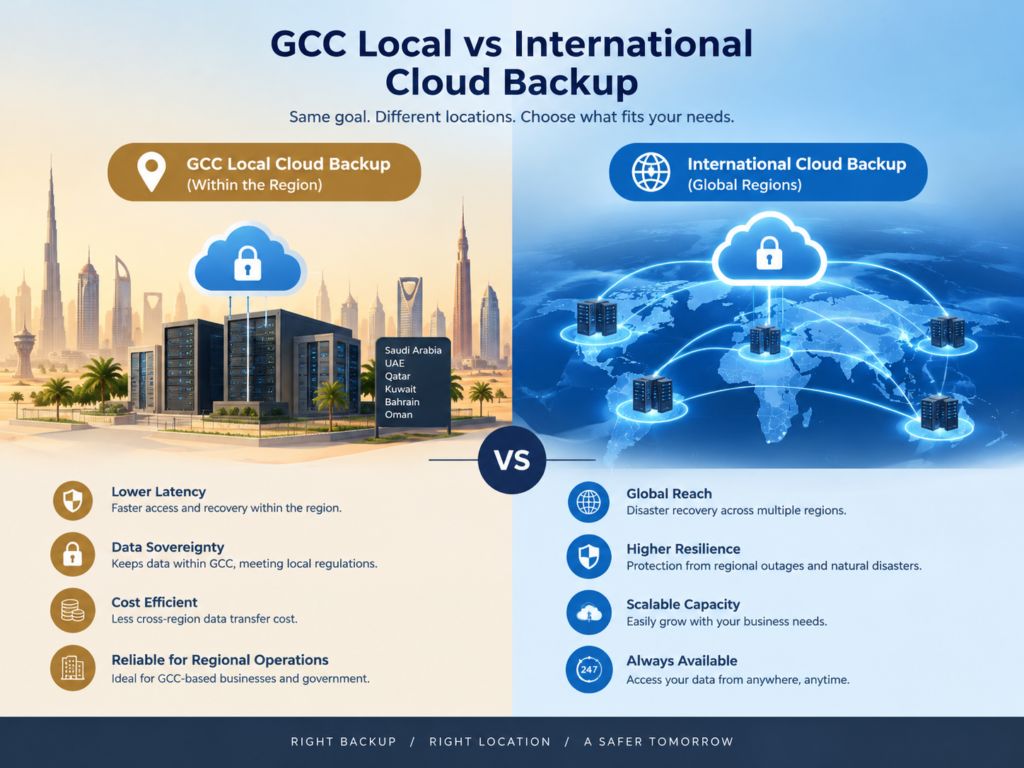
Local vs International Data Backup.
Local and international backups serve the same basic purpose: protecting business information so it can be restored after accidental deletion, hardware failure, cyberattacks, or other disruptions.
The main difference is where the backup copies are physically stored and which legal jurisdictions may apply.
What Is Local Data Backup for GCC Businesses?
Local backup, also called onshore backup, means storing copies of business data within the same country where the organization operates.
For example, a company in Jeddah might store its customer databases in a Saudi-based data center rather than sending them to overseas infrastructure.
This approach can make residency management more straightforward, particularly for businesses handling regulated or sensitive information.
However, local storage does not automatically guarantee legal compliance or faster recovery. Security controls, provider arrangements, and the distance between backup facilities still matter.
Important terms to understand.
Onshore backup: Data stored within national borders.
Offshore backup: Data stored in another country.
Data residency: The physical geographic location of stored information.
Data sovereignty: The legal authority and jurisdiction governing information.
Cross-border transfer: Sending or making personal information accessible across national borders, where applicable regulations classify the activity as a transfer.
How Does International Cloud Backup Work?
International cloud backup stores or replicates business information on infrastructure located outside the company’s home country.
For example, a UAE business may use an overseas recovery location if its data protection obligations, contractual requirements, and any applicable sector restrictions permit it.
The main attraction is geographic separation. If a major disruption affects domestic infrastructure, an independently accessible overseas copy may support recovery.
But international storage can also create challenges involving foreign laws, transfer safeguards, network performance, and retrieval charges.
Local vs International Backup Comparison
| Factor | Local backup | International backup |
|---|---|---|
| Data residency | Within the home country | Outside the home country |
| Compliance | Domestic legal requirements | Domestic and applicable cross-border requirements |
| Disaster recovery | Depends on separation between sites | Can provide wider geographic separation |
| Recovery speed | Depends on network and system design | Depends on network and system design |
| Costs | Domestic storage and infrastructure costs | Storage, transfer, and retrieval costs |
| Jurisdiction | Primarily domestic | May involve multiple legal jurisdictions |
| Best suited for | Residency-sensitive and regulated workloads | Permitted geographic disaster recovery |
Key takeaway.
Neither location is inherently more secure. A well-designed backup system with encryption, restricted access, immutable copies, and verified restoration procedures matters more than storage geography alone.
Data Backup Rules in Saudi Arabia, UAE and Qatar
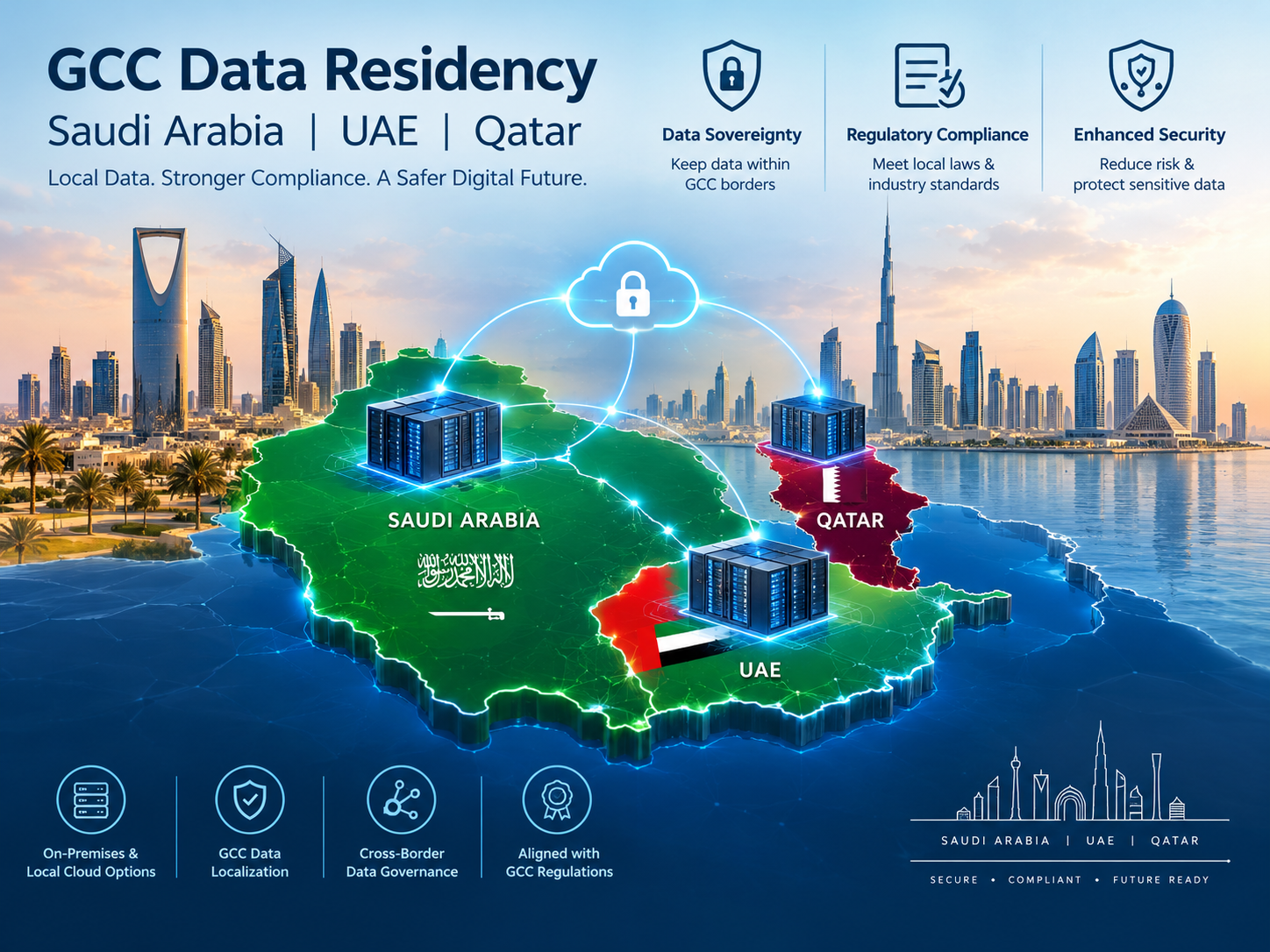
Data residency is one of the most important factors in selecting cloud backup infrastructure across GCC markets.
However, Saudi Arabia, the UAE, and Qatar do not operate under a single unified data protection law. Each jurisdiction has its own requirements, and certain sectors face additional obligations.
Saudi Arabia.
Saudi Arabia’s Personal Data Protection Law (PDPL), overseen by the Saudi Data & AI Authority (SDAIA), establishes requirements for processing personal information.
The law and its implementing regulations address transfers of personal data outside the Kingdom.
Does Saudi Arabia require all backups to remain inside the country?
Not necessarily. Certain international personal-data transfers are permitted when the relevant legal grounds, conditions, and safeguards are satisfied.
Organizations must consider the transfer destination, protection measures, purpose of processing, and any applicable risk assessment requirements.
Additional controls may apply to particular types of information and regulated activities.
For example.
Fintech and banking: Institutions should examine relevant Saudi Central Bank (SAMA) cybersecurity and outsourcing requirements.
Government workloads: Applicable National Data Management Office (NDMO) policies and data classification requirements may influence permitted storage locations.
Commercial businesses: Organizations should assess PDPL obligations and contractual restrictions before using international backup services.
Saudi Arabia’s regulatory environment also supports broader data governance and digital transformation priorities associated with Saudi Vision 2030.
Businesses should consult the official SDAIA Data Governance Platform and Saudi Central Bank for applicable guidance.
UAE.
The UAE’s Federal Personal Data Protection Law establishes a framework for protecting personal information, including requirements concerning certain international transfers.
However, UAE businesses must establish which regulatory regime applies to their operations.
In particular.
UAE Federal PDPL: Relevant to personal-data processing within its legal scope.
Dubai International Financial Centre (DIFC): Maintains its own data protection framework.
Abu Dhabi Global Market (ADGM): Has a separate data protection regime.
Telecommunications and Digital Government Regulatory Authority (TDRA): Oversees telecommunications and related digital-government regulatory areas, rather than serving as the general federal personal-data regulator.
For example, an ordinary Dubai retailer and a financial business operating within DIFC may face different legal requirements despite using similar cloud infrastructure.
Before signing with a cloud provider, UAE companies should confirm where their data is stored, whether backups are replicated overseas, and which transfer safeguards apply.
Qatar.
Qatar’s Personal Data Privacy Protection Law (Law No. 13 of 2016) establishes requirements for the handling and protection of personal information.
Businesses must consider these obligations when selecting domestic or international cloud backup services.
Certain industries also face sector-specific requirements.
For instance, a bank regulated by Qatar Central Bank (QCB) may need to meet additional cybersecurity, risk management, and outsourcing obligations.
A smaller Doha-based marketing or software company may have different requirements, depending on its activities and the information it processes.
Qatar businesses should verify the actual storage location and service availability of their chosen cloud products rather than assuming that access to a regional cloud data center guarantees local backup storage.
GCC Data Backup Regulatory Comparison
| Country | Main regulatory frameworks | International backup considerations |
|---|---|---|
| Saudi Arabia | PDPL, SDAIA, relevant NDMO and SAMA requirements | Lawful transfer grounds, safeguards, classification, and risk assessment |
| UAE | Federal PDPL, DIFC and ADGM frameworks where applicable | Governing jurisdiction and appropriate transfer mechanisms |
| Qatar | PDPPL and applicable QCB requirements | Personal-data protection and relevant sector obligations |
Compliance note.
These frameworks do not create identical requirements for every business. Storage permissions depend on the data involved, the organization’s activities, and applicable legal obligations. Obtain qualified regulatory advice before implementing cross-border transfers of sensitive or regulated information.
Security and Disaster Recovery Trade-Offs
Choosing a backup location is only part of business continuity planning.
A compliant backup system is of limited value if the company cannot restore data quickly, securely, and reliably when something goes wrong.
RPO and RTO.
Two important recovery measurements are Recovery Point Objective (RPO) and Recovery Time Objective (RTO).
RPO describes how much data loss a business can tolerate, measured in time.
RTO describes how long critical systems can remain unavailable before they must be restored.
Consider a Riyadh retailer with a 15-minute RPO.
If its backup system copies customer orders only once per day, it cannot reliably meet that objective.
It needs sufficiently frequent recoverable backups or another suitable data-protection mechanism.
Similarly, a business requiring rapid system restoration must evaluate network speeds, application dependencies, storage performance, and recovery procedures.
A nearby backup facility may help with certain recovery scenarios, but physical distance alone does not determine recovery speed.
Encryption, Immutable Backups and Ransomware Protection
A secure backup system needs protection against unauthorized access, accidental changes, and malicious activity.
Important safeguards include.
Encryption for stored data and information moving across networks.
Strong authentication and restricted administrator privileges.
Protected encryption-key management.
Immutable or otherwise tamper-resistant backup copies.
Isolated recovery environments where appropriate.
Regular restoration testing and monitoring.
Businesses should also consider security controls aligned with recognized frameworks such as ISO/IEC 27001.
In practice, ransomware recovery depends on more than having backup files. Those copies must remain accessible, trustworthy, and restorable after production systems have been compromised.
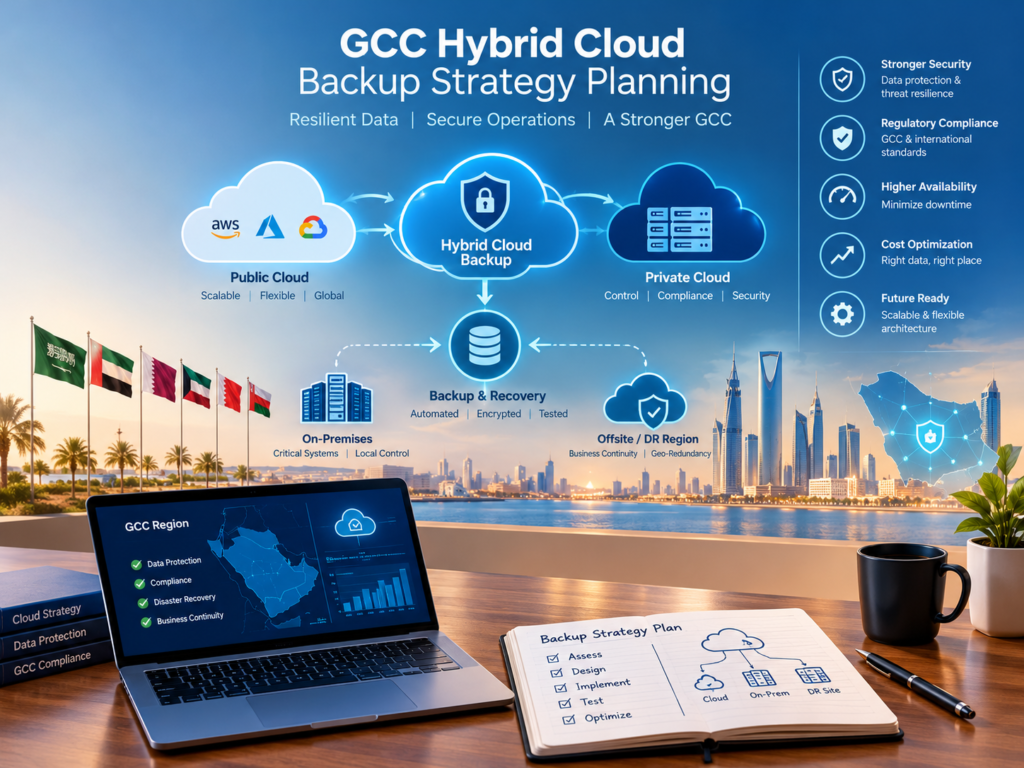
Hybrid and Multi-Region Backup Strategies
A hybrid backup strategy combines domestic storage with other recovery locations or infrastructure types.
For example, a Saudi company may maintain its primary backups within the Kingdom while using an additional international recovery copy where regulations permit.
This can provide geographic separation without abandoning local data management requirements.
Alternatively, organizations with strict domestic residency obligations can maintain independent backup copies in geographically separated facilities within the same country.
For enterprise applications, these decisions should begin during system architecture planning rather than after deployment.
Companies developing complex platforms through Mak It Solutions’ back-end development services should account for database recovery, secure backup access, and disaster recovery requirements from the beginning.

Best Data Backup Locations in GCC for Business Use Cases
There is no universal backup location that works for every GCC company.
An e-commerce business, a financial institution, and a government organization may need different architectures even when they operate in the same country.
Saudi Fintech and Government Workloads
A Riyadh fintech company may handle financial transactions, identification records, and other sensitive customer information.
Its backup strategy should account for Saudi PDPL requirements and any SAMA rules applicable to its regulated activities.
Domestic-first storage may help simplify governance, but it does not replace the need for security reviews, contractual checks, and recovery testing.
Government organizations must also consider applicable data classification and NDMO-related requirements.
For these workloads, selecting a backup provider should begin with regulatory eligibility rather than storage pricing alone.
UAE Retail, E-commerce and Logistics
Dubai retailers often depend on order databases, payment integrations, customer accounts, and inventory systems.
Losing access to these systems can interrupt sales and customer support.
Businesses using e-commerce development solutions should plan backups around recoverable customer transactions and critical operational data.
An Abu Dhabi logistics company might have different priorities, such as restoring delivery tracking, shipment records, and warehouse management applications.
Both organizations can compare UAE-based backup services with overseas recovery options, provided the relevant legal requirements are satisfied.
The ideal architecture should match actual recovery needs rather than relying on the assumption that international cloud infrastructure is always more advanced.
Qatar Banking and SME Backup Scenarios
Qatar’s banking and SME sectors have different operational and regulatory considerations.
A Doha bank must assess applicable QCB obligations and carefully evaluate service-provider risks.
A software company or marketing agency may have more flexibility, depending on its processing activities and contractual responsibilities.
Businesses developing reporting platforms through business intelligence services should also consider protecting analytics databases, reporting pipelines, and related business information.
Regional cloud infrastructure, including Google Cloud’s Doha region, may be relevant when assessing available services.
However, companies should verify the residency capabilities of each specific backup product. The existence of a local cloud region does not guarantee that every cloud service or recovery copy remains within that region.
Local vs International Backup Costs and Timelines
Backup pricing should be evaluated against the total cost of ownership, not simply the advertised monthly storage rate.
A low-cost storage subscription can become expensive when data retrieval, international transfer, or disaster recovery operations are required.
Storage, Bandwidth and Data Transfer Costs
Key expenses may include.
Storage capacity and backup retention periods.
Frequency of full and incremental backups.
Network bandwidth and international data transfers.
Retrieval or egress charges.
Security controls and key management.
Disaster recovery testing.
Support agreements and contractual commitments.
Businesses with large databases or frequent replication requirements should pay particular attention to ongoing transfer costs.
Currency exposure and provider billing structures may also affect budgets across GCC markets.
When comparing offers, request a cost estimate based on real data volumes, retention requirements, and expected recovery scenarios.
Comparing GCC Cloud Backup Service Options
Businesses in the region can evaluate domestic telecommunications and enterprise infrastructure providers alongside international cloud platforms.
Examples of organizations and infrastructure worth assessing include.
| Market | Potential providers or infrastructure |
|---|---|
| Saudi Arabia | stc, solutions by stc |
| UAE | e& enterprise, du, Azure UAE Central |
| Qatar | Ooredoo, Google Cloud Doha |
| Wider region | AWS Bahrain and other eligible cloud regions |
These examples are starting points for evaluation, not endorsements or confirmation that a particular managed backup service is available in every location.
Cloud infrastructure availability is different from managed backup capability.
Before committing, ask providers for documentation covering backup locations, encryption, disaster recovery arrangements, service availability, contractual protections, and applicable residency guarantees.
Backup Migration and Recovery Testing Timelines
Moving backups between providers or locations requires planning.
The migration duration depends on factors such as.
Total data volume.
Available network capacity.
Initial backup and synchronization methods.
Encryption and access requirements.
Regulatory or contractual reviews.
Application complexity and recovery testing.
A sensible migration approach involves creating the new recovery environment, performing an initial backup, synchronizing subsequent changes, and successfully testing restoration before retiring the previous solution.
For applications built through web development services, recovery testing should include databases, APIs, authentication, and uploaded files.
A backup migration should not be considered complete until the organization can demonstrate that critical information can actually be restored.
How to Choose a Compliant GCC Backup Strategy
The most reliable way to select a data backup location in GCC is to begin with business requirements, regulatory obligations, and recovery targets rather than comparing storage prices alone.
Classify Data and Identify Residency Rules
Start by identifying the information your company stores and processes.
This may include personal records, financial transactions, healthcare information, government data, and commercially sensitive material.
Determine which local laws, sector regulations, and contractual restrictions apply.
Then establish whether the relevant data can legally be replicated or accessed outside the country.
Compare Locations, Providers and Recovery Needs
Evaluate each potential backup option against practical requirements.
Consider physical storage locations, international replication, administrator access, encryption-key ownership, recovery performance, service agreements, and provider support.
For mobile-first businesses, mobile app development planning should also account for secure restoration of customer accounts, databases, and application services.
Request written confirmation of important technical and contractual commitments wherever possible.
Test, Document and Review the Backup Plan
A backup strategy needs ongoing verification.
Conduct restoration tests, document the results, review access permissions, and confirm that the recovery process meets business requirements.
Reassess the strategy when applications, service providers, data types, or regulations change.
GCC Backup Decision Checklist
Identify sensitive data, residency obligations, and legal restrictions.
Compare local, international, and hybrid backup architectures.
Test restoration, document compliance evidence, and schedule regular reviews.
For businesses requiring strong jurisdictional control, domestic storage may be the most practical starting point.
Where international transfers are permitted, overseas backups can provide additional geographic resilience.
Hybrid strategies can be attractive when legal requirements, technical design, and recovery objectives support them.
The right backup strategy is the one your business can legally operate, securely maintain, and successfully restore when it matters most.
To Sum Up
Selecting the right data backup location in GCC requires more than choosing between domestic and international storage.
Saudi Arabia, the UAE, and Qatar each have distinct regulatory considerations. Businesses also need to balance security, operating costs, recovery performance, and infrastructure reliability.
Local backup can simplify residency management. International backup may improve geographic diversification when legally permitted. Hybrid backup can combine these advantages when designed carefully.
Whatever approach your company chooses, prioritize documented compliance, strong security controls, and regularly tested recovery.
Your backup investment should protect business operations not simply store copies of files.
Contact Mak It Solutions to discuss your technical requirements, explore our technology services, and request a tailored consultation for your business.
FAQs
Q : Does Saudi PDPL require all business backups to remain inside Saudi Arabia?
A : No. Saudi PDPL does not establish a universal requirement that every business backup remain inside the Kingdom.
Certain international transfers of personal information may be permitted when applicable legal grounds, conditions, and safeguards are met.
However, regulated financial institutions, government organizations, and businesses processing certain sensitive information may face additional restrictions.
Organizations should review SDAIA guidance and any relevant sector requirements before implementing overseas backup replication.
Q : What should Dubai businesses check before choosing a UAE-hosted backup provider?
A : Dubai businesses should confirm where backup data is physically stored and whether the provider replicates it to other countries.
They should also review encryption, administrator access, subcontractor arrangements, retention policies, and restoration capabilities.
The applicable legal framework matters too. Some businesses fall under the UAE Federal PDPL, while relevant DIFC entities must assess their distinct data protection obligations.
Written documentation from the provider can help verify storage arrangements and contractual commitments.
Q : Are Qatar SMEs subject to the same cloud backup requirements as QCB-regulated banks?
A : Not necessarily.
Both may need to comply with Qatar’s personal-data protection framework, but regulated banks can face additional financial-sector cybersecurity and outsourcing obligations.
A Doha software company and a licensed bank may therefore need different backup governance and approval processes.
Regardless of size, businesses should maintain appropriate encryption, access controls, and tested restoration procedures.
Q : Do DIFC and ADGM companies follow the same international data-transfer rules?
A : No. DIFC and ADGM maintain separate data protection frameworks.
Both address international personal-data transfers and recognize applicable protection mechanisms, but their requirements and procedures are not identical.
Organizations operating across these jurisdictions should identify the relevant legal entities, governing regulations, and appropriate transfer mechanisms before selecting overseas backup infrastructure.
Q : Can a GCC business recover data if its local backup data center becomes unavailable?
A : Yes, provided it maintains an independently accessible recovery copy and has successfully tested its restoration process.
That copy could be stored in another domestic data center or, where regulations permit, an international location.
Businesses must also consider network availability, administrator credentials, application dependencies, and recovery objectives.
Simply maintaining multiple copies does not guarantee business continuity unless the full recovery process works.