


AI Search Optimization GCC: Saudi & UAE Trust Guide
AI Search Optimization GCC: Saudi & UAE Trust Guide
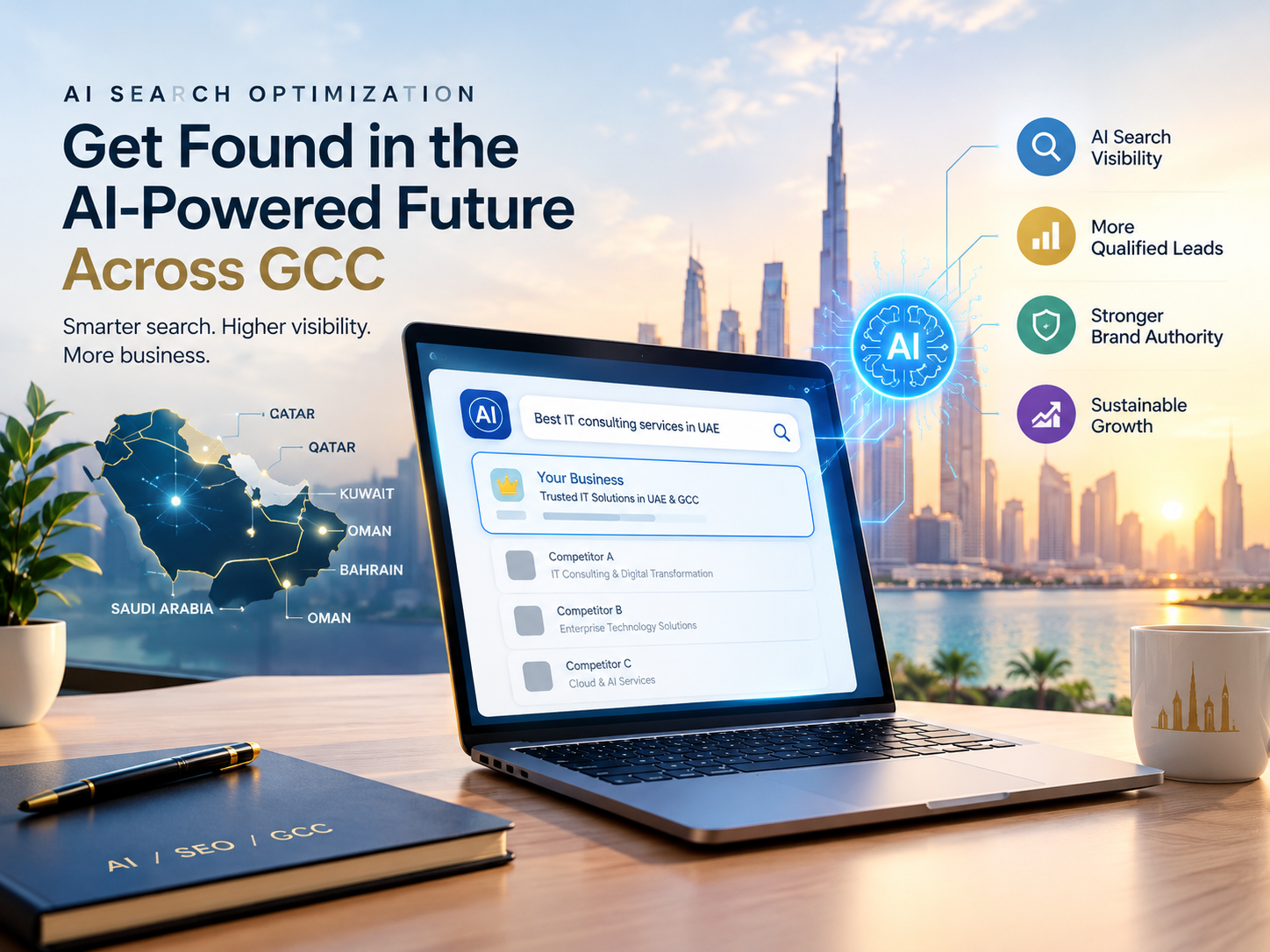
AI Search Optimization GCC: Saudi & UAE Trust Guide
Imagine a procurement director in Riyadh asking ChatGPT to recommend a reliable technology partner. Your company has an established reputation, experienced professionals and satisfied customers. Yet the AI-generated answer mentions your competitor instead.
That’s the challenge AI Search Optimization GCC aims to address.
AI search optimization helps businesses make their expertise easier for AI-powered search and answer systems to discover, understand and reference. For companies in Saudi Arabia, the UAE and Qatar, the strongest approach combines technical SEO, credible content, bilingual localization and independently verifiable business information.
The goal isn’t to force your brand into AI answers. It’s to give search engines and AI platforms reliable reasons to consider your business a useful source.
What Is AI Search Optimization GCC and Why Does It Matter?
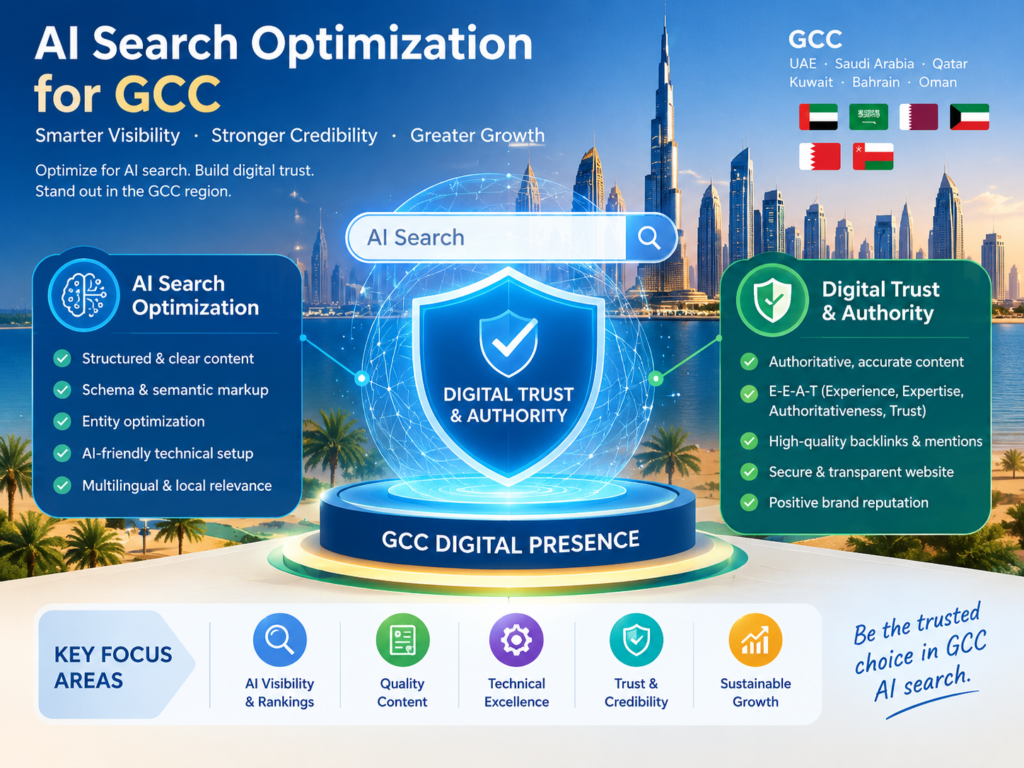
AI Search Optimization GCC is the process of improving a company’s visibility and credibility across AI-powered search experiences, with particular attention to Gulf markets.
It builds on traditional search engine optimization while addressing how systems such as Google AI Overviews, ChatGPT, Gemini and Perplexity retrieve, interpret and sometimes cite information.
Traditional SEO vs. AEO vs. GEO for GCC Businesses
These approaches serve related but distinct purposes.
| Strategy | Primary purpose | Business benefit |
|---|---|---|
| SEO (Search Engine Optimization) | Improve visibility in organic search | Attract relevant website visitors |
| AEO (Answer Engine Optimization) | Make information easier to use in direct answers | Help answer specific buyer questions |
| GEO (Generative Engine Optimization) | Improve discoverability within AI-generated responses | Increase opportunities for brand mentions and source citations |
For a GCC business, these disciplines complement rather than replace one another.
Traditional SEO helps make content accessible. AEO encourages clear explanations of customer questions, while GEO emphasizes credible, useful information that AI systems may retrieve or reference.
Mak It Solutions’ search engine optimization services provide the foundational practices needed to support this broader approach.
How Google AI Overviews and LLM Answers Find Sources
Google AI Overviews and AI Mode can use information retrieved from Google’s Search index to support generated answers. Retrieval-augmented generation (RAG) is one technique used to ground AI responses in relevant information.
Other AI platforms have their own retrieval, browsing and citation systems. Their source selection may vary depending on the question, available information and platform behavior.
Google’s official generative AI optimization guidance emphasizes that established SEO practices and genuinely helpful content remain important.
There is no special markup that guarantees inclusion in AI-generated answers.
Why Saudi Arabia, UAE and Qatar Need Local AI Visibility
Buyers across the GCC don’t necessarily search in the same language or evaluate companies using identical criteria.
A Riyadh financial services executive might ask a question in Arabic. A Dubai procurement manager may compare suppliers in English, while a Doha enterprise buyer could prioritize local project experience.
Businesses therefore need more than generic international content.
Useful regional signals include accurate bilingual information, genuine customer experience, clear service coverage and references to applicable local requirements.
Simply adding Riyadh, Dubai or Doha to an otherwise generic page won’t establish meaningful regional expertise.
How GCC Companies Become Trusted Sources in AI Answers
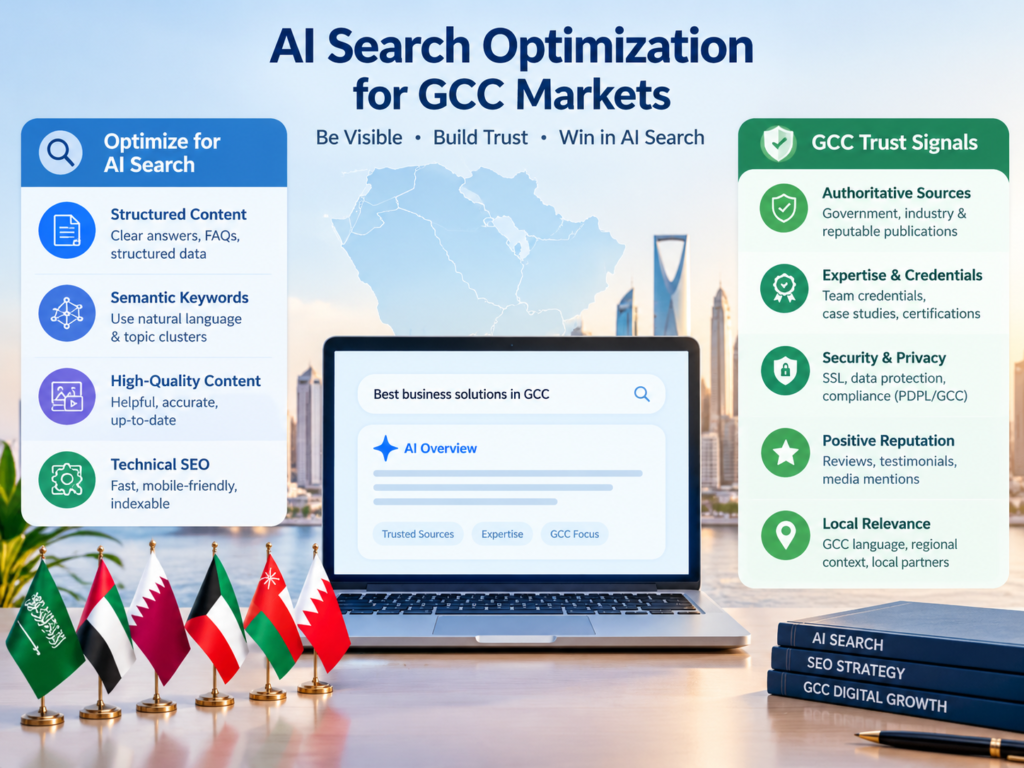
AI search visibility begins with a credible digital identity. Businesses need to communicate who they are, what they do and why their information deserves consideration.
Although no method guarantees citations, the following practices help build an independently verifiable online presence.
Publish Original Expertise, Research and Saudi Market Evidence
Generic promotional articles rarely provide the same value as content based on genuine industry knowledge.
A Riyadh fintech company, for example, could publish explanations of Saudi payment processes, supported by relevant regulatory sources and reviewed by qualified subject-matter experts.
Other useful content formats include.
Documented case studies with permission from participating customers.
Expert-reviewed guides addressing real business challenges.
Original research with transparent methodology.
Practical industry comparisons supported by evidence.
Regularly reviewed explanations of relevant regulatory developments.
These approaches reflect Google’s E-E-A-T principles: experience, expertise, authoritativeness and trustworthiness.
Importantly, E-E-A-T is a content-quality framework, not a standalone AI citation score.
Publishing credible information makes a business easier to assess, but doesn’t guarantee that an AI platform will reference it.
Strengthen Brand Identity and Entity Recognition
Imagine finding three different descriptions of the same company across its website, business directory listings and social profiles.
That inconsistency creates unnecessary confusion for customers and automated systems alike.
Keep essential business information accurate across relevant online properties, including the company’s official name, services, leadership information and contact details.
Independent references can also strengthen confidence in a brand’s identity.
These might include genuine partnerships, industry publications, supplier directories and approved customer testimonials.
A sustainable digital marketing strategy should focus on earning credible recognition rather than purchasing artificial mentions or manufactured citations.
Use Real UAE and Qatar Success Stories
Regional case studies help prospective customers judge whether a company understands their market.
A Dubai fintech provider might describe an approved implementation project. An Abu Dhabi logistics company could explain a documented operational improvement, while a Doha technology supplier might outline a completed enterprise deployment.
Strong case studies explain the customer’s problem, the work performed and the outcome.
Where results are available and approved for publication, include the methodology used to measure them. Avoid unsupported performance claims or invented customer success stories.
Technical SEO and Bilingual Content for AI Discoverability
Even excellent content can struggle to gain visibility if search engines cannot properly access or understand it.
Technical SEO therefore remains essential to an AI search strategy.
Improve Crawlability, Indexing and Search Visibility
Begin with a technical audit of the website’s most important pages.
Check whether search engines can access and index relevant content, and whether navigation makes those pages easy to discover.
Pay particular attention to.
Robots.txt rules and unintended crawl restrictions.
Canonical tags and duplicate-content issues.
Internal links connecting related service pages.
Important information available in readable HTML.
Mobile usability and page experience.
Indexing problems identified through Google Search Console.
Google’s AI features documentation explains that pages must satisfy applicable Search technical requirements to qualify as supporting links.
Companies dealing with complex architecture or performance problems can consider professional web development services.
Technical improvements don’t guarantee citations, but they help remove barriers to discoverability.
Use Organization Schema and Accurate Structured Data
Structured data helps search engines interpret information about an organization and its published content.
Depending on the page, relevant markup may include Organization, Article or Person schema.
The markup should reflect information actually visible to users. Company names, author details, business descriptions and other properties must remain accurate.
Google does not require special AI-specific schema for inclusion in its generative search features.
In practice, structured data should support a well-organized website, not serve as a shortcut around content quality.
Optimize Arabic UX and English Content for GCC Buyers
Bilingual optimization involves more than translating headings.
Arabic-speaking visitors need clear navigation, natural terminology and properly formatted right-to-left interfaces. English-speaking buyers may expect detailed technical explanations and consistent service descriptions.
Where appropriate, implement hreflang for language or regional URL variations.
A company operating across Riyadh, Dubai and Doha should also make regional pages genuinely useful by explaining differences in services, market experience and relevant customer requirements.
For businesses using WordPress, localized WordPress development can help manage multilingual pages and maintain consistent website functionality.
GCC Compliance and Local Trust Signals for AI Content
Regulatory accuracy matters, particularly in sectors involving personal data, financial services and government procurement.
Businesses should reference applicable rules carefully and distinguish legal compliance from marketing claims.
No GCC regulator provides a general certification guaranteeing visibility in AI search results.
Saudi PDPL, SDAIA, NDMO and SAMA Considerations
Saudi businesses handling personal data should assess their obligations under the Personal Data Protection Law (PDPL), alongside relevant official guidance and applicable data-governance requirements.
The Saudi Data and Artificial Intelligence Authority (SDAIA) and National Data Management Office (NDMO) are important references within their respective areas of responsibility.
Financial institutions must also consider requirements issued by the Saudi Central Bank (SAMA).
For content teams, the practical lesson is straightforward: use accurate regulatory terminology, refer to authoritative sources and avoid suggesting official approval where none exists.
UAE PDPL, TDRA, ADGM and DIFC Frameworks
The UAE has multiple legal and regulatory frameworks that businesses may need to consider.
Federal personal data protection requirements should be distinguished from the separate data protection frameworks operating in Abu Dhabi Global Market (ADGM) and Dubai International Financial Centre (DIFC).
The UAE Telecommunications and Digital Government Regulatory Authority is relevant to telecommunications and certain digital-sector matters.
It should not be presented as a general authority certifying SEO or AI search practices.
Businesses publishing compliance-related information should confirm which framework applies before making public claims.
Qatar Privacy, QCB and Cross-Border Data Considerations
Qatar-based businesses should assess applicable personal data protection obligations and relevant sector-specific requirements.
Financial services companies may also need to consider guidance and rules issued by Qatar Central Bank.
Cloud hosting decisions deserve similar care.
Options such as AWS Bahrain, Azure UAE Central and Google Cloud Doha may be relevant when assessing regional infrastructure.
However, selecting a nearby cloud region does not automatically establish data residency suitability or regulatory compliance.
Such decisions require assessment of the applicable rules, service configuration, contractual arrangements and data-processing activities.
GCC Industry Use Cases, Costs and Implementation Timelines
AI search priorities vary according to industry, company maturity and the markets being served.
A technology supplier may need detailed technical resources, while an e-commerce company may benefit more from accurate product information and improved multilingual navigation.
Fintech, Government, Retail and Logistics Use Cases
The following examples illustrate how businesses might approach optimization.
| Market and industry | Practical AI visibility opportunity |
|---|---|
| Riyadh fintech | Publish expert-reviewed payment guidance referencing applicable Saudi requirements |
| Dubai e-commerce | Improve product descriptions, Arabic navigation and e-commerce platform performance |
| Doha government supplier | Explain verified procurement capabilities and documented project experience |
| Abu Dhabi logistics | Publish accurate service coverage, operational information and approved case studies |
The most effective content addresses questions that real customers ask before choosing a supplier.
Each example should be adapted to the company’s actual capabilities rather than copied as a generic content template.
What Affects AI Search Optimization Costs Across the GCC?
There is no universal price for AI search optimization.
Budgets depend on the website’s existing condition, technical complexity, number of target markets and amount of research required.
Translation quality, industry expertise, content production and measurement requirements also affect the scope of work.
A focused Saudi-only assessment will generally require fewer resources than a multilingual program covering several GCC markets.
Companies may also use business intelligence services to connect visibility monitoring with meaningful commercial performance.
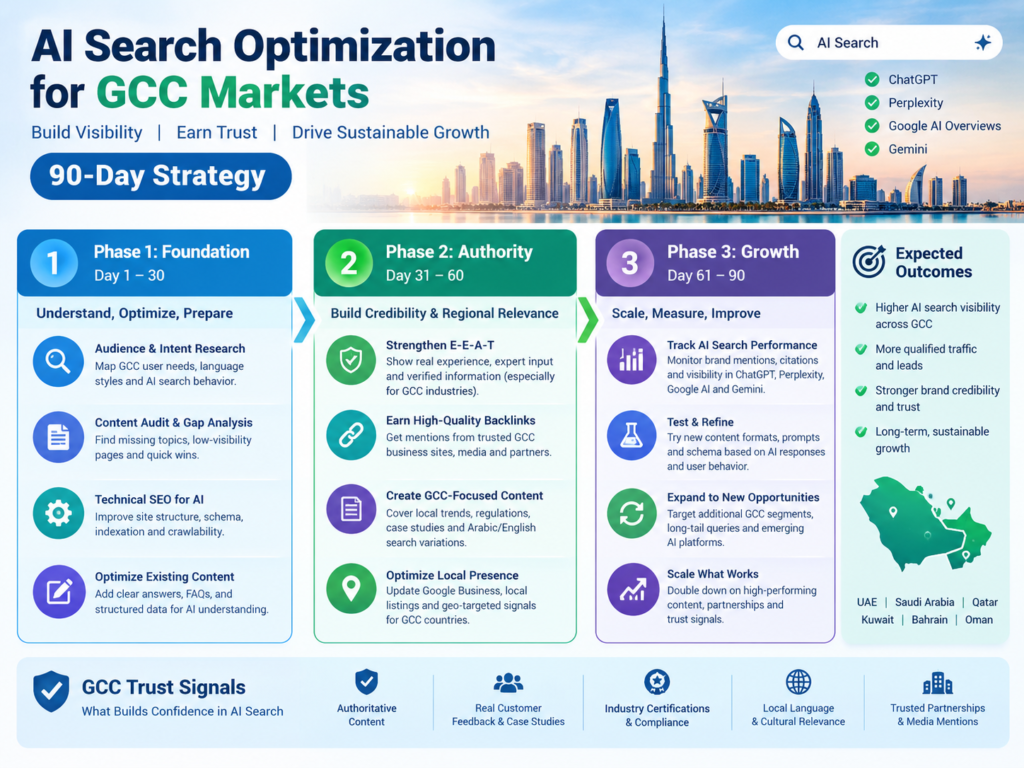
What Can Businesses Do in 30, 60 and 90 Days?
A phased plan helps organize implementation without promising ranking or citation outcomes.
| Timeline | Priority | Key activities |
|---|---|---|
| Days 1–30 | Audit | Establish a visibility baseline, assess indexing and identify content or credibility gaps |
| Days 31–60 | Improve | Address technical issues, strengthen useful content and improve localization |
| Days 61–90 | Measure | Review observed citations, brand mentions, referrals and qualified inquiries |
These are planning milestones, not guaranteed timelines for being mentioned by AI systems.
Some businesses may need longer to resolve website issues, gather approved case-study material or complete specialist reviews.
How to Build and Measure an AI Search Optimization GCC Strategy
A practical GCC AI search strategy follows a cycle of assessment, improvement and measurement.
Audit AI Visibility and Verify Brand Information
Start by identifying the questions potential customers ask about your industry.
Test relevant Arabic and English queries across selected AI platforms, using consistent prompts where possible.
Record which businesses are mentioned, which URLs are cited and whether your brand appears accurately.
At the same time, assess indexing, technical accessibility and the consistency of your company information.
This creates a baseline for future comparison.
Publish Authoritative Content and Strengthen GCC References
Prioritize content that demonstrates genuine expertise.
Update outdated explanations, publish properly reviewed resources and make regional experience easier for customers to verify.
Where possible, strengthen the website with credible external references and genuine industry relationships.
Avoid publishing large volumes of near-identical material solely to target different location keywords.
The objective is useful, trustworthy content that answers specific buyer needs.
Monitor AI Mentions, Referral Traffic and Qualified Leads
AI-generated answers can change between platforms and individual tests.
That makes consistent measurement more useful than treating a single mention as proof of long-term success.
Track relevant indicators such as.
Brand appearances for a defined set of prompts.
Cited URLs and accuracy of brand descriptions.
AI-attributable referral visits where identifiable.
Qualified inquiries and meaningful conversions.
Changes in organic search visibility.
Use Google Search Console and website analytics alongside documented AI visibility tests.
Not every AI interaction produces measurable referral traffic, so avoid presenting incomplete analytics as a full picture of AI discovery.
Over time, this process helps businesses identify which content is useful, where credibility gaps remain and whether their visibility efforts support real commercial goals.
Final Thoughts
AI Search Optimization GCC is best approached as a long-term investment in discoverability, regional relevance and trustworthy business information.
For companies operating in Saudi Arabia, the UAE and Qatar, this means combining sound technical SEO with clear bilingual communication, authentic expertise and accurate local references.
Businesses that make their knowledge easier to find and verify create stronger foundations for organic search and potential AI citations.
The opportunity isn’t to chase every new AI optimization tactic. It’s to build a digital presence that customers and search systems can confidently evaluate.
Your company may already have the expertise buyers are looking for. The challenge is presenting that expertise clearly, consistently and credibly online.
Explore Mak It Solutions’ services or contact our team to discuss your business’s regional visibility needs.
Request a GCC AI Search Visibility Audit to identify technical issues, content gaps and opportunities to strengthen your brand’s online authority.
FAQs
Q : Can a Riyadh B2B company improve AI visibility without creating a separate Arabic website?
A : Yes. A Riyadh B2B company can publish high-quality Arabic content within its existing website. Dedicated Arabic URLs, natural Saudi terminology and accessible bilingual navigation can improve the experience without requiring a separate website.
Q : Do Dubai businesses need a GEO agency, or can an in-house SEO team manage the work?
A : An experienced in-house SEO team can manage technical audits, content improvements and visibility monitoring. Outside specialists may help with advanced technical work, multilingual projects or citation analysis. Regulated businesses should use qualified compliance expertise where necessary.
Q : How can Doha companies make English content relevant to Arabic-speaking buyers?
A : Doha companies can combine detailed English specifications with clear Arabic explanations and locally relevant examples. Bilingual navigation, appropriate terminology and genuine Qatar project references help buyers evaluate the information more easily.
Q : Should Abu Dhabi companies create separate regional landing pages for AI search?
A : Regional landing pages are worthwhile when they describe genuine differences in services, delivery capabilities, customer needs or applicable requirements. Nearly identical pages with only the city name changed offer limited value.
Q : Can small businesses in Kuwait, Bahrain and Oman compete for AI search visibility?
A : Yes. Smaller businesses can focus on specialist expertise, authentic customer evidence and useful local information. A targeted strategy addressing clearly defined customer questions is often more manageable than attempting to cover every GCC market at once.