


AI Search Visibility: The Ultimate 2026 Guide
AI Search Visibility: The Ultimate 2026 Guide
AI Search Visibility: The Ultimate 2026 Guide
A brand can rank on Google’s first page and still be missing from the AI-generated answer above it. For B2B companies investing in SEO, that’s a visibility gap worth paying attention to.
AI search visibility measures how frequently a brand appears in AI-generated search results through mentions, citations, and supporting links. Improving it requires a combination of technical SEO, trustworthy content, original evidence, and consistent performance tracking. The goal isn’t simply to appear in more AI answers. It’s to reach prospective customers who are researching solutions and making purchasing decisions.
The shift is already visible in user behavior. A 2025 Pew Research Center study found that approximately 18% of Google searches in its analyzed sample produced AI-generated summaries.
For SaaS companies, digital agencies, and enterprise service providers, this changes how search performance should be evaluated.
Rankings still matter. But brand mentions, AI citations, qualified visitors, and conversions deserve attention too.
What Is AI Search Visibility in 2026?
AI search visibility refers to how often a company, product, or website is mentioned or cited in AI-generated search experiences.
Traditional SEO focuses on making websites discoverable, relevant, and competitive in organic search results. AI visibility adds another consideration: whether search systems reference your brand when answering relevant questions.
A website may perform well organically without appearing as a cited source in a particular AI answer.
AI Search Visibility vs. Traditional SEO
The two approaches are closely connected, but their performance indicators differ.
| Traditional SEO | AI Search Visibility |
|---|---|
| Organic keyword rankings | Brand mentions in AI answers |
| Search impressions | AI feature impressions |
| Organic clicks | Linked AI citations and referral visits |
| Keyword coverage | Visibility across buyer questions |
| Organic conversions | Qualified leads associated with AI search discovery |
Traditional SEO remains the foundation. AI optimization builds on it rather than replacing it.
Businesses should maintain strong SEO services and optimization practices while developing content that AI search experiences can discover, interpret, and reference.
Google AI Overviews vs. AI Mode.
Google offers different AI-powered search experiences.
Google AI Overviews provide AI-generated summaries within conventional search results. These summaries may include links to supporting websites, giving users additional sources to explore.
Google AI Mode supports more conversational research. Users can investigate complex questions, compare options, and ask follow-up questions.
Both experiences may reference external sources, although the answers and linked pages can differ.
According to Google Search Central’s AI features documentation, established SEO practices remain relevant for both.
That means businesses don’t need an entirely separate technical SEO system just to become eligible for AI search features.
How AEO and Generative Engine Optimization Fit Together
SEO, Answer Engine Optimization (AEO), and Generative Engine Optimization (GEO) address related aspects of search visibility.
SEO.
Improves discoverability, indexing, relevance, and organic search performance.
AEO.
Makes information easier to understand and extract through concise, useful answers.
GEO.
Focuses on improving a brand’s discoverability and reference potential in generative search experiences.
These approaches work best together.
For example, a SaaS implementation guide can use technical SEO to become discoverable, answer-focused headings to explain common problems, and original evidence to support its recommendations.
The result is useful content that serves both human readers and search systems.
How to Improve AI Search Visibility and Earn Citations
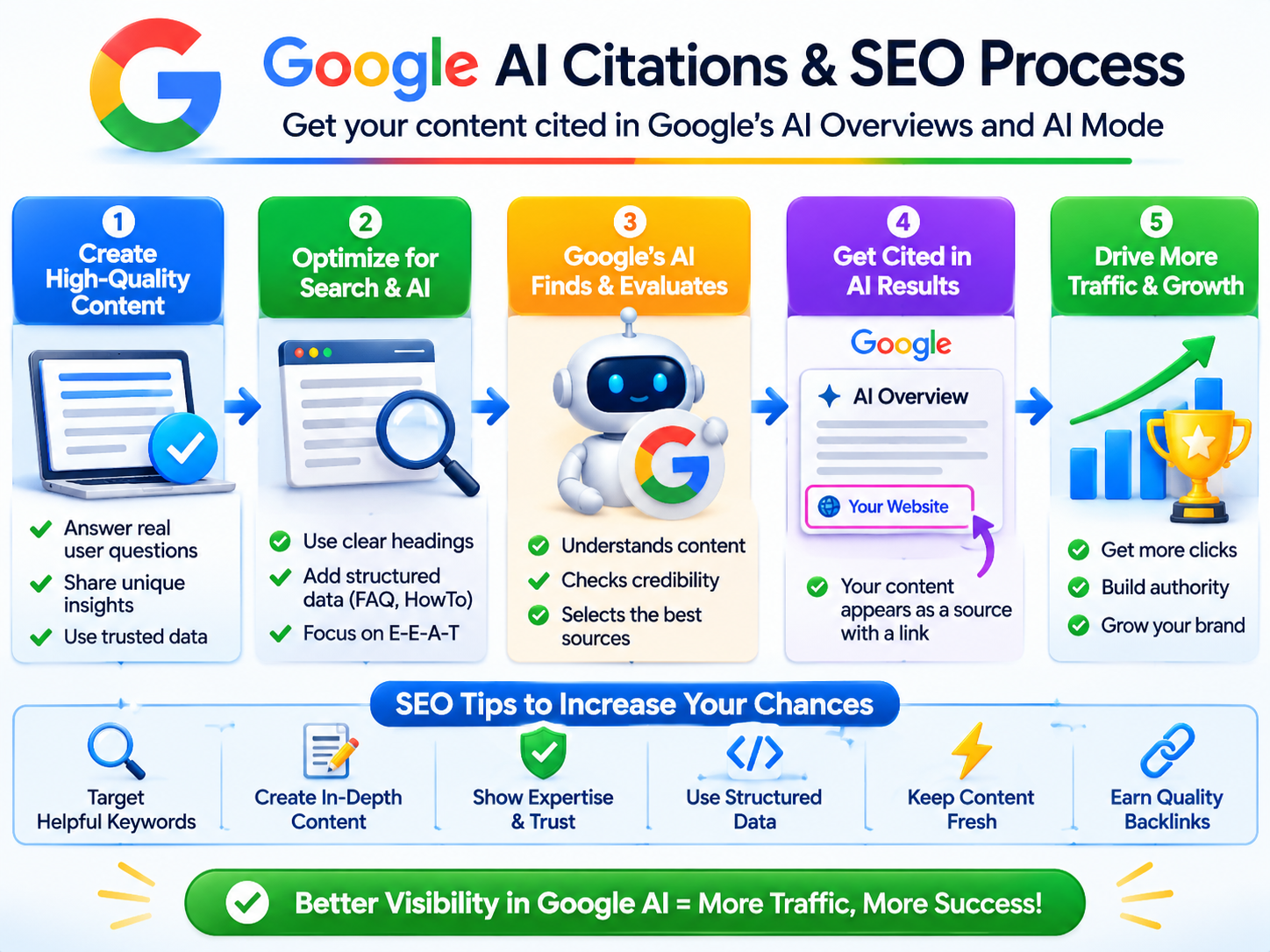
Improving AI search visibility begins with content that is technically accessible, genuinely helpful, and supported by credible information.
No technique guarantees that Google will cite a particular page. However, businesses can strengthen the conditions that make their content eligible and valuable.
Make Content Indexable, Crawlable, and Snippet-Eligible
Before investing in new content, review the technical health of your website.
Important pages should be accessible to search engines and eligible to appear in search results.
Check the following.
Robots.txt: Confirm that essential pages aren’t unintentionally blocked.
Indexing directives: Review noindex settings on commercially important content.
Canonical tags: Make sure pages reference their intended canonical URLs.
XML sitemaps: Keep relevant, indexable URLs represented accurately.
Internal linking: Connect useful articles, service pages, and related resources.
Snippet eligibility: Avoid restrictions that unnecessarily prevent important content from appearing in search snippets.
Google explains that supporting links in AI Overviews and AI Mode must meet ordinary Search indexing and snippet eligibility requirements.
There’s no requirement to implement special AI-only structured data.
If website architecture, rendering, or indexing problems are limiting accessibility, professional web development services can help address those issues.
Publish Original Research and Citation-Worthy Answers
A generic explanation of an industry topic may answer a basic question, but it doesn’t always provide a compelling reason for another source to reference your business.
Original evidence creates a stronger opportunity.
Useful content can include.
First-party research and customer surveys
Industry benchmarks with transparent methodologies
Anonymized B2B performance findings
Detailed software comparisons
Expert interviews and technical explanations
Implementation case studies with measurable outcomes
Consider a SaaS company that publishes research about enterprise onboarding challenges.
Instead of repeating general advice, it could share anonymized observations, explain how the information was collected, and identify practical lessons.
That gives potential customers, industry writers, and researchers something specific to reference.
For more context, see Mak It Solutions’ guide to original evidence in AI search optimization.
The important distinction is between content that merely repeats existing information and content that contributes something useful.
Strengthen Brand Authority and Entity Recognition
Search visibility also depends on how clearly a business communicates its identity and expertise across the web.
Keep company descriptions, website details, professional profiles, and service information consistent.
Build genuine recognition through relevant channels such as LinkedIn, YouTube, credible industry publications, and specialist Reddit communities.
Named subject-matter contributors, transparent company information, and verifiable case studies can strengthen credibility.
Avoid manufactured brand mentions or low-quality placements created solely to influence search systems.
A trustworthy reputation develops through consistent evidence and useful contributions, not artificial authority signals.
How to Measure AI Search Traffic, Citations, and ROI
More AI exposure doesn’t automatically mean more website traffic.
Someone may read an AI-generated answer, learn about your brand, and leave without clicking. Another prospect may return later through organic search or visit your website directly.
This makes measurement more complicated than monitoring keyword rankings alone.
To measure AI search visibility effectively, track brand mentions, citations, AI feature impressions, website visits, and qualified conversions as separate indicators.
Track Brand Mentions, Citations, and AI Share of Voice
Start with a defined set of commercially relevant questions.
For a B2B software provider, these might involve implementation costs, platform comparisons, security requirements, or integration challenges.
Monitor how frequently the business appears across those questions.
| KPI | What It Measures |
|---|---|
| Brand mention rate | Percentage of sampled AI answers mentioning the brand |
| Citation rate | Percentage of sampled answers linking to the website |
| Prompt coverage | Presence across selected buyer questions |
| AI share of voice | Relative brand visibility within a defined competitive sample |
| Qualified conversions | Leads or revenue associated with measurable search journeys |
A consistent testing method matters.
Record the AI platform, country, language, search prompt, observation date, brand mentions, and source URLs.
Because generated responses can change, individual observations shouldn’t be treated as permanent rankings.
Measure Clicks and Conversions With Search Console and GA4
Google introduced dedicated Search Generative AI performance reporting in Search Console on June 3, 2026. According to Google’s official announcement, the rollout reached websites worldwide by August 31, 2026.
These reports provide additional visibility into performance within generative AI features, including AI Overviews and AI Mode.
For a broader picture, combine Search Console data with Google Analytics 4 (GA4).
Search Console helps identify search exposure, impressions, clicks, and affected pages. GA4 helps examine landing-page engagement, lead submissions, and conversions.
A practical measurement framework is:
AI Exposure → Brand Mention → Source Citation → Business Outcome
These are distinct measurement stages, not a guaranteed sequence that every visitor follows.
A brand mention doesn’t necessarily produce a citation. A citation doesn’t guarantee a click. And a website visit doesn’t automatically become a qualified lead.
Businesses that need unified reporting can use business intelligence services to connect relevant search, website, and conversion data.
Why AI Visibility Can Increase While Organic Traffic Falls
AI-generated answers can satisfy a user’s immediate information needs without requiring a website visit.
Pew Research Center’s March 2025 US browsing analysis found that:
Users clicked a traditional search result in approximately 8% of visits involving an AI summary.
That figure was approximately 15% when no AI summary appeared.
Users clicked a source cited directly in an AI summary in approximately 1% of visits involving those summaries.
These figures describe the study’s sample and methodology, not every Google search or every industry.
They nevertheless highlight an important measurement challenge.
A company may gain exposure through AI-generated answers without seeing a corresponding increase in organic clicks.
That’s why AI visibility, referral traffic, engagement, and revenue should be analyzed together rather than treated as interchangeable metrics.
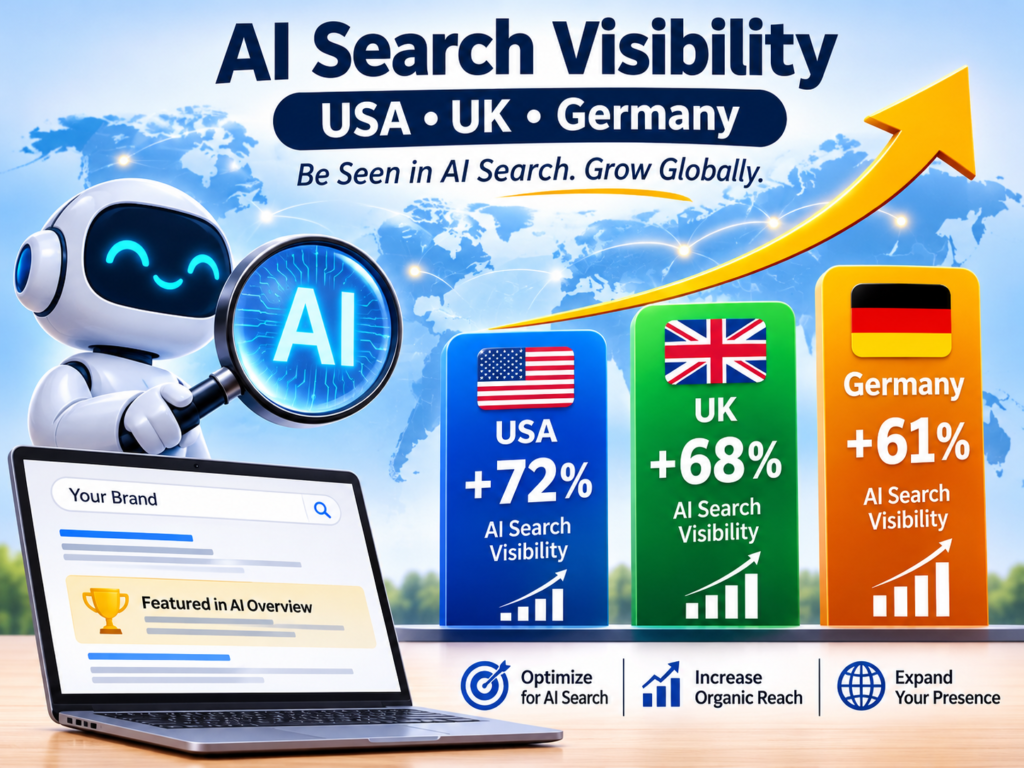
AI Search Visibility Strategies for the USA, UK, and Germany
International search strategies need more than a single English-language content plan.
AI-generated answers can vary by country, language, buyer expectations, and the sources available for a particular topic.
For companies serving the United States, United Kingdom, Germany, and wider European markets, localization should influence both content creation and performance measurement.
USA.
US B2B buyers frequently evaluate providers through software comparisons, implementation information, case studies, and commercial requirements.
Businesses targeting competitive markets such as New York, Austin, and San Francisco should prioritize detailed, decision-supporting content.
Useful resources include implementation guides, product comparisons, transparent pricing explanations, and customer success stories.
Link this research to a broader digital marketing strategy that prioritizes qualified demand over impressions alone.
UK.
A London-based buyer researching software implementation may have different commercial and regulatory considerations from a US prospect.
Use British English where appropriate, GBP pricing when relevant, and UK-specific examples that reflect genuine service capabilities.
For businesses collecting personal information, consider applicable UK GDPR requirements.
The UK Information Commissioner’s Office provides official guidance on data protection obligations.
Track UK search questions independently instead of assuming US search performance represents British demand.
Germany and EU.
Germany requires more than translating English-language keywords.
German search terminology, including KI-Sichtbarkeit, should be used where it naturally matches local search intent.
Businesses serving Berlin or Munich can improve regional relevance through native-language explanations, locally meaningful case studies, EUR pricing, and accurate business information.
Where appropriate, use hrelang annotations to clarify language and regional page alternatives.
Personal-data collection and analytics should also follow applicable GDPR requirements, known as DSGVO in German.
The European Commission’s data protection resources provide further guidance.
Similar localization principles apply in other European markets, including France and the Netherlands.
Best AI Search Visibility Tracking Tools in 2026
AI visibility platforms can help businesses understand how often their brands appear in generated answers and how that presence compares with competitors.
However, tools differ in platform coverage, sampling methods, geographic support, and reporting capabilities.
No single tool captures every possible AI-generated response.
Ahrefs Brand Radar vs. Semrush AI Visibility Toolkit
Ahrefs and Semrush offer established options for measuring AI search exposure.
| Platform | Main Strengths | Best Suited To |
|---|---|---|
| Ahrefs Brand Radar | Brand mentions, citations, competitive analysis, custom prompt tracking | SEO teams and competitor research |
| Semrush AI Visibility Toolkit | Brand benchmarking, prompt research, competitor analysis, reporting | Integrated B2B marketing workflows |
According to published vendor pricing, Ahrefs offers custom prompt tracking packages starting at approximately $50/month, while its AI Visibility Index starts at approximately $199/month.
Semrush lists its AI Visibility Toolkit Base plan at approximately $99/month per domain when billed annually.
Pricing, included features, and billing conditions may change.
Review the current offerings directly through Ahrefs Brand Radar and Semrush AI Visibility pricing before purchasing.
SISTRIX, Google Search Console, and GA4 for Regional Insights
Dedicated AI monitoring platforms aren’t the only useful tools.
SISTRIX can support SEO and regional market research, particularly for German-speaking audiences.
Google Search Console offers first-party evidence of search performance, while GA4 helps connect website visits with engagement and conversion activity.
Dedicated AI visibility software adds competitive and prompt-level observations that first-party reporting doesn’t necessarily provide.
Used together, these tools can help businesses distinguish between exposure, actual website visits, and commercial performance.
How to Choose AI Visibility Software for a B2B Team
Avoid selecting software solely because it displays an impressive visibility score.
Evaluate whether the platform supports the questions your actual customers ask.
Important considerations include country and language coverage, citation-level reporting, historical data, competitor comparisons, exports, and transparency around prompt sampling.
For international companies, reliable reporting across English and German searches may be more valuable than a large global dashboard with limited regional detail.
Whenever possible, test the platform using genuine commercial queries before committing to a subscription.
Your 2026 AI Search Visibility Action Plan
Improving AI search visibility doesn’t require changing every page on your website.
Start with the content that supports important buying decisions. Establish a baseline, identify technical or content gaps, and prioritize improvements that can be measured.
Audit Search Eligibility and Citation Gaps
Begin by examining important service pages, commercial landing pages, and informational resources.
Check whether they are indexed, accessible, and aligned with relevant buyer questions.
Then examine AI-generated answers for those questions.
Record whether your company is absent, mentioned without a link, or cited as a source.
Compare relevant competitors using the same prompts and geographic settings.
This reveals where technical improvements, original evidence, or clearer answers may be useful.
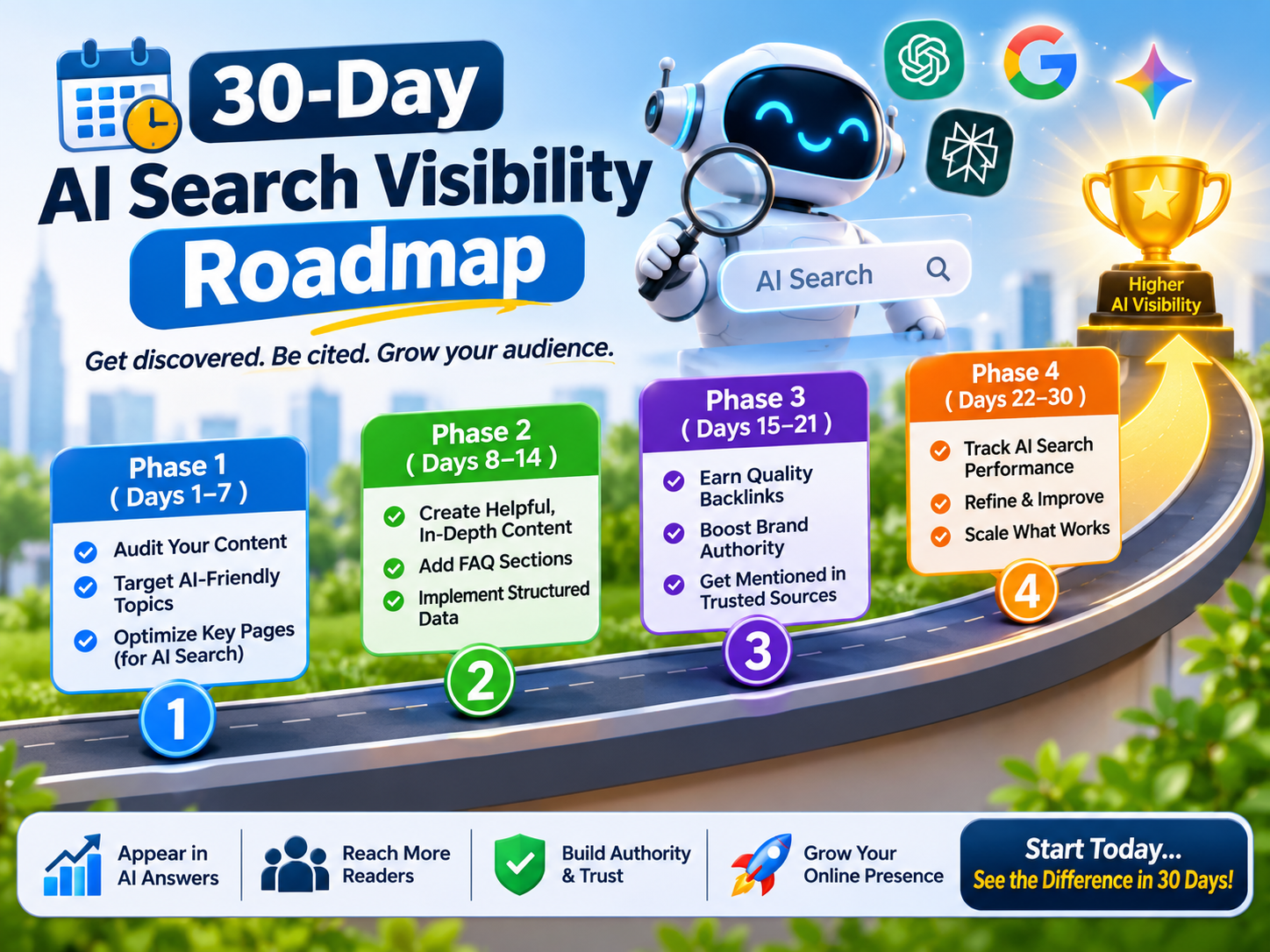
Build a 30-Day AI Search Optimization Roadmap
A focused implementation plan makes optimization easier to manage.
| Timeline | Priority | Key Activities |
|---|---|---|
| Days 1–7 | Establish a baseline | Audit pages, review AI answers, record mentions and citations |
| Days 8–14 | Improve priority content | Add original evidence, clearer answers, expert information, and internal links |
| Days 15–21 | Test regional relevance | Review US, UK, and German queries, language variations, and content gaps |
| Days 22–30 | Measure and prioritize | Compare observations, review conversions, and plan the next cycle |
This roadmap provides a manageable starting point.
Thirty days is an implementation period, not a promise that rankings or AI citations will improve within that time.
Sustained measurement is necessary because search systems, competing content, and generated answers continue to change.
Turn AI Visibility Insights Into Qualified B2B Leads
Visibility becomes commercially useful when it supports the customer journey.
Prioritize pages that help prospective buyers evaluate solutions, understand implementation requirements, compare providers, and make informed decisions.
Make the next step clear, whether that’s requesting a consultation, exploring relevant services, or reviewing a detailed case study.
For further guidance, explore how to earn brand mentions in AI-generated answers.
The aim is to turn relevant search discovery into meaningful business opportunities, without relying on AI exposure alone.
Final Thoughts
AI search visibility is becoming an important part of how businesses are discovered and evaluated online.
For B2B companies, the strongest approach combines reliable technical SEO, credible content, regional relevance, and meaningful measurement.
If your website performs well in traditional search but your brand rarely appears in AI-generated answers, understanding that gap is a practical starting point.
Mak It Solutions can help assess your technical SEO foundation, content opportunities, and international search performance.
Contact Mak It Solutions to discuss an AI Search Visibility Audit for your business in the USA, UK, Germany, or wider European market.
Key Takeaways
Technical SEO still matters. Indexing, crawlability, and snippet eligibility remain essential.
Original evidence creates stronger content. Research, transparent methodologies, and expert insights provide substance worth referencing.
AI visibility isn’t the same as traffic. Measure mentions, citations, clicks, engagement, and conversions separately.
Localization improves relevance. US, UK, German, and wider European audiences may have different research needs.
Tracking software needs careful evaluation. Compare coverage, reporting methods, pricing, and regional capabilities.
Business outcomes remain the priority. Focus on qualified demand rather than visibility scores alone.
FAQs
Q : Does FAQ schema help a website appear in Google AI Overviews?
A : FAQ schema doesn’t guarantee inclusion in Google AI Overviews. Google doesn’t require special AI-only structured data for these features. Focus on accurate, crawlable content and structured data that matches the visible page information.
FAQ Page markup also doesn’t guarantee eligibility for Google’s restricted FAQ rich-result display.
Q : How long does it take to improve AI search visibility?
A : There is no guaranteed timeline. Technical changes and content improvements must be processed by search systems, and results vary depending on competition, content quality, and query behavior.
A 30-day improvement plan can establish a baseline and organize initial work, followed by regular performance reviews.
Q : Can small B2B companies compete with enterprise brands in AI search?
A : Yes. Smaller companies can concentrate on specialized topics where they offer genuine expertise.
Detailed implementation advice, original research, and clear explanations can make specialized content valuable to prospective customers and potential referring sources.
Q : Can businesses track AI search visibility without paid software?
A : Yes. Begin with a representative set of buyer questions and manually record mentions, citations, and competing sources.
Combine those observations with Search Console and GA4 reporting.
Manual monitoring has limitations because AI answers can vary, but it provides a useful starting point before investing in dedicated tracking software.
Q : Should companies create separate pages for US, UK, and German searches?
A : Separate regional pages are helpful when they offer meaningful differences in language, pricing, regulations, buyer requirements, or practical examples.
Use appropriate hreflang annotations and avoid publishing nearly identical pages solely to target different countries.
Prioritize genuinely useful localization over unnecessary duplication.