


AI-Generated Content SEO: How to Stand Out in 2026
AI-Generated Content SEO: How to Stand Out in 2026
AI-Generated Content SEO: How to Stand Out in 2026
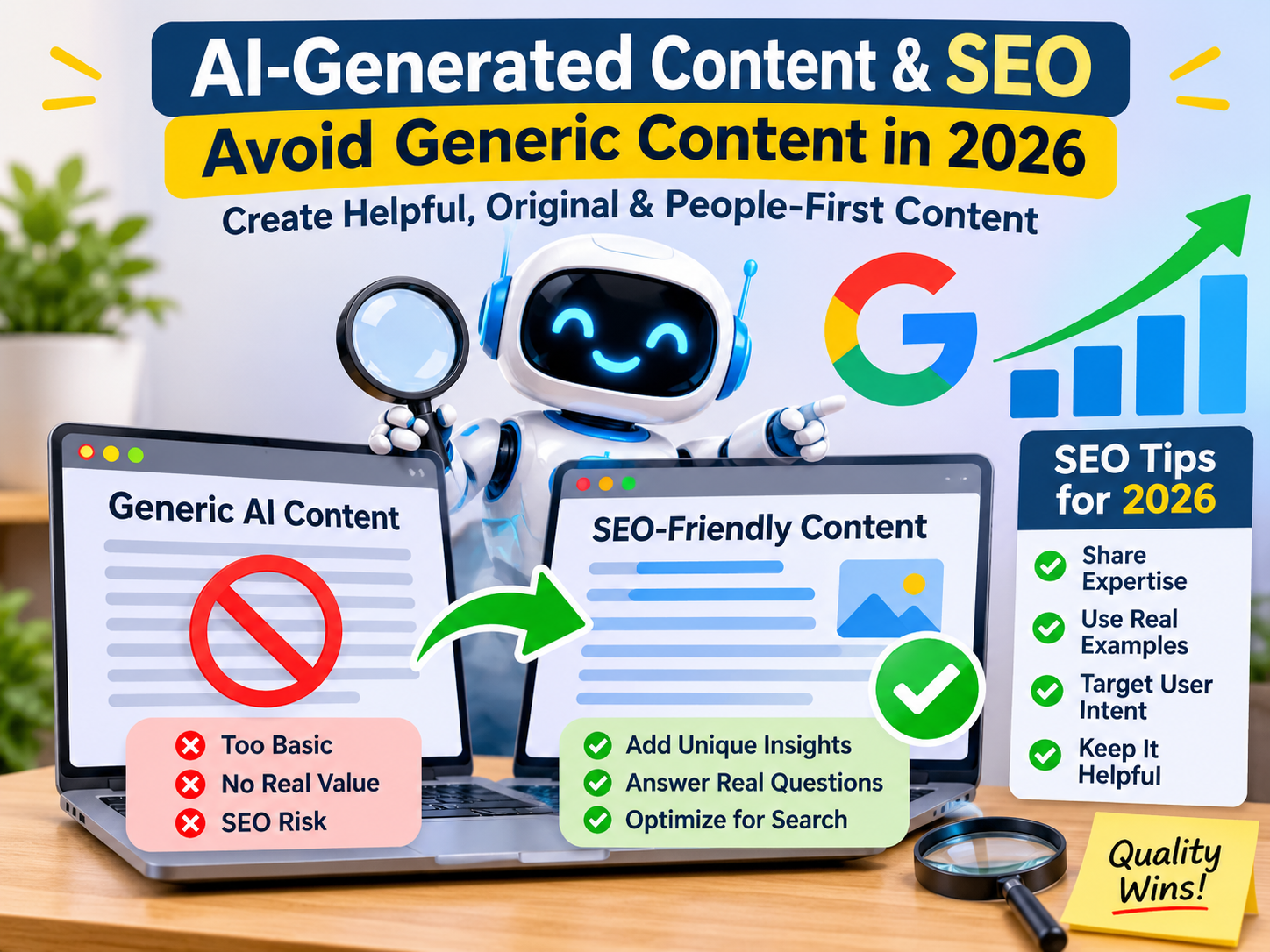
AI has made content creation faster and more accessible than ever. Businesses can produce blog posts, landing pages, and marketing copy in minutes. Yet publishing more content doesn’t necessarily mean earning more traffic, stronger rankings, or better leads.
The biggest challenge in AI-generated content SEO is no longer production speed. It’s differentiation.
Generic AI-written content is losing its competitive advantage because countless websites can now publish similar information with minimal effort. To stand out, businesses need original insights, credible evidence, expert knowledge, and content that genuinely helps their audience.
Research supports the growing importance of this distinction. In a 2025 Ahrefs survey of 879 marketers, organizations using AI reported a median publishing frequency of 17 articles per month, compared with 12 among non-users—approximately 42% more content.
That creates more opportunities to publish, but also more competition for readers’ attention.
Why Generic AI-Generated Content Is Losing Its SEO Edge
Generic AI content becomes less competitive when it repeats information already available across search results.
The problem isn’t that AI writes the content. It’s that many businesses use it to produce articles without adding meaningful value.
How AI Content Saturation Creates Lookalike Articles
Give several AI tools the same prompt, and their responses may follow similar patterns: familiar definitions, predictable headings, and broadly applicable advice.
When companies publish these drafts without adding their own expertise, their websites begin to sound alike.
Consider several SaaS companies in Austin publishing guides about CRM automation. Most might explain the same benefits and implementation steps.
One company, however, could include real deployment challenges, verified workflow improvements, and lessons from its product team.
That article offers readers something the others don’t.
This is the difference between producing information and creating distinctive value.
Why Generic AI Content Fails to Build Brand Authority
Brand authority grows when readers consistently find trustworthy information they cannot easily get elsewhere.
Generic content often lacks.
Original industry insights
Real examples and verifiable outcomes
Expert analysis
A distinctive brand perspective
Practical answers to specific customer problems
A UK marketing agency publishing broad SEO advice may struggle to differentiate itself from competitors.
An agency explaining its campaign methodology, actual challenges, and documented lessons from projects in London or Manchester gives potential customers more reasons to trust its expertise.
What Makes Generic AI Content a Competitive Disadvantage?
The central weakness is limited information gain the absence of meaningful new perspectives, evidence, or useful details beyond what’s already available.
Repeating familiar advice doesn’t necessarily make an article worthless. Clear explanations still serve readers.
But when competing pages answer the same questions equally well, original evidence and practical expertise can become important differentiators.
Effective digital marketing strategies should therefore prioritize audience value over publishing volume alone.
Is AI-Generated Content Bad for Google SEO?
No. Google does not automatically penalize content simply because AI helped create it.
Its guidance focuses on usefulness, originality, accuracy, and compliance with search policies rather than the writing tool itself.
What Google’s AI Content Guidelines Actually Say
Google Search Central recognizes that generative AI can support research and content organization.
However, using AI or other automated methods to generate large numbers of pages without adding meaningful value may violate Google’s scaled content abuse policy.
The important distinction is between content that helps people and content produced primarily to manipulate search rankings.
An AI-assisted technical guide reviewed by an experienced specialist can provide genuine value. A mass-produced collection of inaccurate or repetitive pages may not.
Why Low-Quality AI Content Can Struggle to Rank
Poor AI-generated articles frequently share recognizable weaknesses.
Unsupported or outdated claims
Repetitive explanations
Weak alignment with search intent
Missing technical context
Little practical advice
Inadequate source verification
These problems are not exclusive to AI writing. Human-written content can suffer from them too.
Strong SEO optimization involves improving content quality alongside technical SEO, search intent, internal linking, and ongoing performance analysis.
How E-E-A-T and Originality Influence Content Quality
Google’s E-E-A-T concept covers Experience, Expertise, Authoritativeness, and Trustworthiness.
E-E-A-T isn’t a single numerical ranking factor. Instead, it provides a useful framework for evaluating whether content demonstrates credibility and serves its intended audience.
Businesses can strengthen these qualities by publishing verifiable references, demonstrating relevant expertise, providing first-hand examples, and making authorship or editorial responsibility clear.
The objective isn’t to make an article look authoritative. It’s to make the information genuinely dependable.
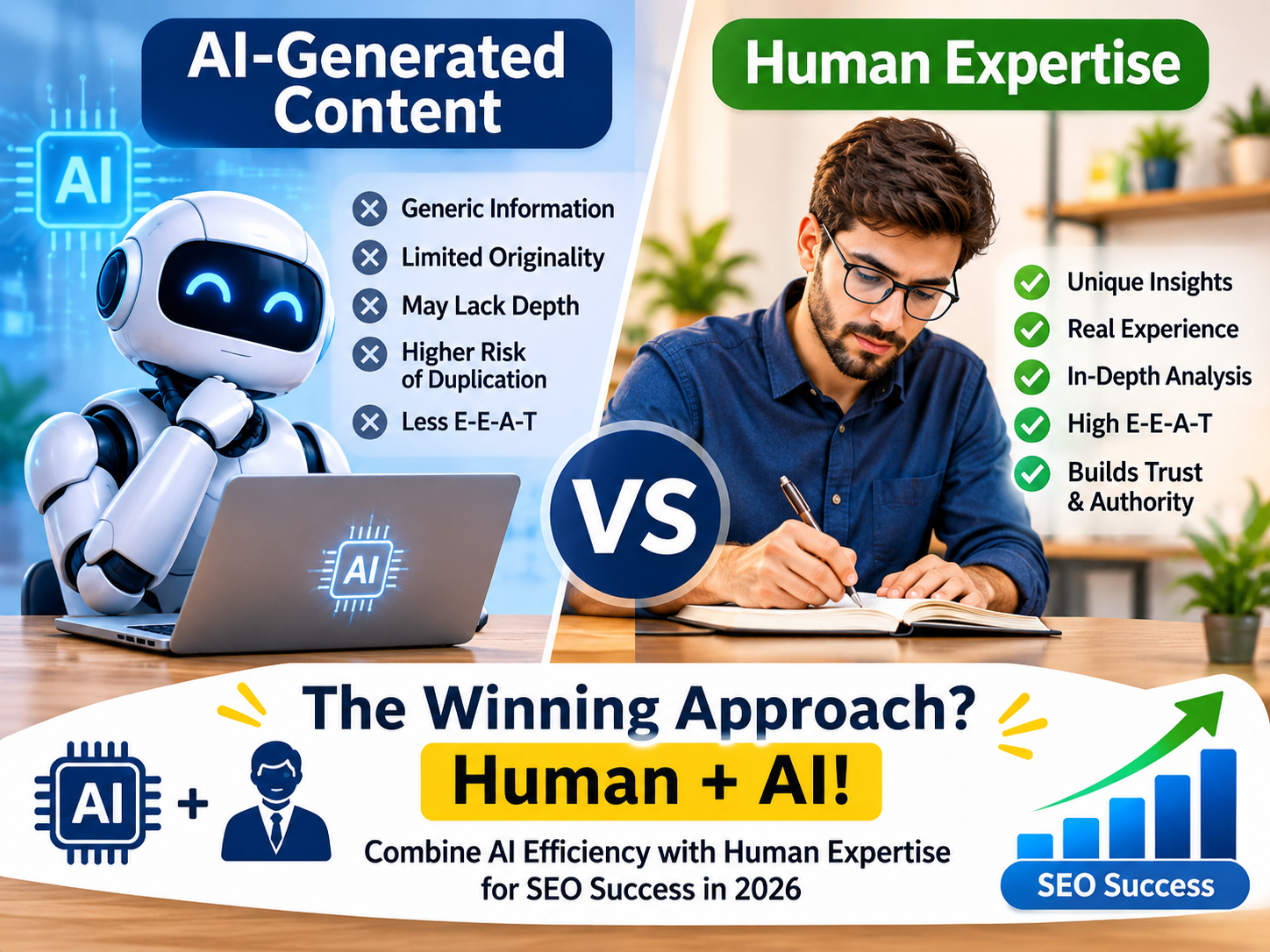
AI Content vs Human Content.
AI and human writing shouldn’t be treated as automatic opposites.
An expertly reviewed AI-assisted article can be more useful than a poorly researched human-written piece. Equally, a specialist can contribute experience and judgment that a generic AI draft may lack.
AI Speed vs Human Expertise and Judgment
AI tools are particularly useful for outlining, summarizing research, identifying content gaps, and preparing initial drafts.
Human professionals contribute deeper context, strategic decisions, customer understanding, and real-world experience.
HubSpot’s 2024 marketing research found that 86% of marketers using AI to create written content edited it before publication.
That finding shows how commonly marketers combine automation with editorial involvement.
How Human-in-the-Loop Workflows Improve Content Quality
A human-in-the-loop workflow uses AI for efficiency while keeping responsibility for accuracy, quality, and final decisions with people.
| Content approach |
Main advantage |
Main limitation |
|---|---|---|
| AI-only | Fast and scalable drafting | Greater risk of generic or unsupported content |
| Human-only | Original experience and judgment | Higher time and resource requirements |
| Expert-led AI-assisted | Combines efficiency with specialist oversight | Requires a consistent review process |
For many content teams, expert-led AI assistance offers a practical balance.
Why Original Research and Real Experience Matter
Original research makes content harder to replicate.
Customer interviews, authentic product screenshots, verified benchmarks, and documented case studies can turn a familiar subject into a genuinely useful resource.
For example, a technology company can share lessons from its actual web development projects.
Readers gain more from documented implementation challenges and solutions than from another general explanation of development best practices.
The strongest articles don’t merely describe what businesses should do. They explain what happens when those recommendations are applied.
AI-Generated Content SEO Across the USA, UK, and Europe
AI content strategy should reflect the expectations, terminology, and search behavior of each target market.
Simply translating an article or adding city names rarely produces meaningful localization.
USA.
Competition in American B2B SaaS search results can be intense, particularly for broad software and automation topics.
Businesses can create stronger content by publishing product comparisons, verified performance benchmarks, customer implementation stories, and industry-specific research.
A New York automation provider, for instance, could explain how a particular workflow was implemented and what the team learned.
That offers more practical value than repeating generic productivity advice.
UK.
UK-focused content benefits from appropriate local terminology, familiar business examples, and transparent commercial claims.
A London-based agency might publish its actual campaign methodology or discuss common challenges faced by regional clients.
Businesses processing personal information should also consider relevant UK GDPR obligations and Information Commissioner’s Office guidance when using AI tools.
Localization should strengthen relevance without making unsupported claims about regional audiences.
Germany and the EU.
German-language content may target queries such as KI-generierte Inhalte SEO or KI-Texte Google Ranking.
However, successful localization requires more than inserting translated keywords.
Businesses targeting Berlin, Munich, or other German-speaking markets should use natural terminology, credible local examples, and accurate technical explanations.
Organizations must also assess relevant GDPR/DSGVO requirements and any applicable obligations under the EU AI Act.
These legal considerations can affect data handling and AI workflows, but they do not directly determine Google search rankings.
A regional AI search visibility strategy should balance search intent, linguistic quality, useful evidence, and responsible business practices.
How to Build a Human-First AI Content Strategy
A stronger AI content strategy begins with a simple question:
What can our business explain or demonstrate that competing articles cannot?
The answer may come from proprietary research, product knowledge, customer conversations, or specialist experience.
Start With Search Intent and Real Audience Problems
Before creating another article, examine what people actually want to know.
Review competing results, recurring customer questions, and common problems raised during sales or support conversations.
Look for areas where existing content is incomplete, outdated, or too general.
A focused article solving a specific purchasing or implementation problem can be more valuable than a broad guide covering familiar information.
Add Expert Interviews and First-Party Evidence
Talk to subject-matter experts and use data your business has permission to publish.
Examples include anonymized customer feedback, product demonstrations, internal research, documented workflows, and verified project results.
The Content Marketing Institute’s 2025 technology marketing research found that 87% of surveyed technology marketers used generative AI tools.
With AI widely adopted, original evidence becomes a valuable way to distinguish your content from easily reproduced explanations.
Use AI for Drafting, but Keep Humans Responsible
An effective process begins with research and clear editorial objectives. AI can support outlining and drafting, while specialists review factual accuracy, originality, relevance, and tone.
Before publishing, use this five-point content audit.
This process can also complement Google AI Mode SEO practices, helping teams create valuable material for traditional search and AI-powered discovery.
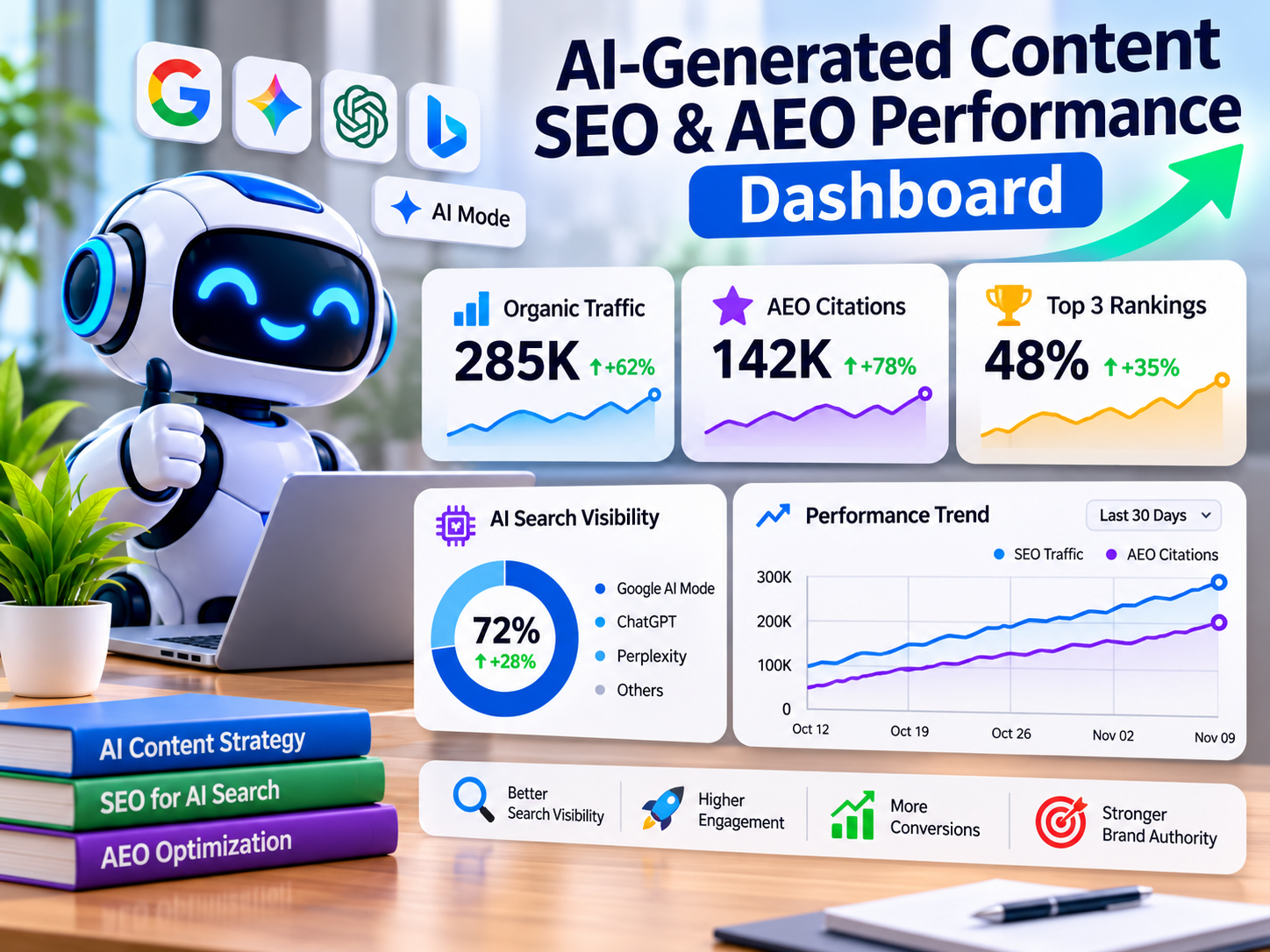
How to Measure AI Content Success Across SEO and AEO
Publishing a high volume of articles means little if those pages fail to attract relevant visitors or contribute to business outcomes.
Effective measurement should cover organic visibility, engagement, qualified conversions, and useful indicators of AI-search exposure.
Track Organic Search Visibility and Conversions
Google Search Console helps teams monitor impressions, clicks, queries, and individual page performance.
Google Analytics 4 can provide additional insight into engagement and tracked conversion events.
Look beyond raw traffic.
An article generating fewer visitors but more qualified enquiries may contribute more to business goals than a high-traffic page attracting the wrong audience.
Monitor AI Answers, Citations, and Brand Mentions
AI-powered discovery adds another consideration to content measurement.
Businesses can examine whether their websites appear in relevant Google AI Overviews, ChatGPT answers, or other AI search experiences.
Record observations consistently, including query wording and the date of testing.
These results can vary across users, systems, and contexts. A citation or mention should not be treated as a guarantee of future visibility, referral traffic, or revenue.
Evaluate Originality, ROI, and Long-Term Value
Assess content performance against production costs, maintenance requirements, lead quality, and business results.
Regularly ask whether an article still reflects current expertise and whether its information remains valuable to readers.
Business intelligence solutions can also help connect content and marketing performance with broader commercial reporting.
Over time, a useful, well-maintained library of evidence-backed content can provide a stronger competitive foundation than rapid publishing alone.
Final Thoughts
Generic AI content is losing its competitive advantage because producing a polished article is no longer difficult or unusual.
The businesses most likely to differentiate themselves are those that combine AI efficiency with authentic expertise, reliable research, practical experience, and audience-focused storytelling.
For companies operating across the USA, UK, Germany, and the wider European market, localization and credibility make this approach even more important.
Successful AI-generated content SEO isn’t about avoiding automation. It’s about using automation without sacrificing the insights that make your business valuable.
Is your content strategy creating meaningful business opportunities, or simply adding more pages to your website?
At Mak It Solutions, we help businesses strengthen search visibility through SEO, content optimization, and data-driven digital marketing.
Request a content and SEO strategy consultation to discover which pages deserve improvement and where original insights could create a stronger competitive advantage.
Key Takeaways
AI-generated content isn’t automatically bad for SEO. Quality and compliance with search policies matter.
Generic articles are harder to differentiate when they repeat widely available information.
Original evidence, expert insight, and practical examples make content more valuable.
Human editorial oversight helps reduce factual and credibility risks.
Regional strategies should reflect local audiences, terminology, and relevant regulations.
Track conversions and meaningful business outcomes alongside rankings and AI-search mentions.
Improve useful existing content before increasing publishing volume unnecessarily.
FAQs
Q : Can AI-written content rank on Google without human editing?
A : Yes. AI-written content can rank if it satisfies search intent, provides genuine value, and follows Google’s policies. Human editing is not an explicit ranking requirement, but reviewing AI-generated material helps identify inaccuracies, unsupported claims, and weak explanations.
Q : Does publishing more AI content improve topical authority?
A : Not automatically. Publishing many overlapping articles can add little value. Meaningful topical coverage comes from answering related audience questions thoroughly, connecting useful resources, and demonstrating relevant expertise.
Q : How often should businesses audit AI-generated articles?
A : Reviewing important articles every three to six months is a practical starting point. Fast-changing technical or regulatory topics may require more frequent updates. Google does not prescribe a universal content audit schedule.
Q : What evidence should businesses add to AI-written blog posts?
A : Useful evidence includes original research, expert interviews, verified customer examples, product benchmarks, authentic screenshots, and first-party operational data. Important claims should link to trustworthy sources or explain the methodology used to reach a conclusion.
Q : Should German businesses publish AI content in English or German?
A : The best language depends on the target audience and search intent. German usually makes sense for local German-speaking customers, while English can help reach international B2B audiences. Businesses serving both groups may benefit from properly localized versions with suitable hreflang implementation.